Shownotes
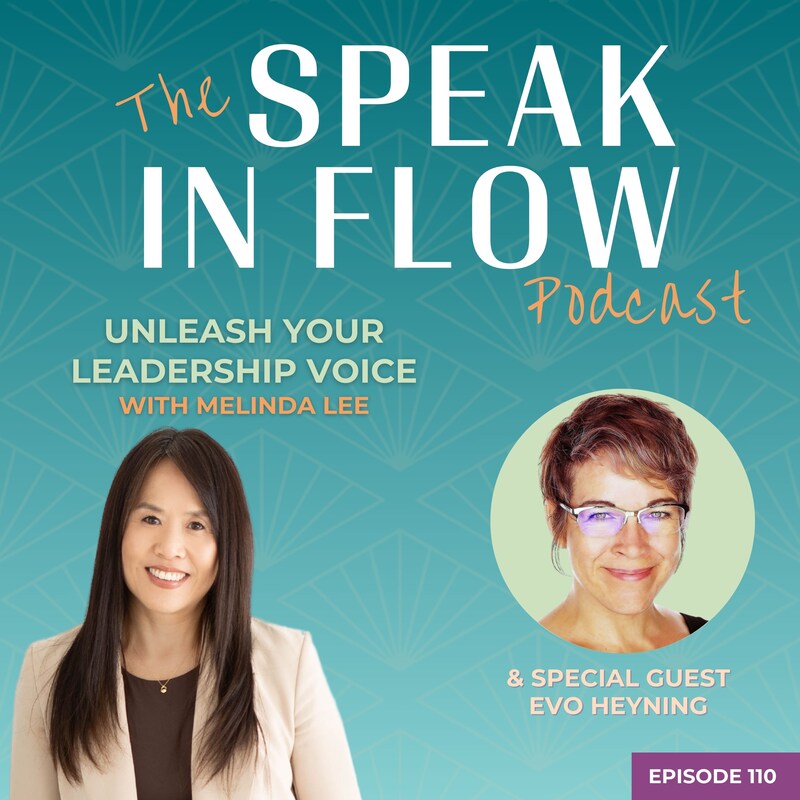
Media and technology strategist Evo Heyning (CEO of Reality Craft, VP of XR Guild) sits down with Melinda Lee in this episode of the Speak in Flow Podcast to explore how AI is reshaping communication, creativity, and disaster resilience, while revealing why slowing down might be the key to wielding these tools effectively. From rebuilding homes after wildfires to crafting ethical AI policies, Evo shares how to lead with intention in a noisy digital world.
In This Episode, You Will Learn:
The Double-Edged Sword of AI Tools
Evo dives into the paradox of generative AI. While it can accelerate workflows, like turning smartphone scans into permit-ready architectural plans for disaster zones, it also demands fierce discernment.
"Can I trust the company behind this tool?"
Evo urges us to ask ourselves this question before entering our data into an AI tool.
The Art of "Promptcraft"
"If the output looks cool but isn’t what you imagined, you’re being led by the tool, not leading it."
Evo shares how her teams blend AI with human intuition, warning against losing your vision in the process.
Less Input, More Insight
AI’s verbosity is a trap. "Large language models give you tons of information, very little meaning," Evo laughs. The fix? "Step back, and ask: Does this add insight, or just noise?"
The Ultimate Question for Creators
Evo leaves us with a challenge.
"Generative tools invite us to give language to our vision. But first, ask: What world do I actually want to create? If you’re stuck in dystopian headlines, you’ll just recreate noise."
Connect with Evo Heyning
Website: https://evo.ist/
LinkedIn Profile: https://www.linkedin.com/in/evonne/
YouTube: @RealitycraftArt
Instagram: @amoration
About the Guest:
Evo Heyning is a pioneering media technologist and futurist at the forefront of AI and XR innovation. Blending generative tools and immersive experiences, Evo shapes ethical and creative futures. As the founder of Realitycraft and the VP of the XR Guild, Evo has led groundbreaking projects, championing technology that amplifies human potential rather than replacing it.
Fun-facts:
- 🌐 Virtual Diplomat: Served as the first avatar ambassador between diplomatic offices in virtual worlds (2009).
- 🎥 AI Trailblazer: Taught YouTube to integrate AI tools back in 2014 and produced the Affordable Care Act’s launch campaign.
- 🎨 Multidisciplinary Creator: When not sculpting digital worlds, Evo bakes gluten-free treats and hunts antiques for storytelling inspiration.
About Melinda:
Melinda Lee is a Presentation Skills Expert, Speaking Coach, and nationally renowned Motivational Speaker. She holds an M.A. in Organizational Psychology, is an Insights Practitioner, and is a Certified Professional in Talent Development as well as Certified in Conflict Resolution. For over a decade, Melinda has researched and studied the state of “flow” and used it as a proven technique to help corporate leaders and business owners amplify their voices, access flow, and present their mission in a more powerful way to achieve results.
She has been the TEDx Berkeley Speaker Coach and has worked with hundreds of executives and teams from Facebook, Google, Microsoft, Caltrans, Bay Area Rapid Transit System, and more. Currently, she lives in San Francisco, California, and is breaking the ancestral lineage of silence.
Website: https://speakinflow.com/
Facebook: https://m.facebook.com/speakinflow
Instagram: https://instagram.com/speakinflow
LinkedIn: https://www.linkedin.com/in/mpowerall
Thanks for listening!
Thanks so much for listening to our podcast! If you enjoyed this episode and think that others could benefit from listening, please share it using the social media buttons on this page.
Do you have some feedback or questions about this episode? Leave a comment in the section below!
Subscribe to the podcast
If you would like to get automatic updates of new podcast episodes, you can subscribe to the podcast on Apple Podcasts or Stitcher. You can also subscribe in your favorite podcast app.
Leave us an Apple Podcast review.
Ratings and reviews from our listeners are extremely valuable to us and greatly appreciated. They help our podcast rank higher on Apple Podcasts, which exposes our show to more awesome listeners like you. If you have a minute, please leave an honest review on Apple Podcasts.
Transcripts
Hello, dear listeners, thanks for joining the speak and flow podcast where we dive into unique experiences and strategies to help you and your team maximize their potential and flow even in high stakes situations. Today, I have an amazing innovative on the front line of technology. And AI, she's a media and technology strategist.
2
:Melinda Lee: executive producer. She's a Vp. And board of Directors of Xr guild as well as CEO, of a reality craft Evo painting.
3
:Melinda Lee: Hi Ivo.
4
:Evo Heyning: Hi, Melinda! Great to be with you.
5
:Melinda Lee: I'm so excited about our conversation today because it's juicy, it's fun and exciting. So let's just launch off, can you? You've been in the technology producing world AI world for many years now. So what are you seeing? That's exciting between AI technology and communication today?
6
:Evo Heyning: Well, we've seen an amazing convergence of the capacities of our tools. If you think of
7
:Evo Heyning: AI, and broadly, our digital tools as being a toolkit, that toolkit has expanded to be thousands of interesting tools that can be applied to any challenge.
8
:Evo Heyning: So I work on things like rebuilding and concept design after disasters. So I'm excited to see where things like a Gaussian splat and a scan of a space can meet the generative and the procedural AI to come up with a concept for a space that can be built quickly. So if you imagine that we have
9
:Evo Heyning: tens of thousands of people who've lost their homes to hurricanes and fires. Just in the Us. This year there is a huge need for being able to take our mobile phones out. Do a site plan, add our concept design works and our architectural works and get those through to permits fast. So this is where AI tools are meeting things like Bim, our building and infrastructure tools so that we can get things done together quickly and hopefully.
10
:Melinda Lee: It was a mistake.
11
:Melinda Lee: Yeah, it sounds like, and it's such a huge need. And so what do you think will be the struggles to getting to what you just described efficiently and effectively.
12
:Evo Heyning: Well, there's there's quite a few current struggles. I tend to be an early researcher at the edges of what these technologies can do. So what we're seeing right now are workflow challenges and bringing all of these elements together. And then we have the challenges of publishing that in a way that the Permit Office and County Hall is going to be able to say yes to it quickly.
13
:Evo Heyning: Right? So that's just one workflow. That's for rebuilding and resilience after disaster. But there are infinite use cases out there for being able to rapidly do concept design for storytelling, and then build that world so that people can participate in it, whether that's a game world or a story world, or making a film like the movie flow that was using Blender as a digital tool.
14
:Evo Heyning: So I'm excited to see the tools converging, and I'm excited to see what small, relatively independent teams can do with those tools in order to enhance and enable their own creative process.
15
:Melinda Lee: And what you've seen. Like, you mentioned the beauty beautiful part of this is like imagining things seeing a space and then using these tools to bring it to life. What are the things that are challenging and about doing that?
16
:Melinda Lee: The struggles about doing.
17
:Evo Heyning: Well, currently the the crop of generative media tools is going to be based on existing models of the world, and those are incomplete. So while we have a number of teams going out there and volumetrically scanning our cities and bringing together data so that we have better models.
18
:Evo Heyning: For now, if I type in, imagine a seaport that seaport might not look anything like the seaport that's in my mind, and so.
19
:Evo Heyning: We are seeing a refinement in especially 3D world building process and being able to take a conceptual 3D. Design and fill it out, using both generative or procedural methods. Right.
20
:Evo Heyning: That is closing the gap that is making it simpler and easier to go from my house burnt down to my house is now rebuilt right, which is currently sometimes a 4 or 5 year process. If we look at, for example, Paradise, California. This has been almost now 5 years to get people into their homes again right?
21
:Evo Heyning: Altadena and la! They're only 60 days out, right? They're just now returning to their homes for the 1st time. So anything we can do to shrink the gap by saying, use this information, including my volumetric scan, my architectural concepts, everything I know about resiliency and fireproofing, and bring that together into a plan that's going to work for me. That is where generative tools, I think, are going. That's.
22
:Melinda Lee: And regrett.
23
:Evo Heyning: One use case of many. But that's a use case that we know. Tens of thousands of people here just in America need.
24
:Melinda Lee: Right.
25
:Evo Heyning: Use today.
26
:Melinda Lee: And and are people adopting to these like you? Said the the government, the
27
:Melinda Lee: the the teams that are out there in the fields like? Are they taking these plans, and actually do? Are they adopting.
28
:Evo Heyning: Starting to see that right? So.
29
:Melinda Lee: Okay.
30
:Evo Heyning: Much of that rebuilding and resiliency.
31
:Melinda Lee: Yeah.
32
:Evo Heyning: In the use of generative AI is early stage
33
:Evo Heyning: experiments where I work with teams in 5 different regions currently from Africa to Maui and Hawaii that are working on these methods, and in some cases building a stakeholder driven process so they can bring together the indigenous community. The universities, all of the local engineers to help make better decisions together.
34
:Evo Heyning: But that's again, not about the tools. It's about understanding the tools and then building a collaborative process that allows.
35
:Melinda Lee: Right.
36
:Evo Heyning: Participated.
37
:Melinda Lee: Right. And like you said, there's very specific language
38
:Melinda Lee: on how to do that. And how to. Yeah.
39
:Melinda Lee: A.
40
:Evo Heyning: There you go!
41
:Melinda Lee: Go ahead!
42
:Evo Heyning: I was. Gonna say, there's there's the
43
:Evo Heyning: essential tools. And then there's the essential language to learn. There are 2.
44
:Evo Heyning: Of this puzzle. When people are looking at, for example, how to unlock generative media for something they're trying to achieve, whether that's storytelling or concept, design or research, there's understanding language and how to use it, and how to clarify your language for prompt craft. And then there's understanding what tools do best, and which tool is right for you.
45
:Evo Heyning: And both of those skills are essential. If you're going to make the most of your generative process and not just sort of experiment with whatever someone handed you.
46
:Melinda Lee: Hmm.
47
:Evo Heyning: That's also essential. If you're going to be creatively leading the process instead of being led by the tool, which is what some people often fall into a trap of which is sort of over trusting the tool to tell you the future. Instead of telling the tool, the future, you want to create.
48
:Melinda Lee: Yeah, how do you know when you're being led by the tool versus? Okay, this is what I want to create. How would I know.
49
:Evo Heyning: If it looks like something very cool, but different than what you imagined. But you find
50
:Evo Heyning: on the rabbit hole, anyway, and it's a fun rabbit hole.
51
:Melinda Lee: Yeah, it's a fun rabbit hole.
52
:Melinda Lee: But then.
53
:Evo Heyning: Got to remember. It's like.
54
:Melinda Lee: Yeah.
55
:Evo Heyning: You're like, you're like playing at that point. You're you're being 9 year old exploring. And then you have to come back and say, okay, was that useful? Or was that play.
56
:Melinda Lee: Interesting, interesting.
57
:Melinda Lee: I've been using some tools with my clients, usually an AI speech and coach
58
:Melinda Lee: beach coach AI tool. And it's I think it's great. I think it's fun. I think you get some really nice analytics from your practice. And you could do role play. And I also find that people are not as open to using it because it's something new, something different. And it's telling me something. And it's not a human.
59
:Evo Heyning: And it might be rubbing up against their ideas of is this appropriate? Is this.
60
:Melinda Lee: Yeah.
61
:Evo Heyning: Trustworthy? Is it consensual? All things.
62
:Melinda Lee: Right.
63
:Evo Heyning: We go through and choosing whether or not any tool is right for us. Any digital.
64
:Melinda Lee: Right.
65
:Evo Heyning: Just generative tools, but especially generative tools. We need to be asking, Hey, do I trust the company on the other side of this tool to use my information effectively, and in some cases you cannot do that. So when I teach agencies or marketing professionals, or anyone who is publishing.
66
:Evo Heyning: they need to be using tools that they can trust, and they also have to pass it through their legal department. So they may say, we'll stick with the adobe creative suite and anything in adobe creative suites. Fine. But we don't want to come over here to these other tools because we don't know what they're going to do with our assets right? If I upload the image of my upcoming product? Are they going to somehow.
67
:Melinda Lee: Yeah.
68
:Evo Heyning: Make make me more vulnerable or create a trust problem for me. And that's a huge issue, I think, for people at all stages of their career. Can I trust this tool? Can I trust the company behind this tool is really important inquiry. Early on.
69
:Melinda Lee: Right.
70
:Evo Heyning: When you're testing.
71
:Melinda Lee: Right, so fascinating. And what do you think is changing? How does this change our written language? And both written and verbal language.
72
:Evo Heyning: Well, I think we're seeing people becoming more concise in some ways an ideal prompt for many of these tools is going to be under 50 words and frequently under 25 words. And there are certain elements you need to hit like style or description that absolutely are going to need to be there for it to be effective.
73
:Evo Heyning: So that making language more concise
74
:Evo Heyning: is a clarification process. It's a little bit of a language dance like jazz, or like dancing. And you're you're finding your way over time. You're you're going to keep practicing at it until you find the words that work for you.
75
:Melinda Lee: Right.
76
:Evo Heyning: But then, on the other side, you're getting tons of stuff. If you're working with a large language model, I've been testing perplexity for doing both deeper research and for analyzing research across all different types of ecosystems.
77
:Evo Heyning: And you're getting so much information there, right? But relatively little of it is actionable, or things that I need to go. Take back to the board at Xr Guild and say, here's what we need to be paying attention to. So then I have to do the critical thinking work of. Is this important for us, or is this too much noise, too much information without meaning? Because a lot of.
78
:Melinda Lee: Hmm.
79
:Evo Heyning: Gonna give you lots and lots of information, very little, meaning very verbose. And that's not.
80
:Melinda Lee: I.
81
:Evo Heyning: Helping any of us get forward.
82
:Melinda Lee: Right. I mean, we can easily turn it around and write it up and then post it and get it out to the world again. And yeah, and it just becomes a lot of information.
83
:Evo Heyning: That are slop right. They think of it as having very little meaning, because it's just adding to the noise without adding to the insight in the public.
84
:Melinda Lee: Of correct and losing authenticity, and losing possibly connection.
85
:Evo Heyning: It, probably, especially if you're prospecting
86
:Evo Heyning: over time. This is what I heard.
87
:Melinda Lee: Yeah.
88
:Evo Heyning: Is that some people keep a strong filter away from all things. AI, because they're noticing that for them it it gives them a red, alert.
89
:Melinda Lee: Oh, yeah.
90
:Evo Heyning: Trust it.
91
:Melinda Lee: Right.
92
:Evo Heyning: Have to recognize that if I'm going to use AI tools, that there is a certain audience that is not going to see it or read it, or pay attention to it.
93
:Melinda Lee: Right right? They can smell it.
94
:Evo Heyning: Yep.
95
:Melinda Lee: And then what about verbal communication? How do you think this impacts herbal.
96
:Evo Heyning: Well, I think we are starting to.
97
:Evo Heyning: think about how we clarify language a little bit differently in the conference room. I've seen this in my Zoom Meetings. They tend to be a little bit shorter, and then we go back and use our AI notes. And so we have a little bit more of a longer train of collaboration. But it's not happening inside the meeting. It's happening outside the meeting now. Which is nice. Actually, I prefer shorter meetings and.
98
:Melinda Lee: And we can.
99
:Evo Heyning: Of bang through things quickly, and the note takers done all that work right
100
:Evo Heyning: doesn't have to be certain types of roles in the room, freeing the the secretary of the board up to.
101
:Melinda Lee: Correct.
102
:Evo Heyning: Right? That's that's a really valuable role as an Ombudsman or as a data manager, or as someone who's making sure that our systems and security are not being compromised in some way or that we're speaking about things in the right way.
103
:Evo Heyning: What I've noticed is that many, especially nonprofit organizations don't have an AI policy. And so they're having to come together now and very quickly sort these things out and say, Okay, we trust these tools, but not these tools. We absolutely don't want you to put our data sets into certain tools, because that might compromise the groups we're trying to work with. That might be a data.
104
:Melinda Lee: Goodness.
105
:Evo Heyning: And so this is no
106
:Evo Heyning: organizations, health providers. Everyone who's in any sort of service with the public has to figure out, okay, what's my AI policy. And am I like just going to take my data, set upload it to the web and just hope that it works out. Okay, these are conversations that pretty much. Every group I know right now is having around the board.
107
:Melinda Lee: Right?
108
:Melinda Lee: Right? And it's gonna continue to evolve. But we have to have these conversations. What are we gonna do? How are we going to have what policies are right. And yes, how do I, as a person, use it ethically, effectively.
109
:Melinda Lee: Wow, I'm so I've learned so much today. And
110
:Melinda Lee: I want to close off with. Can you share with the audience? What is that one leadership, takeaway that you want them to remember.
111
:Evo Heyning: Well, we have talked to just a little bit about flow, and about the importance of being centered in yourself.
112
:Evo Heyning: in your own creativity in your own vision when I'm going on stage to talk about AI for me. That's a quick meditation process and just taking a few deep breaths. But in my creative process and in my leadership process both. I like to take a step back, breathe, listen, and then ask a good question.
113
:Evo Heyning: Think about what everyone else in the room is probably holding on to, but isn't speaking into, and then point a question in that direction, because there's a way in which you can open up everyone in the room at once, just by asking the right question at the right time.
114
:Evo Heyning: But to do that you have to be attuned to the people you're working with. So that takes a little bit of centering and being
115
:Evo Heyning: be very focused in yourself
116
:Evo Heyning: so that you can then be open and aware and really present with everyone around you.
117
:Melinda Lee: That is beautiful, especially in tying this into your expertise about generative AI and discussion it. Kinda can you tell us a process of similar. So you said, take a pause, breathe, get centered within ourselves, and then what is the space like inviting
118
:Melinda Lee: what is here?
119
:Melinda Lee: And noticing what is here? And then asking the right question to to move forward or to learn to. So that's just like what we do with AI or the generative.
120
:Evo Heyning: It is.
121
:Melinda Lee: Share the key. Tie that? Yeah.
122
:Evo Heyning: It is. It's certainly tied together in the places.
123
:Melinda Lee: Yeah.
124
:Evo Heyning: Generation, right? So many of us are
125
:Evo Heyning: constantly tapped into various forms of inspiration. But we're very rarely putting language to it. And what generative tools invite us to do is to give it language, and then the language is going to give something form, so you can create any world you want. You don't have to be stuck with a dystopian mindset just because it's on the TV at the Evening News. You can create something completely new.
126
:Evo Heyning: But to do that you have to center in yourself and think about. Well, what is the world I want to see? And how is it different from all the noise around me.
127
:Evo Heyning: and then, once I give that language, that inquiry becomes the seed for a prompt that I can then take into any tool I'd like.
128
:Melinda Lee: Beautiful that that gives me chills. I love that so beautiful. Thank you, Evo, and you teach classes on on this like, can you share with the audience how to find you more about the classes.
129
:Evo Heyning: Sure. So I wrote a book called Promcraft in 2023. I'm currently working on a second book and a new edition
130
:Evo Heyning: of prompt craft, so prompt craft and reality craft are interactive guidebooks. I teach them both internally inside companies and organizations as well as
131
:Evo Heyning: in public and on zoom, and you name it so you can go to evoist, which is my website and channel. There you'll see some previous talks. You'll find out how to book a session, and you'll see a number of different creative projects that I've done over the years to integrate different tools, technologies and methods.
132
:Melinda Lee: Wonderful reach out to evo. This is amazing, innovative, and brings our creativity into the world. So how do you want to bring your creativity into the world. This is your opportunity. Yeah. So we have all your links in the show notes, click on the links and reach out to evo.
133
:Evo Heyning: Thanks.
134
:Melinda Lee: Thanks so much, Evo, and thank you so much. Audience, for being here. I trust that you got your golden takeaway. And remember, anytime you have an opportunity to communicate, you have an opportunity to connect with others and inspire and make a bigger difference in the world
135
:Melinda Lee: until next time. I am your sister-in-flow. Take care, bye, thank you.



