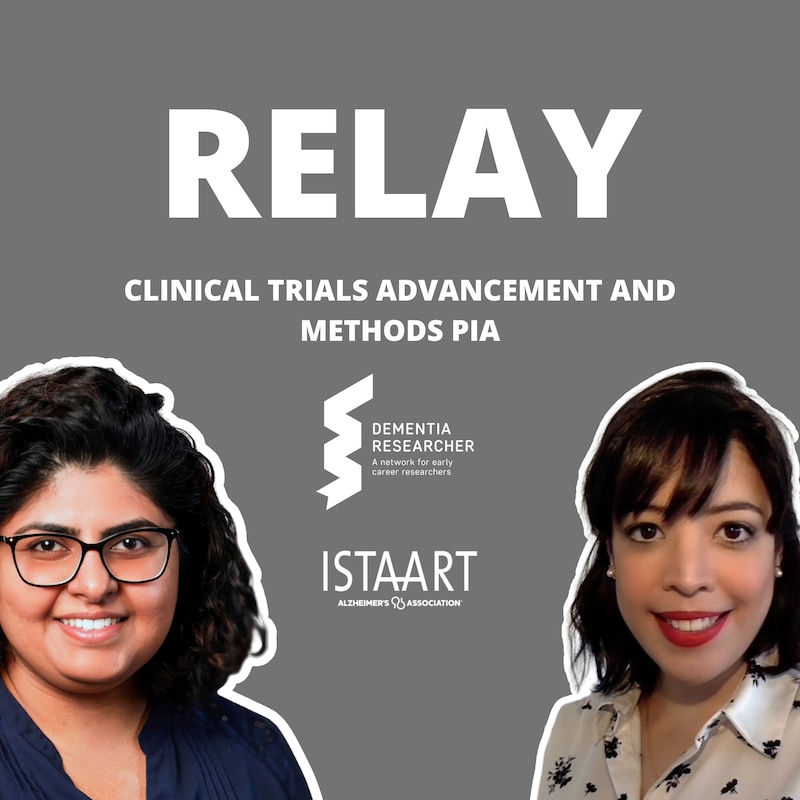
Speaker:
00:00:00
(gentle upbeat music)
Speaker:
00:00:02
- [Narrator] Hello, and
welcome to season seven
Speaker:
00:00:04
of the Dementia Researcher
"ISTAART Relay" podcast.
Speaker:
00:00:08
In this series,
Speaker:
00:00:09
members of the ISTAART's
professional interest areas
Speaker:
00:00:12
interview each other about their PIAs
Speaker:
00:00:15
and the hot topics in their fields.
Speaker:
00:00:18
Each guest then becomes
the next episode's host,
Speaker:
00:00:21
passing the conversation along
Speaker:
00:00:22
from one researcher to the next.
Speaker:
00:00:25
We are releasing one
episode a day in the run up
Speaker:
00:00:28
to the Alzheimer's Association
International Conference,
Speaker:
00:00:31
this year in London and online,
Speaker:
00:00:34
showcasing the work of the ISTAART PIAs.
Speaker:
00:00:37
Thank you for listening.
Speaker:
00:00:40
(gentle guitar music)
Speaker:
00:00:45
- Hello and thanks for tuning in.
Speaker:
00:00:48
I'm Sindhuja Tirumalai Govindarajan.
Speaker:
00:00:50
I'm an Alzheimer's
Association research fellow
Speaker:
00:00:52
and postdoctoral researcher
Speaker:
00:00:55
at the University of Pennsylvania.
Speaker:
00:00:57
And over the summer, I'll be
transitioning into a new role
Speaker:
00:01:00
as an assistant professor
at the Karolinska Institute.
Speaker:
00:01:04
I also serve as the outgoing chair
Speaker:
00:01:07
on the Professional Interest Area
Speaker:
00:01:09
for Elevating Early Career Researchers,
Speaker:
00:01:12
it's shortened as PEERs PIA
and this is within the ISTAART.
Speaker:
00:01:16
Today, I'm delighted to be
talking with Dr. Carla Abdelnour
Speaker:
00:01:20
from the Clinical Trials
Advancement and Methods PIA.
Speaker:
00:01:24
Hi, Carla, welcome to the show.
Speaker:
00:01:27
- Hi, Sindhuja.
Speaker:
00:01:29
- To kick things off,
Speaker:
00:01:30
could you introduce
yourself to our listeners
Speaker:
00:01:32
and tell us a little bit
Speaker:
00:01:33
about your current work
and research focus?
Speaker:
00:01:36
- Of course.
Speaker:
00:01:37
My name is Carla Abdelnour,
I'm a clinician scientist,
Speaker:
00:01:41
and I work in Barcelona, Spain
Speaker:
00:01:43
at the Hospital de la
Santa Creu i Sant Pau
Speaker:
00:01:47
in the neurology department
in the memory unit.
Speaker:
00:01:50
My work focuses
Speaker:
00:01:52
on studying mixed neurodegenerative
diseases of ageing,
Speaker:
00:01:57
particularly Lewy body disease
Speaker:
00:01:59
with Alzheimer disease mixed pathology.
Speaker:
00:02:02
And what I want to do with my research
Speaker:
00:02:05
is to try to understand how
these proteinopathies interact
Speaker:
00:02:09
to develop better tools for diagnosis
Speaker:
00:02:12
and also for treatments of our patients.
Speaker:
00:02:17
- That's great.
Speaker:
00:02:18
That's such a massive space
Speaker:
00:02:19
at the intersection of two
very important questions.
Speaker:
00:02:23
How did you first get involved
in this area of research?
Speaker:
00:02:27
- Well, that's a great question, Sindhuja.
Speaker:
00:02:30
I started working on this
approximately 10 years ago
Speaker:
00:02:34
when I started my PhD.
Speaker:
00:02:36
And I developed my PhD on
dementia with Lewy bodies
Speaker:
00:02:39
with Alzheimer's disease mixed pathology.
Speaker:
00:02:42
This I was studying in dementia
with Lewy body patients
Speaker:
00:02:44
that have Alzheimer
disease profiles at CSF.
Speaker:
00:02:50
So, I studied different aspects
of this mixed pathology,
Speaker:
00:02:55
in particular, how this
patient progress over time
Speaker:
00:02:59
because they had faster progression,
Speaker:
00:03:01
that's our studies have shown also.
Speaker:
00:03:04
We studied how that,
Speaker:
00:03:06
the presence of ID capacity in DLP
Speaker:
00:03:09
influenced the clinical
presentation and atrophy patterns.
Speaker:
00:03:13
And all of that work was
done in collaboration
Speaker:
00:03:16
with the European Dementia
with Lewy body consortium,
Speaker:
00:03:19
which I'm very grateful
for their help with my PhD.
Speaker:
00:03:24
Then I moved to the US to do
my postdoctoral fellowship
Speaker:
00:03:29
with Professor Kathleen
Poston at Stanford University.
Speaker:
00:03:33
And there, I was able to include
Speaker:
00:03:36
Parkinson's disease patients
with cognitive impairment
Speaker:
00:03:38
that also have Alzheimer's
disease biomarkers,
Speaker:
00:03:41
so, then I will have the full
Lewy body disease spectrum
Speaker:
00:03:45
to study and understand the differences
Speaker:
00:03:48
and how the presence AD pathology
influence their cognition,
Speaker:
00:03:55
their disease progression in general,
Speaker:
00:03:56
function, global cognition, et cetera.
Speaker:
00:04:00
And also, try to study novel biomarkers,
Speaker:
00:04:02
in this case, plasma markers
Speaker:
00:04:03
and how to interpret them
Speaker:
00:04:05
in this setting of mixed pathologies.
Speaker:
00:04:08
So, it has been great,
Speaker:
00:04:11
working on this field for all 10 years now
Speaker:
00:04:14
'cause I have been seeing the explosion
Speaker:
00:04:16
and this awareness of the
presence of co-pathologies now
Speaker:
00:04:21
which is great, I'm excited to see
Speaker:
00:04:23
how many people now is
interested in this field.
Speaker:
00:04:26
And, yeah, so I started
working on my PhD on this.
Speaker:
00:04:30
It was a great opportunity,
Speaker:
00:04:31
at that time I was working
at the, at Fundacio Ace
Speaker:
00:04:36
as a neurologist, and
I got the opportunity
Speaker:
00:04:39
to join the European Dementia
with Lewy body consortium
Speaker:
00:04:43
and work on our dementia
with Lewy body cohort,
Speaker:
00:04:47
so that's how I dive into this field.
Speaker:
00:04:50
I have to be honest with you,
Speaker:
00:04:52
when I finished my
residency as a neurologist,
Speaker:
00:04:55
I was interested in stroke
and also movement disorders.
Speaker:
00:05:01
But, then I got in memory unit
Speaker:
00:05:02
and I fell in love with our patients
Speaker:
00:05:05
that have cognitive impairment
because it's so interesting.
Speaker:
00:05:08
Our memory, our behaviour,
that's what make us human.
Speaker:
00:05:12
And since I started neurology,
Speaker:
00:05:15
what I wanted to do is
understand our brain
Speaker:
00:05:17
and how the brain works.
Speaker:
00:05:19
So, understanding behaviour and cognition
Speaker:
00:05:22
is a great way to do that.
Speaker:
00:05:24
So, when I got the opportunity
Speaker:
00:05:26
to work on dementia with Lewy
bodies, it was my pure luck,
Speaker:
00:05:31
but I was super lucky
Speaker:
00:05:32
because I was able to combine my passion
Speaker:
00:05:34
about movement disorder,
so Parkinson's disease,
Speaker:
00:05:37
but also cognition.
Speaker:
00:05:40
And I always have thought about that,
Speaker:
00:05:43
with sometimes we make these
difference fields more,
Speaker:
00:05:47
a little bit arbitrary, right?
Speaker:
00:05:49
At the end there are all
neuro reactive diseases,
Speaker:
00:05:54
the patients are very similar.
Speaker:
00:05:55
It's just sometimes because of how the,
Speaker:
00:05:59
these diseases have been
described that we separate them,
Speaker:
00:06:03
but they're more similar than we think
Speaker:
00:06:06
and patients are very
iterative in general.
Speaker:
00:06:09
So, I'm very happy to be kind
of in both fields because we,
Speaker:
00:06:14
that way it gives me the
opportunity to learn from one field
Speaker:
00:06:18
and move the information to the other,
Speaker:
00:06:19
so have a different perspective, I guess.
Speaker:
00:06:23
- I think we're kindred spirits in that.
Speaker:
00:06:25
I did my PhD with a different
field of neurodegeneration
Speaker:
00:06:28
and moved to the field of ageing.
Speaker:
00:06:31
I worked on multiple sclerosis before
Speaker:
00:06:33
and there are a lot of commonalities
Speaker:
00:06:35
in terms of how the brain is affected.
Speaker:
00:06:38
And I could see like
the spark in your face
Speaker:
00:06:41
when you're talking about
how complex the brain is.
Speaker:
00:06:43
I agree with you that a
lot of the presentations
Speaker:
00:06:47
perhaps even are similar
Speaker:
00:06:49
across a diverse spectrum of diseases.
Speaker:
00:06:52
But exactly how we study them
is quite different, right?
Speaker:
00:06:55
So, for example, I'm
representing the PEERs PIA today,
Speaker:
00:06:59
but my area of research is
neuroimaging, mainly MRI focused.
Speaker:
00:07:03
And so, we're looking at how
the path mechanisms manifest,
Speaker:
00:07:09
how can we study them in vivo,
Speaker:
00:07:11
you know, before sometimes when
cognitive impairment present
Speaker:
00:07:14
sometimes during the
process along the continuum.
Speaker:
00:07:18
In terms of your specific research areas,
Speaker:
00:07:20
am I right in understanding
Speaker:
00:07:22
that you're focusing more
on the plasma markers
Speaker:
00:07:25
and as such the biofluid
markers and cognition?
Speaker:
00:07:29
Can you tell us about the methodologies
Speaker:
00:07:31
you use for your research?
Speaker:
00:07:33
- Yes, of course, definitely. Yes.
Speaker:
00:07:35
So, I have been analysing
biofluid biomarkers, mainly CSF.
Speaker:
00:07:41
More recently I also have
been study plasma markers.
Speaker:
00:07:45
And at the beginning
of my PhD I also will,
Speaker:
00:07:48
or during my PhD I also study MRI
Speaker:
00:07:52
for studying the atrophy patterns.
Speaker:
00:07:54
But, I think what my goal is,
Speaker:
00:07:58
is to work more on fluid biomarkers
Speaker:
00:08:01
because it's the best metrics, I guess,
Speaker:
00:08:05
to understand different dignopathies
Speaker:
00:08:07
and different processes,
Speaker:
00:08:09
so, that's why I'm very excited
Speaker:
00:08:12
that we are now able to
identify alpha-synuclein at CSF.
Speaker:
00:08:15
I remember doing my PhD when
we were not able to do that,
Speaker:
00:08:19
that is fairly recent,
Speaker:
00:08:21
and reading on the papers
at the end that said like,
Speaker:
00:08:25
well, what we need is alpha syn biomarker
Speaker:
00:08:27
and now we have it.
Speaker:
00:08:29
And that has changed our understanding
Speaker:
00:08:31
of these diseases also,
Speaker:
00:08:33
and the awareness as I mentioned before,
Speaker:
00:08:36
about the frequency of mixed pathologies
Speaker:
00:08:39
and all the implications
Speaker:
00:08:40
that that will have for our patients
Speaker:
00:08:42
and the treatments that
we decide for them.
Speaker:
00:08:44
So, yeah, I think I am
more inclined or, I guess,
Speaker:
00:08:49
I guess I biassed to fluid markers
Speaker:
00:08:51
because we can identify different proteins
Speaker:
00:08:55
that reflect the proteinopathies
Speaker:
00:08:56
but also the pathophysiological processes
Speaker:
00:08:59
that might indicate this
is progression or even,
Speaker:
00:09:04
I think I'm interested in
trying to find biomarkers
Speaker:
00:09:07
for monitoring patients,
Speaker:
00:09:08
or to see if we're able
to identify markers,
Speaker:
00:09:10
for example, for responses to treatment
Speaker:
00:09:13
or for better for prognosis or prediction.
Speaker:
00:09:16
And I guess biofluid markers
are very good for that.
Speaker:
00:09:20
But I'm happy to incorporate
other markers too
Speaker:
00:09:23
from, you know, imaging,
Speaker:
00:09:25
particularly I will be super happy
Speaker:
00:09:27
when we have a PET profile
Synuclein that will be great
Speaker:
00:09:31
to see alpha-synuclein clinging the brain.
Speaker:
00:09:35
I think that will be super exciting.
Speaker:
00:09:38
- That's great.
Speaker:
00:09:39
One cannot argue with the specificity
Speaker:
00:09:41
that comes from biofluid markers
Speaker:
00:09:44
and how complimentary they interact
Speaker:
00:09:46
with other biomarkers as
well, it's great to hear.
Speaker:
00:09:50
So, in your opinion,
Speaker:
00:09:51
do you think the more recent advancements
Speaker:
00:09:55
or discoveries that
you're so excited about
Speaker:
00:09:57
are adequately incorporated
in clinical trials?
Speaker:
00:10:01
Like what would you want
Speaker:
00:10:04
if you had a magic genie or a magic wand,
Speaker:
00:10:06
what wish would you want to
incorporate in clinical trials
Speaker:
00:10:09
to fix a current problem?
Speaker:
00:10:11
- I think that's a great question.
Speaker:
00:10:14
I think one of the things
that I'm very excited about
Speaker:
00:10:17
is to incorporate the identification
Speaker:
00:10:21
of different proteinopathies
in clinical trials.
Speaker:
00:10:25
Even for inclusion or exclusion
or for stratification,
Speaker:
00:10:29
I think maybe we can start
with a stratification.
Speaker:
00:10:32
And that is because there is this question
Speaker:
00:10:36
about what happens with a
patient with Alzheimer disease,
Speaker:
00:10:39
for example, receive a
treatment for amyloid or tau
Speaker:
00:10:43
but also have alpha-synuclein,
does that person respond
Speaker:
00:10:48
similar to a person that
doesn't have alpha-synuclein,
Speaker:
00:10:51
or labri by this, right?
Speaker:
00:10:52
So, I think this is a fair question
Speaker:
00:10:56
and I definitely would love
to see more clinical trials
Speaker:
00:11:00
trying to answer that question
Speaker:
00:11:02
as a secondary outcome
or exploratory outcome.
Speaker:
00:11:05
I understand the difficulties though
Speaker:
00:11:07
because, right now, the alpha-synuclein
Speaker:
00:11:10
is available only in CSF,
Speaker:
00:11:13
not all clinical trials have
as an inclusion criteria,
Speaker:
00:11:17
CSF is specifically, sometimes
only you can have the PET,
Speaker:
00:11:22
the amyloid or tau inclusion criteria.
Speaker:
00:11:26
And not all clinical trials in Alzheimer's
Speaker:
00:11:28
does either require biomarker
confirmation actually,
Speaker:
00:11:31
so, that's another thing.
Speaker:
00:11:34
But yeah, I think I
understand that it's not easy,
Speaker:
00:11:38
but even if in a sub group of patient
Speaker:
00:11:41
the clinical trials could answer that.
Speaker:
00:11:43
And I must say
Speaker:
00:11:44
that there are some great
setting clinical trials
Speaker:
00:11:47
happening on that space.
Speaker:
00:11:50
'Cause there are at least
two that I'm aware of
Speaker:
00:11:52
that are going to investigate
antiamyloid treatments
Speaker:
00:11:58
in patients that have
alpha-synuclein positivities
Speaker:
00:12:01
of level one disease.
Speaker:
00:12:03
And so I'm very excited about that
Speaker:
00:12:05
'cause it's the first time
Speaker:
00:12:06
that we're going to use a treatment
Speaker:
00:12:09
that has been developed for this field
Speaker:
00:12:12
of Alzheimer's one disease
Speaker:
00:12:14
and we're going to treat
a different population
Speaker:
00:12:16
that comes from the movement disorder,
Speaker:
00:12:18
also the Parkinson disease
with cognitive impairment
Speaker:
00:12:21
or dementia vulnerabilities.
Speaker:
00:12:23
And, so for me that means that
these fields are converging,
Speaker:
00:12:29
which is super good
Speaker:
00:12:30
'cause I think that cross collaboration
Speaker:
00:12:31
is going to teach us a lot of these.
Speaker:
00:12:35
And I think that's the best
way also to help our patients
Speaker:
00:12:38
'cause at the end what we want
is treatment for our patients
Speaker:
00:12:41
and we're going to meet
different resources
Speaker:
00:12:44
for different patients,
Speaker:
00:12:46
and for personalised
medicine we need that detail.
Speaker:
00:12:49
We need that level of detail
Speaker:
00:12:51
of how many proteinopathies patient has
Speaker:
00:12:55
in order to respond to the treatment.
Speaker:
00:12:58
- That's great.
Speaker:
00:12:59
Your excitement for the research topic
Speaker:
00:13:02
and for the future horizon is very obvious
Speaker:
00:13:05
from the way you can talk about this.
Speaker:
00:13:07
(upbeat music)
Speaker:
00:13:13
That's been really
helpful to set the stage
Speaker:
00:13:15
for what I want to talk about next,
Speaker:
00:13:17
which is the work of your PIA
Speaker:
00:13:19
with the clinical trials
and advancements PIA,
Speaker:
00:13:22
can I call it the CTAM PIA?
Speaker:
00:13:24
- Yes.
- Okay, great.
Speaker:
00:13:26
So, clearly it's a massive
interdisciplinary effort
Speaker:
00:13:29
with converging disease spectrums,
Speaker:
00:13:33
with converging proteinopathies,
diverging as well,
Speaker:
00:13:36
which is what makes it very fascinating.
Speaker:
00:13:38
So, how does your PIA organise itself
Speaker:
00:13:42
with the different experts from
statisticians to clinicians?
Speaker:
00:13:45
How are you organising,
Speaker:
00:13:47
how do you bring this work
together within the PIA?
Speaker:
00:13:51
- Well, I think that's
a very good question.
Speaker:
00:13:53
In our PIA we have
collaborative environment
Speaker:
00:13:57
and we're very open to any topic or idea
Speaker:
00:14:04
that somebody might have.
Speaker:
00:14:06
And we always try to encourage people
Speaker:
00:14:09
and help them and support them
in moving those ideas forward
Speaker:
00:14:14
because usually they are within
the objectives of the PIA.
Speaker:
00:14:18
What our PIA wants to do is we
want to develop better tools
Speaker:
00:14:22
for synuclein clinical trials.
Speaker:
00:14:25
And also we have a second objective
Speaker:
00:14:27
that has to do with
the education of people
Speaker:
00:14:30
about the design of clinical trials.
Speaker:
00:14:33
So, yeah, you're right, we're
very interdisciplinary PIA
Speaker:
00:14:37
and I think that's a strength
Speaker:
00:14:39
because we can learn from
different perspective,
Speaker:
00:14:42
and, yeah, so any idea that people have
Speaker:
00:14:46
and any of the members,
Speaker:
00:14:47
I invite them to collaborate,
Speaker:
00:14:49
if you have any idea
Speaker:
00:14:51
about something that you want to develop
Speaker:
00:14:53
either a webinar or a
different activity or a paper,
Speaker:
00:14:58
just reach out to us
Speaker:
00:15:00
where we will support you with your idea
Speaker:
00:15:03
and probably put you
in contact with people
Speaker:
00:15:05
that will help you.
Speaker:
00:15:07
- We will come back
Speaker:
00:15:08
to how people can get
involved in a second,
Speaker:
00:15:10
but just to take a step back,
Speaker:
00:15:11
I'd like to highlight a little bit more
Speaker:
00:15:14
what were the objectives
of the CTAM PIA in general?
Speaker:
00:15:18
I think you mentioned it already,
Speaker:
00:15:19
but maybe we need a specific segment of it
Speaker:
00:15:22
so the audience can know better.
Speaker:
00:15:25
- Yes. So, our PIA is on
clinical trials and methods.
Speaker:
00:15:30
And the methods part is,
Speaker:
00:15:32
I think, one of the very interesting ones
Speaker:
00:15:34
because what we want to do
Speaker:
00:15:37
is try to develop novel
methods or identify methods
Speaker:
00:15:41
for the clinical trials
Speaker:
00:15:43
for Alzheimer's disease
and related disorders.
Speaker:
00:15:46
And the second objective is
to educate people about the,
Speaker:
00:15:51
how to conduct clinical trials?
Speaker:
00:15:53
What are the best methodologies
Speaker:
00:15:54
that you have an idea
for a clinical trial?
Speaker:
00:15:57
Which I found fascinating and,
Speaker:
00:16:00
there have been a lot of
webinars and different activities
Speaker:
00:16:03
that the PIA has developed over the years
Speaker:
00:16:06
to support people in this regard.
Speaker:
00:16:07
Info transfer are very difficult to,
Speaker:
00:16:12
to manage and to perform.
Speaker:
00:16:14
But I think with the right
support that can be done.
Speaker:
00:16:18
So, again, if people are
interested in lome one,
Speaker:
00:16:22
just reach out to us.
Speaker:
00:16:26
- Did you get involved with the CTAM PIA?
Speaker:
00:16:28
What brought you here?
Speaker:
00:16:30
- Yes, I love that question.
So, I got involved in:
2020
Speaker:
00:16:35
It was during the pandemic.
Speaker:
00:16:36
I remember when I received
it, that email of invite us,
Speaker:
00:16:41
and I thought, oh my god,
that's such a great opportunity
Speaker:
00:16:44
because during the pandemic
Speaker:
00:16:47
I was working in Fundacio
Ace as neurologist
Speaker:
00:16:51
and I was heavily involved
in the clinical trial unit.
Speaker:
00:16:54
I was actually the deputy head
of the clinical trial unit
Speaker:
00:16:57
and I was coordinating
several clinical trials
Speaker:
00:17:00
and more than 100 participants
in clinical trial.
Speaker:
00:17:04
And during the pandemic what happened was
Speaker:
00:17:08
that we had that question, oh my god,
Speaker:
00:17:10
how are we going to cover clinical trials
Speaker:
00:17:12
in this situation, right?
Speaker:
00:17:14
All these protocols of these visits,
Speaker:
00:17:16
what are we going to do?
Speaker:
00:17:17
We have to adapt super
quickly to all of that.
Speaker:
00:17:20
So, I thought that that
will be a great opportunity
Speaker:
00:17:23
to reach out to people from
different parts of the world
Speaker:
00:17:27
and understand how they were
going to manage that situation.
Speaker:
00:17:30
It was a great opportunity in that regard.
Speaker:
00:17:34
I learned a lot from my
colleagues around the world
Speaker:
00:17:36
or how they were managing that.
Speaker:
00:17:38
Where after that it was
a great opportunity also
Speaker:
00:17:41
for networking.
Speaker:
00:17:43
I have been always
interested in clinical trials
Speaker:
00:17:46
because I'm a clinician,
Speaker:
00:17:47
and I want also been able
to develop better treatments
Speaker:
00:17:53
for my patients,
Speaker:
00:17:54
and clinical trials are the
best way to do that, right?
Speaker:
00:17:57
It helps me also being up
to date on the treatments
Speaker:
00:18:02
that are being developed in the pipelines
Speaker:
00:18:05
of the different neuroactive diseases.
Speaker:
00:18:07
So, yeah, I think clinical
trials are very helpful,
Speaker:
00:18:11
and as a researcher, it
also has taught me about
Speaker:
00:18:16
what is the best way to develop a protocol
Speaker:
00:18:20
for a research.
Speaker:
00:18:21
So, if you are a researcher
doing an observational study
Speaker:
00:18:26
or you have an idea of
an observational study,
Speaker:
00:18:30
learn about clinical trials
Speaker:
00:18:32
because that will be a great foundation,
Speaker:
00:18:34
that is the gold standard, I would say,
Speaker:
00:18:37
for developing protocol for any research.
Speaker:
00:18:39
It's the highest level
of scientific evidence,
Speaker:
00:18:43
so learning about clinical trials
Speaker:
00:18:44
is actually very helpful for your career.
Speaker:
00:18:49
So then, that was what
brought me to the CTMP
Speaker:
00:18:53
and has been an amazing journey.
Speaker:
00:18:56
- That's great, that's such
a great way to introduce
Speaker:
00:18:59
and highlight the
contributions of the PIA.
Speaker:
00:19:03
Could you tell me a little bit
Speaker:
00:19:04
about how it's organised
in terms of roles,
Speaker:
00:19:08
the structure within the PIA
Speaker:
00:19:09
and how new members can
potentially participate?
Speaker:
00:19:14
- Yes, of course.
Speaker:
00:19:15
So, we're in the process
Speaker:
00:19:19
of updating our executive committee,
Speaker:
00:19:22
and currently the vice chair, Rema Raman,
Speaker:
00:19:25
is the chair of our PIA,
Speaker:
00:19:27
she's been an amazing work
during the last two years
Speaker:
00:19:31
and I'm very grateful for her leadership.
Speaker:
00:19:34
And this year I will even
a new chair of the PIA
Speaker:
00:19:39
and we are waiting for the elections
Speaker:
00:19:41
'cause we have elections just recently
Speaker:
00:19:43
and we will have our new EC team,
Speaker:
00:19:46
which I'm, I'm looking
forward to meet them
Speaker:
00:19:51
either in person or virtually,
Speaker:
00:19:52
we'll have a virtual coffee if needed.
Speaker:
00:19:54
So, yeah, we're in the process
of building the new EC,
Speaker:
00:19:58
but we have had an amazing EC this year
Speaker:
00:20:01
and the the past period and
we have three working groups.
Speaker:
00:20:06
And so, we have a working
group on Lewy body trials
Speaker:
00:20:10
that I work on in collaboration
Speaker:
00:20:13
with the Lewy body dementia PIA.
Speaker:
00:20:15
We also have another working group
Speaker:
00:20:18
on diverse representation across the flow
Speaker:
00:20:23
and we have another one
about remote assessments
Speaker:
00:20:29
in clinical trials.
Speaker:
00:20:30
So, we have several working groups
Speaker:
00:20:33
and if people want to be involved
Speaker:
00:20:35
in any of these working
groups of have other ideas,
Speaker:
00:20:38
please reach out,
Speaker:
00:20:39
and I'll be happy to talk
with you about your ideas
Speaker:
00:20:43
and how to get involved more actively.
Speaker:
00:20:47
- Thank you, yeah,
Speaker:
00:20:47
I'm aware of some of the
programming you offer
Speaker:
00:20:51
because I think our PIAs
Speaker:
00:20:52
have been collaborating for
webinars or information sessions
Speaker:
00:20:57
even before I was part of it.
Speaker:
00:21:00
In terms of programming that's
related to the upcoming AIC,
Speaker:
00:21:04
what kind of sessions do you offer,
Speaker:
00:21:06
scientific, career development?
Speaker:
00:21:08
Could you share a little bit
Speaker:
00:21:10
about what new members or
interested parties can attend
Speaker:
00:21:14
or look out for at AIC?
Speaker:
00:21:17
- Yes. So during AIC, I encourage
people to come to the PRA.
Speaker:
00:21:23
There is going to be
an amazing discussion,
Speaker:
00:21:26
a panel discussion on
global representation
Speaker:
00:21:28
in clinical trials.
Speaker:
00:21:29
This is something that we
have been discussing a lot
Speaker:
00:21:32
during the past three years.
Speaker:
00:21:34
Rema and Jorge Libre,
Rema Raman and Jorge Libre
Speaker:
00:21:38
are leading that effort
with the working group
Speaker:
00:21:41
and that is going to
be a launch at the AIC.
Speaker:
00:21:45
And, so, please come to our PIA deck.
Speaker:
00:21:47
I think it's going to be
an amazing discussion.
Speaker:
00:21:50
And, in addition to that,
Speaker:
00:21:51
we have an FRS on the similar
topic on representation
Speaker:
00:21:56
that is led also by Rema.
Speaker:
00:21:58
I don't recall the exact details,
Speaker:
00:22:03
but, just reach out
Speaker:
00:22:06
'cause I haven't checked the
programme in detail just yet,
Speaker:
00:22:10
but, we're going to have
an FRS on clinical trials
Speaker:
00:22:14
from the CTAM PIA.
Speaker:
00:22:16
And I'll be in London,
Speaker:
00:22:18
so, if you have questions
Speaker:
00:22:20
about how to get involved more actively,
Speaker:
00:22:22
we're always asking for
members input or ideas.
Speaker:
00:22:27
We, I think we're very open PIA,
Speaker:
00:22:29
and one of the things that
we want to do for next year,
Speaker:
00:22:34
in addition to continue the
work from the previous EC
Speaker:
00:22:38
is to continue the
increase of the engagement
Speaker:
00:22:42
of the members,
Speaker:
00:22:43
in particularly, the early career members
Speaker:
00:22:46
that might be interested
Speaker:
00:22:47
in clinical trail design or methods.
Speaker:
00:22:51
So, yeah, reach out to
me, I'll be happy to,
Speaker:
00:22:54
to give you my contact
then we have, can have
Speaker:
00:22:57
more personal discussion about your ideas
Speaker:
00:23:00
or how to get involved.
Speaker:
00:23:03
- Great.
Speaker:
00:23:04
I particularly like your mention
of early career researchers
Speaker:
00:23:07
because that's the objective
of my PIA, which is PEERs PIA,
Speaker:
00:23:12
that I represent.
Speaker:
00:23:14
In terms of easier involvement,
Speaker:
00:23:17
you also have an EC position
Speaker:
00:23:21
for early career researchers, right?
Speaker:
00:23:23
- Yes, that's correct.
- Can you-
Speaker:
00:23:24
- Yeah.
Speaker:
00:23:25
- Although the elections
are done for this year,
Speaker:
00:23:27
can you tell us a little bit
Speaker:
00:23:28
about what kind of
activities have those ECR
Speaker:
00:23:32
executive committee members
gotten involved in in the past?
Speaker:
00:23:37
- Yes, in the past the is,
Speaker:
00:23:39
there literary researchers have
been involved in helping us
Speaker:
00:23:43
with the, in review webinar.
Speaker:
00:23:48
And that year actually the,
Speaker:
00:23:50
we used to do two segments of
that within one webinar talk,
Speaker:
00:23:55
but, because we want to talk
about pharmacological trials
Speaker:
00:23:59
and non-pharmacological trials.
Speaker:
00:24:01
And as you can imagine,
Sindhuja, that's a lot of work.
Speaker:
00:24:05
But people have done an amazing work.
Speaker:
00:24:07
I remember last time it
was Erina who took on the,
Speaker:
00:24:12
from trials I remember,
Speaker:
00:24:15
and I'm very sorry 'cause I
don't remember the other person,
Speaker:
00:24:18
but, I think, it was an amazing
summary of what has happened
Speaker:
00:24:22
because clinical trials is
such a big field, right?
Speaker:
00:24:25
There are a lot of clinical trials
Speaker:
00:24:26
happening within one year, so.
Speaker:
00:24:29
I think, but, I think
it's a good opportunity
Speaker:
00:24:31
for being up to date of what is happening,
Speaker:
00:24:36
and I think we are going
to continue to do that.
Speaker:
00:24:40
In addition, I think also
Speaker:
00:24:42
we might want to consider
discussing novel methodologies,
Speaker:
00:24:46
not only focusing on the chemical trials
Speaker:
00:24:49
from the pharm or non-pharm side,
Speaker:
00:24:51
but also what are new methodologies
Speaker:
00:24:53
that people are developing
Speaker:
00:24:56
for designing clinical trials.
Speaker:
00:24:58
- [Sindhuja] So,
Speaker:
00:24:59
so in what ways do you
think the methodologies
Speaker:
00:25:02
or techniques that you use
for clinical trials different
Speaker:
00:25:07
from what's used in research studies?
Speaker:
00:25:09
Like what are the challenges
that one might not know about
Speaker:
00:25:13
if they've only been exposed to,
Speaker:
00:25:14
you know, research
prospective studies like that?
Speaker:
00:25:19
- Yes, I think that's
a very good question.
Speaker:
00:25:22
I guess, well, the clinical trials
Speaker:
00:25:24
since they are organising different phases
Speaker:
00:25:28
and each phase has some main objective,
Speaker:
00:25:31
you will identify your outcomes
Speaker:
00:25:35
depending on the phase that your studies.
Speaker:
00:25:38
So, for example, if you are
conducting a phase two trial
Speaker:
00:25:42
where you want to study
safety and tolerability,
Speaker:
00:25:46
your outcomes will have to reflect that,
Speaker:
00:25:49
although you can incorporate
as a secondary outcomes,
Speaker:
00:25:53
cognition function or other
aspects that your interest,
Speaker:
00:25:58
for example, biomarker changes
Speaker:
00:26:02
as an exploratory markers, et cetera.
Speaker:
00:26:04
Now, when you have a project
or a research question,
Speaker:
00:26:09
you will be designing your methods
Speaker:
00:26:12
for answering that
specific question, right?
Speaker:
00:26:15
You are going to design your experiment
Speaker:
00:26:18
to answer that question
Speaker:
00:26:19
and you will identify
what are the outcomes
Speaker:
00:26:21
that I have to measure to
answer my research question.
Speaker:
00:26:26
What I think might be similar
between two approaches
Speaker:
00:26:30
is how to develop the
protocol, for example,
Speaker:
00:26:33
you will have to identify
Speaker:
00:26:35
what are the occlusion
and inclusion criteria
Speaker:
00:26:38
for their subjects.
Speaker:
00:26:40
You are going to have to identify
Speaker:
00:26:42
all the outcome measures
and describe them.
Speaker:
00:26:44
You have to calculate your sample size
Speaker:
00:26:46
to know you have enough people
involved or samples or X
Speaker:
00:26:53
to answer your research
question, which is very important
Speaker:
00:26:56
in both clinical trials
and research studies.
Speaker:
00:27:01
And so, I think having all
that prepared beforehand,
Speaker:
00:27:05
before doing the actual
study is super helpful.
Speaker:
00:27:08
So, I think the way that
clinical trails is structure
Speaker:
00:27:13
is translatable the most part
to observational studies,
Speaker:
00:27:17
has a similar to-do list.
Speaker:
00:27:22
This is when you are designing
an observational study.
Speaker:
00:27:24
- Clinical trial design is very complex
Speaker:
00:27:27
and interdisciplinary it looks like.
Speaker:
00:27:30
You previously mentioned
Speaker:
00:27:32
what you would like to see
ideally in a new clinical trial
Speaker:
00:27:36
with the incorporation of
Speaker:
00:27:39
like a magic wish of PET alpha-synuclein.
Speaker:
00:27:42
But, in terms of recent studies
that have shown success,
Speaker:
00:27:46
is there a particular study
Speaker:
00:27:47
that sounds very exciting
to you, very promising
Speaker:
00:27:51
that you want to see more of?
Speaker:
00:27:55
- Such a good question.
Speaker:
00:27:56
So, do you mean research study
Speaker:
00:27:59
or a clinical trial in particular?
Speaker:
00:28:00
- Clinical.
- A clinical trial?
Speaker:
00:28:01
- I mean a clinical
trial in specific, yeah.
Speaker:
00:28:05
- Yes, yes.
Speaker:
00:28:06
So, I went to ADPD recently in Copenhagen
Speaker:
00:28:11
and they presented a clinical trial
Speaker:
00:28:15
that is going to investigate total a map
Speaker:
00:28:18
in people with Lewy body.
Speaker:
00:28:22
So yeah, I'm very excited
about that clinical trial.
Speaker:
00:28:25
It is a phase two trial.
Speaker:
00:28:27
It has been done also collaboration
Speaker:
00:28:29
with the Lewy Body
Dementia Association and,
Speaker:
00:28:33
and that has been an
effort that has been led
Speaker:
00:28:35
by Charles Shaw from Stanford
and Dokavaskov from UCSD.
Speaker:
00:28:40
So, I'm very, yeah,
super happy to see that.
Speaker:
00:28:43
'cause I just, I just, I need to know,
Speaker:
00:28:46
I need to know if this, this,
Speaker:
00:28:49
these treatments also
work in the population
Speaker:
00:28:51
of data clinical phenotype
that is for samples
Speaker:
00:28:56
Lewy body disease, but have
the percents of amagoic data.
Speaker:
00:29:02
- Thank you for sharing that.
Speaker:
00:29:04
(upbeat music)
Speaker:
00:29:10
What advice would you have for
someone who is new to ISTAART
Speaker:
00:29:13
or Alzheimer's Association in
general in this field of work?
Speaker:
00:29:18
How do you think it has helped you
Speaker:
00:29:20
to be involved outside of
research advancements alone?
Speaker:
00:29:25
- Yes. I think that's a
very important question.
Speaker:
00:29:28
I will say reach out to
members from different PIAs
Speaker:
00:29:33
from your main interest.
Speaker:
00:29:37
I think people is very open
to extend their experience,
Speaker:
00:29:41
so, if you reach out to people
Speaker:
00:29:43
and ask them about their experiences,
Speaker:
00:29:45
if you are interested in
getting involved more actively
Speaker:
00:29:49
in any of the activities,
just reach out to people.
Speaker:
00:29:53
Also, you can reach out
Speaker:
00:29:54
to the Alzheimer's Association
and the PIA directly.
Speaker:
00:29:58
I think their leadership team is amazing.
Speaker:
00:30:00
They, they're doing an
amazing job helping us
Speaker:
00:30:04
to build this network of
collaborators across the world.
Speaker:
00:30:09
So, you have any questions,
Speaker:
00:30:11
I think that's also a great resource.
Speaker:
00:30:13
There is a lot of information
on the PIA website
Speaker:
00:30:16
about the different PIAs if
you want to check that also,
Speaker:
00:30:21
because there are a lot of opportunities
Speaker:
00:30:23
and you might have different interests,
Speaker:
00:30:25
not only on one field,
but different fields.
Speaker:
00:30:28
And you can definitely be a member
Speaker:
00:30:30
of several PIAs at the same time
Speaker:
00:30:33
and different working fields too.
Speaker:
00:30:36
I will also say that it's
an amazing opportunity
Speaker:
00:30:41
to meet people, to discuss ideas,
Speaker:
00:30:45
and at the end, to move the
field forward, Sindhuja,
Speaker:
00:30:48
because this is such a complex problem.
Speaker:
00:30:52
We want to develop
better diagnostic tools,
Speaker:
00:30:55
a better treatments for our patients.
Speaker:
00:30:58
And we're not going to do that alone,
Speaker:
00:31:01
we need a big team, a global team.
Speaker:
00:31:04
And the Alzheimer's
Association with the PIAs
Speaker:
00:31:06
are doing that.
Speaker:
00:31:08
So, I'm very happy to be part of the PIA,
Speaker:
00:31:10
and I will say that if you
interest, just reach out.
Speaker:
00:31:14
We need more people
working on this problems,
Speaker:
00:31:16
more ring trying to
answer these questions.
Speaker:
00:31:20
So yes, just come onboard
and help us to end dementia.
Speaker:
00:31:26
- Well said, we cannot do this alone,
Speaker:
00:31:28
we have to work together on that.
Speaker:
00:31:30
I think that is a fantastic
wrap up for the podcast so far.
Speaker:
00:31:35
Thank you all for listening.
Speaker:
00:31:36
This is the last show
in the season for:
2026
Speaker:
00:31:40
ISTAART PIAs are a great
way, like Carla mentioned,
Speaker:
00:31:43
to expand your network,
find new collaborators,
Speaker:
00:31:47
and learn more about
Alzheimer's and dementia field
Speaker:
00:31:50
in general.
Speaker:
00:31:52
We hope that these podcasts
Speaker:
00:31:53
have inspired you to get involved
Speaker:
00:31:55
and you can find the profiles on myself
Speaker:
00:31:58
and our wonderful guest, Carla,
Speaker:
00:32:00
and information on how to
become involved in the ISTAART
Speaker:
00:32:03
on our website at
dementiaresearcher.nihr.ac.uk,
Speaker:
00:32:10
and also at www.alz.org/istaart,
Speaker:
00:32:19
or, for simpler terms, Google ISTAART
Speaker:
00:32:22
and it'll take you there.
Speaker:
00:32:24
We're looking forward to seeing
you at the AIC conference,
Speaker:
00:32:27
so, if you haven't already registered,
Speaker:
00:32:29
visit alz.org for more information
Speaker:
00:32:32
and come find us and say hello.
Speaker:
00:32:34
Thank you. Bye.
Speaker:
00:32:36
- Thank you. Bye.
Speaker:
00:32:40
- [Narrator] You have been
listening to the "Relay" podcast,
Speaker:
00:32:42
delivered as a collaboration
Speaker:
00:32:44
between Dementia researcher and ISTAART.
Speaker:
00:32:47
This podcast is made at
University College London
Speaker:
00:32:50
with generous funding from the
NIHR, Race Against Dementia,
Speaker:
00:32:55
Alzheimer's Association,
Alzheimer's Research UK,
Speaker:
00:32:59
and the Alzheimer's Society.
Speaker:
00:33:02
Please like and subscribe
Speaker:
00:33:03
and share your thoughts in the comments.
Speaker:
00:33:08
(gentle upbeat music)