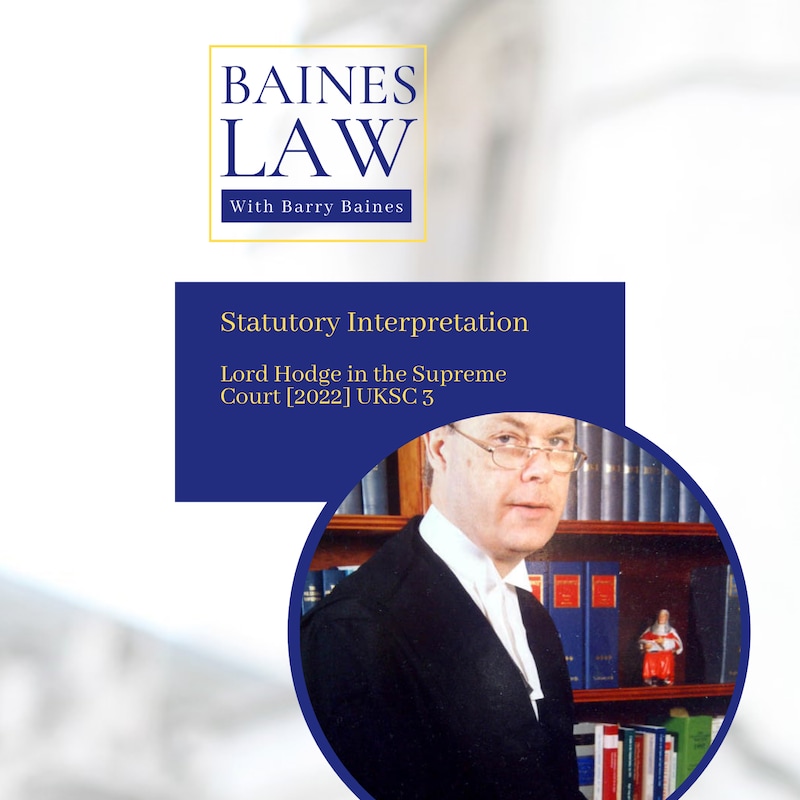
The Deputy President of the Supreme Court, Lord Hodge, takes the opportunity to explain in this judgment the meaning of statutory interpretation.
Transcripts
tate for the Home Department [:
When the courts conduct statutory interpretation they are seeking the meaning of the words which Parliament uses.
Recently, Lord Nicholls of Birkenhead said: “Statutory interpretation is an exercise which requires the court to identify the meaning borne by the words in question in the particular context.”
Words and passages in a statute derive their meaning from their context. A phrase or passage must be read in the context of the section as a whole and in the wider context of a relevant group of sections.
Other provisions in a statute, and the statue as a whole, may provide the relevant context. They are the words which Parliament has chosen to enact as an expression of the purpose of the legislation and are therefore the primary source by which meaning is ascertained.
An important constitutional reason for this is that citizens, with the assistance of their advisers, are intended to be able to understand parliamentary enactments so that they can regulate their conduct accordingly. They should be able to rely upon what they read in an Act of Parliament.
External aids to interpretation play a secondary role. None of them displaces the meanings conveyed by the words of a statute that, after consideration of that context, are clear and unambiguous and which do not produce absurdity.
Statutory interpretation involves an objective assessment of the meaning which a reasonable legislature as a body is seeking to convey in using the statutory words which are being considered.
The phrase “intention of Parliament” is a shorthand reference to the intention which the court reasonably imputes to Parliament in respect of the language used.
It is not the subjective intention of the draftsman, individual members or even a majority of individual members of either House.
When a court says that a certain meaning cannot be what Parliament intended, it is saying only that the words under consideration cannot reasonably be taken as used by Parliament with that meaning.
An earlier statute can be expressly or impliedly amended or repealed by Parliament enacting a later statute. That includes empowering the executive branch of government to make subordinate legislation which impinges upon, and even removes, rights conferred by the earlier statute.
Where the later statute authorises subordinate legislation, the court’s task is to ascertain the scope of the enabling power contained in the later statute.
In doing so the court will take into account assumptions or presumptions such as the principle of legality.
If the court concludes that the later statute empowers the executive to make subordinate legislation which has the effect of removing rights conferred by the earlier statute, the Rule in R v Secretary of State for Social Security exp Joint Council for the Welfare of Immigrants imposes no additional hurdle.
Where the court is not dealing with an interference by statute with a common law constitutional right or with a statutory provision which declares such a fundamental or constitutional right, the normal rules of statutory interpretation apply.
You can read a summary of this Podcast episode with case citations under the title Lord Hodge Explains Statutory Interpretation in the News Section at www.barrybaines.co.uk