Shownotes
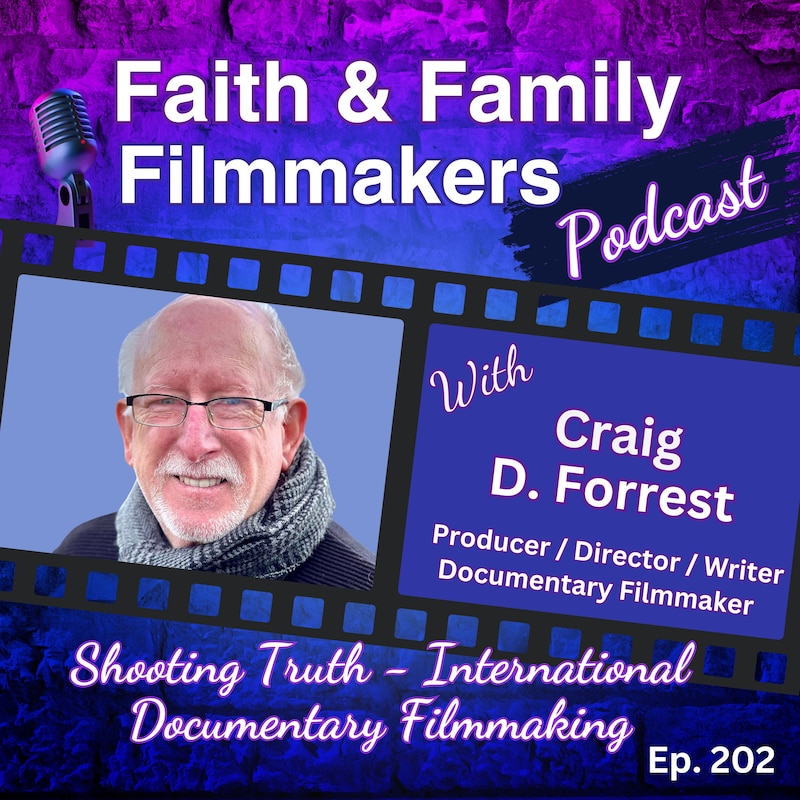
Episode 202 - Shooting Truth: International Documentary Filmmaking - with Craig D. Forrest
This interview is also published in video format. You can watch it here: https://youtu.be/tCH65oYvzTE
In this episode of the Faith and Family Filmmakers Podcast, Matt Chastain welcomes award-winning documentary filmmaker Dr. Craig D. Forrest to discuss his career spanning 250+ overseas assignments across 161 countries and six continents for major TV /news outlets and faith-based groups. Forrest contrasts common Christian media topics with the darker realities he has filmed, including voodoo, demonic oppression, sex trafficking, war, famine, and terrorism. Craig worked at PTL and INSP, lived in Belgium as a missionary, sharpened live TV skills at Trinity Broadcasting Network, and gained “film school” experience traveling worldwide for World Vision.The conversation covers documentary vs. narrative storytelling, today’s accessibility via smartphones, his book “Night Train to Cairo,” and practical ways to live out faith in secular productions through prayer, Scripture, and Christian community. This engaging conversation provides insightful reflections on how filmmakers can navigate the crossroads of faith and media, while maintaining an uncompromised creative vision.
Highlights Include:
● Why Tell the Hard Stories
● Craig’s Early Beginnings and Career
● World Vision and Going Global
● Old School Cameras and Editing
● Voodoo, Haiti, and Spiritual Warfare
● Living With Cultural Divide
● Documentary Versus Narrative
● Shoot With Your Phone
● Spielberg - Shoot What You Want to Watch
● Marvel Studio's Stan Lee
● Faith on Secular Sets
Bio:
Award-winning documentary filmmaker, Craig D. Forrest, has traveled on-location to 161 countries and 6 continents producing, directing & shooting projects for leading TV networks & cable channels, plus numerous humanitarian and faith-based groups.With over 250+ overseas assignments he has covered subjects as diverse as voodoo, Santeria, tribal warfare, sex trafficking, Islamic terrorism, famine, poverty, war zones, politics, sports, new age cults, demonic possession & the supernatural.
email: [email protected]
web: CraigForrest.com
Instagram = @craigdforrest
twitter: @craigdforrest
threads: @craigdforrest
books: https://www.craigforrest.com/books
Edited by Wally De La Fuente
The Faith & Family Filmmakers podcast helps filmmakers who share a Christian worldview stay in touch, informed, and inspired. Releasing new episodes every week, we interview experts from varying fields of filmmaking; from screenwriters, actors, directors, and producers, to film scorers, talent agents, and distributors.
If you would like to support the production of this podcast, you can do so at https://www.faffpodcast.com/support
Get Email Notifications: https://faffpodcast.com/email
Enter the Faith & Family Filmmakers Awards festival: https://filmfreeway.com/FAFFawards
FAFF Association Weekly Zoom Meetups for Filmmakers: https://www.faffassociation.com/events
Jaclyn's Book - In the Beginning, Middle and End: A Screenwriter’s Observations of LIfe, Character, and God: https://www.amazon.com/dp/B0D9R7XS9V
Produced by Geoffrey Whitt for Faith and Family Filmmakers Association https://www.faffassociation.com/
Faith and Family Filmmakers Association is sponsored by Rediscover Television https://www.rediscoverfamily.tv/
Copyright 2026 Ivan Ann Production
Transcripts
Okay, everybody.
Matt:Welcome to another edition of the Faith and Family Filmmakers podcast, your old pal.
Matt:Matt, here with you on our, our new and improved video versions.
Matt:So sorry.
Matt:You have to look at us now.
Matt:Not just hear us, but if you're hearing us on, um, any of the platforms you're used to hearing us, you can also jump over over to YouTube and actually see us.
Matt:'cause I think our, our guest today is a, is a beautiful man you're gonna want to see.
Matt:Um, he is award-winning documentary filmmaker Craig d Forest.
Matt:This guy's traveled, he, he's got a story man, and I, I can probably a lot of stories and I can't wait to, uh, to kind of uncover them, but he's traveled on location to over 106 to 161 countries.
Matt:Over, uh, but six continents.
Matt:He's produced and directed and shooting projects for really all the leading TV, cable and news channels.
Matt:Uh, plus a a ton of, uh, humanitarian and faith-based groups over 250 overseas assignments you've covered.
Matt:Yeah.
Matt:Subjects like Voodoo and, and Santeria and tribal warfare, sex trafficking, Islamic terrorism, famine, poverty wars.
Matt:But you've, you've covered it all.
Matt:So, uh, that's enough of the introduction because I think I'm, I'm ready to dive into it.
Matt:So, Craig, for Dr. Craig Forrest, thanks for joining us today on the Faith and Family Filmmakers Podcast.
Craig:Thank you, man.
Craig:Appreciate that.
Craig:You know what you're talking about, sex trafficking and centia and voodoo and, and tribal warfare.
Craig:You know what it is?
Craig:Everyone out there, it is very rare that a Christian faith-based group in media, TV shows, radio, want to talk about that.
Matt:No,
Craig:they, they don't wanna talk about that.
Craig:Talk about, they don't wanna talk about that at all.
Craig:They wanna talk about the five, five principles for an over overcoming life and seven ways to grow your Church to a mega church in, in less than nine months.
Craig:And I'm going.
Craig:I wanna talk about trying to keep myself safe during the Iraq war and, and how different travel, uh, deepened my faith.
Craig:Uh, I'll, I'll leave all the seven principles of this and six keys to that to someone else.
Craig:I'm, I'm just a documentary filmmaker, TV director that God flung across the world loved that term, almost like a Frisbee.
Craig:They've flu across the world and uh, I look back on it now and wow, the Lord really had a plan for my life.
Matt:Well, going out into the world, um, and, and glorifying God in places where God is not allowed to exist.
Matt:Uh, right.
Matt:Not that he is not allowed to exist, but where places where God is rejected.
Matt:That's a way, way more fascinating.
Matt:Story.
Matt:I think it's more reflective of biblical stories than the polite bureaucracy of the modern church who just wants to tell everybody about Jesus, but doesn't want to get their hands dirty.
Matt:So, no, I think that that exists quite often.
Matt:So how, so let's just start from the beginning.
Matt:Um, sure.
Matt:H how, how did you get into documentary filmmaking?
Matt:Um, I think today a lot of people wanna make a documentary film.
Matt:They think they have a story to tell, but you know, today it's, you better finance your own, uh, production and finance, your own distribution, and you better not expect a whole lot of, uh, of monetary return.
Matt:So it becomes more of a service project than a, than a career.
Matt:So how did you get in involved in documentary filmmaking?
Craig:Well, uh, uh, I have a two part answer for that, but the part A is that, uh, I won a trophy at the age of 16 in sports writing for high school.
Craig:I, I won number one in San Diego County out of the blue.
Craig:Okay.
Craig:I had no idea.
Craig:I had no idea I had writing talent.
Craig:And, um, about four or five weeks after the competition, my, uh, journalism teacher, Mrs. Uh, Mrs. Zimmer, still alive with a great lady in her eighties now, uh, said, Hey, you need to come over to my desk.
Craig:Yeah.
Craig:Yeah, you won a trophy.
Craig:What?
Craig:And, uh, that's how that happened.
Craig:I said, whoa, like the literal, not literally, but a light, the light bulb went on that I had a talent in writing.
Craig:I went off to Bible college and coming out, I really, really wanted to be involved in TV because when I, when I was 16, Matt, I, my dad set up an internship with me.
Craig:For me with, uh, KG TV 10, the number one station, A, B, C, back in the day.
Craig:Uh, and then with the local newspaper and I, the, the whole world of television and journalism opened to me just because of that trophy.
Craig:Just because of that after college.
Craig:A uh, at the end, last couple of months before I graduated, uh, an acquaintance of mine, still wonderful pastor named Jim Pickens.
Craig:Jim Pickens, he was at Bethany University at that time.
Craig:He says, you wanna go into tv, right?
Craig:Yeah.
Craig:I know somebody at PTL Televis.
Craig:Would you like me to make a phone call and see if you'd like to be an intern?
Craig:There I go.
Craig:Would I Yeah.
Craig:Make the call.
Craig:And I went off, uh, and came back a few hours later.
Craig:He said, you're set.
Craig:They want you, you, you start in June if you want it June 20th, uh, after you graduate.
Craig:And that's really what.
Craig:It got me down the road and then I worked for PTL, which later became INSP or Inspiration Network.
Craig:Went to Belgium to live for a while as a a young fledgling, nearly, nearly broke missionary.
Craig:At the age of 23, 24, I got a job at Trinity Broadcasting Network, where I sharpen my skills on directing live TV and also paying the bills.
Craig:I was the production coordinator, so I saw both sides.
Craig:I saw the, the, uh, executive side of it, the project side of it, and I saw the creative side of it.
Craig:And then I was, oh, this is real.
Craig:Gets to the nub of what you're asking, man.
Craig:Um, out of the blue, someone recommended you, there's a job opening at World Vision.
Craig:World Vision, the, you know, sponsor a child and you, you know, it's gonna help somebody.
Craig:Community development or famine, famine, relief, all that.
Craig:Right?
Craig:I was right in the middle of all that.
Craig:And they have a job opening, you should apply.
Craig:And I did.
Craig:And about a month later, they offered me the job.
Craig:And, uh, for four years they sent me all over the world.
Craig:Out of their own budget to shoot projects, uh, on urban evangelism, community development, sponsorship.
Craig:Um, what, what else?
Craig:Oh, you know, again, famine was, was also one of those at the time, mid, mid eighties.
Craig:I know that's a long time ago, but famine was Michael Jackson.
Craig:We are the world.
Craig:If anyone remembers those days, that was.
Craig:Big story Bono from YouTube.
Craig:Yeah.
Craig:Big, big stories.
Craig:And the
Matt:CO was the big, was the country that I, I, I always thought of as, as
Craig:1985.
Craig:We are the World.
Craig:Quincy Jones, all of them, all the famous people.
Craig:Anybody who was famous, Lionel Richie, all of them back then.
Craig:Mm-hmm.
Craig:And um, and so they sent me all over the world and really that was sort of my film school.
Craig:Or my mass, my film school was sending me across the world because none of this was in a really, truly, in a book.
Craig:I learned it on the job experience.
Craig:You know, how do you get through a, uh, a city or a slum, a suburb, uh, difficult places, temples, um, all of that.
Craig:How do you do that when you don't have a, a roadmap?
Craig:You have, you have to create your own roadmap.
Craig:Is what you do.
Craig:Okay?
Craig:This was no GPS.
Craig:It's where am I going and how am I gonna get there?
Craig:And that's what got me started on documentary filmmaking.
Craig:And uh, boy, that's been more than 30 years, 40 years since then.
Craig:And uh, the more I did international, Matt, the more I got called to do international.
Craig:It's sort of like he's the international specialist called Craig.
Craig:And then the nineties, I, I started, uh, doing a couple shoots on Voodoo and about every few months or so, six months, the phone would ring.
Craig:Heard you did a shoot on Voodoo?
Craig:Could you go to Haiti on Friday?
Craig:Literally?
Craig:Can you leave?
Craig:Can you leave?
Craig:I think so.
Craig:Let me check my, let me check my schedule.
Craig:Yep, I can go on Friday.
Craig:And, uh, and so these people commissioned me, these groups.
Craig:That was for, uh, I did 1 3, 3 stories for Discovery Channel, and once I did Discovery Channel, all the faith-based work that I had done in the past didn't matter anymore because.
Craig:I had Discovery Channel on my resume, and so History Channel, travel Channel, ESPN, Fox Sports, all these people that wanted shoots that were done, uh, near and mostly far away wanted me because I was legitimate.
Craig:And so I toggled back and forth with one foot, uh, in the, in the, the pool of secular and one foot in the pool of faith-based.
Matt:So I, I, I have big questions and I have small questions.
Matt:So many questions.
Matt:Sure.
Matt:So in the mid eighties when you're going around and you're, and you're making these documentaries internationally.
Craig:Yeah.
Matt:Um, I'm gonna get technical here, but what, what were you shooting on?
Matt:Were you shooting on Threequarter Inch video?
Matt:Were you actually, actually develop using film?
Craig:Yeah, that's a, that's a great question.
Craig:A lot of people wouldn't even ask that now because everything is digital on a right.
Craig:Either a Dr. A drive or a, um, SD card, whatever it might be.
Craig:Uh, unless you're getting into 4K and six K raw, and that's really big files.
Craig:Okay.
Craig:Um, I started out in the, the early eighties with World Vision and we shot on three quarter.
Craig:With a corporate Iami camera, and you don't even see Iami cameras, I don't think anywhere unless it's, unless it's an old one.
Craig:Uh, and then just as I was getting started, halfway through World Vision, we bought a beta cam.
Craig:Camera, which was great 'cause the cassettes were smaller than three quarter inch and one camera person could shoot the whole thing themselves rather than having the umbilical cord.
Craig:Uh, for a videotape operator on some shoots early on were World Vision.
Craig:World Vision.
Craig:I was the videotape op, and I did sound.
Craig:And somebody else was a camera, but we were tied together by the tether of, of a cord.
Craig:Whatever was being shot by the camera would be recorded.
Craig:Then on the, basically the tape deck, the VCR that I had slung over my shoulders and I'd pop in 20 minute cassette loads.
Craig:But then when, once we went to beta cam, it went to beta cam, sp, and the special, special practice, special whatever the performance.
Craig:Um, and we could do 30 minute loads.
Craig:And we thought we'd died and gone to Heaven because we could do it all on the 30 minute cassette.
Craig:And then you take that in to edit suite as I did dozens upon dozens of times, pop 'em into beta cam sp machines, uh, the, these 30 minute cassettes and we would master on one inch tape.
Craig:One inch tape and we'd, we'd made the, the transition from two inch quad to one inch tape, and it was that way for the longest time until the nineties.
Craig:Then you could go SP to SP and your cassette would be this big.
Craig:And for anyone out there, this is not beta max, like in competition with vhs, this was a speed that was five or six times faster.
Craig:Better tape and very, very much pro professional, network standard at that time.
Craig:So don't get beta cam mixed up with, with Beta Max and now those days beta max.
Craig:Yeah.
Matt:Also of our younger listeners don't probably, they can't, they can't appreciate the Yeah.
Matt:The complexity of having to, to shoot on tape.
Matt:Right.
Matt:Um, and, and then, and then edit.
Matt:What's linear editing?
Matt:Right on, on editing machines.
Matt:I, when I was in school, I, I was in college, uh, for, for television production right at the transition.
Matt:So all my professors were, had the kind of experience you have and that's, that's what they knew.
Matt:But, but non-linear editing was, was kind of coming out at that point, 1997, I think 98 I got my first copy of Adobe Premier.
Matt:So I'm doing projects at home, you know, non-linear editing and they're trying to teach us linear editing.
Matt:I'm gonna tell you, having done a lot of non-linear editing and a little bit of linear editing, what you were having to do was, was far more complicated to actually yes.
Matt:Put together a well timed out, well-paced, well cut piece.
Matt:Um, on, on, on beta.
Matt:So sorry to get too nerdy for it.
Craig:Give you a little anecdote about that.
Craig:You talking about years and such.
Craig:I was called one of the best gigs I could ever have as a director.
Craig:I was called by PBS.
Craig:To do a pilot show called Traveling Light, LITE, traveling light, a backpacker's guide to Paris.
Craig:So I get paid to go to Paris for eight days and direct, uh, you know, a guy named Brad and a gal named Sophia.
Craig:Uh, going around Paris and how do you get there and what are, you know, the metro, how do you order a meal?
Craig:Mm-hmm.
Craig:And what's the difference between the cost of a meal at the counter and the cost at the front on the patio and such?
Craig:All of that for eight days with, with a crew.
Craig:When I went to go edit, I edited in Chicago and really George and Mary George was the editor, George, uh, George was from Boston, but lived in Chicago.
Craig:I said, George, I've never done, done non-linear.
Craig:I have one question.
Craig:He's got all these computers, he's set up in a dining room and an apartment said, can I start anywhere I want?
Craig:Do I have to start the beginning?
Craig:You can start anywhere you want.
Craig:Great.
Craig:I wanna start with the easy.
Craig:I I It is a key for everybody out there.
Craig:Take, write this down.
Craig:Write this down.
Craig:When I started editing, uh.
Craig:Project, like, you know, first thing in the morning, cup of coffee, let's sit down.
Craig:I always start with the easiest segment first.
Craig:The easiest 'cause I kinda wanna warm up.
Craig:To what I'm doing and I'll just go put together some scenes or sequence, whatever it might be, the easiest one that comes to my brain.
Craig:And then from there I begin to transition to the more difficult.
Craig:By then I'm awake.
Craig:I'm on my second or third cup of coffee.
Craig:Uh, I figured out, oh, you know what?
Craig:Alright.
Craig:I finished this one.
Craig:Now let's go tackle the hard one where, where he walks through the square, uh, and can't quite figure out how to get down into the metro, whatever.
Craig:It's, and I start with easy first, and my, uh, editors always love that because I wasn't giving them the tough stuff first.
Craig:I'd save that for the, for the middle of the day.
Craig:As soon I got non-linear, NLE, non-linear editing.
Craig:In five minutes, I can start anywhere I want.
Craig:And then making changes is so easy now, and you can make different, lengthy.
Craig:You have one version that's 22 min minutes.
Craig:Okay, let's cut that down.
Craig:Make a copy.
Craig:Let's cut that down to 11 minutes of the best.
Craig:Okay, let's do a teaser reel from that.
Craig:30 seconds long.
Craig:All of that is so easy now.
Craig:And even, let's make another copy and we're gonna translate.
Craig:Translate this one into French or German or Spanish.
Craig:Yeah.
Craig:All of that during the linear days was hard because you were working with a tape based system.
Matt:Well, I'm, I don't wanna open up a can of worms, but I will just add to that, that even the, the current model of of, of an NLE that's, like I said, has been pretty standard practice since the mid to late nineties.
Matt:It's about to, to look a lot harder because I think what's, what's coming next is we're going to load all of our footage and there's gonna be an a, you know, an AI built into Premier or whatever.
Matt:You're using Da Vinci, and you're just gonna write a prompt.
Matt:Telling it what you want the edit to kind of end up looking like, and bam, the whole edit is done for you and then you're just gonna go, uh, review and, and it's all gonna be prompt base, which is, it's kind of sad.
Matt:It's making
Craig:it almost Yeah, it is sad 'cause there's not as much creativity involved.
Craig:I have hate to tell you that AI does some really great stuff that's sometimes better than I could ever do it.
Craig:But don't let anybody paying you a salary know that.
Matt:That's exactly right.
Matt:Use ai, but don't tell 'em you're doing it.
Matt:Okay.
Matt:I wanna, I've gotta dive into what the, the stuff that really pops off of, of your bio sheet to me as, as, as being so fascinating.
Matt:So you, you, you mentioned at the very beginning, one of the first things you said was how, you know.
Matt:A lot of, especially American Christians, uh, we, we don't want to dive into the, to the really scary stuff.
Matt:The, the heavy stuff, the voodoo Islamic terrorism, things like that.
Matt:I wanna know about your experiences in that.
Matt:You mentioned voodoo, um, particularly, especially down in Haiti, so
Craig:mm-hmm.
Matt:Just, what is that experience like diving into.
Matt:Such a foreign and, and frankly, demonic practice.
Craig:Right?
Craig:Yeah.
Craig:If, if you don't mind, I'm gonna make a tiny pitch for my book I just finished last September and it's called Please Do Knight Train to Cairo.
Craig:Night Train to Cairo.
Craig:Doesn't that sound like a movie Night Train to Cairo?
Matt:Well, they should see the cover of your book too.
Matt:'cause the cover really makes me wanna read that book.
Matt:The cover is awesome
Craig:that that cover came out really, really good.
Craig:My friend Emilio is now, now passed away.
Craig:He did a, a first version of it.
Craig:Uh, he's a great editor and, uh, he's now gone, gone on to glory, uh, physical ailments that he had, and we were able to, to tweak that a bit.
Craig:And that e everyone goes, what a night train to Cairo.
Craig:You can find in on Amazon.
Craig:It's also, uh, what's it called?
Craig:The Kindle e-version, E ebook version.
Craig:And it's also on iBooks for Apple.
Craig:I, I write about, I've done maybe five or six.
Craig:Shoots on Voodoo, and I write in the book about how difficult Haiti was because of the demonic, not only oppression, but the demonic possessions.
Craig:I, I'm a Pentecostal preacher's kid that has seen some things in my life, but voodoo and demonic possession, I was not that familiar with, and I had seen it a couple of times in Africa.
Craig:Uh, and then I did Haiti, and that's the most difficult shoot.
Craig:I was dealing with some really evil, difficult people that were, um, very manipulative.
Craig:And I write about that very everything that we were supposed to do.
Craig:And this is a secular shoot.
Craig:I'm a Christian TV director, doc filmmaker, uh, doing a secular shoot.
Craig:I couldn't just say to the, the lady, the position's called Mambo.
Craig:Just like the, just like dancing mambo, uh, and she's the high priestess.
Craig:And I could just say, you know, Jesus Christ loves you and you need to give your life to, I couldn't do that.
Craig:I was in a secular shoot interviewing her and she believed in Jesus.
Craig:But you know, Jesus is just another prophet like everybody else.
Craig:Uh, they were literally worshiping.
Craig:Demonic spirits called LOAs, LOWA, LOAs and, uh, and such, and I, I don't have time we get into all of that, but man, they were drinking gin and dancing and cutting off the, the heads of chickens.
Craig:It's, it's almost everything that you would expect.
Craig:Uh, and here I am, Mr. California White boy.
Craig:And everybody is darker than the darker than the night sky.
Craig:I am really a guy outta my depth and I
Matt:standing out a little bit.
Craig:Yeah, think.
Craig:And um, I still remember people ask me this now and then what did you do?
Craig:And I said, I remember we were gonna go into this sanctuary, uh, voodoo sanctuary.
Craig:And it was, it was twilight.
Craig:It was just to become dark.
Craig:And I still can see in my eyes right now.
Craig:I said, dear Jesus, I prayed, man, I just looked at that sanctuary and I then I turned to heaven and I said, Lord, I am a child of the most high God, and I am asking you by the blood of Jesus and in the name of Jesus to protect me.
Craig:Protect me by your Holy Spirit, by the cross, by the, the blood of Jesus, by your redemption, that no harm is gonna come to me.
Craig:And, uh, nothing did.
Craig:Not one thing.
Craig:I've never had anything ever, uh, you know, jump out at me or, or try to, to, to harm me physically, because I believe that Jesus and the angels of heaven are protecting me in a realm that I cannot see and I trust in that.
Craig:So I, I've done, again, five or 6, 3, 3 in Africa, two in the Caribbean.
Craig:One was in Cuba.
Craig:Cuba, one of course was Haiti and one in Los Angeles.
Craig:Which really threw me, 'cause it was only about a five minute drive to a voodoo sanctuary, uh, down from the little apartment that I had in West LA.
Craig:I thought There's Voodoo in la.
Craig:Yeah, there was.
Craig:And uh, so I've seen, oh, and I also, in Argentina.
Craig:In Argentina there was a, I talk about a little, it's a little segment of a chapter called Little Tent of Demons.
Craig:And in there they were being, um, oh, delivered.
Craig:Delivered from, uh, demonic possession and oppression in that tent right on the edge of a, uh, a big gospel crusade.
Craig:A great gospel crusade.
Craig:And I write about that as well.
Craig:I've, I've seen a lot.
Matt:Goodness gracious.
Matt:I, I, um, yeah, the voodoo stuff certainly scares us all, but like you say, it's, it doesn't have power over Jesus and so you just have to go in completely surrendered to him and, uh, and typically it'll work out.
Matt:Yeah.
Matt:Um, if that's what it's what it's supposed to.
Matt:So, let, let's get into some of the Islamic terrorism stuff you've covered.
Matt:Oh yeah.
Matt:'cause you've been all over the Middle East and Right.
Matt:What have you seen there?
Craig:Well, I, I will tell you.
Craig:That I did a using footage that was available to us at World Vision.
Craig:I did a, like a 35 minute documentary, uh, on, on terrorism because World Vision had offices all over the world and there was even a Mi Middle East office in Cyprus and they had to deal, uh, with, with bombings and oh gosh, there was even the bombing.
Craig:Of, uh, a couple of the embassies.
Craig:One was in Nairobi and the other one was Dore Solana.
Craig:Mm-hmm.
Craig:I can't remember which of them I went by.
Craig:I think it was Nairobi, and it looked like a, a war zone.
Craig:I mean, the terrorists completely blew up the American Embassy.
Craig:It just looked like a wrecking ball had just crunched down on that embassy.
Craig:And of course, a number, number of people, both Americans and the staff were, were killed in that bombing.
Craig:And so I saw that.
Craig:I go, this is not a safe world.
Craig:This is not just some safe place where you can sit in the backyard and drink your little drink when you get outside.
Craig:Uh, a lot of territories and, uh, borders of this world.
Craig:And look, while we're talking right now and recording this, this is not a safe world in, uh, the Persian Gulf or in Iran or the Middle East.
Craig:You could be in Cyprus.
Craig:And get, get a bomb coming at you with the British, uh, army base or air force base.
Craig:You know, how, where is there other than the South Pole that you could possibly be safe in this world.
Craig:This is a desperate world.
Craig:And there, there is evil versus good.
Craig:And I, I've just, I have been in mosques from Morocco to Indonesia.
Craig:Oh my goodness.
Craig:Uh.
Craig:Buddhist temples from, huh?
Craig:Don't, I don't, I'm not worried about budhist.
Craig:They, they don't blow things up, but, uh, Malaysia.
Craig:Malaysia to Tunisia, to Albania to Turkey.
Craig:Been to Turkey many, many times.
Craig:Jordan, Iraq during the war, Lebanon.
Craig:Oh, just lots of places.
Craig:I live in France, uh, Rebecca and I and my wife live north of Paris.
Craig:And we, uh, I just wrote about it recently that when we go to the market, the open air market down by the supermarket, or I mean a hundred yards from here, 200 yards from here, half of the population are all from North Africa.
Craig:And Arabic is being spoken, and another chunk are from Africa and they're speaking whatever tribal language, and maybe another third or 40% are French, older French people.
Craig:And they don't mix together at all.
Craig:They keep completely separate from each other.
Craig:So I and Rebecca and I live in a very intercultural, uh, environment that is literally outside our apartment door.
Craig:It's just right there, and I'll see it on Friday morning.
Craig:And, and, uh, well, terrorism, it's not going away.
Craig:It just isn't because there, there are those that believe that killing of non-Muslims is fully justified.
Craig:It's called the House of War and the House of Islam, and they believe they live in the House of Islam.
Craig:And anyone that is an infidel that's in the House of war.
Craig:Is fair game, whether they're wearing a, uh, army uniform or just someone sipping a, uh, a, a coffee across from a concert hall in Paris a few years ago where they just machine gunned all these people and jumped on motorcycles and ran away.
Craig:It's a crazy, scary world.
Matt:You know, the, and, and, and kind of telling those stories.
Matt:Do you find it difficult even among your, your fellow Christians because this, uh, safe space, Christian culture that's out there right now, this is even political.
Matt:This is, this is, yeah.
Matt:Cultural
Craig:right?
Matt:It, it feels like.
Matt:You're not allowed to say things like that because as Christians we're supposed to be kind and impolite and, and polite and, you know, not judge other cultures.
Matt:And, but, but what ends up happening is we end up getting taken over, you know, by cultures who do not share these same values because of our politeness, the, the whole, you know, uh, suicidal empathy kind of concept.
Matt:Right.
Matt:Do you see that actually in, as you're covering these stories, do you see that going on in real life?
Craig:I will tell you the answer is yes.
Craig:I will tell you, I never knew that this was gonna happen for Rebecca and I, we, Matt, we moved to, uh, to France because someone invited, invited us.
Craig:Hey, we'll get your visas for you.
Craig:They're really good church group, and we'll put you, uh, out, down as a pastor, even though I'm not really a pastor, but sort of, I, I, I do media mentoring, so that's my, my pastoral, uh, advocation in a way.
Craig:My ministry.
Craig:I go, for some reason God keeps pushing us towards the United Kingdom over and over again.
Craig:New opportunities in the United Kingdom.
Craig:One just came up last week.
Craig:Uh, to join a ministry that does, or to come alongside a ministry that does media mentoring all over the world in the 10 40 window from Morocco all the way to Japan and all the stretch in between.
Craig:Uh, and we're, we're talking to them.
Craig:I'm gonna tell you something about not only 15, about 15% of France is Muslim, 15%.
Craig:And in the United Kingdom, especially England, not all England, but mostly England.
Craig:Uh, mosques everywhere.
Craig:Mm-hmm.
Craig:There are Muslims that are mayors of cities.
Craig:Mm-hmm.
Craig:And there is great violence going on, and whether the English understand it or not, they're, the Muslims are outgrowing them by population because they're having births and immigration, birth, birth and immigration is continuing like a, like a tide.
Craig:Like a tide that's coming in.
Craig:You can look at it and, oh, it went a little bit closer.
Craig:Oh, it's almost to the shore.
Craig:Oh, it's at my feet.
Craig:That's what's happening in the uk.
Craig:And I'm, you know, you pick your moments when you want to be what you want or need to be bold.
Craig:You do.
Craig:Mm-hmm.
Craig:For safety reasons, for, you know, logical reasons.
Craig:Uh, you don't wanna stir all the waters, but I'm telling you, there are parts of Europe, Germany.
Craig:Has taken in so many refugees, uh, from other parts that were displaced by wars, Syria especially, so many Syrians.
Craig:Uh, easily over a million Syrians that are in Germany.
Craig:And once this is a Muslim culture.
Craig:I hope this is okay to say, 'cause I'm getting old and I don't care what I say anymore.
Craig:I just say
Matt:that's may edit this entire part out because this is, you know what we get into
Craig:You have to, you go, you go ahead.
Craig:But, but I will say that Muslim culture is not in cohesion, does not mix with a non-Muslim culture.
Craig:They just don't go together because of the Muslim cultures.
Craig:Do not want to fraternize.
Craig:Do not want to assimilate.
Craig:This would be the same as if we were doing a news interview, Matt, and, and it had nothing to do with Christianity.
Craig:They don't wanna assimilate with Western societies.
Craig:They want to take it over.
Craig:There you go.
Matt:Well, and, and I know this is, we're not supposed to say this because it's quote unquote political, but it's not political.
Matt:It's cultural and spiritual.
Matt:It does have, has everything to do with, you know, an environment that is, that is ripe to spread.
Matt:Spread the word.
Matt:And, uh, you cannot spread the word in Muslim countries.
Matt:So if Muslims are taking over vast swaths of the, of Europe.
Matt:And, and they have goals elsewhere.
Matt:Um, it's, it, it kind of stinks.
Matt:We can't talk about that because it's impolite and divisive and too political.
Matt:So it's, it's good that you're out there with the camera and, and, and, you know, uncovering this and that World vision is as well.
Matt:And I, I long wanna go back to kind of a storytelling question for you.
Matt:'cause I've noticed this with, with directors even my own instincts sometimes.
Matt:Um, but also dps, there's such a giant difference between narrative.
Matt:And documentary, I mean, obviously in the outcome, but I mean in, in the way you approach it.
Matt:Because I've taken, uh, dps into more of a Docus style shoot and it, and it drives them crazy because they're used to, in the director and everybody, they're used to controlling the environment, controlling every minutia of the environment to tell their story.
Matt:Whereas I think it's.
Matt:Fun in documentary that you don't get to do that.
Matt:You can only react to the environment and you have to see the story happen, and you have to find that story and react in a way that still, you know, keeps the shot in focus and, and the, you know, the f stop at the right place and your eyes there correctly, Eric, you're trying to adjust.
Matt:So I want talk a little bit about that, about the kind of the, the, the, the exhilaration of, of having to react to and find a story happening in front of you rather than the narrative style of controlling it all.
Craig:Yeah, you made me think of some things that, that not only, uh, have I done and seen, but also, uh, some of my film, film, school background, uh, which there were no Christians at my film school.
Craig:Hardly a, in
Matt:Southern California.
Matt:Yeah, I guess not.
Craig:Yeah, it, uh, went to a great school, Chapman University, which is now top five.
Craig:Uh, uh, about 20 years ago I went to get my master's anyway to your story.
Craig:Uh, documentaries.
Craig:You can start without a script, but you do need to start with an idea or a subject.
Craig:Mm-hmm.
Craig:And you can, it can evolve over time.
Craig:And I really do think that in shooting style with documentaries, you adapt to the story.
Matt:Mm-hmm.
Craig:And that's what drives the dps crazy because they want the story to adapt to them.
Craig:They want it pristine or they want it to look beautiful and such.
Craig:Mm-hmm.
Craig:But then you look at something like Jason Bourne movies, those are shot very much like news.
Craig:And jerky cam and, uh, Paul Greengrass and, and all of that, and Matt Damon all, all done as if it was a running news thing.
Craig:And then they'll slow down for the love scene or they'll slow, slow down for Jason Bourne to get his, uh, kind of catch his breath because you also want the audience to catch their breath.
Craig:You don't want two hours of nonstop action.
Craig:You'll drive people crazy.
Craig:It's like someone who talks.
Craig:But never stop socking and never takes a breath.
Craig:And every, uh, an audience needs a moment to compose and think about what they just saw before you move on to something else.
Craig:Now, the other way to do it is in feature films that, uh, every young.
Craig:Person coming up, what's the director of feature film?
Craig:And the chances of you doing that are, are not very good because it takes money and time and somebody has to believe in you to give you the money and you have to have a script and actors scenes, you know, all that.
Craig:To that.
Craig:I'm gonna get back to something you said though from earlier, is a, is a good observation, is that.
Craig:Yeah, today with your, I've got my cell phone here.
Craig:I'm not gonna take it out my iPhone.
Craig:Uh, you can shoot a documentary in 4K on your own phone with a tripod and a a, a light and a a microphone or two, and come up with a great little two to 15 minute documentary, uh, that you can never do 20 years ago.
Craig:You didn't have the gear to do it.
Craig:You had HI eight and all these other creative, but you need to have to edit and such.
Craig:Mm-hmm.
Craig:But now you can edit on your phone, Matt and everyone knows you.
Craig:You edit on Canva or iMovie, whatever it is that you put it on.
Craig:You could do it on your laptop and such, or hand it to somebody that loves editing, and you sit with them and put it together and you can have your documentary done in a day or a week.
Craig:Or 10 days and you're done and you have a documentary, you do, or you could slice it up into episodes.
Craig:This is really cool.
Craig:I'm gonna, I'm gonna go seven minutes.
Craig:I'm gonna give them a cliffhanger as to what happens.
Craig:Boom.
Craig:That's episode one.
Craig:And then a week later, episode two come and that's how you build your YouTube audience too.
Craig:Mm-hmm.
Craig:With episodes or Netflix.
Craig:My wife can't wait for the next Bridgeton epi episode to come out.
Craig:It's like, it's coming out on Tuesday.
Craig:Okay, we're gonna have dinner, then we're gonna watch it.
Craig:Oh, okay.
Craig:Right.
Craig:Bridgeton I got And so, so what I'm saying is, is there is never everyone out there, Hey, listen to Obiwan here.
Craig:I'm gonna tell you there has never been an easier time.
Craig:Then right now to shoot the project, you always wanted to shoot.
Craig:All you need is a phone with enough storage and an idea and a style, and if you don't like something, you can shoot it again.
Craig:In the past, we had to commit it to videotape and use that all this money on videotape.
Craig:Now if you don't like it, you could delete it.
Craig:Or take a portion out of it that did work.
Craig:Never quit telling yourself no that you can't do it, and start telling yourself, yes, I'm going to do it.
Craig:I love that.
Craig:And pick up your phone.
Craig:Get an idea and go shoot it.
Craig:Finish it.
Craig:Get your friends to help you, whatever it might be, or a great story, and then go do another one.
Matt:I love that and I, I'm gonna add something to that though.
Matt:Mm-hmm.
Matt:Because on the other side of that, be because it is so accessible for anyone to do, that means the pool of competition is rising, um, exponentially.
Matt:Everybody's doing exactly that.
Matt:So it's also incredibly important, not that I try to tell my kids this, it's not, don't focus on.
Matt:I wanna make a video.
Matt:No, no, no.
Matt:VO or, or, or I. I'm gonna, I'm gonna get so many views.
Matt:You've got, you, you've got to focus on finding an incredibly fascinating story and telling it in an incredibly fascinating way.
Matt:You've got a, a lot of competition.
Matt:You have to rise at the top of, so always be focused on the, the quality of your story, whether it's narrative or documentary style.
Matt:You've gotta, it's not just about doing it 'cause you can, it's about finding a great story to tell that moves people.
Craig:I, I, I've got a, a suggestion that just popped in my head because of what you said from Steven Spielberg.
Craig:They asked him many years ago, like when he was in his thirties, you know, he'd had a number, close Encounters and Raiders of the Lost or on and on and on.
Craig:He's probably done 30 or 40 films by now.
Craig:They asked him back then, how do you decide Steven Spielberg, what movie you're gonna shoot?
Craig:And he said, oh, that's easy.
Craig:I shoot the movie that I'd wanna watch if I was in the audience.
Matt:Bam,
Craig:I shoot the movie that I would want to go see and get some popcorn and a soda and sit and, and, and either moved or, or laugh or cry.
Craig:All the emotions that, that, that would be, whether it's a drama or even a comedy and such, I shoot.
Craig:The movie that I would wanna watch and for anyone out there, forget about the social media influencing.
Craig:And once I get, you know, a hundred thousand, they're gonna pay me some money in a million.
Craig:Thank
Matt:you.
Craig:Forget about that stuff.
Matt:Yes.
Matt:Shoot.
Craig:Shoot the, shoot.
Craig:The documentary or the clip or even the music video.
Craig:That you would wanna watch if you start there and you have good enough taste and your taste is going to change.
Matt:Mm-hmm.
Craig:For anybody, and Matt, you completely agree with this, what your taste was when you were 22 is gonna be different when it's 32, 42, 52, 62.
Craig:Yes.
Craig:It's just gonna change.
Craig:And it should,
Matt:right?
Craig:It should change because you're a different person.
Matt:Mm-hmm.
Matt:What should never change, I think is your curiosity.
Matt:And I think that's what film, that's what stood still over talking about.
Matt:I have to be so curious, even if I'm writing a narrative, how does this story end?
Matt:You know?
Matt:And as you're writing it, you gotta be that curious as you're making it.
Matt:You gotta be that curious.
Matt:But for a documentaries.
Matt:Especially, are you crazy curious as to what's going on?
Matt:Yeah.
Matt:Because if you are, that means, uh, likely someone else will be too.
Matt:Nick, Shirley, the kid in Minnesota who did exactly what you're talking about, grabbed his iPhone and went out and just was curious about something as boring as government spending.
Matt:That's boring stuff.
Matt:But he was so curious about it, and now he, he gets to do this kind of stuff for a living.
Matt:I mean, nevermind the political implications of it.
Matt:That's not what's important.
Matt:What's important was a kid.
Matt:With an iPhone was crazy curious, crazy bold.
Matt:And he just went and did it.
Matt:Yeah.
Matt:So that's the lesson for me.
Craig:You know, the, and every, every now and then, Matt, someone will ask me, who's the most creative person you've ever worked with?
Craig:And I'll immediately
Matt:say, this is the most creative person you've ever worked with.
Craig:Thank you for asking Stan Lee of Marvel Studios and Marvel Comics.
Craig:He's now passed away.
Craig:Stan Lee, who created Spider-Man.
Craig:And I wa was sent to do an interview with him at Marvel Studios.
Craig:And it was me and Stan Lee in his office at that time were, were cartoon racks, the wire racks where you could swivel them and all the cartoons and Spider-Man's revenge and soup, all that kind of stuff.
Craig:Right.
Craig:And he and I, he says to me, he's now passed, passed away just a few years ago.
Craig:Right.
Craig:He said, what, what, uh, what comment did you like?
Craig:Oh, Sergeant Nick.
Craig:Fury and his howling commandos.
Craig:And he goes, oh, wasn't that fun.
Craig:And we started talking and he started pulling out comic books and we sat with a coffee table.
Craig:And chairs, and we taught comic books for half an hour.
Craig:Mm-hmm.
Craig:Like two kids with a, a bag of marbles in a way.
Craig:Who would just come or who had just come from the, from the, uh, the comedy stuff, comic store, from the drug store, whatever it is, magazine store.
Craig:And then we'd go, oh man, we just used up half an hour.
Craig:We better.
Craig:Okay.
Craig:I think we need to do the interview now.
Craig:Oh yeah, yeah.
Craig:Let's do the interview.
Craig:And that was, it was like I was talking to a 9-year-old.
Craig:He was the most curious, creative man.
Craig:He was in his easily in his sixties at this point, Matt, he still had the curiosity of a kid and I thought, that's how you do it and you can't learn it.
Craig:It has to be something inside you
Matt:that is amazing.
Matt:He seemed like that, that, that God really cool, coolest guy.
Matt:I always liked how in every Marvel movie he has some tiny, tiny little cameo, like a little Orson Wells putting himself in a crowd scene type thing.
Craig:Hitchcock, yep.
Matt:Or Hitchcock, excuse me, not Rose son.
Matt:Wells.
Matt:Wells.
Matt:What's, sorry.
Matt:So, I guess, you know, as we finish up, and this has been a fascinating conversation.
Matt:I, I do want, um, once again, uh, encourage everyone to go to Amazon.
Matt:Um, the night Train to Cairo.
Matt:All these stories are, are, I was exit,
Craig:I was on that train, on that train at age 16, a night Train to Cairo, and that was the start of that book.
Matt:Wow.
Craig:H 16 on a night train to chiro.
Matt:That is amazing.
Matt:Well, one thing I want to kind of end with though, 'cause this is a, a obviously Faith and Family Filmmakers podcast, so, you know, you mentioned, I, I wanna know how Faith played into what you do because a lot of what you do, obviously the higher paying gigs are secular, and so you mentioned that with the Voodoo, but, but how do you, how do you as a Christian bring your faith to these projects in a way that allows you to express it, to glorify God, but.
Matt:Um, and is not hindered by the limitations of, of secular content.
Craig:Yeah.
Matt:While still being able to, to keep your job in secular content.
Craig:Yeah.
Craig:I worked, uh, worked for a season on the Amazing Race for CBS.
Craig:Oh,
Matt:fun.
Craig:Yeah.
Craig:There were hardest work I've ever done in my life.
Craig:Completely exhausted
Matt:on the go.
Craig:Yeah.
Craig:Um.
Craig:There were only three Christians on the entire show that we could, we could tell my assistant Maria and myself and another guy named Michael, who was a producer, multi ma, award-winning producer.
Craig:Good guy.
Craig:Um, you know what we did, Maria and I, we usually got in early in the office.
Craig:Like I be in by eight, she'd be in by eight 30.
Craig:Everyone came dragging in at 9, 9 30, 10.
Craig:Uh, we would close the door a bit.
Craig:So we had privacy, not completely, but mostly close, and we would start out each day quietly in prayer together, that we would be an example of God's grace with our language and with our behavior and how we interacted with people.
Craig:And, uh, we started with prayer.
Craig:And anyone that's out there listening, whether you are in faith-based or secular or in a film school or wanna work in communications, video, media, whatever it is, number one, have a prayer life.
Craig:Have a good prayer life that's consistent on a daily basis.
Craig:Read your Bible every single day.
Craig:I'm, I've gone, gone back into the one year Bible.
Craig:And, and you can just pick whatever date you want, you know, and I so many days into that now, and in the course of 365 days, you'll have gotten through the entire Bible.
Craig:They give you a couple of scriptures from the Old Testament, couple from the new.
Craig:They'll give you psalms and they'll give you proverbs and they'll keep a kinda little buffet.
Craig:For lack is the scripture of the Lord said the word of God, but they put it in a way that makes it interesting.
Craig:So you're not just starting at Exodus one, excuse me, Genesis one, and going straight through to Revelation 22.
Craig:And also have some really good close friends that are believers and a church.
Craig:Don't skip out on that.
Craig:Have some close believers that you can get together for a coffee or a barbecue or however you get together, uh, and stay close to each other because the way the enemy picks you off is when you try to do it all by yourself.
Craig:There is strength in numbers and there's uh, there's strength in rapport conversation.
Craig:Crying, the laughing, sharing.
Craig:And uh, and also when you're working in a secular environment and, and faith, the Holy Spirit is gonna open up opportunities that you never expected.
Craig:And if you are just quiet and you wait, someone's gonna say, I'm going through a tough time.
Craig:How do you go through tough times?
Craig:And that's when the Holy Spirit shows up to help you.
Matt:That is beautiful, man, Dr.
Intro:Craig.
Intro:That wasn't for me.
Intro:That's from the Holy Spirit.
Matt:That's from the Holy Spirit.
Matt:Of course, as most of our good eyes are, our good ideas are.
Matt:So, uh, Dr. Craig for I, I thank you so much for, uh, joining us today on Faith and Family Filmmakers Podcast.
Matt:These stories are fascinating.
Matt:Again, I'm gonna encourage you go to Amazon, I'm gonna do it, um, and look for Night Train to Cairo, um, to get more of these fascinating stories from a, uh.
Matt:You can,
Craig:you can also find [email protected].
Craig:Craig forests.com.
Craig:Two R in Forest, Craig forests dot ComCom and match.
Craig:Are you on the
Matt:social medias?
Craig:It's at Craig dfo.
Craig:Almost Everything's at Craig d Forests.
Craig:But craig forests.com.
Craig:I grabbed it before another Craig Forests did.
Craig:Uh, famous soccer player, uh, craig forest.com and um, my teaching in ministry.
Craig:Media is matchstick media.org matchstick, click your're lighting a match matchstick media.org, and you can always send me an email or say hi and I love Instagram.
Craig:You follow me.
Craig:I'll follow you.
Matt:Awesome.
Matt:Thank you so much Dr. Craig Forest.
Craig:Thank you, Matt.






