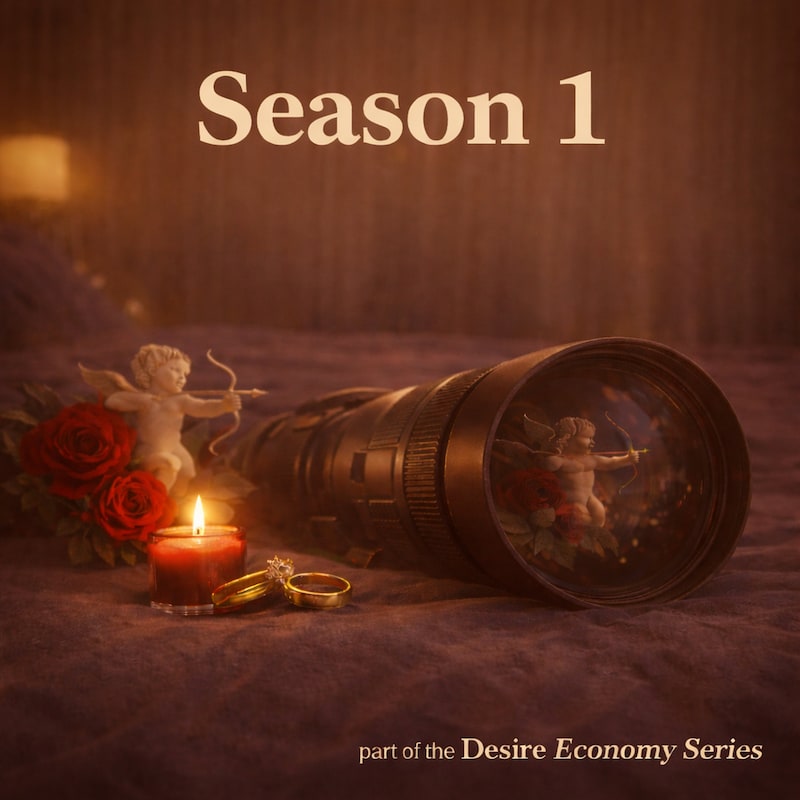
Romantic mythology, the greatest PR campaign in history.
When I say Romantic mythology, I'm not talking about love itself.
I'm talking about the story we've been told about love.
The way desire is framed.
The way intimacy is moralised.
The way suffering is explained.
The way confusion is justified.
It's not one myth, it's a campaign.
And like all successful campaigns, it works because it feels true.
Not because it explains reality accurately, but because it organises feeling efficiently.
Romantic mythology tells us things like love is pure and spontaneous.
Desire cannot be negotiated.
If it's real, it shouldn't feel transactional.
Pain is proof of depth, effort will be rewarded.
And if you're confused, well, you're just not doing it right.
None of these are outrageous claims on their own.
That's why they're effective.
But taken together, they form an operating system.
One that shapes how men interpret rejection, attraction, commitment, sex, loss, worth, and most importantly, costs.
And here's the part that most people never ask:
Who benefits from a story like that?
Who benefits from a story that:
Discourages men from naming exchange
Treats clarity as unromantic
Frames endurance as virtue
Turns confusion into a personal failure
That story didn't appear by accident
Romantic mythology is a public relations campaign for desire
This sanitises exchange
It moralises attraction
It hides power
It obscures leverage
Not to deceive maliciously, but to keep the system running
Think about it:
A culture that openly acknowledged desire exchange would have to:
Talk honestly about power
Talk honestly about inequality
Talk honestly about attraction asymmetry
Talk honestly about costs
That's destabilizing and romantic mythology smooths out those edges
So instead of saying access is conditional, it says love should be unconditional.
Instead of saying desire fluctuates with leverage and context, it says if it's meant to be, it will work out
Instead of saying your pain emotional costs you never priced, it says that's just what love feels like
This is why romantic mythology is so resilient
It doesn't deny pain, it repurposes it
Pain becomes meaning
Endurance becomes depth
Confusion becomes effort
Loss becomes growth
The story always wins
Over time, men internalise this
So when something doesn't work, they don't say this system is incoherent, they say:
Something is wrong with me
That's not romance, that's misattribution
And over the course of the desire economy, I'll be dissecting specific mythologies that
sit inside this larger campaign, not to mock them and not to dismiss love, but to show where
they stop explaining reality and start extracting cost
Some of the mythologies will explore include love is not transactional and why denying exchange
makes emotional debt invisible
If it hurts, it must be real, how pain became proof instead of a signal
Being chosen equals being desired, and why this confusion breaks men slowly
Desire can be earned through goodness, the myth of emotional meritocracy
Honesty guarantees intimacy, why truth doesn't automatically create desire
And if it's right, it will feel easy, and why ease and alignment are not the same thing
Each of these myths feels compassionate, but each of them fails on depression
Romantic mythology isn't wrong because it values love
It's wrong because it claims love alone explains everything
It doesn't
But the desire economy does differently, it's simple
It treats desire as an economy, that doesn't make it cold, it makes it legible
Because once you can see the markets you're in, the currencies you're spending, the costs
you're in, the identities you're constructing, confusion starts being personal, and it becomes
structural
This isn't about rejecting romance, it's about removing monopoly
Romantic mythology is dangerous because it insists it's the only language for intimacy
When it fails, men have nowhere else to think for
The desire economy exists to give you that other language
Not to replace love, but to support it with structure
Because love without structure doesn't become pure, it becomes expensive
So if you felt disillusioned but not bitter, tired but not numb, confused but not ignorant,
you are not broken, you're just waking up inside a story that no longer explains your life
And after the romantic mythology, we'll go back and return to the markets
The market where romantic mythology does its damage and where men pay the highest price
when they enter unconsciously
But this episode matters because it reframes everything that came before, everything that
comes next
I'll leave you with this
What if romantic mythology isn't wrong because it lies, but because it tells only one part
of the story and arcs you to live as if it were the whole truth?
That question doesn't end romance
It liberates you from it being the only map you are allowed to use