Shownotes
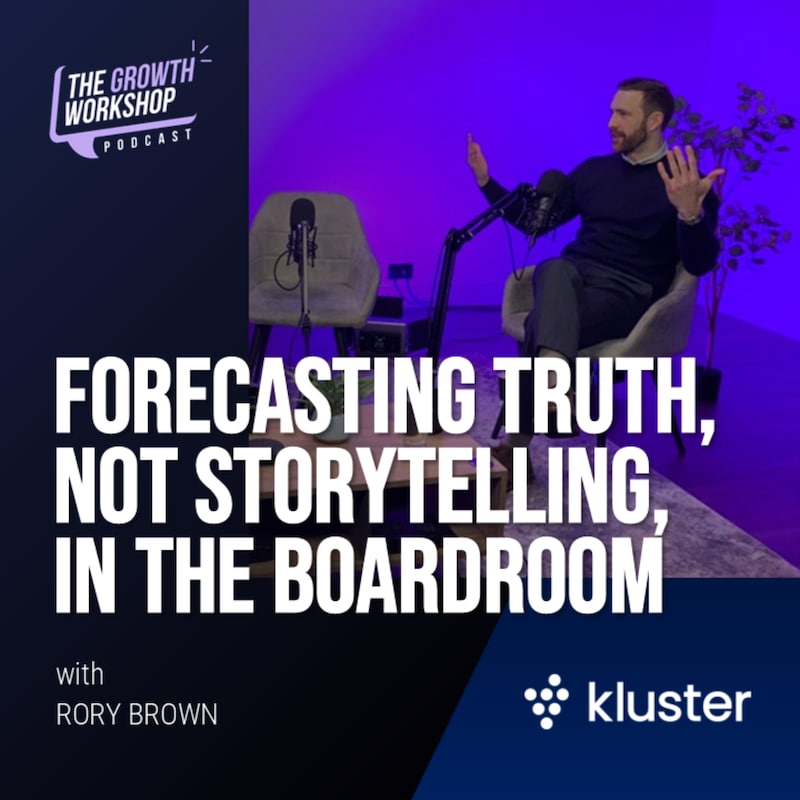
In Part 1 of this episode, Rory Brown (Chief Commercial Officer at Kluster) reframes forecasting as an executive decision tool, not a spreadsheet ritual. He explains why many businesses still “feel” their way through board reporting, how latency and fragmented data kill credibility, and why sales forecasting becomes politics when culture rewards narratives over evidence. You’ll hear how Kluster blends the art + science of forecasting to surface uncomfortable truths early enough to act.
Transcripts
Hello and welcome to the Growth Workshop Podcast.
Speaker:In this podcast, we'll be hearing from other industry leaders to get their
Speaker:thoughts and perspectives on what growth looks like in modern business.
Speaker:We'll cover all aspects of leadership, sales, account development, and customer
Speaker:success alongside other critical elements required to build an effective
Speaker:growth engine for your business.
Speaker:This is part one of our two part series.
Jonny Adams:Fantastic.
Jonny Adams:Welcome to the Growth Workshop podcast.
Jonny Adams:It's lovely to have Rory Brown, the Chief Commercial Officer
Jonny Adams:from Kluster here today.
Jonny Adams:We've got a fantastic episode and we're gonna dig into some of the great
Jonny Adams:insights around Kluster, a little bit of background around Rory and his career
Jonny Adams:to date, and also understand a little bit more about the partnership that
Jonny Adams:Kluster and SBR have together so we can understand how data insights and also
Jonny Adams:how sales enablement works together for our mutual clients, and future clients.
Jonny Adams:Rory, welcome.
Rory Brown:Thank you for having me.
Rory Brown:Great to be here.
Rory Brown:A little bit of a wet day out there, but we got there.
Jonny Adams:You've just timestamped where we are.
Jonny Adams:They know it must be winter.
Rory Brown:Yes, it is winter.
Rory Brown:Sorry folks.
Jonny Adams:Fantastic.
Jonny Adams:And and what we do like to start with is just a little bit about
Jonny Adams:you and also about Kluster.
Jonny Adams:Just so the audience and people listening can understand a little bit more
Jonny Adams:about, where you come from, what's your career today and how have you become
Jonny Adams:Chief Commercial officer of Kluster.
Rory Brown:Of course.
Rory Brown:So Kluster, we build, trusted forecast systems for complex enterprises.
Rory Brown:We take people on a journey from looking at forecasting as a very simple kind of
Rory Brown:roll up your pipeline view and mentality to this business wide, let's get real
Rory Brown:and let's look at every single facet of our business, how it's likely to perform
Rory Brown:around the corner, and what we can start doing about it to pool levers to perform.
Rory Brown:Really we see forecasting as a, an executive tool for expectations,
Rory Brown:for decisions for strategy, but more importantly, or equally as important
Rory Brown:is looking at it as a performance tool.
Rory Brown:The more time people spend in the reality of this is how we're likely to perform,
Rory Brown:the more time they're in action mode.
Rory Brown:And that's really what we stand for as a business.
Rory Brown:How did I get into this world?
Rory Brown:So left university, I was up in York.
Rory Brown:I actually met, my co-founder at Kluster at York.
Rory Brown:we went off into different careers in London, so I went off to work
Rory Brown:in sales, recruitment, sales training, sales consultancy.
Rory Brown:And then eventually I built a sales team in London.
Rory Brown:So my first, sales team.
Rory Brown:My co-founder Dan, went into actuarial science.
Rory Brown:So he was doing incredible things, funnily enough.
Rory Brown:He was in the world of forecasting and he did amazing things such as,
Rory Brown:forecasting the, cost of the BP oil spill for the White House, which was
Rory Brown:Barrack Obama's government at that time, worked with the Bank of England.
Rory Brown:He worked with, Goldman Sachs.
Rory Brown:So he used to help me in this pursuit of how do I get more data, more
Rory Brown:clarity into where my sales team is going, where my business is going.
Rory Brown:I was looking after a profit center at that time, and he used to help me and we
Rory Brown:just landed on, hang on, this has gotta be something that people should be better at.
Rory Brown:And of course I was serving lots of technology companies
Rory Brown:in London at that time.
Rory Brown:So I was asking the, sales leaders and the executive leaders in those
Rory Brown:companies, is this a thing for you?
Rory Brown:Are you, confident all the time and where you're headed and what you need to do?
Rory Brown:Absolutely not.
Rory Brown:So that's where the business was born.
Jonny Adams:Wow.
Jonny Adams:That's a great background and there's a little bit of insight
Jonny Adams:there that I didn't know about.
Jonny Adams:So I have to say your co-founder probably, that's a vastly interesting background.
Jonny Adams:But just out of curiosity, so there's a couple of things that you said
Jonny Adams:there, you said about how Kluster and, your sort of career has panned out.
Jonny Adams:If we get straight into it because people listening will wanna understand
Jonny Adams:some of the use cases and some of the challenges that you solve for.
Jonny Adams:If you had to summarize the major use case that you see and Kluster
Jonny Adams:are solving for, how would you describe that and summarize that?
Rory Brown:Clarity of the reality that we're in and the depth of that clarity.
Rory Brown:I'll explain what that means.
Rory Brown:It's very good if an executive team can say six months out,
Rory Brown:there's a performance delta.
Rory Brown:If you are, Private Equity backed, that's board expectations.
Rory Brown:It's costs, it's decisions, it's strategy, it's managing your stakeholders.
Rory Brown:It's gaining credibility that that situation is coming and
Rory Brown:you have it under control.
Rory Brown:If you're public, it's markets, it's forecast calls, it's earning.
Rory Brown:That's great.
Rory Brown:That's level one.
Rory Brown:Level two is when you start to bring that clarity of reality
Rory Brown:deep into the organization.
Rory Brown:And by what I mean by that is, okay, your demand team, the demand
Rory Brown:and the campaigns that are running today, we're going to have a revenue
Rory Brown:shortfall in six to nine months.
Rory Brown:What are we doing?
Rory Brown:I'm a sales rep. It's the beginning of the quarter.
Rory Brown:I'm feeling really good about this quarter as sales reps tend to do
Rory Brown:'cause that's why we hire them.
Rory Brown:They're positive.
Rory Brown:but ultimately, okay.
Rory Brown:Statistics say reality says there's a shortfall, there's a shortfall
Rory Brown:on these areas, and these are the profiles of opportunities, activities
Rory Brown:that you need to do to catch up.
Rory Brown:That the more we bake that into an organizational way of working.
Rory Brown:And it takes the right leadership and it takes the right culture and all the
Rory Brown:things I'm sure we're gonna discuss that SBR do absolutely brilliantly.
Rory Brown:The sooner we get to a place where everyone is anticipating and everyone
Rory Brown:is in course correction, we do not want people who are sitting there and somewhere
Rory Brown:beneath them there's data and information telling them you will not perform.
Rory Brown:They can't see it, and they're off to the pub at five o'clock every night.
Jonny Adams:But you're really bringing to the surface the solution and what's
Jonny Adams:going through my thoughts with some of our mutual clients, some of the businesses
Jonny Adams:that we will be working together with when we can mix data and enablement together.
Jonny Adams:Why is this still a problem?
Jonny Adams:Because what you are sharing there is about clarity and clearly Kluster
Jonny Adams:is around to provide the clarity at not just level one down further, but
Jonny Adams:why do businesses have that issue?
Jonny Adams:What's the makeup of their organization where they're not able to see the clarity?
Jonny Adams:Because just to give the audience a bit of background that the C-suite that we
Jonny Adams:speak to, whether it's the chief revenue officer or even the CEO of organizations.
Jonny Adams:Has to typically go to a board.
Jonny Adams:And they have to present figures.
Jonny Adams:And I always see the balance between data and storytelling
Jonny Adams:as one of the most crucial two skills that you can take there.
Jonny Adams:And there's a lot of BS that goes on with the storytelling piece because
Jonny Adams:they don't really know the data.
Jonny Adams:So surface the pain and, I think that will help the audience really understand what
Jonny Adams:are we solving for in the organization.
Rory Brown:Yeah, of course.
Rory Brown:The first part of this is intelligence.
Rory Brown:The intelligence that you can produce as an organization.
Rory Brown:There's the efficiency of producing that intelligence, which immediately
Rory Brown:turns into how much of it can you produce, and at what quality.
Rory Brown:If you have typically this falls with a finance team or revenue operations team.
Rory Brown:They're the people producing information if they spend too much time building.
Rory Brown:If they spend too much time stitching together, they're immediately building
Rory Brown:a latency into how that intelligence and that information travels up
Rory Brown:and out and into the hands of the people that we need to action it.
Rory Brown:More importantly, their time is then being taken out and away from
Rory Brown:using that intelligence of becoming experts themselves, of how to turn
Rory Brown:that intelligence into things that we need to do, things that we need to
Rory Brown:change, levers that we need to pull.
Rory Brown:The importance is the window that we give them.
Rory Brown:For example, we work with lots of companies from private equity backed
Rory Brown:mid-market businesses to listed companies.
Rory Brown:And the other week, I was speaking to a CEO, over in the States, and
Rory Brown:the question that they had was, I need to know what levers I need to.
Rory Brown:I'm sitting here, I'm getting the news of how my business is performing 'cause it's
Rory Brown:coming through all these different places.
Rory Brown:Slowly, Spreadsheet system, through someone's hands, logic,
Rory Brown:manipulate, blah, blah, blah, blah.
Rory Brown:And eventually it ends up at his level and then he's thinking, I now
Rory Brown:got the news of where we're headed of the performance, but what do I do?
Rory Brown:There's no depth to this.
Rory Brown:Like what?
Rory Brown:Where are the gaps?
Rory Brown:What are the teams who needs to action what?
Rory Brown:Where do I build a memo of an action plan to who and hold them to account
Rory Brown:on it, and how do I do that in time?
Rory Brown:Otherwise, I'm literally sitting here and I'm going to my board
Rory Brown:and saying, here's the news.
Rory Brown:Full stop.
Rory Brown:Not, here's the news in six months, here's what we've identified as the gaps.
Rory Brown:Here's the people responsible.
Rory Brown:Here's the programs we're running, here's what we're expecting in terms
Rory Brown:of a delta close on those programs.
Rory Brown:I'll come back next time that we meet and I'll tell you how
Rory Brown:well we're closing that gap.
Rory Brown:That is someone who has their business on a shoestring, and
Rory Brown:that's the ultimate challenge.
Rory Brown:So many executives, so many, leadership people will be
Rory Brown:quietly in their mind thinking.
Rory Brown:And like that.
Rory Brown:I need more visibility.
Rory Brown:I need to demonstrate more control.
Rory Brown:I need to run my business on the shoestring.
Rory Brown:And it's, too slow to get the information to me.
Jonny Adams:I think whenever I've spoken to you before today, I've
Jonny Adams:always gathered insight from you.
Jonny Adams:You've always been someone that's shared a couple of golden nuggets.
Jonny Adams:I'm like, oh, that's a really great thinking point.
Jonny Adams:How, how could we describe what a boardroom is like?
Jonny Adams:And then if we think about that environment, because fundamentally what
Jonny Adams:Kluster is able to do is really, be able to give that data driven insight for
Jonny Adams:those individuals in that boardroom to have really compelling conversations,
Jonny Adams:not just to look at as is state or past state, we're actually able to look to
Jonny Adams:the future and think about the obstacles.
Jonny Adams:And so what de describe what that boardroom might look
Jonny Adams:like from your experience.
Jonny Adams:And then how does Kluster solve for that?
Jonny Adams:Create that orchestration for us.
Rory Brown:What's the forecast... what's the empirical
Rory Brown:evidence that we can trust it?
Rory Brown:That's the fundamental underlying top level conversation.
Rory Brown:Everything below that is.
Rory Brown:Actions, strategies, plans.
Jonny Adams:And why forecasting?
Jonny Adams:I know it sounds really basic question because if you think about the litmus
Jonny Adams:test of what a great business is about, also what sales leaders should
Jonny Adams:be, CROs should be, salespeople, should be, it's all about forecasting.
Jonny Adams:But what is forecasting?
Rory Brown:Forecasting is actually, an interesting word.
Rory Brown:I think it's misunderstood.
Rory Brown:I think it's,
Rory Brown:it's slim lined into something less than it.
Rory Brown:That it is in many organizations, forecasting is in any important part
Rory Brown:of the business that we're monitoring, will it hit or beat plan in the future?
Rory Brown:And the second part of forecasting is the empirical evidence that sits
Rory Brown:underneath that's baked into that.
Rory Brown:So as an example, it's very
Rory Brown:possible to choose data and choose trends and be someone who's in a room under
Rory Brown:pressure and create a narrative based on those selected trends that tell everyone
Rory Brown:we're going where we think we want to go.
Jonny Adams:Sounds like politics.
Rory Brown:Sounds like politics.
Rory Brown:It is.
Rory Brown:I'm sure there's loads and loads of politics going on in every boardroom.
Rory Brown:How many are earnest and honest with each other all the time?
Rory Brown:I don't know.
Rory Brown:I don't have those stats.
Jonny Adams:And let's not get into that.
Rory Brown:No, let's not get into that or politics for that matter.
Rory Brown:But the skill is being able to showcase empirical evidence that cannot have
Rory Brown:a narrative next to it, which can be tweaked and changed and moved.
Rory Brown:It is a fact.
Rory Brown:It is cold hard.
Rory Brown:This is what's happening.
Rory Brown:This is where we're going.
Rory Brown:This is where the delta is.
Rory Brown:So forecasting is about how far in advance can we confidently
Rory Brown:understand where important parts of our business are going to perform?
Rory Brown:Is that on plan?
Rory Brown:Then what's the empirical evidence that sits underneath that we can trust
Rory Brown:that hasn't been manipulated, that we all trust, that we all believe?
Rory Brown:When you've done that, you're in this incredible space where you can
Rory Brown:make some really big, bold decisions.
Rory Brown:And it could be positive decisions for the business or negative,
Rory Brown:like the, it goes both ways.
Rory Brown:Let's launch in Germany and beat our competitor to the market because
Rory Brown:we're gonna beat plan and we're so confident in that empirical evidence,
Rory Brown:or we need to dial back here and just back out that market and let them
Rory Brown:take it and focus on what we're good at because we're not gonna make it.
Rory Brown:And so many times those plays don't turn out right.
Rory Brown:or more importantly, the decisions just don't get made.
Rory Brown:We're at an impact.
Rory Brown:We're just like sitting there thinking.
Rory Brown:We could have made a call there.
Rory Brown:We didn't, take advantage, or we didn't take advantage of the uphold downside.
Jonny Adams:This is so compelling.
Jonny Adams:I absolutely love it.
Jonny Adams:We've got business level forecasting.
Jonny Adams:Sales leadership.
Jonny Adams:You own the forecast.
Jonny Adams:Describe what does that feel like for the sales leader and what do they need
Jonny Adams:to do from a forecaster perspective?
Rory Brown:I feel for sales teams, I really do, for lots of reasons.
Rory Brown:I have a sales background, so probably empathetic for that reason.
Rory Brown:Empathetic.
Rory Brown:Yeah.
Rory Brown:They have the world's worst anchor when it comes to forecasting, they
Rory Brown:have a quota, but that quota may be well designed and maybe ill designed.
Rory Brown:I'm sure many people think I'm in one of those, one of those camps, but every
Rory Brown:sales rep thinks their quotas unfair.
Rory Brown:But they've got quota in their head.
Rory Brown:So let's say I'm an enterprise rep and my quota is a million.
Rory Brown:That's my anchor.
Rory Brown:So immediately the first time I'm on a, I'm on a forecast call and I'm
Rory Brown:under pressure from my VP and saying, whatcha gonna do what gonna do.
Rory Brown:You've gotta create a narrative.
Rory Brown:You've gotta create a story.
Rory Brown:You've gotta bend everything in front of you to a million.
Rory Brown:And if you don't, they'll probably say, how could you get to a million?
Rory Brown:But what's the scenario?
Rory Brown:Okay, should we submit that scenario, scenario.
Rory Brown:I've seen this so commonly that, and it all comes from the top, if forecasting
Rory Brown:is not a true serum culturally, and it's okay to be open and it's,
Rory Brown:celebrated that someone can forecast.
Rory Brown:Half their quota.
Rory Brown:unless that's the case, everyone's gonna be coming up with a story
Rory Brown:to make quota until it's not.
Rory Brown:I've got a really interesting story.
Rory Brown:I've got a good friend of mine, who works at a huge data company, my IPO,
Rory Brown:since you might guess who they are.
Rory Brown:and famously he joined the organization from, from Amazon and,
Rory Brown:in his early days his VP who was of that way, okay, tell me the story.
Rory Brown:Tell me the story that gets you there.
Rory Brown:What's your story?
Rory Brown:Zero.
Rory Brown:You say, no, it can't be zero.
Rory Brown:It's zero.
Rory Brown:My forecast is zero.
Rory Brown:Just stop talking and this, VP like, couldn't take it.
Rory Brown:Couldn't understand it.
Rory Brown:No.
Rory Brown:No.
Rory Brown:There has to be a way.
Rory Brown:Nope.
Rory Brown:There's no way.
Rory Brown:It's a zero.
Rory Brown:Now, fast forward a few years and he is brought in some huge banks and some
Rory Brown:multimillion dollar contracts, and he's now in with the executives of that
Rory Brown:business and he's doing incredibly well.
Rory Brown:But yet the conference in that moment as an individual contributor.
Rory Brown:To see a zero.
Rory Brown:And so many sales reps will not have that because the culture
Rory Brown:coming down is like that VP and they'll just, pander to the wishes.
Jonny Adams:Wow.
Jonny Adams:That is so helpful.
Jonny Adams:We haven't had a guest on this podcast that's really perfectly, and so well
Jonny Adams:put how forecasting is not just for the board, but for the sales reps
Jonny Adams:and also for the sales leaders.
Jonny Adams:And I guess in a moment we're gonna talk.
Jonny Adams:More about Kluster.
Jonny Adams:How Kluster supports that.
Jonny Adams:Because ultimately if we've got a fantastic piece of technology that can
Jonny Adams:surface those insights, then we've got an ability to actually, make this a
Jonny Adams:little bit more industrialized, scalable, and actually start to think about what
Jonny Adams:the future could look like for us.
Jonny Adams:Let's think about Kluster.
Jonny Adams:Now we know that the challenge that organizations have and maybe forecasting
Jonny Adams:is one of those, levers, and you did mention earlier, there's a number of
Jonny Adams:other levers, which I'm so curious about.
Jonny Adams:You can't, just tease me with, there are loads of levers and
Jonny Adams:not tell us what those are.
Jonny Adams:So you have to do that later.
Jonny Adams:But how does Kluster help and support businesses achieve their outcomes?
Jonny Adams:Could you give a little bit more insight around that?
Rory Brown:Sure.
Rory Brown:I think this is where our partnership with SBR really comes in as well, because,
Rory Brown:there's the platform, there's the data that feeds the platforms, there's the
Rory Brown:workflows, there's the processes, there's how we inspire our people to use those
Rory Brown:and be honest, intellectually honest.
Rory Brown:And there, there's how we train people and enable people to do that.
Rory Brown:And SBR runs some brilliant programs in this area.
Rory Brown:So forecasting is part art.
Rory Brown:Scenarios deals, influencing people, navigating politics, building
Rory Brown:champions, navigating risk, pulling favors, social capital, like all these
Rory Brown:important things to, to, win deals.
Rory Brown:And in the science.
Rory Brown:'Cause at some point there's a volume of these scenarios that roll up.
Rory Brown:And we've got to quantify where most people go wrong is one person builds art.
Rory Brown:Roll up forecast.
Rory Brown:Another person builds science, Finance, or Rev Ops, and then they come together
Rory Brown:and they clash and they disagree.
Rory Brown:And one, these people say, no, the science is wrong.
Rory Brown:And then the science says, no, you are wrong.
Rory Brown:And then it's, a butting of the heads.
Rory Brown:But what if we blend art and science into one workflow?
Rory Brown:And this is where Kluster brings something incredibly unique to market, where we
Rory Brown:see a lot of success and eureka moments.
Rory Brown:And I cannot believe I didn't forecast this way before because when you have a
Rory Brown:VP, let's say, and they build a scenario of the deals that are coming in, and some
Rory Brown:are in commit, some in best case, some are outside shots, there's maybe some
Rory Brown:couple from next quarter that I could pull in, a bit of rob Peter to pay Paul.
Rory Brown:But when I look at that.
Rory Brown:And I also look at, okay, what's the pace we're creating demand?
Rory Brown:We're like, will I create some more pipeline in quarter?
Rory Brown:Will we close it?
Rory Brown:What does that typically look like?
Rory Brown:How we, how are we trending there and how much of next
Rory Brown:quarters do I tend to pull in?
Rory Brown:And, I know I've got these deals in Commit.
Rory Brown:There's 40 there and there's 60 in Best Case.
Rory Brown:And there's 106 in Pipeline.
Rory Brown:But from today until the end of the quarter, I know we push.
Rory Brown:What does that look like?
Rory Brown:What is that data point?
Rory Brown:As soon as you start bringing this jigsaw together, you allow the
Rory Brown:scenario, the art, the skill of the deal, and you quantify how well that
Rory Brown:skill and that art turns into results, and you bring it into one workflow.
Rory Brown:You're bringing the two roles together, and you more importantly, you're
Rory Brown:bringing the two worlds together in a way where people can say, here's my
Rory Brown:forecast, here's my empirical evidence.
Rory Brown:Tell me why I'm wrong.
Jonny Adams:Oh, this is like a Shakespearean play.
Jonny Adams:It's, I've got an image in my head of the artist and, the scientists
Jonny Adams:coming together and, clashing with their swords and dueling.
Jonny Adams:I guess when we think about, that aspect, then Kluster, I would imagine
Jonny Adams:opens up some uncomfortable truths about a business, and as humans, we
Jonny Adams:particularly like to protect ourselves away from the uncomfortable situation.
Jonny Adams:So what are some of maybe name two things that Kluster can really shine a light
Jonny Adams:on that could be slightly uncomfortable, for sales teams or even businesses alike.
Jonny Adams:Are there any that come to mind?
Rory Brown:Oh, there's a lot.
Jonny Adams:And this is a positive aspect of uncovering these.
Rory Brown:We live in the game of un uncomfortable truths and that's where,
Rory Brown:that's where the culture of how you deal with that and how openly you can discuss
Rory Brown:that is incredibly important with programs running, working with someone like SBR
Rory Brown:about how you build this into cadence and the things that should be discussed
Rory Brown:in meetings and how openly and getting executives to sponsor that openness.
Rory Brown:This is super important stuff.
Rory Brown:But to give you examples, it could be as simple as,
Rory Brown:you are a region and a VP and there's a 20, there's a, 20 million hole
Rory Brown:and you created a story that you get there, but all the data says it's
Rory Brown:not possible and you're coining that, but you're building exactly the wrong
Rory Brown:type of pipeline to close the gap.
Rory Brown:It's never gonna close in time, and the whole story is just
Rory Brown:completely shot in an instant.
Rory Brown:There, there's something as, as obvious as that.
Rory Brown:It could well be, and we have this a lot, bear in mind, we come into a
Rory Brown:business and they're having quarterly or, sometimes if it's a new PE
Rory Brown:firm, I've just bought them over.
Rory Brown:It's, monthly, it's, bimonthly board calls, they've come out of a
Rory Brown:board meeting and they've said this confidently and we meet the CEO for
Rory Brown:the first time and the this is now no longer confident and it's incredibly
Rory Brown:shaky and there's an uncomfortable scenario here and that I thought
Rory Brown:the APAC journey was further along.
Rory Brown:You just showed me in the data, there's so many holes, like this demand channel
Rory Brown:isn't even working we'll just put loads of money into it or we really
Rory Brown:can't replicate our top performers.
Rory Brown:And another thing that SBR come in and do beautifully,
Rory Brown:but I've just told the board that APAC's gonna head at calls.
Rory Brown:So what do we do now?
Jonny Adams:I think, this is so interesting because I'm sure people
Jonny Adams:are thinking, I've led the witness with that question about what are the,
Jonny Adams:what's the uncomfortable situation?
Jonny Adams:But I guess it comes back to this sort of science and art piece, is that if
Jonny Adams:the organization has the right culture, the right mindset, actually you can
Jonny Adams:look at those challenges as a positive.
Jonny Adams:You could see that as the information that's being provided gives us the truth
Jonny Adams:serum, that we can make great decisions moving forward, draw a line in the sand
Jonny Adams:and go, we are in a 20 million pound hole, but actually, how do we solve for that
Jonny Adams:and not make that, worse effectively.
Jonny Adams:Yeah.
Jonny Adams:So if coming from the, probably the, element of seeing what the challenges
Jonny Adams:are, but what are some of the positives, and I guess you could flip
Jonny Adams:those things around its head, right?
Jonny Adams:Yeah.
Jonny Adams:But what are some of those things that are light bulb moments that I guess your
Jonny Adams:clients have seen from using Kluster?
Rory Brown:This is where I'm very excited about Kluster coming in on the consult
Rory Brown:phase with SBR because you've got the qualitative, let's interview the people.
Rory Brown:Let's find out where their skillset is, where their biases are, where
Rory Brown:they're uncomfortable, what they do and don't want to talk about.
Rory Brown:And let's show us in the data like exactly where that's hurting us and where that's,
Rory Brown:that's causing decision lag and where that's causing gaps in our business.
Rory Brown:Yeah.
Rory Brown:So the next step, once you've done that is the insight that's directional.
Rory Brown:So we have a gap.
Rory Brown:What we've got to show people is how do you close that gap?
Rory Brown:What are the channels that are working?
Rory Brown:Where are you strong?
Rory Brown:What deal profiles win fast enough that we should be going out and seeking
Rory Brown:right now with our marketing team, with our SDR team to close a gap in time.
Rory Brown:There's a real acuity behind the information that we need to
Rory Brown:surface for it to be actionable.
Rory Brown:I think people forget that.
Rory Brown:And without that, it's very difficult to actually do anything about it.
Rory Brown:Like exposing a gap is fine, but.
Rory Brown:What specifically can be done and can it be done?
Rory Brown:You could be in a scenario where it's like there's not an awful lot that can be done.
Rory Brown:It's expectation setting.
Rory Brown:Now it's management, it's thinking about next quarter.
Rory Brown:It's thinking about how we close the collapse for the year and I think
Rory Brown:something that Kluster does incredibly well is it brings an acuity of insight to
Rory Brown:people and direction of what needs to be done next that they're just not used to.
Rory Brown:And especially as we, develop our, AI offering and our AI program like that,
Rory Brown:that level of actionability is just that the crank is just turning and turning
Rory Brown:until really it becomes a world of it's so obvious what we need to do now.
Rory Brown:Do we have the right people to execute?
Rory Brown:Are they good executors?
Rory Brown:And then that's where SBR come in.
Rory Brown:Let's turn 'em into brilliant executors.
Rory Brown:Let's replicate our A players.
Rory Brown:There's only 10% of those.
Rory Brown:And how do we get our Bs to there and how do we get 5% more out of
Rory Brown:A players and all that wonderful stuff that you guys do brilliantly.
Jonny Adams:We're gonna get into that in a second.
Jonny Adams:Rory, you're, like, like the best trailer in the world you seem to tease
Jonny Adams:in with, with, a couple of themes before we get onto the, partnership
Jonny Adams:and, we're gonna, we're gonna bring together a bit of a use case together.
Jonny Adams:So we are gonna hypothesize on a mutual client.
Jonny Adams:We're gonna talk about how Kluster can extract the great insights, and
Jonny Adams:then we're gonna talk about how SBR supports basically dealing with the
Jonny Adams:so what, of that insight in a moment.
Jonny Adams:We'll pick this up in part two.
Jonny Adams:For more insights, make sure you subscribe, and if you enjoy the journey,
Jonny Adams:don't forget to leave us a review.
Jonny Adams:Your feedback fuels our growth.
Jonny Adams:Until next time, keep up that forward thinking mindset.
Jonny Adams:Goodbye.



