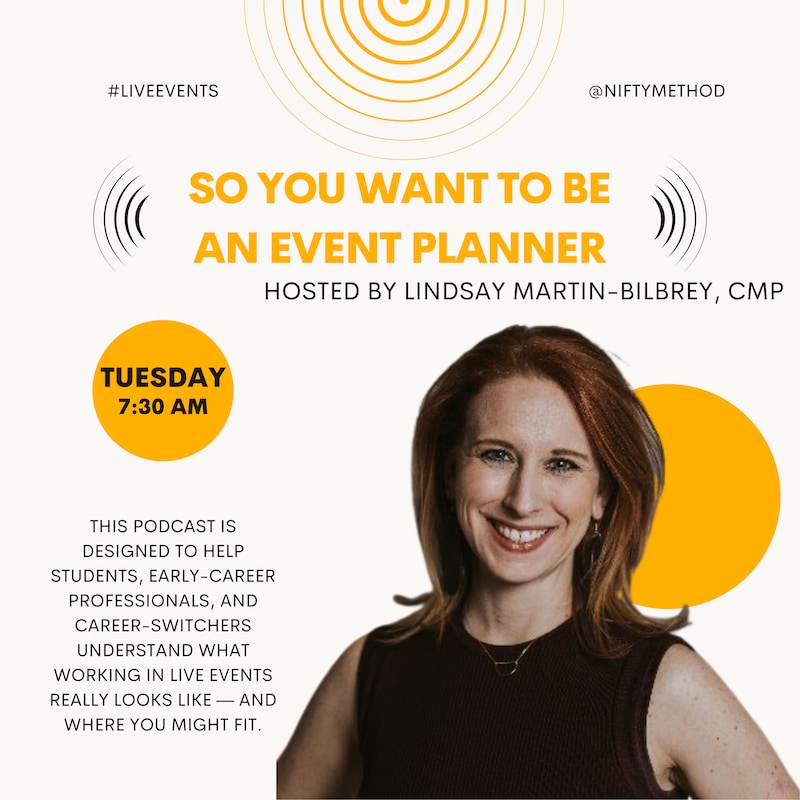
Shownotes
🎙️ Episode 2 — The Live Event & Experience Industries:
A Tour of the Ecosystem
If live events are a real field, where do they actually live?
In this episode of So You Want to Be an Event Planner, we take a guided tour of the live events and experience industries to make the event ecosystem visible. We explore how live events show up across sport, festivals, corporate environments, associations, tourism, civic life, and mega-events—and why event planning and event management work is often embedded inside other industries rather than labeled clearly.
This episode helps students, career-switchers, parents, counselors, and advisors understand where event careers exist, why event jobs can be hard to spot, and how seeing the full ecosystem makes the field larger, more legitimate, and easier to navigate.
If you’re curious about event planning or event management careers—and wondering where this work actually “lives”—this episode gives you the map.
🔑 Key Ideas
- Events operate across multiple experience industries, not a single sector
- Event roles are often embedded inside marketing, operations, tourism, and civic systems
- Visibility and legitimacy are not the same thing
- Sport, festivals, corporate events, associations, tourism, civic life, and mega-events all rely on live events
- Understanding the ecosystem expands career options and reduces confusion
🧠 Language We’re Using
- Experience industries
- Embedded event roles
- Distributed ecosystem
- Cultural and economic value
- Event labor market
✍️ Try This
Think about an industry you wouldn’t normally associate with events (tech, healthcare, government, education).
Where might live events show up inside that system—and what purpose would they serve?
🎧 Coming Up Next
Episode 3: How Do People Get Into This Field?
If event planning is everywhere but hard to see, how do people actually find their way into it? Next, we break down the real entry paths into live events—and why non-linear backgrounds are the norm, not the exception.
🔍 Examples Referenced in This Episode
- Professional sport leagues (live sport events)
- Music and arts festivals
- Corporate conferences and brand activations
- Association annual meetings
- Destination and tourism-driven events
- Civic and public sector events
- Global mega-events
Companies mentioned in this episode:
- Apple
- American Cancer Society
- Taylor Swift
Transcripts
Episode 2 the Live Events and Experience Industries A Tour of the Ecosystem welcome to so youo Want to Be an Event Planner, a podcast about how people actually find their way into the live events and experience industries.
Speaker A:I created this show because live events are everywhere in our lives conferences, concerts, weddings, festivals, sports and civic moments.
Speaker A:But the field itself is surprisingly invisible.
Speaker A:People work in live events for years without ever being able to explain what the industry really is, how they got into it, and what career paths even exist.
Speaker A:My name is Lindsay Martin Bilbrey.
Speaker A:I've spent over 20 years working across hospitality, live events strategy and operations, working in agencies, venues, brands, membership associations, and classrooms.
Speaker A:And I've seen firsthand how many talented people stumble into this work without a map.
Speaker A:This podcast is designed for students who think they might belong in live events but don't quite know what that means yet.
Speaker A:It's for career switchers who found themselves adjacent to this field and are wondering if there's a place for them here.
Speaker A:And it's for parents, advisors, and educators who want better language for explaining what this industry actually is and how it matters.
Speaker A:This isn't a how to show about event planning.
Speaker A:It's about understanding the field, the roles, the pathways, the identities, and the systems behind live events and experiences so you can decide where you fit.
Speaker A:Let's get into it One of the biggest reasons people struggle to see live events as a real field is that live events don't just live in one industry.
Speaker A:They show up in sports, tourism, entertainment, business, politics, sometimes all at once.
Speaker A:So today we're going to take a tour of the live events and experience industries to make the ecosystem visible and to show you where events actually live.
Speaker A:In episode one, we defined what an event is.
Speaker A:Now we're asking the next logical question.
Speaker A:If this is a real field, where does it live?
Speaker A:And the answer is almost everywhere.
Speaker A:That's both the opportunity and the confusion.
Speaker A:So why are events hard to see as an industry?
Speaker A:One of the biggest challenges with events is that they're rarely labeled as live events.
Speaker A:You don't walk into a company and see a department called Events the Industry.
Speaker A:Instead, events are embedded inside marketing teams, PR departments, tourism boards, athletic departments, nonprofit development offices, and government agencies.
Speaker A:So when people go looking for event jobs, they don't always recognize them as such.
Speaker A:This doesn't mean that the work isn't real.
Speaker A:It means the ecosystem is distributed.
Speaker A:Let's name the container Industries are sectors where value is created primarily through planned live moments, shared presence, designed experiences, and economic, social, symbolic, or cognitive outcomes.
Speaker A:In these industries, what people feel Remember and participate in is just as important as what they buy.
Speaker A:Live events are one of the primary mechanisms industries use to create those values.
Speaker A:Let's walk through the major sectors not as a list of jobs, but as parts of a shared ecosystem.
Speaker A:Sports Sport is one of the most visible homes for events.
Speaker A:Games, tournaments, races, championships, all planned live experiences.
Speaker A:Sport events combine live audiences, broadcast and media safety and crowd management, sponsorship and revenue, and intense emotional investment.
Speaker A:Many people enter the live events field through sport without ever calling themselves event professionals.
Speaker A:But they are.
Speaker A:Festivals and live entertainment are also part of the sector.
Speaker A:They include music festivals, arts festivals, touring shows like Taylor Swift's Era Tour.
Speaker A:These live events are often framed as creative or cultural.
Speaker A:But behind the scenes, they are operationally complex, very labor intensive, highly regulated, and economically significant.
Speaker A:This part of the sector teaches production flow, audience energy and creative logistics.
Speaker A:Corporate and brand events include conferences, user summits, product launches, sales kickoffs, and internal meetings.
Speaker A:An example of that, like a product launch, would be when Apple gets up to tell you about the latest version of the iPhone.
Speaker A:That's a corporate event.
Speaker A:These events exist to align organizations or stakeholders, to transfer knowledge, to signal credibility, and of course, to drive revenue.
Speaker A:They're often dismissed as boring, but they are some of the most strategically intentional live events in the ecosystem.
Speaker A:Association and nonprofits are another place that relies heavily on events.
Speaker A:Annual meetings, fundraisers, galas, college conferences.
Speaker A:Examples of associations and nonprofits you might be familiar with the American Cancer Society.
Speaker A:They hold galas to raise money for their research.
Speaker A:That gala is a live event.
Speaker A:These events, designed for their membership, sustain those membership communities.
Speaker A:They fund operations, support advocacy and create professional identity.
Speaker A:For many people, membership associations are the first exposure to large scale event work.
Speaker A:Also in the ecosystem is tourism and destinations.
Speaker A:Destinations which by mean a city, so say Philadelphia, Dallas, Destin.
Speaker A:These destinations use events to attract visitors, fill their hotels, activate public spaces and build place identity.
Speaker A:So this might include citywide conventions, festivals, sports, sporting events and civic celebrations.
Speaker A:In many parts of the world, live events are inseparable from the tourism strategy.
Speaker A:Finally, civic and political events.
Speaker A:They're often overlooked, but they're foundational.
Speaker A:One of the first live events that was ever researched happened in China.
Speaker A:And it was to celebrate the marketplace opening for a new downtown, quote unquote farmer's market.
Speaker A:These can also include parades, commemorations, rallies, inaugurations, public ceremonies.
Speaker A:These live events signal legitimacy, they reinforce collective memory, and they organize public life.
Speaker A:Civic and political events remind us that events are not just commercial, they're part of our social infrastructure.
Speaker A:Mega events can fall into all of the categories we've just discussed, but they also a singular event type of their own.
Speaker A:They sit at the intersection Olympics, World Cups, World expos, Global summits.
Speaker A:These live events mobilize governments, reshape cities and destinations, generate global attention, and carry long term economic and cultural impact.
Speaker A:They make the ecosystem visible at its largest scale.
Speaker A:What all live events and experience industries share are common characteristics like a live audience, risk and uncertainty, time pressure, high coordination costs, emotional intensity and temporary organizations.
Speaker A:What do we mean by that?
Speaker A:A temporary organization is an organizing body that comes together to do that particular event.
Speaker A:You'll hear it commonly in any of the sectors we've just talked about.
Speaker A:There's an event director, but usually that person's event team is made up of people across the organization to produce and execute the live event.
Speaker A:Events require people who can operate at the intersection of logistics, creativity, communication and human behavior.
Speaker A:That's why live events is a field, not a side task.
Speaker A:One more important note, everyone.
Speaker A:Event jobs don't always say event in the title.
Speaker A:You'll see job titles like marketing manager, operations coordinator, community engagement lead, partnerships director, or Program manager, but the work is still event centered.
Speaker A:So if you're struggling to see event jobs, it's not because they aren't there.
Speaker A:It's because the ecosystem is layered.
Speaker A:So why does this matter?
Speaker A:Understanding the live events and experience industries does two things.
Speaker A:First, it expands your sense of what's possible if you decide to work in live events.
Speaker A:They aren't belonging to just one narrow lane.
Speaker A:Second, it reduces anxiety.
Speaker A:If you don't see this career as a straight line, that's totally normal.
Speaker A:For years, my father used Hallmark movies to describe what I did, because the event manager he saw in the movies did things like a gazebo lighting.
Speaker A:And that was the only real concrete example he had to understanding what I did for a career.
Speaker A:As the career has matured, he's gotten better at it.
Speaker A:But still.
Speaker A:My parent was really worried why this matters.
Speaker A:You can work in a variety of industries and types and still work in live events, but this field is built on intersections, which actually gives you more career legitimacy and orientation rather than less.
Speaker A:Once you see the ecosystem, the next question becomes very personal.
Speaker A:How do people actually get into live events as a field?
Speaker A:Do we study it?
Speaker A:Do they fall into it?
Speaker A:Did they switch careers?
Speaker A:And that's what we're going to talk about next.
Speaker A:In the next episode, we're breaking down the real entry paths into live events and experiences as a career.
Speaker A:How people migrate into this work.
Speaker A:Why a nonlinear background can kind of be the norm and why your past experience is probably more relevant than you think.
