Thanks to our Partners, Pico Technology, and Autel
Watch Full Video Episode
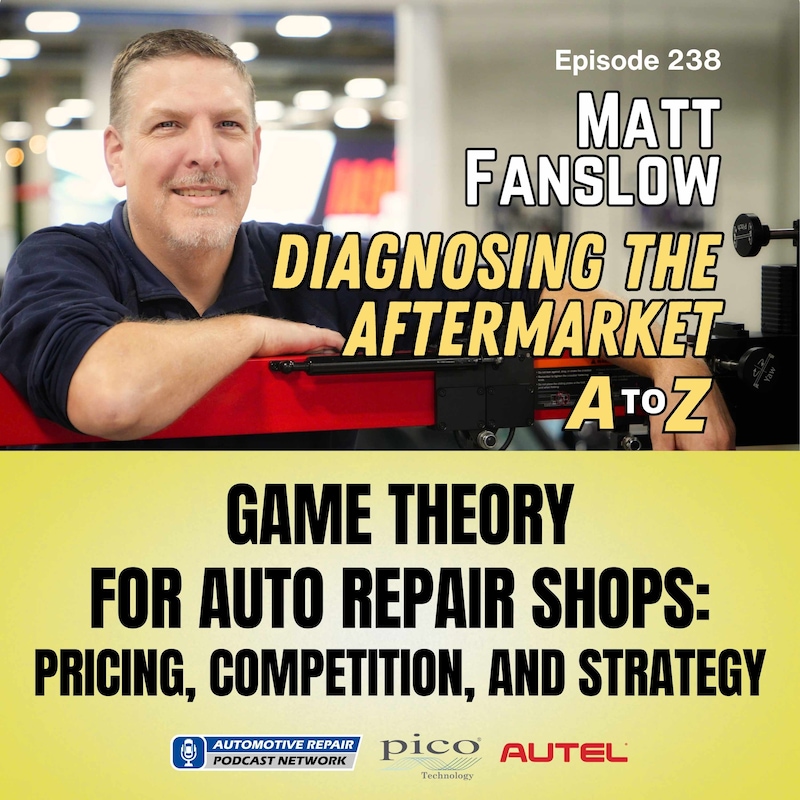
In this episode, Matt begins laying the groundwork for a larger discussion on game theory and how it applies far beyond poker tables, chessboards, casinos, or movie references. What starts with John von Neumann, poker strategy, bluffing, and imperfect information quickly becomes a broader conversation about how people, businesses, customers, competitors, and coworkers interact.
Matt explains that “games,” in the game theory sense, are not just games. They are interactions where people make choices, respond to incentives, interpret incomplete information, and try to get outcomes. That means shop pricing, marketing, hiring, customer behavior, technician cooperation, and even where a business chooses to locate can all be understood through this lens.
The episode touches on the difference between games of perfect information, like chess, and games of imperfect information, like poker. Matt uses poker as an entry point into bluffing, strategy, table image, and why mathematically sound behavior may involve moves that seem strange in isolation. He then connects that to real-world business decisions, where the “obvious” move, such as lowering prices because a competitor did, may not actually be the strongest response.
Matt also walks through classic game theory examples like the Monty Hall problem and the Prisoner’s Dilemma. The Prisoner’s Dilemma becomes especially relevant to shop culture and business strategy because it shows how cooperation can often outperform pure self-interest, even though individual incentives may push people toward betrayal or defensive behavior. That idea becomes a bridge into behavioral game theory, which accounts for the fact that humans do not always make clean, rational, mathematically optimal decisions.
From there, the conversation moves into automotive repair shop strategy. Matt discusses why competitors often cluster together, using examples like hotels, gas stations, Target and Walmart, Lowe’s and Home Depot, and auto repair shops. The point is not that a shop should always build next to competitors, but that proximity, customer behavior, friction, convenience, and visibility may matter more than the simplistic idea of “go where there is no competition.”
The episode closes by encouraging listeners to start seeing shop life as a series of interactions, incentives, exchanges, and strategies. Not “playing games” in a manipulative sense, but understanding that every interaction involves expectations, investments, risks, and perceived rewards.
Key Topics Covered
- Game theory as a way to understand real-world interactions, not just board games or gambling.
- John von Neumann, poker, bluffing, and imperfect information.
- Why poker strategy involves more than simply playing the cards.
- The role of Oscar Morgenstern and economic theory in the development of game theory.
- Why older economic models struggled with human irrationality.
- The difference between perfect information games and imperfect information games.
- Chess as a perfect-information game and poker as an imperfect-information game.
- The Monty Hall problem and why switching doors improves the odds.
- The Prisoner’s Dilemma and why cooperation often beats betrayal over time.
- Tit-for-tat style strategies: cooperate first, respond to betrayal, then return to cooperation.
- Nash equilibrium and the basic idea of making the best available decision based on known information.
- Behavioral game theory and why people do not always act rationally.
- How game theory applies to shop pricing, competition, and marketing.
- Why lowering price in response to a competitor may not be the right move.
- Why businesses often cluster near direct competitors.
- Shop location strategy and customer convenience.
- Seeing everyday shop interactions as “games” in the game theory sense.
Memorable Ideas
- “The game” is not necessarily manipulation. It is the interaction itself.
- Poker is not just cards. It is incomplete information, behavior, bluffing, risk, and response.
- Cooperation can be a stronger long-term strategy than constant defection.
- A competitor lowering their price does not automatically mean you should lower yours.
- Sometimes the stronger move is counterintuitive.
- Customers may choose convenience and proximity over reputation, price, or even prior loyalty.
- A shop’s strategy is not just what it charges or how good it is. It is also where it sits, what friction customers face, and what alternatives are nearby.
Thanks to our Partner, Pico Technology
Are you chasing elusive automotive problems? Pico Technology empowers you to see what's really happening. Their PicoScope oscilloscopes transform your diagnostic capabilities. Visit PicoAuto.com
Thanks to our Partner, Autel
From drivability diagnostics and TPMS service to ADAS and advanced safety systems, Autel helps technicians follow OEM procedures and repair with confidence. Learn more at Autel.com
Contact Information
The Automotive Repair Podcast Network: https://automotiverepairpodcastnetwork.com/
Remarkable Results Radio Podcast with Carm Capriotto: Advancing the Aftermarket by Facilitating Wisdom Through Story Telling and Open Discussion. https://remarkableresults.biz/
Business by the Numbers with Hunt Demarest: Understand the Numbers of Your Business with CPA Hunt Demarest. https://huntdemarest.captivate.fm/
The Auto Repair Marketing Podcast with Kim and Brian Walker: Marketing Experts Brian & Kim Walker Work with Shop Owners to Take it to the Next Level. https://autorepairmarketing.captivate.fm/
The Weekly Blitz with Chris Cotton: Weekly Inspiration with Business Coach Chris Cotton from AutoFix - Auto Shop Coaching. https://chriscotton.captivate.fm/
Speak Up! Effective Communication with Craig O'Neill: Develop Interpersonal and Professional Communication Skills when Speaking to Audiences of Any Size. https://craigoneill.captivate.fm/