Shownotes
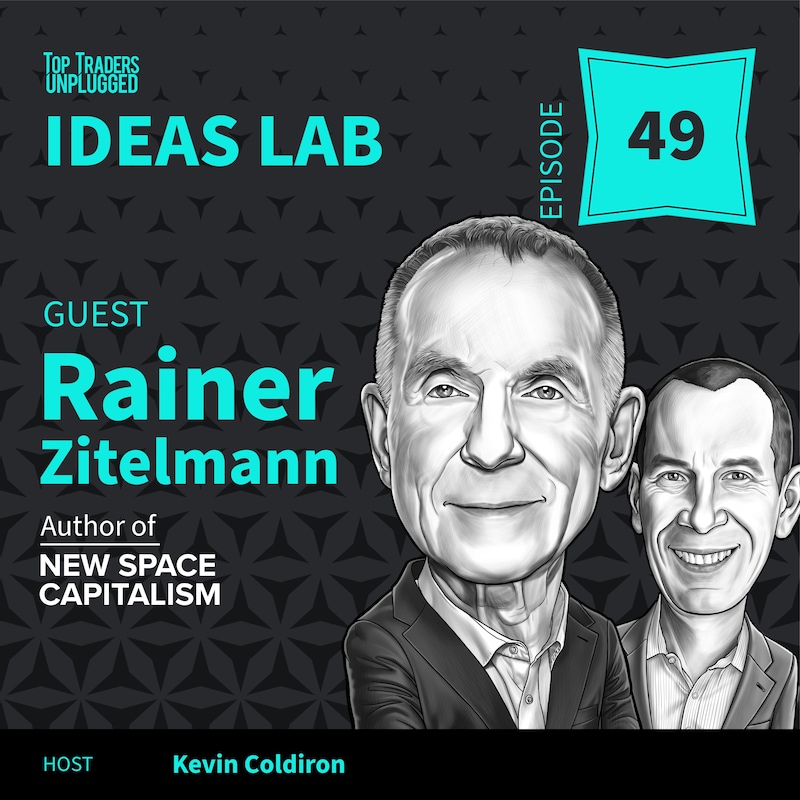
On this episode we are joined by Dr. Rainer Zitelmann, to discuss his book New Space Capitalism: The Entrepreneurial Path to the Stars. We discuss why government-funded space programs were initially successful but also why the future of space exploration, and the space economy, will be driven by private companies. Dr. Zitelmann explains what he believes to be the key driver of unlocking the economic potential of space and why it’s conceivable that ventures such as space tourism, orbital data centers and asteroid mining might be listed on the stock exchange. This is a conversation for everyone who wants an early look at an industry that is about to “take off”!
-----
50 YEARS OF TREND FOLLOWING BOOK AND BEHIND-THE-SCENES VIDEO FOR ACCREDITED INVESTORS - CLICK HERE
-----
Follow Niels on Twitter, LinkedIn, YouTube or via the TTU website.
IT’s TRUE ? – most CIO’s read 50+ books each year – get your FREE copy of the Ultimate Guide to the Best Investment Books ever written here.
And you can get a free copy of my latest book “Ten Reasons to Add Trend Following to Your Portfolio” here.
Learn more about the Trend Barometer here.
Send your questions to [email protected]
And please share this episode with a like-minded friend and leave an honest Rating & Review on iTunes or Spotify so more people can discover the podcast.
Follow Kevin on SubStack & read his Book.
Follow Rainer on Instagram and read his book.
Episode TimeStamps:
00:00 - Why incentives may explain why humans stopped going to the moon
01:07 - Kevin introduces Dr. Rainer Zitelmann and New Space Capitalism
02:47 - How childhood fascination with space led to a lifelong interest
05:45 - Why Apollo succeeded and why it may have been a historical exception
09:22 - The Space Shuttle program and the limits of government-led innovation
13:50 - How SpaceX changed the economics of launch services
20:32 - Why private property rights may be essential for space capitalism
24:36 - The legal uncertainty around owning land and resources in space
32:23 - How Mars settlement could be financed through private ownership
42:49 - Asteroid mining, space resources and the business case beyond Earth
48:06 - Space tourism and why early innovation often starts with the wealthy
53:51 - How investors might think about the emerging space economy
58:27 - Why space capitalism is no longer science fiction
Copyright © 2025 – CMC AG – All Rights Reserved
----
PLUS: Whenever you're ready... here are 3 ways I can help you in your investment Journey:
1. eBooks that cover key topics that you need to know about
In my eBooks, I put together some key discoveries and things I have learnt during the more than 3 decades I have worked in the Trend Following industry, which I hope you will find useful. Click Here
2. Daily Trend Barometer and Market Score
One of the things I’m really proud of, is the fact that I have managed to published the Trend Barometer and Market Score each day for more than a decade...as these tools are really good at describing the environment for trend following managers as well as giving insights into the general positioning of a trend following strategy! Click Here
3. Other Resources that can help you
And if you are hungry for more useful resources from the trend following world...check out some precious resources that I have found over the years to be really valuable. Click Here
Transcripts
I don't believe it. I have another alternative explanation why it didn't happen. Because everything is about incentives. And there were no incentives to do it.
Intro:Welcome to Top Traders Unplugged. In markets, success doesn't come from predicting what happens next. It comes from being prepared for what you can't predict.
In each episode, we go deep with some of the world's most thoughtful minds in investing, economics and beyond to understand how they think, how they prepare and how they decide, and the experiences that shaped how they see the world. No noise, no shortcuts, just real conversations to help you think better and invest with confidence.
Kevin:Welcome everyone to Top Traders Unplugged.
My name is Kevin Coldiron and I'm host of the Ideas Lab series where we talk with authors of new books that help us understand how the global economy works and where it's headed in the future. Okay, I have to admit, I really had to resist the temptation to start today's show by reading out the opening monologue to Star Trek.
Because today we're going to be talking about space, which is shaping up to potentially be the final frontier for capitalism. And the captain on our journey today is going to be Dr. Rainer Zetelman. Dr. Zetelman is a prolific author.
He's written and edited 32 books which have been translated into 35 languages, including in Defense of Capitalism, the Power of Capitalism and How Nations Escape Poverty. He's here today to talk about his latest book which will be released in the US on June 9, called New Space the Entrepreneurial Path to the Stars.
Dr. Zitleman, thanks for joining us today and welcome to the show.
Rainer:Yes, thank you for inviting me.
Kevin:So it sounds like you have been a space capitalist since you were a boy. You were 12 years old when the first moon landing took place and you wrote a special edition of your school newspaper and sold it to your classmates.
So you made some money from the moon landing. Can you tell us about how your interest in space got started? And please.
Rainer:Yes, I think like a lot of children watching science fiction movies in tv. Not Star Trek, it was another one in Germany and I saw it when I was 9 years old.
And then it's correct with 11 years, I founded a school newspapers called Galactis Zeitung. It means Galactic Newspaper. It was only about astronomy and space flight. And yes, I had good luck at this time was also the first moon landing.
So you mentioned it.
I had a special edition about this, but all in my children's room was full with a big poster from the moon and from the Saturn 5 rocket and books about astronomy. So this was all about. But it was not this way that I'm to be honest, all of my life interested in these topics.
You know, I'm a historian and in the last years I wrote a lot of books. Why Capitalism is better with the Example of Countries. I give you two examples. I wrote a book, How Nations Escape Poverty.
It's about Poland and Vietnam. And always I showed what happens if you add more market economy in a system or on the opposite, more government.
Maybe I can compare it with a test tube with two ingredients, Market and state or capitalism and socialism. And then I watch what happens if you add more market and what happens if you add more state.
poorest country in the world,:And then they started with free market reforms, the so called Stoi Mauro reforms. And the result is that the number of people living in Poverty decreased from 80% to 3%. From 80% to 3%. And I have a lot of other examples.
And now I turned from studying countries or nations to studying an industry and an industry that was decades ago, totally led by the government.
And I think almost no one could imagine that some days there will be Elon Musk or Jeff Bezos or multi billionaires like this will start there private companies. So everyone thought this is definitely something that can only be done by the state.
And today, you see, it's the time of private, as I call it, space capitalism. And this is what the book is about.
Kevin:Yeah, thanks for that. Because I have to say I approached your book.
I don't know if skepticism is the right word, but I mean, I definitely had that perspective of, well, space is something that the government runs and you know, in the us, in America, the mythology of the moon landing and NASA is very deep in our psyche.
And I guess your perspective is that the success of NASA governments funded space programs in general were really a historical exception, not the roadmap for the future. So I'd like to kind of explore those ideas a little bit. First of all, why was the initial NASA government funded space program successful?
Tell us about how that worked and then, then we can kind of transition to why that's not the correct model for the future.
Rainer:Yes, of course it was successful. Maybe the greatest thing ever done in the history of mankind. And I don't say that absolutely everything, 100% what the government does will fail.
Of course there are an exception. But you have to know that the Apollo program cost 300 billion in today dollars. 300 Billion.
And at its peak it had 400,000 people and 20,000 companies working on it. So it was a mobilization, as in war times. And this is what Johnson said at this time. He said who's first in space is first everywhere. And.
And tours second in space is second everywhere. So it was. Money plays absolutely no role. It was at this time 5% of the American birch in NASA. This is 10 times more as a percentage as it is today.
Today's only 0.4%. So you can't do it for such a great thing for a couple of years.
But of course I tell the story then what happened after Apollo with the space shuttle. And we can talk more in detail about it. But this was as far as concerns manned space flight. 50 Years of failure.
had planned Mars landing for:But of course the Apollo program was a big success. But then the politicians thought, okay, what we did one time so successful, we can do always not only in space, also with other ideas.
For example, President Nixon, who was the President of the United States at this time, even had the idea to reprint the NASA to give a new name because he didn't want to focus only on space. But he had some other ideas, like the fight against cancer, for example. But these were all failures.
And this is what the politicians thought, okay, we were so successful, we did it and now we can do everything in the same way. But this is not true because I tell the story then what happened after this with the space shuttle program? Maybe we can talk about this.
This was a total failure.
Kevin:Yeah, let's talk about the space shuttle program. Because that I think probably for, well, listeners my age and younger, I mean that's kind of what they identify with spaceflight now.
And you say it essentially became a program where the goals kept changing all the time. And it was almost like a.
My reading of your take is that it almost became like a social program where politicians competed to dole out the spending in their districts. And you say in the end it had all these goals and really couldn't deliver on any of them.
So maybe, just maybe, walk us through the chronology of the space shuttle a little bit. And I think that's a good kind of template for why you think we need a different path in the future.
Rainer:Yes. First of all, there was no clear idea. Everyone had another idea what to do with it.
The military, the scientists, everyone had another idea, the politicians. And it was a discussion about three years what to do with Space Shuttle. It changed a lot of time.
And they had them estimate that the development costs would be 5 billion. And then for every flight between 5 million and 10 million, between 5 million and 10 million.
The reality was it was between 1 billion and 1.5 billion every flight. And why is that? Of course, if you make a calculation, you know, with Axle, the more flights you predict per year, the cheaper it will be.
And they started with maybe the estimate of 10 flights a year. And in the end they calculated with 140 flights every year. This was the calculation. The reality was 135 flights in 30 years.
. And then they stopped it in:And then this is the headline of this chapter in my book is the End of the Future. Because what happened then?
The Americans were not able to bring their own astronauts with their own rockets from American soil to the International Space Station. But they had to rely on very old Russian Soyuz rockets. They had a monopoly at this time.
And so every flight costs maybe 10 or 20 million more than before.
And after winning this first space flight, being so successful, of course then it was really a big disaster for the United States then that they were not able to bring their own astronauts. A total failure. The whole program was a failure. There were some smart people who even had before the idea, let's do it in a different way.
Let's cooperate with private companies in another way than we did before. But most politicians reject it. No, this will be a disaster. It will never happen. This is a totally stupid idea. Go away with this.
Okay, but then if you have the situation that you have lost everything and almost no alternative. It's like in the football game, the, you know, the Mary pass. Hail Mary pass. Yes, and they said this was our Hail Mary pass.
Then let's try with this crazy SpaceX people from Elon Musk. And of course it was not everyone in Asia There was one woman especially, she believed in it.
And she reported every week some people came in her room and told, oh, you're so poor that you have to work with this idiots for this private space. So I feel with you of my sympathy. But she liked it and in the way, so what happened then?
Kevin:Okay, I just want to make sure I get what you're saying. So I think what you're saying is you had the space shuttle program, long period of time, wasn't achieving its goals.
By, I think you said by:And so what you're talking about now is the kind of, I guess the origins of the private space industry as we know it today.
Rainer:Exactly. It was another way of cooperation.
You have to understand, even in the time of the Polo program in the 60s and the 70s, NASA never built their own rockets. They were also built by private companies like Boeing and Rockwell. But the corporation was like micromanagement from NASA.
They told them exactly what to do, even sometimes who to hire, what employees work. So in every detail. And they had a very strange kind of contracts. You call it cost plus contracts.
I have to explain it, because this is very important to understand.
The cost plus program means, okay, you build a rocket for us and we buy it and you have to make clear your costs and then you can add maybe 8 or 10% profit because they had fear that these private companies will make profits that in their eyes from the bureaucrats and politicians would be too high. So, okay, this is the best idea, show us the cost and then you can add it. But the result was that it became more and more expansive.
I spoke with one person who was at this time worked for one of the two biggest companies in the space industry. And he said our best product was our overhead. Because I think it's simple to understand.
For example, if you have 1 billion castes and you can add 10%, then you make 100 million. But if you have 3 billion karsts, then you make 300 million. So it was really an incentive for increasing costs.
Oh, it takes longer than we thought or it's more complicated. We have to do this and that. I think it's always very important in the economy to understand the incentive.
And if the incentive is to make it even, that it costs more and more and more, then it will cost more and More this is exactly what happened. And now to understand what's the difference in the cooperation today between SpaceX and NASA.
SpaceX doesn't sell any rockets to NASA, but a service like a service like FedEx or UPS. We bring your satellites to orbit, for example, and charge you a fixed price.
Or we bring your astronauts to the International Space Station and charge you a fixed price. But how we built the rocket and what our costs and our profits and all this, this is ours. And from this moment on was an incentive for lower costs.
Because lower cost would mean more profit. And before with this cost plus program, higher costs mean more profit. Of course, companies are profit seeking entities.
And the result, and this is amazing, if you compare the launch costs, this is the word for how much does it cost to bring one kilo to space? If you compare the space shuttle with the cost that Elon Musk has today with his rockets, he reduced it by 95%. 95%. This is his self cross.
And how was this possible? For example, one very important thing is that he was the first to build reusable rockets. The Falcon 9 is a reusable rocket.
The same rocket was used now 34 times. And of course it makes a huge difference in the course.
Imagine you go from maybe from LA to New York and after this the plane, you have to throw it away. It's only one time yours for the air traff. I think the cost, I don't know how much, maybe $800,000 for the ticket or something like this.
It's only cheaper because it's reusable. And this is what NASA also tried before, but without success. And other countries tried also.
So today no state owned space agency, not in China, not in Russia, not in Europe and not in the United States was able to build such a reusable rocket. But Elon Musk did it 10 years ago. And the only other one who was successful now, I think it's a half year ago, was Jeff Bezos.
He did it 10 years later. But these are two private companies. And so you see, this makes the difference. And no one told Musk, you should make a reusable rocket.
It was not NASA told it was his idea. And why? Because he thought it's much cheaper. And this was not the only way to reduce costs.
There were a lot of other things that he did, but in the result he reduced it, as mentioned, by 95%. And he says today, from this point I will reduce it even 90% more.
So it's important to understand the completely different way for cooperation between the government on the one hand and this private companies on the other hand.
Kevin:Yeah, thank you for that. That serves excellent description of how things work now.
And you say in the book that it's kind of fascinating because you were saying, well, okay, once rockets become reusable, the, you know, their contribution to total cost goes down and then other stuff starts becoming relevant in particular fuel. Right. So once you start getting reusable rockets, then fuel costs start to matter a lot more.
And so it made me think that maybe there'll be some innovation on that side as well, like figuring out how to lower the fuel costs. Or is that, is that still something.
Rainer:That, you know, there are, I try to do, there are a lot of things to, to reduce costs in this way.
But I think the most important thing now if we go maybe a little bit of first, first one thing, some people ask me, you know the title of my book is New Space Capitalism. And then they, they ask when, when is it this with this space capitalism?
Because they think you told me maybe you had a little bit of similar idea that it is still government led in a way everyone knows their private commerce. And I will give you one number, this is the most important number. Two numbers. First of all, we had last year 324 rocket launches worldwide. 324.
And from this 324, 165 were SpaceX. So it means SpaceX alone as a private company had more launches than all other countries together.
Or to say it in another way, if SpaceX were a country, it would be number one far before China. That comes with 88 launches after this, or if I compare it with Europe, where I live, we had eight launches. So it means we had 5% whole Europe.
What SpaceX did as a private company, or it's not only SpaceX, I have a lot of content about another company. It's Rocket Lab. It's founded in, in New Zealand from Peter Beck.
Later they moved to the United States, but founded in New Zealand and they had 21 rocket launches last year, 100% successful.
It means this private company from this Peter Beck, who never studied or did anything like this, had three times more rocket launches than whole Europe. And so you see the space capitalism is reality today.
Or if I speak about satellites, we have today 15,000 active satellites in orbit from this 15,000, 10,000 Starlink from SpaceX. So you see, it's still private.
But now the most important thing is my book that I say all these other goals, some people, maybe we can talk about this. Think about asteroid mining Space mining. Elon Musk has the idea to settle the Mars, or maybe now first the moon, to build a city there.
And all these plans will not happen or very hard to realize if we have no private property in space. And this is a big, big problem. And to be honest, this is really the main message of my book and the reason why I want to start a discussion about it.
And if you like, I can explain a little bit why I think it and what is the legal status today?
Kevin:Yeah, okay, I do want to talk about that. And that would be because you have a chapter in the book where you talk about, I think some of the things we've talked about.
We hear asteroid mining and then also space tourism. So two kind of natural ways potentially for, you know, for there to be capitalism, profit making in space.
But that's all founded to a large extent on, as you say, private property rights. So let's, let's talk about that. There are a couple existing, you know, kind of international agreements on property rights.
ere's the moon agreement from: Rainer:Yes, fortunately we don't have to talk long about the moon treatment because only about 20 countries signed it and no one of the space faring countries. It's a real socialist idea that celestial bodies and everything is like a common good or something like this. But forget about this.
s the Outer space treaty from:According to Article 2 of this Outer Space Treaty, it's prohibited for nations to aim ownership over celestial bodies or land over celestial bodies. So it means the United States cannot say this asteroid or moon or Mars or forever is a part of the United States or belongs to us. This is forbidden.
And this is crystal clear. There is no dispute among space lawyers that it's not allowed. Because it's crystal clear in this.
Kevin:There are space lawyers out there.
Rainer:Yes, yes, there are experts for space, yes. They have also discussion. And one discussion that they have is how is it with private person, with private companies?
crystal clear why. Because in:So there is Nothing. And there are two opinions among space lawyers.
The one, they say, okay, they try to make it indirectly clear that what is forbidden for nations is also forbidden for private person and private company. And the other said, no, it's nothing in the treaty. And what is not forbidden is allowed in the first place.
So the only thing that is really clear is that it's not clear. And this is of course, not really good for investors.
If it's not really clear, the legal situation and my approaches, I ask a question, and I wonder why not more people ask this question. When Elon Musk had this idea of settling, he's talking about 1 million people to settle them on Mars.
Whether we speak about 1 million, or like Robert Suprin, who's the founder of the Mars Society, I spoke with him. He's talking about 50,000, wherever it is, whether it's thousand or a million. This can't be funded by the government.
We have anyway more than enough debt right now. And I think it's absolutely not possible. Of course, another landing on Mars to bring five or 10 people there.
Yes, this could be funded by the government, but not like a city on the moon or on Mars. So who could pay first? And what's the business model behind it? And I give an answer. It's not possible without private property.
Because on Earth there is no system that works without private property. There were 24 socialist experiments in the last hundred years and they failed without any exception.
And there is no successful economy in the world without private property. Also private property of land.
In some countries, like China or Vietnam, you have no private property of land, but you can lease it and sell it for maybe 70 years. What is similar, but without any form of private property, it will not work. It would be like in North Korea, maybe.
And if it doesn't work in North Korea, why should it work on Mars? Of course not. Maybe you have lower gravity there, but the laws of the economy still exist. And my idea is.
So my question is, who should have the right to own Mars or part of it? Maybe not the whole planet. And I have this idea.
For example, if Elon Musk or whoever private company is able to go there, they take the risk, they spend the money, they are able to go there, not only to go there, but to develop it, then they should have could claim ownership. Of course not of the whole planet. Yes, but it's similar to homesteading. In the history of the United States, it was this way.
The only difference is there was a government who gave to the settlers a part of the Land on the condition that they develop it and do something for build house. And so for five years the difference is that there is no government who owns Mars because it's not allowed.
But also this is not so different from the way as it happened in the United States at this time. Because the idea that there was a government and they told people you can use it, it was a little bit different.
First in a lot of cases, first they took it without any permission and then later they legalized it. Okay, keep it there.
If you do this, and this is the way I think how it should happen on Mars, for example, Elon Musk goes there and then he takes apart maybe as big as Singapore. Singapore there are place for 200,000. The area of Singapore is going 200,000 times on Mars.
So even if he takes a part of the Mars that is as big as Singapore, there's enough for anyone else, but of course to develop it and do something. And then the next idea is he should bring it to the stock exchange like a real estate investment trust reit. And then who owns Smarts?
Every shareholder, maybe you and me. And I think this is a way to finance all these things.
Kevin:Yeah, you have a couple of ideas like that. And I do want to talk about that in a second. I just said I wanted to circle back on the property rights.
So how would you imagine, and I know you're not a lawyer, but how would you imagine property rights get enforced? Right. So you say, okay, if you can finance and get there, then you can own this Singapore sized bit of Mars.
And then they get there and they start mining outside their given property. And there's no, no police force is going to go up and stop them.
Rainer:Sure.
Kevin:So you know what happens there? How does that work?
Rainer:Sure. Of course on Mars there's no police force and no one who could stop them. But of course on Earth there are.
And if maybe it's in the United States and it's not legal and it's illegal or something like this, okay, then they will go to another country. Maybe, maybe Yavi Milei will make then a better space law.
And then Elon Musk goes there, then he will move maybe from the United States to Argentina or whatever. This is a little bit science fiction fiction of course, but on Mars they cannot do anything against it. And I think this is the only way.
How you could finance it is in my point of view it's first it's a real estate story, maybe it has a little bit to do. I'm a, you know, I'm A mixture. I studied history and political science and sociology.
But on the other hand, I spent 20 years in the real estate industry and I had a very successful company in the real. So maybe I see it a little bit with a real estate perspective with this real estate investment trust.
But I think in the same moment as it will be possible to buy and sell land on Mars and on Moon, even before people go there, there will be a trade.
People will start to buy and sell only because they think they hope the same when you buy Bitcoin or stocks and so that it will increase in value and people will have the fantasy. Or maybe this part is the best. Or this. Maybe you know, this movie. Once upon a time in the west.
So there was this, I think they called him crazy Irishman who bought their piece of land in the desert. And they Ah, he's totally crazy. But he knew because water was near there that it will increase in worth. And so it was the only mistake that he made.
He didn't know that the owner of the railway that later he came and killed his family. So by the way. But the idea is to start buying something because you see something that can increase in value in the future.
This is the same that will happen there. And on the other hand, if Elon Musk talks about this 1 million people there and there would be no private property.
How should they organize their society? This would be a completely not socialist, complete communist society there. And why should it work on Mars?
On Mars it's even harder that it, you know, on our planet, on Earth, in some countries, it worked in a way for some decades. Very poor and a lot of people died and were poor, but it worked in a way. But on Mars, the conditions, you know, with they are so hard.
Every place on Earth is much more relaxed than going to Mars. So you should have an economic system that is even much more efficient as it is on Earth. And the same is with asteroids.
Asteroid mining, I think this will be a great topic. But if you go there for asteroid mining, of course it should be clear that, for example, there's a lot of platinum or water. Water is.
You have a lot of water on asteroids, frozen water.
But it's important in space, because you cannot bring all the water from the Earth in space, the water that you need, you have to get it there on asteroids or on Mars. And then who should be the owner? And of course, I'm not the only one who sees these problems.
There was an executive order from Obama and also another executive order from Trump for space mining that you can keep this, what you dig there, for example? Yes, but the problem is if you don't own the land, then it's hard to finance such things. So it was a halfway for a solution. But I think we.
Without real private property, this is my opinion, all these things will not work. Because let me.
Kevin:Can I just ask a question? So, I mean, that makes sense. I understand that.
Yet at the same time, you have someone like Elon Musk continuing aggressively to pursue things like going to Mars, colonizing the moon, potentially setting up data centers in space, all these things without those property rights having been, you know, determined.
So do you think his bet is just that it's going to be determined that I'm just going to go ahead, or is he just kind of operating on the principle that what you've just outlined, like, if I get there, then it's mine.
Rainer:Unfortunately, I had not the possibility to talk with him in person. I know some very close friends of him. I talked with him and I talked with Robert Suprino.
You know, he's the one who gave Elon Musk all these ideas with Mars. He was the first one. He's the founder of the Mars Society and he wrote a lot of books about.
And I think sometimes these people think about the economic perspectives. But I think Elon Musk is more someone like, if the problem is there, we will find a solution.
Not before you start to think about the next, next, next next step, how we will. But I think if it is there, we have to find a solution. But I'm very proud. When I wrote the book, I've sent it to two experts.
The one is Matthew Reinshiel. He's I think the most famous expert for space economy on Harvard Business School. And he said, everyone should read this book. This is how it is about.
And Robert Sucrin, the man who gave Ilmaci ideas, he said something about the book. I am very proud. He said, freedom will bring us space. Space will bring us freedom. And Zeidelman shows us the way how to do it.
And because this is what I think, I can say it on a technical way.
But what was very important for me, I had a conversation with one from NASA Aims Center, Harry Jones, and we had some emails and he sent me some papers that he wrote. And he's older than 80 years. I think he's now almost 60 years in the space industry.
And he told me, and this was very important, there are no technical showstoppers for our way to Mars. It's all today. We can solve all this. There are Problems a lot.
But he has this paper and he lists seven or eight huge problems and said none of these problems is not solvable. So the reason why we were not there, and this is my answer, it's the incentive for the moon landing. There was a crystal clear incentive.
It was the moon race, who will be number one. The competition between the Soviet Union and the United States. It was about national prestige and being number one.
But in the moment when there was the American flag on the moon, there was no incentive. They gone five times more and then stopped. Because no one does everything without incentive, without a clear reason.
Are you doing anything without having a reason? And even not things that cost so much money? No, you have to have a clear reason, incentive.
And this is what the architect of the Apollo program, the German Werner van Braun, when they asked him after ending of the Apollo program, what is the next. He said we should make it in a way that it makes economical, in economic way sense.
And this is where all these scientists from NASA maybe they didn't thought about enough. We have this funding from the government and we have taxpayers money. And now we think what we can do with it.
his is the reason why we were:But I think you have to ask why. And you know, there are this conspiracy theorists. I don't believe anyway in moon landing. This was all made in tb. I don't believe in this stuff.
But of course they feel, oh, you see, if we were not able to do it for 54 years, this proves our theory it was only fake. I don't believe it. I have another alternative explanation why it didn't happen.
Because everything is about incentives and there were no incentives to do it.
Kevin:Well, let's talk about some of the areas that, you know, the space economy might develop. And we've mentioned, we kind of mentioned both of them. One is, you know, mining for minerals on asteroids.
And the other one is essentially space tourism. So tell us the space industry at the moment, space economy is mostly about satellites. Let's talk about asteroid mining.
I mean, is that something that we can expect kind of realistically in kind of the next five years or so? I mean, you have a great section where you talk about. Asteroids aren't necessarily what we think they are.
They're not just solid hunks of rock floating in space. Oftentimes they're almost like, you know, patches of rubble that are Held together by weak gravitational forces. So it's not trivial to land on them.
And it's not even clear that once you start mining them that they'll. They won't just break apart. So tell us a little bit about what your take is on asteroid mining.
Is that something that we can really expect to be a part of the space economy?
Rainer:First of all, I don't think that it will happen in. In the next five years more the next 10 to 20 years. It will happen. But it depends. It depends again on the property rights, if it would be illegal.
Or you find a way. You are there on this asteroid and then you're the owner and you take the asteroid on the stock exchange. What is my idea? Ezriel?
I think then they would start race routes first there and to get it. But this is not the situation.
Kevin:And so just to be clear to you, so you have your example. Essentially you list an asteroid on the stock exchange, right? You sell shares in it.
And that provides the capital for a company to go and do the mining.
Rainer:Or who should have the right. The one, of course not here. And me, I'm not able to go to an asteroid and I don't know anything about asteroid mining. You're not. So we not.
But the one who are able to go there and take the money and take the risk, they should be the owner. But then of course, if they're smart, they bring it to the stock exchange and then we have a lot of owners. And so.
But let's talk a little bit more about it. There are maybe between 700,000 or maybe even 1.7 million asteroids. But most of them are between Mars and Jupiter. But they are very far away.
But we have also like the earlier 40,000 near Earth asteroids. These are one where usually we have fear, and rightly so, but they are closer to us and it's not so hard to reach them.
And of course what to do there. So there's a big misunderstanding that people think we will bring the resources back to Earth.
This will happen for example, for platinum, this PGM group or gold or so. But this is the exception. I think it's more important to use it in space, because we need a lot of resources in space.
For example, if Elon Musk's want to build like data centers in space, even with reduced launch costs, costs a lot of money to bring it to space. Better to use the things that are still in space. The same with water. Water is a basis also for propulsion. Yes.
And of course you need water when you are in Space. And so I think most of what you do with asteroid mining is not for use on Earth. Some things, yes, but to use it in space.
And there were two companies, but it's more difficult than you thought. And these companies, they had a good lobby in the United States.
You know, both of them, it was Ted Cruz and Marco Rubio, they lobbied for them for this asteroid mining companies.
And the result was Obama's and then Trump's executive orders that the resources that you get there belong to you and that it's nothing against the Article 2 of the Outer Space Treaty. So. But these two companies failed in the end.
And I think it will take a time, but of course it will happen in the future when there are resources that are valuable for us that we need, especially that we need in space. And the same is they will do it on the moon and on Mars and everywhere. So this is one topic. The other topic that you mentioned is space tourism.
Space, of course, today it's extremely costly. It costs a lot of money. There's this.
Kevin:What does it cost? If you want to go up in.
Rainer:Jeff Bezos, there's a cheap version, cheap version, like $300,000.
This is going only for a few minutes, for example, with Jeff Bezos, who did it for a time, not at the moment, Richard Branson with his virtual Galactica. There were some space truths, but this is the cheap version, like the Ryanair version of yes, for 300,000.
But the other version to go, for example, to the International Space Station. Some people did it, but not many. This is, I think today it would cost like 40 or 50 million. So you have to be a billionaire. I give you one example.
Who did it? Isaac Mann. He's the new NASA, NASA director, CEO and he was a space tourist with Elon Musk. He did it because he's a billionaire.
And he has also a hobby. I think his hobby is he's the owner of the biggest private collection from. How do you call it? Fighters.
Kevin:Oh, fighter jets.
Rainer:Fighter jets, yes, yes, I saw that.
Kevin:I remember that in your book.
Rainer:Yeah, it's his hobby. Yes, but so he was a space tourist and I think he paid something like 40 million. So this is only for billionaires.
And so you think, okay, why it's only for rich people. But if we go back, all innovation in history were first for very rich people. Even a window to have a window was such luxury.
Only the richest people in the country could have a window like kings, or with cars in the beginning, or even with flight. This was always for very rich people.
And in the end it became cheaper and cheaper and cheaper because the wealthy people first they finance it and in the end it becomes cheaper for everyone. And I think with space it will happen in a similar way. I know for some people it sounds like science fiction. They can't believe it.
But it was also I read something in nineteen three when the first man tried to fly with an airplane. He failed. And then there was an article in the New York Times and they had it. Yes, of course it failed.
Because it will be possible in between 1 million and 10 billion years if we put all this knowledge from the best scientists. This is what they wrote. And in reality, two months later, we are the Wright brothers and they did it.
And there were surveys before the moon landing and the majority of people said, no, it will never happen, this is not possible. And everything that was science fiction in the first way, later it became reality. But I think this will not the precondition for this.
And so I come back to this. There has to be a strong reason why to do it. So why space? Why space matters? And if it is not national prestige or space race?
Now we have a little bit the situation as we had in the 60s. In the 60s it was between the Soviet Union and the United States. And now it's China and the United States. It's again about national prestige.
But I think this is not enough. If you look in our society, money matters and money makes the world go round.
And so I think space capitalism is important topic because it will not work without economic incentives.
Kevin:Yeah, I completely agree with you.
like an African safari in the:Something that you would only the rich could do. It'd be very dangerous.
And now, you know, it's commonplace just to kind of maybe wrap things up for someone who believes in your story, believes that the space economy is in its infancy and we're just at the very, very beginning. How do you. And again, I'm not asking for any specific advice, but how should they go about thinking about investing in that?
I mean, we have SpaceX IPO coming up. That's obviously one way to do it. There's some listed ETFs. I think out there might be like seven or eight of them.
You know, are those, you know, kind of viable ways from your perspective, or is it just too early or you know, what about the. I guess the other question kind of related is, you know, you have the SpaceX, you have Jeff Bezos's company like Blue Origins is what it's called.
But you know, presumably there's also kind of secondary industries that benefit from the growing space industry. They provide components or raw materials or things like that.
So I don't know, it's a broad question, maybe not a totally fair one, but how do you think about kind of investing in this new future space economy?
Rainer:Okay, first of all, if you would have invested like two years ago, for example, two companies that I mentioned in my book Rocket Lab, I mentioned it, this roster is from Peter Beck New Zealand company and Another Planet Lab. They are based in San Francisco and in Berlin by the way, only five minutes from my home. So I, I spoke with, with them and they have now the plans.
For example, they work together with, with Google for data center in space. But Elon Musk does the same. They have 200 satellites in, in space. So of course if you believe in these topics, I'm more as it is to investment.
I was more real estate investor. Very, very successful as real estate investment. Of course I've also I'm invested in equity.
But I'm all this what you mentioned, passive etf because I think if you go, if you. According to statistics there are not so many laymen people who are really successful with stock picking. So I, I, I don't believe that, that I am.
But of course people are different and if they read my book and you see, I think with SpaceX especially on the one hand it's a great opportunity. I think they have the opportunity to be the biggest company in the world. Maybe because it's a. Today they have a kind of monopoly even.
Yeah, if I tell the numbers. But of course on the other hand it depends a lot maybe on Elon Musk.
So this is the risk what is if he's going to die or get a heart attack or so you never know. But of course it's a great story. But of course on the other side it's not cheap.
But Tesla is also not cheap this earning ratios and so I don't know where they will be. Some hundreds maybe. So it depends, I don't give advice but definitely it's a future industry.
And there was a prediction a couple of years ago, I don't know which investment bank it was. Was it bank of America or Merrill Lynch? I don't know.
They predicted that the first trillionaire will be a space entrepreneur and people Laughed at them. I think it was three or four years ago, but now I don't know. Today Elon Musk estimated net worth, but last time I watched it, it was 840 billion.
I don't know how is it today, but it's close to this trillion. So people laughed about it after the ipo. Definitely he will be the first trillionaire. And the prediction was correct.
And when I started to write about it, space economy a couple of years ago, not a book, but paper and some essays. People say, ah, this is a strange idea and this is a niche topic and so on. But of course now it will be with Elon Musk, the biggest IPO in history.
If it happens, we don't know always, you know, capital markets, a lot of thing, what happens with Iran or what does Trump tomorrow, two things no one can predict and a lot of things, you know, influence then the, the capital market. And if it is the right time for IPO or not. But if it happens, and it should happen in June.
So this is the way, the reason why my book is published in June. Then he tries to raise more than $70 billion. And this is by far the biggest IPO in history.
Because so far the biggest IPO they launched 29 billion and it will be twice as much. And this shows only if one thing, that it is real. It's not fantasy. It's real a topic. It's an important topic.
This is the reason why I wrote a book about it. In spite of the fact that people told me no one will be interested in this. And what is this strange space economy?
And this sounds like science fiction. I can tell them now this science fiction happens today in Churn. It's here and now.
Kevin:Well, you're right, it is here.
And we're going to be hearing a lot more about the new space economy as the SpaceX IPO approaches and as a number of the developments you talk about in the book begin to take shape. So I think that's a good place to wrap up today. Dr. Zeidelman, thanks so much for joining us.
It's been truly fascinating conversation and a great introduction to a topic that we're all going to be hearing a lot more about in the future. So we wish you all the best.
Rainer:Great. Thank you for the opportunity and apologize. No, because I'm German that my English is not as good as it should be.
But I hope you showed your question that you could follow everything and I hope the audience also.
Kevin:Okay. The book is called the New Space Capitalism will be out in the US in June.
Please make sure to get a copy and to follow Dr. Zeitoman's work because I think you can tell from today's conversation that many of these topics are not being discussed enough, or even at all on mainstream media. For all of us here at Top Traders Unplugged, thanks for listening and we'll see you next time.
Ending:Thanks for listening to Top Traders Unplugged.
If you feel you learned something of value from today's episode, the best way to stay updated is to go on over to your favorite podcast platform and follow the show so that you'll be sure to get all the new episodes episodes as they're released. We have some amazing guests lined up for you and to ensure our show continues to grow, please leave us an honest rating and review.
It only takes a minute and it's the best way to show us you love the podcast. We'll see you next time on Top Traders Unplugged.
This podcast expresses the views of its hosts and the guests appearing on the podcast as of the date of its recording, and such views are subject to change without notice. Top Traders Unplugged do not have any duty or obligation to update the information contained herein.
Furthermore, Top Traders Unplugged make no representation to its accuracy and it shall not be assumed that past investment performance is an indication of future results. Moreover, wherever there is a potential for profit, there is also the possibility of loss.
This content is made available for educational purposes only and should not be used for any other purpose.
The information contained in this podcast does not constitute and should not be construed as investment advice or an offer to sell or a solicitation to buy any securities or related financial instruments in any jurisdiction.
Certain information contained herein concerning economic trends and performance is based on or derived from information provided by independent third party sources. Top Traders Unplugged may believe that the sources from which such information are obtained are reliable.
However, Top Traders Unplugged cannot guarantee the accuracy of such information and has not independently verified the accuracy or completeness of such information or the assumptions on which such information is based.
This podcast, including the information contained herein, may not be reproduced, copied, republished or posted in whole, whole or in part in any form without the prior written consent of Top Traders Unplugged.




