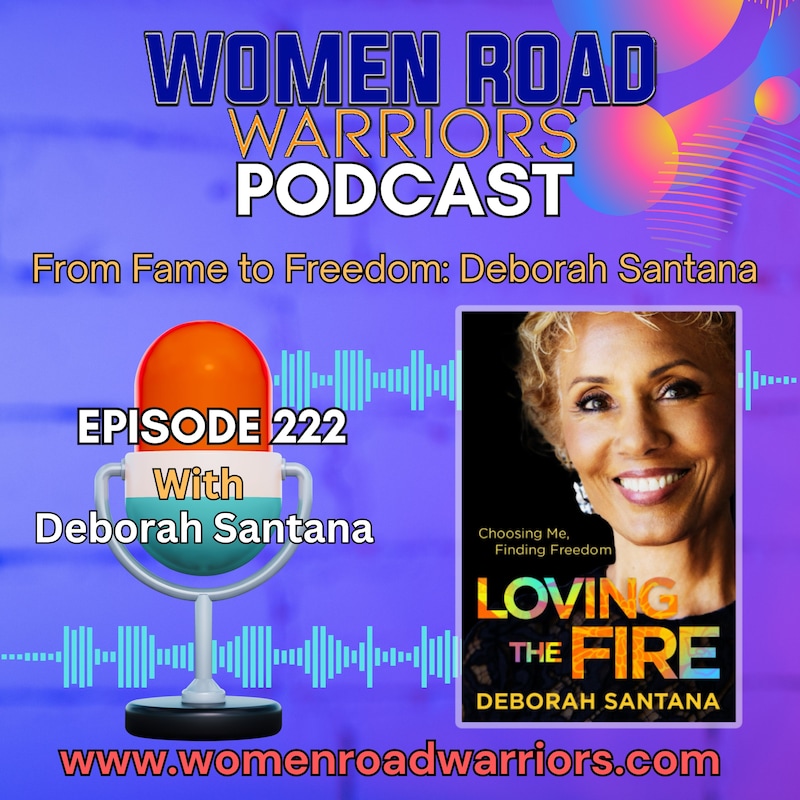
Shownotes
What does it truly mean for a woman to choose herself — after decades of devotion, visibility, and living at the center of global fame?
As we enter Women’s History Month, on this powerful episode of Women Road Warriors, Shelley Johnson and Kathy Tuccaro welcome Deborah Santana — author, activist, philanthropist, and former wife of legendary musician Carlos Santana. For 34 years, Deborah served as Vice President and Chief Operating Officer of Santana Management, helping steward an international music empire while raising three children in the spotlight of worldwide acclaim.
But her story is far deeper than celebrity.
Born into a lineage of Pentecostal preachers and acclaimed blues musicians, and raised in an interracial family during the Civil Rights era, Deborah carries generations of resilience, faith, and spiritual conviction. She is a visionary leader, lifelong spiritual seeker, and passionate advocate for women’s education in Africa through her foundation supporting women and girls in health, education, and happiness.
In her powerful memoir, Loving the Fire: Choosing Me, Finding Freedom, Deborah shares the deeply personal journey of reclaiming her voice after decades devoted to marriage, spiritual teachers, and roles that defined her identity.
This conversation explores:
- Identity beyond fame
- Ancestry and generational strength
- Spiritual awakening and self-discovery
- Leadership behind the scenes of a global brand
- The courage it takes for women to step out of the shadows and into sovereignty
At its heart, this episode asks a profound question:
What does freedom look like when a woman chooses herself?
If you are navigating reinvention, healing, spiritual growth, or redefining your own power — this conversation will resonate deeply.
https://deborahsantana.com/loving-the-fire
https://deborahsantana.com/do-a-little
#DeborahSantana #CarlosSantana #WomenRoadWarriors #WomensHistoryMonth #WomenEmpowerment #ShelleyJohnson #KathyTuccaro #SpiritualAwakening #LovingTheFires
Transcripts
This is Women Road warriors with Shelly Johnson and Kathy Tucaro.
Speaker A:From the corporate office to the cab of a truck, they're here to inspire and empower women in all professions.
Speaker A:So gear down, sit back and enjoy.
Speaker B:Welcome.
Speaker B:We're an award winning show dinner dedicated to empowering women in every profession through inspiring stories and expert insights.
Speaker B:No topics off limits.
Speaker B:On our show, we power women on the road to success with expert and celebrity interviews and information you need.
Speaker B:I'm Shelley.
Speaker C:And I'm Kathy.
Speaker B:Today we're honored to welcome Deborah Santana, author, activist, philanthropist, and former wife of legendary musician Carlos Santana.
Speaker B:For 34 years, Deborah lived at the center of global fame, serving as vice president and chief operating officer of Santana Management while raising three children and helping steward an international music empire.
Speaker B:Many people know her story through that lens, but her journey is far deeper and more profound.
Speaker B:Born into a lineage of Pentecostal preachers and acclaimed blues musicians, and raised in an interracial family during the civil rights era, Deborah carries generations of resilience, faith, and spiritual conviction.
Speaker B:She's been a visionary leader, a passionate advocate for women's education in Africa, and a lifelong spiritual seeker.
Speaker B:In her powerful new memoir, Loving the Fire, Choosing Finding Freedom, she shares the deeply personal journey of reclaiming her voice after decades of devotion to marriage, to spiritual teachers, and to roles that defined her.
Speaker B:It's a story about ancestry, identity, heartbreak, and ultimately the courage to choose oneself.
Speaker B:It asks a profound question.
Speaker B:What does freedom look like when a woman steps out of the shadows and into sovereignty?
Speaker B:Welcome, Deborah, thank you for being on the show with us.
Speaker B:We're really looking forward to talking with you.
Speaker D:Thank you so much, Shelley.
Speaker D:Thank you, Kathy.
Speaker C:Yes.
Speaker C:This is awesome.
Speaker C:I'm so excited.
Speaker B:Absolutely.
Speaker B:Deborah, you've had an amazing life that many people can they never experience.
Speaker B:You've been a powerhouse and a tremendous leader.
Speaker B:Plus, you were married to an international superstar, Carlos Santana, who I understand you met backstage at a Tower of Power concert.
Speaker B:Was that love at first sight?
Speaker B:I mean, he's so magnetic.
Speaker D:I think it was destiny.
Speaker D:I don't know that it was love at first sight, but we were young.
Speaker D:I was 22 and he was 25.
Speaker D:So in that time of life, I think you do sort of have love at first sight.
Speaker B:Yes, I think we do.
Speaker B:No doubt about that.
Speaker B:Well, I know our listeners would be curious because Carlos has been such an extraordinary icon who's revolutionized music.
Speaker B:What was it like living with someone so famous, with all the glamour and public attention?
Speaker B:I imagine it's easy to get lost in that whirlwind.
Speaker D:My father, Saunders King, was a famous musician, although a blues jazz musician.
Speaker D:And so my mother, Joe Francis, always taught us to live simply, not to be attracted by fame, and to always keep our morals and our values.
Speaker D:So I didn't go into this marriage thinking about that.
Speaker D:I got married because we fell in love.
Speaker D:But at the time, we had a spiritual guru, and the guru actually told us to get married.
Speaker D:I don't know that we would have gotten married if he hadn't told us to.
Speaker B:Were you attracted to him because of the music background that you've had in your family, you think?
Speaker D:Not at all.
Speaker D:I think I just was.
Speaker D:It was a attraction because you see someone and they draw your attention.
Speaker D:And I did know, though for a fact, that I wasn't overly impressed by his guitar playing, because my father played the guitar, and he played the guitar every day in our house.
Speaker D:So I think it was really a wonderful way to be with someone where I wasn't overwhelmed by the outer makings of his life.
Speaker D:I was really intrigued by our inner journey together.
Speaker B:Interesting.
Speaker B:Well, you've had some real powerful people in your life shaping your destiny in many ways.
Speaker B:Both your parents had a strong influence.
Speaker B:Your mother, strong feminist, and your father is a blues musician.
Speaker B:They were an interracial couple, and that was when it was illegal in many places.
Speaker B:So you saw a lot of adversity.
Speaker B:How would you say all of that shaped you?
Speaker D: was shaped by the News in the: Speaker D:And I had a very shy, sort of timid spirit.
Speaker D:So growing up in the church, and I grew up in our family's Pentecostal church as well as the Lutheran Church, my faith gave me the strength, and my parents certainly did, by their inner fortitude and their absolute dedication to living their lives as free people.
Speaker D:So I don't think that I was shaped so much by anything other than our home life and our values.
Speaker D:I was very innocent.
Speaker D:You know, I was a Girl Scout.
Speaker D:I was.
Speaker D:I was cheerleader.
Speaker D:I was on the debate team in high school.
Speaker D:I had a very normal, sort of lovely upbringing.
Speaker D:So when I moved into my adult life, I was not out of my element, but I was definitely not accustomed to being in those rooms.
Speaker B:You saw so many things in the era that you grew up.
Speaker B:Would you say that there was a lot of adversity?
Speaker B:Would that have also shaped you?
Speaker B:Because, I mean, there was so much injustice at the time.
Speaker D:Well, there was and there still is, I think.
Speaker D:What and What I've really been resonating with lately, because of all the unjustice and the unfairness and the division and the hatred that's going on now, I've been remembering, and sometimes I'll see a clip on Socials or something of the beautiful songs we used to sing, the freedom songs and the gospel songs and Joan Baez and Harry Belafonte.
Speaker D:And all of that brings a richness because we bonded together through the adversity, and we believed we would prevail.
Speaker D:And I think that's what we need now.
Speaker B:I agree.
Speaker C:I agree.
Speaker B:You know the music today.
Speaker B:I'm not sure the music has that message.
Speaker D:Well, I've been listening to this.
Speaker D:Well, I've been listening to the people who are singing in the churches in Minneapolis.
Speaker D:There's this song, hold on, and I won't try to sing it, but it's beautiful.
Speaker D:It's now sort of snaking its way across the country as a new song of freedom and a song of resistance.
Speaker D:And it's beautiful.
Speaker D:It just says, hold on, hold on.
Speaker D:It's just beautiful.
Speaker D:If you find it, please listen to it.
Speaker C:I've been listening to a lot of gospel lately.
Speaker C:Brandon Lake, you know him?
Speaker B:If you're.
Speaker D:No, I don't.
Speaker C:Oh, my gosh.
Speaker C:He came out with Jelly Roll, and they won Grammys for their song Hallelujah.
Speaker D:And.
Speaker C:And they won a Grammy for.
Speaker C:Oh, Geez.
Speaker C:What's his recent one?
Speaker C:Yeah, look him up.
Speaker C:And he's gonna be in Minneapolis.
Speaker C:He's doing a show April 26th.
Speaker C:And, I mean, I just happen to be in town, and he sells out every time.
Speaker C:He is amazing.
Speaker C:He's just a young guy, but all he sings is only worship music and I am in love.
Speaker C:His one song, gratitude.
Speaker D:Oh, my gosh.
Speaker D:Sorry.
Speaker C:I kind of went off on a tangent there.
Speaker C:Sorry.
Speaker D:When we're inspired, we get to go on tangents.
Speaker B:That's right.
Speaker D:Yeah.
Speaker B:Yeah.
Speaker D:Actually, you know.
Speaker D:Sorry.
Speaker C:When I saw Carlos in Edmonton, Alberta, with my best friend before she passed away, and we saw him, and I was so unbelievably inspired.
Speaker C:I must have seen about 50 concerts over my life, ranging all kinds of different genres.
Speaker C:But to listen to Carlo, I counted.
Speaker C:There was nine people on stage, nine different musicians, and he played for almost three hours, and it blew my mind.
Speaker D:Oh, my gosh.
Speaker D:What a show.
Speaker C:That's all I gotta say.
Speaker C:It's like I talk about, I left there and I was almost floating for three days.
Speaker B:That's neat.
Speaker B:Yeah, absolutely.
Speaker B:So, Deborah, when would you say that you kind of came into your own.
Speaker B:Was writing something that helped you really reclaim yourself in many ways?
Speaker D:I don't know that I ever really lost myself.
Speaker D:I just went through different iterations of who I was.
Speaker D:And I think when I was in my 20s, we didn't have children until I was in my 30s.
Speaker D:So in my 20s, we had the guru.
Speaker D:I was teaching meditation.
Speaker D:I had a vegetarian restaurant that I owned and managed.
Speaker D:I learned so much about being in the world as a spiritual seeker, but also a worker, as someone who brought food to people in San Francisco.
Speaker D:And I taught meditation, which was my service.
Speaker D:And then when we left that I came into another phase of life when I started bearing children in my 30s and loved every moment of having children and raising them and trying to give them the best education, music lessons, interacting with the road life and home life and my family, my parents.
Speaker D:So that was another type of.
Speaker D:And you, I'm sure you have had different iterations of your life.
Speaker D:And then when my children started growing older and when I was launching myself, I went back to college.
Speaker D:I finished my BA I got a master's degree.
Speaker D:We had a nonprofit.
Speaker D:So, you know, I had all these different sort of incarnations of one life.
Speaker D:And then I really felt that it was time for me to focus more on my life and not be in support to Carlos because he was on his own trajectory and I needed to write.
Speaker D:I wanted to be seen in the world as myself.
Speaker D:I wanted to plant my seeds of growth and watch them blossom.
Speaker D:So that's sort of how it went.
Speaker D:I didn't really come into myself.
Speaker D:I just kept growing and growing and growing.
Speaker B:That's important.
Speaker B:Not everybody grows.
Speaker A:Stay tuned for more of Women Road warriors coming up.
Speaker E:Dean Michael, the tax doctor here.
Speaker E:I have one question for you.
Speaker E:Do you want to stop worrying about the irs?
Speaker E:If the answer is yes, then look no further.
Speaker E:I've been around for years.
Speaker E:I've helped countless people across the country, and my success rate speaks for itself.
Speaker E:So now you know where to find good, honest help with your tax problems.
Speaker E:What are you waiting for?
Speaker E: -: Speaker E:And get your life back.
Speaker A:Welcome back to Women Road warriors with Shelly Johnson and Kathy Tucaro.
Speaker B:If you're enjoying this informative episode of Women Road Warriors, I wanted to mention Kathy and I explore all kinds of topics that will power you on the road to success.
Speaker B:We feature a lot of expert interviews, plus we feature celebrities and women who've been trailblazers.
Speaker B:Please check out our [email protected] and click on our episodes page.
Speaker B:We're also available wherever you listen to podcasts on all the major podcast channels like Spotify, Apple, YouTube, Amazon Music, Audible, you name it.
Speaker B:Check us out and bookmark our podcast.
Speaker B:Also, don't forget to follow us on social media.
Speaker B:We're on Twitter, Facebook, Instagram, Pinterest, LinkedIn, YouTube, and other sites.
Speaker B:And tell others about us.
Speaker B:We want to help as many women as possible.
Speaker B:We're honored to be talking with Deborah Santana, author, activist, philanthropist, and for 34 years, a central force behind the Carlos Santana global music empire, while she raised three children with Carlos.
Speaker B:But today, we're going far beyond the spotlight.
Speaker B:In her powerful memoir, Loving the Fire, Choosing Me, Finding Freedom, Deborah opens up about ancestry, identity, heartbreak, and the courage it takes to reclaim your own voice.
Speaker B:So what does freedom really look like when a woman steps into her sovereignty?
Speaker B:Let's dive back in.
Speaker B:Deborah, you've been a powerhouse in so many ways, and spirituality that's been pretty central to your life.
Speaker B:Would you say that that's really something that empowers us in a different way?
Speaker B:I mean, I think too many people try to make their own decisions and they don't realize the full depths of who they are and how important spirituality really is.
Speaker D:That's so true.
Speaker D:You know, I think that also I grew through spirituality also because when I was younger, I was very strict in following the Christian tenants and everything that I've been taught as a child.
Speaker D:And then, of course, when we had a guru, I started meditating.
Speaker D:And then I think I started listening more to my inner being because I believe spirit is everywhere.
Speaker D:I have a much more indigenous belief system that spirit is in nature and in each being and in the earth and in the sky.
Speaker D:And I do believe that I function much better when I have meditated and I have grounded myself in my inner voice, because spirit speaks through us.
Speaker D:It can also speak through others, to us.
Speaker D:But my grounding is in feeling connected to the highest essence of life.
Speaker B:That's important.
Speaker B:That carries us, doesn't it?
Speaker B:I mean, you talk about loving the fire, the fire, the trials, humiliation, various other things that can happen in life that carries us through that, doesn't it?
Speaker D:Absolutely.
Speaker D:You know, I don't think anyone gets through life without tremendous sorrow and loss.
Speaker D:It's a part of life.
Speaker D:And as I've studied different religious messages and teachers and doctrines I have resonated with many, many thoughts in all of them.
Speaker D:And one of the things that I really try to do is be in this body now.
Speaker D:I try not to go back and spend my time in the past because sometimes that's harmful and it'll just keep me in the past, which I don't want to be there.
Speaker D:And I try not to go too far in the future of worry or anything.
Speaker D:So to be in my grounded.
Speaker D:Being right here is really a meditative practice.
Speaker D:And it's a little bit leaning more towards Buddhism, maybe, but I just think it's universal.
Speaker B:How do people do that?
Speaker B:I'm not sure people know how.
Speaker B:Not everybody.
Speaker D:That's true.
Speaker D:And I don't think that everyone wants to.
Speaker D:Some people are very content being in the world and working and going out and having a great time.
Speaker D:And everyone has a different way that they choose to live.
Speaker D:I've always had a little bit more of a contemplative side.
Speaker D:I've never really been a partier, so I lean towards silence and introspection.
Speaker D:But I also believe that everybody has to go through life their own way.
Speaker D:Life is a school.
Speaker D:We're each here to learn, and no one can tell another person how to do the walk.
Speaker B:Life is definitely a school.
Speaker B:And sometimes we feel like we've been stuck in the principal's office because we've been bad or something.
Speaker B:Things happen.
Speaker B:You're just kind of like Willow, Hard knocks.
Speaker B:Yes, I like that.
Speaker B:The school of hard knocks.
Speaker B:That's right.
Speaker B:And to have the spirituality that can really carry you through because you can
Speaker C:get so discouraged, you know, if I didn't have.
Speaker C:And not just myself, but from speaking with literally thousands of people around the world over the last 10 years, the common denominator I find is.
Speaker C:Is spirituality.
Speaker C:Faith is what keeps people moving.
Speaker C:I know personally I would.
Speaker C:I should be dead 10 times over.
Speaker C:And if I did not have my faith and if I did not have my meditation every day, you know, singing my.
Speaker C:My word hu.
Speaker C:Doing what I need to do and having these incredible spiritual dreams that have shown me what I needed to do and help me at my darkest moments, I wouldn't be alive.
Speaker C:And so people around the world have that faith.
Speaker B:It's all.
Speaker C:It's like the common denominator for people.
Speaker C:And I think the more you tap into your own divinity, the.
Speaker C:Not the easier life gets.
Speaker C:But I think your awareness expands and your.
Speaker C:You don't become as complacent and you don't become as negative, because how can you be negative when you have the beautiful light of God living within you, you know, or.
Speaker C:Or just that
Speaker D:the way of looking
Speaker C:at the world through different lens than most people.
Speaker D:I love that.
Speaker D:Well, that's certainly been my next.
Speaker D:My experience.
Speaker D:I named our third daughter.
Speaker D:Her middle name is Faith and I live by faith.
Speaker D:And there it's so to me, it's a blessing and a gift that I've never lost my faith because I think that life does give people hard experiences.
Speaker D:And sometimes it's hard to hold onto your faith in something divine when life is sort of raking you over the coals.
Speaker D:So I just feel like I'm really blessed to be able to still have that faith.
Speaker D:And when times have been hard, I just really wait.
Speaker D:I wait for things to pass.
Speaker D:This too shall pass.
Speaker D:And I've just been really gifted.
Speaker D:But in the moment I experience it all, I have felt it all, but I just let.
Speaker D:I don't know how I'm able to let go, but so far, and I'm almost want to knock on wood, but I don't want to make noise for the podcast, but so far I've been able to maintain my faith in spirit.
Speaker B:You have some interesting and wonderful inspirational statements in your book.
Speaker B:I would rather be alone than compromise my soul.
Speaker B:Everything ends, everything begins anew.
Speaker B:Those are some powerful thoughts because I don't think that people sometimes they're lost and they don't always think about those things.
Speaker B:It seems like you have had a wonderful insight into life most of your life, haven't you?
Speaker D:I don't know.
Speaker D:I definitely have it now and I think that's one of the parts of life that we can look forward to if we're fortunate enough to age.
Speaker D:That if we want wisdom, wisdom will come.
Speaker D:Because not only do we have a life experience, but if we have a faith based life, then we've also got all of the miracles we've heard about.
Speaker D:I mean, my grandparents had miracles they talked about in our church.
Speaker D:They talked about people who had been given poison and didn't fall dead.
Speaker D:You know, I mean every.
Speaker D:There are so many miracles that people experience.
Speaker D:And one of the things you said earlier, Kathy, about all the thousands of people you've spoken to and that faith is sort of the base.
Speaker D:I also really love being in the company of believers.
Speaker D:And it doesn't have to be what I believe, just when people have that sense of truth that they believe something outside of themselves, I just find it so sweet.
Speaker C:I agree, I agree.
Speaker B:It's so important and you know, if we don't have something that's going to keep us grounded.
Speaker B:I'm not sure we really have a direction.
Speaker B:And it seems like today a lot of people wander around aimlessly and of course then they're on social media and they're looking at things in 15 seconds segments.
Speaker B:It doesn't feel like life.
Speaker B:Like you were saying the songs that were sung when you were younger.
Speaker B:We had more purpose, didn't we?
Speaker D:I think we didn't have so much as an onslaught to our minds and our beings.
Speaker D:I mean, now, I mean, I'm guilty of it.
Speaker D:I will scroll.
Speaker D:I'm on Instagram.
Speaker D:I get some of my inspiration from seeing other people's stories.
Speaker D:But we are now so addicted to being connected all the time that to unplug, that's a big thing.
Speaker D:I mean, people write about it.
Speaker D:Oh, I didn't turn anything on.
Speaker D:I read a friend of mine said I went on a vacation and I read three books.
Speaker D:I mean, those are things that we did just naturally before, right?
Speaker B:Yeah.
Speaker D:So the world just continues to change.
Speaker D:And as it changes, what do we embrace?
Speaker D:What do we not embrace?
Speaker D:What do we hold onto from the past?
Speaker D:It's always a juggling.
Speaker D:And each individual has make that choice based on their values and what they want for their lives.
Speaker D:I want to be able to be in silence.
Speaker D:I want to go in my backyard and just hear the birds.
Speaker D:That's just who I am.
Speaker D:And other people want to have the cacophony of life blaring all the time.
Speaker D:You know when you drive by somebody in their car and they've got the bass and the music up so loud that you can.
Speaker D:Your heart's vibrating in your car.
Speaker D:So again, yeah, some people just need that maybe to make them feel alive, I'm not sure.
Speaker B:Or to show off.
Speaker C:I know that me personally, like Dorit just.
Speaker C:I think it was two days ago I was reading just a short blurb about the still point and I've never heard that term before.
Speaker C:And the still point is where you go inside yourself and it's that moment when you're able to shut everything out and even like it becomes so peaceful.
Speaker C:And that is where you meet God.
Speaker C:And I love that.
Speaker C:And I'm like, I never heard it being called the still point.
Speaker C:So I've been trying to reach that still point.
Speaker C:I mean, I've been meditating for years and I make sure I do it, you know, 20 minutes a day.
Speaker C:It's very important to me.
Speaker C:And so.
Speaker C:But I've never tried to really connect
Speaker D:to that still point.
Speaker C:So that's my goal.
Speaker D:I Love that.
Speaker D:I haven't heard that before either.
Speaker D:I'm going to think about that when I sit down and meditate tomorrow morning.
Speaker D:And it was from.
Speaker C:Oh, here it is.
Speaker D:Hang on.
Speaker D:It is.
Speaker C:I'm just rereading.
Speaker C:The prayer of silence is better known today as centering prayer.
Speaker C:It's a replay from Thomas Merton, a Trappist monk who authored a number of inspiring religious books.
Speaker C:He picked up on the old existentialist idea of going to the center of one's being, then passing through it to the heart of God, the still point.
Speaker D:So Thomas Merton, he is a beautiful writer and his beautiful experiences.
Speaker D:Oh, you know him?
Speaker D:Yes.
Speaker D:He's passed on to glory.
Speaker D:But yes, I know a. I know.
Speaker D:Yes, yes.
Speaker B:When you think about it, stillness, you're listening.
Speaker B:When we're always activated, we're not really listening.
Speaker B:And I think, Deborah, that that's where you have a lot of strength and you've gone through a lot of different iterations of your life.
Speaker B:And certainly you've been a wonderful leader with everything that you've done.
Speaker B:You've influenced so many people, and I think you've done a lot in terms of teaching people about service.
Speaker D:Thank you.
Speaker D:Well, I've learned from the greatest.
Speaker D:We're so fortunate that we were able to work with artists for New South Africa and work to end apartheid in South Africa.
Speaker D: the beautiful opportunity in: Speaker D:And then we were able to sit at Nelson Mandela's feet and reading about those amazing activists, life changers, dedicated human beings to freedom for all.
Speaker D:You can't help but be inspired and touched by their wisdom and by their lives.
Speaker B:And you're living it yourself.
Speaker B:You've worked with the Daraja Academy, to the Smithsonian National Museum of African American History and Culture.
Speaker B:You've done so many things.
Speaker B:It's been just marvelous.
Speaker A:Stay tuned for more of Women Roadblocks warriors coming up.
Speaker E:Dean Michael, the tax doctor here.
Speaker E:I have one question for you.
Speaker E:Do you want to stop worrying about the irs?
Speaker E:If the answer is yes, then look no further.
Speaker E:I've been around for years.
Speaker E:I've helped countless people across the country, and my success rate speaks for itself.
Speaker E:So now you know where to find good, honest help with your tax problems.
Speaker E:What are you waiting for?
Speaker E: -: Speaker A:Welcome back to Women Road warriors with Shelly Johnson and Kathy Tucaro.
Speaker B:Our guest today is the extraordinary Deborah Santana.
Speaker B:Many people know her as the former wife of legendary musician Carlos Santana.
Speaker B:But her story is so much deeper than fame.
Speaker B:Raised in an interracial family during the civil rights era and rooted in a lineage of Pentecostal preachers and blues musicians, Deborah carries generations of resilience and spiritual conviction.
Speaker B:In her memoir, Loving the Fire, Choosing Me, Finding Freedom, she shares what it means to step out of the shadows and into self definition.
Speaker B:This conversation's powerful.
Speaker B:Let's continue.
Speaker B:Deborah, in your book, you're revealing how a life devoted to service can really evolve into one that's rooted in truth, wholeness, and fulfillment.
Speaker B:I mean, there's so many messages in this book that you have.
Speaker B:It's very empowering.
Speaker D:Thank you so much.
Speaker D:And you know, the ultimate is that when I'm serving, I have joy and I get to be involved.
Speaker D:Now with, there's an upcoming museum in San Francisco called the Courage Museum, and it's a place that's going to have scientific research and classes for high school students to teach non violence.
Speaker D:This does not have to be a violent world.
Speaker D:We can actually change the way we think and hopefully impact others so that we can create a world, a future without violence.
Speaker D:So I get all these amazing opportunities.
Speaker D:Who am I to be so lucky, right?
Speaker B:That is one.
Speaker C:You are amazing.
Speaker B:You are.
Speaker C:But, you know, anybody can take the time and do something.
Speaker C: d Operation hydration back in: Speaker C:And I lost everything I owned.
Speaker C:And I realized that homeless people didn't get, have access to water.
Speaker C:So when I got this amazing job and I'm like, oh my God, they're thirsty when it's hot.
Speaker C:So I started going out in the alleys.
Speaker C:I bought seven cases of water.
Speaker C:I bought coolers, I got ice and put the, you know, the water in the, in the ice.
Speaker C:And I drove around and I had put stickers on free water.
Speaker C:Operation Hydration, my daughter named it.
Speaker C:And I do that in every single city that I go to.
Speaker C:I don't care where I am.
Speaker C:I get, I do my Operation Hydration.
Speaker C:And people say, oh, you know, you're
Speaker D:so lucky you get to do that.
Speaker C:No, anybody can do it.
Speaker C:Anybody can do whatever you want as service to the, to the human race.
Speaker C:You just have to take the time to do it.
Speaker C:I mean, I spend 50 bucks and who cares, right?
Speaker C:Like, it's nothing.
Speaker C:But it means so much.
Speaker D:Yeah, that's so wonderful.
Speaker D:But you're also thinking of someone other than yourself.
Speaker D:So I think a big part.
Speaker D:Some of.
Speaker D:I think it's so wonderful that you've been gifted this heart to think of others and.
Speaker D:Yeah, to think of something that.
Speaker D:I mean, that's why I named my foundation Do A Little.
Speaker D:Because what Archbishop Tutu said was, do your little bit of good wherever you are.
Speaker D:It's those little bits put together that overwhelm our world.
Speaker D:Anybody.
Speaker D:And that's what I always say.
Speaker D:I'm just doing a little, you know, that's my.
Speaker C:I love that.
Speaker D:And we can.
Speaker D:You're right.
Speaker D:We can all do a little.
Speaker B:Kathy so what does your foundation do for people who may not be familiar with it?
Speaker D:Well, I serve women and girls in the areas of health, education and happiness.
Speaker D:I don't take really people submitting to receive a grant because I have so many that I already support.
Speaker D: e had my foundation now since: Speaker D: orted probably since I think,: Speaker D:And I've watched them grow from a school outside of Nairobi.
Speaker D:It's in three hours outside of Nairobi.
Speaker D:And it went from this little school with 10 roofs and simple rooms and classrooms and a tiny Library to with 26 girls to now they just, I think they have 300 girls.
Speaker D:They've moved, they've raised funds and built a whole new campus.
Speaker D:And to watch something like that and stay with it.
Speaker D:I'm not the only donor, but I'm part of the community and that's what Do A little does.
Speaker D:I try to get involved with something that's going to help other people's lives, and then I try to stick with it.
Speaker B:Doing a little.
Speaker C:Beautiful.
Speaker B:It is very beautiful.
Speaker B:Doing a little bit every day.
Speaker B:If we all did that, can you imagine the logarithm, the wave we created?
Speaker D:It's a ripple effect.
Speaker D:It is, yes.
Speaker B:And maybe I'm just, I'm not trying to be skeptical, but it does seem that we've got a lot of people, especially with the social media.
Speaker B:They're more focused on themselves instead of extending out.
Speaker B:If you aren't giving, you really aren't living.
Speaker D:Well, I think that that's what our culture, our country really has promoted.
Speaker D:And certainly we're in a corporate culture that looks at earning as the ultimate goal.
Speaker D:And the more I can have for myself, then I'm going to be the best.
Speaker D:And so I think it really takes a Different way of being raised or being exposed to different ways of being.
Speaker D:And that's something that hopefully young people can.
Speaker D:There are a lot of people who follow that.
Speaker D:There are a lot of young people who are environmentalists and care about the Earth and care about the use of the overuse of plastic that's just clogging our oceans.
Speaker D:There are so many people doing good things in this world.
Speaker D:I, a member of Plastic Pollution Coalition, and this beautiful woman, Diana Cohen, started this at least 20 years ago, educating people that the more plastic we use is just going into the oceans and birds and fish and whales are eating it and dying.
Speaker D:So there are so many people who are doing something great.
Speaker D:We just have to want to care.
Speaker B:Yeah, so true.
Speaker B:We do need to care.
Speaker B:Deborah, you've had a very rich ancestry and upbringing that I think really shaped you into a wonderful person.
Speaker B:You learned courage and spirituality.
Speaker B:You describe your grandmother as bulletproof.
Speaker B:How much of your courage do you think is inherited?
Speaker D:Oh, gosh, I think a lot of it.
Speaker D:Both of my grandmothers were pretty remarkable.
Speaker D:So that's my African American side.
Speaker D:My grandmother, Sarah Anna Celestine King, and she grew up in Louisiana, and she and my grandfather were converts to Christianity early on.
Speaker D:And then they built their own church.
Speaker D:And when they moved to Oroville in California, she was shot in the stomach by white ranchers who didn't like the way they played the tambourines and sang and they just shot through the windows.
Speaker D:And my grandmother was struck in the stomach.
Speaker D:And that's why I call her Bulletproof, because of course she came out of that and continued to teach and preach, although they moved the church to Oakland.
Speaker D:And my grandmother on my English, Irish, Scottish side, my mom's mom, was just formidable.
Speaker D:I mean, she left home when she was 14 to marry this man because she just wanted to get away from her home.
Speaker D:And she bore five girls and sewed all their clothes and they went to school.
Speaker D:They lived in Casa Grande, Arizona, and I mean, she did everything.
Speaker D:So their example has definitely informed me because life was so much harder then.
Speaker D:I basically am cruisin compared to my grandmother's.
Speaker B:But what wonderful examples.
Speaker B:Yes, we do have it much easier today.
Speaker B:In many ways.
Speaker B:Just day to day work many, many years ago was you were working constantly as soon as you.
Speaker B:Your feet hit the floor when you got out of bed.
Speaker B:And not to mention all of the adversities that you'd experience in life.
Speaker B:So that gave you a really wonderful foundation.
Speaker B:But your book is really about your metamorphosis and it has a wonderful message.
Speaker B:What would you say is the overall theme of your memoir?
Speaker D:I think the overall theme is you cannot live another person's life.
Speaker D:One must find their own way, their own intention, their own goals and their own path.
Speaker D:And along the way that we must stay in tune with ourselves, stay grounded, stay open and in loving relationship with all people, knowing that every person carries a nugget of truth and that every person is here for a reason, just like we are.
Speaker D:I think respect is such an important part of my belief system.
Speaker D:I really try to respect other people even if they don't think the same way I do, which is really hard because of course, we want to be around people who agree with us.
Speaker D:But that's not really what I want to do.
Speaker D:I want to be able to be in community with all people.
Speaker D:And I think the theme of identity and resilience are gonna always carry through for me.
Speaker D:And I think it's not an identity of outer characteristics.
Speaker D:It's an identity of who I am inside.
Speaker D:What do I believe, what do I want to do with my life?
Speaker D:And how can I do that?
Speaker C:That requires a lot of self reflection and self awareness.
Speaker C:And I love that about just listening.
Speaker C:I see a beautiful human being, a beautiful soul that just shines everywhere she goes.
Speaker D:And I love that.
Speaker C:So thank you.
Speaker D:So kind.
Speaker D:Thank you.
Speaker D:You know, when I had my restaurant, I was 23, I was in my 20s, and I.
Speaker D:It was a vegetarian restaurant in San Francisco.
Speaker D:And I had all these.
Speaker D:I mean, I was young, but I considered the other people who were working that I hired, I just felt they were so young.
Speaker D:And I would work through the day and I would, you know, I didn't do the chef work, I did the.
Speaker D:I like, I did the cash register.
Speaker D:So I would bring people up and interact with our neighbors.
Speaker D:And at the end of the day, every night when I would get in bed, I would go over my day and I would think about what I did great, what I did that was not so great.
Speaker D:And it's sort of not really.
Speaker D:It's self reflection in a different way.
Speaker D:Like, what did I do?
Speaker D:What can I do better?
Speaker D:And I have a kind of a big sense of wanting to do things right and not being able to really let myself fall or trip or hurt someone else.
Speaker D:And I had to really learn that I'm just a human being.
Speaker D:And so at the end of the day, what did I do well and what do I want to do better tomorrow?
Speaker B:That's a good perspective.
Speaker A:Stay tuned for more of women Roadblock warriors coming up.
Speaker E:Dean, Michael, the tax doctor here.
Speaker E:I have one question for you.
Speaker E:Do you want to stop worrying about the irs?
Speaker E:If the answer is yes, then look no further.
Speaker E:I've been around for years.
Speaker E:I've helped countless people across the country, and my success rate speaks for itself.
Speaker E:So now you know where to find good, honest help with your tax problems.
Speaker E:What are you waiting for?
Speaker E: -: Speaker A:Welcome back to Women Road warriors with Shelly Johnson and Kathy Tucaro.
Speaker B:We're back with Deborah Santana, visionary leader, advocate for women's education in Africa, lifelong spiritual seeker, and now author of a new memoir.
Speaker B:After decades devoted to marriage, spiritual teachers and the roles that defined her, Deborah made the courageous choice to choose herself.
Speaker B:Her new book, Loving the Fire, Choosing Finding Freedom, is a deeply personal journey of reclaiming identity and rediscovering freedom.
Speaker B:It has nuggets and takeaways we can all use.
Speaker B:If you've ever wondered what it really takes to step fully into your own power, stay with us.
Speaker B:This is where it gets real.
Speaker B:Deborah, the message in your book really talks about finding yourself, not losing yourself, because women, I think they can get lost.
Speaker B:We're so busy taking care of other people, we can get lost in somebody else's life and the ability to find our own sovereignty and our own power.
Speaker B:And certainly spirituality helps that, too.
Speaker B:So, I mean, you have some powerful messages.
Speaker D:Thank you.
Speaker D:Yes.
Speaker D:Well, you know, I learned the hard way when I had the restaurant.
Speaker D:And then later we took over the management of the band.
Speaker D:And I mean, by taking over, we just stopped letting other people manage.
Speaker D:But we hired amazing, capable people to lead the organization and work with accountants and attorneys.
Speaker D:But when I did that, I realized that, you know, you have to have a sense of responsibility, and I don't let down.
Speaker D:So I have a very high standard.
Speaker D:And yet I see so many women who were trying to do it all right.
Speaker D:We want to be in the workplace.
Speaker D:We want to be great mothers if we have that opportunity to mother, we want to be great partners.
Speaker D:And in our society in the past, it was that no men could just work and then women had to do everything else.
Speaker D:So it's this gradual change.
Speaker D:Hopefully, it's changing for the younger people, too, where you don't have to be at all or do it all.
Speaker D:You can really demand that 50, 50 partnership or not go into anything Unless there's an equal understanding of how it's going to work.
Speaker D:But it's very hard to be balanced.
Speaker D:And balance is something that is just difficult to do.
Speaker D:I mean, I think of the clown on the plank and the rolling on the barrel.
Speaker D:It's very hard to get balanced.
Speaker D:And yet I, for some reason, keep trying to become that balanced person.
Speaker D:But it's hard.
Speaker B:It really is.
Speaker B:Women, they work like crazy.
Speaker B:I mean, they work all day, they come home, they do more work.
Speaker B:And has it really changed since pioneer times?
Speaker B:Women did that then or even before that.
Speaker B:We really, really, really take on a lot.
Speaker B:And having that balance and having the ability to say, look, I need some help, you know, to be acknowledged.
Speaker B:When somebody helps you, they're acknowledging you, they're respecting you.
Speaker B:Like you were talking about respect.
Speaker D:I hope it's.
Speaker D:You know, I can't look at everyone, and I certainly don't have my finger on the pulse of all women, but there are so many women who are remarkable and who are doing what they love and also choosing to have the life that they want to live.
Speaker D:And everybody comes to a crossroads.
Speaker D:I really don't think that anything, as you quoted from my book, nothing lasts forever.
Speaker D:We grow, we evolve, and what worked for us 10 years ago May not work for us anymore.
Speaker D:So it's being able to see where we are, look at what is in balance and what may be out of balance, and then ask for guidance, pray for guidance, and acknowledge what's not working when it's not working.
Speaker D:That takes up a little bit of slowing down to do also.
Speaker D:And then it takes a tremendous amount of bravery to call it what it is.
Speaker B:Absolutely.
Speaker B:Your book offers a lot of different things for people.
Speaker B:Certainly, it gives people a perspective of what it was like to be married to Carlo Santana and how you evolved and what that world was all about.
Speaker B:And people can really see the metamorphosis and find hope in that.
Speaker B:You're a woman that's stepping out of the shadow into sovereign light, which is something I don't think all women know how to do.
Speaker B:They want to maybe achieve that.
Speaker B:Some don't even think about it.
Speaker B:So this gives people a real perspective and a lot of takeaways.
Speaker D:Thank you.
Speaker D:I hope so.
Speaker D:That was my goal.
Speaker D:My intention is really to just show how I've done it.
Speaker D:One of my intentions when I was.
Speaker D:I've been wrestling with this book for a long time, because when I published Space between the Stars, and that was 20 years ago, and that was my first memoir, which really talks a lot more about my life with Carlos.
Speaker D:This book is more about my life with me.
Speaker D:But when I stepped into that life and into my being now, I really wanted my children to know who I am.
Speaker D:You know, you raise your children and they see you as one thing, even though they're watching and they have some experiences with you.
Speaker D:But I really wrote this one book so that my children would know what I've been through.
Speaker D:They're adults now, and they know a lot of it, but they don't know what I felt.
Speaker D:I was one of those parents, and I think maybe because my mom was like this, she didn't share a lot.
Speaker D:She just went through her life and she shared what she wanted us to know, but she didn't share what was going on inside of her.
Speaker D:And I think I raised my children like that also.
Speaker D:I tried to keep everything together, or I thought I did.
Speaker D:I don't know.
Speaker D:Sometimes my son Salvador tells me, I knew when this was going on, but in general, I try kind of keep them away from any turmoil.
Speaker D:And so I want them to see the beauty of my life.
Speaker D:And that was one of my intentions, to write this memoir.
Speaker B:It's kind of the protective mechanism that mothers have with their children, but certainly for children to actually look at their parents.
Speaker B:I mean, we do growing up, we think of them as parents.
Speaker B:I'm not sure we think of them as humans.
Speaker B:It's mom and dad and that kind of thing.
Speaker C:That's right.
Speaker D:That's right.
Speaker B:You know, you can't imagine your parents having fun running around, playing in the snow, doing snow angels, doing some of the things that kids do at a young age.
Speaker B:We think of them as parents.
Speaker B:And so, yes, it brings in the human perspective.
Speaker B:And it's a wonderful heirloom for your children, too.
Speaker D:I hope so.
Speaker D:I hope so.
Speaker D:I hope they want to read it.
Speaker D:You know, it's interesting because they're just not as interested in us as we are in them.
Speaker D:But I just learned so much from my adult children.
Speaker D:They're really my best buddies.
Speaker D:And I don't mean that in terms of hanging out, but I mean, I really admire them and want to be more in their company.
Speaker D:And so I hope that they get something from my memoir that shows them how I did it.
Speaker B:That's an important thing.
Speaker B:I think a lot of people can get a lot of out of your book.
Speaker B:Where do people find your book?
Speaker B:Online and in the bookstores.
Speaker D:Yes.
Speaker D:Well, right now it's a pre order because it's not going to be on the bookshelves until April 21.
Speaker D:But if people go to my website, debrasantana.com there is a pre order button on the front page of my website and so it can be pre ordered and I will personalize it if you pre order it from my website now.
Speaker D:And then there will be, hopefully it'll be in all the bookstores, but there's some other locations online, bookshop.org, barnes Noble, and of course, Amazon.
Speaker B:Wonderful.
Speaker B:And the book is called Loving the Fire, Choosing Me, Finding Freedom.
Speaker B:This is terrific.
Speaker B:People get to know you, which is really important because you're an amazing lady.
Speaker C:Yeah, you are.
Speaker D:Thank you.
Speaker D:You're both amazing.
Speaker D:And thank you so much for having me on.
Speaker D:I just feel that when we share our stories, we can change another person's life with something that comes from the heart.
Speaker D:And people need encouragement and inspiration.
Speaker D:So I thank both of you for doing that every day.
Speaker B:Thank you so much, Deborah.
Speaker B:Thank you.
Speaker B:Is.
Speaker B:Is there a nugget you could share with our listeners?
Speaker B:We primarily have women listening on.
Speaker B:Maybe some encouragement and empowerment for women.
Speaker D:Hmm.
Speaker D:I have at the end of my book, this thing that calls how to.
Speaker D:It says how to walk through fire.
Speaker D:And it's two pages of How I Walked through My Fire.
Speaker D:And one of the things I really love, and I did this a few years ago with Louise Hay, has a book that is called Mirror Work.
Speaker D:And it shows you, takes you to your mirror every single day for a few minutes.
Speaker D:I had never done that before.
Speaker D:I mean, it's really hard to look at yourself in the mirror.
Speaker D:I don't know if you.
Speaker D:I mean, when we're putting on makeup or something.
Speaker D:That's different.
Speaker D:Look yourself in the eye.
Speaker D:So.
Speaker B:Yep.
Speaker D:So this is what I have to say to women.
Speaker D:There is a reason, a very special reason you're here.
Speaker D:Have you leaned in close to a mirror and stared into your eyes?
Speaker D:Stood naked in your full length reflection and smiled?
Speaker D:Spread your arms and thrown your head back to the sky.
Speaker D:Do you love the strong curve of your back?
Speaker D:It is good to know who you are.
Speaker D:Without fear, without fences, without the rattle of human striving and misplaced desire.
Speaker D:Life brings suffering.
Speaker D:The root of survival is courage.
Speaker D:Bend with the pain.
Speaker D:See the light the kind another person's cloud.
Speaker D:Life beats from within.
Speaker C:Wow.
Speaker B:That's beautiful.
Speaker C:That's powerful.
Speaker B:Yes, it is.
Speaker D:Wow.
Speaker B:Thank you for sharing that, Deborah.
Speaker B:There's so much in there.
Speaker B:It's very true.
Speaker D:Thank you.
Speaker B:That's very empowering.
Speaker B:Deborah, it's been an absolute honor having you on the show.
Speaker C:It has.
Speaker C:Wow.
Speaker C:You're an amazing human being.
Speaker C:And this has been just a wonderful, precious 45 minutes.
Speaker D:Thank you.
Speaker D:Yes, thank you, Kathy.
Speaker D:Thank you, Shelly.
Speaker D:I appreciate you.
Speaker D:And may you walk in your own power, ladies.
Speaker B:Thank you.
Speaker B:You too.
Speaker B:You're a wonderful example of that.
Speaker D:Thank you.
Speaker B:We hope you've enjoyed this latest episode.
Speaker B:And if you want to hear more episodes of Women Road warriors or learn more about our show, be sure to check out womenroadwarriors.com and please follow us on social media.
Speaker B:And don't forget to subscribe to our podcast on our website.
Speaker B:We also have a selection of podcasts just for women.
Speaker B:There are a series of podcasts from different podcasters, so if you're in the mood for women's podcasts, just click the Power network tab on womenroadwarriors.com youm'll have a variety of shows to listen to anytime you want to.
Speaker B:Podcasts Made for Women Women Road warriors is on all the major podcast channels like Apple, Spotify, Amazon, Audible, YouTube and others.
Speaker B:Check us out and please follow us wherever you listen to podcasts.
Speaker B:Thanks for listening.
Speaker A:You've been listening to Women Road warriors with Shelly Johnson and Kathy Tucaro.
Speaker A:If you want to be a guest on the show or have a topic or feedback, email [email protected].




