Shownotes
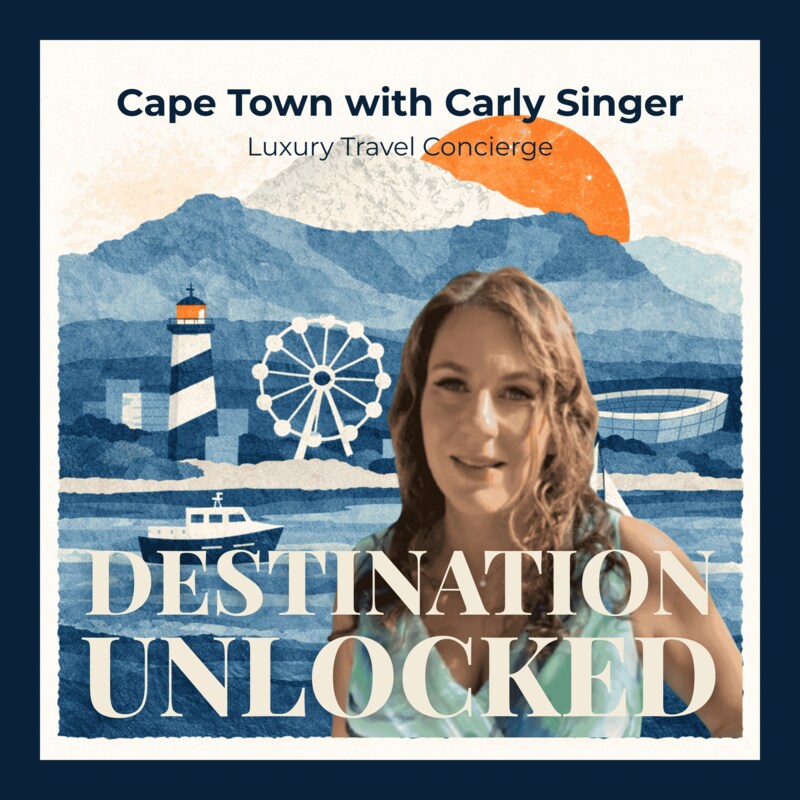
Carly Singer joins us to share her expert insights on the stunning landscapes and rich experiences to be found in Cape Town and the Garden Route of South Africa. From breath-taking hikes up Table Mountain to the vibrant atmosphere of the V&A Waterfront, Carly paints a vivid picture of the region's must-see spots and hidden gems. We dive into the luxury travel experiences she curates, emphasizing the unique blend of culture, wildlife, and gastronomy that South Africa offers. Plus, if you're considering a safari, Carly shares her recommendations on private game reserves that provide an intimate encounter with the Big Five. Whether you're a seasoned traveler or planning your first adventure, you're bound to find inspiration in our conversation about this incredible destination.
Transcripts
Welcome to Destination Unlocked with me, Daniel Edward.
Speaker A:Destination Unlocked is the chatty travel podcast where in each episode I'm joined by a top traveler who shares somewhere in their world with us.
Speaker A:Today we're joined by Carly Singer who is a travel concierge for corporate and luxury clients and she's sharing with us her experiences of Cape Town and the garden route in South Africa.
Speaker A:Within the conversation she also draws on her personal travel experiences as a travel agent and concierge and tells us how she even got into that to begin with.
Speaker B:I hope you enjoy.
Speaker B:So Carly, where are you unlocking for us today?
Speaker C:I am going to unlock Cape Town, the garden route and some of the private game reserves.
Speaker C:South Africa is the ultimate destination for a combination holiday of luxury, beach city, animals, culture, the full shebang really.
Speaker B:It's been on my list and I've not yet made it.
Speaker B:So I am already particularly interested to find out why people should go there.
Speaker B:Let's start in Cape Town itself.
Speaker B:Where should we head and what should we do?
Speaker B:Straight away in Cape Town I would.
Speaker C:Recommend a two to two and a half week itinerary within this area.
Speaker C:Flying into Cape Town I'd probably recommend four, five days, something like that.
Speaker C:In Cape Town you've obviously got Table Mountain to hike up or cable car.
Speaker C:You've got Robben island where Nelson Mandela was imprisoned.
Speaker C:You've got Boulders beach where you can see the penguin colonies.
Speaker C:You've got the Cape of Good Hope which is where the Indian Ocean and the Atlantic Ocean meet and it's stunning views.
Speaker C:The main sort of touristic and popular area to stay is the VA the Victoria and Alfred waterfront which offers that beautiful views of the Table Mountains.
Speaker C:There's a huge shopping mall there and there's just so much going on around there.
Speaker C:So that's generally where you would start as your base point.
Speaker B:And are you recommending a specific area to stay in hotel wise?
Speaker C:Yeah.
Speaker C:So the V and a Victorian Alfred waterfront is the most popular.
Speaker C:I would say it is generally the most expensive as well.
Speaker C:There's a few other areas that you can stay that are deemed safe.
Speaker C:It's a really touristy area around there.
Speaker C:I never felt unsafe.
Speaker C:I think the important thing with Cape Town is Uber is super cheap.
Speaker C:You can just book an Uber from anywhere, take you wherever and we never experienced any issues.
Speaker C:I think it's more when go out further out of the city that there can be trouble.
Speaker C:But generally if you just drive through it, keep the doors locked and don't stop.
Speaker C:Majority of people don't really experience those issues.
Speaker C:So the beach area.
Speaker C:So Camps Bay is also a lovely area to stay in.
Speaker C:Not as many hotels.
Speaker C:I would say Sea Point as well is a nice area today.
Speaker C:And we actually stayed in the City bowl in the downtown area, which I didn't feel unsafe.
Speaker C:I wouldn't walk around at night, don't get me wrong.
Speaker C:But I was happy to get an Uber to and from the hotel personally.
Speaker C:We stayed there for a slightly lower price point and it was a nice hotel and it was just so easy to get around with Ubers.
Speaker C:If I was to go back, I'd definitely stay in the VA because there's just more going on.
Speaker C:There's a one and only hotel there which is stunning.
Speaker C:Another hotel which isn't quite in the center.
Speaker C:It's called the Twelve Apostles, which is just a stunning little boutique resort, super.
Speaker B:High end, super luxury in terms of nightlife options.
Speaker B:It's a big city, so there's still stuff going on.
Speaker B:Is it all in that VNA area?
Speaker B:The tourist friendly nightlife is generally.
Speaker C:I think so.
Speaker C:And to be honest, we didn't venture out too much from that area when we went.
Speaker C:I'm sure there's probably things going on in other areas, perhaps by the beach and Camps Bay, but generally we felt like that was where it was all happening.
Speaker C:Like we were just sitting in a restaurant in the VA and there was just dancers coming up, just doing like cultural dances and with music and stomping just on the street.
Speaker C:It was incredible just to sit and watch you.
Speaker C:Obviously, as I said, you've got the view of Table Mountain, so you watch the sunset with Table Mountain behind.
Speaker C:So we didn't feel the need to venture out, to be honest, unless it was a restaurant that we'd been recommended that was elsewhere.
Speaker B:Tell me about the cable car up to Table Mountain.
Speaker C:Oh, it was incredible.
Speaker C:It was a clear morning.
Speaker C:Just you go up in the cable car.
Speaker C:We got there early to avoid the queues.
Speaker C:You can just walk around.
Speaker C:You could spend ages walking around.
Speaker C:Like it's huge.
Speaker C:It's all fairly easy and it's just very peaceful and quiet.
Speaker C:You can see the whole city or the ocean outside and the mountains and it's just.
Speaker C:Yeah, it's just one of those iconic experiences, I think.
Speaker B:I think it's one of the most famous mountains in the world.
Speaker B:Yeah.
Speaker B:Did you have to book your tickets in advance or did you get there early because you had to queue?
Speaker C:I did book my tickets in advance.
Speaker C:From my experience, I'd probably recommend booking it in advance just to try and avoid a bit of the queuing, I don't think it's a must, especially if you're not traveling in peak season.
Speaker B:But Robin island is another one on my list to see what was it like actually being there.
Speaker C:So you obviously take a ferry out from Cajun herself was.
Speaker C:It was actually in the V and A.
Speaker C:So the ferry out there, you obviously walk around the island.
Speaker C:The most memorable part was seeing how small his cell was.
Speaker C:It's tiny.
Speaker C:It's absolutely tiny.
Speaker C:You think of the box room in your house, it's smaller than that.
Speaker C:And just to think that Mandela lived there for 27 years just in captivity is just insane.
Speaker C:But, yeah, I think it's one of those places where you don't fully understand because you can't visualize exactly how it was.
Speaker C:People living there.
Speaker C:It's interesting to see it and it gives you a different perspective on it, but it's hard to really visualize what the daily conditions were like there.
Speaker B:How long would you recommend taking over there?
Speaker C:I mean, that you do a day trip, like afternoon.
Speaker C:It was only in an afternoon.
Speaker C:Yeah, I think it was like a few hours.
Speaker B:I've been to Alcatraz and I'm imagining that it's a similar ish experience in terms of an island prison.
Speaker C:It is similar, but I think because of Mandela and his status and what he stood for and what he accomplished from being released, I think it has a bit more.
Speaker C:But I think for me, the stories from Alcatraz are more about how do people escape those amazing escape stories from Alcatraz, where there's not really that same kind of thing with Robin island, because it is more about end of apartheid and what Nelson Mandela stood for and understanding it from that perspective.
Speaker B:What is the food scene like in Cape Town?
Speaker C:Incredible.
Speaker C:We literally had some of the most amazing meals that we've ever had.
Speaker C:The food was really affordable as well.
Speaker C:We went to a restaurant called the Potluck Club, which I'd highly recommend.
Speaker C:You do need to pre book that one before you go because it does get booked.
Speaker C:It's not in the vna.
Speaker C:You have to take an Uber out there.
Speaker C:And I would definitely recommend going at lunchtime because it overlooks Table Mountain, so it's all smaller, sharing plates style.
Speaker C:It was just incredible.
Speaker C:We had like chickens and steaks and all with local produce and flavors.
Speaker C:And this was a really amazing sushi restaurant called Willoughby's, which is in the V Mall itself.
Speaker C:Fish restaurants, obviously, right on the seafront.
Speaker C:So I don't eat seafood personally, but my husband doesn't.
Speaker C:He said it was Great.
Speaker C:What else he had.
Speaker C:I'm not one for eating weird and wonderful meats and stuff, but he is.
Speaker C:So he had all the.
Speaker C:And all the biltongs, like kudu biltong and all of that.
Speaker C:And he said it was really nice.
Speaker B:That's what comes to mind.
Speaker B:I'm not sure I would enjoy all of them, but for me that's something very special to South Africa.
Speaker C:Yeah, for sure.
Speaker C:I did try a little bit of it, but it just wasn't for me.
Speaker C:I just found it a bit of a weird texture and taste and I was just like, no, this isn't for me.
Speaker B:Is there a lot of touristy restaurants which make a point of all of the exotic, or is it pretty low key in that locals are eating and tourists are eating in relatively similar environments?
Speaker C:I'd probably say it was more touristy.
Speaker C:The places we went to, especially being where we went in the va, in the mall, we didn't really go because of the safety kind of issues as well.
Speaker C:But these restaurants had been highly recommended by South African friends and relatives that we had living here.
Speaker C:But yeah, I just think the food scene was just incredible.
Speaker C:So, yeah, the wine's also amazing.
Speaker B:Just before we jump into moving towards the wine region, what sort of prices were you looking at for a meal out?
Speaker C:The most expensive meal out we had was a restaurant called La Petite Colombe, which is in France, which is the Rhine region.
Speaker C:It has a sister restaurant called La Colombe in Cape Town.
Speaker C:It was a tasting menu, I think it was a six or maybe eight course tasting menu, and it was equivalent of about £100 per person.
Speaker C:That was the most expensive meal out.
Speaker C:The potluck club, the other one I mentioned, we had to Prepay, I think 800 rand, but then it's taken off.
Speaker C:I don't believe we paid much more than that.
Speaker C:We're quite foodie, so we don't mind spending a bit on food because that's what we enjoy and we enjoy high quality food.
Speaker C:But you could easily have a really cheap meal out there.
Speaker B:Let's take a detour through to the wine region.
Speaker B:What's the name of the places?
Speaker C:So there's two main areas, Stellenbosch and Franschhoek.
Speaker C:You can just do it from a day trip from Cape Town.
Speaker C:So if you're not wanting to stay in the wine region, you can.
Speaker C:But we picked up a car and we drove to Franschhoek.
Speaker C:Personally, we chose Franschhoek because it's a bit smaller, a bit more intimate.
Speaker C:Stellenbosch is a bit of a university town, so it's a bit bigger and busier, a bit more going on.
Speaker C:We preferred a quieter vibe.
Speaker C:It's one street and you've got loads of shops, restaurants, that kind of thing.
Speaker C:And then all the vineyards are around, so you can take the wine tram, which takes you all over to the different vineyards.
Speaker C:You can get different passes, different routes that take you to different places.
Speaker C:We actually personally did a Tuk tuk, so it picked us up from the hotel.
Speaker C:We went to five different vineyards and we could choose which ones we wanted and it waited for us and then took us back.
Speaker C:The reason we did the Tuk Tuk over the wine tram was it was just us for one, so we could dictate how long we wanted to be in each place and where we wanted to go.
Speaker C:Whereas when you in the wine tram, obviously there's the schedule to follow.
Speaker C:You're not on your own.
Speaker C:So when you arrive at the vineyards, you arrive with everybody else within the group and then you've got to wait for the next wine tram to come before you can move on to the next one.
Speaker C:So that's why we personally did the Tuk Tuk over the wine tram.
Speaker C:But they're both equally good.
Speaker C:We did two nights there to give us a full day of wine tasting, which was lovely.
Speaker C:And you could pair it with, like, chocolates in some place as well, and different things as well.
Speaker C:And I think just the views again, just stunning.
Speaker C:All the vineyards and the mountains and the lush green.
Speaker C:We also went to another vineyard called De la Graff for lunch on the first day and then we did the full wine day tour on the second day.
Speaker C:So that's closer to Stellenbosch.
Speaker C:We went to the Asian fusion restaurant.
Speaker C:Again, amazing food, looking out over all the vineyards and all of you just can't beat it when you're having nice food, nice wine, looking out on nice landscape.
Speaker B:I hope your Tuk Tuk driver wasn't joining you in the tastings.
Speaker B:By the end of the tour, you'd be sloshed.
Speaker C:Yeah, exactly.
Speaker B:How did you find the Tuk Tuk driver?
Speaker B:How easy is it to get a good private guide?
Speaker C:I think I just booked it online.
Speaker B:Let's stick with getting around for a little bit.
Speaker B:You hired a car when you were leaving Cape Town to go a little bit further afield on the itinerary.
Speaker B:Did you have to go back to the airport to do that or did you do that in the city?
Speaker C:Yeah, there's a city centre depot with.
Speaker C:I think it was avis.
Speaker C:Or Hertz.
Speaker B:So it's the big recognized brands.
Speaker C:Yeah, yeah, yeah.
Speaker B:How easy was it driving?
Speaker C:My husband did most of the driving.
Speaker C:To be honest.
Speaker B:If you're not driving, then yeah, no, it was easy.
Speaker C:He did manage to get two speeding fines though, that got billed to my credit card.
Speaker C:Thanks very much.
Speaker B:Some places are very efficient when they want your money.
Speaker C:Yeah.
Speaker C:From my memory, I think it was all kilometers as well, which obviously slightly throws you because it used to obviously miles here, but that was fairly easy to get around and driver didn't.
Speaker C:The only thing I would say that can confuse people is load shedding.
Speaker C:If you've never heard of it before.
Speaker C:I'd never had.
Speaker C:It's basically for a few hours a day, sometimes in the.
Speaker C:Normally in the afternoon they just cut the electricity so there's no electricity, which means that the traffic lights don't work.
Speaker C:So if you were driving in Cape Town, I'd probably be a bit like, oh.
Speaker C:But out of Cape Town it was fine because it's smaller kind of areas and we didn't actually experience it when we were in an Uber, we had it when I think we were going to Potluck Club and the Uber driver was like, oh, it's load shedding.
Speaker C:We're like, what?
Speaker C:What are you talking about?
Speaker C:But they basically just cut the electricity for a few hours and you just have no electricity.
Speaker C:We had it in one hotel.
Speaker C:Most of the hotels have generators, I would say.
Speaker C:But we did have it in one hotel where for two, three hours in the evening you just had no electricity.
Speaker C:So you're sitting in a dark bedroom, you can't do anything.
Speaker C:It was generally like four or five o' clock and you don't know when it's going to come back on.
Speaker C:It's just crazy.
Speaker B: So I go back to the: Speaker C:Yeah.
Speaker C:But as I said, if you're staying in one of the good five star hotels, they will have generators, so it wouldn't be a massive concern.
Speaker C:It's just a fun, weird experience.
Speaker C:But obviously if you're out and about, like for example, the VA Mall had a generator so you wouldn't necessarily notice it there.
Speaker C:But if you're in a smaller area, you definitely would.
Speaker B:Wow.
Speaker B:It's a local quirk.
Speaker C:Yeah, definitely.
Speaker B:We're gonna go through more animals and then we're gonna go on safari in a minute as well.
Speaker B:But just before we get into that, I wanna find a bit more about you and how you got into all of this travel and turned it into your career.
Speaker C:I've always loved travel.
Speaker C:I think probably you share that with me as well.
Speaker C:And that passion for travel.
Speaker C:All I ever wanted to do was travel.
Speaker C:I was at university, all my friends were talking about these grad schemes that they were applying to.
Speaker C:I was like, no, thank you.
Speaker C:I didn't even know what grad scheme was.
Speaker C:All I wanted to do was travel.
Speaker C:So when I left uni, I lived in Paris for a little bit teaching English.
Speaker C:And then I came back and I got a job in travel at Flight Center.
Speaker C:So I worked there for just over a year.
Speaker C:But my intention was to save up, to go traveling.
Speaker C:My dream was to always go to Australia, live in Australia.
Speaker C:That was always what I wanted to do.
Speaker C:And I knew if I didn't do it, I would always regret not doing it.
Speaker C:So I saved up.
Speaker C:I stayed for about a year at Flight Center.
Speaker C:I booked my flights ages in advance, didn't tell my boss, even though in hindsight he wouldn't have cared in the slightest and I should have just told him.
Speaker C:And I left and I went and I traveled all through Southeast Asia.
Speaker C:So I did Singapore, Malaysia.
Speaker C:I'd done Thailand previously, so I skipped Thailand this time, Cambodia, Vietnam, Bali.
Speaker C:And then I went to Australia and I did a couple of months doing the east coast of Australia.
Speaker C:It was in Sydney for Christmas and New Year's, which was incredible.
Speaker C:The fireworks, they're amazing.
Speaker C:And then I went over to Melbourne and I worked in Melbourne for about six months again for Flight Center.
Speaker C:They're an Australian company actually, so they're huge over there.
Speaker C:Absolutely huge over there.
Speaker C:This was pre Covid, I have to add, so I do.
Speaker C:The company has changed since COVID So I worked there for six months because I was on the working holiday visa which only allowed at the time only allowed you to work with one employer for six months and you were allowed.
Speaker B:To be in Melbourne because now I think they also limit it to remote areas or the north.
Speaker C:You could always work wherever.
Speaker C:You could just only be employed with one employer for six months.
Speaker C:However, if you wanted your second year visa, that was when you had to do the 88 days.
Speaker C:I think it is remote work, farm work basically which you don't have to do now anymore.
Speaker C:If you're British, you can get a three year working holiday visa for Australia if you're 18 to 35 and you don't have to do the farm work, which would have been game changing anyway.
Speaker C:I worked in Flight center because I actually really enjoyed the job and I think that was one thing.
Speaker C:When I started working there, I really enjoyed working in travel and I always thought, well, maybe let's try sales.
Speaker C:Because I like working with people, I like communicating, I like talking to people.
Speaker C:But I wanted to do something with a product that I loved and that was travel.
Speaker C:I remember being told when I first started, you don't know anything about travel.
Speaker C:You think you know loads of things, but when you actually start working in travel, there's so much you don't know.
Speaker C:And I learned something new every single day.
Speaker C:Hotels that were good get bought out by someone else, for example, and they become a different brand.
Speaker C:There's new hotels on the scene, new flights.
Speaker C:Airlines trying to catch up with each other in terms of different cabins.
Speaker C:They're introducing different fair types, different ways that airlines load fares, all these extra things that drive people mad, like airlines charging for lounge passes now and seat selection.
Speaker C:All these different things.
Speaker C:Like you do just learn something new every single day.
Speaker C:So I was working in Melbourne and then I had to leave to do my farm work.
Speaker C:I worked on a banana farm.
Speaker C:I hate bananas.
Speaker C:Don't show me a banana.
Speaker B:You had to pick them with a machete.
Speaker C:No.
Speaker C:So the guys were the ones picking the bananas.
Speaker C:On the field they call it humping bananas.
Speaker C:Genuinely, that's the genuine word for it.
Speaker C:Not joking.
Speaker C:Google it.
Speaker C:And we, like the girls were generally having to sort them to get rid of the ones that weren't good enough to be sold and then we're packaging them into the crate.
Speaker C:I lasted three weeks and got fired.
Speaker C:I think he just had short girl issue with me because I couldn't see, like the bits at the top.
Speaker C:So he fired me.
Speaker C:Only job I've ever been fired from.
Speaker C:I do have to add, at the time it was actually really upsetting because I really wanted my second year visa and I obviously didn't get it because of the bananas.
Speaker C:So I went back to Melbourne and I went to Fiji because why not also Fiji?
Speaker C:Most incredible place I've ever been.
Speaker C:Absolutely love it there.
Speaker C:And then I went to New Zealand for four weeks and then I went back to Melbourne for a couple more weeks and then flew home and surprised my family, which was awesome.
Speaker C:So I ended up back a fly center.
Speaker C:So.
Speaker C:And I was there for three more years.
Speaker C:And then Covid hit.
Speaker C: my husband and got married in: Speaker C: oon, South Africa in February: Speaker C:And we got back just before the pandemic.
Speaker C:I remember we landed in Cape Town and they were like scanning everyone's heads for temperatures.
Speaker C:And we, like, because of that Covid thing, we've not been anywhere near China.
Speaker C:It's China's problem and obviously just completely changed in a couple of weeks.
Speaker C:So we were really fortunate at the time we went because I think we got back on the 20th of Feb or something like that and lockdown was a month later.
Speaker C:So I was working in fly center and then Covid hit and I was made redundant while I was pregnant with my eldest child.
Speaker C:The company agreed to honor the company policy.
Speaker C:So I didn't just get the statute, I got the company policy which is nice and I didn't have to go back.
Speaker C:It pushed me to look for new opportunities outside of the company.
Speaker C:So I decided to go with dial flight.
Speaker C:So I launched officially in May 22 when I after I'd done my trainings on the systems and yeah, I was oh my gosh, how do I do this?
Speaker C:How do I get clients?
Speaker C:I'd actually spoken to a few old clients from flight center who'd reached out to me on LinkedIn.
Speaker C:So I started working with some of them again and it was just all about networking, social media and I think as any small business owner knows you, you have to wear all these hats when you do your own business.
Speaker C:And yeah, I landed an amazing corporate client after about six months.
Speaker C:They were doing workshops all over the world and we were just booking the flights.
Speaker C:They would send us lists of 30, 40, 50 people, even up to 100 sometimes and we'd have to book flights from literally every corner of the globe to get them to the one central place.
Speaker C:But I think for me, as amazing as that was, and as a great as it was to have that client, my passion has always lied within that luxury travel.
Speaker C:The South Africa trip for example, those multi stop destinations where you can plan everything together, booking all the flights, accommodations, transfers, tours, all of that and give that high level of service to my clients.
Speaker C:So that's really where my focus is with the business right now.
Speaker B:And I think that's where travel agents, travel concierges really add to an overall experience.
Speaker B:Generally most people are pretty good at booking a flight.
Speaker B:Now that's relatively straightforward to do online, maybe there are some specific deals that are hidden behind an agent key card, but largely people can sort a flight.
Speaker B:When you're looking at a multi destination trip and you're trying to understand how do you piece everything together and how do you just have it ready to relax when you're actually there, I think that's where the concierge service becomes so valuable.
Speaker C:Totally.
Speaker C:I mean don't get me wrong, it's not difficult to Go onto an airline website and book a point to point flight.
Speaker C:As you said, most people can do that.
Speaker C:But I think if you want something that offers a bit more flexibility, for example, I have that a lot with corporate clients, plans can change, meetings move around and when you're looking online and you're looking at flights and there's all these different fair types, this one's got luggage, this one doesn't have luggage, this one is flexible, this one isn't.
Speaker C:And it's just, it's a minefield sometimes to get that.
Speaker C:And then you, especially for a popular route, say Dubai or New York, where there's multiple airlines that fly there multiple times a day and you're trying to figure out which airline is best to go.
Speaker C:Give me what I need in terms of flexibility.
Speaker C:So we have fully flexible fares, some that you can just refund for 50 quid, some which are hand luggage only to save you some money.
Speaker C:And that is being able to be that person to cut through that noise and just present.
Speaker C:Here are your options.
Speaker C:This is the price for what it is.
Speaker C:A lot of, especially the Middle Eastern airlines, now they've started introducing the lowest business class fare level doesn't include your lounge pass anymore.
Speaker C:And you have to pay for your seat selection, which when you're a business class customer and you've been flying these routes and you have that expectation, you don't want to show up at the airport, not be able to get into the lounge.
Speaker C:So having someone to say that fair doesn't include your business class.
Speaker C:Yeah, the big ones are doing it.
Speaker B:That's the ryanairanization of business.
Speaker B:They'll be charging for the champagne in first.
Speaker C:Yeah, I know.
Speaker C:I chose Dial of like because they're a trusted travel brand within the uk.
Speaker C:If they've got a good relationship with a certain hotel, it's of a certain caliber and it's of a certain level.
Speaker C:I know it's going to be good for my client.
Speaker B:So if somebody likes the sound of this and hasn't come across you before, how can they find you and who are you open to working with?
Speaker C:I'm Most active on LinkedIn.
Speaker C:So that's Carly Singer and I'm also on Instagram at Carly Travel Concierge.
Speaker C:You can contact me on either.
Speaker C:You can also email me.
Speaker C:I do it on WhatsApp as well.
Speaker B:So LinkedIn is the number one and then Instagram.
Speaker C:Yes, follow me on LinkedIn.
Speaker C:I post my main content on LinkedIn.
Speaker A:Well, I hope you're enjoying my conversation with Carly Singer.
Speaker A:Luxury and corporate travel Concierge.
Speaker A:I always find it so interesting to hear how people get into what they do and how they fell in love with travel in particular.
Speaker A:And I think that is so clear from our conversation with Carly so far.
Speaker A:We're going to dive back into South Africa now.
Speaker A:A bit more about Cape Town and the garden route and more about the animals, because that is what really stands out in the memories for a lot of people after a trip to the region.
Speaker A:But first, it's time for a bit of a quiz.
Speaker A:Good luck.
Speaker B:What iconic mountain overlooks Cape Town?
Speaker C:Able Mountain.
Speaker B:Exactly.
Speaker B:Penguins can be found at which Cape Town?
Speaker B:Beach.
Speaker C:Boulders Beach.
Speaker B:And you went, Yes, I did.
Speaker B:Question three, true or false.
Speaker B:The garden route is named after its many botanical gardens.
Speaker C:I'd assume true.
Speaker B:Well, it is false.
Speaker B:Yeah.
Speaker B:Apparently it's just because of its lush, diverse landscapes, there aren't actually specific botanical gardens along the route.
Speaker C:Yeah, I did know that.
Speaker B:Change your answer.
Speaker C:Yeah, the answer's not false.
Speaker B:Correct.
Speaker B:Let's do an animal question.
Speaker B:In safari terms, what does the Big five refer to?
Speaker C:Elephants, lions, rhinos, leopards.
Speaker B:Yeah.
Speaker C:And buffalo.
Speaker C:Yes.
Speaker B:Yeah.
Speaker B:I would have got lion and elephant.
Speaker B:Probably rhino.
Speaker B:I'm not sure I would have got buffalo and leopard.
Speaker B:I definitely wouldn't have got leopard.
Speaker C:I wouldn't have pre going.
Speaker C:I Also we've got these little posters from one of the markets in Cape Town which has got all the big five on them, and my kids play with them.
Speaker B:What wine region sits closest to Cape Town?
Speaker C:Stellenbosch.
Speaker B:Yes, indeed.
Speaker B:All right, so you did very well on the quiz.
Speaker B:Five out of five.
Speaker B:All right, so if you're heading to Cape Town and you don't speak Afrikaans, how well do you get around with English?
Speaker C:Very easily.
Speaker C:English is the other official language.
Speaker C:We never experienced any issues with people not understanding us.
Speaker B:If you wanted to play around with a few words in Afrikaans, though, how would you say hello?
Speaker C:Hello.
Speaker B:What about thank you?
Speaker C:Danke.
Speaker B:Right, let's see.
Speaker C:Please.
Speaker B:Goodbye.
Speaker B:Okay.
Speaker B:English, I think, is probably what I would stick to, but it's always nice to know a few words.
Speaker B:And hello is very easy to remember.
Speaker C:Yes.
Speaker B:Let's go out into nature.
Speaker B:So we're going on a proper tour now we're leaving Cape Town.
Speaker B:Shall we go along the garden?
Speaker C:The general routes would be Cape Town, the wine region, at certain times of year, which is April through November, it's whale watching season, so we'd recommend going to Hermanus.
Speaker C:You can see the whales.
Speaker C:You can also do your shark cage diving there.
Speaker C:I remember booking a trip for a client, literally to go to Cape Town for four days just to do that.
Speaker C:It was insane.
Speaker C:And he just went, did the shark diving and came home.
Speaker B:Well, thank goodness he came home.
Speaker C:That's in Hermanus.
Speaker C:But other times of year, the main attraction is the whales, so you're not going to see it.
Speaker C:It's not as necessary to go.
Speaker C:And then continuing up.
Speaker C:This isn't quite the garden route.
Speaker C:It's a town called Oaks Han.
Speaker C:This was a place where we had the low shedding issue when we're in the hotel.
Speaker C:And do you know what?
Speaker C:It was one of those towns that we didn't feel overly safe walking around, to be honest, especially in the evening.
Speaker C:But the activities there were amazing.
Speaker C:So I'd recommend it for the activities.
Speaker C:We went to a meerkat safari, which you go at 6am and you watch the little meerkats coming up.
Speaker C:And then going back, you can actually stay in that lodge, which is where I recommend, to be fair now.
Speaker C:And you've got some meerkats coming up, going back down, and then they just keep coming up and down and eventually they run across.
Speaker C:It was amazing.
Speaker C:There is the Kango Caves and then there's ostrich farms as well, so you can go see all the ostriches and that kind of thing there.
Speaker C:So the activities there are really cool.
Speaker C:I would just say the town isn't the best or most exciting place to go, but, yeah, that would be the next sort of stuff.
Speaker B:Stop.
Speaker C:And then you'd continue on to the coastal region, which is more your garden route.
Speaker C:So you've got Knysna, Plettenberg Bay, which is just beautiful coastal town.
Speaker C:So Knysna is a set of.
Speaker C:You've got the Knysna headsets for a little bay, which she stayed in the most stunning little boutique hotel.
Speaker C:I think it's called Alexander House.
Speaker C:It was like six rooms.
Speaker C:Three of them had private pools.
Speaker C:It was just really stunning.
Speaker C:Again, like, this is where when you asked me before about local eating, like if I ate more local places or more touristy places, like, I felt like it was a very local experience because it was so small and intimate.
Speaker C:And they offered you a shuttle to and from the town in the evening.
Speaker C:And we.
Speaker C:Yeah, like the breakfast.
Speaker C:They made fresh breakfast for us every morning.
Speaker C:Like, it was just amazing.
Speaker C:And we're overlooking the ocean on the cliff top.
Speaker C:So it was just a stunning, stunning place to visit.
Speaker C:We did a little boat ride there, which was nice.
Speaker C:And then we went on to Plettenberg Bay, which, again, that's where the beach is there's a lovely beach there.
Speaker C:Again, great restaurants, great food, local seafood, that kind of thing.
Speaker C:Fish and meats and all of that.
Speaker C:We actually stayed out a little bit in the, like the more lush region.
Speaker C:In again another little lodge which only had, I think six rooms as well.
Speaker C:We stayed in this huge room.
Speaker C:It was absolutely massive.
Speaker C:It was called Tomodi Lodge and it was absolutely huge.
Speaker C:We had our own little plunge pool on the balcony.
Speaker C:And again it was like fresh breakfast like that.
Speaker C:They made Benedicts, they did omelets like exactly how you wanted it and they cooked it fresh for you.
Speaker C:And you're sitting out overlooking like the stunning views of the trees and the landscape.
Speaker C:It's just.
Speaker C:It was just incredible because we had the car.
Speaker C:It was easy to do that because we could then get into the town to have a look around.
Speaker C:But to be honest, I think we actually spent the time just in the lodge and enjoying the peace and quiet and the serenity of it all.
Speaker C:We then continued on to safari.
Speaker C:So we went to a private game reserve in the Eastern Cape which was called.
Speaker C:We went to one called Amakala, the other one is called Shamwari, which is a bit more luxury, I would say.
Speaker C:Shamwari.
Speaker C:They've actually just launched.
Speaker C:You can fly directly into Shamwari now.
Speaker C:They've launched their own private flights to take you directly into the lodge itself, directly into the private game reserve itself.
Speaker C:We chose to do the private game reserve.
Speaker C:I think this is a big thing with safari.
Speaker C:Everyone thinks of safari in South Africa.
Speaker C:They think of Kruger.
Speaker C:Kruger is a national park.
Speaker C:There is private game reserves within the national park.
Speaker C:But the main differences are on the private game reserve it is only the guest staying within the lodges.
Speaker C:Kruger being a national park is open to everybody.
Speaker C:So there were more people looking at the same animals in Kruger.
Speaker C:So it's a less intimate experience in terms of seeing the animals.
Speaker C:Yes, Kruger's bigger, it's huge.
Speaker C:You don't have to worry about mosquitoes and malaria pills in the private game reserves in the Eastern Cape, which is another big thing.
Speaker C:And for us, our first time safari experience, we had nothing else to compare it to.
Speaker C:For us it was incredible and amazing.
Speaker C:I think if you've done safari in the past, especially in someone like Kruger, especially if you've done Kenya or Tanzania and safari, you potentially would be disappointed.
Speaker C:But if you hadn't, you're not going to be.
Speaker C:So we stayed in a private game reserve called Amakala, which is a bit smaller than Shamwari.
Speaker C:Shamwari is actually only opposite and it's bigger and there are more Luxury lodges within Shamwari than Amakala.
Speaker C:We chose Amakala, I think was just from a price perspective, to be honest.
Speaker C:But I remember we stayed two nights and you're sitting by the pool, all of a sudden there's an elephant walking up to the watering hole just by the lodge.
Speaker C:And it's just incredible.
Speaker C:You just can't beat it.
Speaker C:You go on safari twice a day in the morning and evening.
Speaker C:So you're up at the crack of dawn, they take you.
Speaker C:And I think one of the days, a couple of the days, we were the only people on the safari because the lodge was empty.
Speaker C:So we had a.
Speaker C:Well, like they decided not to show up.
Speaker C:The other people who are meant to be in our.
Speaker C:In our car, in our jeep because they split you.
Speaker C:I don't think the lodge was empty.
Speaker C:I just think you had different jeeps.
Speaker C:We had the same driver who was lovely, really lovely, really informative.
Speaker C:And they radio to each other so they know, say, for example, if someone spotted the lion, they'll be like the lions over here and then they'll take you around there to see.
Speaker C:See it.
Speaker C:The only one we didn't see was the leopard because they only had one and he is rare that they do see the leopard.
Speaker B:So when you say they only have one, does that mean that on a private reserve there are actually border fences?
Speaker C:Yeah, it's not a zoo in the respect that the animals are trapped within a certain space and they're given their food and anything like that.
Speaker C:They're not.
Speaker C:It's completely natural in terms of they hunt as they hunt and they eat what they eat.
Speaker C:But the game reserve do control it, so they can't have too many of certain animals.
Speaker C:They had five or six lions and the lions were eating all the other animals, then there'd be none of the other animals.
Speaker C:So they do have to monitor it and manage it.
Speaker C:So when you're doing Cape Town and the garden, it's just easier to just end the safari on one of the Easter Capes and then you can drive back.
Speaker C:Unless you're in Shamwari and you can fly directly out of Shamwari.
Speaker C:You can then drive to Port Elizabeth, which was only an hour and a half drive, I think.
Speaker C:And you take a flight from Port Elizabeth via Cape Town or Joburg to get to the international flights.
Speaker C:And it's easy.
Speaker C:But Kruger, you've got to.
Speaker C:You fly into Joburg.
Speaker C:You then got to fly to Skuza or H. Smaller airports just outside of Kruger.
Speaker C:There's only two flights a day and they're like roughly Midday So you've got to time the flights right to get you in.
Speaker C:If you're delayed because your international flight is delayed and you miss that flight you then got to wait 24 hours.
Speaker C:So you miss the first day then.
Speaker C:So it's all these things you've got to think about if you're wanting to do Kruger.
Speaker C:It's about a seven or eight hour drive from Joburg so it's not exactly that close.
Speaker C:And then you've got to get.
Speaker C:So the lodges will pick you up from the local airport and take you in.
Speaker C:I think if you're spending more time in Joburg and that kind of area then yes, it's absolutely fine and you can do it.
Speaker C:But if you just do want to do Cape Towns, garden route and safari, I just think the private gamers have tick the boxes and it sounds like.
Speaker B:Such a good route because it's a one way piece where you don't end up circling back which wastes time when you don't have the time to waste.
Speaker B:You go one through the next, through the next.
Speaker B:Then you've got an easy connection back to an international airport to then head home.
Speaker C:Yeah.
Speaker B:What is the tipping custom in South Africa?
Speaker B:From your experience were you tipping in every restaurant to all the drivers or not at all?
Speaker C:Yeah.
Speaker C:So we definitely tipped in the restaurants about 10 to 15% for the restaurants.
Speaker C:The safari lodge they gave us a suggested amount of what we should tip the driver and then for the other tours, the drivers it is expected but it's a bit more flexible as to how much you give.
Speaker C:It's a preference as to what you think is appropriate and how could you.
Speaker B:Think they've been if they were no good then.
Speaker B:But this is why you go with the recommended guides I suppose as well.
Speaker B:They're.
Speaker B:They're going to give you the best experience.
Speaker B:The wrap up round up quick fire.
Speaker C:Finish is now ready for boarding with.
Speaker B:Cape Town or indeed the garden route.
Speaker B:What would you say is your top thing to see or do the safari?
Speaker C:The animals.
Speaker C:I just don't think you can beat that.
Speaker C:As I said that experience of sitting by the pool in your hotel and an elephant just walking up to a walking hole and the baby elephant, they just had babies.
Speaker C:They were so cute.
Speaker B:I think it's amazing how they have to walk from pretty much day one we take years.
Speaker C:I've got a nearly two year old who just hobbles around.
Speaker B:Yeah, not an elephant.
Speaker B:What would you say is a tourist trap to avoid?
Speaker C:We went to the market in Cape Town and I got these Coasters of the animals.
Speaker C:I literally went to every single market stall trying to find the perfect ones, the perfect colors, exactly what I wanted.
Speaker C:And each little one, sometimes I had a little blemish on it.
Speaker C:I was like, no, I don't want that one.
Speaker C:Anyway, I found the ones I wanted and we bought them.
Speaker C:She wrapped them up, took them home.
Speaker C:We got home, didn't open them, obviously, till we got home.
Speaker C:Took them out of the bubble wrap and she'd swapped them and she'd given us one with a massive chip on the thing.
Speaker C:Just be mindful of the market.
Speaker B:I have had that before.
Speaker B:I had that in Fiji.
Speaker C:Oh.
Speaker B:And it's so upsetting.
Speaker C:I genuinely don't know how or when she did it.
Speaker C:She must have just been really sneakily and just swapped them over.
Speaker B:So she's a pro.
Speaker B:What's your favorite time of year to visit?
Speaker C:I would recommend summer.
Speaker C:We went in February was a lovely time to go slightly off season in terms of not being school holidays, which is nice.
Speaker C:Equally.
Speaker C:I think November is nice as well in terms of weather.
Speaker C:The only caveat on that is you do miss the whale watching.
Speaker C:So I would say any time from probably October through to April, you're going to have good weather.
Speaker C:Obviously, October and April being a bit more shoulder seasons in terms of cooler weather.
Speaker B:What would you recommend as a great book or film, TV series that connects to or is about Cape Town or the area that would get someone interested in going?
Speaker C:Cape Town or the area.
Speaker C:I was going to say the Lion King, but it's not necessarily South Africa, but the Cape Town itself.
Speaker C:Not sure of one, to be honest.
Speaker C:No, stick with the Lion King.
Speaker B:Wow.
Speaker B:It really gets you in the mood for the safari for sure.
Speaker B:What's your top food or drink recommendation?
Speaker C:Oh, those restaurants I've recommended already.
Speaker C:The Potluck Club, La Colombo, La Petite Colombe, Willoughby's.
Speaker C:The sushi restaurant.
Speaker C:Yeah, those were honestly, as I said, probably the three best meals I've ever had.
Speaker B:That's high praise.
Speaker B:And finally, a top authentic souvenir.
Speaker B:Not something that you could pick up from anywhere that's probably been made in China, but something that you felt was authentically local.
Speaker C:Authentically local.
Speaker C:What did we buy?
Speaker C:We actually got a lion painting done and it was like a local.
Speaker C:It's not something you could get from Made in China.
Speaker C:It was definitely made locally.
Speaker C:It was a stunning, like, lion painting with all different colors and, yeah, it's really cool.
Speaker B:And then you're supporting a local artist as well.
Speaker C:Yeah, exactly.
Speaker B:Carly Singer.
Speaker B:Luxury and corporate travel concierge.
Speaker B:Thank you so much for unlocking Cape Town, the garden route, and a safari forest.
Speaker C:Thank you so much.
Speaker A:Well, that's all for this episode of the Destination Unlocked podcast.
Speaker B:Thank you very much again to Carly.
Speaker A:Singer for unlocking Cape Town and the garden route for us.
Speaker A:And if you're heading out on safari soon, I hope you have a wonderful time.
Speaker A:I'm sure you will.
Speaker A:If you'd like to join us again, and I certainly hope you do, then please do make sure that you are following this podcast wherever you are currently listening, and I'll see you again on your next journey.
Speaker A:Thanks again for listening.
Speaker B:Bye.
Speaker B:Bye.



