Shownotes
Episode 17: Why Your QuickBooks Profit & Loss Report Is Wrong
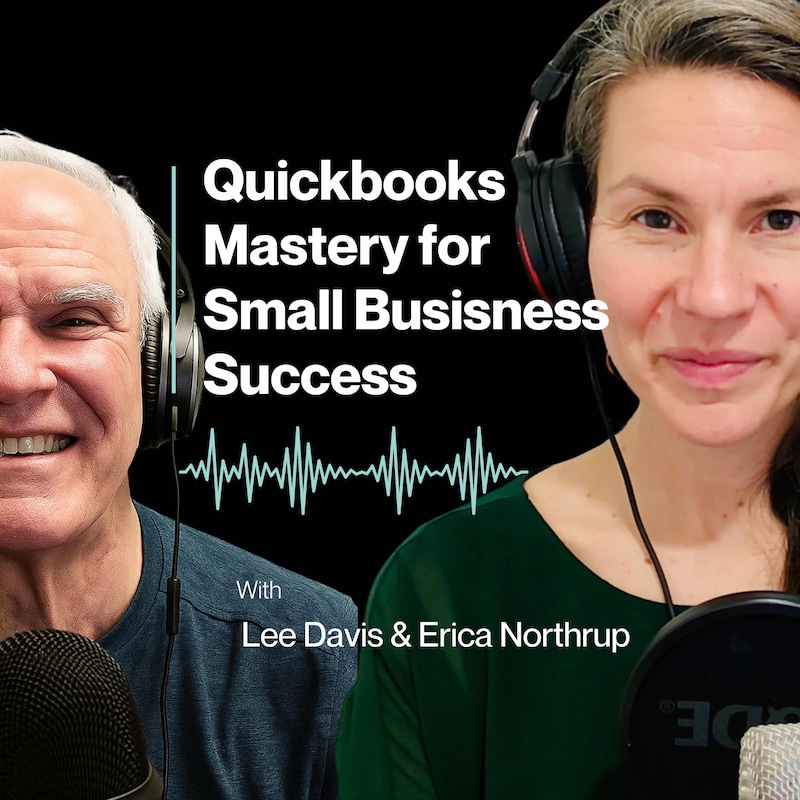
In this episode of QuickBooks Mastery for Small Business Success, father-daughter team Erica Northrup and Lee Davis answer a question many business owners eventually ask:
“Why is my QuickBooks Profit and Loss report wrong?”
Many business owners open their Profit and Loss report in QuickBooks, look at the bottom number, and assume that number represents their real profit.
But the reality is that the report is only as accurate as the information going into the system.
QuickBooks itself is very good at generating reports. The problem usually isn’t the report — it’s the data behind it.
When QuickBooks is set up incorrectly or transactions are entered improperly, business owners often find that their QuickBooks reports don’t match their real financial picture.
In this episode, Erica and Lee explain some of the most common causes of incorrect Profit and Loss reports, including:
• Poorly structured Chart of Accounts
• Products and Services not connected to the correct income accounts
• Duplicate transactions created through bank feeds
• Miscategorized or uncategorized expenses
• Confusion between cash basis vs accrual basis reporting
These issues can cause business owners to believe their business is more profitable — or less profitable — than it actually is.
And when the numbers are wrong, the decisions that follow can be wrong as well.
From pricing and hiring decisions to expansion and owner compensation, accurate financial reports are critical for running a healthy business.
This episode helps business owners understand why QuickBooks Profit and Loss reports often become inaccurate and how to start identifying the underlying problems in their bookkeeping systems.
Key Takeaways
• A QuickBooks Profit & Loss report is only as accurate as the bookkeeping data behind it
• Poor QuickBooks setup is one of the biggest causes of incorrect financial reports
• Products and services must be correctly linked to income and expense accounts
• Duplicate transactions from bank feeds can inflate revenue or expenses
• Understanding the difference between cash basis and accrual accounting is essential when interpreting reports
Questions to Reflect On
• Do you know whether your QuickBooks Profit & Loss report is running on cash or accrual basis?
• Are your products and services properly linked to the correct accounts in QuickBooks?
• When was the last time someone reviewed your QuickBooks setup to ensure your reports are accurate?
Mentioned in This Episode
Free QuickBooks Clarity Scorecard
Download at:
https://lee-davis-and-company.aweb.page/unlock-clarity-free-scorecard
Send Us Your Questions
Timestamps
00:54 – Why most Profit & Loss reports are wrong
01:41 – Can you trust the Profit & Loss report in QuickBooks?
03:23 – The biggest cause: poor QuickBooks setup
05:58 – Products and Services setup mistakes
09:10 – Duplicate transactions and bank feed errors
11:00 – Cash vs accrual reporting explained
14:06 – Why wrong numbers lead to bad business decisions
If you enjoyed this episode, subscribe and stay connected with us at leedavisandcompany.com.
Download the QuickBooks Clarity Scorecard to quickly see whether your QuickBooks setup is giving you reliable financial information.
Have a QuickBooks question? Send it to [email protected] — your question may be featured in a future episode.
Transcripts
Welcome to QuickBooks mastery for small Business Success. I'm Erica Northrup.
Lee:And I'm Lee Davis.
Erica:I handle the tech and he handles the numbers. And together as a father daughter team, we bring decades of experience helping small to medium sized businesses thrive.
Lee:We know that as a business owner, your time is best spent mastering your craft and growing your business, not getting lost in QuickBooks. Managing finances can be confusing and you don't have hours to waste sorting through spreadsheets or fixing bookkeeping mistakes.
That's where we come in, helping you streamline QuickBooks so you can focus on building your business.
Erica:Each week we break it all down into simple, actionable steps so you can focus on growing your business, not fixing your books.
Lee:Let's embark on this journey together.
Erica:This is episode 17, why most profit and Loss Reports are Wrong okay, you guys, today we're talking about something that might make a few business owners a little uncomfortable. And that's the idea that the profit and loss report you're looking at in QuickBooks might not actually be telling you the truth.
A lot of business owners open their profit and loss report, look at the number at the bottom and assume that's their real profit. But Papa, after working with hundreds and hundreds of businesses over the years, I'm guessing it's not quite that simple.
So, so let me start with a big question, Papa. When a business owner opens their profit and loss report in QuickBooks, should they automatically assume that what they're seeing is accurate?
Lee:Yeah, Erica, that, that's a great question and thank you for zeroing in on that. Because first of all, businesses don't necessarily know how to use the profit and loss.
So when they go and click on the button and they expect to say, oh, I'll just kind of click this button and I'll get my profit and loss. There are a lot of factors when you're putting together your profit and loss.
You have to make sure you have selected the correct accounting period and that you need to know whether you want cash or accrual. And you also want to know that your profit and loss in some ways is just for a period of time.
So if you want a 30 day profit and loss, or do you want a cumulative profit and loss, and if so, do you want to measure it by the month? Lots of times businesses will measure profit and loss from a period, the closing of the previous month.
And then they want to also understand that profit and loss is only as good as the information they have in it.
Erica:It's the data behind it.
Lee:And a lot of businesses I've worked with.
When they come to us, they really sense when they look at their accounting or they look at their register, they will have this thick feeling that something is wrong. Okay. They know something's wrong, they just don't know how wrong.
Erica:Absolutely. I'm sure the problem usually starts long before the report is generated. Right? I'm.
Lee:That would be correct.
Erica:Okay, so what are some of the most common things that cause a profit and loss report to be wrong?
Lee:One of the causes is usually that somebody else set the information up.
Erica:Okay, now we're getting down to the nitty gritty. Right.
Lee:And that person had little or no experience, and they've passed on that and they've left the company. And now a new person walks in who's got maybe just a little bit less than the person who left. Although it's hard to tell.
I worked with a client who had used this particular woman to set up her accounts, and she had already set up two other clients incorrectly.
So when people trust people to set their accounts up, they have to make sure they're using a trusted advisor who's got experience in working with multiple type of businesses and understanding a good, solid accounting process.
Erica:Using QuickBooks, they actually understand what they're doing. Because if they don't have that baseline, because that's where everything flows from, is from that baseline. So if your baseline is wrong.
Lee:Right.
Erica:It's like building your house on sand or on a firm foundation. Where are you building this?
Lee:That's right.
Erica:Absolutely. And I'm sure some of those other issues are. They might have set up too many categories. That seems to be an issue.
Categories don't match how the business actually operates. I'm sure that is a major issue right there.
Lee:Well, a lot of people have way too many accounts, and they don't go back in the number of podcasts, Erica, that we've done.
We talked about setting up accounts and check that podcast out, because, frankly, sometimes people don't understand that you can use QuickBooks and understand it that you'll have a limited number of accounts.
Erica:Absolutely.
You know, and if chart of accounts isn't structured properly from the beginning, I'm sure transactions start getting categorized in ways that really don't reflect how the business is operating at all. So then you're just total chaos.
Lee:Yeah. Or sometimes, you know what people, they didn't find the account they were looking for, so they set up another account.
And so it's very difficult to measure from year to year on accounts if you have multiple accounts used different ways. So, yeah, Getting your accounts back to the IRS format where they choose for your Schedule C is a good way to get back to a new normal.
Erica:So let's talk a little bit about products and services and when they aren't linked correctly, because that seems to be a major issue for your profit and loss. For not working the way that it should, for not showing you the correct information that's correct.
Lee:Usually people understand about setting up the chart of accounts. That's generally a place you can look, and you look to get them categorized correctly are the assets, liabilities, equity, income, or expense.
And even though I see some of the mistakes there, but I see a lot of people don't understand products and services because that's the information that's used in the income statement. Okay.
And you want your income categorized into sales, you don't want your income categorized into expense, or you don't want to categorize into other types of GL accounts. While you may think it's simple, people don't quite understand setting up the products and services.
And that's a very strong tool that helps you do a lot of analysis.
Erica:Yes.
Lee:And for example, if you have a expense, particularly in your cost of goods sold, and you want to monitor that cost of goods sold compared to what you are selling your product for, you want to be able to measure those two items to see, particularly in this market where prices have fluctuated a great deal, you could be underwater in a particular product you're selling because the price has gone up substantially.
So you want to understand the value of the product and services account, but you know what products and services mean and make sure that is set up correctly.
Erica:It really seems like QuickBooks relies heavily on the way products and services are connected to accounts. And if those links aren't set up correctly, revenue and costs can end up appearing in all the wrong places.
Lee:Correct. We're talking about the income statement. It could be totally wrong.
Erica:Total chaos. You don't need total chaos in your business. You want to know what is happening at all times.
Lee:And I've seen people go to their chart of accounts and try and fix it in the register. And yet when they put it back in again, it's still wrong.
As many times as they want to put it back in, it will be wrong because underneath the hood is products and services directing where it goes on the income statement. So you do need to fix that account. And the good news is once you have fixed it, it fixes the total problem in that account.
But there could be other products and services you need to Also look at and people, when they've gone through, some people mean well, they go through and set it up. And they don't pay attention to what's in the boxes. You must pay attention in filling out a form in QuickBooks.
And really products and services is just another form. All right. That you direct where information gets put.
Erica:That makes a lot of sense. Okay. So it seems like another issue that probably happens more often than people realize is transactions getting entered more than once.
Can you explain how duplicate transactions end up happening in QuickBooks?
Lee:People will go through and enter into the bank feed and they'll have that bank feed set up. And they haven't looked at all of the information when they clicked Enter. They just have checked it all off.
And sometimes QuickBooks makes suggestions for the accounts where they think it should go. And so without a thorough understanding there, it could be misclassified.
Erica:Right.
Lee:Also, people, if they have entered a bill and that they've used their bank feed to record the payment, then it's going to be entered on an accrual basis, it's going to be entered twice, and their register will be filled with duplicate transactions.
Erica:Right. Which is a problem.
Lee:Yeah. The sales account particularly could vary because the sales account is hooked to accounts receivable.
And some people decide when the deposit, when the bank comes through on the bank feed. Oh, I'm just going to press enter.
They both recorded the receipt on the accounts receivable side and it went to the chart of accounts on their register. And now they've also entered it on the bank feed and the two of them don't speak. Some people say, how come they don't speak? Well, they don't.
Their QuickBooks is not a modular system, but it will allow you to put in whatever you want.
Erica:QuickBooks is good like that, but sometimes it's not helpful.
Lee:That's correct.
Erica:Not helpful. So you also mentioned something earlier about timing issues with revenue. Can you explain what that means?
Lee:Yes. When you look at your revenue, lots of times people, when they do their invoicing, they will send out that invoice to their customer.
And what you're really interested in when you look at your profit loss statement is I'd rather see clients run their profit loss on an accrual basis, not cash, because I would like to see what they have on their books for revenue and then also what's in their accounts receivable.
And I want to run their accounts receivable aging, because I want to see if they are having maybe accounts receivable issues where that could Be slow pay and therefore I want to then take a look at their profit and loss on a cash basis and see how much trouble they're in.
Erica:Absolutely.
Lee:You use different tools to analyze, but I like to start with the accrual basis. And I think a lot of companies can hide things with a cash basis, but when you get to accrual, you get the whole picture.
Erica:That makes a lot of sense. You know, I'm sure if you don't understand which method you're looking at, the profit and loss can be very confusing.
This seems to be the theme of this. Just understanding profit and loss is just crucial.
Lee:So important, Erica, you want to tie your balance sheet out with your profit and loss. So the correct way to do that is to run the accrual financial for both, period, the same period, and run it on the accrual basis.
Erica:Okay, people, you hear that? Let's use the accrual.
I'm sure a lot of business owners are looking at reports without realizing whether they're looking at cash basis or accrual basis reporting. And depending on which one you're looking at, the numbers I'm sure can look very different.
Lee:Of course. Very different.
Erica:Yeah. So it's important to have all the correct information in front of you. That's the whole point here.
If you have the solid foundation, if you have the right data in front of you, you're going to be able to make the right decisions for your business and then you will continue to grow. But if you have the wrong numbers, you're going to make bad decisions, which is going to result in business chaos and business failure.
At the end of the day, quite
Lee:frequently the business owner isn't the one who's putting the data in.
Erica:That is true.
Lee:Okay. So they're relying on somebody to put data in that would include their accounts receivable and their accounts payable.
And sometimes businesses don't have them up to date.
And again, if the picture is blurry and banks and institutions that rely on financial statements for a business would like to see systems in place that account for. What does a month end closing look like for a business?
Erica:Absolutely.
Lee:Now how do you know everything's in and reconciled and the reports are correct? So yeah, that's important.
Erica:Super important. Okay, so if a business owner has some of these things happening in their books, what does that actually affect? Why does it matter?
Lee:It could affect a lot of decisions they might make around, particularly areas having to do with pricing. They might need to look at what their cost of goods sold and their fees.
Some companies will adjust their fees annually, and that may not be soon enough. And then sometimes they think a particular product or a particular department is doing great and they'll look to hire people.
And maybe they haven't done the whole analysis to look like, no, that particular department is losing money. Or there's another place where they should put their money in terms of expanding another area of their business.
Erica:Right.
Lee:People shouldn't look at their competition. I tell you time and time again, somebody comes to me and says, my competition's doing this. I think I should know.
You should expand because you believe your customers can be serviced better and that you have a better product or you have an enhanced product.
Erica:Papa. There's a saying, when racehorses get into the race lanes, they wear blinders, so all they can see is what's right in front of them.
And I feel as business owners and as people that are running businesses and that are creating content and that are focusing on their best life and their best business, I think sometimes it is best if we put our blinders on if all we can see is right in front of us.
Not looking left, not looking right, not looking at the Joe Smo across the other side of the country that is doing this particular thing, you know, and then you get caught up in, oh, this person's doing this thing over here. Maybe I should do that. You have so many options.
You're doing anything because you're overwhelmed and you're making bad decisions based off of what other people are doing instead of simply focusing on what's right in front of you and doing you, doing your business to the best of your ability.
Lee:I will often tell businesses just, let's get back to the basics. Yeah. I worked with a company in New York. What they were doing is they were just throwing solutions at their people to fix problems.
They didn't pay attention to the fact that the last five fixes people hadn't worked on. They were just trying to throw things at them to fix problems without getting back to the very basics and say, here, maybe it's training.
We gotta get back to getting the data inputted correctly.
Erica:Yes.
Lee:Collecting the right numbers. So people always look for a quick fix. And quite frankly, that quick fix doesn't usually work out.
Erica:Yeah, you can't go round things, you can't go under things. You can't go over it. You really got to go through it.
Because if you don't go through it, you won't work through all the things that you need to work through. It's so important. If you think your business made 200,000 in profit, but the real number is closer to 120,000.
You're going to make very different decisions about hiring, investing, or even paying yourself based on those numbers. So it's important to have the right numbers. I think, again, it comes down to bad numbers leads to bad decisions.
Lee:Right. I think we talked about owner pay in one of the other podcasts, but it's true. You need to make a decision about owner pay and taxes.
When somebody tells me they'd like to add a 401k plan because it would be good for their small businesses, for their employees, my first question is, are you being paid correctly?
Erica:Right.
Lee:Let's make sure that you're being taken care of in the pay structure. And yes, if we can add a 401k after that happens, great. But really looking at the numbers.
Erica:Yeah.
Lee:Which is why the financials become so critical.
Erica:Yeah, absolutely.
Lee:Is let's get the owner pay correct and let's get the employees taken care of.
Erica:There's a saying in the family, if mom is not happy, nobody's happy. So the mom in this circumstance is the owner.
I think it's important to get that straighten away and then make sure that you take care of your people, because without you people, you have no business. Absolutely. Okay, so after working with so many businesses over the years, Papa, how common is this problem? How often do you see this?
Lee:It's a common problem when you look at the financials. Lots of time. People don't really want to look at them. They just want to get to. Yes, I want to borrow money. I go to the bank. How come it isn't.
Yes, the bank sends back a whole list of things they want because they've got a whole back office. The bank does. Okay, yes.
You've just got maybe yourself and maybe your bookkeeper, and maybe you've got your accountant that you could get to help you. But at this time of the year, nobody's getting help from their accountants because they're buried in tax work. So, yes, it's a very common problem.
This is the time of the year some of the surfaces because the accountants come up with the fact that your balance sheet and your income statement are not correct and we're going to use these for tax filing. Get in touch with your QuickBooks Specialist and have them fix your problem.
Erica:I guess it actually is far more common for businesses to have inaccurate financial reports than perfectly clean ones. And that's usually not because the owner did something wrong. Puppet. It's because nobody ever showed them how the system should be structured.
Lee:That's correct.
Erica:Really?
What you're saying, if I'm taking everything in correctly here, what you're saying is the profit and loss report itself isn't the problem, it's whether the information going into QuickBooks is being handled properly.
Lee:That's correct.
Erica:Oh, guys, this was so very good.
If you're listening right now and you're thinking, I'm honestly not sure whether my profit and loss is actually accurate, you're definitely not alone. That's exactly why we created the QuickBooks Clarity Scorecard.
It walks you through a series of simple questions that help you QuickBooks quickly see whether your QuickBooks setup is actually giving you reliable financial information.
You can find the QuickBooks Clarity Scorecard in the show notes or you can go over to our website, leedavisandcompany.com that's leedavisandcompany.com and you can check it out there.
And in our next episode, we're going to talk about the five financial numbers every business owner should know if they want to run their business with confidence. Have a great week, you guys, and we'll see you next week. Thanks for tuning in to QuickBooks mastery for small Business Success.
Lee:If you enjoyed this episode, hit subscribe and stay connected with us at leedavis
Erica:and company.com we know QuickBooks can be overwhelming, so we've put together a free resource to help you get started right away.
Grab your [email protected] and when you do, you'll also get access to our VIP email list where we share exclusive QuickBooks tips, business strategies and support, and we'd
Lee:love to hear from you. If you have a QuickBooks question or a business challenge, send it our [email protected] we might feature it in a future episode.
Erica:We're here to help you simplify QuickBooks and grow your business one step at a time. See you next time.




