Shownotes
What if doing everything “right” for your health was actually part of the problem?
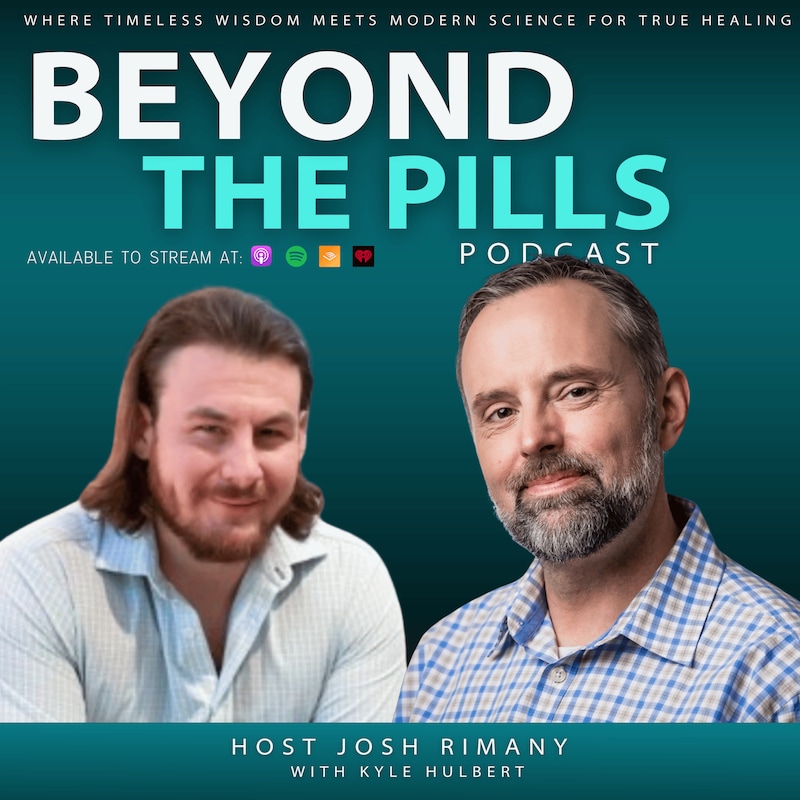
In this episode of Beyond the Pills, Josh Rimany sits down with Kyle Hulbert to explore a reality many high-performing men face but rarely talk about: feeling deeply unwell despite clean living, disciplined routines, and “normal” lab results.
Kyle’s story begins the way many modern health stories do...with success on the outside and silent suffering on the inside. In his early twenties, while pursuing advanced education and living what looked like an ideal life, his body began to shut down. Anxiety, depression, fatigue, and intrusive thoughts took over, even though nothing appeared wrong on paper.
After years of being dismissed by conventional medicine, Kyle uncovered the real issue: heavy metal toxicity and critically low testosterone that standard testing failed to flag as a problem. This conversation exposes why the medical system often misses root causes, how toxins quietly disrupt hormones and mental health, and why being told your labs are “normal” doesn’t mean your body is functioning optimally.
Josh and Kyle unpack the dangerous gap between symptom management and true healing, the risks of detoxing without proper guidance, and how nervous system overload plays a major role in chronic illness. They also challenge the idea that longevity and healing should be expensive, exclusive, or trend-driven.
If you’ve ever felt exhausted, anxious, foggy, or disconnected from your body despite doing everything you were told to do, this episode will resonate deeply. This isn’t about biohacking, supplements, or chasing the next protocol. It’s about understanding what your body is communicating, restoring balance, and recognizing that healing doesn’t happen until the body feels safe enough to heal.
This conversation offers clarity, validation, and a grounded perspective on what real longevity looks like when you move beyond symptom suppression and into root-cause medicine.
Listen now to this powerful episode of Beyond the Pills to discover why modern health is missing the mark and what it actually takes to reclaim vitality, mental clarity, and long-term well-being. If this conversation resonates, share it with someone who’s been told “everything looks fine” but knows deep down that something isn’t.
Connect With Kyle + Support His Work!
https://www.thelcfl.com
https://www.instagram.com/thelcfl
https://www.youtube.com/@longevityunlocked-w5l
https://podcasts.apple.com/us/podcast/longevity-unlocked/id1727734924
https://www.linkedin.com/in/thelcfl
https://www.tiktok.com/@thelcfl
https://x.com/theLCFL
💊 Join The Beyond The Pills Community Today, Unlock True Healing Tomorrow!
Transcripts
116_Kyle_H
===
Josh: [:Join me and other practitioners as we
Kyle: guide you towards vibrant health, body, mind, and spirit, and move beyond symptom management into true healing.
Josh: Welcome back to Beyond the Pills. I'm Josh Rimini, pharmacist Turn Healer. And today I am joined by Kyle Holbert. He's the CEO of the Longevity Center co-host of the Longevity Unlocked Podcast, and a wellness and integrative nutrition code specializing in detox in Men's health.
awesome is why I brought him [: first year, helped more than: it's a podcast for a time I [:So I'm, I'm glad to
Josh: be here. Yeah. And, and I love having my friends and colleagues on the show because they be, they become so much more dynamic of conversations. We can cut through the chase, we can work through this stuff. And literally the first time we met over the phone, like we just were connecting on other things and we instantly connect.
'cause we, we definitely have a lot of energetic matches with what our lives have done and what we're actually doing today. So let's, let's lock into it. I love, I love starting with like, like take us back before the Longevity Center. I want, I want people to understand a little bit about. What did your, like, what brought you here?
What was life like when things weren't working for you?
in my undergrad and I was a [:I was working out. I was not going out and drinking and partying and doing all that stuff, but I was falling asleep in class. I had this fatigue and it was just kind of crushing. Now I just thought, Hey, I'm pushing hard. I'm crushing it in school. I'm crushing it in my, you know, athletic pursuits. I'm probably just over pushing it.
And a few years later, you fast forward, I'm in my master's degree and everything starts shutting down little by little.
Josh: Mm-hmm.
Kyle: So my mental health falls apart. Anxiety, depression, suicidal thoughts. I'm living the objectively perfect life, right? I'm in Dubai doing my master's degree on a rotation, like studying business.
, um, for that time. And I'm [:Um, and eventually I was like, you know what? The thing I've heard the most is testosterone, right? And I was like, I should just go get it checked. I should, we should just go check it. And went into a integrative physician and he checked my testosterone. It was 159. And for reference, um, men at my age during that time, should it be around a thousand?
Josh: What, how old were you? You were in your twenties.
Kyle: Yeah, I was like 21.
Josh: Yeah. This isn't a time to think about low T, by the way.
Kyle: Yeah. And that was extremely low. That is low for a 90-year-old man.
Josh: [:Kyle: Yep. It's, it's like nothing. It's like,
Josh: where is your testosterone? Is what they should say. We,
Kyle: yep.
Josh: You get a false reading. Like, we have to take this again. You're 25 years old. We, we probably don't we Something's wrong with his laugh. Right. I
Kyle: think the doctor's reaction was, oh, he just looked at it and went, uh oh. Um, so. This was my first foray into kind of figuring out what was wrong with my health.
Right at this point. I had fatigue, I had brain fog. I had, uh, had a lot of mental health problems. That physician ended up putting me on, um, an all natural hormone replacement therapy. Um, I did both in Clonapine and HCG at the time. So it's not testosterone, injections, they're different things to innately stimulate your testosterone production.
ng. And when I tell you it's [:Josh: gone, suicidal thoughts
Kyle: gone.
Josh: It was just no longer there.
Kyle: Now, I still had a lot of these issues, a lot of fatigue, a lot of brain fog.
They were improved on the testosterone replacement therapy. However, the mental health, that was a game changer. And so fast forward a few more years. I'm in my career, I'm working, I'm hard charging, I'm doing my testosterone replacement therapy. Um, and symptoms keep getting worse than other avenues. Joint pain, allergies, gut issues.
And I'm like, what is going on? And so I went to doctor, to doctor, to doctor to doctor, and they all told me they either couldn't find it or I was making it up. One of those two, which in then turn led me to a biohacking conference because I was like, Hey, these crazy people experimenting on themselves, they feel, I feel like they know something.
They, they wanna push [:Josh: possible. Must they must have found something I haven't looked at yet. Right?
Kyle: Yeah,
Josh: yeah, yeah,
Kyle: yeah. And, and so I went to one of these conferences and weird place, by the way, for someone who's not used to this world, right? You roll in, in one of these conferences and like you can hug anyone.
You could just, you could just go up and hug anyone. Like it's so full of love and passion and like these people are like awake and alive and want to help. Um, and there I ended up, ended up meeting a, a physician who referred me to a different physician. Um, and I ended up going to do mercury testing. And the doctor who treated me for my mercury, which was my root cause, it was the thing causing all of those problems.
y Centers of America. Um, in [:Josh: Well, this, I love the common threads, right? The threads that. Brings a practitioner or someone from their personal story into what their calling is and what they're doing in the world now is, it's always the same. It's like went to doctor, to doctor to doctor. They said, there's nothing wrong with you.
'cause all they're looking at is a lab or you're making it up. Right? Like, what, what does that do? Right. Nothing. Right? It's like, oh, you're, you're making up your own symptoms, which makes things worse, by the way. And then you serendipitously like fall into the thing that did the thing you kind of gave me like, all right, I got enough and I'm just gonna go do this thing and see what, like, no attachment, right?
It was just, I'm just going,
Kyle: yeah.
ough that experience. I call [:Kyle: Mm-hmm.
Josh: Um, or the shamanic journey. Right. Of like going, coming back out of something and being rebirthed and then boom.
Okay. Yeah. Now I have Longevity Centers of America.
Kyle: Mm-hmm. Yep.
Josh: Talk to people a little bit about, uh, that, that the, the mag the, the mercury thing, 'cause it's, it's a pretty big deal that we miss a lot of, a lot of times in functional medicine. It's like many little things are making a downstream approach to this, or there's one big thing that's causing all these downstream issues, which is kind of what happened with you.
Right?
Kyle: Yeah.
e you are, like on the other [:So I wanna, I want you to like enlighten that a little bit more.
Kyle: Yeah. Yeah. Mercury poisoning is a very real thing. Um, chronic mercury poisoning. Let's be clear. All, almost all mainstream medicine accepts the fact that acute mercury poisoning is real and dangerous. Right? Chronic mercury poisoning is not commonly accepted as in mainstream medical as a real thing.
But if you look at how our society has evolved and the use of toxins like mercury, like heavy metals in pesticides that are being applied to food in certain injections given to certain aged children during certain periods, let's, let's phrase it that way. Um, it, you get this massive, massive buildup of toxins that your system, if you're not genetically absolutely optimal, cannot clear.
all these downstream issues, [:Um, and then Cadium would probably be the fourth one.
Josh: But these are the things that, based on the generation you were born in, if you're older, it's probably lead. If you're middle
Kyle: age to maybe 30, it's probably a mercury. And if you're sub 30, it's probably aluminum. Um, these are the things that could be an underlying root cause for people.
Um, so in my case, I was born, um, I was first born, so I probably got a fairly decent burden of mercury in the womb from my mom because it's shown to transfer. My mom had amalgam fillings, so silver fillings full of mercury. And then I was during the, it was born during the vaccine period at which, um.
re mercury deli derivatives. [:Just cans of tuna.
Josh: Yes.
Kyle: Mustard all over top. Can't taste it. Just go. And, um, all of that culminated in this mystery illness, right? My hormones were trashed. And it wasn't just testosterone, testosterone, growth hormone, thyroid, like they were just trashed. Um, all the gut symptoms, the nervous system was fried.
And so when I found out that this was the root, when I did the test, it was, um, I think it was like three x the maximum limit for the EPA and for reference, the maximum limit for the EPA is way too high.
Josh: Yes. I glad you said that.
Kyle: Yes.
Josh: Like I don't give a, I don't give a shit about the EPAs standard. It's like, no.
They're like, [:Kyle: yeah,
Josh: exposure is not good like you got, but they have to take a reference point because everybody's exposed. They couldn't do anything if they said this. Right.
Kyle: Yeah.
Josh: I don't love the, I don't love the logic, but I'm glad you crossed.
Kyle: Yeah. So the EPA standard, in my opinion, is about 10 x what the standard should be.
Josh: Yeah.
Kyle: And I was three x the EPA standard. And so I had this huge burden of mercury. Right. And I was, I was blessed enough to be able to find the physician who actually could take it out safely and controllably through IV chelation. So DMPS IV chelation is like the best, most effective way to get rid of it.
t all this inflammation just [:Josh: Well that's, that's literally what the body does. Mm-hmm. When it's in a toxic state, it doesn't, it has to hold onto it. 'cause if it water solubilize it out, you get further tox. So the body's like holding. Same thing with stress and fat. Right. We, we know we hold it. So you're, you're getting the detox, but in a safe way, which is important for people to know.
Like, a hundred percent we gotta go, we gotta detoxify in a right way. Especially things that are highly toxic.
Kyle: And I'd like to hit on that for just a second.
Josh: Sure. Let's,
Kyle: when you, when you look at heavy metal detox, right? If you are trying to do this yourself with supplements, don't do it. Just don't do it.
ucket before you get the iv, [:So you have to work with someone who knows what they're doing and if they are a, if it's an online, like, I'm gonna send you a bunch of supplements and this is gonna get rid of your heavy metals. That's probably not the answer There are.
Josh: It's good. It's good to know though, because. I never start detoxing people when I see what's there.
'cause that's what some lab labs are sometimes there to just give you a snapshot of what's there, right? Mm-hmm. Then what do you do with it is so important. I don't, I always prepare people in certain ways to get them ready to detox. Right. We're, and this is part of the functional approach we, we've always learned.
And so [:Kyle: Yes. Yes.
Josh: And, and it's way worth whatever. And you don't have to go to a hundred thousand dollars clinic either. Right. It's not difficult, but it's complex enough to not DIY.
Yes. But I, I think we're trying to get to people today. This is not a DIY approach.
Kyle: Yeah. I think there's only one supplement brand on the entire market that I'm aware of, that does a half decent job at detoxing heavy metals. Um, I think you're familiar with 'em. Quicksilver.
Josh: Yeah. Quicksilver has a, I use some of their stuff when I'm doing things like this because mm-hmm.
We're, I, I always talk to my dentist all the time, like, do you have anybody with like amalgams that you're removing? He's like, oh, yeah. I'm like, let's talk.
Kyle: Mm-hmm. Yeah.
some screening processes of [:Kyle: Mm-hmm.
Josh: Like, it wasn't like this, oh, you just take this one thing. It was like a big deal. And they were telling everybody in this health, all the healthcare practitioners and people, and there was like thousands of them and they were really focused on that. So it is a real, and it is a big deal.
Kyle: Yeah. So it needs to be guided.
Don't. Don't fall for some online marketing thing that's just like, Hey, if you take this, it's gonna detox your heavy metals one test, see what you actually have, and two, have a guide that can guide you through a detox that's built for you for your test results.
Josh: And you, you do, you do this a ton in your practice?
Like you're screening for this a lot?
Kyle: Yeah. Yeah. So
hing that's been like on, on [:Kyle: Mm-hmm. Yeah. So we do, when, when someone comes to the Longevity centers in America, we start them with what we call the longevity panel.
It's a blood work panel that covers about 20 x what a standard doctor would pull. Super comprehensive panel. We check hormones, we do all kinds of screenings, metabolic health, you name it. But one of the screenings we have on there is heavy metals. If you pop up on a heavy metal screening on a blood test, it means one of two things.
One, you were recently exposed, or you have such high levels of heavy metals in your tissues that it's actually pulling out into the blood because heavy metals don't like to live in the blood. They live in the tissues. So if it's circulating, you need to dive deep in that. You need to look at it.
Josh: There's, so [:At the same time, what you're testing for isn't terribly expensive, but we're still in the space of like, you know, I was talking about it from a cardiovascular perspective and in our men's vitality, um, we're, we're launching our men's vitality programming. Right? And a lot of that's has to do with like cardiovascular health for men, right?
to look at. And we're still [:So I'm glad that you, you're bringing this up in your process in the very beginning.
Kyle: Yeah. We, we, so going back to the Longevity Centers of America, when my business partner called me, one of the key points he hit on was the affordability point. Right. He was like, I am losing patients because they can't afford the treatments and I want control over the pricing.
So every single piece, part [:And we priced it across every vendor, across the us, every one we could find. And then the second part, no magic, we just charged less. So we just cut margin to make this affordable. So what does this look like? Applicably, like when you would join the Longevity Center, your initial consult is $175 for an expert level practitioner, that $175 is applied to your first treatment.
ve the data to affect health [:Josh: You beat me to it. I was gonna, I was gonna lean you into what was the essence of building this longevity center. 'cause we've talked about it because you, you're hitting on two points that I think most this is, it's the entrepreneurial spirit in you. Like, what are the problems and how can I solve it?
Mm-hmm.
Kyle: And
Josh: what. How can we scale? Like, but scaling, not to make money, but scaling to give access to things that people ultimately think are inaccessible. And I'm glad you were telling me the story of the, the provider that you partnered with was like, Nope, I need control. Nope. I'm not doing it that way.
e we literally are trying to [:Kyle: Yeah.
Josh: And I think that's powerful information when we're talking about moving humanity in a new light, right?
If we all lived longer and we are having these things that are accessible to us in easier, more, more efficient ways, which is how you make it less expensive. Like there's. It's not just going to the best because they're the best. I've been speaking about this with our supplement line for 15 years. The first thing I say to people, it's the best quality on the planet for the price.
When you put those two together, it makes a difference. I could sell you more expensive supplements. There's a lot more I could sell you, but this is the best quality I could possibly find. So you're, you're literally paying for Kyle's due diligence here. Mm-hmm. Like, I've done all the work. Just do this.
It's the [:Kyle: Yep.
Josh: No, and that, but that gives a huge level of confidence and trust too. Right? There's an, this isn't because you're trying to make a puppy mill out of a longevity center and run 'em in and run 'em out, but you're also being practical. You said the other day when we were talking, you're like.
You could be a billionaire or you could be a garbage man, and we're gonna just treat you the same. Yeah. Like we're, we're literally gonna treat you in and out because we don't play elitist here. Like, but you didn't do it in a way that was like snugging anyone. It's just like you show up and you're, you're you.
If Michael Jordan shows up, he's just gonna get the same thing. Right? It's like
Kyle: mm-hmm.
Josh: Great. You got what you got.
Kyle: Yes.
Josh: I have a lot of entrepreneur friends that pay for shitty doctors just to say that they paid more money.
Kyle: Mm-hmm.
s and supplements and charge [:And then everybody's in their own little circle at dinner going, oh yeah, I got that doctor too. And he's doing like. No, none of that ever resonated with me. Yeah. It was just like, no, I just wanna make you feel better and make you the best human you can be. And that's really what I love.
Kyle: Yeah.
Josh: So I'm, I'm glad that you brought that to, to the light, and that's really the ethos or part of the ethos of the Longevity Centers of America.
Right?
n the world. Somewhere in the: inic in West Palm that sells [:They're doing it just because they can, to say they can. So we really, my personal mission here is, is impacting the health and lives of a million plus people. And you can't do that without scaling, right? You have to have more access. You have to democratize it. You have to get out into different locations to be able to actually drive a change of that magnitude.
Josh: I agree with that. That's another reason why you, like, you saw our mission, uh, beyond the pills. It's like, I'm here to de-prescribe 10 million unnecessary medications. He's like, well, I'm here to grab a million people and put them through these process. I was like, well, I think if you did that and I did, like we both do what we wanted to do if we do what we wanna do.
[:Kyle: Yeah.
Josh: Right. We're impact. I love, this is why I put all my focus, especially my one-on-one clients of high impact heart-centered people. Like if you're doing good in the world, like let's do that and let's let you do that more so your impact ripples and this ripple effect happens.
And I think to me, that energetic frequency vibration or just alignment works, right? That $70,000 I injectable or I've, I've heard of people that go to that have a specific Dr. Shaman that they go to that stacks psychedelics in a certain way and charges a million dollars. Like I'm literally a million dollars to see this guy.
And I'm like, why? Why, [:I was talking to my kids though, it is like everything is coming down in price because that's what technology does. Mm-hmm. But we still need that human equation, right? Where we're doing things in a sequential order or in a stepwise approach. That makes sense. That's simple to understand and that people can have empowerment to be a part of, right?
as things that happened, but [:Kyle: Yeah.
Josh: No matter how much you spend, you still gotta take part in it.
Kyle: Yeah. And, and I think that's, that's one of the differentiations, like, we are not concerned about status. Right. We, our, our process is we listen, we take this objective, we test, we then we heal. Right? We don't care about status or who you are or what you wanna brag about.
We care about driving the results and your health and your life. We want to get you to where you want to be and where you deserve to be as a human, fully optimally functioning.
love studying the indigenous [:It's kind of like, you know, rom Dass meets Mark Hyman, you know, it's like we did both. It was fun. Mm-hmm. But that one thing that stuck with me is like when you see the shaman, he doesn't give a crap about your story. He literally is there to do work now. He has fun while he does it too, by the way. Which is another key piece to this is joy is really important to help in longevity, but the, the story around what got you there doesn't make a difference.
It's that subjective piece you were talking about is like, what are we working with here? And then let's get to work. So I love that approach. I, I resonate with that for sure.
Kyle: Yeah, so I mean, that's, that's our mission and it comes from a place of like, like you said, my journey and, and in this journey for me, there were two main hallmarks.
[: ng, transformation, and, and [:Not just because, well, I love it. Even if I just did it for me, it would be worth it. Like I've always learned to invest in myself, but now I can relay it back to the, how do I give this back? It's like this wisdom that you're imparting on people. That journey was a long time. It was arduous. And so we wanna shorten the refractory period of someone's, uh, wellbeing.
Like getting them there quicker means we're shortening their experience of being sick. And you're shortening their, their, their budget too. Like this doesn't have to be crazy and expensive.
Kyle: It's, it's another reason we don't believe in memberships for us. Um, we believe so. Like, we don't sell, like if you wanna come in, do something random and you want to pick off a menu and you wanna join a membership, that's not us.
ized treatment plan for your [:And I go, we're in healthcare isn't the point to heal. I don't want to keep them sick.
Josh: Well, you know, it depends on who you talk to.
Kyle: Yeah.
Josh: Because when we go to. School and for healthcare to be a physician or a nurse or a pharmacist or a coach or whatever, it's like you literally do wanna heal people. And healing is different than being less sick.
Kyle: Mm-hmm.
al, but I also know that the [:Kyle: Mm-hmm.
Josh: And what we're doing is going beyond what the healthcare system is offering because beyond means we're moving forward. We're moving beyond it. We're not excluding it. If, if you get hit by a truck, go to the freaking er.
Kyle: That's what they do. Amazingly
Josh: they do, they crush
Kyle: it,
Josh: they build, they make you less dead.
Really good. Like there, there's, that's okay. I had cancer at 16. I needed an oncologist. Mm-hmm. But I also needed to earn, understand the lessons that I learned along the way to understand what, what truly healed me.
Kyle: Mm-hmm.
s looking at the disease and [:And when you're talking hormones and you're talking longevity and you're, you're activating certain genetic processes if you wanna talk body or if you wanna talk mind or energetics, the field of it is where restoring balance. So the body innately does what it's supposed to. And that's what, that's what healing is.
You let the body do what it was supposed to 'cause it knows what to do. When it knows what to do and it's doing it well and you're in a coherent path. You don't need all this intervention. That's the goal.
Kyle: Mm-hmm.
Josh: The treatment goal for me is I don't need to see you anymore unless we go out to lunch or something.
Kyle: Yeah.
Josh: And I always love treating and working with people that I would cheer a meal with. Mm-hmm. Because there's an energetics behind it.
Kyle: Yeah. Yeah. So
cribe a medicine because you [:I've helped you heal in some way.
Kyle: Yeah. And I see it all the time. I mean, I think your mission is so impactful. Um, you know, a quick story about, uh, one of our patients early on that doc treated, he was on a blood pressure medication and he'd been on it for years and, uh. Doc looked at all his readings and was like, yeah, it's, I mean, it's slightly elevated and the blood pressure medication seems to be managing it fairly well.
And he dug into it and he is like, Hey, uh, lemme see your arm. And the guy goes, yeah, what about it? He's got a big old bicep, right? Big, big arm. He's a jet guy. And doc goes, what size cuff are you wearing on the blood pressure monitor? And he goes the normal one. And he goes, switch it to an xl, switch it to an xl.
d pressure remained perfect. [:Josh: Well, yes. And um, this is why I spend time with my patients. This is why it's the mantra of don't be better.
Be different. Like what we're talking about is I act, you said it too, like we listen, right? That's the first piece we listen. My VIP days with people is me and them. That's it. So imagine just having one conversation like that that had nothing to do with anything else besides just understanding that person's situation a little bit deeper and then allowing that to unfold to like, holy crap.
f all hospital visits have a [:But you also said data. This is why we're capturing subjective and objective data.
Kyle: Yep.
Josh: Because we, if we're giving this supplement because it's helping a nutritional imbalance, but if you're giving magnesium and optimizing it, well there's 400 things you're optimizing, getting it down here. That person may relate it to anxiety or sleep or vitality.
current modern day. Medicine [:Kyle: Mm-hmm.
Josh: That's why I've always used both and maybe that's just me. 'cause the pharmacists in me had to deal with no labs and still work with people because all I get is what they say and what the doctor gave me an order for and I had to work with that.
Mm-hmm. So I've used that more often than the labs for certain things. But when was the last time you just asked somebody like, how do you feel today? Like, how do you feel in your body? Like what do you, are you okay?
Kyle: Yeah,
Josh: that's, or the way I located it, I would say this week I was like, I was like, you know, how you doing?
And they go, good, good. It's like, well how you really doing? And then they're like, well, let me tell you, blah, blah, blah. And they're like, okay, well we gotta deal with that. Yeah. Because I can't, if you don't leave this door thinking you're, you were taken care of. That in itself is actually medicine. It's placebo effect, it's medicine.
Kyle: Yeah. [:Josh: to care how they get better, by the way. Like to me, I don't care if, if you get better and I was a part of that journey with you, I am, I'm happy. I can sleep well.
Kyle: Mm-hmm. So I mean, if we, if we bring it back to like what we're doing, right, like I think the core in terms of like what you're doing with your clients, what we're doing with our clients and patients is like listening, getting the subjective, merging it with the data and the test results.
And then really just trying to find the root of it. Not using the quick fix, not using the quick bandaid, but getting to the root in the fastest, most efficient, most affordable, effective way possible. And I think that needs to be the focus of healthcare moving forward.
Josh: Well, it's focusing on why not what.
Kyle: Mm-hmm. Yep.
cause. But then I've gotten [:The physical's going to affect your mind. And so we have to treat these in a holistic way. And, and I say whole with a W because it's, it's all of it. And that's why I'm sitting on A-P-E-M-F mat to balance my nervous system. And when I went on vacation, I didn't have the mat and I was around a lot of people and I was like, you know what?
I need to go back. I'm, my mute system is being charged in a good way because. For me that works, right? Mm-hmm. But it wasn't like, oh, that's just a thing you do. I do have a lot of biohacking gadgets. 'cause I have a lot of biohacking friends and they tell me what works for them. 'cause they've done all the re r and d on themselves.
Mm-hmm. So I get the benefit of that.
Kyle: Yeah. Yeah.
odern day side of, you know, [:Because we can affect your systolic by 10 points if we could just change the way you breathe. Nope. Let's go to the drug. Try
Kyle: eat.
Josh: Right. Exercise, live better. Take this drug. We'll see you in three months. Three months happens. What happens? Did you eat right? Exercise better? No, but did you take your drug?
Yeah. Okay. Well you're not getting any better. So let's try another drug and then let's do, like, I've seen the poly pharma too long, like we're here to reverse that equation.
Kyle: Yeah. Well, and you hit on a really important point in my opinion, which is the mindset. The mindset of like healing and that my body can do it, right?
nerative injections, um, and [:You need to believe that your body can regenerate. You need to believe that your body can heal before we're going to offer this treatment to you.
Josh: I love it. I love it. This is, this is the, the point of why I think medicine needs to go this direction, and I'm glad that you have the, I They're good, these boundaries, right?
u think it's a snake, there's:So I'm glad that, that you're, you're centered around this, the piece before the piece, and you also put up a buffer, like, I'm not just gonna take your money and say no. Like, okay, here you go, it's fine. You're like, no, this is part of the process.
Kyle: And it, it, it's. It's really hard.
Josh: Even when you're, when you know, even when you, you've experienced, it's still difficult to move past those belief systems when you think it's just the thing affecting you.
And so I like using the placebo effect in reverse to help people heal, to using that for them. Because whether you study the ancients or you study quantum realities, the, the essence is the same. Intention makes all the difference in the world and intention is belief.
Kyle: Mm-hmm.
Josh: I'm [:Kyle: Yeah. And it's, it is so powerful. Like, and it's, and scientific, right? The body can drive healing responses if your brain believes it, right? Your brain can send the signal to the body to repair and it can also do the opposite, right? So we can put in to your joint. All the growth factors, all the raw materials that you could possibly need to help regenerate.
But if your brain is saying, that's not gonna work, where is the healing signal? It won't work. It probably won't work. No,
Josh: no. This is, this is why I love this part of medicine is mind body medicine. It's like, it's not mind or body. It's mind. Body. Because there's an energetics to the thought turning into a chemical signal.
h side you talk from, Lou or [:Like the placebo effect is real, like you said it right? I've said it the same way to my clients is the body can make you sick or the mind can make you sick and it can make you well.
Kyle: Mm-hmm.
Josh: And, and it's a big part of a healing journey, like so big that I, that's why we teach HeartMath and coherence training.
Like we want to bring people back into rhythms. And maybe this is a good segue into our men's vitality, is how do we get back to the nature of the rhythmic nature of the body and what it's supposed to do? Because again, for me, healing is unlocking the body's own abilities.
Kyle: Mm-hmm. [:Josh: And yes, things slow down and, and get less frequent when we age.
This is why longevity is such a big deal now. I don't love that word, but living better. Staying well longer means we have to put these signals or these, these signals in that are helpful to the body, but the, the mind activates them and mm-hmm. You really wanna go another deeper dive. Your body, your body can, your mind can create them.
I've been, I've been in meditation rooms with people where we're literally creating specific molecules to heal our body, which is so, so fun.
Kyle: The power is just incredible with the mind. But yeah, I do wanna,
place to play consciousness, [:Kyle: love it.
Love it. But men's vitali,
Josh: wow. Like we were both highly invested in this new way of treating men's health. Um. I would love to chat and riff about that as we're developing these new processes. 'cause we're literally both kind of creating these new men's vitality clinics centered around these bio rhythmic patterns.
Kyle: Yeah.
Josh: That's exciting for me.
Kyle: Mm-hmm.
Josh: Because in the, I'm, I'm reading this book called, uh, pattern Breakers. I'll send it to you. But it's, it's about how companies or how ideas that changed the world. Like Lyft is a great example. Lyft, Uber, Lyft was really first, but like there were certain things that happened to make Lyft work in the time that it was there.
ngs that have been tried for [:And for me, since I do a lot of men's work and, and, and work and, and men's growth is how would I take vitality with men and put it into this modern day, but also help rhythmically naturally help the body. And I think hormones are going in that direction. They already are. We're doing it now, but hormones is just one way.
this now in the testosterone [:Whereas before, we were giving steady state and we were testing in to see if they're within the normal range. But our bodies don't do that. Like we make cortisol. If we were making cortisol at 3:00 AM every day, we wouldn't sleep. We have to make melatonin when we sleep, we make, and we make like cortisol in the morning, right?
to do this? We have to test [:Kyle: Yeah. Yeah. So the n OT is interesting and, and it's very interesting in the way that like I, so I've experimented with oral forms of testosterone before. I've taken every form of testosterone that is available in the US market, um, and replaced,
Josh: which is really why I think we were supposed to meet. So, playing with this and you're like, oh, I just met, this guy's actually done it all.
Kyle: Yeah. So like, I've taken the orals, I've taken multiple different types of injectables. I've done, the only thing I haven't done is pellets. Um, 'cause I don't, I don't believe in pellets. Um, that's a side note, that's a whole tangent, but
Josh: I don't either
Kyle: don't cut people open to do hormone therapy. It's just
Josh: well, don't give them super doses for three blood.
Kyle: Yeah. It's just make sense.
Josh: That's the opposite of what we're talking about here.
and I've done all the types [:And I'm not talking like I want to get jacked because like, in my opinion, the benefits of testosterone or mental health, the drive, the focus, the cognitive ability and the lack of anxiety and depression like that, that's the benefit.
Josh: Which is the definition of vitality, I believe.
Kyle: Yes.
Josh: Right? Yes, yes.
Kyle: Like I'm not talking about
Josh: muscles.
Kyle: Yeah. I'm not talking about like bodybuilding, like it's
Josh: now not the anabolic side. You know, it's important for lean muscle.
Kyle: Yes.
Josh: But yeah.
able to send that signal to [:So what that looks like is, you know, you get this massive pulse of testosterone during your deep sleep, and if we're able to give another pulse in the am another pulse in the midday range, by the time we could get to bed, when we need to be winding down, when we need to be getting ready for that deep sleep, when the room temperature is cold and we're prepping our body correctly, that that testosterone exogenously is out of the system so our body can still send the signal to make its own testosterone.
That's what the nano t is trying to accomplish.
Josh: Well, and that, that's, yes, that's, that's where I think we are today, is like, how do we. Exogenously give what we need because we're not making as much as when we were in our twenties and thirties. Right. And not because we want to, like men don't wanna preserve low T, they wanna be vital.
Kyle: Mm-hmm.
elating low T with vitality, [:Kyle: Mm-hmm.
Josh: And that's the, and but we need to see it so we can get it right. Yeah. So it is like, I love working with this philosophy because to me, this is the Uber, this is the lift of how we're gonna do it. We a way that the body wants it, the body needs it. So we're waking up the body. Doing it itself. When you and I are kind of figuring this stuff out and then we're at, I always just say it's like icing on the cake.
n they go on TRT, especially [:We're not downplaying it. It is like this is what we had in front of us, but that that when the body shuts down and we don't make it, then we have this sort of like, well now I have this, but I don't have this. And I wanted to create something. And that was balanced in the whole process, which is what I think we're talking about, which is why I'm so damn excited about it.
'cause I feel like we're so much closer than we've ever been. To the place where we can actually work both angles at the same time to achieve what we've all wanted in the first place.
Kyle: Yeah. And so I think, I think the nano t is a good option. Um, I have yet to see, so I'm testing it on myself right now. Um, side note, it kind of burns a little bit in the mouth.
It's a little spicy.
Well, I gave you a bunch of [:Kyle: I got strawberry. Strawberry was the one. I was like, I mean, it taste, it tastes great. Listen, the strawberry tastes great, but it's, it's a little woo, man. It's like a, like if you haven't, you had nicotine lozenge and you put it like up in, up in your gum.
It's like that burning sensation. It's not bad. It's just, just something I noticed.
Josh: I've noticed it with some, I see. I'm, I haven't done the nano t yet. I'm still working on the other side of like the endogenous first, you know. And, but I, I've noticed that in some of the liposomal formats, because for whatever reason, the carrier, carrier molecules are moving it through.
And that's, that's what we're doing though our pulsatile or wrap it in, wrap it out and we're adjusting the, the amplitude and the, the frequency to match what that diurnal pattern would be normally in a, in a healthy thirties and forties year old guy. Right?
can tell you it's absorbing. [:I could tell you that because one, I know by the feeling that burn is the same burn as when you put that nicotine pouch in and that's how you basically, you can, you can feel it, quote unquote going in, but I can also feel the effects. Um, personally, it takes me about 20 minutes to feel the effects. Um, and I'm like.
Laptop open, cranking out work, like doing the things like I, I need to get stuff done. I got that drive locked in.
Josh: Well, the way, the way I just, I teach people and if people are curious, like they can contact your clinic and my clinic, we can work through this. We're working through this with people right now.
gy is. It's this new wave of [:Molecules that the, the gut will chew up and, and spit out 'cause they're gonna detoxify it. So we're moving it in a new, new way that's bypassing all that. But what you said is important is it's rapid absorption into the system where we don't have to shoot somebody full of a needle.
Kyle: Yeah. So I'm very excited to kind of see what our first read of data is.
Um, I'm gonna do some blood tests on like the, the curve of it, right?
Josh: Yeah.
Kyle: So I'm gonna, it's a, it's a terrible experiment that nobody should have to do, but I'm gonna do it. I'm gonna order a bunch of test kits and I'm gonna sit there and I'm gonna spray the nano team in my mouth and hold it there. And then every 30 minutes I'm gonna have our nurse practitioner draw blood from me.
democratizing it to make it [:Kyle: I'm gonna do six blood draws in a day.
So other people don't have to. Is is really, is really the goal here.
Josh: Well, it it's the, the, the do you first principle in a new light, right? I always talk to practitioners in wellness is like, if you're a wellness provider, you literally have to be the product of your product.
Kyle: Yes.
Josh: You can't just teach it and not do it.
It's very different than the sick care model. Right. You don't do open heart surgery on yourself because you're a thoracic surgeon.
Kyle: Yeah.
Josh: No, but if you're a well guy, like you gotta do the right thing. So I like being the Guinea pig in these lights, but it's, it's safe, it's effective, and you have, you have the accessibility to it.
to unleash this in a really [:Kyle: So I'm excited to see what the future holds for nfc. And getting the, I think there's a stacking ability here. I think really with the, I think with the synergistic use of peptides as well.
Josh: Yeah.
Kyle: Um, especially like growth hormone releasing analogs and things like that. You could really, like claim back levels of vitality and an on demand fashion that still syns with the rhythms of the body. That right there,
Josh: that see the technologies are gonna change. But what, what we are talking about is the, what I believe is the next age of, let's call it quantum healthcare at this point, is how do we unlock the rhythms that are natural in an on-demand fashion that are accessible and also not invasive.
Kyle: Mm-hmm.
why I said in the beginning, [:There was a couple other things, but that's what we're talking about is we're not, the technology of nano will change and like the testing parameters and convenience that's going to change. But what we're talking about is doing it the way that the body needs it and is naturally doing it itself. So we're, instead of going against nature, we're, we're embracing it.
just mimicking the bo, we're [:Kyle: Mm-hmm.
Josh: But we're doing it past the time that nature wanted us to be here. Yeah. We are cheating nature, but we're doing it with them, not against them. And I think, to me, that feels very regenerative, but it feels like that's the way it's supposed to be.
Kyle: Yeah. Well, I mean, if you operate within those bounds, you have a less likely percentage chance of all the downsides that come with like steady state, high testosterone replacement therapy, like the thick blood and the possibility of stroke and all these things that you can just mitigate if you work with the bio rhythmic nature of it.
went all in to like explore [:So I'm, I'm, I'm happy, I'm glad to meet people like you that we can work together and collaborate and, you know, do a little bit of math, science on the side to figure it all out so we can benefit others. Right. Um, so you, so we're, we're definitely both fans of what we're building with beyond the pills, men's vitality.
Um, what excites you the most about aligning, detox, longevity with performance?
Kyle: Yeah, I mean, it's one of those things that like if we can remove the interference to the body, the body will do what it's supposed to do. So it's so exciting to where technology is with detox and especially like medical guided detox where we can do like.
rferences, the stuff that is [:And that is an exciting thought.
Josh: Uh, it's, I keep coming back to these same components, and I think when we talk detox, it's important for people really quickly. Like we live in a very toxic burden, toxic load environment, right? We know this, but we don't, like, we don't, it hasn't hit home enough to me with people yet, so I, it's part of what we need to do.
of it, but our food isn't as [:This is why I've, longevity to me, is exactly what you said is like, let's unlock the body. But one of the friction points to make it non-coherent is it's got a lot of noise. There's sludge going on. The body doesn't know what to do. It has no capacity. That's why I love at the genomic side, I like looking at the detox genomics, and then you're talking the same thing is like, we could just unlock what, what your body needs to do by pull the simplicity of longevity and functional medicine, take out the bad signals, put more good ones in.
we can hit those two things. [:Josh: I'm gonna, I'm gonna throw a couple lightning round questions before we have to go, and then we'll Okay. Give people the links. Um, what's the, what's the most underrated detox habit?
Kyle: Underrated detox habit. I don't know if it's underrated, but, uh, infrared sauna. Um,
Josh: I got one in my house. It's a, I have a portable one.
It's like super. I use it all the time. Yeah. I
Kyle: have a, I have a sunlighten two feet away from me right here. It's like I can touch it. I'm touching it on my toe right now.
Josh: Yeah, I, I have a, the in my house and I know, I know Robbie. And we're gonna do a podcast together. 'cause I, I agree that would be, that's a great answer.
What's the most overrated biohack.
e. So cold plunge for stress [:Josh: Oh, nervous system. Rebound.
Kyle: Nervous system.
Josh: That's the reason I use
Kyle: it. Yes. Nervous system. Vagus nerve. Like, yes, yes, yes. But the things I hear online for losing fat by cold plunging garbage.
Josh: Good. Thank you for that. Wow. I got two more. One belief about health. You've completely changed your mind about,
Kyle: oh, one belief about health. That I've completely changed my mind about. Um, this is very personal to me and that it's that I can't get better from anything that hits me, and I've changed my mind a hundred percent on that.
hope to be able to solve it.[:Josh: I just say plainly and simply, there is an infinite amount of infinite possibilities out there. So everything is possible. Everything. Love
Kyle: that.
Josh: I love that. Thank you. One thing, well this is, this is the last one, then we'll close up. One thing you wish every man understood about vitality and longevity,
Kyle: vitality and longevity should be a right, not an option. And so I believe that you are, and you have to understand that you are your best advocate. You have to find the people that you can guide you that can work with you. I can show you how to do the things you need to do to remove the interference, to add in the good things, to get the longevity and vitality that you deserve as you're right.
And you have to advocate for it.
was like, I always say it to [:Doesn't mean everyone heals, but everyone has the right and the ability to.
Kyle: Mm-hmm.
Josh: So where can people find you in the longevity center and what's the best step if they want sport?
Kyle: Yeah, if you wanna learn more, longevity Unlocked is our podcast. Um, we'll throw the link in the show notes. Um, I could give you all the information to our website for our clinics, and if, if you wanna learn more, you can dig and find it.
regenerative injections and [:So really, at the end of the day, um, what would mean the most to us? If you wanna learn more, please dive into our podcast. Longevity Unlocked.
Josh: I love that. And that's another reason why I think we're connecting, because I, I actually don't bring people on the podcast when their PR agent like notifies me and says, this person would be great for your podcast, and here's the things we're gonna promote.
Like. No, it's education and awareness. That's why we do this podcast. If people want to go beyond the pills beyond and move theirselves to true healing, like it's all about awareness. So thank you for that. I appreciate.
Kyle: We don't sell, we don't sell anything on our podcast. In fact, we only give stuff away for free if you listen.
We just give stuff away randomly. There's nothing being sold. It's purely for education. It's a giant cost for us and we just wanna get the information out.
started the Beyond the Pills [:And I said that from the very beginning. I said, we're not creating a community to sell stuff to people. Now, will I invite people to offer things to them? Sure. Because things cost money, but there's an energy exchange, but I will never sell again. Like if this resonates with you and you think this is good for you, we're gonna share with you what it would take.
development and agony going [:And I love your vibe. I love the energy that you go, it's like, it literally is education and education is awareness. Now what do we do with it? That's the point. We gotta go from thinking to doing. 'cause our healing journey is an active approach. So we could become the people that we're supposed to be.
Kyle: Love it.
Josh: My friend, my brother. This has been fun. Um, thank you so much for all you're doing at the Longevity Center of America and, and just through your story, like I I, I hope this resonates with people. Like, I think this is why the Bridge Builders are doing the things we're doing here, is to help humanity and grow into these new, these new things so we can all be the best versions of ourselves.
So thank you for what you're doing, man. Appreciate
Kyle: it. Thank you for having me on. I'd love to, uh, be able to share my, my story and, and hopefully get some good information out there.
can't wait to build our, our [:Kyle: Love it.
Josh: All right guys.
That's a wrap. Until next time, stay well.
Kyle: Thanks for joining me today on Beyond the Pills. If our mission to
Josh: de-prescribe 10 million unnecessary medications resonates with you, share this episode, subscribe and leave a review. Whether you're a practitioner or someone ready to reclaim your health, visit rx to wellness.com for free resources to begin your journey together, let's go beyond the pills and co-create a world of vibrant health and true healing.
Until next time, live better and stay well.





