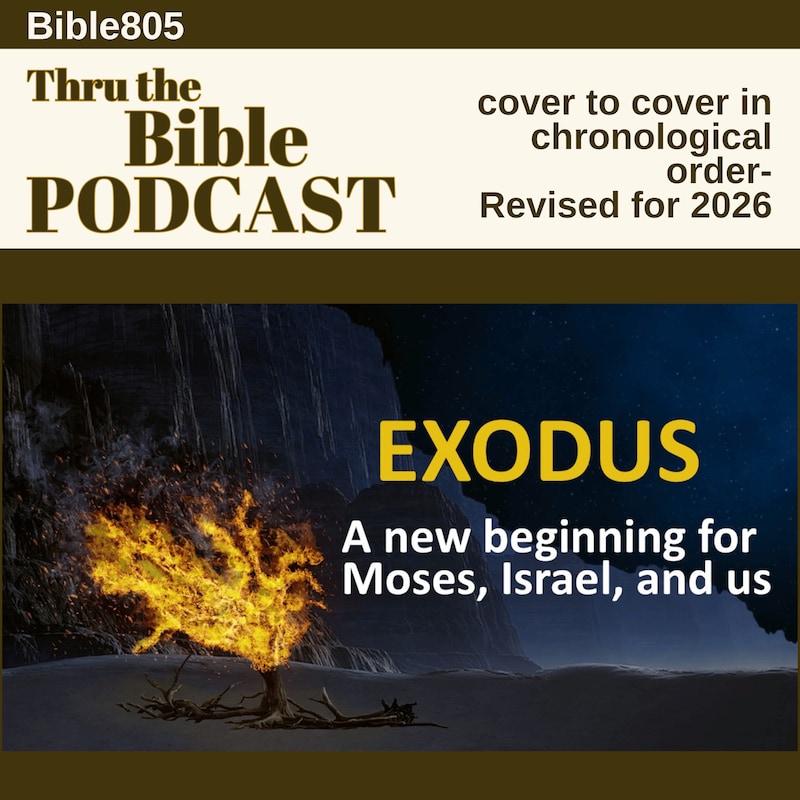
Shownotes
This episode focuses on the pivotal theme of Exodus, highlighting a new beginning for Moses, Israel, and ultimately for us. We explore how God orchestrated events to deliver the Israelites from slavery in Egypt, emphasizing His faithfulness even during their hardships. The discussion reveals that while the narratives of Genesis were relatively straightforward, the transition into Exodus introduces complexities, including laws and regulations that remain relevant today. We delve into how these ancient texts serve as warnings and lessons for modern believers, urging us to understand the expectations God has for His people. Ultimately, we are reminded that God does not forget His promises and continues to call us, regardless of our life stage, to fulfill His purpose.
Takeaways:
- This podcast offers a historical and thematic commentary on the Bible, aiming to be both thoughtful and challenging.
- We discussed how the story of Exodus marks a significant transition for the Israelites, highlighting their journey from slavery to freedom.
- The importance of understanding the laws presented in Exodus, Leviticus, Numbers, and Deuteronomy is emphasized as they are relevant to us today.
- Moses' life serves as a reminder that God can call anyone, at any stage of life, to fulfill His purposes.
- We learned that challenges in life should be viewed as opportunities to trust in God's provision and guidance.
- The podcast concludes with encouragement to remain open to God's calling, no matter one's age or past experiences.
Links referenced in this episode:
Transcripts
Welcome to through the Bible in chronological order from Bible 805 and Yvon Prehn. This podcast is a somewhat unique and I trust, a helpful historical and thematic commentary on the readings in the Bible.
It's not a verse by verse study, but one that I pray you'll find thoughtful and challenging.
PLEASE NOTE: I apologize, but the system that generates these transcripts has done an odd thing on this in making 2 speakers--I have contacted the company, but there is no way I can correct this and do want to get it distributed to you. Please go to the www.Bible805.com web site, the NOTES that are a free download are virtually a transcript of the lesson. They will be posted later today.
New episodes are released each Wednesday and today our lesson is Exodus,
"A new beginning for Moses, Israel and us"
Where we are in the Bible at the end of Genesis, Jacob, who is now called Israel, took his family to Egypt to escape the famine in Canaan. God prepared the way by sending Joseph ahead, though he used the means of his brothers selling him into slavery to get him there.
But as God so often does, God took an impossible situation when he took Joseph out of prison and made him a ruler in Egypt.
And through Joseph, God gave Jacob's family a safe, protected and privileged place in Egypt where for the next 400 years they could grow into a nation. But then things changed. As the Book of Exodus begins in the Bible, the new Pharaoh no longer.
Speaker B:Protects the Jews, but forces them into slavery.
Speaker A:For us, our experience reading or listening to the Bible all changes with the book of Exodus.
Up to this point, it's been very easy reading or listening to the true stories of creation, the Tower of Babel, the Flood, the start of the family of Jacob that becomes the nation of Israel.
Speaker B:But about halfway into the book of.
Speaker A:Exodus, after the incredible story of the Exodus, things change and we get into mostly lists of rules and regulations for the next four books that can be a challenge to read. And and it is where many people bail out but don't stop. Here's why it's important to keep reading.
Speaker B:Your Bible in what follows the laws.
Speaker A:Rules and regulations we need to understand they aren't just for people in the past, but for us.
As Paul reminds us in First Corinthians 10, where it says, for I do not want you to be ignorant of the fact, brothers and sisters, that our ancestors were all under the cloud and that they all passed through the sea.
They were all baptized into Moses in the cloud and in the sea they all ate the same spiritual food and drank the same spiritual drink, for they drank from the spiritual rock that accompanied them, and that rock was Christ. Nevertheless, God was not pleased with most of them. Their bodies were scattered in the wilderness.
Speaker B:Oh, that's not good, we'd say.
Speaker A:But then Paul goes on telling us why this happened. Here's why they died and what it teaches us. He goes on to say.
Now these things occurred as examples to keep us from setting our hearts on evil things as they did. Do not be idolaters as some of them were. As it is written, the people sat down to eat and drink and got.
Speaker B:Up to indulge in revelry.
Speaker A:We should not commit sexual immorality as some of them did, and in one day 23,000 of them died. We should not test Christ as some of them did, and were killed by.
Speaker B:Snakes, and do not grumble as some.
Speaker A:Of them did, and were killed by the destroying angel.
Speaker B:These things happened to them as examples and were written down as warnings for us on whom the culmination of the ages has come. So if you think you're standing firm.
Speaker A:Be careful that you don't fall.
Speaker B:These books are a warning for all of us, especially if we think we don't need it.
Speaker A:The warning works in these ways. Here's what these books will teach us.
Speaker B:I'm talking about Genesis, Exodus, Leviticus, Numbers, and Deuteronomy. First, they underscore that God always has a people and not everyone on earth is automatically his child, his people.
To be his people, Israelites had to believe Moses and move out of Egypt. Today we must accept Jesus as our Savior. Doing these things makes us individually his child and part of his people.
Second, they tell us what God expects.
Speaker A:Of his people after salvation.
Speaker B:For Israel it was salvation from slavery in Egypt. For us it is salvation from the penalty of our sins, which is death. As Romans 6. 23 puts it when it says the wages of sin is death.
Death means a life without significance while we're here on earth.
And even though it might be filled with lots of fun and toys and stuff and activities and then eternal damnation, separation from God when we die, we don't like to hear those things, but they're true. There are consequences to our choices and these books tell us what makes a life giving choice and what choices lead to spiritual and eternal death.
We need to learn how to live as First Corinthians tells us. We need to learn how to live as God's people in our personal lives, in our worship and in the world. We can't just do what we want.
What was acceptable in Egypt was not always acceptable to God and God is very specific about his requirements. The rest of the Old Testament will make sense in the cycles of blessing and judgment for Israel and individuals.
When you understand the ground rules presented in these books, the material you will be reading is complex and quite honestly sometimes challenging to get through. But I'll be sharing overviews, insights, commentary and applications for you. Each lesson, each step of the way.
So let's jump in now as the story, as the story often is. It starts with one man, Moses. Exodus opens after 430 years of silence since Joseph's death.
It begins with the story of Moses, born an Israelite, but raised by Pharaoh's daughter, most likely. Who is Hatshepsut? An extremely powerful woman. Somehow, when we meet him as an adult, he knew he was called to be the deliverer.
And like Joseph, he inappropriately bragged about it. He called on Joseph, bragged about God's calling on his life inappropriately, and he got sold as a slave for it.
Moses decides to do things his way, and he kills an Egyptian who's abusing his fellow Israelite. Things did not go well. Joseph Moses was then labeled a murderer and he had to Flee. He spent 40 years in Midian.
When we next see him, he's now an old man, 80 years old. Maybe he was one filled with regret. He may have thought his days were winding down.
He may have planned on spending his days doting on his grandchildren. But one day, a bush was burning. And when he turned to look at it, he heard a voice.
Exodus 3, 7, 10 tells us, I am the God of your father, the God of Abraham, the God of Isaac, the God of Jacob. At this, Moses hid his face because he was afraid to look at God. And the Lord said, I've indeed seen the misery of my people in Egypt.
I've heard them crying out because of their slave drivers, and I am concerned about their suffering.
So I've come down to rescue them from the hand of the Egyptians and to bring them out of that land into a good and spacious land, a land flowing with milk and honey. The home of the Canaanites, Hittites, Amorites, Perizzites, Hivites and Jebusites.
And now the cry of the Israelites has reached me, and I've seen the way the Egyptians are oppressing them. So now go. I am sending you to Pharaoh to bring my people, the Israelites, out of Egypt. Moses was hesitant, but Moses said to God, who am I?
That I should go to Pharaoh and bring the Israelites out of Egypt? And. And God said, I will be with you. A key in any calling from God is that it's not about you. It is about the God who calls you.
God goes on to tell Moses a new name for himself. God said to Moses, I am who I am. This is what you are saying. The Israelites, I am has sent me to you. Now some comments and application.
God can call you at any time in your life. From any place, no matter how isolated or shut in it might be. God is incredibly creative in his callings.
He called Abraham out of an advanced civilization into the desert and relative isolation for the rest of his life. God called Moses out of the wilderness, back to an advanced civilization, from isolation to lead over a million people.
What God calls you to, he's prepared you for. You might not think it, you might not believe it, but that's true. Moses was educated, literate, well acquainted with Pharaoh's court.
And he also knew what a nomadic life was like. Age does not matter in God's call. Young or old, we're an eternal people. After much complaining, questions, hesitation, Moses submits.
And though he didn't know it, he goes on to do things and write materials that will change the course of human history. What first comes to mind when we think of what Moses accomplished is his deliverance of the people.
But equally important was the writing of Job and the first five books of our Bible. Genesis, Exodus, Leviticus, Numbers and Deuteronomy.
These books are the foundation for human life and law, for our understanding of God, the rest of his message to us and ourselves. Imagine if they'd never been written. We can't, as they are a core of human history.
These books form, even if we aren't as familiar with them as we should be, they are the foundation for all who we are.
Think of the time he'll spend listening to God to write it all down, all during the same time, serving as leader of a complaining, ungrateful multitude of people. It was an extraordinary calling that he could have never imagined in his 40 years of exile. Some comments and application.
If you're still alive, God isn't finished with you, though. The challenge I'm about to talk about is for everyone of every age.
Also for everyone who feels they've been shut in, shut away, or sidelined for any reason. I want to specifically address this challenge that I'm going to give in just a few minutes to my cohort, the baby Boomer generation.
What are you doing to finish? Well, we were the Jesus People generation. We invented the one way sign. Our generation created modern gospel music.
We created Christian coffee shops, Christian communes, huge Christian festivals. We had an overarching desire that people needed to know Jesus as their personal savior. And we did all we could to help them know Him.
And though the Jesus People movement had its problems, it was powerful. It was passionate in its desire to know God. What are you passionate about now? Interacting with grandkids and playing golf can be great fun.
So is shopping and traveling even more so. But none of these or many other retirement activities, if you can afford to retire, that is. They're not inherently evil.
I don't want to make you feel guilty here. Well, that's not really true. Maybe just a little bit. But if you have time and health, there's room for so much more.
Room to recover, a passion, to see God work in mighty ways in your life. I'm quite sure God has a bush burning for you. There's something or some.
Some project, some ministry, some something he wants you to do so that you can finish strong. Take some time to think about it, pray about it. Our world has incredible needs and many of the people around you still need Jesus.
I know boomers who are working at Foodshare, serving as an advocate for the homeless. I know a 90 year old woman who runs an incredible tutoring after school program. All their lives and communities are much richer for it.
Regardless of your age, keep your eyes.
Speaker A:Open for that burning bush.
Speaker B:Now back to our story. God does not forget his people or his promises. He's at work, even if we don't see it. After his preparation and call, God sends Moses back to Egypt.
He confronts Pharaoh who refuses to let the people go. Plagues against the gods and pride of.
Speaker A:Egypt last for 10 months.
Speaker B:The final one is the death of the firstborn of Egypt. While those under the Passover blood on their doorways are safe, people leave the land at last. Early challenges.
After being freed, Pharaoh changes his mind and goes after them. The Israelites are hemmed in by the red Sea. For 10 months, they've seen incredible miracles of judgment against Egypt.
They're going free with riches given to them by the Egyptians. After 400 years of slavery, they have ample reason to trust God.
Instead, they immediately start to complain and cry, God opens the sea and they go through. And you think after all this and all the previous miracles that they would trust God when trials come. But that doesn't happen.
Three days into the desert and they can't find water. Do they rejoice? Do they say, wow, what an opportunity to see what God's going to do? No. They grumble, they complain, they. They whine.
God gives them water, then they grumble about the food. God gives them manna, which means, what is it now? God gave them the manna. In doing that, it was also part of a test.
On the sixth day, they were to gather double the manna. And on the seventh day to rest, God said he would use this to test them. Some obeyed, some didn't.
God was Teaching them that the Sabbath was a gift along with the food. In their years as slaves, I imagine they had few days off and no free food. Just a little historical note here.
The Egyptian Week was 10 days long and though there were periodic religious festivals, there's no record of a weekly day of rest, which would have been difficult regardless in a primarily agrarian society and probably as slaves they had little or no time off ever. Now the food they did not work for was freely provided and they were given a day of rest every seven days.
Comment and Application Regarding the Sabbath Are we still living like slaves and not taking the rest we could and should take in now that we have Jesus who has done everything for us? Here is not a place to argue the details of Sabbath. Is it Saturday or Sunday? Exactly what constitutes rest? Can you do this? Can you? Whatever.
The Bible is not specific and consistent on the details. Jesus said the Sabbath was made for man, not man for the Sabbath. He broke it to do good, to care for others.
He infuriated the religious leaders about it.
Speaker A:In that he didn't follow their Sabbath rules.
Speaker B:The Jews did not rest for 52 days when they were rebuilding the wall around Jerusalem. God commended them for their work.
Speaker A:So there are exceptions to a strict observance. I think the main point is do.
Speaker B:We trust God or do we think that our success in everything in our work or spiritual lives depends totally on us and how hard we work? Think and pray about it and ask God to help you answer how he.
Speaker A:Wants you to rest.
Speaker B: mies of Israel in Deuteronomy: Speaker A:It tells us a little bit more about this situation where it says, remember.
Speaker B:What the Amalekites did to you along the way.
Speaker A:When you came out of Egypt when.
Speaker B:You were weary and worn out, they met you on your journey and attacked.
Speaker A:All who were lagging behind, typically women and children. They had no fear of God. Moses told Joshua to gather an army to fight them. He goes into battle, Joshua that is, and Moses is on the top of.
Speaker B:The mountain praying for them.
Speaker A:So long as Moses arms are held.
Speaker B:Up in prayer, they win. When he tires, they lose. Then Aaron and Hur hold up his.
Speaker A:Arms until the army is defeated. Here's some lessons from the story.
Speaker B:The primary one remembered and told about.
Speaker A:This event is from Charles Spurgeon who.
Speaker B:Talks about the importance of both prayer and action.
Speaker A:He reminds us that Moses is on.
Speaker B:The mountain praying and Joshua is fighting hand to hand combat.
Speaker A:Both important and both are needed. I've often used this illustration in my.
Speaker B:Church communication ministry, but it's always useful in all ministries in that yes, we must always pray, but usually there's also a lot of just tangible, everyday, detail oriented work to be done. It's often again, detailed, boring, brutal work.
For example, to have an effective small group ministry, you must pray all you can about it, but here are just some of the things you must also do. Find curriculum with an overall plan and purpose. Communicate the plan and purpose. Cast vision for the ministry. Train leaders.
Organize the groups, Recruit attendance by using every communication format that you can and repeat again and again. From printed bulletins to text messages to social media to pulpit encouragements, and then again, repeat many, many times.
Train and encourage leaders.
Speaker A:Celebrate success.
Speaker B:Share stories. Again, repeat continuously.
Without all this work, you may have some scattered small groups, but you won't have the powerful discipleship and outreach tool a small group ministry can be if you don't put the needed organizational and intentional work into them. Here's the second important lesson they learned how to fight and win. They were slaves, newly out of Egypt.
Yet they fought a formidable foe and defeated them. Battle should teach us something. They aren't simply a trial to get through and be done with.
They should have remembered this as they were about to go into the land and were fearful of the battles ahead. Consider journaling how God has helped you in the past to enable you to trust him in future trials. Finally, they arrive at Sinai.
When they left Egypt, they were simply a group of slaves. God will now work to make them into a people, a nation to serve Him.
To do that, they needed to learn everything how to worship, how to govern their nation, how to live in their interpersonal lives. Next, he will give them the Ten Commandments and other laws, which is his right as the I am God who brought them out of Egypt.
God isn't just though the I am for Israel. In a story long ago, I subtitled this lesson a New Beginning for Moses, Israel, and us. Because God is also the great I am for us.
And even more so than in the Old Testament, because Jesus finished the start of that statement when in the Gospel of John he tells us, I am the bread of life, I am the light of the world, I am the door of the sheep, I am the good shepherd, I am the resurrection and the life. I am the way, the truth and the life. I am the vine. He is all those things for each of us. He has a plan for you.
Even though you may not see it yet he has equipped you for it even though you may not be aware of it or have forgotten it, keep your eyes open for that burning bush. Move forward and finish strong.
Speaker A:That's all for now. For notes from this lesson, related resources and links to teaching materials, go to www.
Bible805.com in closing, I'm Yvonne Prynn, your fellow pilgrim, writer and teacher for Jesus, and I'd like to close with this benediction.
May you know the invitation of God to move from confusion, clarity, from wandering to rest, from loneliness to knowing you are loved, from turmoil to peace, from wherever you are on your spiritual journey to a growing knowledge of God's Word and in your personal relationship with the Father, Son, and Holy Spirit. Amen.

