Audio • Trailer • Trailer, series 2 • What to expect (updated).
© 20 26 The Rise of the Protestants., Author, Shaughan Holt.
Welcome, and thank you for joining me for series 2.
In this podcast, we examine the emergence of Protestantism, its challenge to established traditions, its transformation of key beliefs, and its global impact.
At the heart of our story are England’s Nonconformist and Separatist movements, and we’ll show why they matter in the wider Christian tradition.
We examine how these movements changed Christian beliefs, shaped Western Christianity, and deepened the divide between Roman Catholicism and the new Protestant groups.
Our journey unfolds chronologically, beginning in early 1500s Germany, where Martin Luther is cast out of the church, and concluding a century later, along the southern shores of England.
Each episode, begins and ends with a short piece of music, that is relevant to the content presented
A complete transcript, also accompanies every episode.
This series does not seek to persuade or promote any particular belief.
Instead, the objective is to examine the events, ideas, and conflicts that shaped a pivotal period in European religious history.
Throughout the series, you’ll meet early Puritans, Nonconformists and Separatists.
These individuals confronted a hostile society, endured persecution, and frequently risked their lives to uphold their beliefs.
Their actions contributed, to the foundation of religious freedom and individual rights, that are widely valued today.
In the first 12 episodes, we examined the contributions of figures such as Beza, Vermigli, Calvin, Tyndale, Knox, and Robert Browne, who is often referred to as the father of Congregationalism.
The subsequent twelve episodes begin in 1585, a period when the Protestant movement, was encountering significant challenges in Holland.
From this point, we trace the events leading to the execution of Mary Queen of Scots, and examine the narrative of another significant figure, Martin, who is frequently overlooked.
These events move the story from the time of Queen Elizabeth, to the troubled reign of King James I, Mary's only son.
In the third series, commencing in 1607, we examine the challenges encountered by Puritan Nonconformists, as they transition from Puritanism to Separatism, and ultimately migrate to newly established English Separatist communities in Holland and Europe.
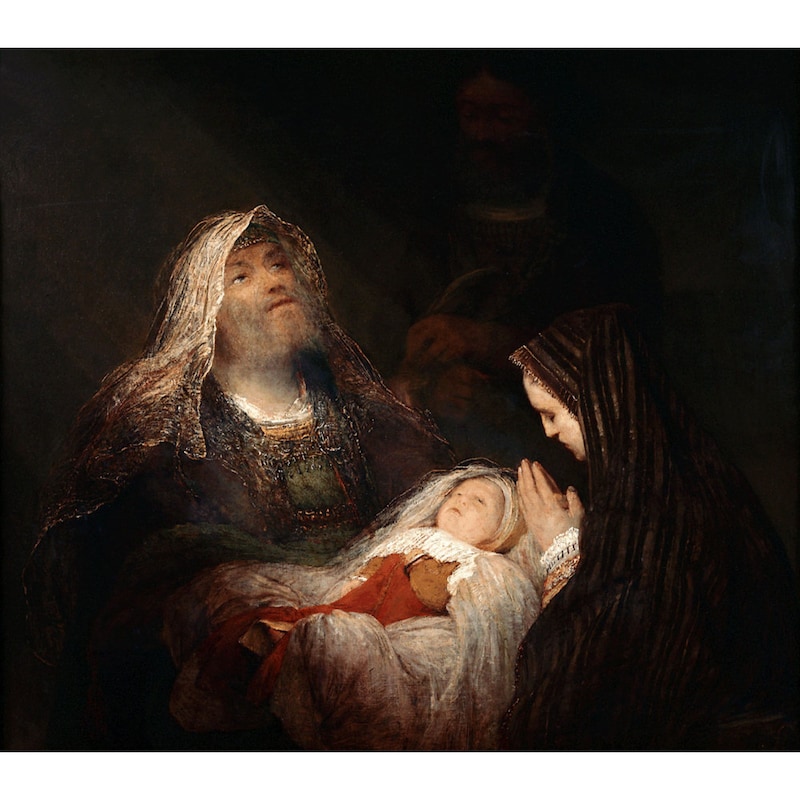
Artwork • Simeon's Song of Praise by Aert de Gelder, around 1700–1710.
This Dutch Baroque oil painting on canvas is now part of the Mauritshuis collection in The Hague.
It shows the moment when the elderly Simeon recognises the infant Jesus as the Messiah.
The painting depicts the biblical story from the Gospel of Luke, in which the prophet Simeon holds the infant Jesus in the temple and sings a song of praise.
The Mauritshuis is internationally renowned for its distinguished collection of paintings by Dutch and Flemish artists from the period of Rembrandt and Vermeer.
Music: The Nunc Dimittis, also known as, 'Now lettest thou depart,' was composed by Orlando Gibbons (1583-1625).
This piece is featured in, 'The Best of Choral and Organ Works' by the Oxford Camerata. It is also called the Song or Canticle of Simeon. This canticle comes from the second chapter of the Gospel of Luke, verses 29 - 32.
© 20 26 The Rise of the Protestants., Author, Shaughan Holt.
"All rights reserved. No part of this podcast may be reproduced, translated, distributed, or transmitted in any form or by any means, including photocopying, recording, or other electronic or mechanical methods, without the prior written permission of the copyright holder, except in the case of brief quotations embodied in critical reviews and certain other non-commercial uses permitted by copyright law".
Requests regarding translation, licensing, or republication should be directed to: [email protected]
Your feedback matters, send me an email at [email protected], with any comments, suggestions, or criticisms.I read every message.