Shownotes
What does it take to survive the unthinkable and then transform because of it?
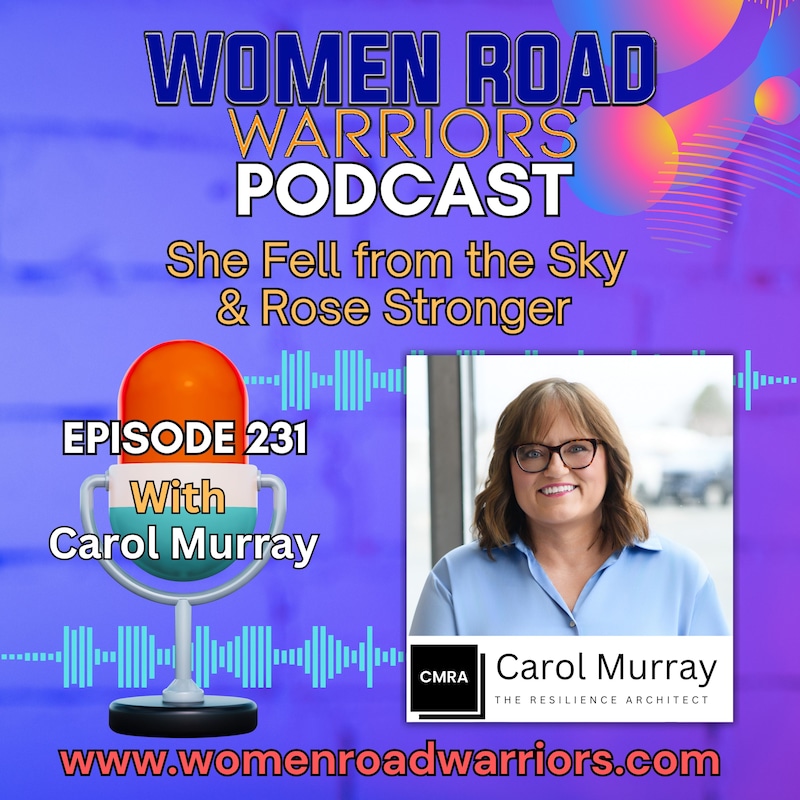
In this powerful episode of Women Road Warriors, Shelley Johnson and Kathy Tuccaro sit down with Carol Murray, a woman whose life changed in an instant after a catastrophic skydiving accident left her free-falling over half a mile when both her main and backup parachutes failed. Her story was featured in the Toronto Star. The impact caused devastating injuries and years of recovery, but that’s only the beginning of her story. She talks about her near-death experience and what she has become because of it.
Today, Carol is known as “The Resilience Architect,” a sought-after keynote speaker helping individuals and organizations navigate adversity, lead under pressure, and perform at their highest level when it matters most.
Drawing from her extraordinary journey and a career raising over $50 million for medical research, social services, and community organizations across North America, Carol shares the three pillars that define true resilience: Community, Values, and Perspective.
This conversation goes beyond survival—it’s about rebuilding, redefining fear, and stepping into strength with intention. Carol’s story will challenge the way you think about setbacks, leadership, and what it really means to rise after life knocks you down.
If you’ve ever faced adversity, questioned your strength, or needed a reminder of what’s possible, this episode is for you.
🎧 Listen now and discover how resilience isn’t just built… it’s chosen.
#ResilienceMindset #WomenEmpowerment #OvercomingAdversity #LeadershipUnderPressure #PersonalGrowthJourney #CarolMurray #TheResilienceArchitect #ShelleyJohnson #KathyTuccaro #WomenRoadWarriors
Transcripts
This is Women Road warriors with Shelly Johnson and Kathy Tucaro.
Speaker A:From the corporate office to the cab of a truck, they're here to inspire.
Speaker B:And empower women in all professions.
Speaker A:So gear down, sit back and enjoy.
Speaker B:Welcome.
Speaker B:We're an award winning show dinner dedicated to empowering women in every profession through inspiring stories and expert insights.
Speaker B:No topics off limits.
Speaker B:On our show, we power women on the road to success with expert and celebrity interviews and information you need.
Speaker B:I'm Shelly.
Speaker A:And I'm Kathy.
Speaker B:Carol Murray survived a catastrophic skydiving accident, falling over a half a mile from the sky after both her main and backup parachutes failed.
Speaker B:The impact left her with devastating injuries and years of painful recovery.
Speaker B:But what's remarkable isn't just that she survived, it's who she chose to become afterward.
Speaker B:Today, Carol is known as the Resilience Architect.
Speaker B:A keynote speaker who helps people and organizations navigate adversity, lead under pressure and perform at their best when it matters most.
Speaker B:Her three pillars of resilience are community, values and perspective.
Speaker B:With a career that spans leadership, fundraising and mission driven work, she's raised millions for important causes and she now shares hard earned lessons on resilience, perspective and the power of facing life's toughest moments head on.
Speaker B:She went on to build a career raising over $50 million for medical research, social services and community organizations.
Speaker B:She works closely with teams, leaders and frontline staff across North America.
Speaker B:Carol doesn't just talk about resilience, she lives it.
Speaker B:From life threatening trauma to becoming a voice of strength and transformation.
Speaker B:Her story is going to challenge how you think about fear, survival and what it truly means to rise.
Speaker B:Kathy and I can't wait to talk to her.
Speaker B:Welcome, Carol.
Speaker B:Thank you so much for being on our show.
Speaker A:Thank you very much for having me.
Speaker A:I'm very excited to be here.
Speaker A:Yes, welcome.
Speaker B:Oh my gosh.
Speaker A:Like, wow, what a story.
Speaker B:You're amazing, Carol.
Speaker B:This.
Speaker B:Oh, wow.
Speaker B:I can't even imagine.
Speaker B:And I know that our listeners are going to be.
Speaker B:We want to learn more.
Speaker B:You've got so much to share and you're so blessed to be alive after this experience.
Speaker B:Oh my goodness.
Speaker B:It was featured recently in the Toronto Star.
Speaker B:From what I was reading, this was your first ever skydive and you already knew and felt something wasn't right before you even decided to go up in the plane.
Speaker B:Is that correct?
Speaker A:Yes, that's correct.
Speaker A:I was 24 years old and I feel like, you know, when you're done college and you move to a big city and you're about to launch into adulthood, I was really just at that pace where I was working and living in the city for a year and it was my friend's birthday and it's something that we wanted to do to celebrate.
Speaker A:And I will say that I was the ringleader, I was the pusher in this instance.
Speaker A:And so we decided to go for it.
Speaker A:And on a Saturday morning we headed about an hour north of Toronto to go skydiving.
Speaker A:We actually didn't jump and I actually didn't jump until Sunday.
Speaker A:But there were several things that happened before the jump that led me to wanting to back out, but I didn't have the confidence to do so.
Speaker A:I was 24 years old and when the owner instructor said no, this stuff happens all the time, I didn't have the confidence within myself to say no.
Speaker A:But some of the things that I that made me nervous.
Speaker A:My friend fell asleep three times during training and was told, if you fall asleep one more time, you're going, you're not going to get to go.
Speaker A:And they said this to him three times.
Speaker A:I felt that the training wasn't very comprehensive to jump out of a plane.
Speaker A:Our test jump was once from a wooden structure that was maybe the height of my hip.
Speaker A:The 12 year old was packing parachutes.
Speaker B:A 12 year old was packing parachutes.
Speaker A:Their son was packing parachutes.
Speaker A:They said that he was certified.
Speaker A:And then I learned there was no certificate.
Speaker A:Afterwards, I learned there was no certification to pack parachutes.
Speaker A:And Certainly, you know, 12 year olds shouldn't.
Speaker B:Wow.
Speaker A:The first day, well, it rained all weekend, but the first day on the Saturday, by the time it was our turn to go, we go to the plane and it's too dark.
Speaker A:And the owner instructor, she tried to encourage the pilot to go up for one more time, but he was very firm that no, we're not going, it's too late.
Speaker A:And before I continue, I want to say that I don't think that the people that owned the skydiver school wanted anything bad to happen.
Speaker A:I think that we're really good people running a business and that these things happen and that we got to learn from them and grow on.
Speaker A:But I have no problem pointing out the concerns that I have because we can all learn from them and I bet you they have too.
Speaker B:Yeah.
Speaker A:And then the second day, so we went home, we come back the next day and we went up with a plane in the morning and we were trying to get to 3,200ft and we were at 2,200ish and the pilot said, we can't go any further.
Speaker A:It's too cloudy.
Speaker A:And she was kind of pushing the pilot to go higher because she really wanted to drop us.
Speaker A:So then we had to land in the plane.
Speaker A:So the skydiving drop zone that the plane place, the airport was about, I don't know, a few miles from the skydiving school.
Speaker A:And we had to take a van to get there.
Speaker A:And on the way back in the van, I said, I'm not going to do this.
Speaker A:Like, these are signs I'm not supposed to do this.
Speaker A:And she convinced me to go.
Speaker A:And I always wondered what was involved in her saying that.
Speaker A:Was it the fact that if they gave me a chance to go and I backed out, I do not get my money back?
Speaker A:But since I didn't have a chance to jump, I would have been eligible for my $220.
Speaker A:Did that $220 play a role in that decision?
Speaker A:And I don't know for sure.
Speaker A:Certain.
Speaker A:But I have to wonder, especially when I learned afterwards that they were having some financial difficulties.
Speaker A: years, and this was: Speaker A:I found them in the yellow pages.
Speaker A:The Internet wasn't really a thing so much then.
Speaker A:Right.
Speaker A:And it turned out afterwards, I was asked them how long they were in business.
Speaker A:They answered how long they were doing this, but their business was only open for a year.
Speaker A:Ooh.
Speaker A:Oh, wow.
Speaker A:These.
Speaker A:These are some valuable lessons.
Speaker A:And that's why perspective is one of my pieces of the.
Speaker A:One of the pillars in what I speak about, because we had different point of view.
Speaker A:We had different perspectives on what that question meant.
Speaker A:And there was a few other things.
Speaker A:It turned out risk and consequences is a big piece of it, too.
Speaker A:And certainly, Kathy, you're working in the oil fields.
Speaker A:You know all about this.
Speaker A:I speak about workplace safety.
Speaker A:And one of the things I talk about is risks and consequences.
Speaker A:We look at risks.
Speaker A:Oh, this is a 1 in x, y, Z chance that this isn't going to happen.
Speaker A:So let's save the money or let's do this and let's get home for the game.
Speaker A:But do you think about the mother that's going to get a phone call to say your daughter's parachute didn't open or your son was hurt, like on the oil field and they have 12 hours if you're going to live or die.
Speaker A:Do they think about, you know, the years of rehabilitation that comes afterward?
Speaker A:Yeah.
Speaker A:During the training, there was one thing that I got wrong.
Speaker A:We would.
Speaker A:They would say, okay.
Speaker A:We would stand there and they would say, what happens when you jump out of the plane, you look over your parachute, you make sure it's good, and you grab your toggles, which is the the controllers to help you navigate where you're going.
Speaker A:And I would say, look over your parachute, grab your toggles.
Speaker A:And they said, no, you have to make sure it's safe first, that, that it's good.
Speaker A:And I was like, okay, fine.
Speaker A:They never told me that if I touch those toggles and then need the reserve backup chute, there's a strong chance that I'm going to be in trouble and all the straps are going to tangle and collapse.
Speaker A:And that's exactly what happened.
Speaker A:My parachute was malfunctioned.
Speaker A:I pulled the toggles and then they tangled and collapsed with the reserve chute.
Speaker A:But they never told me the consequences of my error in training.
Speaker B:Wow.
Speaker A:Wow.
Speaker A:Lots of little lessons I think that are valuable in life that I'm honored to share with people.
Speaker B:And we want to get back to that, exactly what happened when you were a half a mile above the ground after you jumped out of that plane.
Speaker B:But unfortunately, we do have to go to break.
Speaker B:We will be back.
Speaker B:Stay tuned for more.
Speaker A:Stay tuned for more of Women Road warriors coming up.
Speaker B:Dean Michael, the tax doctor here.
Speaker B:I have one question for you.
Speaker B:Do you want to stop worrying about the irs?
Speaker B:If the answer is yes, then look no further.
Speaker B:I've been around for years.
Speaker B:I've helped countless people across the country, and my success rate speaks for itself.
Speaker B:So now you know where to find good, honest help with your tax problems.
Speaker B:What are you waiting for?
Speaker B: -: Speaker B:Industry movement Trucking Moves America Forward is telling the story of the industry.
Speaker B:Our safety champions, the women of trucking, independent contractors, the next generation of truckers and more help us promote the best of our industry.
Speaker B:Share your story and what you love about trucking.
Speaker B:Share images of a moment you're proud of and join us on social media.
Speaker B:Learn more at truckingmovesamerica.com.
Speaker A:Welcome back to Women Road warriors with Shelly Johnson and Kathy Tucaro.
Speaker B:If you're enjoying this informative episode of Women Road Warriors, I wanted to mention Kathy and I explore all kinds of topics that will power you on the road to success.
Speaker B:We feature a lot of expert interviews.
Speaker B:Plus we feature celebrities and women who've been trailblazers.
Speaker B:Please check out our [email protected] and click on our Episodes page.
Speaker B:We're also available wherever you listen to podcasts on all the major podcast channels like Spotify, Apple, YouTube, Amazon, Music, Audible, you name it.
Speaker B:Check us out and bookmark our podcast.
Speaker B:Also, don't forget to follow us on social media.
Speaker B:We're on Twitter, Facebook, Instagram, Pinterest, LinkedIn, YouTube and other sites.
Speaker B:And tell others about us.
Speaker B:We want to help as many women as possible.
Speaker B:If you're just joining us, you picked a powerful moment to tune in.
Speaker B:We're here with Carol Murray.
Speaker B:She's someone whose story quite literally redefines survival.
Speaker B:Imagine falling over a half a mile from the sky out of an airplane, both parachutes failing and somehow, against all odds, living to tell that story and to survive multiple surgeries and a very difficult comeback.
Speaker B:But what's even more compelling is what Carol did after that moment.
Speaker B:Today, she's known as the Resilience Architect, helping people and organizations perform under pressure and navigate adversity with clarity and strength.
Speaker B:Carol, I want to dive deeper into that transformation because surviving is one thing, but rebuilding a life, a mindset and a mission after something like that, that's something else entirely.
Speaker B:Before we do that, though, in our last segment, we left off with what happened before you made that fateful jump.
Speaker B:So you jumped out of the plane.
Speaker B:And for those who've never jumped out of a plane, which I would say that's the vast majority of people, I've never ever thought I wanted to ever jump on either, a perfectly good plane at all.
Speaker A:No, thank you.
Speaker B:So, I mean, that takes courage in and of itself.
Speaker B:Carol, you jumped out of the plane.
Speaker B:How far down was it that you were supposed to pull your parachute?
Speaker A:So I will tell you that I don't remember jumping, but I didn't have to pull the main parachute.
Speaker A:They have a system that it takes care of itself.
Speaker A:Okay.
Speaker A:Some parachute companies use static lines.
Speaker A:There was something else.
Speaker A:It was just like a smaller parachute that was attached to the main one, maybe the size of like, remember those little toy soldiers that had the parachutes on them when we were little kids?
Speaker A:Yeah.
Speaker A:Like so about that size.
Speaker A:And the wind picks that up and the drag from the wind opens the parachute.
Speaker A:I don't remember that.
Speaker A:I just remembered that I was falling and that something was wrong, like it just didn't feel right.
Speaker A:The wind was everywhere.
Speaker A:And I remember feeling panicked.
Speaker A:And I wore one way radio so I could hear my instructor on the ground, but they couldn't hear me.
Speaker A:And the sign for pull your reserve chute is, look, thumb pull.
Speaker A:So you look to your left and your shoulder and you grab the strap with your thumb and you pull it.
Speaker A:So he said, look, thumb pull.
Speaker A:And I was pulling and nothing happened.
Speaker A:And he was screaming louder, look, thumb pull.
Speaker A:Look, thumb pull.
Speaker A:And I, I have a video of the accident.
Speaker A:I think it was the same 12 year old boy that was packing parachute that used my sister's camcorder to video it and he was screaming it more on the ground.
Speaker A:So when I watch it, I remember hearing that from above and I just remember feeling my body relaxing and fainting and I thought to myself, oh God, I'm going to die.
Speaker A:But the, the reports have people reporting they could hear me screaming to the ground.
Speaker A:I landed in an elderly woman's front yard about a kilometer up from the base of the skydiving school or maybe half a kilometer.
Speaker A: So I fell about: Speaker A:That's two CN towers.
Speaker A:So the height of two CN towers, the top of the two CN of the CN tower.
Speaker A:I hit the ground at 900 kilometers an hour.
Speaker A:And part of my body went three and a half.
Speaker A:Oh my God.
Speaker A:Sorry.
Speaker A:I had a visual there.
Speaker A:Oh my God, that's horrible.
Speaker B:So part of your body went three and a half feet into the ground.
Speaker B:Wow.
Speaker A:Yeah, yeah, that's a fair reaction.
Speaker A:But I like to, you know, I'm a pretty positive thinker that an elderly woman was sitting on her step having tea.
Speaker A:So I say I dropped in for tea.
Speaker B:Oh geez.
Speaker A:Oh my gosh.
Speaker B:Literally, that's one way of looking at it.
Speaker A:But literally dropped in, that's.
Speaker A:Oh my gosh.
Speaker A:I feel really blessed because two feet in the other way, I don't think I would have made it because it was a paved driveway, there was a brick house, there was a big thick tree.
Speaker A:Yeah.
Speaker A:I just feel it's, it's hard to accept or wonder, could it all be physics, but also wonder if, if there's a greater purpose or it just time.
Speaker B:Right.
Speaker A:Divine intervention in a sense that you don't think that.
Speaker A:Okay, well how is that divine intervention if I'm, you know, if I had so many surgeries.
Speaker A:But I firmly believe there's a reason for everything.
Speaker A:And you're right about all the lessons learned along the way for everyone involved, but still, that's an awful way.
Speaker B:Oh yeah.
Speaker B:Oh my goodness.
Speaker B:I mean, I'm reading here you had a broken pelvis, multiple broken ribs.
Speaker B:Both of your legs were severely fractured.
Speaker B:One common fracture, punctured lung and a concussion.
Speaker B:And you had to have 26 surgeries.
Speaker B:I mean, oh, my God.
Speaker A:And I probably need another one soon.
Speaker A:I need new hip, but I have to lose a little weight.
Speaker A:If I lose some weight, I can delay the hip, which is great.
Speaker A:I have been losing, but I have more to lose.
Speaker A:So the biggest problem was my right femur, my thigh bone.
Speaker A:So it.
Speaker A:That was a compound fracture, and that means it came right out of the leg and it dug right into the ground.
Speaker A:So there was a little bug dirt in there, and it was a raging infection.
Speaker A:So every second day I would go to the OR for something called irrigation to clean it.
Speaker A:And I didn't know right away because my family wanted me to remain positive, and they're really positive.
Speaker A:This port network I had is really unreal.
Speaker A:And.
Speaker A:But toxicity of the amputation were happening, and it would have been the amputation at the hip.
Speaker A:So I wouldn't have even really had much of a stump.
Speaker A:So it sounds really bizarre, but I had 16 centimeters.
Speaker A:What's that?
Speaker A:That's about five inches maybe.
Speaker A:I don't know.
Speaker A:I don't know the math as well as I should.
Speaker A:I had 16 centimeters, you know, like a small half of a small ruler of a ruler.
Speaker A:I had 16 centimeters of my right femur removed, and I grew back 14 centimeters.
Speaker A:Oh, okay.
Speaker B:Wow.
Speaker A:Yeah.
Speaker A:So it was really painful.
Speaker A:I had external fixators, which are like huge, big rings on the outside of my legs and pins.
Speaker A:Big, huge pins as thick as my index finger.
Speaker A:And I had to move the contraption to support the bone growth.
Speaker A:And pins are slicing through my leg, and I had to do this every day.
Speaker A:The first external fixator didn't work, and then they didn't know what they were going to do.
Speaker A:But I was lucky enough that there was a fellow there from a children's hospital, and they were using a different external fixator that was more solid and supportive.
Speaker A:So I used that one and it worked.
Speaker A:So my accident was in September and the external fixator came off in June.
Speaker B:Wow.
Speaker B:So I wasn't aware that bone could grow like that.
Speaker B:Did they have to give you something to make the bone do that or.
Speaker A:No.
Speaker A:So I did find a video that shows it that I share sometimes.
Speaker A:But the best way I can describe it is, you know, when someone breaks their bone, they set it and it fills in.
Speaker A:So it's like one cell or microbe or whatever, one, like, little cell at a time.
Speaker A:It fills in, dot, dot, dot, dot, dot, until the bone is rehealed.
Speaker A:So it's basically based on that.
Speaker A:So at the top, what they did was they took like about an inch of the bone at the top of the femur and they broke it, the good stuff.
Speaker A:And then that like 1 inch length piece of bone was connected to a pin and I would use a wrench and four times a day I would turn a quarter of a millimeter so that every day the bone was moving down and stretching down kind of a millimeter a day and new bone would grow behind it.
Speaker B:That had to have been painful.
Speaker A:It was so painful, like going through, slicing through my skin to my body.
Speaker A:It was very painful.
Speaker A:And I have the scars to prove it, which is fine.
Speaker A:My scars are my honor badges.
Speaker A:I don't know how many there are.
Speaker A:There's so many huge ones, but I love them.
Speaker B:Those are your tattoos of valor?
Speaker A:Yeah, yeah, my tattoos of valor.
Speaker A:My big one is like fading over the years, although it's still quite prominent.
Speaker A:But I'd be fine to have the original.
Speaker A:Well, you said you had that from September.
Speaker A:The accident happened in September and you didn't have your external fixator removed till June.
Speaker A:That's a long time.
Speaker A:It is a long time.
Speaker A:And what happened by about February or March, ish, I was experiencing a very.
Speaker A:I was in the rehab by then, almost ready to go home, like the physical rehab.
Speaker A:And so I had to be brought into the hospital.
Speaker A:And.
Speaker A:And what happened was so new bone was supposed to grow as I moved the bone down that space.
Speaker A:But the big empty space that I was moving down towards, new bone was growing there, too.
Speaker A:And they hadn't seen it before because no one had ever done such a big space of bone to try to regrow again.
Speaker A:So when I was moving it down for a couple of weeks while I was having that pain is because I was crushing the new bone that was being developed.
Speaker A:Ow.
Speaker A:Stay tuned for more of women road warriors coming up.
Speaker B:Industry movement Trucking moves America Forward is telling the story of the industry.
Speaker B:Our safety champions, the women of trucking, independent contractors, the next generation of truckers and more.
Speaker B:Help us promote the best of our industry.
Speaker B:Share your story and what you love about trucking.
Speaker B:Share images of a moment you're proud of and join us on social media.
Speaker B:Learn more at truckingmovesamerica.com.
Speaker A:Welcome back to Women Road warriors with Shelly Johnson and Kathy Tucaro.
Speaker B:Today's conversation's one you're not likely to forget.
Speaker B:We're talking with Carol Murray, who survived a catastrophic skydiving accident after both her main and backup parachutes failed, falling over a half a mile to the ground next to someone's house who was having tea on her porch.
Speaker B:And while that moment could have defined the end of her story, it actually became the beginning of something extraordinary.
Speaker B:Carol went on to become the resilience architect, building a career rooted in leadership impact and raising over $50 million for causes that matter.
Speaker B:She talks about her three pillars of community, values and perspective.
Speaker B:Carol, you're a perfect example of resilience.
Speaker B:What you went through was absolutely amazing.
Speaker B:From the fall through your recovery with 26 surgeries, your tenacity is remarkable.
Speaker B:You had to have.
Speaker B:Well, obviously there was bravery.
Speaker B:You had absolute terror when you jumped out of that plane.
Speaker B:You had to have absolute fear going through the rehabilitation process because you had setbacks with MRSA infections and everything else, and constant pain.
Speaker B:It took so much courage for you to just go on from day to day.
Speaker A:The first few months were a nightmare.
Speaker A:Like the hospital was harder than the fall.
Speaker A:Absolutely.
Speaker A:It was nightmarish.
Speaker A:What I experienced, I would say, and I'm so thankful for healthcare in Canada and I'm so thankful for the doctors and nurses in my family.
Speaker A:But I, you know, I.
Speaker A:That's why I'm the resilience architect.
Speaker A:I come from a very resilient family.
Speaker A:It starts with my mother.
Speaker A:My mother was 17 when her mother died and she was the oldest of 10 and her mother died of cancer and she raised them all.
Speaker A:So I have like an amazing network.
Speaker A:So, you know, we've had hard times like we all had growing up and we got through them and we're just resilience.
Speaker A:And you know, as I the last year when I was developing my speeches and I talk about values for teams and workplace and my friend came up with the brand of resilience architect and it's really true.
Speaker A:And that's what I speak about.
Speaker A:And when I looked back of why I am so resilient, that's kind of what my three pillars about resilience are.
Speaker A:And they are grit, I think played a part of it, but I don't think that's a pillar.
Speaker A:That's just something that sometimes people have.
Speaker A:We look at resilience and we think that when it comes, we're going to have grit and we're going to push through it.
Speaker A:But I think resilience is more than that.
Speaker A:I think it's something that we can prepare for.
Speaker A:It's like in architecture for resilience, they like to build foundations that can withstand all kinds of pressures and weathers and unexpected events.
Speaker A:So I like to think that I do that for People in teens.
Speaker A:And my three pillars for resilience are community.
Speaker A:So that's one of the reasons why I was really strong is because I had a very good support network near me.
Speaker A:And there were times throughout that and even now in my life when things are hard, the people that are around me that are stronger than me at the moment and rising me up, I literally visualize myself forwarding their strength.
Speaker A:And so when I help friends or there's a few people I do resilience coaching for, I tell them to borrow mine.
Speaker A:So community is a really big part, the support network to be ready for when your resilience needs to be used.
Speaker A:The next one is values like our own foundational values and figuring out what they are in our life.
Speaker A:And that also is a big part of teamwork as well, to have aligned values.
Speaker A:But if we don't know what we stand for, how are we going to get through the storm?
Speaker A:Right?
Speaker A:Like we have to be grounded in something.
Speaker A:And the third one is perspective and how we look at things.
Speaker A:I spent the first 20 years like immediately after my accident and then all the years just being positive.
Speaker A:And while it served me well at the time, I never took the time to go through the emotions and think about, have look at the perspective of the girl that was lost.
Speaker A:So at the 20 year point I had a bit of a crash emotionally and I took the time to grieve who I might have lost and celebrate the woman that I've become.
Speaker A:And I realized that perspective was really better than just being positive, but to find true narratives and focus on those.
Speaker A:So like I know perspective is powerful for a lot of people, but for me, I use it as a very simple example.
Speaker A:I wasn't able to have children because of this and that was really hard.
Speaker A:So I could either focus on oh poor me, I can't have children, or I could find the perspective that you know what, I can be the best auntie that I can be not just to my siblings children, but to as many children as possible.
Speaker A:So I'll go to the mall, there'll be like a 30 year old man saying hey Auntie Carol.
Speaker A:And like when, when their niece would, they were in elementary school with my niece.
Speaker A:So the three pillars and that's the what the resilience.
Speaker A:That's where the resilience come from.
Speaker A:Because when I look back at those days in the hospital and getting through it all and all these years afterwards and chronic pain and you know, raising money for charity sometimes isn't easy, but it's always rewarding those Are the things that ground it for me for resilience, that's important.
Speaker B:Do you think that if this accident had not happened, you would have not gone in the direction you have?
Speaker A:I think I would have found philanthropy as a career choice.
Speaker A:I loved business, but I wanted to help people, so I think I would have found it.
Speaker A:I really do.
Speaker A:So I'm lucky.
Speaker A:I mean, I'm living my dream now and doing public speaking and sharing my story and sharing the lessons that I learned along the way.
Speaker A:But I'm also lucky.
Speaker A:And I think I'm able to do that is because I've spent my career the last 25 years in my passion, fundraising and nonprofit leadership and management.
Speaker A:It's in my soul.
Speaker A:It's what I love.
Speaker A:And I do think I would have.
Speaker B:Found that your message is so powerful.
Speaker B:And I think most people just kind of stop what happened to you?
Speaker B:You know, I mean, that gets people's attention right now.
Speaker B:And when you talk about resilience and everything you had to go through, that's a testament to resilience.
Speaker B:I mean, it's a powerful word, but it is hard for people to grasp it.
Speaker B:You know, when we go through life's challenges, sometimes we just want to give up.
Speaker B:And what you're helping people to do is see that ray of sunshine or some light at the end of the tunnel and how to get there.
Speaker A:It's like I've had a neck sprain for the last three weeks, and I don't think I'll ever complain again.
Speaker A:Oh, no, no.
Speaker A:I don't believe that either.
Speaker A:I'm like, oh, my gosh.
Speaker A:Like, oh, my Lord.
Speaker A:It is a matter of perspective, right?
Speaker A:It could always be worse, because when I was in the hospital, like, with this metal cage around my leg and literally screeching my head off because I could feel and sense when someone walked in the room, there was a woman next to me that broke her arm, that had nobody.
Speaker A:And I instantly, as.
Speaker A:As hard as it was, I instinctively knew, even though I was going through it, I knew I was going to be okay, but I worried about her.
Speaker A:So it's like, it's all relative to what people are saying.
Speaker A:So I'll meet people.
Speaker A:Oh, I broke my leg.
Speaker A:I'm not going to complain.
Speaker A:I'm like, no, but how does it affect your life?
Speaker A:How are you doing?
Speaker A:Right?
Speaker A:Because.
Speaker A:And we all have our own individual circumstances and our own.
Speaker A:The way that things affect us in our life.
Speaker A:And everybody's has value.
Speaker A:And it's human to recognize when people in our situations that we have empathy for.
Speaker A:So I appreciate that you said that, but I just wanna make it.
Speaker A:I just want people to know just because mine is so sensational, that doesn't minimize what other people are going through.
Speaker B:Sure, yeah.
Speaker B:It's all a matter of personal experience and what's going on in your life.
Speaker B:But when you talk about your pillars for resilience, community, that is so important.
Speaker B:And I think that we forget.
Speaker B:We forget about that.
Speaker B:I'm not sure everyone is as supportive as they should be when they're needed,.
Speaker A:You know, and that also links to values.
Speaker A:So I've had instances like my values certainly did not align with that, with the people at the parachute in school that day.
Speaker A:But me and my values with my, with my family and with the healthcare workers, they aligned.
Speaker A:And, you know, I've worked places where we all wanted the same outcome, but we thought there was different ways to get there.
Speaker A:And it was a train wreck in one place that I work because my values did not align with those of my team.
Speaker A:But yet I'll work somewhere else.
Speaker A:And, you know, everybody on the team is aligned.
Speaker A:And it was, it was like beautiful music, what we would make together and the impact that we have.
Speaker A:So that's how you build communities, I think, is through those aligned values.
Speaker A:I mean, I'm very lucky because my family that I was born into, they are all these things and I get to live those other every day.
Speaker A:But I have friends who that's not the case.
Speaker A:They don't necessarily connect with their family.
Speaker A:So I also have chosen family members too.
Speaker A:And a lot of that is because our values are aligned.
Speaker B:Yeah.
Speaker A:So two values.
Speaker A:I think that we build these connections and when we make new friends or we meet new people, if our values are aligned, then we can build those stronger connections.
Speaker B:We need other people.
Speaker B:We can't do it alone.
Speaker B:No man is an island, as they used to say.
Speaker B:Well, no woman is an island either, you know.
Speaker A:No, nobody does it alone.
Speaker A:No, they don't.
Speaker A:Stay tuned for more of Women Road Warriors.
Speaker A:Coming up,.
Speaker B:Industry movement.
Speaker B:Trucking Moves America Forward is telling the story of the industry.
Speaker B:Our safety champions, the women of trucking.
Speaker B:Independent contractors, the next generation of truck truckers and more.
Speaker B:Help us promote the best of our industry.
Speaker B:Share your story and what you love about trucking.
Speaker B:Share images of a moment you're proud of and join us on social media.
Speaker B:Learn more at truckingmovesamerica.com.
Speaker A:Welcome back to Women Road warriors with Shelly Johnson and Kathy Tucaro.
Speaker B:We're in the middle of a truly inspiring conversation with Carol Murray.
Speaker B:Her story starts with an unsinkable moment, a fall of over a half a mile when both of her parachutes failed.
Speaker B:For many people, that would have been it.
Speaker B:But that's when her next chapter began.
Speaker B:Carol transformed that experience into a life of impact, becoming a sought after speaker and what she calls the resilience architect.
Speaker B:She guides others through adversity and helps them show up at their absolute best when it matters most.
Speaker B:Carol, you've worked with leaders and teams and organizations across North America, raising millions in dollars and creating real change.
Speaker B:You've been such a positive influence, spreading hope to so many people.
Speaker B:You teach so many really important things of transformation and purpose.
Speaker B:I was reading on your website, in workplaces, failure doesn't look like a falling parachute.
Speaker B:It looks like burnout, miscommunication and decisions that impact lives.
Speaker B:That makes so much sense.
Speaker B:So, I mean, you're, you're bringing your message into the workplace to make it better, more powerful, make people resilient and well, in the, ultimately they're more productive too.
Speaker B:So, I mean, it's, it's all a continuum, right?
Speaker A:Yeah, I think so.
Speaker A:And even to hear you say that, like I'm, I'm humble and it's hard for me to, to even still see myself that way, but, but I'm working on it.
Speaker A:We're all a work in pro progress.
Speaker A:And I think, you know, I think other people have learned different, similar things and they also teach similar things.
Speaker A:But to be honest, my story is an anchor, right?
Speaker A:My story is so sensational that people will remember it.
Speaker A:So I feel like when I've done follow up, like I've done some resilience workshops last summer and when I followed up at the six month mark, they said, you know, we'd done training before and if we, if we think about it, they're like, oh yeah, that person.
Speaker A:But they said, you know, over the months we've come over some things and we use, we're trying to use the tools that you mentioned.
Speaker A:They're like, oh yeah, Carol, the girl that went skydiving, this is what she said.
Speaker A:This is where this is relevant here.
Speaker A:So I think the fact that I have an anchor story makes it more memorable and that people are more likely to put it into action when it's someone that's lived it not just in the workplace, but in their regular life.
Speaker A:And just a story that's memorable, it just grows more at the top of their mind.
Speaker B:Well, your story is the exclamation point.
Speaker B:It puts everything top of mind.
Speaker B:It gets people's attention right away.
Speaker B:Which sometimes you have to do that.
Speaker B:Hey, I need your attention here.
Speaker B:And people will go, wow, we want to learn from this lady.
Speaker B:Because very few people can talk about this.
Speaker B:I mean, I don't know what the survival rate is of falling out of the sky without a parachute, but I'm.
Speaker A:Going to say not.
Speaker A:Not very big.
Speaker A:Like, not very much.
Speaker A:I asked AI recently, last year, and the answer so the accident happening was one in a million.
Speaker A:Add to that, surviving would be one in a million.
Speaker A:And then growing your femur back.
Speaker A:They're like, we don't have any number for you.
Speaker A:It's just miraculous.
Speaker B:Yeah.
Speaker B:There's a reason why you survived, and you're sharing that with the rest of the world.
Speaker B:And yes, I think maybe your story is there to get people's attention so they really listen to your message.
Speaker B:You know, human beings don't listen well.
Speaker B:It's like they have stuff in their ears you need to clean out their ears.
Speaker B:It's like, hello, hello, are you listening, please?
Speaker A:You know, or we listen to respond instead of listening to hear.
Speaker A:True, Very true.
Speaker B:Yes.
Speaker B:We're very bad, active listeners.
Speaker B:It isn't something that we're taught we're more concerned with.
Speaker B:Oh, I want to.
Speaker B:I want to figure out how I'm going to respond to this.
Speaker B:So I sound really good.
Speaker A:Yeah.
Speaker B:Well, in the workplace, you want to look good for your boss.
Speaker B:Right.
Speaker B:You want to get that next promotion.
Speaker B:You want to look good in front of your peers.
Speaker A:Exactly.
Speaker A:So you have credibility and so they will go along with your plans.
Speaker A:Absolutely.
Speaker A:And, you know, I'm going to tell you, I am a lifelong learner.
Speaker A:Like, I've lived experience and everything.
Speaker A:I will tell you, there has been times in my career where I was probably the train wreck in the office that was just learning and growing and try to fit in and that I would say that there was one occasion where that was.
Speaker A:That was true.
Speaker A:And I'm perfectly fine to say it.
Speaker A:And part of it was because my values didn't align, but part of it was my own confidence level.
Speaker A:Like, I would just open my mouth all the time because I wanted people to know that I was smart.
Speaker A:But really, it wasn't helping me any.
Speaker A:I didn't listen enough.
Speaker A:My mother tells me that all the time.
Speaker A:You talk too much.
Speaker B:Well, I remember being stuck in the hallway.
Speaker B:I was running around the room and talking.
Speaker B:And so I got stuck out in the hallway in third grade for talking.
Speaker B:I typically say I used to get in trouble for talking.
Speaker B:Now I get paid for it, type of thing.
Speaker A:I'm a fundraiser, and I work with donors at all levels, so I literally get paid to go meet people and have conversations with them.
Speaker A:Like, I can't.
Speaker B:Yeah.
Speaker B:But, you know, you're able to parlay that skill, and maybe that's not something you would have done had this not happened.
Speaker B:You're able to rally everything and condense it into something that has got a lot of impact.
Speaker B:And what you're teaching for people through all of the different organizations and individually, you're giving people strength and you're giving them a direction.
Speaker B:I think a lot of it.
Speaker B:We lack direction and we don't communicate well.
Speaker B:I personally see a huge communication problem.
Speaker B:Even though we have all the technology in the world, people don't communicate the way they should, you know?
Speaker A:No, I think it's worse now than before.
Speaker B:Yeah.
Speaker B:Yeah.
Speaker A:Oh, absolutely.
Speaker A:Yeah, it's definitely worse now than it was before.
Speaker B:And if we don't communicate, how do we know what the other person's thinking?
Speaker B:How do we know what direction we need to head?
Speaker A:It's.
Speaker B:You have to have.
Speaker B:That's.
Speaker B:That's a huge part of the puzzle, and it's missing.
Speaker B:So you're empowering people, and I think you're bringing back the humanity, maybe.
Speaker A:Thank you.
Speaker A:You know, we talk about you and you.
Speaker A:As you're talking about people communicating.
Speaker A:One of the.
Speaker A:One of the speeches I do is about values.
Speaker A:And I line out how I got my values and the importance of team values.
Speaker A:And I encourage teams to make their own team compass or their own team charter, whatever term they want to use it for.
Speaker A:But organizations, they'll have values on a website somewhere that no one knows.
Speaker A:But if teams build their values and they build a structure on how they're going to communicate with each other, which is just what you were talking about, is how we communicate, it'll be different.
Speaker A:Like, I worked for a team and I was a subject matter expert, and their opinions would say, but you didn't do that.
Speaker A:But you didn't do this, and why didn't you do that?
Speaker A:And it was just kind of felt like an attack.
Speaker A:And then I'm like, can we come at this with curiosity and say, can you help me understand why that decision is or why that is?
Speaker A:You'll get the same understanding of learning, but when you phrase it as curiosity instead of an attack, painted.
Speaker A:So that's why I think it's important to have the values and have conversations about how we're going to communicate with each other and how we're going to phrase things because the people that were berating me with questions, I don't think they realized that they were doing that.
Speaker A:But once we said we're going to come at things of curiosity instead, they totally changed how the team communicated with one another.
Speaker B:It's not adversarial.
Speaker B:I think people are always on the muscle.
Speaker A:Yeah.
Speaker A:Or they made.
Speaker A:Maybe it didn't even sound adversarial, but to me it felt like I needed to be defensive or vice versa.
Speaker B:Yeah, well, it's our ego getting in the way.
Speaker B:Yeah.
Speaker B:I've been guilty.
Speaker B:Well, I think we all have.
Speaker A:I was, I was just gonna say that I think everyone is.
Speaker B:Especially if we're insecure about something, we're gonna be even more on the defensive, you know, and everybody has their own insecurities.
Speaker B:They may not talk about it, you know, I mean, you look at these celebrities, they look absolutely perfect.
Speaker B:But I betcha if you really talk to them, they've got a lot of insecurities.
Speaker A:Probably more than you and I.
Speaker B:Yes.
Speaker A:The microscope that they're under, they can't even run out for a coffee without making it on to a tablet.
Speaker B:Very true.
Speaker A:So I, I have a question.
Speaker A:So what was the hardest thing in your recovery for you to overcome?
Speaker A:So it took me two and a half years to walk, like with a cane to get rid of the crutches.
Speaker A:And that was probably psychologically it took me longer than I needed to because I would look at the.
Speaker A:I, I always remember the X ray.
Speaker A:There was no bone there and I just couldn't allow myself to do it.
Speaker A:So that would require.
Speaker A:We, we didn't get into this as much, but the MRSA you spoke about earlier, Shelly, it's an infection I caught and it's a super infection and it's resistant to mostly antibiotics.
Speaker A:So they need incomycin.
Speaker A:At the time, that was the one that would work.
Speaker A:And I was allergic to it and almost killed me.
Speaker A:And I was getting ready like I was preparing myself for death.
Speaker A:Like I really believed that we wouldn't die.
Speaker A:So that was really hard.
Speaker A:But otherwise I took it out of the stride.
Speaker A:But at the 20 year mark, when I crashed and realized that I didn't allow myself to feel those emotions, I would say that that was a really hard time.
Speaker A:And also when my, my boyfriend and I, we moved in with my sister for the first year and then we went out on our own and I was trying to.
Speaker A:And I was going to therapy and he was going to work and I was trying to like cook or tidy, and it was really hard on Crutches that, that was.
Speaker A:Oh yeah.
Speaker A:But otherwise, you know, choose your hard just.
Speaker A:So what about faith?
Speaker A:Did that help you at all?
Speaker A:Like, I most.
Speaker A:Like I been to hell and back, you know, a thousand times and just I should be dead 10 times over in my personal story.
Speaker A:So I understand a lot of, you know, the pain, the suffering, the hardships, the, the ups, the downs, like the hills, the valleys.
Speaker A:But also the only thing that, that kept me going was my faith that this is for a reason.
Speaker A:And even though I may not see it or understand it, the bigger picture is that I'm going through this.
Speaker A:And what's that saying?
Speaker A:If you're in hell, keep going, don't stop.
Speaker A:Like, yeah.
Speaker A:You know.
Speaker A:Yeah.
Speaker B:And what doesn't kill you makes you stronger, right?
Speaker A:Yeah.
Speaker A:So.
Speaker A:But it was my faith.
Speaker A:Bottom line is that I don't think I would be alive if my faith wouldn't, wouldn't have kept, kept pushing me forward.
Speaker A:So my question to you is basically, did faith have anything to do with it?
Speaker A:I, I certainly believe in God and I certainly believe in a higher power.
Speaker A:I don't know if faith played a role into it for me.
Speaker A:I, I do think that I, I did pray for certain things at certain times in the sense that I know a lot of people prayed for me, especially in the beginning with prayer circles and things.
Speaker A:So I think in that respect played a role.
Speaker A:But for me, I think it was my family did lend me their support for me that took me going and my mom, like, no matter, like I couldn't even sit up or even brush my own teeth.
Speaker A:So then when I brushed my own teeth, when came to brush my own hair, she was like, well, remember yesterday you couldn't brush your teeth.
Speaker A:If you can do that, you can do this.
Speaker A:So I think it was more faith in myself and I, it was faith in other things.
Speaker A:But K chair the role in terms of that.
Speaker A:Yeah, I would pray for things and I know a lot of people pray, prayed for me.
Speaker B:Okay, so that's where your three pillars of resilience, community, values and perspective come in.
Speaker A:Yeah.
Speaker B:What are some of the messages that you give both individuals as well as companies?
Speaker B:I was wondering if maybe you could kind of give a synopsis for people because I think our listeners can really benefit from your perspective here.
Speaker A:Well, I don't usually get too much time.
Speaker A:Like I usually have 45 minutes and my story can be really long and sometimes I shorten it for that.
Speaker A:But when I, a lot of times afterwards I have one on one with conversations because if I'M speaking in the morning, I'll go to your conference at lunch and just sit at the table.
Speaker A:And people are shocked.
Speaker A:So a lot of people have a lot of questions for me.
Speaker A:But really where the follow up comes personally is I get a lot of people on social media, I do a little bit on social media.
Speaker A:I.
Speaker A:Or they'll find, they'll go to my website and write me and people will ask me for conversations.
Speaker A:They'll say, I am going through this.
Speaker A:So the first thing I would do, I would say is I would listen.
Speaker A:And sometimes people will say this in a crowd too in the question.
Speaker A:So what I tell them is important to listen.
Speaker A:It's important to have empathy.
Speaker A:It's important to know that you can't be in someone else's shoes even if you're the same size.
Speaker A:Everybody molds their shoes differently.
Speaker A:And I always go back to values that you gotta have the right values.
Speaker A:That's a lesson that I say over and over.
Speaker A:We don't give up on people.
Speaker A:We have to understand that everybody's human, having their own human experience.
Speaker A:And then from that, the individual conversations and what I say to people, it really depends on their situation.
Speaker A:But I really, again, I encourage them to go to their support networks and I encourage them to look at different perspectives on things and I encourage them to look into mindset.
Speaker A:I think mindset is a really important thing here.
Speaker A:If you want to, if you want to have values that work for you, if you want to have, if you, if, if you want to have community that's going to work for you, it, all of it goes back to mindset and that it has to be.
Speaker A:Your mindset has to be a positive place.
Speaker A:If you're putting garbage in your mind, it's going to, that's what's going to stay there.
Speaker A:But if you fill it with good things and good people, then that's what's going to have you there and that's what's going to you stronger to use the tools that I mentioned.
Speaker B:I'm nodding my head, all of this, yeah, yeah, yeah.
Speaker A:I'm not a therapist.
Speaker A:I'm just a girl, a woman at 52 years old who shares her life experience and what she learned from that.
Speaker B:You have more sage and wisdom than somebody over a hundred years old, I think, you know, seriously.
Speaker B:And you're bringing people back to the humanity that they're supposed to embrace and certainly the sense of community and compassion and empathy.
Speaker B:We are so lacking in empathy today.
Speaker A:Yes.
Speaker B:You know, like what, what is that movie?
Speaker B:Was it a movie Mean Girls or something.
Speaker B:I mean, there's a lot of that.
Speaker B:It's like, wow.
Speaker A:I mean, North America has a huge homeless problem.
Speaker A:And, you know, some people panhandle on the street, like at a stoplight, and you know that there's an empathy probably in your community when no one's even smiling and wishing them a good day, they just like, look straight because they don't want to look at them in the.
Speaker A:Like, I always keep change in my car for the.
Speaker A:For that purpose to give someone enough for a coffee or whatever.
Speaker A:But if I don't have change, I always roll down my window and say, hello, I hope you're having a great day.
Speaker A:Yeah, that's an empathy time for me right now.
Speaker A:I'll give out water or if I have a granola bar or any.
Speaker A:Anything that I have.
Speaker A:Hey, are you thirsty?
Speaker A:Here, I got carry extra water.
Speaker A:And in winter, I always carry extra gloves.
Speaker A:So when I see.
Speaker A:When I'm stopped there, I always give them gloves.
Speaker B:That's excellent.
Speaker B:You know, I think a lot of times too, people have fear.
Speaker B:They don't want to necessarily see somebody who's homeless because in many cases, and I've heard this stat, that the vast majority of a lot of people are one month away from being homeless financially.
Speaker B:So I mean, this is.
Speaker B:That's something they don't want to see, you know.
Speaker A:Yeah.
Speaker A:They don't want to put their own reality into focus.
Speaker A:Right.
Speaker A:I mean, I worked at homeless shelters, so I mean, it was going back a while ago, but earlier in my career, but I saw just that like a lot of people automatically think people with mental health conditions and addiction illnesses, but a lot.
Speaker A:There's other things that go rain.
Speaker A:But some people become homeless, especially now with living.
Speaker A:So is so expensive for housing and for food.
Speaker A:I know certainly in Canada that they find themselves homeless and they could have never imagined entire their lives.
Speaker A:And then they're.
Speaker A:They're in these places and the drugs are right there, and they might find themselves an addict because they were homeless.
Speaker A:Sure.
Speaker A:Or maybe not.
Speaker A:It depends.
Speaker A:It's such a tough thing.
Speaker A:And we have to.
Speaker A:We have to be human and we have to be empathy.
Speaker A:And you made a good point.
Speaker A:We have to realize that so many of us are not far as far away from it as we might think.
Speaker B:Inhumans want to deny.
Speaker B:We're good at denial, you know.
Speaker B:You know, we're going to live forever.
Speaker B:None of this is going to happen.
Speaker B:I can deal with that 20 years from now.
Speaker B:Not a big deal.
Speaker B:We're good at that really.
Speaker B:Good at that.
Speaker B:So, Carol, where can people reach out to you?
Speaker B:Because you work with people individually, you are do keynote speaking for businesses and nonprofits and all of that, too.
Speaker A:I would say that the best thing to do would be to go to my website, CarolMurray Cat, because I'm Canadian, but I would certainly do things in the US and there you can find my LinkedIn, my Instagram, my Facebook.
Speaker A:I do do some posting.
Speaker A:Not very popular at it, but that's okay.
Speaker A:The people that follow me seem to get a good amount out of it, and they can contact me there through the booking form and they can say anything.
Speaker A:It doesn't have to be for booking.
Speaker A:And if you scroll down further on the website, you'll see, like, infoarolmurray Cat and myself or my coordinator, Lisa will get back to you, probably me at some point.
Speaker A:But Lisa usually figures out what it is that people want information for, so I can be prepared when I respond.
Speaker B:Excellent.
Speaker B:As I see you also speak at women's leadership events.
Speaker B:That's really, really powerful.
Speaker A:Yes, yes.
Speaker A:They're one of my favorites.
Speaker B:Carol, this has been such an honor having you.
Speaker B:We understand that you're one of our regular listeners, so we're very honored to have you listening to us.
Speaker A:Yes, thank you.
Speaker B:Yes.
Speaker A:If you're putting such positive content out there, I love to have.
Speaker A:Even if sometimes I can't pay attention because I'm at work, I like to have the positive stuff flowing in the background.
Speaker A:Just have me full of positivity.
Speaker B:Wonderful.
Speaker B:Well, that's what we're trying to do.
Speaker B:Positivity, but empowerment and, you know, that's unifying.
Speaker B:There's so much divisiveness out there with all this negative junk.
Speaker A:Oh, my God.
Speaker A:There's too much of it.
Speaker B:And we're trying to turn the tables on that.
Speaker A:I think you're doing a great job at that.
Speaker B:Well, thank you, Carol, and so are you.
Speaker B:I'm.
Speaker B:I'm amazed at you.
Speaker B:I really am.
Speaker A:Yep, me too.
Speaker B:Well, thank you, Carol.
Speaker B:What is your website again?
Speaker B:In case nobody wrote that down.
Speaker A:C A R O L M U r r a y.ca carolmurray ca Excellent.
Speaker B:This has been terrific.
Speaker B:Thank you for being on the show.
Speaker A:Thank you for having me.
Speaker A:I really enjoyed our time together.
Speaker B:If you're getting value from our show, Women Road warriors, be sure to hit follow on Apple Podcasts or Spotify or wherever you listen to podcasts so you don't miss out on what's coming next.
Speaker B:We hope you've enjoyed this latest episode, and if you want to hear more episodes of Women Road warriors or learn more about our show, be sure to check out womenroadwarriors.com and please follow us on social media.
Speaker B:And don't forget to subscribe to our podcast on our website.
Speaker B:We also have a selection of podcasts Just for Women.
Speaker B:They're a series of podcasts from different podcasters, so if you're in the mood for women's podcasts, just click the Power network tab on womenroadwarriors.com youm'll have a variety of shows to listen to anytime you want to.
Speaker B:Podcasts Made for Women Women Road warriors is on all the major podcast channels like Apple, Spotify, Amazon, Audible, YouTube, and others.
Speaker B:Check us out and please follow us wherever you listen to podcasts.
Speaker B:Thanks for listening.
Speaker A:You've been listening to Women Road warriors with Shelly Johnson and Kathy Tucaro.
Speaker A:If you want to be a guest on the show or have a talk topic or feedback, email [email protected].




