Transcripts
Welcome to Live With The Pricing Lady.
Speaker:I'm Janene, your hostess.
Speaker:This show is all about helping you build a sustainably profitable
Speaker:business while making an unbelievable impact on your world.
Speaker:Learn from my 20 years of experience and from my guests as we discuss their pricing
Speaker:challenges, failures, and successes.
Speaker:Pricing is a way of being or behaving in your business.
Speaker:My mission is to help you confidently charge for the value you deliver.
Speaker:Pricing is either hurting or helping your business.
Speaker:Let's make sure it's helping you reach your dreams
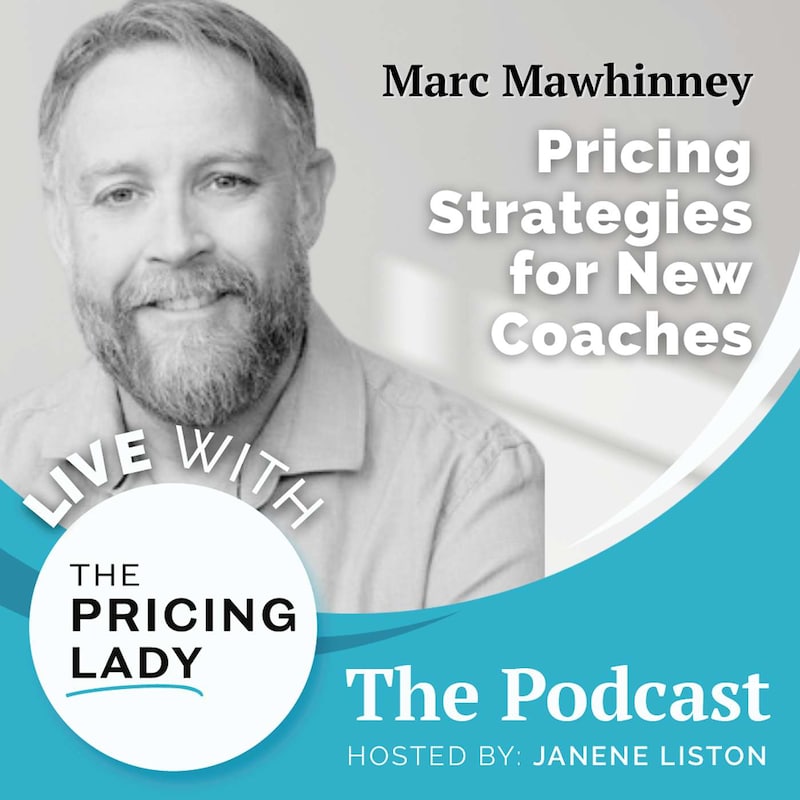
Speaker:In this episode of Live with The Pricing Lady, I sit down with Marc Mawhinney
Speaker:Marc is a lifelong entrepreneur and owner of natural born coaches.
Speaker:He's coming on the show to share with us his pricing experience and what he sees
Speaker:you coaches doing with your pricing that you shouldn't be and how to do it better.
Speaker:Sit back, relax, and enjoy the episode.
Speaker:So welcome to the show, Marc.
Speaker:So happy to have you here.
Speaker:Yes, thank you for having me.
Speaker:And full disclosure, I had some technical difficulties, which that's
Speaker:the joys of online business, but I'm glad that we're here now and all's good.
Speaker:Happy to have you here.
Speaker:So Marc, why don't you start by sharing with us where you're joining from today?
Speaker:I am in Atlanta, Canada, more specifically Moncton, New Brunswick, Atlanta, Canada.
Speaker:So the East coast of the country.
Speaker:Okay.
Speaker:Okay.
Speaker:Haven't been there yet.
Speaker:Look forward to it one day.
Speaker:It's a beautiful part of the world.
Speaker:I say nine, 10 months of the year, I could do without January, February, but besides
Speaker:that, the rest of the year is great.
Speaker:Well, we just came off a very hot summer for us here in Switzerland.
Speaker:And finally, Yes, last night to today it cooled.
Speaker:So I know what you mean by those nine months of the year.
Speaker:I love it.
Speaker:We're in the same boat here.
Speaker:A lot of people think we live in igloos in Canada.
Speaker:We have lots of 40 degree Celsius days.
Speaker:You know, what's at a hundred and low hundreds for American
Speaker:listeners which is great.
Speaker:So everyone's, Oh, it gets that hot there.
Speaker:I'm like, yeah, it gets hot here.
Speaker:Yeah, yeah.
Speaker:The thing here in Switzerland, they don't have air conditioning
Speaker:except for in essential facilities.
Speaker:Oh, really?
Speaker:So, it's sometimes it, it, when you have those day after day after
Speaker:day, it's quite not much fun.
Speaker:All right, Marc, what would you describe as your superpower?
Speaker:Oh, boys superpower.
Speaker:The word that pops into my mind is consistency.
Speaker:So I've been doing my coaching business for 10 years, but I've been
Speaker:doing certain things in that business consistently, you know, every day.
Speaker:So daily emails to my list.
Speaker:I've done many years of that.
Speaker:I'm up to almost a thousand podcast episodes released, et cetera.
Speaker:So it's just, it's not the sexiest superpower to say consistency,
Speaker:but that's the word that pops up.
Speaker:That's a good one to have though.
Speaker:That's amazing.
Speaker:Excellent.
Speaker:What's one interesting thing that you'd like to share with us that
Speaker:most people don't know about you?
Speaker:Well, I have a twin brother, which a lot of people don't know because
Speaker:now he doesn't have the beard.
Speaker:He has a different hairstyle, but we sound the same.
Speaker:He's a little more behind the scenes.
Speaker:He has a podcast editing business and they're doing really well with that,
Speaker:but he's not into the content creation, dancing monkey stuff that we have to do.
Speaker:Right.
Speaker:On the other side of the screen, he, his business is very referral based.
Speaker:They're, they've got some great clients.
Speaker:He's happy with it.
Speaker:So a lot of people are like, Oh, you have a twin.
Speaker:Or they'll go to tag me into something, say on Facebook or whatever.
Speaker:They tag him by mistake because his name's Matt, M A T T, very close to Marc.
Speaker:And then he has to say, Oh, you wanted my brother or whatever.
Speaker:So yeah, I have a twin brother.
Speaker:I sat on his head for nine months.
Speaker:That's funny.
Speaker:You know, I have to confess this because it's quite funny.
Speaker:So I have a little, a little card here to remind you because I've been
Speaker:talking to a Matt the last three days.
Speaker:I was so afraid I was going to call you Matt.
Speaker:It's happened once
Speaker:or twice.
Speaker:Yeah, we The li the life of a twin.
Speaker:So yeah, we, we look probably more like brothers now, you know?
Speaker:Mm-Hmm.
Speaker:Rather than twins, but up until, gee, I don't know, grade five or six, we were
Speaker:quite at, we're, we are identical twins.
Speaker:But you, you couldn't tell us the part in grade school.
Speaker:Oh wow.
Speaker:Interesting.
Speaker:Super cool.
Speaker:So why don't we start by sharing a little bit about how you started your business
Speaker:and, and got to where you are today.
Speaker:Yeah, so my business is helping coaches get more clients
Speaker:organically without paid ads.
Speaker:I started it in March of 2014, so celebrated 10 years earlier this year.
Speaker:And how did I start was like anything I do, I just tend to jump into the pool.
Speaker:My past life, I was in real estate.
Speaker:I got started right when I was in university.
Speaker:And I remember coming home One day to my girlfriend at the
Speaker:time, and I, she had no clue.
Speaker:I was even thinking real estate.
Speaker:I'm like, yeah, I'm gonna get my real estate license or whatever.
Speaker:And that, that turned into a decade long journey where I did
Speaker:quite well with real estate.
Speaker:Mm-Hmm, . Same.
Speaker:Same thing with coaching.
Speaker:I had actually been helped by a couple different coaches, mentors.
Speaker:I thought, I wanna do something that's online.
Speaker:It's flexible.
Speaker:I can work with people all over the world.
Speaker:And coaching was a no brainer to jump into this.
Speaker:So that's how I, I just jumped in and that's learned as I went along.
Speaker:I didn't definitely didn't have it all figured out.
Speaker:I still don't have it all figured out.
Speaker:I don't think I ever will or anyone.
Speaker:I think
Speaker:it's often, it's just changing all the time.
Speaker:So just as soon as you think you figured it out, something shifts and you know,
Speaker:everything needs, not everything, but you know, things need to be done differently
Speaker:or, you know, You need to shift things.
Speaker:Is that?
Speaker:Exactly.
Speaker:Yeah.
Speaker:There's been a big shift in the Marcet.
Speaker:We'll probably touch on this.
Speaker:I imagine with your niche and around pricing and stuff, but the last few
Speaker:years, I think around 2022, probably started 2023 and into this year, there's
Speaker:been some changes in the online space.
Speaker:Not necessarily bad, just means that you have to do things
Speaker:differently to grow your business.
Speaker:Exactly, exactly.
Speaker:If you go back to the very first time you had to set a price for something that you
Speaker:were offering, what was that like for you?
Speaker:For coaching, of course, you know that it's (pricing) a wild west, right?
Speaker:You've got coaching that's peanuts, you know, 25 bucks an hour.
Speaker:While you have free coaching all the way up to six figures a year.
Speaker:You got Tony Robbins steve Hardison is another one that comes to mind
Speaker:and, and everywhere in between.
Speaker:It can be difficult to set a price, especially if you're a new coach.
Speaker:When I started, I set a price and this was not you know,
Speaker:any deep research or whatever.
Speaker:It sounded good to me at the time.
Speaker:500 bucks a month, 1 on 1 weekly calls supporting between
Speaker:500 a month, month to month.
Speaker:I wasn't selling package either, you know, stupid Marc.
Speaker:But anyways I learned very quickly that wasn't the best approach to it.
Speaker:And that's fine.
Speaker:You don't know until you try it.
Speaker:But I look at My experiences with the clients, so their experience versus
Speaker:now when I'm charging much more.
Speaker:Mm-Hmm.
Speaker:. And it, it seems very silly or naive the way I was doing it before, but I
Speaker:didn't know any better, so I just plucked it outta the air and just got started
Speaker:Why in retrospect do you see that as not being the right way to do it?
Speaker:You know, well, there's, for somebody right now who's listening and, and
Speaker:either doing it that way or thinking about doing it that way, I think
Speaker:it's interesting for them to know.
Speaker:Yeah, I mean, there's two parts to that.
Speaker:Of course, there's two ways.
Speaker:I believe I was doing it wrong.
Speaker:I believe I was charging too little because if we're looking at 500
Speaker:for weekly calls, whatever, 125 a week for one on one, very intimate.
Speaker:I say intimate sounds dirty.
Speaker:You know what I mean?
Speaker:Yeah, close coaching with them one on one but also, but also the month,
Speaker:to month means that you're having to resell the person every single month,
Speaker:as opposed to if you sell three months, six months, one year engagement.
Speaker:And a lot of times people think a month is a long time.
Speaker:A month really goes by very quickly.
Speaker:We know cause our summer went so quick right?
Speaker:I'm like, geez, where did the summer go and it just felt like it
Speaker:was just starting, now it's gone.
Speaker:So I'm not a fan of doing single sessions or month to month, you know,
Speaker:I recommend bare minimum three months, but ideally more and it's not helping
Speaker:the client if you're doing the shorter ones as well, cause if you're only
Speaker:doing one session or a couple sessions.
Speaker:It's very difficult to get what needs to be done that quick.
Speaker:There's two things I believe I was wrong with the pricing.
Speaker:I was too low and I was also wrong with the way that I set it up.
Speaker:The Packaging.
Speaker:Yeah.
Speaker:Those are really valid points.
Speaker:When you made the shift, when you started shifting your pricing over,
Speaker:how did you go about making that shift from this time based because it was
Speaker:really a monthly, a monthly offer into something else and where you are now.
Speaker:The impetus to make the change came from dealing with a client who
Speaker:I call my what about Bob client.
Speaker:Do you remember that movie with Bill Murray back in the day?
Speaker:Vaguely.
Speaker:It may be before everyone's time, but in a nutshell, Bill Murray was
Speaker:this kind of kooky, crazy client.
Speaker:He had a therapist or a psychiatrist or whatever.
Speaker:Who, well, he was driving nuts because he needed so much
Speaker:hand holding and everything.
Speaker:And that professional referred him to Richard Dreyfuss, who was a shrink which
Speaker:should have been the first red flag.
Speaker:Back in my real estate days, whenever I had a competitor refer me a
Speaker:client, I knew something was up.
Speaker:Why are they giving me a client, not working myself?
Speaker:But Bob in the movie ended up, you know, he'd be called him a million times and
Speaker:they end up tracking him down on vacation to the little lakeside town or whatever,
Speaker:where Richard Dreyfuss took his family.
Speaker:The client I had in the coaching end wasn't that extreme, but he would send
Speaker:a message and then he would expect, and if I didn't answer within an hour,
Speaker:it's a barrage of other messages.
Speaker:Okay, geez, what's going on here?
Speaker:It's not like you waited a week to get a message, you know, come on.
Speaker:That's not to knock him, but what I've found in the past since then is that
Speaker:the more people pay, I've had clients pay me 10,000 that I'm reaching out to
Speaker:them and checking in it's not them, you know, or whatever, And that's generalized
Speaker:because there's a holes that are paying little and there's a holes paying a lot.
Speaker:But generally speaking, the more people pay that they don't engage in jackassery
Speaker:as much, I would say, if that's a word.
Speaker:So I had a what about Bob client.
Speaker:I said, this isn't worth it for 500 bucks a month, because this is
Speaker:a full time job holding his hand.
Speaker:And that's when I made the change.
Speaker:The other thing that really helped me was I read a book down the road a little bit
Speaker:called Book Yourself Solid by Michael Port
Speaker:. In Book Yourself Solid, he has a concept in there.
Speaker:He talks about the red velvet rope strategy.
Speaker:He suggests that whether you're a coach, consultant, whatever service provider,
Speaker:really, that you treat your business like the hot new club restaurant in town.
Speaker:That not anyone can just walk off the street and get a
Speaker:table or get a spot in there.
Speaker:You know, you need to be on the list and then you've got the security
Speaker:guard, the bouncer at the door checking the list, making sure everyone's
Speaker:waiting in the line up there.
Speaker:That was a mind changing for me because I thought, wow, it flips the power.
Speaker:A lot of times we give away the power to the prospect because we all want business.
Speaker:We want to grow.
Speaker:We want to get clients.
Speaker:We need money to, You need to make a profit to stay in business.
Speaker:And that one simple change, Michael Port alerted me to with the Red Velvet
Speaker:Road Strategy or policy changed things.
Speaker:Suddenly you as the entrepreneur are in a position of power, which I think
Speaker:is very attractive for clients because they don't want to work with a desperate
Speaker:person who doesn't have any clients and doesn't value what he or she's doing.
Speaker:And so I went through my list.
Speaker:Create a list of my criteria and it stayed the same right to
Speaker:this day of my ideal clients.
Speaker:So I have certain things on there like they must be action takers, you
Speaker:know, I don't want to have to drag them along and chase them to do stuff.
Speaker:They have to have big goals.
Speaker:I, that motivates me.
Speaker:People that want to work with somebody has a big goal as opposed to, Oh,
Speaker:I just want to make some spare pocket change or whatever they say.
Speaker:They have to you know, like to have fun cause I joke around, you know,
Speaker:and my coaching sessions and things.
Speaker:I don't want to be too uptight.
Speaker:And there's other things too, obviously be pay me what I'm worth, pay me on time.
Speaker:That's an important one as well.
Speaker:So I put those I have, I think five piece of criteria down on a list.
Speaker:I looked at the people I was currently working with.
Speaker:I said, anyone who doesn't match at least four of the five, I'm going to
Speaker:have to say so long, you know, good luck.
Speaker:All right.
Speaker:And anyone who's going forward has to match that criteria.
Speaker:And I've been pretty good.
Speaker:I mean, the odd one sneaks in when you're doing high volume, that
Speaker:isn't going to be perfect, but, or whatever, but overall a knock on wood.
Speaker:I haven't worked with a lot of a holes so.
Speaker:Well, that's, that's also on my list, not to, that was one of the very first
Speaker:things when I started my business.
Speaker:And I think you bring up a really important point with both of the
Speaker:points you just made, and that's that boundaries are also very important
Speaker:when it comes to your pricing.
Speaker:Yeah.
Speaker:And so what you're talking about here is really setting boundary conditions for the
Speaker:way that you want to work and how you want to work and who you want to work with.
Speaker:Yes.
Speaker:So people.
Speaker:It's human nature to try to get a discount, right?
Speaker:Like some cultures and more than others, some it's a national sport haggling
Speaker:at the markets and things, right?
Speaker:Right.
Speaker:I found this back in my real estate days.
Speaker:The standard commission in my marketplace was 6 percent
Speaker:pretty much across the board.
Speaker:And I would go into a listing appointment to put someone's home in the market.
Speaker:And when we're getting ready to sign the paperwork, they would
Speaker:say, what's the commission?
Speaker:I'd say, okay, it's 6%.
Speaker:And they say, are you flexible on it?
Speaker:And I would fire back without wasting a second.
Speaker:I'd say, sure, I'll take 7%.
Speaker:Aha.
Speaker:You know, , they'd laugh and then they'd sign in the dotted lines.
Speaker:As opposed to other agents, if they're like, well, it's 6%, you
Speaker:know, maybe I could do it for five.
Speaker:You know, and they're just sort of waffling there and it's not gonna be good.
Speaker:In the coaching world, it's the same thing.
Speaker:Not with commissions, obviously, but with pricing, it's not uncommon.
Speaker:Are you flexible?
Speaker:Oh, I, or I only have this much money and whatever.
Speaker:So a couple of, here's a great example in the coaching world.
Speaker:I'm in Canada.
Speaker:My pri my.
Speaker:Fees are in us.
Speaker:'cause most of my clients are in the us Mm-Hmm.
Speaker:or they're elsewhere.
Speaker:You know, I've dealt with people in Europe and things like that.
Speaker:Everyone knows what their dollar is compared to the US for the most part.
Speaker:Mm-Hmm.
Speaker:. I've had
Speaker:the odd Canadian person who's looked at working with me and
Speaker:they're like, what's the pricing?
Speaker:I'll say X dollars.
Speaker:They'll say, oh, is that Canadian?
Speaker:Now our Canadian dollar is crap versus the US It's like, you know, usually
Speaker:70 cents on the dollar, whatever.
Speaker:And I'll say, no, that's American.
Speaker:And then they're like, oh, okay.
Speaker:Cause you know, there's more money and they're like, well, can we
Speaker:do that pricing Canadian, which is essentially a discount, right?
Speaker:If if, if I'm, if I'm charging, well, I'll just take a flat number here.
Speaker:Cause it's easy if, if you're charging a thousand dollars for something
Speaker:American, and then they say, well, you know, is it American or Canadian?
Speaker:That's roughly a dollar, 25, 30.
Speaker:Sorry!
Speaker:1, 300 Canadian.
Speaker:If I charge them a thousand Canadian, in reality, I'm dropping down to whatever
Speaker:800 American, so it is a discount,
Speaker:yeah, so
Speaker:I say to them in that case, like look my, I don't want to get into
Speaker:different types of prices and fees on my website, different stuff like that.
Speaker:I said I could charge you Canadian, but it's going to be Whatever
Speaker:the exchange rate is today.
Speaker:Yeah.
Speaker:So if you, if you feel better me charging you 1, 300 Canadian instead
Speaker:of a thousand dollars us, I could do that if you want to feel better.
Speaker:And then people are usually like, oh, okay, I get it.
Speaker:And that's a good example in one way with pricing.
Speaker:This is why it's important to have a couple of different options on
Speaker:your menu, because if you've got a one on one that you're charging
Speaker:$5000 for someone who can't do that.
Speaker:You don't want to be like, okay, well I'll cut the price down or whatever.
Speaker:But if you have something that's a little more hands off and do it
Speaker:yourself digital Program, Group Program or something, then you could
Speaker:pull that out of your back pocket.
Speaker:5,000, this isn't going to work for you.
Speaker:That's cool.
Speaker:I do have a group program.
Speaker:It's $2500 small group of six people.
Speaker:Would you be interested in hearing more
Speaker:? Right.
Speaker:Right.
Speaker:And I love that.
Speaker:There's so many creative ways to hold value and what I've found over the years,
Speaker:because I used to, well, sometimes I still do it, but I used to quiz people at the
Speaker:beginning of a web class and ask them, make me a list of all the ways you can
Speaker:think of to discount or lower your prices.
Speaker:Now make me a list of all the ways you can think of to raise them.
Speaker:Yeah.
Speaker:That's a good way to look at it.
Speaker:There's so, you know, we're so creative when it comes to ways to
Speaker:lower our prices, but most people.
Speaker:Don't nearly have the same level of creativity when it comes to raising them.
Speaker:Yeah.
Speaker:I mean, unfortunately the online space is, again, it's human nature,
Speaker:but there are a lot of people who I would prefer not to work with.
Speaker:You know, you get the Christmas refunders is one of the terms in
Speaker:there where Christmas is coming.
Speaker:They want to buy their kid that PS5 and the other stuff coming in.
Speaker:And what, Oh, what can I refund from earlier in the year that I bought or
Speaker:whatever online I have been really clear on my agreements, on everything.
Speaker:There's no con's and no guarantees You know I can't guarantee my staffs gonna
Speaker:work if you're laying on the couch watching Netflix 24/7 so whatever so I
Speaker:think we have to be very clear on it.
Speaker:Now, that being said, if you know, I'm, I'm experiencing a situation
Speaker:now I won't get into the whole thing.
Speaker:Good guy.
Speaker:But a client who didn't show up to many of our six months of calls, you
Speaker:know, like roughly half the calls and then summer hit or whatever.
Speaker:And he was musing about a refund or whatever.
Speaker:And like, that's the first I'd heard anything of it.
Speaker:Like he, I thought he was traveling, all this other stuff I was checking in.
Speaker:So, yeah.
Speaker:Yeah.
Speaker:And we have to have that conversation.
Speaker:I don't mind if there's something I could do.
Speaker:Were you stuck in something?
Speaker:Do you need to do a little bit more?
Speaker:Because I want people to be happy, but I, I don't do like
Speaker:refunds and things like that.
Speaker:Just cause like, yeah, you have to do it.
Speaker:And it's not helping him either.
Speaker:Cause as he's growing his coaching business, I want him to be firm on
Speaker:what he's accepting for his as well.
Speaker:Yeah.
Speaker:Yeah.
Speaker:There's a, there's a time and place for that compassion.
Speaker:There's a time and place to, you know, to do what you lead by example
Speaker:is what I'm trying to say there.
Speaker:Yeah.
Speaker:I like that.
Speaker:So Marc, you work with so many coaches.
Speaker:I'm curious, what types of struggles do you see your coaches having most when
Speaker:it comes to pricing in their businesses?
Speaker:Well, determining the price is a big one because they have a
Speaker:bunch of people giving advice.
Speaker:Oh, you should be pricing this much, should be pricing that one.
Speaker:And I, I don't shame people for what they set for a price.
Speaker:You know, it's, this isn't terribly scientific, but I think
Speaker:it has to feel good in your gut.
Speaker:So right now, if I could be like, yeah, I'm going to charge as much as
Speaker:you can, you're worth it or whatever.
Speaker:If I went out there and started advertising a million dollar
Speaker:coaching package million dollars a year I'd love to pay a million
Speaker:if anyone is watching us once I get my Paypal at the end and I fired it over
Speaker:sit, but I've never sold a million dollar coaching package I'm not feeling that
Speaker:I want to put everything on my basket so that doesn't feel good and that
Speaker:being said, if I'm charging 500 dollars I mentioned as a rookie coach I was
Speaker:doing, that wouldn't feel good either so you have to pay attention to yourself
Speaker:and I consistently increase my feast and There's always a little bit of hesitation
Speaker:regardless right how long you been at it.
Speaker:And then usually it's like, Oh, okay.
Speaker:It's selling and it's like, oh, that worked out really well.
Speaker:But you can tell if I'll give you an example.
Speaker:I the 5, 000 offer a few years back was selling like hotcakes.
Speaker:Just being taken orders.
Speaker:I said, you know what I'm going to charge 6, 000.
Speaker:Cause you know, it's going great at 5, 000 and then it got quieter and I still
Speaker:had people booking calls and stuff.
Speaker:They weren't doing six and I ended up the saying after an experiment, you know
Speaker:what, I'm gonna move it back to five.
Speaker:And the Marcet was telling me, and the Marcet will tell you it's
Speaker:just like a real estate Marcet.
Speaker:You know, you could have a nice house and, you know, beautiful paint
Speaker:and the best nails or whatever.
Speaker:But if you're pricing it up a hundred thousand over what it's
Speaker:worth, it's not going to sell the market's going to tell you that.
Speaker:So that's probably a big one.
Speaker:Cool.
Speaker:Another question.
Speaker:So a lot of coaches, they they'll go through a training program
Speaker:to get accredited or certified.
Speaker:And a lot of the training programs tell them, this is what they've told me,
Speaker:tell them that they should price really low at the start because they're new.
Speaker:And I'm curious what your take on that is.
Speaker:I don't like it because I think confidence wise if you're busting your butt and
Speaker:you're doing this coaching you've already spent hundreds of hours probably
Speaker:doing buddy coaching, accountability coaching for free in the certification
Speaker:program, and then you get out into the real world and you're charging peanuts.
Speaker:It's gonna be pretty discouraging and it's gonna be tough to move the needle
Speaker:in this arena as well I've seen a lot of new coaches going back to the
Speaker:selling individual sessions that will put a price at like 50 on a session
Speaker:And their goal is you know, whatever if their shooting for 10k a month They're
Speaker:selling a hundred dollar packages.
Speaker:You're well, first off, you're gonna be, if you're lucky enough to fill all those
Speaker:slots, you're going to be spending all the rest of time selling them, right?
Speaker:Then you have to do the fulfillment, the actual coaching, you're
Speaker:gonna be burnt out really quick.
Speaker:It's much easier if your goal is 10, 000 to sell two 5, 000 packages a
Speaker:month, three times 3000, 333, whatever, as opposed to, you know, a hundred or
Speaker:whatever packages need the other way.
Speaker:it.
Speaker:It's, it's much easier.
Speaker:So yeah I'm not, and you can tell I'm not a fan of the bargain basement coaching
Speaker:fees, I just think it's too difficult and I don't think it helps the client either.
Speaker:No, I don't think it helps the client.
Speaker:I also think like with the time based rates, if you, like as you get better
Speaker:and more efficient at your coaching, you can deliver better results, maybe even
Speaker:in a slightly shorter period of time, not always, but You, but in the end you end
Speaker:up somehow charging less for them getting better results out of it quite often.
Speaker:And so it doesn't scale and grow with you as your business evolves and you, and you
Speaker:find your niche and your way of working.
Speaker:And I think that's
Speaker:unfortunate.
Speaker:I'm glad you mentioned that because a lot of coaches don't realize
Speaker:they're improving every year.
Speaker:You're not the same person you were 365 days ago.
Speaker:You've read more books, you've worked more clients, you've taken
Speaker:more courses, you have more skills.
Speaker:It's a lot like my son years ago.
Speaker:He's 16 now, but when he was younger, we bumped into a friend at the mall
Speaker:who hadn't seen him in a couple years.
Speaker:Friends like bowled over like, oh my God, he's so bigger, whatever that.
Speaker:And like I see him every day.
Speaker:I'm like, no, he isn't, he's not much, that much bigger.
Speaker:Right.
Speaker:But he was probably like six inches taller or whatever at this time.
Speaker:And yeah, same goes with our businesses, you know, comes down to
Speaker:valuing ourselves and our skills.
Speaker:Coaches are Addicted To Personal Development And Growth.
Speaker:I mean, they're just, most every coach is a but I see you're a reader.
Speaker:I'm a reader.
Speaker:I've got 20 totes of boxes besides those books.
Speaker:But they just can't get enough of learning and things.
Speaker:But unfortunately, they don't always put the proper value on those skills
Speaker:and that experience and that knowledge.
Speaker:So that good thing to mention, you said about new coaches, they might
Speaker:be a brand new coach, but maybe they were in that field doing something
Speaker:different for 10 or 20 years.
Speaker:I got all this stuff up here, but they're like, well, I've
Speaker:only been a coach for a week.
Speaker:A week.
Speaker:No, you've been in that world for 20 years.
Speaker:Yeah.
Speaker:I, and I, that's one of the things that really.
Speaker:It drives me a little bit crazy when I hear them being given that advice
Speaker:because most of them come with quite a lot of experience before they started
Speaker:getting their coaching credential which they're completely discounting, ha ha ha,
Speaker:no pun intended, you know what I mean?
Speaker:Exactly.
Speaker:Yeah.
Speaker:So why don't we start wrapping this up, What is it that you would like people
Speaker:to remember from our conversation today?
Speaker:There's a really good quote that a past guest on my show said, and it stuck with
Speaker:me because that episode was in 2015.
Speaker:He's coming back on the show for episode number 900.
Speaker:So it's Bob Berg who wrote the book, The Go Giver.
Speaker:Anyone
Speaker:who's read that, endless, Referrals.
Speaker:This is one of his, he's written a bunch of great ones, but the go giver
Speaker:is the one that people tend to know.
Speaker:And he mentioned to me way back then, almost 10 years ago, he
Speaker:said, money is an echo of value.
Speaker:And what he was saying was that you have to put value out into the marketplace,
Speaker:but when you do, you're, it's inevitable.
Speaker:You're going to be rewarded.
Speaker:with money on your bank or in your wallet so a lot of times when people
Speaker:are struggling and they don't have much money it doesn't mean that they are bad
Speaker:person that they'll never make money.
Speaker:but they need to change the things around them and look and say "Is this what
Speaker:really people want?" "Is this giving that value that the marketplace needs?".
Speaker:There's another saying feed a starving crowd, you know, Gary Halbert talked about
Speaker:that, you know, and he has a whole story about a hamburger stand with a class.
Speaker:He's teaching marketing, but basically the point of that was to find
Speaker:out what the crowd is hungry for.
Speaker:And then you just feed it to them piping hot on a plate.
Speaker:And I think not enough time goes into that.
Speaker:People spend a little too much time working on their logo, the
Speaker:banner on their website and all this other stuff, their webinar.
Speaker:Great.
Speaker:But they're not thinking.
Speaker:Trying to
Speaker:hack this and that.
Speaker:Yeah, that's right.
Speaker:It's such a noisy place too.
Speaker:It's tough.
Speaker:You got to put horse blinders on, but the number one thing is what does
Speaker:the market need help with, you know?
Speaker:So if I went out there today and started coaching on MySpace,
Speaker:generating business on MySpace, there's not going to be a lot of takers.
Speaker:Cause when did that die?
Speaker:It was big in like what?
Speaker:Oh five or six or whatever, you know?
Speaker:There's not a big Marcet for MySpace at the moment.
Speaker:So there's an example.
Speaker:Right, right.
Speaker:Very good.
Speaker:And what's next for you?
Speaker:What are you working on?
Speaker:Or what's coming down the pipeline?
Speaker:Boys, like anything, when you've done something for a long time, over 10
Speaker:years, I always want to keep it fresh.
Speaker:So I've been popping open the hood.
Speaker:What do I like in my business?
Speaker:What don't I like as much?
Speaker:You know, I'm an admitted workaholic, so I have to work, work on that.
Speaker:I just hired someone.
Speaker:She started two days ago who's joining the team helping with
Speaker:Facebook Group admin and stuff.
Speaker:So I would say that's part of it delegation.
Speaker:We also have a good new program in my Facebook group.
Speaker:That's giving people VIP perks, which get going really well.
Speaker:We launched that earlier this summer, we've got a lot of people in there.
Speaker:So that's, You know, I would probably direct people you know, if, if they
Speaker:want to learn more about me and about that, it's at thecoachingjungle.
Speaker:com.
Speaker:That's my Facebook group.
Speaker:There's 26, 000 coaches in there.
Speaker:Good, good people, good conversations going on.
Speaker:Excellent.
Speaker:So you stole my last question here, which is where can people reach out to you?
Speaker:No problem.
Speaker:We'll pop that and some of your other links into the show notes as well.
Speaker:So people can reach out to you as they wish.
Speaker:Yeah.
Speaker:Thank you so much, Marc, for joining me today.
Speaker:It was a real pleasure to have you on the show.
Speaker:Yes.
Speaker:Well, thank you for having me.
Speaker:Thank you everyone.
Speaker:Wish you all the best and as always enjoy pricing.
Speaker:Thank you for listening to this episode of Live with The Pricing Lady, the podcast.
Speaker:If you enjoyed the episode, rate, review, and subscribe to it, then share
Speaker:it with your friends and colleagues.
Speaker:I love hearing back from you listeners.
Speaker:If you've got comments, questions, or topic ideas, go on over to thepricinglady.
Speaker:com and contact me there.
Speaker:Not sure where to start when it comes to improving pricing and profits?
Speaker:At ThePricingLady.
Speaker:com you can download a copy of my Self Assessment Pricing Scorecard.
Speaker:Find out where it's going well and where you can begin improving.
Speaker:Or just simply book a discovery call with me.
Speaker:There we can discuss what's up with pricing in your business and
Speaker:how I might be able to help you.
Speaker:Thanks once again for joining.
Speaker:Remember, pricing can hurt or help your business.
Speaker:Let's make sure it's helping you reach your dreams.
Speaker:See you next time and as always, enjoy pricing.