Shownotes
Transcripts
For me, as a really young writer, one of my big breakthroughs was understanding that people have these contradictions inside of them and that if you're a novelist or a fiction writer, you can explore them.
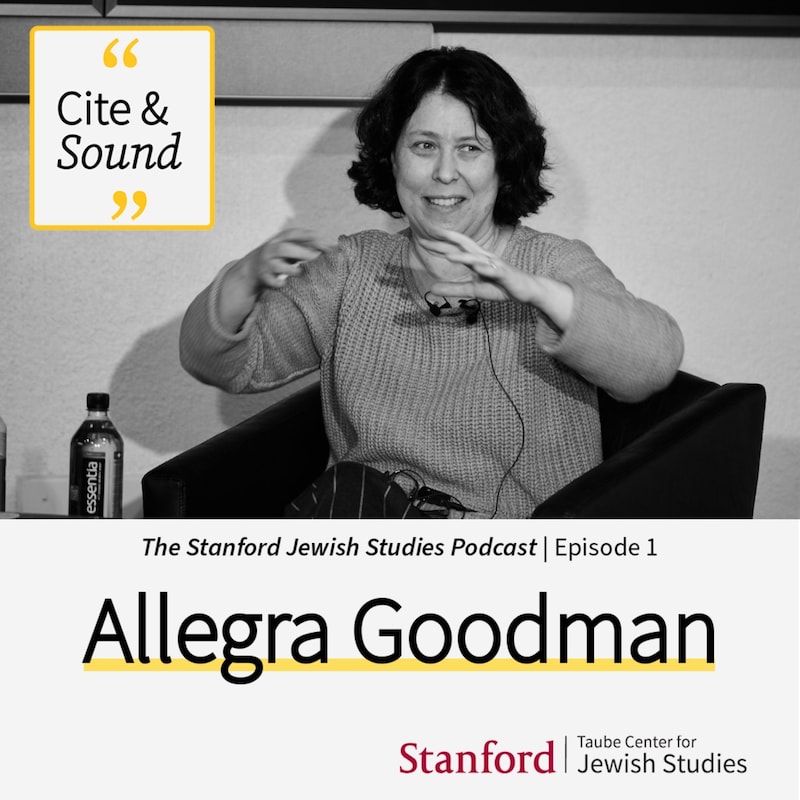
Shaina Hammerman |:That was Allegra Goodman, prolific novelist and short story writer whose books include most recently, Isola, Sam, The Cookbook Collector, Paradise Park, and Kaaterskill Falls, which was a National Book Award finalist. She has published two collections of stories, The Family Markowitz and Total Immersion, and a novel for younger readers, The Other Side of the Island. Raised in Honolulu, Goodman studied English and philosophy at Harvard and received a PhD in English literature from right here at Stanford.
I'm Shaina Hammerman, and this is Cite & Sound, the Stanford Jewish Studies podcast. Here, we host conversations with scholars and artists as we explore Jewish scholarship, culture, and history. Listen to the voices shaping the Jewish studies conversation at Stanford University and beyond. Goodman joins us in conversation with Molly Antopol, assistant professor of English and creative writing at Stanford, and a member of the Taube Center for Jewish Studies affiliated faculty. Together, they explore Goodman's craft and process from her first publication as a teenager through today, and what it means for her to write about Jews. Goodman begins by sharing the prologue to her novel, Isola. And now, the conversation.
Allegra |:I'm gonna read you the very brief prologue of my novel, Isola. And you can see the cover, this dramatic cover of this cold -looking ocean and this solitary figure on this rocky island. And it sort of captures what it was like for this young woman who really was marooned on an island in 1542. And this was long before the pilgrims sailed to Plymouth. She was on a ship that accompanied Jacques Cartier on his third voyage to New France, as they called it. And this was so long ago that at that time, they thought that if you kept sailing through up the St. Lawrence River, you might get to China. They were still looking for the Northwest Passage, and all of Canada and the interior was unknown. They only knew sort of the coastline. And in the Gulf of St. Lawrence, if you've ever seen it, it's huge, and there are these little islands there. And she was set down on a deserted, uninhabited island. And it was very cold. It's a subarctic place. I should say one of my themes that I'm interested in addition to being interested in Jewish themes and Jewish families, which I write about a lot, I'm kind of obsessed with islands because I did grow up on one, a tropical island, Oahu. This is a very different kind of place where Marguerite ended up. And this is the prologue of the book.
I still dream of birds. I watch them circle, dive into rough waves, and fly up to the sun. I call to them, but hear no answer. Alone, I stand on a stone island. I watch for ships and see three coming, tall ships close enough to hail. I load my musket and shoot into the air. I see penance close enough to touch as I run barefoot to the shore. Rocks cut my feet and I leave a trail of blood. Brambles tear my sleeves and score my arms as I shout, wait, stop, save me. The ship's commander hears my voice and gun. Dressed in black, he stands on deck to see me beg. As I plead for help, he smiles. When I shoot, 10 ,000 birds rise screaming, their wings beat against
the wind. All the sailors hear and see, but their commander orders them to sail on. I reach, but cannot stop the ships. I wade after them into the sea. In vain, I struggle as wet skirts drag me down. I cry out, but water fills my throat. I cannot fly, I cannot swim. I cannot escape my island.
So that's the opening of this new book. Thank you.
Molly |:I loved hearing you read from it. I just finished it. It's amazing because I feel like it's this incredible exploration of what it means to thrive and survive. She kind of felt like a female Robinson Crusoe to me.
Allegra |:Exactly, that was what I was interested in writing about. Yes. I stumbled upon her story in a book about Cartier. And it was like in the side, in parentheses, it was sort of like, and on the third voyage, on a ship commanded by Robert Voll, who is somebody who's pretty well known, you know, was a historical figure, a nobleman. His young kinswoman was on the ship and she annoyed him and he marooned her on an island in the Gulf of St. Lawrence.
And then I was like, wait, what? And then close parentheses.
And then the author, Mann, continued on to talk about the Robert Voll's attempts to found a colony. Just went on and I was like, wait, what happened to this person? And she was real. She was relatively famous in her own time. There were two short renditions of her ordeal during her lifetime. But each of them is only about a page and a half.
So there's lots of space to imagine a novel.
Molly |:This is your first big historical fiction novel. So what was it like, one, to do that kind of research and two, to have a starting off point of an actual real person?
Allegra |:Yeah, so both of those things were different for me. So when I first got the idea to write this and when I was reading about her, it was 22 years ago.
So I thought at the time, what a great topic for a novel. I've always been fascinated by castaways and I could do like a female Robinson Crusoe. Of course I thought that, but then I thought, wait, I don't write historical novels. This is stressful. I have to figure out what she wore and what they ate and how the ship moved through the water, you know? And so I put it aside and I wrote a lot of other books. I wrote Intuition about cancer researchers in Cambridge and I wrote The Cookbook Collector, which is half set on the East Coast and half set in the Bay Area, sort of during the dot -com boom and bust and has a lot of techies in it. And I wrote The Chalk Artist, which is set in Cambridge. I wrote a lot of other things, but eventually I began to come back to this idea and I started doing a lot of reading and I told myself, I'm just reading. I'm not actually gonna write a historical novel.
ed only just two years ago in:last one finally went to college at that point. And I had more time. And I started thinking maybe I would come back to this idea and I sort of gathered some of my reading up and I was working on Sam in the mornings and I had some time in the afternoon, which I never had when my kids were growing up. And I thought, well, maybe I'll just try to write the first sentence of this novel. Only just the first sentence. And I didn't even call it a novel to myself. I had a notebook. I wasn't working on my computer. I was just writing by hand because that made it feel less real. And I called it Project M for Marguerite, which is the name of the protagonist. It was like my stealth project. And I just started writing the first line over and over again, just to see if I could hear her telling the story because I wanted it to be in the first person, like the way Robinson Crusoe tells his story.
So I wrote the sentence over and over, like over a period of weeks until around the 30th rendition of the sentence. I came up with this line that went something like this. I never knew my mother. She died the night that I was born and so we passed each other in the dark.
And then I thought, wait, I can hear her. That's her. Because it was sort of this slightly formal voice. Sam is about a contemporary 21st century girl and it's all from her point of view and it's very much sort of the way we talk in the book. Her voice came to me, it was like slight, ever so slightly more formal, a noblewoman's voice. And I thought after I wrote that sentence, I had a foothold. I could continue. And I started writing.
Molly |:Yeah, you heard the music of her voice.
Allegra |:I heard the music of her voice. And voice is very important to me in all of my work. If I can hear the characters I can write the story, usually. I always tell my students and young writers, listen really carefully to the way people talk because you wanna make sure that it's authentic dialogue.
So there's a character in The Family Markowitz named Rose Markowitz, who's one of the main characters. And she's in the story, “The Wedding of Henry Markowitz.” She's older and she's kind of pixelated and she's impossible, but she has certain cadences in her voice and the way she tells the stories of her life. And I definitely took that from some of my older relatives from listening to them.
Molly |:I didn't know that you were working on Isola and Sam at the same time and yet they're so different, right? So it's a twenty-first century book, girl living on the North Shore of Massachusetts and then this book. But somehow they feel connected to me, right? Because it's resilience and it's the physicality.
So if anyone who hasn't read Sam, Sam's a boulderer. And so she's climbing these huge rocks. It's such a physical book. And this is obviously just such a physical book. It's about endurance and strength.
.
Allegra |:Exactly. And now looking back, I feel like writing Sam allowed me to write this book because it was a book about physical endurance and spiritual resilience. And they're both books about young women, obviously separated by many centuries, but trying to find their place in the world despite a lot of challenges. And Sam has her own challenges, even though she has, you would think, a lot more freedom than a noblewoman of the 16th century. She so there is kind of a through line.
Molly |:My gosh, that's so interesting. So when you were working on Project M, did you get struck by the research rapture?
Like, did you feel like my gosh, this is the most interesting information that I'm learning. This is the most interesting thing that ever happened in the history of the world, and I need to all put it into the book, even if, like, did you have that? How did you balance that?
Allegra |:I did not, I mean, I was fascinated and kind of obsessed with it. And I did not put it all into the book. I didn't feel tempted to put it all into the book because I knew that would be too boring. And I don't like historical novels that feel like a history lesson where all the history shows.
So I think what helped me was that she was telling the story, not me. If it had been me as a third -person omniscient narrator, I might've been tempted to give a lot of background and explain a lot of stuff. But when a person is telling their own story, they take for granted that the listener knows certain things.
Like, if you were telling your story right now of your life, you would refer to maybe the president. You wouldn't say, President Trump, who had just been elected in January.
Like, you would assume that everybody would know that, right? So it was liberating to use her voice and just have her make assumptions and carry the reader along that way.
Molly |:I love that. There's none of the research weighs it down because she, it's just all coming from her. It's coming.
Allegra |:From her. So in a sense, and actually this is true of most of my writing. I sort of write in characters, even if it's the narrator. Even if it's a third -person narrator, I'm writing in character.
So it's not so much me. It's more me performing that person.
Yeah, Yeah.
Molly |:It's like method acting. Exactly.
Allegra |:Exactly. Yeah.
Molly |:So do you always write in tandem?
Allegra |:No, that was the first time I ever wrote in tandem because I never had time to write in tandem before. -
Molly |:So before, like when your kids were home, you had, you know.
Allegra |:I would have like one session in the morning or when they were in school, when I was good to go. And then in the afternoon, I didn't do any meaningful work.
And then I don't, I'm not a night person. I don't like the night.
So don't like writing things at night. So then when they were gone, when I finally stopped spending all afternoon going to the dance studio and picking, ferrying people and preparing dinner, like just doing all the stuff that I did, I suddenly had a lot more time. This will happen to you one day.
Molly |:One day… I know now I'm like typing outside of basketball practice. Like in the car.
Allegra |:I did that. Yeah. Or in the car with this in front of the soccer field.
I mean, it's all good. It's very rich to live that way. It is, it's wonderful. And I don't begrudge any of it, but I have a lot more time now.
So my kids, when I first had this idea, my kids were 10, seven, three and a newborn. And now 22 years later, they're 32, 29, 25. And 22. And my oldest son, the 32 year old, who is an economist, a labor economist. And he actually said to me, I've noticed that since we all left home, your productivity has increased. And I was like, well, you don't need a PhD to figure that out.
Molly |:I know it's so true. I know I was just reading someone's acknowledgements, a father of three. And he said, you know, and I want to thank this person and my children without whom this book would have been written much quicker. Exactly.
Allegra |:That's honest at least. Yeah, it's honest.
So that's what I did when I became an empty nester.
Molly |:I love that. My gosh, you had two really different books that feel like in one way so different, but they're actually, it's interesting. They're thematically connected.
Yeah, and they're in conversation. And I think something that strikes me about all of your books, all of your 10 books is the way that ritual comes into it. There's the religious rituals that come in, but when I was reading intuition about the cancer lab, there are these scientific lab rituals that I had never even thought about until I read it in your book.
Yeah, so can you just talk about what ritual means to you? Yeah.
Allegra |:I'm really interested in ritual. I'm interested in religion in general. And you can sort of see that in all, this woman of course is a Catholic French person. She's not Jewish. But this book is very much about what she believes and she has doubts and she has a crisis of faith on this island because if you're brought up in that framework, it's very challenging to wonder why this would happen to you. Why is there providence? Is there a lesson here or is it random that she ended up here?
So she really struggles with faith. One of the things that really interests me about ritual is sort of ritual in our time because we live in a very secular world, most of us, at a time where we don't need to do ritual. It's not ingrained, it's not a given that we would follow certain rituals or worship in certain ways. It's a choice for many of us in America. And one of the questions that really interests me in all of my books from my earliest stories till now is why somebody would choose to maybe restrict their life or to structure their life in a way when they don't need to, when they have freedom to choose that, when they might not even been brought up that way and then to return to that. What are they getting from it? What is it bringing them? I'm interested in exploring that for some people, it's structure that they seek. It's shaping their days and their lives. And I've particularly explored that with Jewish people in my stories.
Molly |:Yeah. It's community, it's the feeling of maybe never being alone, it's having someone during the hardest times of life, but then it's all those restrictions and maybe it can feel alienating and all of that.
Allegra |:Yeah, I know that the theme of this class is storytelling and community, but what are rituals but stories that we engage in? They may be stories that we enact. There's a theater to them. There's a narrative to them often. And to choose those scripts is very interesting, not to reinvent the wheel.
Molly |:Absolutely. I was actually just talking about this with a lot of the students right before this, just this idea of family tradition and storytelling and how we tell stories. And I think about this so much with your stories what people don't wanna talk about and because of that, what are the things that they obsessively talk about?
Right? And that tension that feels so apparent to me in your stories too. It was so great to go back and look at your earliest work and then to your more recent work and to just think about the way that intergenerational conflict, but love and loyalty and just the way that all of that comes together in your work. Thank you.
Allegra |:Yeah. Yeah, that's something I'm really interested in. All my books really deal with family in some ways and even the book, Intuition, which is about a lab, is about a work family.
So the two PIs are like the parents and they have these postdocs there and they're like the rebellious children. Some favored, some less favored. There's a lot of friction there. I was really interested in those structures that people create for themselves.
Molly |:What does ritual mean to you?
Allegra |:Ritual means to me, interesting. I think for me, ritual is, okay, this is weird. I am not really a rule follower. I don't like being told what to do. I don't even like to go to a yoga class. I don't want somebody to tell me how to exercise. I swim because I wanna be alone.
So that said, I like to go to synagogue, which is very scripted, but I like to sit there and I like to kind of think my thoughts. So I guess I like to be free spirited within a framework. That has more meaning for me. I guess ritual for me is the frame. The frame for which I can think and imagine.
Molly |:You know, I have the same thing. So my husband's more religious. He grew up more religious than I was and he likes to go and I get really bored, but I feel really guilty saying that. We have kids, it's a whole, it's a conflict. But I find when I go that what I love is the ritual of knowing that I have to be really quiet and I'm able to think about my book in a really helpful way. Because you can't show that you're thinking about anything else.
So there's something about sitting that quietly.
Allegra |:Yeah, I like to sit quietly.
Molly |:But you're right, it's a quiet rebellion because I feel guilty that I don't really wanna do that on Saturday morning, that I wanna, you know, sleep in.
Allegra |:I do… I will say that I'm not totally tuned out. I like hearing the Torah reading. I like thinking about the words of the prophets. I like that poetry. I like the singing. But I like to think my own thoughts within those, within that framework. People always talk about how like you should unplug. What better way to get away from your phone to stop checking your emails and stop thinking about the news, which is overwhelming than to go to a space with other people who are unplugging. And so, and that's another thing I think for me, I'm more interested in communal ritual than individual ritual, so.
Molly |:That makes so much sense. Do you set out to write about these things or do they just kind of spin out naturally for you?
Like these ideas of ritual and community and family.
Allegra |:Yeah, I guess I start with the characters and these things bubble up. I think you can't help but express all your obsessions in your work, but I don't start with an abstract, sort of a concept or a schema. When I write, I start from the particular and then I watch these things kind of develop.
Molly |:And it’s the voice too, so you're - Yes, yeah. I was thinking about with your books, obviously there's the incredible, physical, plot -based, action -based urgency of some of these, but then some of them, it's really coming from character, right, and it's coming from these intergenerational conflicts. But with all of them, there's a feeling of urgency, of something's about to happen and this is why we're so absorbed. Does that always happen for you? Have you ever worked on a project that just kind of lost its blood and you had to abandon it or how do you -
.
Allegra |:I've definitely abandoned projects. Yes, I have abandoned projects. And any of you who write things, it's okay to try things and it doesn't work out. I've often found when I've abandoned something, it's sort of like, well, there are times when you have what you think is a good idea but you can't figure out how to execute it well. And there are times when you have an idea that's maybe not such a good idea and you can execute it pretty well but you can only take it so far because the idea really wasn't that great to begin with. And I've had both situations. You've Correct, but then often what will happen is that years later, I'll come back to that character or I'll come back to that voice because I think sometimes timing is important.
Molly |:Had both? Yeah.
So sometimes you'll just hear a voice and you're like, I want to follow this, but then the voice doesn't take you anywhere?
Allegra |:Maybe it's not the time for you to write to explore that or maybe you haven't figured it all out yet, but then those ideas will return to you and you'll figure out how to do it later because you're older.
Molly |:Yeah, I feel like if it just sits somewhere else for a while then you're done. Totally.
Allegra |:And for those of you who write, use time as your friend, put it away, wait till you're older. My first novel, Kaaterskill Falls, which is very much about Jewish families and intergenerational conflict and rituals and women and Judaism, has all of those things. I started writing that when I wrote
the first draft when I was 21, before I came here, and it was completely messy. It didn't work at all, and I knew I had to put it aside because it didn't hold together, but I had all the characters there, I had the voice that I wanted, I had some of the best scenes there. I just couldn't, I was too young to deal with such an ambitious novel at that point in my life. I was 21, I was reading a lot of George Eliot. I wanted to kind of write a middle march. It was like my Jewish middle march, which was a good aspiration, but I was really young.
So when I was at Stanford, actually, while I was writing The Family Markowitz stories, I guess this was another tandem thing, I decided to rewrite that whole book from scratch, and every word I rewrote.
Molly |:So what did that mean? Did you even look at the first draft or you just wrote what you remembered? When you wrote Kaaterskill Falls.
Allegra |:What I remembered, really. I didn't even really look at the first draft that much. And so then Let me clarify, my husband finished his PhD in four years because he was a theoretical computer scientist.
Molly |:So you wrote two books while you were doing your PhD.
Allegra |:And I don't know how the computer science department works these days, but in those days, if you're a grad student, first of all, he did no teaching. Second of all, he had no course requirements.
So in English, and those of you in the humanities will know this, you have to teach, you have three years of coursework before you can really start your dissertation. So he finished, he got this job at MIT and we went back East and I wasn't done yet.
So I was at that time working on these two things, but I was in Cambridge, so it wasn't just at Stanford, but during my graduate years. So - Victorian novel, yeah.
Molly |:Kaaterskill Falls is kind of like big, ambitious, and it does feel that it has the heft of a… So what were the elements that felt too hard to put together when you were 21? Because you had the character, you had the scene.
Allegra |:So when I was 21, the thing about that book, it's in the third person and there are multiple points of view. And multiple storylines. And I just couldn't figure out how to keep it moving and how to juggle the different points of views at that point. But I think that writing The Family Markowitz and those stories, which are all about a family, but each of them has different points of views. Each of those stories is from a different point of view and they kind of add up. I was sort of
training myself. And after that experience, I was able to come back and manipulate the material properly.
Molly |:You had character, right? You had scene, right?
Allegra |:I had strong ideas about the Jewish community in America and these immigrants and what the whole thing was. I had a lot of these ideas, but I didn't know how to dramatize it or handle it.
So I never got an MFA in creative writing, but I would say writing The Family Markowitz and Kaaterskill Falls was like my MFA. I went to school with those books. They taught me.
Molly |:And then you taught in an MFA for a long time. I did, Yeah, you taught at Boston University for a long time, right?
Allegra |:I did. I've taught an MFA.
I teach there on and off. I'm teaching there in the fall. When I first started teaching in an MFA program, the students were telling me things. I talk about ritual and culture. I didn't understand some of the things they were asking me about. They were like, we can't speak while our story is being workshopped, right? And I was like, well, why not? There was like this thing where like there was a ritual in some workshops where the writer was silent while the work is being critiqued. And I was like, feel free. I didn't know. There are philosophies about this, but I just didn't have any experience.
Molly |:I have my students talk They get to decide. They're different.
Allegra |:I didn't even understand that this was a discussion. Like there was a controversy. I have the literature side, yes.
Molly |:Think it's so great because they were getting someone with the whole literature side though. Like thinking they were writing.
Yeah, I did so thinking about so many undergrads here, people in English, a lot of people who are writing books, I really want to think about the fact that total immersion, which I mean, this story collection, I really didn't know that you were an undergraduate when you wrote it, but these stories, they move from Hawaii to Venice Beach to Oxford, England. And back again, it's this really seamlessly constructed and really ambitious story collection. And you were writing them as an undergrad.
So can you just like talk about your experience of what that was like, who was reading them?
Allegra |:Like - Yeah. So I was really a kid.
I mean, I didn't think of myself as a baby at the time, but now I look back and I was like my God, I was a baby. My very first story, “Variant Text,” which is in Total Immersion, and you can find it in Jewish anthologies in various places. I started that one in high school. I wrote that in high school.
So it was from when I was 17 till when I was about 20, I wrote the stories in that book. And I went to Harvard at the time and I was this kid from Hawaii. And before, when I got to Harvard, I had over the summer submitted this story to Commentary Magazine, which as you all know, is this sort of conservative, political Jewish journal, but they sometimes published fiction. I think they may still publish some fiction. And my parents got it. I always remembered it as very boring because there were no pictures, but I think my parents suggested, why don't you just send it to them?
So I had sent it to them and the editor there, the managing editor who did all the work, the woman who did all the work, named Marian Magid, actually wrote back and she was like, dear Ms. Goodman, and this is typed, you know, this is in the 80s. I was intrigued by your story. It doesn't really work for us, but we'd be interested in looking at other stories that you've written. And I was like my God. First of all, does she know that I'm 17? And I had only written one story.
So I quickly wrote another one and sent it to her. And that one she accepted. And I found out it was accepted the day I arrived in college, which was really a weird situation. But I had validation that I was a paid writer. I was like at that point, 18. And I developed a relationship with that magazine and with her. And throughout my college years, I was writing these sort of Jewish satirical stories. And in my junior year, when I was 19 or 20, I got a phone call from a woman who was starting out as an agent. And she said, do you have enough stories for a book?
Cause I think I could try to sell it. And I was like, does it cost me money?
Like I didn't even know what an agent was. And when she said it wouldn't cost me any money, she would just take some of the profit or whatever. And I was like, okay, fine. Go try. And she sold it. And so that was how the book, it's a long story, very short. I lived in Dumpster House at Harvard and there was a resident tutor at the time who was a Jewish, Marxist, anti -Zionist guy. But we got along really well. And this was the time when Out-of-Town news was in Harvard Square and you could actually buy magazines there. And he actually told me that since he liked me, even he, Noel Ignatieff, put a paper bag over his head and went and bought a copy of Commentary to read my story. Although he was, of course, with every fiber of his being, he hated this magazine and everything it stood for.
So it was funny. And I didn't start publishing in The New Yorker until I was here at Stanford.
Molly |:You were publishing in The New Yorker when you were in college, right? No.
Allegra |:My first year at Stanford, my first story was published in The New Yorker and that was bananas. This woman, my agent, had sent them stories from Total Immersion and it was sort of like, she's getting there, she's good. It sent them several.
And then sort of my breakthrough with The New Yorker was when I was 23 here, my first year in grad school in English. Wow.
So that was very validating at the time. I was very excited.
Yeah.
Molly |:My God. So when you were in college, I know a lot of people here take workshops. Were you taking writing workshops at Harvard? Did you have readers or were you just kind of writing and sending them out? I.
Allegra |:Didn't take any creative writing workshops at Harvard. At the time, there was hardly any creative writing in English at Harvard. They didn't believe in it. Now it's a good part, as you know, because you've taught there. Now they have a lot of workshops and they're very popular and there are multiple opportunities for students to do creative writing there. But at the time, there was maybe one little seminar or something and I was at the time doing a lot of 19th century poetry. I wrote my senior thesis on Paradise Lost. I was really going the literary route because I thought I wanted to be an English professor, you see, and a fiction writer, which is why I came here to get my yeah, I wanted to be an English professor.
Molly |:PhD. So then you just instead became a writer and taught in an MFA program. Did you think about being an English professor?
Allegra |:Yeah, But I didn't.
Molly |:But you were like, but it didn't.
Allegra |:By the time I finished graduate school, I had published quite a bit. I think I'd published two books and I was publishing The New Yorker and I had two children at that point. And I realized that I could write or I could teach. There was writing, teaching and doing research. And I was interested in research and I was interested in writing. And I had these children and taking care of the children and then teaching. And I had to give up one of those things.
So I gave up the teaching at that point. I did end up teaching later when my kids were a bit older.
Molly |:Yeah, so I feel like I've noticed that it's almost like you've been really consistently publishing in The New Yorker and it was this exciting thing to realize that they were all kind of seem to be about the same family, the Rubenstein family. And I remember reading in an interview in The New Yorker that you're now working on this collected story.
Allegra |:That book is done. It's in copy editing.
Molly |:Actually, you're the author of 11 books! I was wrong!
Allegra |:So I mean, my son, the tconomist, my son is right.
y editing. It's coming out in:So I had always wanted to kind of return to this form of writing these linked stories as I did in The Family Markowitz. And so I'd been writing these stories all along. Five of them were in The New Yorker and there's 17 in the book. And how, Well, it's all a third person, but they're from different points of view.
Molly |:And narrated by how many relatives?
Allegra |:So there are the two great aunts and the son who's getting a divorce and then his ex -wife and then their child.
Molly |:Was it like a joy to write about this family? It was totally Was it happening where you were writing one and then getting it published and then writing the next one?
Allegra |:Fun. It was totally fun.
Molly |:Cause it almost felt Dickens or a Fitzgerald, right?
Allegra |:Like a serial novel. Like a that's - Yes, it was like that.
Molly |:That's exactly right. Like where you've got the, right? So your readers are kind of following this family in the same way that you're writing them.
Allegra |:I wrote one and then I wrote another and they were getting published in sequence. They definitely haven't all been published in magazines. Only like six or seven have been published in magazines, but yes, they're all in sort of sequence. And when you read them together, it feels like this kind of serial novel.
Molly |:My gosh. It's really fun. What's the title?
Allegra |:Okay, this is really funny. I sent the document to my daughter who's now working in London. She just graduated from college. She's 22. And she goes, I think it's hilarious that you titled the document, "'This is not about us' to reassure the family." And I was like, that's the title of the book.
Molly |:That's a really good title.
Allegra |:Thank. you. It's the title of one of the stories, which I used as the title of the book. Thank you.
So she was like. My sister read the whole thing to vet it. I think she was looking for certain.
Molly |:Did she find anything?
Allegra |:No. I think she was good, but she was interested in reading.
Molly |:That's so funny to think about your kids because I think my kids are still so little that it hasn't occurred to me what it will be like when they read my books. My gosh. Is it more nerve wracking than?
Allegra |:No, it's not too bad because two of my kids don't really read my stuff at all, which is fine. My oldest son reads everything, the economist. He reads everything, but he's a very enthusiastic reader. And my daughter has told me, my daughter read Sam, which is dedicated to her. And the spirit of Sam is very much my daughter's spirit. And she's informed me that she only reads the books that are dedicated to her. She's very funny. I was like, I can send you a copy of my new book. And she goes, is it dedicated to me? I'm sorry, no. She's like, that's okay then.
Molly |:That's really funny.
Allegra |:I've always objected to the term anxiety of influence because I think the thing that idea forgets is influence as inspiration or the joy and delight that young readers take from reading their idols. So for me, I wasn't anxious.
Like I wasn't like thinking my God, I'm 21, I'm not ever gonna be as good as George Eliot. My work is gonna be derivative. No. I was inspired by her and fired up by her work. For me, George Eliot showed me what a novel could do, what it could be. And I wanted to, in my own way, enter into that.
Molly |:It's a final question, Allegra. This is a question that Jewish Studies likes to ask all their visiting writers, which is if you can share a quote from the field of Jewish Studies or a Jewish text or any other text you find meaningful or relevant to this contemporary moment.
Allegra |:So I have a quote for you and it's from Maimonides. And my dad is a philosopher who's a Maimonides scholar and he's coming to this very center in May to talk about his new translation of the Guide to the Perplexed, which he translated with his colleague from Arabic. And he wrote a philosophical commentary on this great treasure of Jewish and world philosophy. But the quote that I have is about Pesach, really. In every generation, you should feel as though you personally left Egypt. And I always found that, those words, particularly moving and profound, the way that Maimonides is capturing this idea that something that happened so long ago, this exodus that happened so long ago should still be alive for you in the rituals. And that is the use of ritual to make something come alive for you in history that happened so long ago to other people, to your ancestors, through text, through narrative, through the telling of a story. And as a fiction writer, I think that that's something that we can give to the community, that we can make an experience come alive and that the reader or the listener can feel that they personally are experiencing it. They can enter into an experience of somebody who might be far away or long ago or very different from them.
So those are the words that I find very meaningful.
Molly |:That's beautiful. Thank you. Thank you. And thank you so much for this conversation.
Allegra |:Thank you for having me. Thank you for your questions.
Shaina Hammerman |:Today's episode was produced by me, Shaina Hammerman, along with Iva Klemm and Adam Jacobson. Sound design by Romi Chicorean. Original music is by Jeremiah Lockwood. Cite and Sound is a production of the Taube Center for Jewish Studies at Stanford. Stanford University.

