Shownotes
Hiring has become one of the hardest problems CTOs and CIOs face, and most tech leaders are still using a playbook that no longer works.
There is no longer a deep talent pool. Long interview processes lose top candidates. Remote work has changed what “good” looks like. And AI is forcing leaders to rethink experience, roles, and team design entirely.
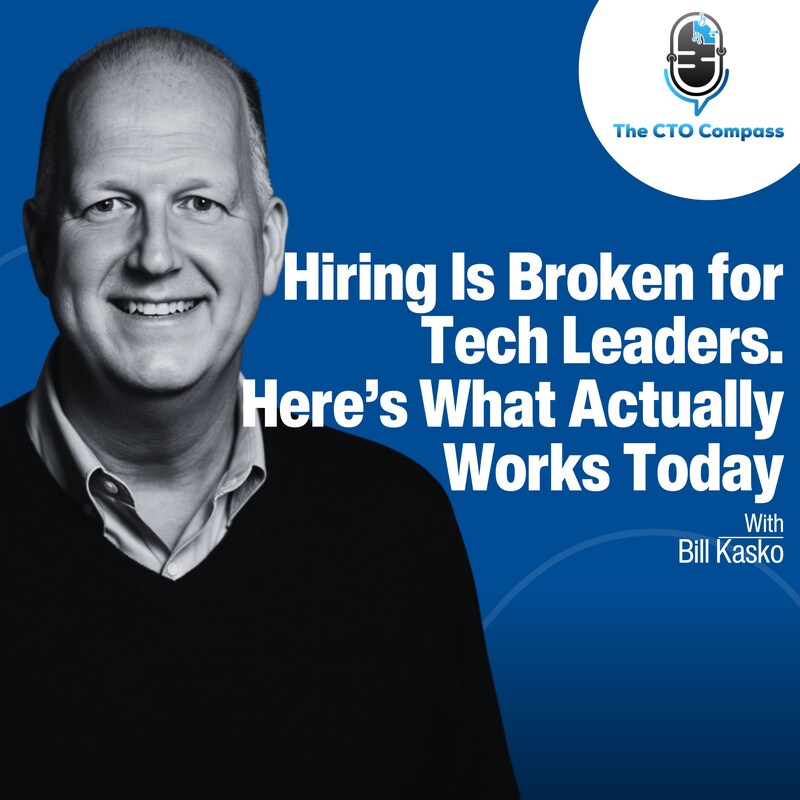
In this episode, Mark Wormgoor speaks with Bill Kasko, President and CEO of Frontline Source Group, a national staffing and executive search firm. Bill began his career in IT security and infrastructure before spending more than 20 years helping companies hire and scale teams, giving him an expert view of what actually works in today’s market.
You’ll learn:
- Why there is no longer a true “talent pool”, and how to hire without one
- How to design tech roles around outcomes instead of outdated requirements
- Where great tech talent actually comes from today
- How remote work has changed hiring signals and expectations
- Why adaptability matters more than years of experience in the AI era
- The one leadership habit that consistently separates strong tech teams from weak ones
If you’re a CTO, CIO, or senior tech leader and you frequently need to hire, this episode will help you rethink how you build teams.
Chapters
00:00 Starting Out in IT
08:29 Infrastructure and Security Today
15:46 Where To Start With Recruitment
24:34 What's The Secret with Recruitment
30:50 Approaching Remote Work
36:56 The Hiring IT Landscape
42:33 Hiring In Today's Market
46:52 Hiring Retention
50:26 Communication is Important!
About Bill
Bill Kasko is a seasoned business leader and entrepreneur with extensive experience in strategic planning, business development, and organizational growth. With a proven track record of driving results across multiple industries, Bill brings valuable insights into leadership, innovation, and sustainable business practices.
Where to find Bill
• Website: https://www.frontlinesourcegroup.com
• LinkedIn: https://www.linkedin.com/in/billkasko/
• Instagram: https://instagram.com/frtline
• YouTube: https://www.youtube.com/@frontlinesource
Transcripts
There isn't a pool. You know, we used to cast a net and we'd bring in a hundred people. Now we'd sort through them, we'd figure out what it is and you'd bring it down into your funnel and you'd end up with three people. You'd do the interviews, you'd bring them in like eight times, you'd wear them out and you'd hire one.
And then they'd stay with you three to five, seven years if you were lucky. Well, the pool got smaller and smaller. There was no longer a net. It was just one fishing pole out there. If you hooked one, you were lucky. You can forget doing more than about a couple interviews.
Mark:Welcome to the CTO Compass podcast. I'm your host, Mark Wormgoor, tech strategist and executive coach. In every episode, we meet tech leaders from startup CTOs to enterprise CIOs to explore what it means to lead in tech today. They share their stories and their lessons so that you can navigate your own journey in tech. Let's dive into today's episode. Tech leaders, they spent years learning about code, infrastructure, architecture, platforms.
Well, you guys know it all. Yet the hardest problem they often have, they aren't the technical issues, but the human. Hiring the wrong person can slow everything down for months. And I've seen that happen over and over. And now we have remote work, we have AI, and it's changing the entire job market.
So where do we go? Today's guest, Bill, he is at the center of all of this. He's the president, the CEO of the Frontline Sourcing Group. Frontline Source Group a US staffing and executive source for sourcing for search firm sorry but bill didn't come up through traditional HR, he actually has a background in tech himself which makes him Even more interesting to speak to. He spent the last two decades building a front line. And in this conversation, we'll talk about how tech leaders should actually go design roles, hire for them, recruit them where they can find great talent and how remote work is changing that all together as well. Last, we'll also get into AI, of course. Bill, Welcome. And tell us a little about yourself.
Bill:No, I appreciate that. It was a very kind intro and actually kind of scared me talking about it. It sounds like I'm going to find all the answers to all the questions here today. And if I do that, I don't even know what I'm talking about.
So but no, I appreciate it very much. And yeah, I did start from the IT side back when I always like to say it was when IT was becoming kind of cool. And it was interesting because I was in IT security and infrastructure way before that was cool.
So if we go back to:And then at the same time, I was recruited out to go to work for a Fortune 500 staffing agency to run one of their groups and start selling this IT product. And have conversations because people didn't really didn't understand it. And I just kind of fell in love with the business and I did that for a few years and then realized I could do this a different way and had another idea. And we're going into our 22nd year now at Frontline Source Group.
So it's funny. I tell the story that when I started the company originally, I had this idea and the IT people understand this. All I wanted to do was I was going to sell IT products. ERP system implementation high level like SAP people, right? And I was going to do consultant type work. And my whole thought was, You know, all of these gigs were going on. I'd put like five, 10 people to work and they'd be on a project for, it could be nine months, 18 months at a time, you know, and they're billing out, you know, 175, 200 bucks an hour. And I thought that's all I need to do. What's funny is that 22 years later, And we've grown way from being just an IT company. But 22 years later, we've never placed an ERP SAP person ever. That route that we've been on has been zigzagging all over the place. And so it's been an interesting ride.
Mark:Well, because I still, I mean, those SAP projects, they happened 20 years ago, 22 years ago. They're still going on today. It's warranted S4 migrations today, but it's nothing has really changed that much. I would say over the 20 years in the SAP space, maybe.
Bill:Yeah. It was definitely an area, it was definitely a time when it was a high demand and there were a lot of things going on and, you know, the technology space was still so much of a, had to be in the office, had to be working all the time, had to be on site. It was five days a week, at least, you know, it wasn't any of this. Show up late, leave early. And so, It was just a different mindset that you had going on. You had a little bit of consolidation taking place. But if you think about 20 years ago, 22, 25 years ago, I mean, we were just still in the infancy of what we're at today. But what's interesting, I think more than anything is just, that knowledge transfer and that growth that you would expect to see, you know, an industry really adding more people to, as technology gets better, I mean, it actually, you end up have dwindling return. And so you don't add more necessarily because you start advancing. And I think there's a lot of different ways that we can look at this and talk about it, but It's interesting today.
I mean, 25 years, we've been through a lot, right? This isn't just, it just didn't happen overnight. We didn't go from dial up with AOL to, you know, this high speed AI technology. Phone calls and avatars.
You know, even for us, I mean, If I had looked back 25 years ago and thought that we would have an AI recruiter today actually doing interviews, I would have said, you're crazy. This is never going to happen.
So I don't say that anymore. Now, instead, I kind of go, well, that sounds interesting.
I mean, how's that going to work? And so it's definitely changed a lot in that space. And I think that's one of the things that especially in the IT space, As everybody else is trying to figure it out, there's no doubt the IT space, that's really all about trying to figure it out right now.
Mark:Yeah. And I think that's probably been the case for the last 25 years, trying to figure it out, because as soon as we sort of start to figure it out, everything changes around us. The technology changes, the experiences change, and then we start again.
Bill:Well, I don't know that we ever really figured out, right? Because if you think like before COVID was kind of a stable time, if you think about it from an IT side, right? We had moved into all the remote operations. Companies were actually good with it. We knew we had a shortage of talent. And so if you're going to hire top talent, you had to be open to remote. You had to be open to maybe some offshoring of what was taking place from coding. You were looking at budgets. We really weren't changing, if you think about it from a software perspective, there wasn't a lot of change going on. We really didn't have anything that was spurring like the next movement. We had moved into so much of the social piece of it. If you really look at what was buzzed, kind of the buzzwords and things going on, Meta, Facebook, Google, were definitely still obviously dumping a ton of money.
So was Apple. There was a little bit of this conversation about the AI piece of it, but honestly, we were more in a digital space. Timeline in a digital automation. Kind of movement that was taking place.
So I think IT people felt very secure with what was happening. And then when COVID hit, I think they kind of wrote their checks and were like, we're never going back to the office. This is job security. I've got to hook up 9,000 desktops and make them all work. You had infrastructure people that were going crazy trying to figure out how do we do load balancing. You had individuals looking at the product, the software to figure out how do we make it flow better. Man, it was like good times, man. This was, we're rocking and rolling, but we weren't putting people into that space. And so we didn't have new individuals coming out of schools. We didn't have people coming into it going, hey, I want to jump into this. I'm going to start entry level. And so we go through that and then we immediately jump into this AI thing And I think it's just rattled the cages of everybody at the end of the day.
Mark:And I'd like to get your perspective on that because I have a background in infrastructure and security as well. And a lot of people don't see that as maybe the most interesting part.
So even five, 10 years ago, you would see a lot of people come out of college, university, and they would start as software engineers because that's everybody wanted to go into SaaS and a software engineering. Some people ended up in the ERP space. Very few people ended up in infrastructure or security. And I think somehow it feels like there's always a shortage of experts in that space and it's still not the most interesting space. How is it.
Bill:Today? Yeah.
I mean, look, it's not fancy, right? It's not all bells and whistles. And on top of that, you know, especially when you're doing security type things, which I was in the security side and infrastructure, that was really my area. And, you know, as fancy as it got was 9-11. And when you think about when 9-11 happened, there were only handfuls of us that actually understood all of that. Right. And so. Maybe at that time it became very fancy. And we if you think about moving forward with, because specifically within security, we went through a time where you had Sarbanes-Oxley, you had a lot of information that was traveling through because of financial piece.
So you had the spur within the Cisco side and CIS side. And CISPs and individuals that put a lot of that security and infrastructure But today, when we think about security, we don't think about it. As much as we used to from that.
So we think about it as being hacked. We think about the stealing of data, the stealing of information, websites, emails, I mean, all of those pieces of it that are so much different. And so... It's still not fancy. And it's behind the curtain.
I mean, it's like the Wizard of Oz in a lot of ways, right? It's like, we know we have to have it, but we don't understand it. And CEOs of companies just know, I need to be protected. Am I protected? And you hire these guys that come in and, you know, Even when you put them through the test, it's like trying to figure out, do you actually know what you're even talking about? And so, When you look at that and then you throw the AI piece of it into it, you know, one of the questions we always get is that, well, my job. Is going to go away. Or it's like the guy who is the coder, He's like, well, now it can all be done with that.
Yeah, it can. But by the way, someone needs to actually input that. And understand how to create the prompts correctly and understand how to, what's in the field called, how do you code without code? And so if you don't understand that, you don't understand how it's going to all fall together.
So, you know, the worry of the people today that we hear is, you know, is there job security for what I do? Is it going to be around me? 10 years from now, look, When they came out with the microwave, we thought we weren't going to have cooks and chefs anymore, right? Because the microwave was going to solve everything. Today, we all have a microwave, but guess what? We still go to restaurants. We still have great chefs. And it's the same thing when you look at the IT side. The problem is that The IT individual in their pay and what they want to make from a salary, has gone up so much. That companies have pretty much you know, out salaried themselves, especially small and medium sized businesses to being able to afford to have, the IT structure that we're all kind of used to. That's been a problem. We've had issues Specifically with IT, which I'm going to tell you is the worst when it comes to this. But we run into a lot of scams with IT people, unfortunately.
Look, and I'm sorry, I'm going to get hate mail probably, but this is the truth. And, you know, if you can get away with it and do it ethically, Great. Tell your employer you're working three jobs. But I can't tell you how many, because we stopped counting, people that we interview that we're going to get to a client, they're ready to make an offer and they go, well, I need 180,000. And you're like, okay, this job only paid 120 when you originally said you were going to take it. And they're like, well, yeah, but they want me to work full time. It means I'm going to have to quit my other two jobs. And you're like, wait a minute, you're working like two other, well, I do, you know, five hours a week for this one and, you know, 10 hours a week for this other one or something, let's say. And you're going...
Well, what hour? I mean, you do that at night on the side? No, I'm just on call during the day. How can you do that if you're supposed to be working for this company full-time during the day? And so it's just become... A really interesting space to be in because that's the question when people started their concern about working remote. Was how do we make sure you know, that they're actually working for us the whole time, right? That was the whole dilemma before COVID.
Well, you can't work remote because I can't make sure that you're doing it. I don't know. I know you're showing up on at 8 a.m. And staying till five. Okay. The regular person that does that actually ends up being the one you're not worried about. The guy who's in charge of the systems and making sure everything works, who's behind the curtain, that was the one they weren't worried about until really COVID hit.
And then they realized because there was such a shortage, That, yeah, it was pretty simple and easy for them to work two or three extra gigs on the side. And because at the same time we were going through the gig economy, And everybody was kind of, not everybody, but you know, a lot. We're picking up extra side gigs to make some extra money. Now, all of a sudden it became realistic. Hey, if I'm going to work 60 hours a week, this is what I'm going to want. And so... Again, you don't have the talent pool. There isn't a pool there.
You know, we used to always talk about, Hey, there's a pool of people out here. There's not a pool. And so the demand that is out there is high. The problem is that we have companies today with demands that are unrealistic. And that's the issue. The issue is the companies, a lot of them, and we're, you know, we're post COVID here, right? We're, I don't know what are we have three years plus three, maybe, Now we're going back to hearing, I need this software developer to And we have a position like this right now. And it's a great position. It's in Florida. If anybody's in the Orlando area, reach out to me. It pays great company, but it's in office. Five days a week. It just, you're not attracting the talent and that's the problem. That, you know, I understand that that's what your model is. But you can only... Bring so much into your neighborhood. And if they're not there, but they're located in Boulder, Colorado. Then Figure out how to get a monitor on them to make sure they're going to do what you need to do and go hire the talent.
So I think that's the biggest thing is that the talents out there, it just isn't necessarily exactly where you want it to be.
Mark:Not in your city even.
Bill:Yeah, exactly.
Mark:Let's take it a couple of steps back. So if I'm maybe this company in Florida or somewhere else, if I'm a tech manager, right, and I want to go and hire the right person, that's what we're engineering that you talked about. Where do I start? Because a lot of people follow the process that they know, the process that they have in their heads, but that More often than not.
Well, either it takes a very long time or it just doesn't lead to the right hire. So where should I start? What should I really do?
Bill:So that's a great question. That's one of those conversations I have. In fact, I had one yesterday. I took a phone call with a potential client yesterday on a Sunday because just like everything else, it's unrealistic to think that we only recruit Monday through Friday from eight to five. That's not the way it works, right? And that's not the way that you attract top talent. That's the same type of mindset that a manager needs to take. They need to think about it as this isn't an eight to five job. Quote, this isn't an eight to five process. And by the way, As I said just a moment ago, there isn't a pool.
You know, we used to cast a net and we'd bring in And here we go. Look, we got 100 people. Now we'd sort through them. We'd figure out what it is. And you'd bring it down into your funnel and you'd end up with three people. You do the interviews. You'd bring them in like eight times. You'd wear them out. They need to hire one.
And then I'd stay with you. Three to five, seven years if you were lucky. Right. Okay. Then we switched.
Well, the pool got smaller and smaller. There was no longer a net. It was just one fishing pole out there. If you hooked one, you were lucky. You can forget doing more than about a couple interviews. That's not going to happen because they're done. Right. Because you can't. And so what I encourage companies to do today is And somebody that, not too long ago told me that this advice was horrible. This was the worst advice I could give anybody because it takes away from me making a living. And I said, it's the best advice. Because the more someone understands the difficulty in finding top talent, the easier it makes my life. Because I'm not trying to fool anybody about this. This isn't a conversation I have up front. Start early. With your search when you're looking for people. If you're running a group, And you're the manager and let's say they're all, you're running a developer group. Let's say you're lucky you've got three people in your group and you have absolutely no headcount for the entire year. You're not going to have that. Then the easiest thing you can do as a manager is to go onto the number one source that's out there today. And that's LinkedIn. And at the end of the day, start having conversations with people and join groups and start talking to people and talk about positions that you fill within your group so that you're starting a conversation and you're connecting with developers so that when you have a position that comes open, you put it through your network. And say, "Hey, I have something going on." Or, for that matter, create something. I'm always looking for people like this. Now, the argument is, okay, well, I did that. And guess what?
Somebody all of a sudden approached me and they're available. And my gosh, they're incredible talent. And in fact, they're better than anybody I have, well then put together a proposal to take to your management to explain to them why you need to hire this person or figure out how you can bring that person on part-time. Because what happens is what you don't know. And think about that. What we don't know is what will happen. And so when you least expect it. You think your team is solid. Nobody's going anywhere. That's not going to happen. Everybody's there. We're all good. Nobody's going to leave. They'll love working for me. That is when it hits the fan. And that is when out of nowhere, One of them says, guess what? Those six emails and in-mails and phone calls I get every single day, I decided over the weekend because I didn't like my bonus. I didn't like that I didn't get an increase. I didn't like whatever. I don't like the fact that I have to come to the office one day a month. Took them up on it. And I've been interviewing and I'm going to go ahead and accept that offer they just made me and I'm leaving. And guess what? The company policy is somebody does that. We don't give them, we're not going to counter. Have a good day. You're gone. Okay. Now to fill that position. You think you're just going to go out there and find somebody over there? You think you're just going to go to an agency? Because this is the other thing that happens. And you're going to go to an agency and you're going to call like five of them. Because you're going to do it contingent. And you're going to be, because your management's telling you, get their price down. They're going to charge us. They're going to get the price down.
So now you're going to look for top talent. And you're going to try to bargain shop. At like a flea market, right?
So you're wanting to hire top talent to replace this individual in the intellectual property they just walked out the door with but yet you want to pay as little as possible in a market where you have absolutely no pool. And then you're going to be upset when these agencies don't find you anybody. It doesn't work that way.
Yeah, exactly. It doesn't work that way.
So instead, what we do is to say, we don't work that way. If it's about that, call somebody else. Because we're going to tell you the truth. We don't even do it on a contingent basis because we can't. It doesn't make sense.
Plus, by the way, why are you using six companies? That's ridiculous. And when you do contingent, there's no skin in the game with anybody.
So we do an engaged search. Which is the best thing that anybody should do. And you get people involved and you start that partnership. But you need to look at what you're looking at. You got to look at that description to understand if you're making them come in the office five days a week, And that's not what the market's telling you. You've got to adapt. And I'm sorry. That's the, and I get it. And I hear this all the time. My CEO says, no, it just absolutely not.
Well, then your CEO needs, somebody needs to tell him, then you're not going to be able to fill the position. And by the way, You need to go up because if you want to hire that 180,000, then you should be offering 300,000. Because that's what it's going to take to get someone to come into your office. We can't afford that.
Well, then change what you're looking for. Why don't you hire two or three people? And that's the interesting part. Is that I don't understand why they're not doing that as much. Why don't you then just go and hire a couple people to fill the role? Because, They're all working multiple gigs. And there's plenty of opportunity out there to pick up a position that somebody wants to have. You just need somebody 10 hours a week. On a retainer. If you're needed. But I need to know I can get you. For those 10 hours or maybe five hours, whatever it may be. There's plenty of opportunities for things like that. And you'll be able to find people. But they don't think about it like that because every company's mindset not every, a lot is that, Everyone out there is out to rip you off. And I think that's where it's actually hurting, especially the IT sector right now today, And not helping, but they need to be on LinkedIn. And I don't understand it.
You know, we used to go to Dice. And, you know, Dice... That's a joke.
And then I'm going to probably get in trouble for that one. And Monster and Career Builder.
You know, those were the two big ones and they filed bankruptcy this year. And so, you know, they're not a rock.
So what are you left with? You're left with ZipRecruiter.com. Who tells you that if you post, you're going to get somebody within 24 hours. And your first 30 days are free. I don't know how they make money. I still can't figure that out because if I fill my position in 30 days and it was free, Why am I sticking around?
And then you've got Indeed. And so, I mean, they're great resources.
You know, to go to look, but are you finding what you need? No, because you're, When you have a supply and demand issue, which is what we have with IT, They don't have to go and look. You have to go look for them.
So if you're going to have to go look for them, You got to do everything possible. You're going to have to post on Dice. You're going to have to post on Indeed. You're going to have to post on ZipRecruiter. You're going to have to hire... One recruiter, not five.
You know, hire one. You're going to have your team involved as a company. It takes, Omnichannel marketing. To attract top talent. There isn't a silver bullet to find that person out.
Mark:There. And then I think the challenge is we have these tech leaders that only need to do this process once. Maybe once a year, right? Especially if they're running a group of three, four, five, eight people. They need that process once a year. It's not something like you're in the business. You do this 40 hours a week. They do this maybe once a year. How do they figured it out. People that present? How did they go about that at that point? Or is it just...
Yeah. Find an agency anyway.
Bill:You know, when they have a short term need, I mean, the agencies can help out. Because let's bring them out as a contractor, right? And it really just depends on how their company is set up. Are they set up where they need to go through an agency or a third party to protect? Can they do a straight 1099 to someone? Again, I'm going to go back to I'm going to go back to LinkedIn. But here's the problem with LinkedIn. Which is really another interesting kind of idea. You think about LinkedIn and how long it's been around now, and it hasn't been around as long as everybody thinks. It feels like they've been here for a while, but they haven't. And everybody's not on LinkedIn. Which is another thing to me that blows my mind. And it really blows my mind is that the number of IT people that are not on LinkedIn. Blows my mind.
So great. You're on LinkedIn. You got a profile. And here's the next thing I hear.
Well, I don't do anything with it. I haven't logged in years. That's a mistake. And that's a huge mistake because It's not just about where you're at today. But what happens tomorrow if the bottom falls out with the company that you're at? Where are you going to go? How are you going to network? Because we don't go to real networking things anymore. Even conventions, shows, things like that. Okay, if you're lucky, your company sends you to one a year.
And then if you do have, you know, a local networking company, IT group in your area and your near and large metropolitan place. Then, okay, maybe once a quarter if they still do them even in your area, but a lot of them don't even do that. And so what you're left with is nothing. And so, If you're not differentiating between everybody else, when it does come time, You're not up here. You're down here jumping back in. And yet you were way up here. Your pay was up here. This is what you demanded. This is your talents. You're not just going to roll out. One of the things we hear from clients almost every time a person interviews is, 99% of the time. Was, hey, they were great. Loved them. They did great in the interview. We went and checked out their LinkedIn. They're not very active. Now, we used to hear...
Social media Hey, we went to their Instagram. We went to Facebook. There's some sketchy stuff. We're out, right?
And then everybody found out and they started locking it down. And we had a lot of EEOC issues and people looking at things.
Well, guess what? LinkedIn isn't one of those. LinkedIn isn't something that is locked down in a company. I've yet to find a company that you cannot access your LinkedIn profile bio profile in the company. To date. Now, I'd love to hear if there's somebody out there that says, we lock it down. Most. Don't. Now Facebook, yeah. Why? Because they're worried about viruses coming in.
I mean, it's like a firewall nightmare to everybody, right? And all the other ones are, plus a waste of time. For the most part. Which could be said, I guess, about LinkedIn too. But at the end of the day... If the CEO of a company wants to go on LinkedIn and take a look at where a competitor is, or a competitor CEO or a buddy of his you went to college with, what is he doing? He goes on there. He doesn't go on Facebook at work. He's going to go on LinkedIn.
So, Being on LinkedIn and being active is promoting your company, promoting what you do. It's telling others in that space that you're a subject matter expert, hopefully, in what you do, and it's promoting. And that's what you should be doing. Sharing, liking, congratulating, telling. This is how we now communicate. FYI. Right. And so. It's actually easier than it's ever been because you've got it on your phone and you can sit there while you're, you know, in between commercials or watching football and we do it. And we look at this stuff and it's not, The same as a Facebook account. But it's something where you're leading a group. If you're in management, especially, You should be on there. You should have your team on there. It gives you an opportunity to look at your team. What's your team doing? What are they doing? Are they, you can tell pretty quick, are they active? It gives you a head. Are they looking for a job? Why are they connected to other people that do exactly this? And like in our space in the staffing world, If I have an employee who all of a sudden is connecting with all these other staffing companies, You're like, what are you doing? Because the going somewhere, I mean, it should be used as a tool for you to connect with people and build relationships. And so, I can't stress that enough. Whether you use it in the right way or not, You got to be on like.
Mark:And that's for everyone then. It's the experts, right? Maybe one day they, well, the company rolls out and they need to find a new role as well as for the hiring manager, they build their network so that If something happens, they need to hire somebody, they already have the network and they can just go on the network because that's still the fastest way to.
Bill:Go. It's by far. And, you know, as long as... When you go on LinkedIn, and send an invite to connect to the CEO of Walmart. It tells you. There's something I understand.
Somebody be like, well, why would I want to? I don't know. But guess what? They're the fourth largest employer in the world.
I mean, there's got to be any posts all the time. And so... They're posting information. And even if you, it's something of value and you share it to the people that you know, they may be like, wow, that was interesting. I didn't know about that. But the fact that you can do that, the fact that you have access to information like that to me is, That's mind boggling. And that's where it's pretty impressive.
Mark:Cool. I want to get into this remote work thing a bit more.
I mean, you just gave this example from a company in Florida. I want somebody in the office and their best candidate could be in Boulder, Colorado or anywhere else. Right. And I guess the U.S. Is a big place. Maybe some smaller countries this doesn't play. But we may actually even hire overseas or in another country, Canada or Asia or Europe.
I mean, especially now with all these experts, it becomes harder and harder to find somebody to actually understands the technology that you're looking for. So how do you look at that, the talent pool or the teams that tech leaders are building now? Is that more remote or remote hybrid teams? What happens?
Bill:It really goes back to, you know, what are they doing exactly? And then it goes back to the culture of the company. And I'll give you an example. We had a client about six months ago came to us this is the true story i can't make this up and they were in Atlanta Georgia yeah it was no it was not it was actually they were in Florida now I'm thinking about it but it was like Palm beach or something. It was a nice area. Okay. But what they were looking for was to replace, and I'm not joking with you. They needed to replace their AS 400 administrator. Now, Those of us that are old enough to know what an AS400 is. Understand that You're not only looking for a season, you're looking for a fossil. Right. This is, and I used to always joke and go, you know, you'd go into these companies or go visit a client and they'd have one. And you're like, holy cow.
I mean, wow, that's just crazy. Yes, they've upgraded with technology and they're, you know, they're more in tune. But it's pretty rare to find someone that has that. And my whole thing to them. Was, you know, are you open to relocating people? And they said, well, we've never talked about that before because this person's been with us for 30 something years and they're like 70 and they're about to retire finally. We hadn't thought about that. And so you need to think about it. Because you're in Florida. And you can attract and you can recruit from this entire country to get a seasoned individual, which is what you're going to need, to relocate to Florida, which is the relocation capital pretty much of this country other than maybe Arizona, I guess. And cost of living is less. And you'll be able to attract the talent. And they were like, we never really thought about it like that. And I said, that's what you need to do. And I said, well, we had a guy who relocated here from Peru His mom was an AS400 administrator for years and actually taught him the code and taught him how to do everything. And he stayed with us for like three or four years and just left not too long ago. We thought maybe we'd just find somebody young like that. And I go, that's not like something they don't put those out in school. You're not going to find that. That's an anomaly. And that's one of those where you just got lucky and it fell out of the sky because So it all depends on what it is. It depends on the environment. It depends on you know, what are they looking for?
You know, right now, the other issue with us in this country is the H-1B issue. And, you know, if you think about We got a lot of issues going on. Here. There's a lot of hesitation. For anyone to come to this country, even on an H-1B. There are concerns. We had a situation not too long ago with an individual who was on an H-1B who was going to go to work for our client. And there was a little bit of a hiccup. With the transfer of his H-1B from his current folder over to the new company. It wasn't going to be a big deal. But that window that's there for them to have that transfer is really small. And if you miss that window, And they're deported.
I mean, they're out of here. And It's no news to anybody.
I mean, that's what's going on here. , in a violation. That's low-hanging fruit. Right. It's not difficult for our government to go out and pick them up. And so that's an easy one. Because they've probably done everything right. They've probably registered their addresses. They know exactly where they're at. All of a sudden it's flagged. Hey, and the next thing you know, They're scared to death. And this individual ended up going to our client and pretty much creating such havoc and panic that they pulled their offer. On that person because he didn't listen to us. It was no big deal. We had already made the calls. Everything was going to be fine. It was just a delay. In some stuff in Washington. Calm down. I promise. He's got plenty of time. But he didn't. He was scared. And so because of that, you know, they pulled the offer. Now he didn't have a job. Now, guess what? He's going to get, he was going to get kicked out. And so, I think when they're talking about remote, when they're talking about fewer people, and we're talking about in-office There's not a right or wrong answer. And I think from an IT manager perspective, They take direction. From the CTO, CIO, who takes direction from the CEO or COO or somebody that, as they say, that chit rolls downhill and they have to do what they're told to do. But I think that if people were smart in the way they did it, they would present business cases to explain why we need to differentiate why we need to diverse in the way that we look at things. How do we use, you know, our partners and contractors in a different manner? How do we make sure we don't put all of our eggs in one basket? Because just as we talked about right in the beginning. When you least expect it, expect.
Mark:It. It feels to me like this is not a new story. I've seen a story for 20 years at least where we need to have either different salaries, we need to have differentiation in IT because the salaries need to be higher than somebody else or otherwise we're not going to be able to find someone or How long has this been going on? Duh. And I.T. Forever.
Bill:Yeah. I mean, it really started... In the United States, it started about in 2009. I would say 2009, 2010. When we went through the great recession, almost a depression here, right? And we had the complete failure of all the banking systems and the infrastructure and everything that took the mortgage and loan business and all of that took place. That's when it really started. And again, if you think about technology, we go through these phases of five, 10 year spans before we have something new that comes out that takes us to the next level. And when you really think about it, I mean, If you think about the internet in our today, How many years have we really been using the internet as far as the public goes? We're like 27, 28 years, theoretically, of using it. Okay. Think of where we're at.
And then take a look now and look at AI. Make a way it took us like Almost 30 years to get to where we're at today with the internet. And utilizing it and optimizing it to be able to do a conversation like you and I are having right here over video and talking over voice over IP and everything else that we're doing here today. 30 years to get there. Now I'll take a look at what AI has done in 27 months. You tell me. Where are we going?
I mean, what's going to happen here? So, If you're not changing quicker, then what's changing outside around you you're going to fail. And that's my advice to these companies is that You've got, and a lot of them have, listen, a lot of them have been, are so much better. COVID made them be that way. But they've got to do a lot more to get what they need. And the problem is, hoping that you'll find someone, hoping that you're going to find a perfect, it's just that, that's, That ship has sailed. And what you need to do instead is understand and embrace the change, That doesn't mean, hey, I'm going to put everything again into AI, let AI run my whole operation.
So, I mean, I don't think anybody who does anything with AI today can argue that it's just the most amazing and fascinating product. That's out there. It's just, it's mind boggling to me. To see what it can produce and do for the novice person who has no knowledge whatsoever of IT. That scares me. But it doesn't mean that we're going to go away. It doesn't mean that the human touch of it's going to go away, but finding top talent, it's going to get more and more difficult. Right now in the United States, the average tenure of a person in a position is 1.9 to 2.9 years. That's the average. And they don't come out until next year with the update. Every two years, the Bureau of Labor Statistics comes out and tells us what the average is. I expect it to be less. And when you look at IT, They're not staying. Why technology changes.
I mean, when technology changes, people leave. They're going to go after the latest and the greatest and they're moving forward.
And then when people want to hire to bring them in It's really difficult to find. I mean, right now, try to find a person from an AI perspective. Guess what? You don't have to be an IT coder, In fact, some of the best people creating AI agents for companies They're like right out of high school. They don't even have the college piece of it. That's not what they've done. They're already light years ahead of these other people and know how to create agents and how to create, set it up and run this stuff and automate. Beyond belief. And yet, companies go, "Well, we can't, they don't have a college degree. We can't hire them." I am telling you, that's getting ready to change. Because it's not a matter of that anymore. And the demand that's there for what is needed in that space is difficult. The other hard part, How are we going to find these people? Where do you think these people are at? Do you think that these really intelligent people that are developing AI agents are you're going to find them on a job board. No. You're not. You're not going to find them on a job board. You're going to find them on Reddit. You're going to find him on LinkedIn. And companies need to understand that as well. And I think that's the other piece to me, the Reddit is the sleeper cell. If you will. It's the one that isn't touched yet. It's the one, it's the uncharted territory. Because recruiters aren't sure how to go into Reddit and play nice. Because they're very strict about the way they do things. And a lot of IT managers are already on it. They get it. I don't even have to talk about it. But the LinkedIn piece of it is the one that I don't understand because that's the professional piece of it. The Reddit piece of it, Depends what you do on Reddit, because it's an individual thing. And that's where it becomes difficult. It's not focused around businesses.
Mark:So how do we adjust in hiring? Because, I mean, it used to be the process used to be somebody quits. We write a job description, takes a couple of weeks. We start looking out there. We maybe find an agency. We start the process. We hire somebody. We need for them to leave and their existing job. They start that we spend two, three months maybe getting them up to speed. Six to 12 months before somebody's up to speed. You just said the average tenure is a year and nine months, two year and nine months, probably shorter by now in tech, maybe shorter as well. We're looking for somebody who has five to 10 years of experience in the field, which with at least AI, but a lot of other technologies, it's going faster and faster. Even if you're hiring for Salesforce, It's nice that they have five to 10 years experience, but so much has changed in the last two to three years. You want somebody that knows all this latest stuff. How do we hire against this current market?
Bill:So, you know, when you're in sales, The rule number one of selling is you sell all the time. You're selling all the time. No matter what. You're sell. Right. And when you're in the recruiting business or you're in recruiting or you're looking for talent, you need to be recruiting all the time. That's all there is to it. You have to be looking for upgrading your talent all the time. I'm blown away still when I visit a website of a company and they don't have a career page. And I'm telling you, I don't understand that. I don't understand why aren't you looking? You're in a field or a market or you have positions in your company that you know are in high demand. Why aren't you looking? If that individual is not someone that you can use. Then create a partnership with an agency that when you find someone that you can't use, you can give them to the agency. And refer them to the agency. That's what we have started doing is building that relationship with the companies to say, Look. You guys, if you don't, if you can't use them, send them to us. Refer them to us, tell them to come to our website, send their information and get in our system. Because that's the least you can do. They took the time. If you don't have anything, then at least pass them on.
Well, most companies won't do that. They'll hold on to them. And down the road, when they have a need, they'll go back to it and they'll look. That's what they should be doing. They should be thinking about this as inventory And when their inventory goes out the door, they've got to replenish. And just like you said, if you're looking for something and you need, if you've got a six month ramp time, You don't have six months. He had six days. Because AI alone changes every six weeks. And so how can you stay on top of it?
And then how can you even find someone with the experience? That's the other piece that's so difficult. I hear that a lot. It's like they need five to 10 years of experience. And I will always say, why? Experience with what? Just working experience, you mean? What are you trying to say? Because every bit of technology that you're talking about wasn't even here five, 10 years ago. , Like if you find an individual who's worked for a competitor, of a company. They will be Nine times out of 10 more interested, even if they don't have a position in talking to that person. And making a position than they will the person who has experience in that specific skill set. Because the way that they're learning about their competitor is by hiring basically the low hanging fruit off of the competitor. It's not stealing anymore because I hired the person in. The person comes in, they're like, well, how did you guys do it?
Well, we just kind of would do it this way. They didn't ask him to tell them how they made the widgets. They just asked him, well, how did you guys kind of go about doing that? I don't need to know what the ingredients were. But it's interesting, that's how the companies are gaining that information. Because how do they learn? How they learn about something new. Yes, we could go through and look at every purple squirrel or silver squirrel that runs past us and go, let's try that. Let's try that. That's not going to be successful. Instead, find out what the one that's being, what are they doing? And how are they doing it?
Well, it's much easier to hire a person out of that company than it is to reinvent the wheel.
Mark:Last, one of the last questions. Soft skills.
So I think one of the things that you talk about quite a bit is adaptability. How do we start hiring for people that can actually go along with all these tech changes instead of just Well, whenever new tech change happens, just hiring new skills just for that change. How do you hire the right people that might actually want to stay with us for more than the two years and nine months?
Bill:Yeah, that's a really difficult one. But part of that, I think, is when you If we look at the stereotypical IT person And I'm going to go back further. I'm going to go back to like 40 years, right?
t in because the IT person of: Mark:Bring in just young, fresh, new talent, different ideas, fresh.
Bill:Ideas. We don't want to use the word young.
So I just want to use, I kind of want to look at it as the fresh new ideas, you know, but there's the mindset of thinking of, You know, I'm, I am, you know, okay. I'm the fossil. I want to hire everybody just like me, and I can't. And that's the part of that transition and why HR departments are so good at looking at things differently. But the IT manager And the managers are not necessarily so good about it because they scare the hell out of HR because HR doesn't understand anything about IT. And so they're like, well, the IT guy handles all that.
Well, that's great. But we need to make sure that they understand don't hire somebody just like you. Hire someone that's going to be better than you. And that you can acknowledge that because that'll just add more value to your.
Mark:Team. To wrap that all up, final question. You've seen lots of different tech managers, companies that are hiring tech talent, lots succeed. Quite a few fail as well, I'm sure. What's the one thing or what are the two things that make the companies, the tech managers succeed and build those successful teams?
Bill:It's really simple and easy. And it's just one word. It's so stupid and simple. It's called communication. That's it. And I am mind boggled. At the communication way that people think that a text message or Slack is the right kind of communication. Every conversation should not happen on Slack. That's all there is to it.
You know, they still have a way to communicate via video, a Teams call, video call. Or maybe they actually have a phone on their desk Communication is key. And in every relationship, whether it's business or personal, Communication is what either makes or breaks you. And if we just took a little bit of time still that we have as humans to be able to talk to each other and not talk to the robots and have that open communication. We will learn so much about people and actually be able to communicate more in a better way than short little blips. To be able to express emotion and to understand the empathy that people have in their position or job or struggles, whatever it may be, that would help every person become more successful. I Well, visit our website.
Mark:Love that. Thanks so much, Bill.
So if people want to go and find you, where can we find you?
Bill:So it's frontline source group.com. I'm sure Mark will put a link out there when he gets everything out there.
So you guys click on that, please visit our website. But then I've obviously challenged everybody here to go to LinkedIn.
So go to LinkedIn, look me up, send me a connection, say that you, You heard me on here with Mark because I get hundreds of connections and I don't accept everybody. So, and that's not, I'm not being cocky or something at all. I'm just, I don't have time, but if you heard it here, say it, I will connect, but then go to our LinkedIn company page and follow us on LinkedIn. We post at least one or two things every single day. On LinkedIn, on our website blog. The recruiters, our leaders write things that we do and we put out information to help you. But it's just a ton of information, videos and everything that we do and try to stay ahead, but connect there and, We'd love to connect with you as well.
Mark:Thanks so much. We'll put everything in the show notes below. Thanks so much, Bill. It's been incredible having you on today.
Bill:Thanks. Thank you, Mark. Appreciate it very much.
Mark:As we wrap up another episode of the CTO Compass, thank you for taking the time to invest in you. The speed at which tech and AI develop is increasing. Demanding a new era of leaders in tech. Leaders that can juggle team and culture, code and infra, cyber and compliance. All whilst working closely with board members and stakeholders. We're here to help you learn from others, set your own goals and navigate your own journey. And until next time, Keep learning. Keep pushing and never stop growing.


