Shownotes
Audio • Season 2 • Episode 2 • Series 2 Episode 2 - Martin Marprelate. Part 1, Backdrop (revised edition).
© 20 26 The Rise of the Protestants., Author, Shaughan Holt.
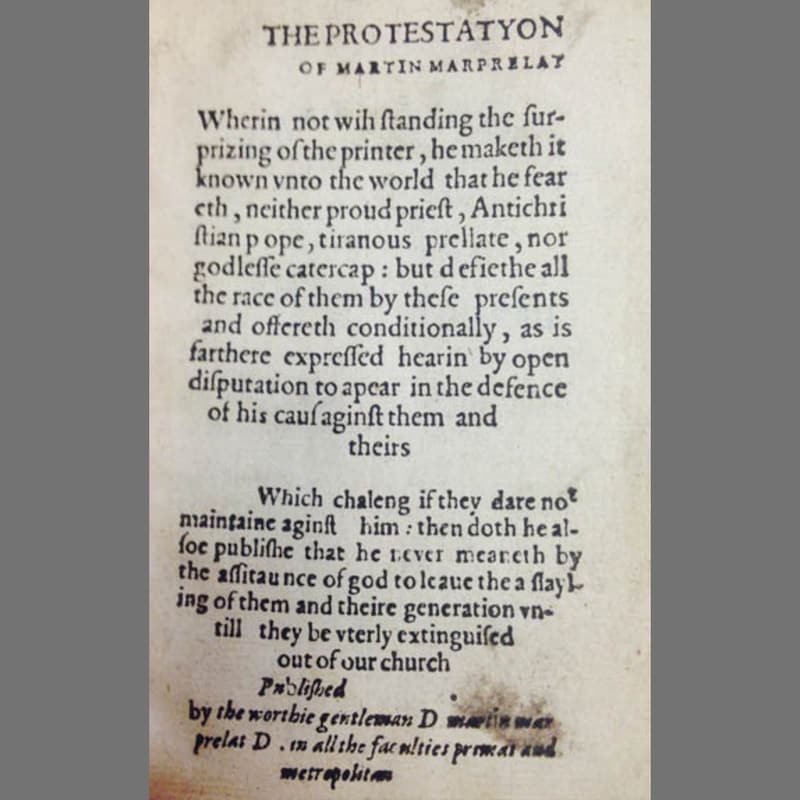
Artwork • The Cambridge University Library copy of:
'The Protestation of Martin Marprelate’, 1589.
Hastily created on an antiquated press hidden in a barn on a Coventry property, this last pamphlet was probably typeset by Martin’s collaborators, Job Throckmorton and John Penry.
Music • Daniel Bacheler: To Plead My Faith · The Consort of Musicke · Anthony Rooley.
A sonnet published as the work of Essex in Robert Dowland's Musical Banquet, 1610, set to music by Daniel Bacheler.
Daniel Bacheler, 1572 – 1619, was an English lutenist and composer. He served an apprenticeship with his uncle, Thomas Cardell, who was a lutenist and dancing-master in the court of Queen Elizabeth I.
Bacheler worked for Sir Francis Walsingham, Robert Devereux, 2nd Earl of Essex, as a groom of the bed chamber for Queen Anne of Denmark, and the consort of James I. At the royal court he composed some fifty lute pieces.
This is his only surviving song, set to the words of Robert Devereux, the Earl of Essex, 1565-1601.
The full text of the sonnet is included in the epilogue,
Notes:
In the late 1500’s in London, if you wanted to buy a good book, or some other publication, there was only one place to go: St. Paul’s Churchyard.
Today, visitors standing at its north gate, see sloping paths and quiet gardens, but over 400 years ago, this open space was packed with a dense maze of bookshops. Shops were tucked between buildings, wedged against the cathedral’s buttresses, and even wrapped around the walls. Everywhere you turned, there were books, and the people who loved them.
In and around, these bustling stalls, groups of shoppers from long ago, rummaged through all manner of publications, while gossiping, and sharing the latest news.
By the end of the 1580s, there was but one name, on everyone’s lips: Martin Marprelate.
The episode's transcript includes an epilogue with additional historical notes for anyone interested in learning more about the story.
© 20 26 The Rise of the Protestants., Author, Shaughan Holt.
"All rights reserved. No part of this podcast may be reproduced, translated, distributed, or transmitted in any form or by any means, including photocopying, recording, or other electronic or mechanical methods, without the prior written permission of the copyright holder, except in the case of brief quotations embodied in critical reviews and certain other non-commercial uses permitted by copyright law".
Requests regarding translation, licensing, or republication should be directed to: [email protected].
Your feedback matters, send me an email with any comments, suggestions, or criticisms.I read every message
Transcripts
Series 2.
Episode 2.
Martin Marprelate.
Part 1.
Backdrop.
The year is 15 87.
In the late sixteenth century, people in London looking for the latest book pamphlet or printed news went straight to St Paul's Churchyard.
Today, visitors to the cathedral only see peaceful gardens and broad walkways.
But over four hundred years ago, this area was at the heart of England's book trade.
Its churchyard was crowded with printers booksellers and stationers.
Small shops filled the spaces between buildings, gathered near the cathedral's buttresses, and stretched along the nearby streets.
The area was full of conversation as people browsed new books, discussed politics and religion, shared rumours, and looked for the latest pamphlets.
In the autumn of 15 88, an anonymous writer appeared, using the memorable name Martin Marprelate.
Over the following year, Martin published a series of sensational pamphlets, produced on secret printing presses, that were constantly moved from house to house to avoid discovery.
They launched a relentless attack on the government of the Elizabethan Church, denouncing its bishops, and championing the Presbyterian cause.
Martin's style was unlike anything England had seen before.
Instead of the measured language normally used in religious debate, his pamphlets were witty, sarcastic, irreverent and often laugh-out-loud funny.
Bishops were mocked by name, their authority ridiculed, and the established Church held up to public scorn, in language that ordinary readers could readily understand.
The authorities were predictably outraged, Church and Crown responding with determination.
The pamphlets were banned, their secret presses were hunted across the country, and an extensive investigation, was launched to uncover, everyone connected with the operation.
By the autumn of 15 89, the campaign had finally been crushed.
The clandestine presses had been seized or destroyed, several printers and their supporters had been arrested, and the Marprelate press had fallen silent.
Yet the extraordinary controversy it created, would leave a lasting mark on the history of the English Reformation.
On a Sunday morning in October 15 87, John Greenwood gathered with his congregation at the home of Henry Martin, in the parish of St Andrew-by-the-Wardrobe, in the City of London.
Like many other Separatists, they gathered in secret to read the Scriptures, pray, and worship in the way they believed matched the New Testament Church.
Their meeting was suddenly interrupted when armed officers, acting on the orders of the Bishop of London, forced their way through the door.
Greenwood and about twenty others were arrested and marched through the streets to the Clink Prison on the south bank of the river Thames.
The church of St Andrew-by-the-Wardrobe had been on that site since at least the twelfth century.
It got its unusual name in 1361, when King Edward III moved the Royal Wardrobe, an important part of the royal household, in charge of robes, furnishings, armour, and other royal possessions, to buildings next to the church.
Both the church and the Royal Wardrobe, were destroyed in the Great Fire of London in September 1666.
Sir Christopher Wren rebuilt the church, completing it in 1695, but it suffered severe damage again, during the Blitz of the Second World War.
After the war, the church was carefully restored and reopened in 1961.
Today, it still stands as a quiet reminder, of the dramatic events that happened nearby.
It was in this religious world, that Henry Barrow first emerged.
Henry Barrow was born in Norfolk around 15 50.
Through his family, he was connected to some of the most influential people in Elizabethan England, such as Sir Nicholas Bacon, Lord Keeper of the Great Seal, and likely John Aylmer, Bishop of London.
Educated at Clare Hall Cambridge, he graduated with a Bachelor of Arts in 15 70.
Like many young men of his class, Barrow seemed headed for a successful career within the established order.
The idea of independent congregations, was not entirely new.
Even before Robert Browne organised his church at Norwich, small groups of believers, were already meeting outside the established Church.
However, Browne explained these ideas most clearly.
He argued that every congregation should be a voluntary group of committed believers, guided by Scripture, instead of bishops or the Crown.
In 15 87, while reflecting on Browne's writings, Barrow found himself increasingly persuaded by many of their arguments.
Although he would later form his own views, he became convinced that the Church of England had strayed too far from the New Testament pattern.
His growing convictions, led him to John Greenwood and the secret Separatist congregation, meeting in London.
When Greenwood was arrested in October 15 87, Barrow went to the Clink Prison to visit and support his friend.
On his arrival, the prison keeper also seized Barrow, and quickly brought him before Archbishop John Whitgift at Lambeth Palace.
When questioned about his religious beliefs, Barrow refused to take the ex officio oath.
This oath required suspects to answer every question, without knowing the charges against them.
Believing the oath to be both unjust, and contrary to English law, he refused to comply.
For his defiance, he was committed to the Gatehouse Prison, beginning an imprisonment that would shape the rest of his life.
A week later, on 27 November 15 87, Henry Barrow appeared before the High Commission at Lambeth Palace for a second examination.
In front of the gathered bishops and commissioners, he was again asked to take the ex officio oath and confirm his loyalty to the Church of England.
During the hearing, Barrow questioned the legality of his imprisonment, and demanded to know the charges against him.
He was accused of teaching, that the Church of England was not a true church, that its worship was idolatrous, its ministers were not lawfully appointed, and its catechisms went against Scripture.
As a result, Barrow again refused to take the oath, believing that no Christian should be forced to incriminate himself.
His defiance brought the proceedings to an abrupt end, and he was returned to prison.
Later that day, the Commission summoned his friend, John Greenwood, for further questioning.
Although measured and cautious in his replies, Greenwood remained unwavering in his convictions.
He insisted, that Christ alone is the Head of His Church, and that no earthly authority, had the right to change the government or worship, that Christ had set out in Scripture.
Six weeks later, Henry Barrow and John Greenwood, again faced the ecclesiastical authorities.
Accused under the Recusancy Acts, of refusing to conform to the Church of England, both men were found guilty.
Although spared a harsher sentence, each man was fined the enormous sum of £260, an amount far beyond the means of ordinary people, and committed to the Fleet Prison.
They would remain there until they paid the fine, and conformed, by attending the services of the Church of England.
The Recusancy Acts, first introduced in 15 81 to suppress Roman Catholic resistance, had now become a powerful weapon, against all religious dissenters.
They required everyone over the age of sixteen, to attend the services of the Church of England, with heavy fines and imprisonment awaiting those who refused.
Persistent offenders could face even more severe penalties.
As the campaign against the Separatists intensified, the authorities widened their investigations and stepped up their searches.
No longer content with raiding secret congregational meetings, they began searching private homes for prohibited books, manuscripts, and evidence of illegal worship.
Roger Jackson and Thomas Legate were arrested in their own beds, without formal warrants, after being suspected of possessing manuscripts written by Barrow.
Also, at the workshop of the felt-maker Quintin Smythe, officials discovered Brownist writings, leading to his arrest and imprisonment in Newgate.
The appalling conditions of their imprisonment, soon began to take their toll.
Over the next nineteen months, at least seven members of the London congregation, died in captivity, victims of the overcrowded and unhealthy conditions.
In 15 92, the authorities briefly eased the restrictions on John Greenwood, granting him a short period of supervised liberty.
The reprieve however, would prove to be short-lived.
John Rough was born in Scotland around 15 08.
At the age of seventeen, he entered the Dominican Order of Friars, better known as the Black Friars because of the black cloaks they wore over their white habits.
During the next sixteen years, he devoted himself to study and preaching, making two journeys to Rome on behalf of the Order.
Those visits left a lasting impression.
Rough was disturbed by the lavish honour and reverence shown to the Pope, which he believed overshadowed, the worship due to Christ alone.
Convinced that the papacy had departed from the teaching of the New Testament, he later denounced the Pope as the Antichrist.
Abandoning the Dominican Order, Rough embraced the Protestant Reformation and became chaplain to James Hamilton, Earl of Arran, then Regent of Scotland.
Political upheaval and changing religious fortunes, eventually forced him into exile.
After periods in Scotland, England, and Friesland, he arrived in London on 10 November 15 57.
There, he discovered a secret Protestant congregation, meeting in defiance of Queen Mary's laws.
Recognising his gifts as a preacher and leader, the congregation soon appointed him as its minister.
On 12 December 15 57, the church assembled at the Saracen's Head Inn, in Islington, using the gathering, as a cover for an illegal service, based on the forbidden Second Prayer Book of Edward VI.
Unknown to them, an informer named Roger Sergeant had infiltrated the congregation.
The meeting was raided, and Rough, the deacon Cuthbert Symson, and several other leaders were arrested.
Three days later, Rough was examined before the Privy Council, before being committed to Newgate Prison.
A letter was then sent to Bishop Edmund Bonner, directing him to proceed against the prisoners.
While awaiting trial, Rough became convinced that Margaret Mearing had compromised the congregation, and formally excluded her from its fellowship.
Ironically, when she later attempted to visit him in prison, claiming to be his sister, so she could bring him a clean shirt, she too was arrested, after openly accusing Roger Sergeant of betraying the church.
During his examinations, Rough endured harsh treatment and relentless pressure to renounce his Protestant faith.
Despite everything, he refused to recant.
Condemned for heresy, he was burned at the stake at Smithfield on 22 December 15 57, at about fifty years of age, leaving behind his wife and their two-year-old daughter, Rachel.
Cuthbert Symson, the deacon of the London congregation, carried one of its most dangerous responsibilities: keeping the membership records of the underground church.
Following his arrest, he was subjected to relentless physical interrogation, in an attempt to force him to reveal the identities, of the congregation's leaders and its members.
He was put to the rack in the Tower of London, yet despite the pain and suffering, he refused to betray his fellow believers.
Condemned for his Protestant faith, Symson was burned at the stake at Smithfield on 28 March 15 58, becoming one of the many martyrs of Queen Mary's reign.
His courage, together with that of John Rough and countless others, was preserved for future generations, in the first Latin edition, of John Foxe's great work on the Protestant martyrs.
Their witness would inspire later reformers, and remind them of the price many had already paid, for the freedom to worship according to their conscience.
Smithfield itself had long been one of England's most infamous places of execution.
It was here that William Wallace met his brutal death in 1305, and where Wat Tyler was killed during the Peasants' Revolt of 13 81.
During the reign of Mary I, dozens of Protestant men and women were burned there, for refusing to renounce their faith.
Today, the site is home to the London Museum, standing as a reminder of both the city's rich history and its darker past.
In 15 86, William Brewster's own life also reached a turning point.
After his patron, William Davison, was recalled from the Netherlands and later imprisoned, over the execution of Mary Queen of Scots, Brewster remained loyal to him throughout his trial.
But with Davison's political career in ruins, and news reaching him that his father was seriously ill, Brewster decided to return home.
In 15 88, after several years in the service of the Crown, Brewster returned to Scrooby.
It was a homecoming that would alter the course of his life.
During his years at Cambridge and in diplomatic service, both Scrooby Manor and the surrounding countryside had changed considerably.
Before long, he would be drawn into a movement that would shape not only his own future, but also the future of English Separatism.
Brewster himself had also changed.
He had left Scrooby as an inexperienced young man, and returned with a broader outlook, shaped by years of study and service.
At Cambridge, he had received the foundations of a classical education, and gained first-hand experience, of the life and government of the established Church.
Later, while serving William Davison in London and on diplomatic missions to the Dutch Republic, he acquired a practical understanding of government, international politics, and the art of negotiation.
His travels exposed him to a country at war.
He visited fortified towns, observed military preparations, and witnessed the hardships of the Dutch struggle for independence from Spain.
During these years, he also forged friendships with civic leaders in Holland, relationships that would prove invaluable in the years ahead.
The young man who returned to Scrooby in 15 88 was very different from the one who had left.
His education, travels, and experience had prepared him for a far greater role than he could yet have imagined.
Meanwhile, events in London continued to unfold.
Barrow's fourth examination, proved to be one of the most important.
This time he appeared before the great man, William Cecil, Lord Burghley, at the Privy Council.
While Barrow was facing the highest authorities in the land, other members of the underground Separatist congregation were preparing a bold appeal of their own.
On 13 March 15 89, members of the underground Separatist congregation, presented a petition, directly to Queen Elizabeth.
They described the relentless persecution they were enduring, complaining of the "daily spoiling, vexing, molesting, hurting, pursuing, imprisoning and locking them up as prisoners in the most unwholesome and vile prisons".
They also appealed for an opportunity to present their case before the Privy Council.
The Queen responded by instructing Lord Burghley to investigate their petition.
Whether this reflected her genuine concern, or simply a desire to establish the facts is uncertain.
A meeting was convened at Whitehall, attended by Burghley, Lord Chancellor Sir Christopher Hatton, Archbishop John Whitgift, and several other senior officials.
Unlike Whitgift, whose policy was to suppress any religious nonconformity with uncompromising determination, Burghley generally favoured a more measured approach.
Although he had no sympathy for Separatism itself, he feared that excessive persecution might prove politically damaging, and deepen religious division.
To Burghley, militant Roman Catholicism, posed the greater danger to the security of Elizabeth's throne.
On 18 March 15 89, Henry Barrow was brought before the Privy Council at Whitehall for another examination.
Present were William Cecil, Lord Burghley, Archbishop John Whitgift, and several of the Queen's senior advisers.
Unlike Whitgift's earlier interrogations, Burghley began with measured and courteous questions, hoping to understand the reasoning behind Barrow's beliefs.
But after many months of imprisonment in the dreadful Fleet prison, Barrow was physically exhausted and emotionally drained.
As the questioning became more intense, his composure finally gave way.
Turning towards Whitgift, he angrily declared:
"That man is a monster; he is neither ecclesiastical nor civil".
The outburst brought the hearing to an abrupt end.
Barrow was forcibly removed from the Council chamber, before he had the opportunity to present his case fully.
Later, alone in his prison cell, he deeply regretted losing control.
In a moving prayer he confessed:
"Lord, pardon my unworthiness, and unsanctified heart and mouth, which can bring no glory to the Lord, or benefit to His Church, but rather a reproach to the one, and affliction to the other".
While Barrow remained behind bars, another leading Puritan reformer, was taking the campaign against the bishops in a very different direction.
In 15 88, John Penry resumed his partnership with the printer Robert Waldegrave, whose clandestine press had already attracted the attention of the authorities.
Together they published, "An Exhortation unto the Governors and People of Wales", a passionate appeal, calling for the preaching of the Gospel throughout Wales.
Penry condemned the bishops, for neglecting the spiritual needs of the Welsh people, accusing them of being "slaughterers and soul tormentors".
A few months later, he followed it with, "A Defence", once again printed in secret by Waldegrave.
Despite an increasingly determined search, Penry managed to remain one step ahead of the authorities, who were becoming ever more anxious to silence, both the writer and his elusive printer.
John Udall soon followed Penry's example, by turning to Robert Waldegrave's clandestine press, to publish one of the most controversial Puritan books of the age.
In April 15 88, Waldegrave printed Udall's anonymously published work, "The State of the Church of England Laid Open”.
The book launched a fierce attack on the government of the Elizabethan Church, directing much of its criticism at the Bishop of London, John Aylmer.
Udall mockingly compared him to, "Diotrephes", the domineering church leader, condemned in the Third Epistle of John.
The authorities moved swiftly.
On 16 April, officers of the Stationers' Company raided Waldegrave's printing house, seizing his press, most of his type, and hundreds of copies of Udall's book.
Waldegrave narrowly escaped arrest, managing to carry away a small box of printing type, concealed beneath his cloak, before fleeing the premises.
The confiscated books were publicly burned, while the press and much of the remaining type were destroyed.
The type that Waldegrave managed to rescue, was secretly hidden at the London home of Mistress Elizabeth Crane, in the parish of St Mary Aldermanbury.
From where, it would soon play a central role, in one of the most remarkable clandestine publishing enterprises of the Elizabethan age.
Udall himself, rejected the label Puritan.
He argued that it was a term of abuse, originally coined by opponents of reform, to discredit those who sought to reshape the government and worship of the Church of England, according to the pattern of the New Testament.
For Archbishop John Whitgift and the High Commission however, works such as Udall's, represented a direct challenge to ecclesiastical authority.
Their response was to tighten censorship, intensify the search for illicit presses, and suppress the growing stream of unlicensed Puritan publications.
While the authorities, were pursuing Puritan writers and Separatist congregations, England faced an even greater threat from abroad.
In the summer of 15 88, King Philip II of Spain launched the Spanish Armada, a vast fleet intended to escort the Duke of Parma's army from the Spanish Netherlands to England.
Its objective, was to overthrow Queen Elizabeth, restore Roman Catholicism, and put an end to English support for the Dutch Revolt.
The Armada entered the English Channel in July, but was harried by the smaller, faster English fleet commanded by Lord Charles Howard and Sir Francis Drake.
Although it reached Calais largely intact, English fire ships broke its formation, and the following day it suffered heavy losses at the Battle of Gravelines.
Forced to abandon the invasion, the Armada sailed north, only to lose many of its ships in violent storms, while attempting to return to Spain by going around Scotland and Ireland.
To Protestant England, the victory seemed nothing short of miraculous.
A commemorative medal bore the Latin inscription, "Flavit Jehovah et Dissipati Sunt", The Lord blew, and they were scattered".
The storm that helped destroy the Armada became known as the Protestant Wind, reinforcing the widespread belief that God had intervened to preserve England.
Yet the danger was far from over.
Fears of another Spanish invasion persisted, and the government became increasingly suspicious of anything that appeared capable of weakening national unity.
In such an atmosphere, even loyal Protestant reformers found themselves viewed with growing distrust, while Separatists and Puritans faced even harsher persecution.
As the threat of invasion grew, Queen Elizabeth appointed her trusted favourite, Robert Dudley, Earl of Leicester, to command the army assembled at Tilbury in Essex, where thousands of soldiers waited for the expected landing of Spanish forces.
On 9 August 15 88, Elizabeth rode to the nearby port of Tilbury, to review her troops, and deliver one of the most celebrated speeches in English history.
Wearing a breastplate over a white gown, and riding among her soldiers, she sought to strengthen their resolve, declaring:
"I know I have the body of a weak and feeble woman; but I have the heart and stomach of a king, and of a King of England too”.
Her words became a symbol of national courage and Protestant resistance.
Although the Armada had already been driven from the English Channel, no one yet knew whether the danger had truly passed.
Across the country, fears of another invasion remained very real.
In such an atmosphere of national emergency, the government became increasingly determined, to suppress anything, which might threaten the unity and stability of the realm.
While Roman Catholics still remained their principal concern, Puritans and Separatists also found themselves facing closer scrutiny, harsher censorship, and more determined persecution.
Just three weeks later, on 28 August 15 88, the ailing Robert Dudley, Earl of Leicester, wrote what would prove to be his final letter to Queen Elizabeth.
Written from Rycote House Oxfordshire, one of the Queen's favourite residences, it expressed his concern for her welfare, while assuring her, that he was taking the medicine she had sent him.
Dudley had been in declining health, for some time.
While travelling to Buxton in Derbyshire to take the medicinal waters, he died at Cornbury Park, near Oxford, on the 4th of September 15 88, aged 56.
Overwhelmed by grief after hearing of Dudley's death, Elizabeth withdrew to her private apartments for several days, prompting Lord Burghley, to intervene out of concern.
Elizabeth, kept Dudley's final letter, marking it, "His Last Letter", and would preserve it in a treasured casket beside her bed, until her own death on 24 March 16 03.
Thank you for listening.
The accompanying transcript also includes an epilogue with additional historical notes for those who would like to explore the story further.
Epilogue.
Words to “To plead my faith” , by Robert Devereux, 2nd Earl of Essex
A sonnet published as the work of Essex in Robert Dowland's Musical Banquet , 16 10, set to music by Daniel Bacheler.
To plead my faith where faith has no reward,
To move remorse where favour is not borne,
To heap complaints, which she doth not regard,
Were fruitless, bootless, vain and yields but scorn.
I loved her whom all the world admired,
I was refused of her that can love none,
And my vain hopes, which far too high aspired,
Are dead and buried and forever gone.
Forget my name, since you have scorned my love,
And woman-like, do not too late lament;
Since for your sake I must all mischief prove,
I none accuse nor nothing do repent.
I was as fond as ever she was fair,
Yet loved I not, more than I now despair.
Notes
Steven W. May, "The poems of Edward de Vere, seventeenth Earl of Oxford and Robert Devereux, second Earl of Essex
St Andrew-by-the-Wardrobe.
Today, St Andrew-by-the-Wardrobe stands on Queen Victoria Street, in the City of London, as an Anglican church in the Church of England.
The church follows the Anglo-Catholic tradition, and keeps many historic Catholic customs in its Anglican worship, while staying fully within the Church of England.
The parish does not ordain women, and instead, receives Episcopal oversight from the Bishop of Fulham.
The Eucharist, remains central to its worship.
Along with St James Garlickhythe, St Andrew Holborn, St Dunstan-in-the-West, and Saint Magnus the Martyr, it is one of five City churches, dedicated to preserving this unique Anglican heritage.
The church also hosts a Coptic Orthodox congregation, showing the long tradition of Christian worship at this site, which has served believers for centuries.
The Coptic Orthodox Church.
The Coptic Orthodox Church, can trace its origins to the first century, and according to ancient tradition, was founded in Alexandria by Saint Mark the Evangelist.
Neither Protestant nor Catholic, it belongs to the ancient family of churches known as Oriental Orthodoxy, which separated from the rest of the Christian Church, following the Council of Chalcedon, in AD 4 51.
Today, it is the largest Christian church in the Middle East, with most of its members living in Egypt.
The Council of Chalcedon remains one of the defining moments in Christian history.
It shaped the course of the ancient Church, and its legacy, can still be seen, in the continuing existence of churches, such as the Coptic Orthodox Church.
Historical Note: The Chalcedon Foundation.
Curiously, the name Chalcedon, would reappear more than twenty centuries later, in a very different setting.
Although unrelated to the ancient council itself, the name "Chalcedon" was adopted in 19 65 by the American Chalcedon Foundation, founded by theologian Rousas John Rushdoony.
The Foundation promotes Christian Reconstructionism, a conservative Calvinist movement, advocating the application of Old Testament biblical law, to modern society.
Influential within parts of the American Religious Right, it has also attracted considerable controversy.
William Wallace.
Sir William Wallace, born around 12 70, was a Scottish knight who became one of the principal leaders of the First War of Scottish Independence.
Together with Andrew Moray, Wallace defeated the English army at the Battle of Stirling Bridge in September 12 97.
Following the victory, he was appointed Guardian of Scotland, serving until his defeat by King Edward I at the Battle of Falkirk in July 12 98.
Wallace evaded capture for several years, but on 5 August 13 05, his resistance came to an end, when Sir John de Menteith, a Scottish knight loyal to the English Crown, betrayed him.
Captured at Robroyston, near Glasgow, Wallace was handed over to the English authorities and taken to London to stand trial.
Following his conviction on 23 August 13 05, Wallace was taken from Westminster Hall to the Tower of London, before being dragged behind a horse to Smithfield, one of the most important locations for public executions in medieval London.
It was to be there, aged about 35, he was to suffer the full punishment, reserved for traitors to the Crown: he was hanged, and cut down while barely alive.
He was emasculated and disembowelled, with his entrails burned before his eyes, before finally being beheaded and his body cut into foreparts.
His head was later dipped in tar, and displayed on a spike atop London Bridge.
Today, a memorial plaque near St Bartholomew's Hospital, close to the site of his execution at Smithfield, commemorates Wallace's death.
It bears the Latin inscription, translated as "I tell you the truth: freedom is the best of all things.
My son, never live under the bondage of slavery", together with the Gaelic words meaning "Death and Victory", an ancient Scottish battle cry.
More than five centuries later, in 18 69, the Wallace Monument was erected on Abbey Craig, overlooking the site of his famous victory at the Battle of Stirling Bridge.
Wat Tyler.
Wat Tyler, born around 13 20 or 13 41, led the Peasants' Revolt of 13 81, one of the most significant popular uprisings in medieval England.
At the head of thousands of rebels marching from Canterbury to London, he called for the abolition of the unpopular poll tax, and demanded sweeping economic, social and political reform.
The revolt occurred because people were angry about high taxes, a labour shortage, and societal changes after the Black Death.
People had also grown increasingly resentful, of the rising cost, of the Hundred Years' War.
Between 13 77 and 13 81, Parliament imposed three increasingly unpopular poll taxes, to fund unsuccessful military campaigns in France.
The first, introduced shortly before the death of King Edward III, charged four pence, on everyone over the age of fourteen.
The rebels enjoyed several early successes, but the uprising came to an abrupt end, when Tyler was attacked and killed, during negotiations with the young King Richard II, at Smithfield in London, on 15 June 13 81.
Even though the revolt did not succeed, it revealed deep problems in medieval English society.
It is now seen, as a key moment in the struggle against serfdom, and an early sign that people wanted more fairness and political change.
Historical Note:
The Hundred Years' War, was a 116-year conflict between England and France, driven by territorial disputes, the French throne succession, and economic rivalry.
