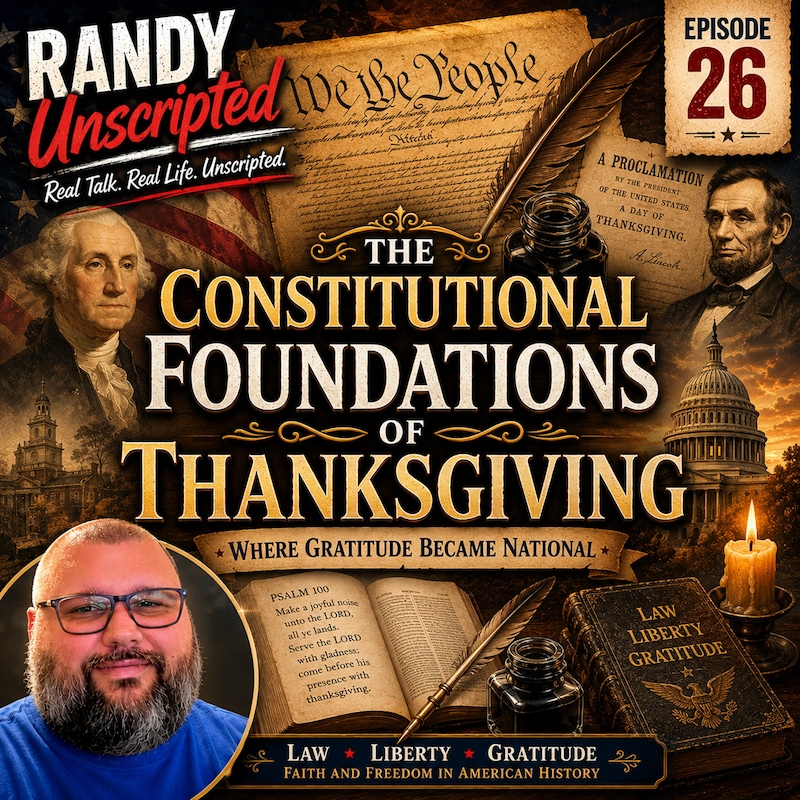
Randy Black discusses the intersection of Thanksgiving and the U.S. Constitution in a podcast episode. He highlights that while the Constitution doesn’t mention Thanksgiving, it provides the framework for national observances through presidential proclamations and legislative actions.
Key Points and Main Ideas:
Constitutional Foundation: Thanksgiving became a legal and national observance due to the constitutional framework, enabling presidents to issue proclamations and legislatures to set holidays.
Early Thanksgiving Proclamations:
George Washington, the first president, issued a proclamation encouraging national gratitude and acknowledging God’s providence.
John Adams continued the tradition, emphasizing civic virtue and gratitude.
Thomas Jefferson’s Stance:
Jefferson did not issue proclamations due to a strict interpretation of the First Amendment, fearing federal endorsement of religion.
He allowed states to continue the tradition, reflecting the Constitution’s support for multiple interpretations.
Abraham Lincoln’s Influence:
Lincoln transformed Thanksgiving into a unifying civic ritual during the Civil War, framing gratitude as a means to bridge political divides.
His proclamation emphasized national blessings and unity.
Modern Thanksgiving:
Today, Thanksgiving blends constitutional tradition, civic identity, cultural heritage, and personal faith expressions.
It remains voluntary and deeply American, supported by the Constitution’s framework.
Actionable Items:
Reflect on Thanksgiving’s meaning and gratitude as a unifying act.
Acknowledge freedoms protected by the Constitution.
Consider how personal faith and civic responsibility intersect in national observance.
Transcripts
:
Randy Black.
:
Randy Black.
:
Randy Black.
:
Randy Black.
:
Randy Black.
:
Randy Black.
:
Randy Black.
:
Randy Black.
:
He's a troublemaker.
:
Welcome back to Randy Unscripted.
:
I'm your host, Randy Black.
:
And this is a continuation of our NAPOD POMO series.
:
That's National Podcast Post Month.
:
This is for November 25th, 2025.
:
I'm sorry.
:
It's a day late.
:
But we had a tragic event in our family.
:
that I'll go into detail on later on.
:
But I wanted to still go ahead and get this recorded,
:
even though it's a day late,
:
and get it out for those of you who have been following along.
:
But National Podcast Post Month,
:
the goal is 30 episodes in 30 days,
:
and we're almost at the end.
:
The light is at the end of the tunnel.
:
But we're going to continue our Thanksgiving series today
:
where we're stepping into a space
:
I don't think most people ever really associate with Thanksgiving.
:
and that's with the U.S. Constitution. Now, that might sound a little bit odd at first. After all,
:
Thanksgiving brings to mind, you know, feasts, pilgrims, parades, football, but our National
:
Day of Gratitude actually sets at a really intersection of law, liberty, and faith in
:
public life. And as a former social studies teacher, I've always found that connection that
:
exists there to be quite fascinating. So today's episode is going to explore how Thanksgiving
:
became legal, how it became national, and how its story reflects our ongoing
:
American conversation about faith, civic unity, and the responsibilities that come along with
:
those freedoms we have. So let's address the obvious question that we might start with here,
:
that the Constitution never mentions Thanksgiving.
:
So, is Thanksgiving constitutional?
:
There's no, like, Article 3, Section 4 that says
:
Congress shall carve the turkey or anything like that.
:
But what the Constitution does create
:
is a framework that makes national observances possible.
:
A president who can issue proclamations,
:
a legislature empowered to set national holidays,
:
and a federal government that can call the nation to unified action.
:
The Constitution gives us that mechanism to do those things.
:
Thanksgiving gives us the meaning that we need for it.
:
And that combination of form and of faithfulness becomes especially clear
:
when you look at the earliest Thanksgiving proclamations that occurred.
:
Just months after the Constitution went into effect in 1789, President George Washington issued the first National Thanksgiving Proclamation.
:
What's remarkable is how openly he spoke about faith, something people today often assume that the founders tried to avoid.
:
Washington wrote that the nation should unite to acknowledge the providence of Almighty God
:
and to render unto him our sincere and humble thanks.
:
That was the first president using his newly created constitutional office,
:
encouraging a national posture of gratitude and grounding it in the idea that our freedoms
:
are gifts from God, not achievements we earned alone.
:
Washington's proclamation didn't violate separation of church and state.
:
Instead, it reflected the founder's assumption that gratitude to God was compatible with
:
and even supportive of a free republic.
:
As Psalms 100 verse 4 says,
:
Enter into his gates with thanksgiving, and into his courts with praise.
:
Be thankful unto him and bless his name.
:
The founders weren't quoting scripture in the document.
:
but they absolutely were drawing from a biblical worldview in what they did.
:
Washington wasn't an outlier. John Adams continued the tradition during his presidency,
:
sometimes declaring days of thanksgiving, sometimes days of fasting. He understood
:
something important. A constitutional republic depends not just on laws, but on virtue.
:
Gratitude cultivates humility.
:
Humility cultivates responsibility.
:
And responsible citizens sustain a free nation.
:
Adams believed that government could encourage virtue without legislating belief,
:
something modern audiences often misunderstand.
:
Early Thanksgivings weren't about establishing a religion.
:
They were about nurturing a moral citizenry.
:
Thomas Jefferson broke the pattern by not issuing Thanksgiving proclamations.
:
Not because he disliked gratitude, but because he held a stricter interpretation of the First
:
Amendment while he was the president. Here's what's important. Jefferson's refusal wasn't
:
a rejection of faith. It was simply a constitutional stance. He believed the president shouldn't
:
recommend religious observances, even if they were voluntary, because it could imply federal
:
endorsement of religion. But he wasn't perfectly comfortable with states continuing the tradition,
:
and many did. He felt that if the state felt that it was the right thing to do, that they could do it.
:
This is a great moment to highlight how the Constitution supports multiple interpretations,
:
and how Thanksgiving traditions survived because of intellectual diversity, not in spite of it.
:
And again, Scripture gives us a universal principle Jefferson respected even if he didn't proclaim.
:
In everything give thanks, for this is the will of God in Christ Jesus concerning you.
:
1 Thessalonians 5, verse 18.
:
While Washington set the tone, Abraham Lincoln is the one who gave Thanksgiving its modern place in our nation today.
:
In the middle of the Civil War, arguably the moment when the Constitution itself was in crisis, Lincoln called the nation to a day of Thanksgiving.
:
His proclamation isn't just poetic, it's constitutional theology.
:
In 1863, his proclamation had these things in it.
:
He acknowledged the blessings the nation still enjoyed despite the conflict.
:
He invited citizens to humility.
:
He asked Americans to remember widows, orphans, and those suffering in the war.
:
And he framed gratitude as a unifying act, one that would transcend the political divides that existed.
:
Thanksgiving became a civic ritual meant to stitch the nation back together.
:
Lincoln's words echo what we see in Psalms 95, verse 2.
:
Let us come before his presence with thanksgiving
:
and make a joyful noise under him with psalms.
:
Today, Thanksgiving stands as a rare national practice
:
that comfortably blends the constitutional tradition,
:
the civic identity, the cultural heritage,
:
and the personal expressions of faith that people have.
:
It remains voluntary, unifying, and of course, deeply American, not because the Constitution
:
requires it, but because the Constitution allows it. Faith provides the meaning,
:
law provides the structure, and gratitude provides the glue.
:
As we think about Thanksgiving this year, maybe the most constitutional thing we can
:
do is simply this. Pause, reflect, give thanks, and acknowledge the freedoms that we enjoy,
:
freedoms protected by the document the founders gave us, and ultimately those gifts. As Psalms
:
107.1 says, O give thanks unto the Lord, for he is good, for his mercy endureth forever.
:
That is something that Washington understood, that Lincoln understood, and something that we as Americans still desperately need to remember today.
:
Thank you for listening to this episode of Randy Unscripted, another episode in our NAPODPOMO National Podcast Post Month Series.
:
The goal is 30 episodes in 30 days.
:
We have another episode scheduled tomorrow about Thanksgiving on Thanksgiving Day.
:
And I hope you'll tune in and listen to that.
:
Sorry, not tomorrow, in two days.
:
We do have another Thanksgiving episode tomorrow
:
and then a Thanksgiving episode on Thanksgiving.
:
And I hope you'll tune in and hear those as well.
:
Until then, I'm Randy, and this has been Randy Unscripted.