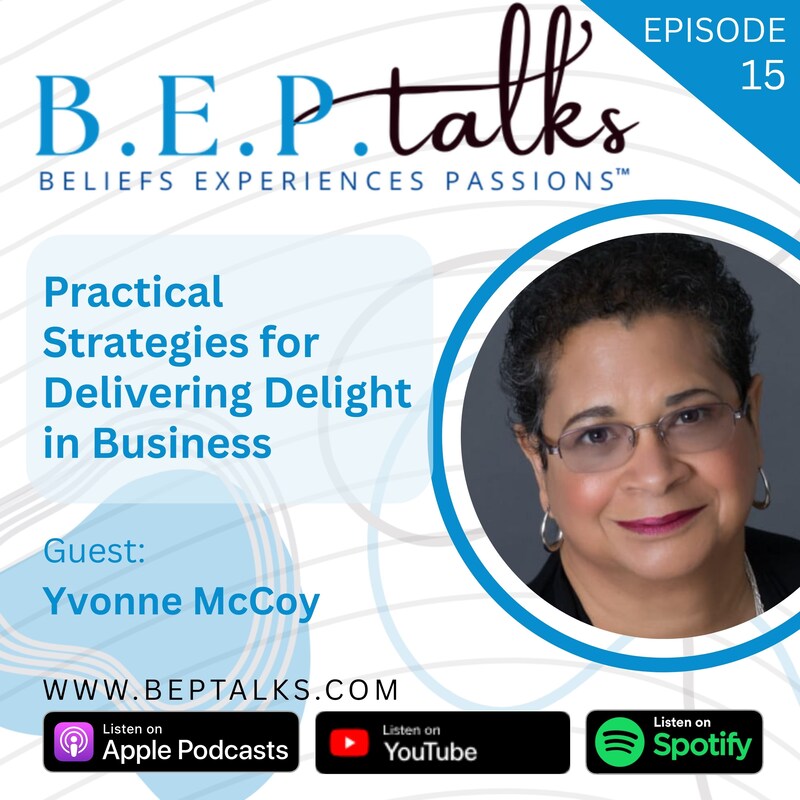
Shownotes
In this inspiring episode of BEP Talks, I sat down with business strategist Yvonne McCoy to explore the power of authenticity and consistency in business. Yvonne shared her Be Found framework—reminding us to focus on our unique strengths, nurture relationships, and always deliver delight. We discussed how being true to yourself, staying relevant, and embracing vulnerability are key to accelerating your success. If you’re ready to collapse your timeline and get real results, this session is packed with practical wisdom you don’t want to miss!
Want to work with a strategist who keeps it real, delights at every step, and helps you accelerate your growth? Connect with Yvonne McCoy https://www.yvonnemccoy.com/podcast!
---------------------------------
B.E.P. Talks makes it possible to connect with those who most resonate with your own personal or professional life – or both. Follow-up in the moment or come back to them when you need them most, attend their events, read their books, participate in their courses.
Visit often! Meet experts from the cross section of the world. Let them motivate, inspire and educate you.
🎤Interested in telling YOUR story?
Visit https://www.beptalks.com/ for all the info you need.
Schedule an interview. Expand your reach and influence. Begin to change the lives of others by changing your own.
You’ll love the experience and your audience will appreciate you.
🔎Explore the MeetN Platform: https://meetn.com/features?x=94034
▶️Subscribe to our Channel: / @beptalks
Follow Us on Social:
Facebook: / thegsew
LinkedIn: / johnstonbeth
Transcripts
Well, hello everybody and welcome to another edition of BEP
Speaker:Talks, Beliefs, Experiences, and
Speaker:Passions. Kind of what life at this stage
Speaker:anyway becomes all about. You know, we bring you
Speaker:guests, a very diverse collection of guests,
Speaker:all of them very special, all of them an expert in their own field,
Speaker:their own industry, um, at different stages. Of
Speaker:their career. Some retired, some still building fantastic
Speaker:businesses. And, um, they come to you to share
Speaker:their beliefs, their experiences, their passions, hoping
Speaker:to inspire you, to motivate you,
Speaker:educate you, sometimes just to entertain you.
Speaker:Combinations of all of the above. None of it's bad. It's all
Speaker:good. Today is certainly no exception.
Speaker:My very special guest today is Yvonne McCoy, who is a
Speaker:business strategist. She's going to
Speaker:explain exactly what that means, what her specialty is. So you know what?
Speaker:Let's just welcome— here she is, Yvonne McCoy. Welcome.
Speaker:Hey, Beth. I'm so excited to be here. I can't tell
Speaker:you just the thing that your podcast is about, the
Speaker:belief, the experience, and the passion, I
Speaker:think is so important. I mean, one of my beliefs that has come
Speaker:about over time is that
Speaker:when I meet with somebody and I talk with somebody and they talk with me,
Speaker:we both leave better for the experience. Do you know,
Speaker:whatever the better looks like, whatever it means. But we, you
Speaker:know, you know, in my Be Found framework, the
Speaker:last, the D is delight, deliver, and delight. And I want to make
Speaker:sure that I hopefully can delight the people that are listening to this, that they
Speaker:can walk away with something that they can remember. My friend,
Speaker:Yvonne, I have absolutely no doubt
Speaker:that, that and so much more will be accomplished. And
Speaker:I say that to the listeners because I have had the opportunity,
Speaker:the honor, the privilege to speak with Yvonne before. And
Speaker:we just connect on a very heart-to-heart basis.
Speaker:And that's why Yvonne being here today talking about beliefs,
Speaker:experiences, and passions is so natural really for both
Speaker:of us. Yvonne, because we've both been around the block a few
Speaker:times. And you realize that when you get to our stage of life
Speaker:and business, so much more in the rearview mirror, shall I say,
Speaker:though we hope there's still a lot ahead for us, is that we can reflect
Speaker:on that. And we have
Speaker:perhaps most importantly, the experiences to share with
Speaker:other people to shorten their timeline on their journey.
Speaker:To whatever it is that they wanna do. So you were just the perfect guest,
Speaker:and I so thank you again for being here today. Well,
Speaker:you know, we've shared messages before, both you being
Speaker:on my summit and you were amazing. Thank you. So I am really happy
Speaker:to be here. Yeah, thank you. And right back at you.
Speaker:So what is a business strategist?
Speaker:Well, for me, a business strategist is a person who
Speaker:helps you to take what you already have and says,
Speaker:how are we going to make you the expert
Speaker:and not an expert, right? How do we make you stand
Speaker:out? Because, you know, what I found for, for many people who
Speaker:are in businesses, they have more than they need. And
Speaker:instead of adding more, they actually need to get rid of
Speaker:stuff and simplify and focus so that
Speaker:people can find them because the visibility is like a really big part. I
Speaker:mean, one of the silly stories that I tell is as
Speaker:entrepreneurs, we love to create. So one
Speaker:day we're doing this, the next day we're doing that, the next month we're doing
Speaker:something else. And it's kind of like you've got a mobile store.
Speaker:On Monday, you're on one corner and you're selling one thing, and
Speaker:on Tuesday you're on another corner selling something else. And the person
Speaker:that came by Monday that wants to find you can't. Because
Speaker:you've now moved and you're selling something totally different.
Speaker:Your clients can't find you because you're not, you're not getting consistent
Speaker:clients because you're not being consistent. This is a great
Speaker:metaphor. That is a great visual. And I will tell you,
Speaker:as a much younger woman in New York City where I was cutting
Speaker:my teeth in business, I lived in that scenario of
Speaker:seeing the guy on Lex and Lex
Speaker:and 52nd, and then you'd go there the next day and he's not there.
Speaker:You're looking for the pretzel guy and now the hot dog guy is there. You're
Speaker:looking for the hot dog guy and now the guy who's selling the knockoff
Speaker:handbags is there. That's a great metaphor.
Speaker:So being consistent,
Speaker:so important. So what I'm
Speaker:hearing from you, Are we getting in our own way? Oh,
Speaker:absolutely we are. Okay. So what should we do? It's
Speaker:not your fault. And this is the reason that it's not your fault.
Speaker:Okay. And that is because
Speaker:historically we are moving out of kind of an
Speaker:industrial way of being educated into the new
Speaker:informational age. In the industrial age, you know,
Speaker:Buckminster Fuller says we are all born geniuses and then it's educated
Speaker:out of us. We were taught in school to follow the rules
Speaker:and do exactly the same thing. We were all, you know,
Speaker:supposed to come out to be cubes to fit into the square hole.
Speaker:Yeah, right. That no longer is what we need.
Speaker:And so we are following people and following
Speaker:people's advice, you know, and saying, this is the expert
Speaker:that, you know, is going to help me. And it has nothing—
Speaker:you know, there may be strategies in there, but it's not personalized.
Speaker:Information is now everywhere. People can get information all over the
Speaker:place. So as an expert, your expertise
Speaker:is not necessarily information,
Speaker:it's implementation and personalization. It's
Speaker:how— what do you need? How can I help
Speaker:you get that and implement it and actually use
Speaker:it? I've actually started in my coaching sessions leaving
Speaker:5 to 7 minutes at the end where people can actually work
Speaker:on stuff. So they don't leave with homework because I'm like everybody else.
Speaker:The night before my coaching sessions, I'm like, I need to do this,
Speaker:I need to do this, you know. So we actually start on it and start
Speaker:working on it together so that they've got a head start. They know what it
Speaker:is, they know what the questions are, and they actually are leaving
Speaker:hopefully with something that they can put to work right away.
Speaker:And, and people just really value that. Like, it's not like one
Speaker:more to-do. Right, right, right. You know, and
Speaker:going back, talking about education, I think children should not get homework in school. If
Speaker:the teachers are doing a really great job in the classroom, they should accomplish it
Speaker:then and there and let the children go home and be with family. That's
Speaker:another whole topic. So, so, but I feel that way. I
Speaker:feel that way. Giving people homework because, and I was that,
Speaker:that student who was writing term papers the night before they were due. Oh yeah.
Speaker:You know, and Yeah, it's
Speaker:just I was being consistently inconsistent.
Speaker:So getting in our own way, what's the,
Speaker:what's the, what's the solution to that? Are we, are
Speaker:we taking in too much information from too many directions? Are we
Speaker:not staying focused?
Speaker:Okay, so here's, here's what makes this
Speaker:an ongoing kind of puzzle. Okay,
Speaker:and that is you need to stay relevant. The
Speaker:world is constantly changing, so the solution that you
Speaker:had, let's say before COVID doesn't work after COVID.
Speaker:The solution that you had maybe 2 years ago
Speaker:may not be relevant for where you want to be now. So you've got a
Speaker:lot of moving things going on. So that's the other
Speaker:reason that you kind of have to have a core And your
Speaker:core really is your belief and
Speaker:your uniqueness. That stays the same. That's your North Star.
Speaker:I mean, oh, I like that. So that as you're
Speaker:navigating all these other things and all these other— that part stays
Speaker:the same. I mean, I had someone who,
Speaker:who was actually a client who came to my workshop, and she said to me
Speaker:afterwards, I don't know who that person was. That was presenting
Speaker:that workshop, because that's not the person I like working with.
Speaker:Because in the workshop, I was like, I had it structured, I had it
Speaker:timed, I had, you know, I wasn't
Speaker:my loosey-goosey self that I normally am, right?
Speaker:And so that's the thing that needs to stay the same. I mean,
Speaker:when I had to do— I decided to do the same workshop, I was like,
Speaker:this is going to be so boring. You know, the same
Speaker:workshop every single month, right? And this is what I
Speaker:learned. First of all, in between workshops, I learned new things
Speaker:from the workshop. The people that come are different, so the
Speaker:energy is different, and you get to know your subject, and you get to,
Speaker:to learn to go deep into what you do
Speaker:as opposed to be very thin and wide. Yeah. Yes.
Speaker:So true. So true. So
Speaker:to be consistent, I'm thinking of the saying, to thine own self be
Speaker:true. Know what you know, know what you don't know, um, and
Speaker:become really great at who you are, what you do, and
Speaker:do it consistently so that you can be found.
Speaker:Oh, be found. You have a program that's called
Speaker:Be Found. Found is an acronym, F-O-U-N-D. Would you talk to
Speaker:us about that please? Sure. So the B is really easy.
Speaker:Be yourself. That's the best person you can be. It doesn't
Speaker:take a lot of extra energy. You don't have to say, you know, am
Speaker:I in the right whatever? Just relax and be yourself.
Speaker:You know, none of us are perfect. And so, you know,
Speaker:enjoy it. And that's really what I've started stepping into.
Speaker:So that part is, is really important because you will
Speaker:show up the same way all the time.
Speaker:The F is focus on your unique strengths and
Speaker:abilities. We all have different things that we're good at,
Speaker:right? And typically I tell people the things that you're really good at
Speaker:are probably the things that irritated your family no end.
Speaker:They did not appreciate you for who you were. So my thing
Speaker:is, my sisters and my kids even will say to me, Mom,
Speaker:don't fix me. You know, don't fix the
Speaker:problem. I just want you to say, I'm sorry you feel sick. And
Speaker:because what I typically say is, did you take something for that? Yeah, we want
Speaker:to be the fixers. So what does the F stand for? F stands for
Speaker:focus. Focus on your unique abilities.
Speaker:And I think I missed the E. What is the E? No. Well,
Speaker:the B is just B. B is B. Gotcha. Gotcha. Oh,
Speaker:boy. Sorry. The B is just B. My bad. My bad. Okay. And the
Speaker:O? The O is outreach. Once you focus and
Speaker:know what your, your unique abilities are, you're going to do outreach in
Speaker:places that make sense for you,
Speaker:right? So if I'm selling ice, I'm not going to go to the Arctic,
Speaker:right? Unless it totally melts. But once you know what
Speaker:you've got to deliver and what your uniqueness is, you know, to
Speaker:be able to go to the places where those people are,
Speaker:right? The U is to understand your client's journey.
Speaker:Okay, so here's the thing that really
Speaker:attracts people to you is that people
Speaker:say, she gets me, he gets me. I
Speaker:don't have, you know, I don't have to explain this to you. And when you
Speaker:understand their journey, then you can language it in a way
Speaker:that lands with them, right? Right. You know, when people
Speaker:do their pitch, which I absolutely hate the word pitch, I
Speaker:call it an introduction. When it starts with I,
Speaker:it's like, to me, that's a turnoff because
Speaker:I want to know if you recognize my problem. I
Speaker:don't want to know who you are until I know that you can recognize my
Speaker:problem. All right. So I
Speaker:typically do my introduction something like,
Speaker:when I was doing productivity, I would say, do you get to the end of
Speaker:the day and all the important projects are still sitting on, you know, that only
Speaker:you can do are still sitting on your desk. Now I've got your attention,
Speaker:if that's you, right? As opposed to,
Speaker:I'm Yvonne McCoy, I'm a productivity coach, you know, or I'm Yvonne
Speaker:McCoy, I'm a strategist. Well, what does that even mean? And, and, and if
Speaker:the perfect person was there, they may totally stop listening.
Speaker:So understand the stages that they go through. Do your
Speaker:clients need to recognize the kind of
Speaker:problem that you have? Do they have to acknowledge that they have it?
Speaker:Right? What makes them go from, you know,
Speaker:acknowledging it to starting to investigate that they're going to get some,
Speaker:and so that you can fill their needs, right? Right. And what are
Speaker:they saying so that you can use that language back to them,
Speaker:right? So that's the understand their
Speaker:journey. The N is to nurture all your
Speaker:relationships. And by that is, it's the thing that I said to you
Speaker:when I first started networking, which I came to very late in my business career.
Speaker:I I was looking, you know, everybody had a dollar sign on their forehead. You
Speaker:know, I was looking for a client. Are you a client? Are you a client?
Speaker:You know, that is probably the worst thing you can do because first
Speaker:of all, if you meet somebody
Speaker:who's going to collaborate with you, they're worth far more than a client
Speaker:is, right? And it may just be that you've got
Speaker:somebody, you know, somebody that you'll never work with. But what I
Speaker:found that has totally surprised me is I'll go to a networking
Speaker:thing and somebody that I didn't think that I had met,
Speaker:but I had spoken someplace else will say, you need to talk to
Speaker:Yvonne. Now, this person is neither a collaborator nor, you
Speaker:know, whatever, but you develop those relationships, you show up, and
Speaker:you're yourself every single time, right? And then the D
Speaker:is delight, deliver, and delight. And I have to tell you, I have to
Speaker:laugh because ChatGPT always takes out the first delight
Speaker:when I, when I do this. And I think if I can't delight
Speaker:you before you choose to work with me and I deliver,
Speaker:then you're not gonna come and let— you know, work with
Speaker:me, right? Yeah. And even once you're working with me, I have
Speaker:to still delight you, right? I have to
Speaker:awaken something, help you be motivated, help you get your momentum
Speaker:going. And I have to tell you, momentum, I've learned,
Speaker:is even better than motivation. Because in the
Speaker:last last couple of months I've had a couple of things happen,
Speaker:but the momentum has been going. And even on the days when I
Speaker:don't feel like it, good things are happening. Oh, that's
Speaker:so good to hear. That's so good to hear. Yeah. So that's the— that's
Speaker:the B, found. You know, that makes so much sense. And I just want to
Speaker:go to the D, because when you said about ChatGPT, and I don't think anything
Speaker:that artificial intelligence can ever replace
Speaker:or equal AI, meaning
Speaker:authentic interest. Mm-hmm. Going back to the N
Speaker:of nurturing the relationship. So a lot of
Speaker:people are willing or capable, very good, very skilled at even
Speaker:delighting at the beginning. Then you get the transaction
Speaker:and now they think it's done. It's like delight,
Speaker:done. Yeah. You know, as opposed to, well, now you gotta
Speaker:deliver, always overdeliver more than you promised. Yes. And then
Speaker:let the delight continue because you over-delivered.
Speaker:And hopefully those people who have engaged
Speaker:with you and trust you are getting results,
Speaker:right? Why wouldn't that continue to— I love that. Be
Speaker:Found. It stands for so much. Be yourself,
Speaker:focus, do the outreach, stay consistent in
Speaker:all of those things so that people can anticipate where you will
Speaker:be because you're always there. And reliability—
Speaker:I'm going back to when you said about stay relevant— reliability,
Speaker:that's kind of missing these days too, isn't it?
Speaker:Reliability. And I think the other thing
Speaker:is what you're saying, reliability. I also think a piece of
Speaker:that is vulnerability. You know, so it was,
Speaker:it was really You know that I have— I have a— I
Speaker:hit my head and I have a concussion. And it was— and so I haven't
Speaker:been able to do 100% of what I've been doing. So
Speaker:it's a wonderful way for me to focus. We know, you know, you go, what
Speaker:do I really need to do? What, you know, I'm outsourcing some things.
Speaker:But one of the things that has been very interesting is
Speaker:it has actually given me content when I acknowledge that I've
Speaker:got this limitation. It has actually given me content
Speaker:to help tell people you need to focus. I mean, I'm sending, I'm
Speaker:sending out an email today that's to my affiliates, which
Speaker:is kind of weird, but my neurologist gave me a list of
Speaker:vitamins to take to help me with my memory and, you know, my
Speaker:cognition and stuff like that. And I put it into my affiliate email.
Speaker:I was like, hey guys, I just got this information and, you know, if you
Speaker:can use it, great, but I'm sending it to you to help you to
Speaker:remember please promote my workshop.
Speaker:Listen, that's very smart. That, that's a win-win-win.
Speaker:You know, so what you've done, what I'm hearing, and I give you so much
Speaker:credit for it. And I just wanna say to the listeners that how
Speaker:vulnerable Yvonne just made herself by saying she's not
Speaker:feeling— my point is this. Can you imagine when she thinks she's on her
Speaker:A-game and this is when she thinks she's not on her A-game?
Speaker:Because it's I couldn't tell the difference. But that
Speaker:vulnerability makes people say
Speaker:they're— you're real. I mean, yes, yes.
Speaker:A lot of the lessons that I've learned, which sounds very weird, at one point
Speaker:in my life I was 440 pounds. I lost almost
Speaker:200. Now, I never talked about that at
Speaker:all. I mean, Zoom to me was the best thing that happened because you could
Speaker:only see me from the shoulders up. Right.
Speaker:But, you know, what I learned was there was nothing worse than going to
Speaker:an exercise class with somebody that was really, really skinny.
Speaker:Right. And you're struggling to do what they're doing and
Speaker:you can't do it and you feel awful and they don't know how to modify
Speaker:it or connect with you. But if you say to somebody, I've
Speaker:struggled with these things, I've gone through this, I— you
Speaker:know, it is hard. It is hard to bare your soul
Speaker:to somebody who puts themselves out there as perfect.
Speaker:Yeah, yeah. And it's not, that's just a false start.
Speaker:Right. And the know, like, and trust that we all hear about in business,
Speaker:you start to automatically know that you don't
Speaker:like the person. And then now I
Speaker:can't trust that person. No, no. Yeah. And you know what? I said
Speaker:it earlier today to somebody, you know, by the time you get to
Speaker:my age, you've kissed a lot of frogs. And,
Speaker:you know, the warts eventually go away. You heal, you get better, you
Speaker:learn. You have learned and you move on and
Speaker:stay consistently authentic
Speaker:to you. I believe in being open-minded
Speaker:and always be willing to learn something new from somebody new,
Speaker:but to your own self be true. But here's
Speaker:the other thing. I think again, when we say there's lots of information, I did
Speaker:a workshop one time and somebody at the workshop said, can I talk
Speaker:to you afterwards? And I said, sure. And she said, I hope you don't mind.
Speaker:I have a couple suggestions for you. And I was like, okay.
Speaker:And she was like, you know, I think you spent too much time here. And
Speaker:then she started telling me all these things, you know, you need to do. And
Speaker:I was like, wait. I said, what do you do? And she
Speaker:said, I'm in entertainment. And I
Speaker:go, I think your suggestions are great for
Speaker:entertainment. I'm not an entertainer. I
Speaker:don't— you know, what you said to me is I'm entertaining too much in this
Speaker:workshop. I need to— I need to go in the opposite direction because
Speaker:I like to tell stories. You know, but you are.
Speaker:And I even said at the beginning of this that sometimes it's about inspiration,
Speaker:motivation, education. And I even said entertainment. But
Speaker:the thing is, when you don't know what your purpose is and what you're
Speaker:trying to achieve, it is really easy to chase after other
Speaker:people's suggestion. They're like, oh, this makes sense. Oh, this—
Speaker:it's like once I realized where she was coming from, that was not where I
Speaker:wanted to go. Right. Traveling in a different caravan.
Speaker:Yes, absolutely. If you wanna head west,
Speaker:go west, don't go east. Eventually, if you went east, you'd get to the west,
Speaker:but it's a shorter path. So the authenticity, you'll eventually
Speaker:get there, but it'll be a longer, harder trip, obviously. But
Speaker:in 2020, I read, I read rather that in
Speaker:2020, you created something called the Clients
Speaker:client's trust journey. What is that?
Speaker:The client's trust journey? I already alluded to it. Um, I use it.
Speaker:I use a thing called RAINN. Um, I actually think it's
Speaker:an addiction model, so it's not mine. It's an acronym.
Speaker:So it is recognizing that there's a problem, a
Speaker:general problem, acknowledging that you have the problem,
Speaker:investigating a solution, and getting your needs met.
Speaker:So if you are— if your client is a breast
Speaker:cancer patient, right?
Speaker:All of us know about breast cancer. Hopefully we'll
Speaker:never have it. We will never know anybody that gets it
Speaker:either. And we will always stay in that recognize that there's a problem. We
Speaker:will never become her client.
Speaker:Right. Okay. But let's say we have another health issue.
Speaker:Let's say we have diabetes, right?
Speaker:Or we have just aching joints. Let's try aching joints because that's one that
Speaker:doesn't come on suddenly because we go through those stages at different speeds. Again,
Speaker:the moving target thing. So, you know, you recognize for
Speaker:a long time your mother, you know, has aches and pains and suddenly
Speaker:you have aches and pains. And then someday, some reason,
Speaker:something happens that makes you go, God, my knees hurt.
Speaker:And you move into the recognition stage, kind of. Does
Speaker:it hurt every day? Does it just happen every once in a while? Do it
Speaker:only happens when I garden? Whatever, right? And so you're in
Speaker:that recognition stage. Something has to happen in that
Speaker:stage to make you say, I don't want to be like this
Speaker:anymore. Oh, okay. So as you're
Speaker:doing the client's journey, what are you saying to them to make them
Speaker:recognize that they don't want to be there anymore, that they can do
Speaker:something about it, that there options for them,
Speaker:enough that they want to move to, I'm going to investigate this. And
Speaker:hopefully you've been there consistently and long enough that you become
Speaker:the obvious choice, right?
Speaker:So that when they come and talk to you, that investigate what you've got,
Speaker:right? You're talking in a language they've heard. You— they've heard you from
Speaker:your newsletter, they've heard you from your interviews and podcasts or
Speaker:summits or whatever. They've heard that you have a different way of doing
Speaker:this than somebody else. Like, yes, everybody says you
Speaker:should lose weight or you should do this, but you're saying there's something
Speaker:else I can do in addition to this that makes you
Speaker:stand out. And then when you get
Speaker:them, you meet their needs, right?
Speaker:And sometimes their needs are not what they think they
Speaker:are. I had one of my first coaches said, paint the door red with what
Speaker:they think they need, but give them what they want, what they actually need when
Speaker:they're in the house. So when I was doing productivity and and
Speaker:profit. People wanted time management, but
Speaker:productivity is really not time management. It's really about
Speaker:prioritizing and focusing and streamlining, right?
Speaker:Right. But what, what made them come to me was the time management
Speaker:stuff, right?
Speaker:So that's the client's journey. And one of the best things that you can do
Speaker:for yourself is take a look at the clients you
Speaker:have right now and say, what was the
Speaker:unexpected results that they got from me?
Speaker:Because that will help you see what your
Speaker:unique strengths are. One of the things that people said to me when I
Speaker:changed that surprised me was, I did not
Speaker:realize that you could help me put together my packaging and pricing so
Speaker:fast. And I was kind of like, doesn't everybody do
Speaker:that? Yeah. Yeah. So,
Speaker:so that's— if you think about, you know, ask them, what did you get
Speaker:from me that you didn't expect, right? A
Speaker:lot of times for women, one of the things they get from me that
Speaker:is kind of just a natural thing for me is, is how do I, how
Speaker:do I use the strategies that I'm giving you for business in your
Speaker:life, you know, so that you're using the
Speaker:same strategies both in business and life and you're not like a split
Speaker:personality. Yeah. Yeah. We went through that
Speaker:discussion many years ago about work-life balance and the
Speaker:shifting gears, you know, the proverbial 9 to 5 and then the 5 to
Speaker:9 kind of thing. And that you had to be two different people and you
Speaker:had to be perfect in all of it. Not really true. Not really possible. You
Speaker:are who you are and you cross the boundaries in
Speaker:a good way. You take it with you. You get better at
Speaker:both ends of both sides of the
Speaker:clock, let's say. And the hardest thing— the easiest
Speaker:thing is to be yourself, right? Either way.
Speaker:I mean, it's kind of like, probably, you know, one of the best things that
Speaker:I heard was somebody said— and this again is be yourself— if you don't,
Speaker:you know, when you're raising your kids, if you don't want to
Speaker:feel like you're, you know, running a diner, don't say to your kids, what do
Speaker:you want for dinner? Because if you've got 3 kids and they all
Speaker:want something different, right? So what
Speaker:you say is you could have this or this. There you go. Oh,
Speaker:yeah. And that's the same thing.
Speaker:That goes back to time management, to all you moms who are saying, what do
Speaker:you want? And you're making 3 and 4 and 5 different dinners. That's
Speaker:your time management. Bad time management. Oh, I like that. I
Speaker:like that. That's a great example. But that's the same way you manage a team.
Speaker:Yes. Yes. If you don't— if you— I used to say to my
Speaker:supervisors, if I get a mandate from
Speaker:corporate and they say we have to cut the budget by 10%, but they don't
Speaker:care where we cut it, our labor costs, then you get to
Speaker:pick where you want to do your labor costs. If they say to me,
Speaker:this is where it's got to come from, I'll give you 5 minutes to moan
Speaker:and groan, and then you have to figure out how to do it. Because if
Speaker:I don't— If I don't get to pick, you don't get to pick,
Speaker:right? You don't give people choices when you really don't wanna give 'em
Speaker:choices. Choice, right? So that's what trying to be pleasant and
Speaker:considerate and everything, and it can bounce back and really bite you.
Speaker:Oh, that makes so much sense. And, and what you're doing is
Speaker:you're giving very practical examples that we all kind of experience
Speaker:one way or the other in real life.
Speaker:That we still just get to practice in our business life. So,
Speaker:so, so, you know, one of the things that I say to people all the
Speaker:time, probably the most important question I think that
Speaker:you can ask yourself is, what's the purpose of this?
Speaker:Okay. And I mean, it sounds silly.
Speaker:It's like I'm marketing. But what is the purpose? What is the purpose
Speaker:of what you're doing and what what you're, you know. So someone
Speaker:said to me, I just recorded this, you
Speaker:know, my class, and there, you know, and there's some time for people
Speaker:to work on stuff. So should I cut that part out when I put the
Speaker:recording out to everybody? And I said, what's the purpose?
Speaker:And she, you know, and she looked at me like, well, of course the purpose
Speaker:is to give them the replay, but what is the purpose? What do you want
Speaker:them to do with the replay? Do you want them just to say
Speaker:there's information here and never go there, or do you want them to be
Speaker:engaged and have the same experience that they would have
Speaker:if they had attended? If that's the case, leave the work
Speaker:time in there so that they will work, right? You know,
Speaker:you can always put in the description, work time is included. If you don't have
Speaker:time, fast forward, right?
Speaker:You are so practical, and I love that. It's one of the things I love
Speaker:about you, but you are so much fun. Uh, that is your
Speaker:authentic self. Um, I get that. And I know that our listeners
Speaker:today are definitely getting that. What I wanna say
Speaker:to everybody is that if you want to work with someone
Speaker:who definitely makes it fun to work with,
Speaker:um, who gives you practical life
Speaker:advice based on beliefs, experiences, and passions.
Speaker:It's what we do here at Bev Talks. Yvonne McCoy is
Speaker:your gal. And I promise you, you will have so
Speaker:much fun, but you will accomplish so much. So in
Speaker:asking, what is the purpose? The purpose of working with
Speaker:Yvonne is to collapse
Speaker:your time and get to the point of
Speaker:it faster. Because she will be very direct with you.
Speaker:That's how. And to get the result and to accelerate your results that you can
Speaker:consistently do. Because Yvonne is gonna ask you, what
Speaker:do you want? She's not gonna tell you what she thinks
Speaker:you need to want or should want, or I want you
Speaker:to want this cuz this is what she does. She's gonna say, what do you
Speaker:want? And that's how she, Yvonne,
Speaker:is gonna help you to be found. Guess what?
Speaker:You have found Yvonne here today.
Speaker:Congrats. Absolutely. You've taken a lot of steps forward.
Speaker:So below today's Bev Talks, you're
Speaker:gonna find out how to be in touch with Yvonne. Now you
Speaker:know why. You know why you should be,
Speaker:because she's gonna make the difference that you want to make in your life.
Speaker:She's going to stay relevant. She's going to be focused on you. She's going to
Speaker:ask you what you want. She will be vulnerable.
Speaker:That's the purpose. That was the purpose of BEP
Speaker:Talks today. That was the
Speaker:purpose of BEP Talks today. So to our listeners, we always say thank you so
Speaker:much for joining us. Thank you, Yvonne. I knew you would be such an outstanding
Speaker:guest. And I love working with you. Oh, you
Speaker:are so dear. I so appreciate that. I so appreciate that. We
Speaker:just have good energy together, and that makes it fun.
Speaker:Absolutely. That makes it fun. And when you're authentic, you have
Speaker:energy. You can't fake it. It becomes so
Speaker:hard to fake anything in life, and you can only do it for so long
Speaker:because the lie, the pretend will eventually catch up
Speaker:with you. And not a good moment. Not a good
Speaker:moment. So as we always say at Bep Talks, everybody has a story.
Speaker:Everybody has great value to share as Yvonne has done today. We want to
Speaker:hear your story. We want you to be here on Bep Talks. The information
Speaker:on how to be in touch with the fabulous Yvonne McCoy is below. The
Speaker:information on how to connect at Bep Talks is below.
Speaker:Please take advantage of it. You're not here by mistake.
Speaker:If you say, why did I listen to this Bep Talks? You know the purpose.
Speaker:It was to meet Yvonne McCoy.
Speaker:So as we always say at Bev Talks, may the best
Speaker:always be yet to come. I believe it
Speaker:is. Do you believe it is for you? Let's discover
Speaker:it together. Use Yvonne to help you discover what your best is
Speaker:because it is yet to come if you decide that it's yet to
Speaker:come. So Until we talk
Speaker:again, thank you for listening. May your best always
Speaker:be yet to come. And to Yvonne McCoy, I say thank you so
Speaker:much. And can you imagine when she thinks she's on her A-game?
Speaker:Oh my gosh, look out, here comes Yvonne
Speaker:McCoy. Thank you so much, Yvonne. Thank you. I'll see you again real
Speaker:soon. Thank you so much. Bye everybody. Until we talk again.