Shownotes
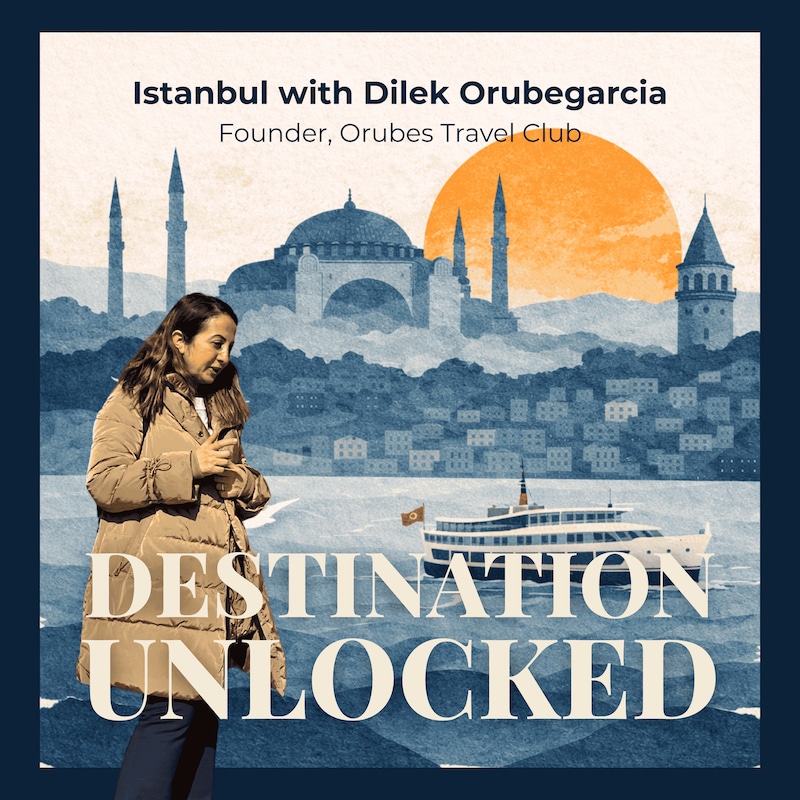
Get ready to unlock the vibrant and bustling city of Istanbul in this episode! We're joined by Dilek Orubegarcia from Orubes Travel Club, who shares insider tips on navigating this historical metropolis that straddles two continents. From must-see landmarks like the Hagia Sophia and the Blue Mosque to the unique culinary delights, Dilek dives into what makes Istanbul a must-visit destination. You'll learn how to avoid common tourist traps—like the crafty shoe-shining scam—and discover hidden gems that only locals know about. Whether you're planning a short visit or a longer stay, we’ve got the essential insights to make your trip unforgettable.
In this engaging conversation, we also touch upon practical tips for navigating Istanbul’s bustling streets and public transport, essential for any traveler looking to explore the city efficiently. Dilek shares the ins and outs of using the Istanbul Card, the city’s public transport pass, and highlights the scenic ferry rides across the Bosphorus as a must-do experience. After all, where else can you traverse continents in just 20 minutes? We also delve into the cultural nuances of Istanbul, including the local customs around tipping and the unique dessert known as Kazandibi—a milky pudding made with chicken that will leave you both curious and delighted! As we wrap up this episode, you’ll be left with a renewed sense of wanderlust and an abundance of practical tips to make your trip to Istanbul unforgettable. Whether you're drawn by the allure of its history, the tantalizing food scene, or the charming neighborhoods, Dilek’s expertise will guide you every step of the way.
Takeaways:
- Istanbul is a bustling city that uniquely straddles two continents, offering a rich cultural experience.
- When visiting Istanbul, don't miss the must-see landmarks like the Blue Mosque and Hagia Sophia.
- Avoid common scams, such as the shoe-shining trick, which can catch tourists off guard.
- Public transportation in Istanbul is efficient, with options like ferries that provide scenic views of the Bosphorus.
- Food lovers should try local delicacies like fish wraps and Kazandibi for a unique culinary experience.
- Exploring the local markets between the Grand Bazaar and Spice Market unveils hidden gems and authentic souvenirs.
Links
Transcripts
Welcome back to Destination Unlocked with me, Daniel Edward.
Daniel Edward:Destination Unlocked is the chatty travel podcast where local guides and
Daniel Edward:top travelers unlock their part of the world for us today, we are visiting
Daniel Edward:a city that straddles two continents and has become a major cruise port
Daniel Edward:for Eastern Mediterranean itineraries.
Daniel Edward:Well, that's certainly how I discovered Istanbul, anyway.
Daniel Edward:Dilek Orubegarcia is one half of the husband and wife team behind Orubes
Daniel Edward:Travel Club, a travel agency and licensed private tour guide company
Daniel Edward:in the historic Eurasian city.
Daniel Edward:In our conversation, she unlocks all the major highlights, gets very excited
Daniel Edward:about warm pita bread, and shares a very common scam for you to avoid.
Daniel Edward:Enjoy.
Daniel Edward:So, Dilek, where are you unlocking for us today?
Dilek Orubegarcia:Istanbul.
Dilek Orubegarcia:A beautiful city where, one side in Asia, one side in Europe
Dilek Orubegarcia:I am in Asian side.
Dilek Orubegarcia:European side is largest, but the city keeps growing bigger and bigger.
Dilek Orubegarcia:They say Istanbul every year needs 700,000 new construction
Dilek Orubegarcia:house or buildings because of the growing population all the time.
Daniel Edward:Wow.
Daniel Edward:And Where's it growing from?
Daniel Edward:Is it the local population, or people are moving to Istanbul from other parts of
Daniel Edward:Turkey or from other parts of the world?
Dilek Orubegarcia:All actually, thousands of students come to study universities
Dilek Orubegarcia:from different part of Turkey.
Dilek Orubegarcia:Most of them stay after university finish.
Dilek Orubegarcia:Lots of Turkish people from different cities, they come to
Dilek Orubegarcia:find a job because commercial, business, everything is in Istanbul.
Dilek Orubegarcia:So young people, everyone, they come to find a job.
Dilek Orubegarcia:Also from the countries around Turkey from other countries.
Dilek Orubegarcia:We have got big numbers of immigrants come to Istanbul to work.
Dilek Orubegarcia:The size of the city and the population of the city, it is bigger
Dilek Orubegarcia:than some countries in Europe.
Daniel Edward:That's so true.
Daniel Edward:And I suppose Turkey is in an ideal position to be an attractive option
Daniel Edward:for people from Central Asia, central Europe, Eastern Europe, Western Europe.
Daniel Edward:It's a great connecting point.
Dilek Orubegarcia:Exactly, yes.
Dilek Orubegarcia:It's an interesting country, we have got borderline with Europe, for example,
Dilek Orubegarcia:from Istanbul, you can drive to Greece in three and a half hours or four hours.
Dilek Orubegarcia:You can drive to Bulgaria in three hours.
Dilek Orubegarcia:Other part of Turkey has got a borderline with Georgia and the
Dilek Orubegarcia:South we have got Iran, Iraq.
Dilek Orubegarcia:It's a really melting pot.
Dilek Orubegarcia:You can find everything in Istanbul.
Daniel Edward:Let's talk about the must see highlights in the city.
Daniel Edward:If you are gonna be staying in Istanbul for, let's say a week, what
Daniel Edward:are the things that you absolutely must have on your itinerary?
Dilek Orubegarcia:I would advise to combine seeing local life, with
Dilek Orubegarcia:the music, food, and, history.
Dilek Orubegarcia:It is good to combine all of them.
Dilek Orubegarcia:All the historical part of Istanbul, they are in Old City.
Dilek Orubegarcia:Like Blue Mosque, Hagia Sofia, Topkapi Palace, underground cistern.
Dilek Orubegarcia:These are all in the same square, walking distance to each other.
Dilek Orubegarcia:And in this square.
Dilek Orubegarcia:It's a congestion charge.
Dilek Orubegarcia:Travel agencies, cars and private cars are not allowed to go pedestrian walking area.
Dilek Orubegarcia:Maybe one day do visits to famous historical monuments.
Dilek Orubegarcia:I would do second day Asian side.
Dilek Orubegarcia:in Asian side, there are several popular places.
Dilek Orubegarcia:Between Asia and Europe, have got public ferries like a bus.
Dilek Orubegarcia:Go to, for example, Kadikoy fish market, see more local life, for example,
Dilek Orubegarcia:foreign guests really enjoy seeing the display of lots of different kinds of
Dilek Orubegarcia:olives, many different kinds of cheese.
Dilek Orubegarcia:They put it outside with lots of color.
Dilek Orubegarcia:It is very beautiful.
Dilek Orubegarcia:On the Bosphorus Asian side, we have got a neighborhood called,
Dilek Orubegarcia:Kuzguncuk, is a beautiful place.
Dilek Orubegarcia:Still you can see old Istanbul.
Dilek Orubegarcia:1950, population of Istanbul used to be 1 million, but now nearly 20 million people.
Dilek Orubegarcia:The way the city looks changed, the construction changed, the materials
Dilek Orubegarcia:they used in the construction changed.
Dilek Orubegarcia:The city doesn't look it used to look.
Dilek Orubegarcia:But in Kuzguncuk, you can still see old Istanbul wooden houses.
Dilek Orubegarcia:And when you walk in nice, beautiful neighborhood, one
Dilek Orubegarcia:side, you can see a synagogue, other side, you can see a church.
Dilek Orubegarcia:Further away, you can see a mosque.
Dilek Orubegarcia:It gives us a idea how many different communities live together in a peace in
Dilek Orubegarcia:this beautiful historical neighborhood.
Dilek Orubegarcia:And the third day, take a stroll on Golden Horn.
Dilek Orubegarcia:Asia and Europe is separated in two parts with Bosphorus.
Dilek Orubegarcia:Bosphorus is a salty water channel, connects the Black Sea to Marmara Sea.
Dilek Orubegarcia:European side is also divided in two parts with another water called Golden
Dilek Orubegarcia:Horn, like a river in the European side.
Dilek Orubegarcia:So Golden Horn is a water, it's like a horn shape.
Dilek Orubegarcia:Around Golden Horn, there are loads of beautiful historical neighborhoods.
Dilek Orubegarcia:For example, Balat Fener, around Greek Orthodox patriarchs Church.
Dilek Orubegarcia:Continuous since Constantinople, you can go and see this church in a beautiful
Dilek Orubegarcia:neighborhood called Fener and Balat with lots of other historical old Istanbul
Dilek Orubegarcia:houses and many different churches and synagogues too around the Golden Horn.
Dilek Orubegarcia:So these are my recommendations in Istanbul.
Dilek Orubegarcia:There are more, of course, every time there are more things to see.
Dilek Orubegarcia:It never finish.
Daniel Edward:Well, it is, it's a massive city, and as you say, it's growing.
Daniel Edward:It's got a hectic charm to it.
Daniel Edward:It's busy, it's frenetic, it's colorful, it's loud.
Daniel Edward:It smells great, especially as you're going through the spice Bazaar.
Daniel Edward:It's an exciting city.
Dilek Orubegarcia:Yes, it's a live city, 24 hours.
Dilek Orubegarcia:Anytime you are hungry in the middle of the night after midnight, there are
Dilek Orubegarcia:places open you can go out and eat.
Dilek Orubegarcia:Istanbul never sleeps and always moving, and always something happening.
Daniel Edward:Let's talk about food.
Daniel Edward:Maybe you wanna start with the midnight snacks, but what is the
Daniel Edward:food that people have to try?
Dilek Orubegarcia:Istanbul it's a place where all the different
Dilek Orubegarcia:people come from different part of Turkey or from other countries.
Dilek Orubegarcia:Also, historically, lots come to Istanbul from different backgrounds too.
Dilek Orubegarcia:So the Food of Istanbul, has got all these combinations.
Dilek Orubegarcia:I cannot say the food of Istanbul, maybe street food, but
Dilek Orubegarcia:we can call it food of Turkey.
Dilek Orubegarcia:Istanbul is maybe like London.
Dilek Orubegarcia:You can find all the international and all different communities,
Dilek Orubegarcia:food from different backgrounds.
Daniel Edward:And so what sort of things might catch your eye?
Dilek Orubegarcia:Fish.
Dilek Orubegarcia:Fishing, with the big nets like industrial fishing is forbidden in
Dilek Orubegarcia:Istanbul in the summertime, we wait for the fish to make lay eggs, and then
Dilek Orubegarcia:the fishing season starts after autumn.
Dilek Orubegarcia:Bosporus has got lots of salt levels.
Dilek Orubegarcia:For example, black Sea is saltier and colder than Marmara sea.
Dilek Orubegarcia:It makes the Bosphorus to have many different varieties of fish.
Dilek Orubegarcia:In different seasons, local people would look, which fish is
Dilek Orubegarcia:available, and we buy a fresh fish.
Dilek Orubegarcia:We have got famous fish wrap in Karakoy near the Galata Bridge.
Dilek Orubegarcia:You can watch the man cooking it, wrap it in the pita bread with lots of pomegranate
Dilek Orubegarcia:molasses, pieces of little pomegranates, and they fried the onions and lots of
Dilek Orubegarcia:herbs , and they heat the pita bread too.
Dilek Orubegarcia:It's so delicious when you eat it warm if the bread is warm too.
Dilek Orubegarcia:Fish wrap, fish wrap.
Dilek Orubegarcia:But, don't confuse with the fish sandwich.
Dilek Orubegarcia:years in Istanbul, uh, they used to sell and eat a fish sandwich.
Dilek Orubegarcia:It's still common, but fish wrap, I like it more.
Dilek Orubegarcia:Galata Bridge separates Eminonu and Karakoy.
Dilek Orubegarcia:One side of the Galata bridge is called Eminonu, other side is called Karakoy.
Dilek Orubegarcia:In Eminonu, they do fish sandwich, also delicious, but usually they
Dilek Orubegarcia:don't heat the bread because it's the big numbers of people.
Dilek Orubegarcia:Millions.
Dilek Orubegarcia:They buy fish sandwich for hundreds of years.
Dilek Orubegarcia:It is fixed in the old guidebooks, they talk about this fish sandwich in Eminonu.
Dilek Orubegarcia:I think that's why it is classic and famous.
Dilek Orubegarcia:It's not a luxurious something nice restaurants, it's little cafeterias
Dilek Orubegarcia:. Also, the spice market, for example, we have got meatball restaurants.
Dilek Orubegarcia:It's not, I mean they have got maybe five seats, but most meatballs in
Dilek Orubegarcia:Istanbul always eaten with bean salads.
Dilek Orubegarcia:It's always together meatball and it bean salads.
Dilek Orubegarcia:like ketchup and mayonnaise always together.
Dilek Orubegarcia:Most of the meatballs, sold in Istanbul would be, frozen.
Dilek Orubegarcia:But in this place where I'm talking about, meat every day is prepared.
Dilek Orubegarcia:If you go late, maybe they will not have more because it's finished,
Dilek Orubegarcia:because it's not frozen and it's more delicious and it's cooked on fire.
Daniel Edward:Nice.
Dilek Orubegarcia:uh, nice, uh, smokey smell.
Dilek Orubegarcia:And they heat the bread also.
Dilek Orubegarcia:We eat lots of bread in Istanbul, Turkey.
Dilek Orubegarcia:I think.
Daniel Edward:What's the name of the Small Meatball
Daniel Edward:Restaurant, do you know the name?
Dilek Orubegarcia:Yes, Kofteci Yasar, kofte means a meatball kofte.
Dilek Orubegarcia:Kofteci means meatball seller.
Dilek Orubegarcia:Ya Yasar is the name of the man.
Dilek Orubegarcia:Y-A-S-A-R, Yasar.
Dilek Orubegarcia:Kofteci Yasar.
Dilek Orubegarcia:And this is the place, actually very difficult to find.
Dilek Orubegarcia:You need to go outside of the spice Market.
Dilek Orubegarcia:Walk in this crowded, chaotic, local market.
Dilek Orubegarcia:It is hidden behind Rustem Pasha mosque and lots of local people work in this
Dilek Orubegarcia:market goes there in the lunchtime.
Dilek Orubegarcia:When I am hungry, I go there.
Daniel Edward:I got so lost coming out of the spice market and then
Daniel Edward:going into the Grand Bazaar area and trying to get out of that area.
Daniel Edward:Oh my gosh, I thought I was there forever.
Dilek Orubegarcia:Yes, it's difficult very chaotic,
Dilek Orubegarcia:crowded local market, actually.
Daniel Edward:It's an exciting adventure sometimes to situate
Daniel Edward:yourself and work out where you are.
Daniel Edward:Let's talk about some of the sweet snacks as well, because I
Daniel Edward:think this is where Turkish food just stands out around the world.
Daniel Edward:You are so good at sweet stuff.
Dilek Orubegarcia:Mm-hmm.
Dilek Orubegarcia:True.
Dilek Orubegarcia:Uh, we eat, . Baklava of course, but sometimes people says, oh, baklava
Dilek Orubegarcia:is so sweet, it burns my throat.
Dilek Orubegarcia:I don't like it.
Dilek Orubegarcia:But, a real good quality baklava would not make you feel this way.
Dilek Orubegarcia:When you take the baklava in your hand, you should smell it first.
Dilek Orubegarcia:It should smell butter and it should have fine layers of flour, fluffy,
Dilek Orubegarcia:and it should not be like a bread.
Dilek Orubegarcia:When you bite it, it should be like croissant.
Dilek Orubegarcia:Lots of little layers of fluffy things with lots of pistachios.
Dilek Orubegarcia:And it should be juicy.
Dilek Orubegarcia:When you bite, the juice would come in your mouth.
Daniel Edward:Delicious.
Daniel Edward:I had to stop at three pieces.
Daniel Edward:After three, it was like, okay, if I do have more, it's not gonna end well.
Daniel Edward:What about Turkish delight?
Daniel Edward:'cause that's something which carries the branding of the country around the world.
Daniel Edward:Everybody has heard of Turkish Delight.
Daniel Edward:Is it a thing in Turkey?
Dilek Orubegarcia:is.
Dilek Orubegarcia:But of course Istanbul now is very modern.
Dilek Orubegarcia:If you look at the young people, lots of Turkish people, as a dessert,
Dilek Orubegarcia:baklava, traditionally, yes, but we eat San Sebastian cake or cheesecakes.
Dilek Orubegarcia:Many Turkish people at home, they have good cakes and milk.
Dilek Orubegarcia:Uh, the sweetss or desserts make with milk.
Dilek Orubegarcia:Turkish delights, yes, it's traditional, but in Istanbul, we,
Dilek Orubegarcia:consume more European desserts.
Dilek Orubegarcia:We have got one dessert you can only try in Turkey.
Dilek Orubegarcia:It is a dessert made with milk and chicken,
Daniel Edward:Milk and chicken
Dilek Orubegarcia:yes,
Daniel Edward:for dessert.
Dilek Orubegarcia:you, it doesn't taste like chicken.
Dilek Orubegarcia:But there is a chicken inside when they make the pudding, milk, flour, sugar,
Dilek Orubegarcia:and that they, in the other cup, they boil the chicken they, uh, grate it.
Dilek Orubegarcia:You make the chicken breast boil and then
Daniel Edward:You pull apart all of the meat.
Daniel Edward:Okay?
Dilek Orubegarcia:be like, uh, strings
Daniel Edward:Okay.
Dilek Orubegarcia:And then you would mix this, you would keep a little
Dilek Orubegarcia:bit in cold water with ice, and then later on you would add it inside the
Dilek Orubegarcia:pudding and stir it all the time.
Dilek Orubegarcia:And then you blend all of them in the machine, put it in a tray
Dilek Orubegarcia:in the oven, to roast it in the bottom, it should be caramelized.
Dilek Orubegarcia:And then when they serve it, they turn upside down.
Dilek Orubegarcia:The caramelized part of the bottom would come on top.
Dilek Orubegarcia:We do food tours and I, most of the times make people eat a chicken breast.
Dilek Orubegarcia:In the end of the tour, say chicken, no, I don't think so, really?
Dilek Orubegarcia:Chicken.
Dilek Orubegarcia:And who thought about this?
Dilek Orubegarcia:Why did they put the chicken inside?
Daniel Edward:Yeah.
Daniel Edward:Did anybody ask the chicken?
Dilek Orubegarcia:Okay, so, but it doesn't taste like chicken, but when you
Dilek Orubegarcia:scoop it out, uh, you can see the texture.
Dilek Orubegarcia:There is a chicken.
Dilek Orubegarcia:It's all blended
Daniel Edward:that shredded and then blended together.
Daniel Edward:Wow, that is interesting.
Daniel Edward:What's the name of that one?
Dilek Orubegarcia:In English, we would say chicken breast or in Turkish
Dilek Orubegarcia:kazandibi, kazandibi is like the bottom of the pot because usually they make
Dilek Orubegarcia:a caramelized and the bottom and turn it upside down when they serve it.
Daniel Edward:I've heard of an apple turnover and upside down puddings,
Daniel Edward:but I've never heard it made with chicken before, so that very exciting.
Daniel Edward:My goodness.
Daniel Edward:To finish off the meal or indeed in the middle of the afternoon, Turkey is
Daniel Edward:well known for its teas and coffees.
Dilek Orubegarcia:Yes.
Dilek Orubegarcia:Turkish people are the third biggest tea consumers in the world, actually.
Dilek Orubegarcia:Coffee came to Istanbul from Ethiopia in 16th century and,
Dilek Orubegarcia:uh, Turkish people loved coffee.
Dilek Orubegarcia:They were drinking, every day in all part of life.
Dilek Orubegarcia:Uh, Ethiopia used to be part of Ottoman Turkish empire, and it came to Yemen.
Dilek Orubegarcia:From Yemen.
Dilek Orubegarcia:It came to Istanbul.
Dilek Orubegarcia:And, when Turkish people conquered Austria, they
Dilek Orubegarcia:introduced to coffee to Europeans.
Dilek Orubegarcia:But after the first World War, coffee became so expensive and Turkish people
Dilek Orubegarcia:could not afford coffee as much as before.
Dilek Orubegarcia:And Turkish politicians, decided actually in the north of Turkey, in the Black
Dilek Orubegarcia:Sea region, we can grow black tea.
Dilek Orubegarcia:Because in the Black Sea region it rains all day, every day, 12 months.
Dilek Orubegarcia:They decided it's a good climate to grow tea.
Dilek Orubegarcia:About 1950s and seventies, they started growing black tea Black Sea region.
Dilek Orubegarcia:Now, most of Turkish people drink black tea actually all day in the
Dilek Orubegarcia:offices, banks, shops, wherever you go.
Dilek Orubegarcia:We don't put milk, and it's not spicy and in a little glass cups.
Daniel Edward:I love those cups.
Daniel Edward:As a design icon that is just, it's so Turkish for me.
Daniel Edward:I see that cup.
Daniel Edward:It takes me straight to Turkey.
Daniel Edward:I wanna quickly touch on transportation and, and how to get around.
Daniel Edward:If you are visiting Istanbul, whether it's for a day or two visiting by
Daniel Edward:cruise ship, or if you're staying in the city, how do you travel?
Dilek Orubegarcia:By public transportation.
Dilek Orubegarcia:We have got a car, but we don't go to city center by car because
Dilek Orubegarcia:difficult to find parking places.
Dilek Orubegarcia:Also, for example, between Asia and Europe, there are
Dilek Orubegarcia:bridges, but very bad traffic.
Dilek Orubegarcia:There is an tunnel under the water between Asia and Europe, but still, uh,
Dilek Orubegarcia:every time if you pass the tunnel it would be expensive, so we have got a
Dilek Orubegarcia:really good public transportation system.
Daniel Edward:So how does it work if you're a tourist?
Daniel Edward:Is there a tourist card or do you pay with your bank card?
Dilek Orubegarcia:You can use Istanbul cards, but bank card is
Dilek Orubegarcia:accepted in public transportation.
Dilek Orubegarcia:Foreign cards of any countries you can use your bank card.
Dilek Orubegarcia:one line.
Dilek Orubegarcia:We have got lots of lines in Metro.
Dilek Orubegarcia:Only one line, the metro under the water between Asia and Europe doesn't
Dilek Orubegarcia:accept Bank cars in this metro line.
Dilek Orubegarcia:So if you need to use this metro under the water between Asia and Europe,
Dilek Orubegarcia:then you can just buy one pass from the ticket booth in the station.
Dilek Orubegarcia:You can take a public ferry too, bank card is accepted on the public
Dilek Orubegarcia:ferries between Asia and Europe
Daniel Edward:The ferry sounds like a really nice way to do it.
Daniel Edward:So where would you pick up the ferry?
Dilek Orubegarcia:Near the Galata Bridge on both sides.
Daniel Edward:It's a really good way to see the Bosphorus
Daniel Edward:as well, a little river tour.
Dilek Orubegarcia:of course, yes.
Dilek Orubegarcia:In the morning for people who goes to work it is really nice to take
Dilek Orubegarcia:a public ferry, uh, because you can buy a sandwich, buy a coffee.
Dilek Orubegarcia:In the summertime.
Dilek Orubegarcia:Nice breeze, people are having breakfast on the ferry before they start to work.
Daniel Edward:That is really nice.
Daniel Edward:I like the sound of the Istanbul card.
Daniel Edward:It sounds just simple.
Daniel Edward:I can do everything on it.
Daniel Edward:Where do you get an Istanbul card?
Dilek Orubegarcia:Every station, every bus stop, and every train stop.
Dilek Orubegarcia:Metro Stop has got a machine.
Dilek Orubegarcia:You can buy Istanbul card and in those machines you can use your
Dilek Orubegarcia:credit card and also cash too.
Daniel Edward:Let's say you've arrived by cruise ship, 'cause I know a lot
Daniel Edward:of people arrive by cruise, maybe their ship stays overnight, they wanna
Daniel Edward:go straight to a particular landmark , let's say maybe it's the Hagia Sofia.
Daniel Edward:They just wanna get a taxi there.
Daniel Edward:They just go straight there.
Daniel Edward:Is that easy to do?
Dilek Orubegarcia:Easy, but Istanbul doesn't have enough taxi.
Dilek Orubegarcia:Even locals find it very hard to find available taxi different applications.
Dilek Orubegarcia:We have gots.
Dilek Orubegarcia:Istanbul municipality has got taxi application.
Dilek Orubegarcia:You can log in and try to find or Uber, Uber on the several other
Dilek Orubegarcia:applications you look, but you cannot find especially if there's a cruise ship.
Daniel Edward:Of course the other way to see a city as big and
Daniel Edward:diverse and interesting as Istanbul is to do it with a guided tour.
Daniel Edward:And that's where you come in.
Daniel Edward:You are a licensed guide in Istanbul.
Daniel Edward:What does that mean?
Dilek Orubegarcia:To be a tourist guide in Istanbul, you need
Dilek Orubegarcia:to get a official license from Ministry of Culture and Tourism.
Dilek Orubegarcia:And to get this license, we study two years.
Dilek Orubegarcia:After that we do educational tour, and then after we finish the tour, we get
Dilek Orubegarcia:an exam about the educational tour, and then we need to pass the language exam.
Daniel Edward:So do you have a specialism that you like to focus on?
Dilek Orubegarcia:I prefer gastronomy also, I like to do historical tour too
Dilek Orubegarcia:because I like doing different things.
Dilek Orubegarcia:I like trying different time, different things.
Dilek Orubegarcia:I like really all of it.
Daniel Edward:If somebody doesn't actually know that much about Turkey or
Daniel Edward:Istanbul; their consciousness of Turkey is that there are some really good
Daniel Edward:beach resorts and some nice weather, but now they want to come to Istanbul.
Daniel Edward:They want to go on a tour because they want to learn a bit more
Daniel Edward:about the history, the culture.
Daniel Edward:Is there an era that really jumps out at you as being very special?
Dilek Orubegarcia:I am most, specialized and experienced in Ottoman time.
Dilek Orubegarcia:I do lots of Topkapi palace tours, which is from 15th century till 19th century.
Dilek Orubegarcia:Topkapi Palace was built by Mehmed the Conqueror, first time in the 15th
Dilek Orubegarcia:century who conquered the Constantinople.
Dilek Orubegarcia:But, till 1856, many different Sultans lived here.
Dilek Orubegarcia:Topkapi Palace is really big.
Dilek Orubegarcia:It was built on top of the Roman Palace, has got lots of
Dilek Orubegarcia:courtyards and buildings around it.
Dilek Orubegarcia:If you wanna see all the details, it can take all your day.
Dilek Orubegarcia:Even 8,000 people live between 5,000 to 8,000.
Dilek Orubegarcia:politicians, parliament members, harem nearly 500 women.
Dilek Orubegarcia:It was a place where they ruled the empire.
Dilek Orubegarcia:There are big kitchens.
Dilek Orubegarcia:They were cooking, industrial cooking, for thousands of people.
Daniel Edward:It sounds less of a palace, more of a village.
Dilek Orubegarcia:like a little town.
Daniel Edward:Wow.
Daniel Edward:Oh yeah, that's, that's gotta be a must see, I can see why that has
Daniel Edward:become such an interest for you.
Daniel Edward:If people want to book a private tour with you, what is the
Daniel Edward:best way that they can do that?
Dilek Orubegarcia:They can go on our website and request a tour or if they
Dilek Orubegarcia:write our name and surname in Google, they can find our phone numbers.
Dilek Orubegarcia:They can just send us a message.
Dilek Orubegarcia:We always get back to people in the same day.
Daniel Edward:So the website is arubestravelclub.com
Daniel Edward:and that's O-R-U-B-E-S travel club.com.
Daniel Edward:And, uh, the website is in English, but also in lots of other languages.
Daniel Edward:We are including Spanish as well, because if people are, are first language Spanish,
Daniel Edward:your husband is a native Spanish speaker.
Dilek Orubegarcia:Yes, my husband is Mexican, he's also a
Dilek Orubegarcia:licensed tour guide in Spanish.
Dilek Orubegarcia:We do tours for many people from Spain, south America, Mexico,
Dilek Orubegarcia:in Spanish, and English mostly.
Daniel Edward:I hope you're enjoying my conversation with Dilek from
Daniel Edward:Arubes Travel Club in Istanbul.
Daniel Edward:Istanbul's, one of those cities where I really think you benefit
Daniel Edward:so much from having a local guide.
Daniel Edward:It's such a busy, chaotic city, and it's so easy to get lost and
Daniel Edward:therefore miss the very best parts because you're spending so much time
Daniel Edward:looking around trying to find it.
Daniel Edward:So people like Dilek and her husband who know the place inside out and know
Daniel Edward:the way around, saves you time and gives you the absolute best experience.
Daniel Edward:Www.arubestravelclub.com is the place to go.
Daniel Edward:Alright, let's get back to our conversation about Istanbul and
Daniel Edward:let's have a little bit of a quiz.
Daniel Edward:Question number one, what strait divides The European and Asian sides of Istanbul
Dilek Orubegarcia:Bosphorus
Daniel Edward:Correct, the Bosphorus.
Daniel Edward:Which iconic landmark was once a church, then a mosque, then a
Daniel Edward:museum, and then a mosque again?
Dilek Orubegarcia:The Hagia Sofia.
Daniel Edward:That is correct.
Daniel Edward:The Hagia Sofia.
Daniel Edward:Which Tower offers 360 degree views of the city?
Dilek Orubegarcia:Galata Tower.
Daniel Edward:Galata Tower.
Daniel Edward:Yes.
Daniel Edward:And would you recommend doing that?
Dilek Orubegarcia:Yes, for sure.
Dilek Orubegarcia:Yes.
Daniel Edward:This is a useful one for people.
Daniel Edward:What is the name of the city's prepaid public transport card?
Dilek Orubegarcia:Istanbul card.
Daniel Edward:That's correct.
Daniel Edward:Istanbul Card.
Daniel Edward:And, we'll go with a true or false as our final question.
Daniel Edward:True or false?
Daniel Edward:Istanbul is Turkey's capital.
Dilek Orubegarcia:Nah, false
Daniel Edward:Indeed it is false.
Daniel Edward:The capital city is
Dilek Orubegarcia:Ankara
Daniel Edward:Ankara.
Daniel Edward:Yes.
Daniel Edward:Is it worth going to an as well?
Daniel Edward:'cause everybody talks about Istanbul.
Dilek Orubegarcia:anca.
Dilek Orubegarcia:Um, yes, of course.
Dilek Orubegarcia:Um, it's a big city like Istanbul with lots of cultures and it is got an
Dilek Orubegarcia:notorious civilization museum that you can see lots of different civilizations,
Dilek Orubegarcia:ruins of all the Asia minor and it has got private museums, city life.
Dilek Orubegarcia:We have got Museum Ataturk, founder of Turkish Republic.
Dilek Orubegarcia:It's also for many local people that they love visiting.
Dilek Orubegarcia:I visited with my kids
Daniel Edward:His picture is up in a lot of place.
Daniel Edward:I remember getting my hair cut and he was watching me from a frame,
Daniel Edward:above where the barber was, I think at the time he was trying to burn my
Daniel Edward:ears off with some sort of flaming ball that he kept throwing at my ear.
Daniel Edward:It was terrifying
Dilek Orubegarcia:Yes, UR you can see his picture on every money, every
Dilek Orubegarcia:school, children's book or every school.
Dilek Orubegarcia:They have got Ataturk statue.
Dilek Orubegarcia:Turkish people love Ataturk and they are very proud of history.
Daniel Edward:founder of a nation.
Daniel Edward:Yeah.
Daniel Edward:I wanna find out a bit more about language and how many people
Daniel Edward:would be able to speak English.
Daniel Edward:If you are visiting Istanbul but you don't know Turkish, are you gonna be okay?
Dilek Orubegarcia:In the city center.
Dilek Orubegarcia:Yes.
Dilek Orubegarcia:And the new generation is speaking better English.
Dilek Orubegarcia:But if you go maybe a little bit more deep inside Istanbul where
Dilek Orubegarcia:the local people lives, less people speak But however, people love trying
Dilek Orubegarcia:to speak English wherever you go.
Dilek Orubegarcia:If they understand you are a tourist, people, even, even you don't need,
Dilek Orubegarcia:they come close and try to speak to you because they wanna speak English.
Dilek Orubegarcia:In Istanbul, sometimes when you walk in the street or if, if you're in the
Dilek Orubegarcia:metro, even sometimes people think I'm a tourist because I walk with the tourists.
Dilek Orubegarcia:They come and approach me, do you need help?
Dilek Orubegarcia:Because they wanna speak English and even they don't speak with good
Dilek Orubegarcia:grammar, they would try to help you.
Daniel Edward:It's a friendly culture.
Daniel Edward:I like that about it.
Daniel Edward:Let's learn a few words that we can then use to engage in the local language too.
Daniel Edward:So, if you wanted to say hello to a local in Turkish, what would you say?
Dilek Orubegarcia:Merhaba
Daniel Edward:Merhaba.
Daniel Edward:Okay.
Daniel Edward:And goodbye.
Dilek Orubegarcia:When we leave, there are two way.
Dilek Orubegarcia:If you're leaving, you would say güle güle.
Dilek Orubegarcia:If the person is leaving, you are behind.
Dilek Orubegarcia:You say Allah'a ismarladik
Daniel Edward:Okay, so it's, we've got two phrases that we need to learn there.
Daniel Edward:How about please?
Dilek Orubegarcia:Lütfen
Daniel Edward:Lütfen.
Daniel Edward:Okay.
Dilek Orubegarcia:You have got a very good pronunciation.
Dilek Orubegarcia:For many foreigners, saying you with tot U is very difficult.
Daniel Edward:I've been practicing.
Daniel Edward:How about, thank you?
Dilek Orubegarcia:Okay.
Dilek Orubegarcia:We have got a, a difficult word for thank you: Teşekkürler.
Daniel Edward:Oh, wow.
Dilek Orubegarcia:Teşekkürler.
Daniel Edward:Teşekkürler.
Dilek Orubegarcia:Yes.
Dilek Orubegarcia:Very good pronunciation.
Dilek Orubegarcia:Bravo.
Daniel Edward:I'm just mimicking.
Daniel Edward:That's the best way to learn.
Dilek Orubegarcia:You've got a good ear.
Daniel Edward:Thank you.
Daniel Edward:How would you say that you are in the Bazaar and you're saying, how much is this
Dilek Orubegarcia:Kaç para
Daniel Edward:Kaç para.
Daniel Edward:And then how do you say no, no, no, no, no.
Daniel Edward:Way lower
Dilek Orubegarcia:İndirim yapar, İndirim.
Dilek Orubegarcia:discount İndirim yapar.
Daniel Edward:That is very useful.
Dilek Orubegarcia:very good
Daniel Edward:where do only locals know?
Daniel Edward:Where's the sort of place that you would really recommend peeling behind
Daniel Edward:the guidebook and saying, no, no, no, they don't tell you about this,
Daniel Edward:but we know this place is good?
Dilek Orubegarcia:Mm, if you like to buy some local things between Grand Bazaar
Dilek Orubegarcia:and Spice Market, there's a local market.
Dilek Orubegarcia:Grand Bazaar is big, has got 29 gates, and one of the gate name is Umut Pazar Gate.
Dilek Orubegarcia:If you come out of this gate, keep walking down.
Dilek Orubegarcia:Finally you would arrive to Spice Market.
Dilek Orubegarcia:Between Grand Bazaar and spice market's a local market that you
Dilek Orubegarcia:can find, clothes, textiles, towels.
Dilek Orubegarcia:The Grand Bazaar mostly you see, handmade, authentic items in spice market spices.
Dilek Orubegarcia:But between Grand Bazaar and Spice Market, you find more clothes like
Dilek Orubegarcia:jackets, jeans, underwears, everything.
Dilek Orubegarcia:Spice market has got also several gates.
Dilek Orubegarcia:you get out to direction of the Rustem Pasha Mosque.
Dilek Orubegarcia:It's also a really beautiful hans, where the first time coffee came, it's
Dilek Orubegarcia:called Beta Han, near the spice market.
Dilek Orubegarcia:It's used to be a place, first time Turkish coffee came to Turkish life
Dilek Orubegarcia:where they roasted the Turkish coffee.
Dilek Orubegarcia:still see where they roasted in a big hole in on the ground.
Dilek Orubegarcia:This is a local place you can, uh, get the Turkish coffee and you can buy
Dilek Orubegarcia:lots of spices, coffees, many different kinds of teas in a historical building.
Dilek Orubegarcia:Also, you can have a local lunch in a local price and
Dilek Orubegarcia:delicious and good quality.
Daniel Edward:Are there good places that locals go to relax,
Daniel Edward:to get away from the crowds?
Dilek Orubegarcia:For the people live in Asian side, we have got Princess Island.
Dilek Orubegarcia:There are ferries every half an hour.
Dilek Orubegarcia:I can arrive to Princess Island in maximum half an hour.
Dilek Orubegarcia:When you take a ferry from the city center near the Galata Bridge, it takes longer.
Dilek Orubegarcia:But we have got a very fast metro.
Dilek Orubegarcia:And as soon as you arrive to Princess Islands, there are five of them.
Dilek Orubegarcia:The Büyük ada, it's very crowded.
Dilek Orubegarcia:But the other four, when you go suddenly you feel you are not in Istanbul.
Dilek Orubegarcia:In half an hour, you feel like you went to a countryside with no
Dilek Orubegarcia:traffic, no noisy, only scooters and electrical cars with a nice nature.
Dilek Orubegarcia:Beautiful trees, summer houses, cafeterias.
Dilek Orubegarcia:I like the Princess Islands.
Dilek Orubegarcia:It's so beautiful.
Dilek Orubegarcia:And the Black Sea, for example, beaches, sandy beaches, you can go
Dilek Orubegarcia:45 minutes you can go to Black Sea.
Dilek Orubegarcia:Big beaches in the summertime.
Daniel Edward:Yeah, that's nice and, and relatively close to the
Daniel Edward:city, which is really convenient.
Daniel Edward:I wanna check on tipping and the customs in restaurants or with drivers and guides.
Daniel Edward:Are people expected to tip?
Daniel Edward:And if they are, how much is the correct amount?
Dilek Orubegarcia:Yes, the people work in tourism.
Dilek Orubegarcia:They expect it.
Dilek Orubegarcia:In nice restaurants, for example.
Dilek Orubegarcia:Tips are included, you should check.
Dilek Orubegarcia:But if it is not a upscale restaurant, if it's a casual place, you can leave
Dilek Orubegarcia:10, 15% or even some little cafeteria.
Dilek Orubegarcia:Very casual.
Dilek Orubegarcia:You can leave the change if nothing, but if you pay a small amount, you can leave.
Dilek Orubegarcia:If you're happy with the service, they would expect.
Daniel Edward:And taxi drivers?
Dilek Orubegarcia:Taxi drivers... I wouldn't stop a random taxi
Dilek Orubegarcia:passing in front of me, always better to use application.
Dilek Orubegarcia:And in the application, sometimes it says, trying to find a
Dilek Orubegarcia:taxi going, you cannot find.
Dilek Orubegarcia:And then later on it tells you at a tip, and then you, at the tip you find one.
Dilek Orubegarcia:Taxi driver, taxi drivers also wants you to leave a tip.
Dilek Orubegarcia:Sometimes when you pay them they say, ah, the post machine doesn't work,
Dilek Orubegarcia:and then you need to pay them cash.
Dilek Orubegarcia:And then they, of course, there's a change, but they are looking at you and
Dilek Orubegarcia:make you understand that leave change.
Daniel Edward:There are, there are unsaid messages there.
Daniel Edward:Yeah.
Daniel Edward:If you're looking to get out of the city for a day trip, where
Daniel Edward:would you say is a really nice day trip from Istanbul to consider?
Dilek Orubegarcia:If it is not really cold in the winter.
Dilek Orubegarcia:Just on the Black Sea area, we have got a town, it's called Şile.
Dilek Orubegarcia:S with tail.
Dilek Orubegarcia:ILE.
Dilek Orubegarcia:Şile is elected third or fourth calming town of Turkey.
Dilek Orubegarcia:It's on the seaside.
Dilek Orubegarcia:Very little town.
Dilek Orubegarcia:Usually people have got summer houses and the beaches, but also it's a nice
Dilek Orubegarcia:little town with the little hotels.
Dilek Orubegarcia:You can just find little interesting cafeterias outside of Istanbul on the
Dilek Orubegarcia:Black Sea, not far away in the Asian side, you drive maybe one and a half hour away.
Dilek Orubegarcia:Another place would be Princess Island again.
Dilek Orubegarcia:I like Princess Island.
Dilek Orubegarcia:There are hotels you can book
Dilek Orubegarcia:. Or for example, if you wanna go another city from Istanbul.
Dilek Orubegarcia:We have got İznik . I-Z-N-I-K.
Dilek Orubegarcia:İznik is a historical place.
Dilek Orubegarcia:First Christian console was held in İznik . It was called Nicaea.
Dilek Orubegarcia:And in the Ottoman time it became famous with the tiles, lots of tiles.
Dilek Orubegarcia:Imperial buildings like Blue Mosque is called Blue Mosque because of the blue
Dilek Orubegarcia:and white tiles provided from İznik.
Dilek Orubegarcia:In The Ottoman time, İznik made the tile for Imperial Buildings.
Dilek Orubegarcia:If you wanna go by flight, one hour flight, you can go to Cappadocia.
Dilek Orubegarcia:Cappadocia is very famous the underground cities.
Dilek Orubegarcia:For many kilometers, you can go and visit all these rock churches carved
Dilek Orubegarcia:into rock and stay in a cave hotel.
Dilek Orubegarcia:All the hotels in Cappadocia, most of them are carved into the rock.
Dilek Orubegarcia:They do balloons.
Dilek Orubegarcia:Very famous.
Dilek Orubegarcia:Everyone goes to Cappadocia, they do balloon.
Dilek Orubegarcia:It's only one hour flight from Istanbul.
Dilek Orubegarcia:You can go today and come back tomorrow.
Daniel Edward:That sounds fantastic.
Daniel Edward:And that is on my list.
Daniel Edward:I wanna see those balloons flying over because I've seen the pictures and
Daniel Edward:they look, it just looks gorgeous.
Daniel Edward:I've got six questions for you all about Istanbul.
Daniel Edward:No right answers all your opinions.
Daniel Edward:So what would you say is the top thing to see or do in Istanbul?
Dilek Orubegarcia:One thing only.
Dilek Orubegarcia:Mm. Seeing Hagia Sofia and Underground cistern.
Dilek Orubegarcia:Can I change my answer?
Daniel Edward:Yeah.
Daniel Edward:Yeah.
Daniel Edward:Yeah.
Dilek Orubegarcia:okay, JI change, this is also historical, but now
Dilek Orubegarcia:I'm thinking you can see historical things everywhere in the world and,
Dilek Orubegarcia:churches are, of course all of them are important in terms of inside themselves.
Dilek Orubegarcia:But for example, in Istanbul doing the Bosphorus being between Asia
Dilek Orubegarcia:and Europe, taking a ferry, crossing the Asian side, in just 20 minutes.
Dilek Orubegarcia:It's something that in the world you don't do every day.
Dilek Orubegarcia:It's very interesting.
Dilek Orubegarcia:I think you take a ferry from Europe past the Asian side.
Daniel Edward:Yeah, you are sailing across continents.
Dilek Orubegarcia:Yes.
Dilek Orubegarcia:It is something more special about Istanbul, I think.
Daniel Edward:What would you say is a tourist trap to avoid in Istanbul?
Dilek Orubegarcia:I have been a guide for 18 years.
Dilek Orubegarcia:It never changed, since when I started working as a guide in 18 years, all the
Dilek Orubegarcia:time I hear from the people in my tour.
Dilek Orubegarcia:Sometimes when you walk outside in touristic places, one shoe shine man walks
Dilek Orubegarcia:in front of you and they drop their brush.
Dilek Orubegarcia:And then you look, you run and get the brush and you say, excuse me, excuse me.
Dilek Orubegarcia:You drop your brush.
Dilek Orubegarcia:And they start saying, thank you very much.
Dilek Orubegarcia:And they start brushing your shoes.
Dilek Orubegarcia:You say, no, no, no, I don't need the brush.
Dilek Orubegarcia:Don't do it.
Dilek Orubegarcia:But they brush it anyway, and then later on they ask money for this.
Dilek Orubegarcia:So if a shoe shiner drops a brush in front of you, don't pick it up.
Dilek Orubegarcia:This is a very common I hear, and people really get upset about this.
Daniel Edward:It's a classic scam, but it, it's so effective.
Daniel Edward:What's your favorite time of year to visit Istanbul?
Dilek Orubegarcia:November.
Dilek Orubegarcia:The most crowded time of Istanbul is September and October.
Dilek Orubegarcia:Lots of people, big numbers of cruise ships come Istanbul
Dilek Orubegarcia:on September and October.
Dilek Orubegarcia:Because, uh, summer is so hot.
Dilek Orubegarcia:Winter is so cold.
Dilek Orubegarcia:People prefer to come in September, October.
Dilek Orubegarcia:April, and May is crowded too.
Dilek Orubegarcia:It's so crowded.
Dilek Orubegarcia:Summer is so hot.
Dilek Orubegarcia:So in my opinion, November, the second week of November, it
Dilek Orubegarcia:is not as cold as cold winter.
Dilek Orubegarcia:December, January, February is really cold.
Dilek Orubegarcia:November still not hot, cold, but start getting colder and less people.
Daniel Edward:That does sound ideal.
Daniel Edward:If somebody's got a trip coming for Istanbul, they wanna read a book or
Daniel Edward:watch a film that's gonna get them in the mood for being in the city, what
Daniel Edward:book or film would you recommend?
Dilek Orubegarcia:Dan Brown's Inferno.
Dilek Orubegarcia:It's a very interesting book that when you start reading it keeps you reading.
Dilek Orubegarcia:You read it , really curious about all the book, finish it, and then it
Dilek Orubegarcia:wants to make you go and see Istanbul.
Dilek Orubegarcia:It's a true story, true historical story.
Dilek Orubegarcia:You see Hagia Sofia inside the book, Hippodrome of Constantinople,
Dilek Orubegarcia:Underground Underground Cistern, and they made a movie about it.
Daniel Edward:Hmm.
Daniel Edward:What would you say is your top food or drink that people just
Daniel Edward:must try when they go to Istanbul?
Dilek Orubegarcia:Chicken breast, which is kazandibi in Turkish.
Dilek Orubegarcia:They should try that: a dessert, which is made with Milky pudding and chicken.
Dilek Orubegarcia:It's very interesting.
Dilek Orubegarcia:They should not go and eat the kebab, in my opinion, first of all, because
Dilek Orubegarcia:kebab, you can eat everywhere in the world, in all Europe, wherever
Dilek Orubegarcia:Turkish people immigrates because, uh, many people think Turkish people
Dilek Orubegarcia:eat kebabs, kebab, kebab, kebab.
Dilek Orubegarcia:But there are many local restaurants.
Dilek Orubegarcia:They cook vegetables, with the meat, homemade food.
Dilek Orubegarcia:What people cook at home.
Dilek Orubegarcia:So I recommend them to eat, for example, Karnıyarık.
Dilek Orubegarcia:Karnıyarık is something eggplant, they fry eggplant, they open the stomach
Dilek Orubegarcia:and put a bolognese sauce inside.
Daniel Edward:That sounds very tasty.
Daniel Edward:Final question.
Daniel Edward:If somebody wants to take home a really authentic local souvenir,
Daniel Edward:not a magnet, not a cap or a mass produced t-shirt, but something
Daniel Edward:that's really locally meaningful, what would you say they should look for?
Dilek Orubegarcia:Turkish towels, for example.
Dilek Orubegarcia:Turkish towels.
Dilek Orubegarcia:Actually Turkey is the heaven of the textiles.
Dilek Orubegarcia:We have got high quality cotton.
Dilek Orubegarcia:Turkish towels, they are very thin, not like a classic towels of the world.
Dilek Orubegarcia:When you fold, it doesn't take too much space in your bag and dries very quickly
Dilek Orubegarcia:and you would put it in your backpack when you go to swimming pool or beaches and you
Dilek Orubegarcia:can get them in every color and in many different designs and very pretty too.
Daniel Edward:Dilek from Arubes Travel Club.
Daniel Edward:Thank you so much for unlocking Istanbul for us.
Dilek Orubegarcia:You're welcome.
Dilek Orubegarcia:I thank you too for inviting me.
Dilek Orubegarcia:I enjoyed it very much.
Daniel Edward:Well, that's all for this episode of the
Daniel Edward:Destination Unlocked Podcast.
Daniel Edward:Thanks again to Dilek Orubegarcia of Orubes Travel Club for unlocking Istanbul
Daniel Edward:for us, and thank you for listening.
Daniel Edward:Before you go, double check that you are following the Destination Unlocked
Daniel Edward:Podcast wherever you're currently listening, so you can easily find
Daniel Edward:your way back for the next journey.
Daniel Edward:I'll see you then.



