Shownotes
Audio • Season 1 • Episode 2 • Series 1 Episode 2 - Three English Bibles. - Shorter listen (Transcript added).
© 20 26 The Rise of the Protestants., Author, Shaughan Holt.
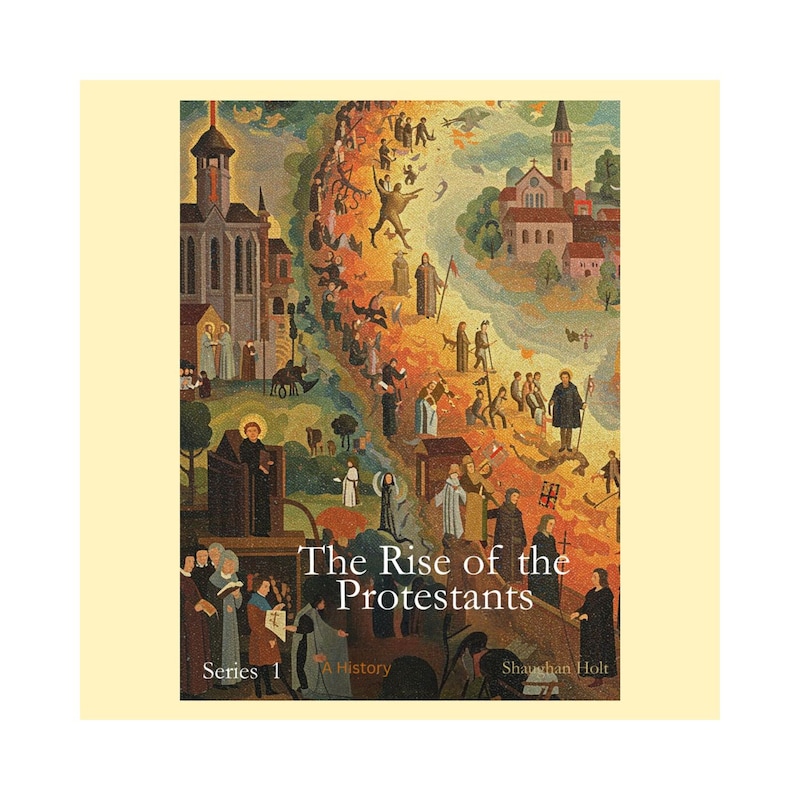
The Artwork is: The cover page of the Coverdale Bible, which was first printed in 1535.
The Music is: Ein feste Burg ist unser Gott, 'A Mighty Fortress Is Our God'; Composer: Martin Luther.
This version of the episode is shorter - for a quicker read.
In this episode, we discuss the life and death of Thomas More, author, statesman, and noted Renaissance humanist. We then focus on Myles Coverdale, an important English Bible translator and reformer.
Working alone, Coverdale carried out his mission independently, successfully creating the first fully printed English Bible, commonly known as The Coverdale Bible.
Our story then leads us to Thomas Cranmer, who was born in Nottinghamshire to a family with connections to the local gentry.
Printed in Antwerp in 1537, the Matthew Bible was an early compilation of English translations of the Bible's books.
The Great Bible of 1539 was the first edition of the Bible in English, authorised by King Henry VIII of England to be read aloud in the church services of England.
Three key English Bibles - the Great Bible published in 1539, the Bishops' Bible in 1568, and the King James Bible in 1611 - were all significantly influenced by Tyndale's biblical translations.
His work profoundly influenced later English translations and played a crucial role in the development and widespread use of the English language.
© 20 26 The Rise of the Protestants., Author, Shaughan Holt.
"All rights reserved. No part of this podcast may be reproduced, translated, distributed, or transmitted in any form or by any means, including photocopying, recording, or other electronic or mechanical methods, without the prior written permission of the copyright holder, except in the case of brief quotations embodied in critical reviews and certain other non-commercial uses permitted by copyright law".
Requests regarding translation, licensing, or republication should be directed to: [email protected]
Your feedback matters, send me an email at [email protected], with any comments, suggestions, or criticisms.I read every message.
Transcripts
© 20 26 The Rise of the Protestants., Author, Shaughan Holt.
"All rights reserved. No part of this podcast may be reproduced, translated, distributed, or transmitted in any form or by any means, including photocopying, recording, or other electronic or mechanical methods, without the prior written permission of the copyright holder, except in the case of brief quotations embodied in critical reviews and certain other non-commercial uses permitted by copyright law".
Requests regarding translation, licensing, or republication should be directed to: [email protected]
Your feedback matters, send me an email at [email protected], with any comments, suggestions, or criticisms.I read every message.
This is a shorter version of the original episode, - for a quicker read!
Series 1.
Episode 2.
Three English Bibles. - shorter listen.
William Tyndale is widely recognised as a groundbreaking English biblical scholar, whose translations played a crucial role in making the Bible accessible to English-speaking audiences.
His work, laid the foundation for three key versions: the Great Bible of 15 39, the Bishops' Bible of 15 68 and the King James Version of 16 11.
His innovative translations, not only rendered the text in everyday English, but also became integral to English religious and literary traditions.
Born in Gloucestershire, William Tyndale, earned a Master of Arts degree from Oxford University in 15 15.
Emerging from the Lollard tradition, a pre-Reformation movement, Tyndale, was inspired by scholars such as John Colet and Erasmus, to become a priest.
Realising, that his beliefs were not aligned with the English Church, he began to publicly criticise the practice of praying to saints, and the belief that only authorised clergy, could interpret Scripture.
As a result, he made the breathtaking decision, to produce an English translation of the Bible.
Between the years 15 10 and 15 20, Martin Luther delivered a series of lectures, focused on key biblical texts, specifically the books of Hebrews, Romans, Galatians, and Psalms.
His insights emphasised Grace, Faith, and Redemption, laying the groundwork for the Protestant Reformation.
Through these teachings, Luther significantly influenced the development of modern Christian thought, advocating for a return to scriptural foundations.
Notably, his interpretation of Romans shaped the concept of Justification by Faith Alone, which became a cornerstone of Protestant theology.
During this period, he reinterpreted the terminology used by the Catholic Church, such as "penance" and "righteousness," concluding that the Church had lost sight of Christianity's central truths.
In Christian theology, Righteousness means being right in the eyes of God, while Justification is the act by which God moves a willing person, from a state of sin to a state of grace.
In 15 28, Bishop Cuthbert Tunstall, commissioned Thomas More, to write, "A Dialogue Concerning Heresies", to refute Lutheran ideas, and challenge, William Tyndale's unauthorised English translation of the New Testament.
Three years later, in 15 31, Tyndale published his rebuttal, titled, "Answer to More".
In this seminal essay, Tyndale outlined six essential themes: The Church, Scripture, Faith, the Papacy, the Fathers, and Sacred Signs.
A remarkable combat now ensued, between Tyndale, who championed Scripture's authority, and More, who defended the authority of the Church, acknowledging, that Tyndale's language, could result in a more decentralised and less sacred church.
Sir Thomas More was born on 7 February 14 78, in London, during a time of significant social and political change.
He was a lawyer, judge, author, statesman, and a prominent figure of the Renaissance humanist movement.
More, consistently opposed the Protestant Reformation, questioning the theologies of Martin Luther, Zwingli, John Calvin, and William Tyndale.
On 16 May 15 32, Thomas More, resigned as Lord High Chancellor, due to his objections to King Henry VIII's assertion of control over the English Catholic Church.
He opposed the king's separation from the Roman Catholic Church, and refused to recognise Henry, as the Church of England's authority, or accept his annulment from Catherine of Aragon.
As a result, More was imprisoned in the Tower of London, for refusing to take an oath, supporting the Act of Supremacy.
Thomas Cromwell visited More several times, urging him to take the oath, but More remained steadfast in his refusal.
Thomas Cromwell was an English statesman and lawyer, born in 14 85 near London.
He played a significant role in the English Reformation, serving as chief minister to King Henry VIII from 15 34 to 15 40.
Despite Cromwell’s heartfelt appeals, Thomas More was found guilty of treason.
The court, sentenced him to the gruesome punishment of being hanged, drawn, and quartered.
However, in an act of clemency, the King commuted his sentence to beheading.
As a result, on 6 July 15 35, Thomas More was executed at Tower Hill.
According to reports, his final words expressed, that, he died as a loyal servant of the King, but placed God above all else.
Following traitor tradition, his head was displayed on London Bridge for a month.
His last wish for a family burial was denied, and he was buried in an unidentified grave at St. Peter ad Vincula church, in the Tower of London.
Thomas More created the word "Utopia" for his famous book, published in 15 16 by his friend Erasmus.
It wasn't until 15 51, 16 years after More's execution, that the book was translated into English.
"Utopia" sparked a new literary genre, inspiring both Utopian and Dystopian fiction, that explores ideal communities, and their flawed alternatives.
In 19 35, Pope Pius XI canonized More as a Catholic martyr.
Meanwhile, William Tyndale was diligently working on his translation of the Old Testament, and published his version of the Pentateuch in 15 30, which includes Genesis, Exodus, Leviticus, Numbers, and Deuteronomy.
The Pentateuch, known as the Torah in Greek, features well-known stories, such as those of Adam and Eve, Jacob, Moses, and the Ten Commandments.
Rome had set the Hierarchy above Faith; the Reformation was now set to restore Faith, to its place, above the Hierarchy.
Thomas Cranmer was born in 14 89 in Nottinghamshire, to a family with strong connections to the local gentry.
He became a significant historical figure, as the first Protestant Archbishop of Canterbury.
He attended Jesus College Cambridge at the age of fourteen, where he studied philosophy and literature, influenced by humanist scholars such as Erasmus.
By 15 15, he completed his Master's degree, and became a fellow at Jesus College, later being ordained, and earning his Doctor of Divinity in 15 26.
In 15 27, while Cranmer was still in Cambridge, Cardinal Wolsey, sought Cranmer's assistance, regarding King Henry VIII's annulment.
In January 15 32, Cranmer was appointed as the resident ambassador, to Charles V, the Holy Roman Emperor.
During this period, his travels took him through Nuremberg, a stronghold of Lutheranism, where, as a catholic cleric, he was able to observe the transformative effects of the Reformation.
In October, he learned that he had been selected to succeed Archbishop William Warham, as Archbishop of Canterbury, a position secured for him, by Anne Boleyn's influential family as Henry pursued her.
Myles Coverdale, born in 14 88 in Yorkshire, was an English Bible translator, reformer, and Bishop of Exeter.
He studied philosophy and theology at Cambridge, earning a bachelor's degree in Canon Law in 15 13.
Ordained as a priest in 15 14, he later joined the Augustinian friars, crossing paths with Thomas Cromwell, whom he would later seek advice from, on his future direction and preaching style.
Coverdale left the Augustinian order, and began preaching in open-air settings, against key doctrines like transubstantiation, the veneration of images, and traditional confession practices.
The risks associated with his outspoken views, likely prompted him to leave England in 15 28, leading to his collaboration with Tyndale.
He found safety in Antwerp, where he worked alongside William Tyndale on the translation of the English Bible.
From 15 28 to 15 35, Coverdale focused on translating biblical texts, while primarily living in Antwerp Belgium.
Although not yet proficient in Hebrew or Greek, he relied on Latin, English and German sources as well as Tyndale's work, to support his research.
On 21 May 15 35, the Antwerp authorities, apprehended John Tyndale, outside his safe house, following a deceptive scheme, orchestrated by the Englishman Henry Phillips.
He was held in prison at Vilvoorde Castle for the remainder of the year.
At the time of his arrest, William Tyndale had translated the Old Testament, only up to, the Book of Chronicles.
Miles Coverdale finished translating the whole Bible into English on 4 October 15 35.
His version included 67 beautiful woodcut illustrations, to help readers understand the text better.
In 15 36, Tyndale was tried and convicted of heresy, leading to a death sentence by burning, despite Thomas Cromwell's plea for mercy.
In early October 15 36, as Tyndale was bound at the stake, he was first strangled, and his lifeless body burned.
After Tyndale was executed, Coverdale took the initiative, to create the first complete printed English Bible, known as the Coverdale Bible.
In 15 34, King Henry VIII faced pressure to authorise an English Bible translation, primarily from the Canterbury Convocation, which petitioned him to acknowledge his headship of the Church of England and request an authorised version.
Influenced by Thomas Cromwell, Henry was already contemplating an official translation, and the Convocation's petition acted as a catalyst for this decision.
The following year, in 15 35, Miles Coverdale presented his English Bible to the king.
This translation was primarily based on William Tyndale's work on the New Testament.
For the Old Testament, Coverdale drew from German translations made by Martin Luther and others.
In the year following Tyndale's death, yet another version of the Bible was published in England.
This edition was called the Matthew Bible, named after its attributed translator, Thomas Matthew.
It was approved by the King and printed in Antwerp in 15 37.
The Matthew Bible was significant because it was one of the first English translations of the Bible put together by an Englishman, John Rogers.
To protect his identity, and hide William Tyndale's contributions to the work, Rogers chose to use the pseudonym, "Thomas Matthew".
In September 15 38, Thomas Cromwell issued an injunction, that required every parish to purchase a copy of the English Bible, and display it prominently in their churches for all to read.
To meet this demand, the Great Bible was commissioned for production.
The French printer, François Regnault, who had supplied all English service books from 15 19 to 15 34, was chosen as the printer due to his superior typography, compared to what was available in England.
Cromwell soon dispatched Miles Coverdale to Paris, to supervise the production of this new Bible.
The Great Bible of 15 39, was the first English Bible, officially sanctioned by King Henry VIII for use during Church of England services.
While it incorporated much of the content from the Tyndale Bible, it removed some of its more objectionable features.
This Bible was dedicated to Henry VIII, who granted it permission for public reading.
The Great Bible, is named for its large size, but is also known by several other names, such as:
The King's Bible, because King Henry VIII of England authorised its use,
The Cromwell Bible, as Thomas Cromwell directed its publication,
The Whitchurch Bible, named after its first English printer, and, the Chained Bible, designed to prevent its theft from the church.
The printing of the Great Bible began in May 15 38.
However, a group of English bishops, along with French theologians from the Sorbonne, sought to put a stop to it, due to its use of the English vernacular.
As a result, the Pope came under pressure, and issued a decree, that halted the operations of the press, and called for the burning of all copies of English vernacular Bibles.
Coverdale was able to save the typeface and some completed sheets, from being confiscated, by relocating them to London, where Grafton and Whitchurch, were able to complete the work.
In an innovative approach, Coverdale arranged the Latin Vulgate text, next to his English translation, in parallel columns on each page, making it easier for readers to compare the two versions directly.
As the decade came to a close, conservative religious leaders, led by Bishop Stephen Gardiner, began to regain their power and influence over the decisions previously made by Thomas Cromwell.
Thomas Cromwell's downfall began, with his arrangement of King Henry VIII marriage, to Anne of Cleves, which ended disastrously, after only six months.
On 10 June 15 40, Cromwell was imprisoned in the Tower of London, on questionable charges of treason and heresy.
To avoid a public trial, his enemies convinced the King, to pass a bill of attainder, which allowed Parliament alone, to sentence him to death.
While imprisoned, Cromwell wrote several heartfelt letters to the King seeking mercy, but his requests were ignored.
On 28 July 15 40, Thomas Cromwell, the King's former chief advisor, was beheaded at Tower Hill at the age of fifty-five, for corruption, heresy, and treason.
On the same day, in an extraordinary turn of events, just nineteen days after the annulment of his marriage to Anne Boleyn, King Henry VIII, aged forty-nine, married his fifth wife, Catherine Howard, who was between fifteen and twenty-one years old.
Standing on the scaffold before his execution, Thomas Cromwell, the Earl of Essex, made the following remarks:
"I have come here to die, not to defend myself”.
“By your law, I have been condemned to die, and I thank my Lord God for appointing me to this fate”.
“I have offended my prince, for which I seek his forgiveness, and I ask you all to pray to God for me".
Likely fortified by alcohol, it is believed that the inexperienced executioner took two or three strokes to behead him.
Henry VIII soon regretted executing Cromwell, blaming his Privy Council, for escalating minor errors into serious, false accusations.
Cromwell had been instrumental in reforming England's religious, political, and social landscape.
Henry quickly realising, how difficult it would be, to find a suitable replacement.
It's important to note that out of the three Bible translators, two faced martyrdom.
John Tyndale was strangled and burned on 6 October 15 36.
John Rogers, the first to be martyred under Queen Mary, was executed on 4 February 15 55.
In contrast, Myles Coverdale escaped execution, likely due to his involvement in later Bible versions.
Three key English Bibles - the Great Bible published in 15 39, the Bishops' Bible in 15 68, and the King James Bible in 16 11 - were all significantly influenced by Tyndale's biblical translations.
Some of Tyndale’s Quotes:
The only way to save your soul, which was the only meaning of being on earth, was to listen to the word of God.
To find God's word, you must understand it in your own language.
The Bible contains the word of God, not rules made by successive Popes over centuries, and turned into a system, which I object to, in almost every particular.
If God spares my life, before long I shall cause a ploughboy, to know scriptures better than you.
Although the Plough boy is illiterate, through education, the Bible could be read aloud directly and understood by everyone.
The Commoners of England must be able to read it for themselves, in plain English.
