Speaker:
00:00:03
Welcome to Summer Speedos from Neighborly, our short in between season
Speaker:
00:00:07
series, while Shannon takes a break from our regular interviews. I'm
Speaker:
00:00:11
Johan, the producer of the show. Some episodes are field notes recorded
Speaker:
00:00:14
outside in ordinary places where care actually happens. Others
Speaker:
00:00:18
are story field notes, more cinematic reflections that start with a story
Speaker:
00:00:22
from history or real life. Either way, we're paying attention to the small,
Speaker:
00:00:26
ordinary ways care, faith, courage and community show up around us.
Speaker:
00:00:30
So grab a cold drink, head out on that bike ride, walk or hike.
Speaker:
00:00:34
Enjoy this year's edition of Summer Speedos From Neighborly.
Speaker:
00:00:41
Hey, everyone, Johan here, back for another field note on the
Speaker:
00:00:44
Summer Speedo series. As we're in between seasons, as we're in between
Speaker:
00:00:48
interviews, just taking a moment to walk around the neighborhoods,
Speaker:
00:00:51
trails and all that stuff, and notice things and people
Speaker:
00:00:55
around me that, you know, teach us how to be better neighbors, how to
Speaker:
00:00:59
be more observant. I'm out on another walk today, actually walking
Speaker:
00:01:03
down a. I don't actually know where I am. I'm walking down a street that
Speaker:
00:01:06
I'm unfamiliar with, which is kind of fun, mostly because I'm running away
Speaker:
00:01:10
from those people that are staring at me as I talk into a microphone.
Speaker:
00:01:14
Anyway, there's a lot of kids in our neighborhood, a lot of
Speaker:
00:01:17
dog walkers and a lot of bicycles.
Speaker:
00:01:21
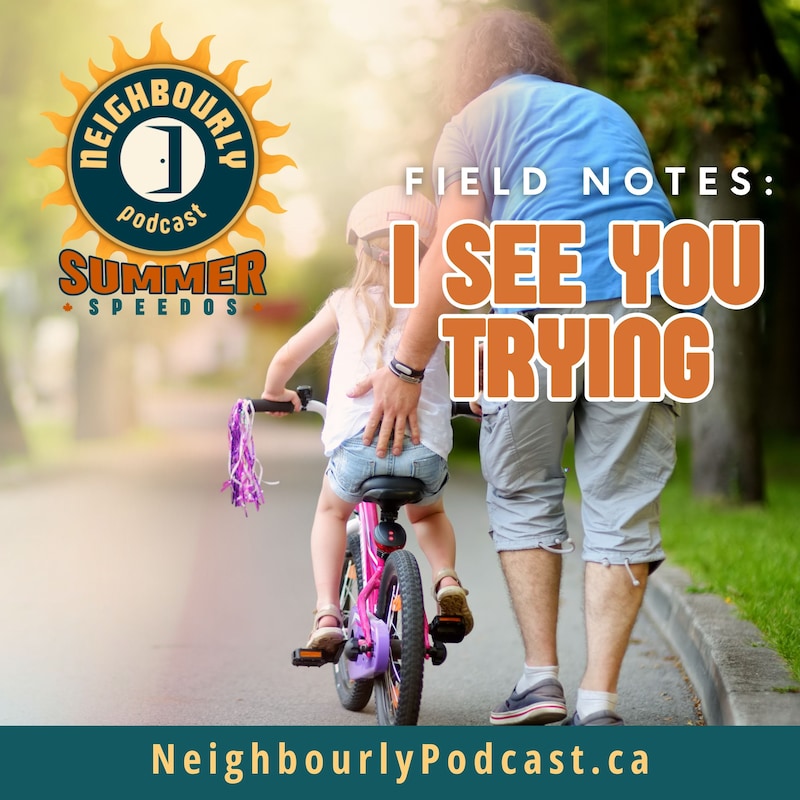
This got me thinking about when my kids were learning to ride their bike. When
Speaker:
00:01:25
I saw a parent teaching the kid to ride a bike, I heard the
Speaker:
00:01:29
words every parent says right before a child either learns to ride a bike
Speaker:
00:01:32
or enters a shrub. You've got it.
Speaker:
00:01:36
You're doing awesome. Well, the bike was
Speaker:
00:01:39
wobbling, the kid was pedaling with the intense focus of
Speaker:
00:01:43
someone defusing a bomb. And the parent was jogging
Speaker:
00:01:47
behind, one hand half raised, ready to help, but
Speaker:
00:01:50
trying very hard not to help too much.
Speaker:
00:01:54
That's the whole tension of teaching someone to ride a bike.
Speaker:
00:01:58
If you hold on forever, they're probably never going to learn. But if you
Speaker:
00:02:01
let go too soon, the sidewalk introduces
Speaker:
00:02:05
itself. Encouragement doesn't remove the risk.
Speaker:
00:02:10
The kid still has to wobble. The parent still has to
Speaker:
00:02:13
let go and chase. The sidewalk remains,
Speaker:
00:02:17
unfortunately, quite committed to being solid.
Speaker:
00:02:21
Unless, of course, you're talking about Winnipeg and their potholes.
Speaker:
00:02:24
But the encouragement matters. Someone is close enough to
Speaker:
00:02:28
help, but not so controlling that the child never learns.
Speaker:
00:02:32
That feels like a picture of care to me. There are times when people need
Speaker:
00:02:36
us to carry them, and there are times when people need us to stand
Speaker:
00:02:39
nearby and help them try. That can be,
Speaker:
00:02:43
well, hard to discern. If we step in too
Speaker:
00:02:47
quickly, we may accidentally communicate. You can't
Speaker:
00:02:51
do this. If we step back too far, we may communicate
Speaker:
00:02:54
you're on your own. Good care often lives in that
Speaker:
00:02:58
awkward middle place, close enough to support,
Speaker:
00:03:02
but far enough to honour growth. I
Speaker:
00:03:06
think about that in parenting, too. Or in friendship,
Speaker:
00:03:09
in leadership. Or in church community. There are
Speaker:
00:03:13
some people around us trying to learn something new. A new rhythm,
Speaker:
00:03:17
a new way of asking for help. Maybe a new way of setting
Speaker:
00:03:21
boundaries. Or a new way of trusting God. After
Speaker:
00:03:24
disappointment, we've all been there. Maybe it's a new way
Speaker:
00:03:27
of belonging after being hurt. And sometimes they don't need a
Speaker:
00:03:31
lecture. In fact, they usually don't need a lecture.
Speaker:
00:03:35
They need someone jogging beside them saying, you've got it. Keep
Speaker:
00:03:38
going. I'm here. That's encouragement,
Speaker:
00:03:43
not empty hype, not pretending everything is easy.
Speaker:
00:03:47
Encouragement helps put courage back into someone.
Speaker:
00:03:51
In courage, there is a reason scripture
Speaker:
00:03:55
tells us to encourage one another. Because people are
Speaker:
00:03:59
people. They get tired, people wobble.
Speaker:
00:04:02
People need courage put back into them. And
Speaker:
00:04:05
sometimes, yes, people need someone nearby
Speaker:
00:04:09
when a shrub or the pavement gets involved. So this
Speaker:
00:04:13
week, think about the people around you who are trying to learn something
Speaker:
00:04:17
hard. Someone taking a step they haven't taken
Speaker:
00:04:20
before, someone trying to rebuild trust,
Speaker:
00:04:24
start again, ask for help, or keep going when they feel
Speaker:
00:04:27
clumsy at it. Maybe the most caring thing you can offer
Speaker:
00:04:31
is not advice. Maybe it's steady encouragement. That
Speaker:
00:04:35
sounds like, I see you trying. I'm
Speaker:
00:04:38
still here. Keep going. Sometimes the bravest thing someone
Speaker:
00:04:42
does all week is keep pedaling. And
Speaker:
00:04:46
sometimes the most neighborly thing we could do is run beside them for a
Speaker:
00:04:49
while. That's the feel note. Keep
Speaker:
00:04:53
noticing.
Speaker:
00:05:04
It.