Shownotes
If you’re ready for real change—not resolutions you abandon in the new year, but a powerful shift in how you live and lead—this episode of Women Road Warriors delivers.
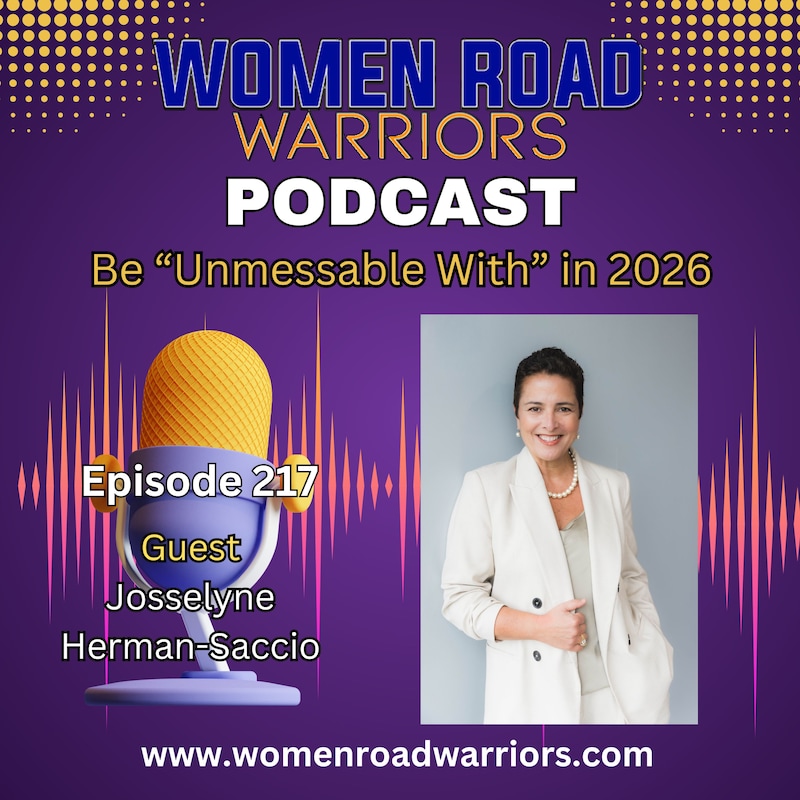
Shelley Johnson and Kathy Tuccaro sit down with Josselyne Herman-Saccio, master transformational coach, TEDx speaker, and creator of Be Unmessable With. With more than 30 years of experience coaching over 200,000 people worldwide, Josselyne reveals how to stop reacting to fear, self-doubt, and outside pressure—and start creating your life with clarity and intention. One problem is that too many people chase dreams that are not theirs, not ones they actually created.
Josselyne explains what it means to become “unhookable” from old stories and other people’s opinions, and how living from vision instead of reaction leads to lasting success. People need to be freed up from their perfection paralysis too. Drawing from her remarkable journey as a former #1 pop star with Boy Krazy, producer, entrepreneur, and founder of United Global Shift, she shares practical mindset tools to help you stay grounded, resilient, and empowered—especially during uncertain times.
This episode is essential listening for anyone ready to continue the new year focused, confident, and truly Unmessable With.
https://womenroadwarriors.com/
https://womenroadwarriors.com/power-network
#BeUnmessableWith #JosselyneHermanSaccio #WomenRoadWarriors #MindsetShift #ShelleyJohnson #KathyTuccaro
Transcripts
This is Women Road warriors with Shelly Johnson and Kathy Tucaro.
Speaker A:From the corporate office to the cab of a truck, they're here to inspire and empower women in all professions.
Speaker A:So gear down, sit back and enjoy.
Speaker B:Welcome.
Speaker B:We're an award winning show dedicated to empowering women in every profession through inspiring stories and expert insights.
Speaker B:No topics off limits.
Speaker B:On our show, we power women on the road to success with expert and celebrity interviews and information you need.
Speaker B:I'm Shelley.
Speaker C:And I'm Kathy.
Speaker B:If you're stepping into the new year, wanting real change, not just resolutions you abandoned by February, but a genuine shift in how you think, action, act and create your life, today's guest is the perfect guide.
Speaker B:She's especially important as it seems today a lot of things have tried to knock many of us off our square.
Speaker B:Jocelyn Herman Sacchio is a master coach in the art of being unmessable with.
Speaker B:She's a transformational expert with more than 30 years of experience coaching over 200,000 people worldwide.
Speaker B:She's also the former lead singer and number one pop star with the group Boy Crazy, film and TV producer, TEDx speaker, celebrity manager, successful entrepreneur and founder of United Global Shift.
Speaker B:She hosts the Be Unmessable with podcast.
Speaker B:And she'll be the first to tell you every dream she's ever had has happened because she lives from creation, not reaction.
Speaker B:Jocelyn teaches people how to stop being hookable by fear, self doubt, old stories and other people's opinions and instead build the muscle of acting from a vision they consciously create.
Speaker B:Kathy and I wanted listeners to learn more about the tools and mindset that will help you become unmessable with in the new year so you can finally create the life you've been dreaming of.
Speaker B:We're excited to have Jocelyn with us.
Speaker B:Welcome Jocelyn.
Speaker B:Thank you for being back on our show.
Speaker D:It's so great to be with you guys and congratulations on all your awards and success.
Speaker D:You've had a bang up year.
Speaker B:Thank you so much.
Speaker D:Thank you.
Speaker B:All we can say is woo hoo, right?
Speaker D:Exactly.
Speaker D:I can say that too.
Speaker B:We love it and we're building momentum and helping a lot of women, which is something we're super passionate about.
Speaker B:And I know you are super passionate about helping a lot of people.
Speaker B:You know, you've been a powerhouse in the methods that you teach.
Speaker B:After shifting away from the limiting beliefs, you accomplished wonders at an early age in many fields.
Speaker B:You even manifested a record deal in just a few weeks with the group Boy Crazy and that ended up going up number one on the charts what with the song that's what love can do.
Speaker D:Yes.
Speaker B:You're amazing.
Speaker B:Could you give us some Cliff Notes on your background before we dive into what people need to have in their arsenal for this year?
Speaker D:Yeah, I mean, I feel like you did the Cliff Notes, but first I started as a producer, then I pursued my dream of being a pop singer because I was kind of in a belief.
Speaker D:And this is one of the things that messes with people.
Speaker D:A limiting belief that you don't know is a limiting belief, because until you see it as a belief, it's the truth.
Speaker D:Right.
Speaker D:So I believed it was true that you couldn't do your art as your career.
Speaker D:And the moment that I saw that as a belief, it opened up a floodgate of actions.
Speaker D:And that was what enabled me to get the record deal with the group Boy Crazy.
Speaker D:And then we went to number one, knocked Whitney Houston out of the number one spot.
Speaker D:She was up there for 14 weeks with I will always love you.
Speaker D:So that was a total dream come true.
Speaker D:Know, traveling the world, I mean, being a pop star is a lot different than you imagine it.
Speaker D:You know, half the girls in the group were riding around in limos but couldn't pay their electricity bill.
Speaker D:So I learned a lot about the music business doing that, which led me to create my entertainment company and had been.
Speaker D:Had been managing the careers of actors and performers for, wow, almost 30 years.
Speaker D:And all the while still coaching people.
Speaker D:So my.
Speaker D:My real love is making a difference with people and empowering them to live their dreams instead of chase them.
Speaker D:So my life has been, you know, a manifestation of living my dreams, whether it was raising money for nonprofits or starting my own nonprofit or traveling, living part time in France and part time in the States and, you know, just really creating a life that is a demonstration of walking my talk, so to speak.
Speaker B:That's amazing.
Speaker B:And, you know, I think a lot of people would love to do that.
Speaker B:They just don't know how instead of chasing their dreams, it feels like they're chasing their tail and they're going around and around and around.
Speaker D:Well said.
Speaker D:Yeah, really, I think I'm going to steal that for a newsletter, you know, stop chasing your tails and your dreams.
Speaker D:But it really is a methodology.
Speaker D:I mean, how I've done it is through what I teach people, which is this be unmessible with system.
Speaker D:And it is completely practicable and developable.
Speaker D:So it's like a muscle.
Speaker D:And it really.
Speaker D:It takes being able to shift out of the world of reaction and reasons and justifications and shift over to the world of Your dreams, your vision, creation, fulfillment, which is a totally different world.
Speaker D:And Most people spend 99% of their day in the world of reaction and getting through life, you know.
Speaker B:Yeah.
Speaker B:What is the world of reaction?
Speaker B:I see one of them is survival mode.
Speaker B:I think a lot of us are in that mode, just kind of hanging on and.
Speaker D:And even if it doesn't feel like you're surviving, because most people, you know, not most people, but a lot of people are very highly functioning.
Speaker D:I mean, they're high performers.
Speaker D:They're producing lots of results.
Speaker D:So sometimes when somebody has all the outside trappings, it doesn't look like they're in survival.
Speaker D:You think of survival like, oh, I'm living paycheck to paycheck or something.
Speaker D:But some of those high performers are the most reactive because they have to be really good at reacting to deal with the breakdowns that come at them, the fires they need to put out, the results they need to produce.
Speaker D:But it's no less reactive than somebody who's living paycheck to paycheck.
Speaker D:It's the same mode.
Speaker D:It just looks prettier.
Speaker B:Yeah, when you get up to the top, that's kind of a small pinnacle.
Speaker B:So you really feel like you have to just keep battling it out to make sure that everything stays the same.
Speaker B:There's a lot more pressure there, too, when you think about it.
Speaker D:It's true.
Speaker D:If you listen to anybody who's, you know, like really famous people like Madonna or Prince or Michael Jackson or, you know, I mean, Marilyn Monroe, you reach the top and you're still not fulfilled.
Speaker D:Then you really know.
Speaker D:It's like a tunnel with no cheese.
Speaker D:And it becomes.
Speaker D:It can become, you know, frustrating and depressing, and some people turn to substances.
Speaker D:I mean, I want to paint this, like, totally bleak picture, but at the same time, that is when people kind of realize it's all kind of a dead end.
Speaker D:That chase that, you know, looking for the next carrot, the next thing and the next accomplishment.
Speaker D:That's not where true fulfillment lives.
Speaker D:And most of those goals are being given to you by external forces like society or your industry or people, you know, you're in competition with or compare yourself to.
Speaker D:So they're not created dreams.
Speaker D:They're inherited dreams.
Speaker D:And that's one of the biggest things that messes with people, is they spend their life chasing dreams that they think they should have, but not that they.
Speaker B:Actually created things that our parents taught us or told us.
Speaker B:And then when you're looking at social media, I think that's an identity hijack isn't it?
Speaker D:It is.
Speaker D:A lot of my clients are like, really frozen around social media.
Speaker D:Like they're afraid to post unless it's perfect.
Speaker D:And, you know, what will people think?
Speaker D:I mean, how.
Speaker D:How long do you look at a post?
Speaker D:I don't look at them that long.
Speaker D:It's like I go, what are you worried about?
Speaker D:You have to really free people up from that perfection paral.
Speaker D:Because people are so afraid of being judged.
Speaker D:But social media is that.
Speaker D:I mean, that's what you're putting yourself there.
Speaker D:You're going to be judged.
Speaker D:I mean, you're judging the people on social media too.
Speaker D:So that's kind of the vehicle for judgment.
Speaker B:Sure it is.
Speaker B:And that's not a good message for teenagers when.
Speaker B:I don't know about you, but puberty, that's a rough time.
Speaker D:Yeah, well, I mean, I am.
Speaker D:I am thankfully through that time, but when my kids were going through it, it's just breaks your heart because, you know, half the stuff that they're suffering over in 10 years is gonna be not even a memory.
Speaker D:But you can't tell them that when they're going through it, because it's very real for them.
Speaker B:Yeah, it really is.
Speaker B:Now I see you have world of reaction.
Speaker B:We need to get away from that.
Speaker B:One of the things is being triggered hooked.
Speaker B:It's an emotional hijack.
Speaker B:That's not something that's productive.
Speaker B:How do we get away from that?
Speaker B:I mean, it seems like today so many things are triggering.
Speaker D:Yeah, it's true.
Speaker D:I mean, you turn on the news and it takes three seconds to get triggered, or you just look at the stock market or, you know, sit down to Thanksgiving dinner with your family.
Speaker D:So it doesn't take much to send you off to the races.
Speaker D:And you know what it looks like when you're in the world of reaction is it's a world of, you know, things are good or bad or right or wrong or shoulds or shouldn'ts.
Speaker D:That's a big thing.
Speaker D:Shoulds and shouldn'ts.
Speaker D:When I'm coaching people and the word should or shouldn't comes out of their mouth, usually it's about other people.
Speaker D:They should be different.
Speaker D:Right.
Speaker D:I know they're gonna suffer if they're in that world of looking at life through the lens of shoulds.
Speaker D:And that's kind of a common theme for being messable with.
Speaker D:So the first thing you need to do is be aware which world you're in.
Speaker D:And that takes consciousness.
Speaker D:And really being someone who's out to find the red flags that you're in.
Speaker D:The world of reaction.
Speaker D:You know, am I justifying something?
Speaker D:Am I giving reasons or explanations?
Speaker D:That's all the world of reaction and survival.
Speaker D:And mostly, especially like when you work with people and you're, let's say you're the boss, people give you reasons and explanations all the time for why things didn't get done.
Speaker D:And so it's, it's kind of hard to train them to function in a different world.
Speaker D:Like the world of word and creation and performance and accountability.
Speaker D:That's a different world.
Speaker D:So I work with people to first identify which world they're in when they're in it, and then create an interruption or a hack so that you can interrupt those brain patterns that are keeping you in that world.
Speaker D:That amygdala hijack that's keeping you in that world of reaction.
Speaker D:Fight, flight, flee.
Speaker D:You know, that whole world is very automatic.
Speaker D:So you have to interrupt it to be able to get to neutral, which lasts for like a nanosecond unless you have created a vision to go to.
Speaker D:Because if you get to neutral, it's like a moment of relief, but then you end up right back in the world of reaction if you don't have a pre created space to go to.
Speaker D:And this is all like, I have a free process called the instant reset on my website that people can download and it'll give them like a cliff note version of this so that they can actually practice it.
Speaker D:It's very simple, but it's powerful.
Speaker A:Stay tuned for more of women road Warri coming up.
Speaker E:Dean Michael, the tax doctor here.
Speaker E:I have one question for you.
Speaker E:Do you want to stop worrying about the irs?
Speaker E:If the answer is yes, then look no further.
Speaker E:I've been around for years.
Speaker E:I've helped countless people across the country and my success rate speaks for itself.
Speaker E:So now you know where to find good, honest help with your tax problems.
Speaker E:What are you waiting for?
Speaker E: -: Speaker B:Industry movement, Trucking moves America Forward is telling the story of the industry.
Speaker B:Our safety champions, the women of trucking, independent contractors, the next generation of truckers and more.
Speaker B:Help us promote the best of our industry.
Speaker B:Share your story and what you love about trucking.
Speaker B:Share images of a moment you're proud of and join us on social media.
Speaker B:Learn more at truckingmovesamerica.com.
Speaker A:Welcome back to Women Road warriors with Shelly Johnson and Kathy Tucaro.
Speaker B:If you're enjoying this informative episode of Women Road Warriors, I wanted to mention Kathy and I explore all kinds of topics that will power you on the road to success.
Speaker B:We feature a lot of expert interviews, plus we feature celebrities and women who've been trailblazers.
Speaker B:Please check out our [email protected] and click on our Episodes page.
Speaker B:We're also available wherever you listen to podcasts on all the major podcast channels like Spotify, Apple, YouTube, Amazon, Music, Audible, you name it.
Speaker B:Check us out and bookmark our podcast.
Speaker B:Also, don't forget to follow us on social media.
Speaker B:We're on Twitter, Facebook, Instagram, Pinterest, LinkedIn, YouTube and other sites and tell others about us.
Speaker B:We want to help as many women as possible.
Speaker B:Here's a question that stops many people in their tracks.
Speaker B:Are you building the life you want or the life you've been talked into?
Speaker B:Our guest is Jocelyn Herman Sacchio, master transformational coach, TEDx speaker, and master coach and creator of the Be Unmessable with program.
Speaker B:She's spent more than 30 years coaching over 200,000 people worldwide and she says one of the biggest reasons people stay stuck is they're chasing dreams that aren't actually theirs.
Speaker B:They also live in a world of shoulds what you should or should not do that they need to get out of.
Speaker B:That takes conscious effort to switch the mindset we're diving into how to stop being hookable by fear, self doubt, old stories and other people's opinions and how to get un messable with especially when the world feels loud and a lot of things are trying to knock you off your square.
Speaker B:Jocelyn teaches how to live from creation instead of reaction.
Speaker B:So you're creating with clarity and intention, not running on outside pressure.
Speaker B:She brings practical mindset tools that you can use right now.
Speaker B:Kathy, you had some thoughts about what Jocelyn's doing.
Speaker C:So it's basically really tuning into yourself like that self awareness and watching yourself how you act or react or how you function or how you think and stop it.
Speaker C:Like at work we have this thing where they give us this card to stop and think.
Speaker C:Like when you're not feeling something or something's not right, you just stop and you think.
Speaker C:So it's basically like I had to do that.
Speaker C:I come from a very traumatic background, very negative and very toxic.
Speaker C:So by the age of 40 I was a complete mess and so I had to unlearn everything and then stop and then relearn and then I had to really be self aware so that I could change those thought patterns about myself, about how I view the world and what is, what it is that I'm looking for or what it, what it is that I want.
Speaker C:Like you said, create.
Speaker C:And it, it, it doesn't happen overnight.
Speaker C:It takes constant, constant practice of basically watching yourself, how you respond and how you think.
Speaker C:I had to change my patterns.
Speaker C:Like you say, just like create a break.
Speaker C:Wait a minute, Kathy, stop it.
Speaker C:Just stop for a minute and then go along a different line.
Speaker D:So, yeah, and the only thing I tweak about what you're saying is not so much like change the way you think.
Speaker D:It's really changed the world from which you're thinking from, because change comes from that world of reaction.
Speaker D:You're reacting to something that's unpleasant, so now you're going to change something.
Speaker D:You're going to do something different or better or so that's still reacting to whatever it is reacting to how you're reacting.
Speaker D:So this is one of the biggest pitfalls people fall into is somebody around them reacts to that, to something, and then they react to their reaction.
Speaker D:So now you're both in the world of reaction and you're, you know, forget it.
Speaker D:There's no way back from that.
Speaker D:So.
Speaker D:Well, that's life, right?
Speaker D:So it's really shifting the, and, and physically it's shifting the part of your brain from which you are thinking.
Speaker D:You have to shift from that amygdala, which is that survival kind of place.
Speaker D:Even the good results that get produced from there, it's still from that survival mode.
Speaker D:And it's like a dopamine hit.
Speaker D:When you produce a result from that space, it feels good for a second, like a hit, you know, like you're, you're taking a hit of cocaine, which, you know, I haven't done, I've never done, I imagine, you know, but in like decades.
Speaker D:Right.
Speaker D:And it's time to put that.
Speaker D:You get addicted to it, you know.
Speaker D:So if you shift from the amygdala to the prefrontal cortex, which is where creative and rational thought comes from, you're thinking from a different space, not changing your thoughts from within the same space.
Speaker B:Most people don't live in their prefrontal cortex today.
Speaker D:No, I don't.
Speaker D:I mean, if you track it, you can track it with all these wearables now, you'll see how much time you spend in that other space, which is very normal and ordinary.
Speaker D:But it's not, it's not inevitable.
Speaker D:You can train yourself to interrupt those brain patterns and shift where you're thinking from.
Speaker B:And you know, it's interesting, social media has it down to a science to tickle our amygdala.
Speaker B:You know, they don't want us really thinking from a world of creation.
Speaker B:They want us in reactionary mode to keep us hooked.
Speaker D:Yeah, it's true.
Speaker D:And you know, and a lot of like chatgpt and all these things, it's taking you out of having to actually use your brain.
Speaker D:And I mean, I love ChatGPT and AI and all of that, but at some point it weakens the.
Speaker D:It's like a muscle.
Speaker D:If you don't use it, it's not going to get stronger.
Speaker D:So, you know, all these little kind of trim tabs that people are using, like social media scrolling and the attention span and all that stuff weakens the muscle of your ability to create because you're not required to.
Speaker B:It's kind of interesting the way the human body works.
Speaker B:If you don't use it, you lose it.
Speaker D:Exactly.
Speaker D:It's very pretty much the same thing.
Speaker D:It's right there.
Speaker D:Exactly.
Speaker D:You get it.
Speaker B:So how do we put ourselves in the world of creation?
Speaker B:Because when we're born into this world and we're children, children have such vivid imaginations.
Speaker B:I mean, they really are creators.
Speaker B:And then they kind of migrate away from that.
Speaker D:Well, if you think about it just logically, from a linguistic perspective, a language perspective, as children get older, they get sort of.
Speaker D:They inherit more and more shoulds, goods, bads, rights, wrongs.
Speaker D:I mean, you know, when you're little, there's none of that.
Speaker D:You're just being, you know, you're free.
Speaker D:And then life starts telling you, oh, don't do that, that's bad, or you shouldn't do this or you should do that, or.
Speaker D:And now your cell gets smaller and smaller.
Speaker D:So the good news is that most of those constraints are constituted in language, which is malleable.
Speaker D:Now it doesn't seem like it's constituted in language because you lived in it for so long.
Speaker D:It seems like there are real bars on the, you know, the cell.
Speaker D:But like I said earlier about the limiting beliefs, you know, you can't do your art as your career.
Speaker D:That was as solid as a block of brick to me until it wasn't.
Speaker D:Until I saw that it was something I said when I was 5 to myself and then just got stuck with it.
Speaker D:So many of these things that mess with us are things like limiting beliefs, shoulds, shouldn'ts, which live in language and are accessible and malleable.
Speaker D:So if you can alter the kind of language you're using, you can alter the way your brain is working and you can alter the actions and results that you're taking and getting.
Speaker B:That makes sense.
Speaker B:Well, it's kind of like when we make a mistake, we'll say to ourselves, oh, that was stupid.
Speaker B:Exactly.
Speaker B:That's a limiting statement, isn't it?
Speaker D:Well, I mean, first of all, it's a descriptive statement.
Speaker D:It's not a created statement.
Speaker D:If you could create anything, you wouldn't create, oh, that was stupid.
Speaker D:I mean, that's an assessment.
Speaker D:So that in itself is something that would be said from the world of reaction.
Speaker D:It's reacting to something.
Speaker D:Creation comes from no thing, from nothing.
Speaker D:So the work that I do with people has them be able to get to nothing, which is a not an easy feat because we're constantly dealing with something in life.
Speaker D:You know, whether it's a thought or a feeling or a circumstance or a person, you know, we're constantly reacting to what life is throwing at us.
Speaker D:So to be able to get to nothing and you don't have to go to the top of the mountain and meditate for 10 years to do this.
Speaker D:This is, you know, why these instant reset tools and all the courses and methodology that I use with people is designed to get them to nothing so they can create anything.
Speaker D:Because you can only create from nothing.
Speaker B:That's true when you think about it.
Speaker D:Yeah.
Speaker D:Just think of a painter.
Speaker D:You're not going to create on top of something.
Speaker D:You're going to create from a blank canvas, from nothing.
Speaker A:Stay tuned for more of Women Road warriors coming up.
Speaker E:Dean Michael, the tax doctor here.
Speaker E:I have one question for you.
Speaker E:Do you want to stop worrying about the irs?
Speaker E:If the answer is yes, then look no further.
Speaker E:I've been around for years, I've helped countless people across the country, and my success rate speaks for itself.
Speaker E:So now you know where to find good, honest help with your tax problems.
Speaker E:What are you waiting for?
Speaker E: -: Speaker A:Welcome back to Women Road warriors with Shelly Johnson and Kathy Tucaro.
Speaker B:If it feels like life's been testing your nerves, news cycles, relationships, work pressure, expectations, all of that, this conversation is your reset.
Speaker B:We're talking with Jocelyn Herman Sacchio, the creator of Be Unmessable with.
Speaker B:Jocelyn is a master transformational coach and TEDx speaker with three decades of experience coaching over 200,000 people around the world.
Speaker B:She helps people stop reacting to fear and self doubt and refuse to let outside pressure run the show.
Speaker B:And she doesn't just teach this.
Speaker B:She's lived transformation on a massive scale.
Speaker B:She's the former lead singer and number one pop star with the group Boy Crazy.
Speaker B:She's also been a film and TV producer, celebrity manager, entrepreneur, and founder of United Global Shift.
Speaker B:She also hosts the Be Unmessable with podcast.
Speaker B:Jocelyn teaches how to build your inner muscle to stay grounded and resilient so you can create your life on purpose, even in uncertain times.
Speaker B:It's a matter of getting to nothing.
Speaker B:So you can create anything you create from your own blank canvas.
Speaker B:Jocelyn, do you run into people who have no idea what their blank canvas.
Speaker D:Is all the time?
Speaker D:I mean, you know, and that's what I do with people, is I get them to get to nothing.
Speaker D:And it takes.
Speaker D:Sometimes it takes, you know, less time than others.
Speaker D:With people, it depends on how much is incomplete from their past.
Speaker D:Because, you know, people walk around with a lot of things that are resented, regretted, incomplete.
Speaker D:I'll call it from the past.
Speaker D:Even good things, you know, like, they're still kind of resting on their laurels, so to speak.
Speaker D:You know, like, okay, so you guys got these awards.
Speaker D:It would be very easy to be talking about those awards for a really long time and not be standing in what's the next space you want to create?
Speaker D:You know, because it's like a cool thing that you got those awards, but even though good results end up clogging up the space.
Speaker B:Yeah.
Speaker B:Sometimes people kind of stagnate, don't they?
Speaker D:Yeah, they.
Speaker D:Well, or I call it, they just stop creating.
Speaker D:And it happens in relationships.
Speaker D:You know, you could be in a.
Speaker D:You know.
Speaker D:You know when you first meet somebody and it's like that first three months is just so exciting, and they can do no wrong.
Speaker D:And you're all exhilarated.
Speaker D:Yeah.
Speaker D:That's because you're creating the relationship.
Speaker D:There's nothing there.
Speaker D:But the minute you stop creating.
Speaker D:And I've been married, you know, 30 years with my husband.
Speaker D:In fact, we just celebrated our 30th anniversary, and we're together 31 and a half.
Speaker B:Congratulations.
Speaker D:Thank you.
Speaker C:That's huge.
Speaker D:Five fights.
Speaker D:It is.
Speaker D:For most people who had five fights this morning, we had five fights in the last 31 and a half years.
Speaker D:Because we use this methodology, we continually create our relationship.
Speaker D:And when we stop creating our relationship, then we're reacting to one another, and that's when those Fights have happened.
Speaker B:That happened a lot during the pandemic and the shutdowns.
Speaker B:People said, I don't like this person I'm married to.
Speaker D:That's.
Speaker D:I can imagine.
Speaker D:Yes.
Speaker D:It's like, oh, you.
Speaker D:It was okay when I didn't have to see you all the time.
Speaker D:Right.
Speaker B:They weren't really proactive when they got together.
Speaker B:And like you said, they stopped creating, which makes sense.
Speaker B:I mean, they kind of stagnated.
Speaker B:They just started taking each other for granted and maybe were more irritated by the way the other person brushed his or her teeth.
Speaker D:Well, yeah, if you're not creating, all you have is reacting.
Speaker D:And there's no little bit pregnant here.
Speaker D:You're either in the world of creation or the world of reaction at any moment of the day, period.
Speaker D:So if you think about it, and creation takes something, it's not there by default.
Speaker D:Reaction is there by default.
Speaker D:You don't have to do anything to react.
Speaker D:You will react automatically unless you interrupt it.
Speaker D:And that's, you know, basically what I teach people to do.
Speaker B:That means thinking actively.
Speaker B:I think people, they become Autobots, don't they?
Speaker D:I mean, we just rehab and it's not.
Speaker D:And you know, listen, haven't you driven in a car and like all of a sudden you kind of like realize you're 20 miles down the road and you don't even remember what happened in the last 20 miles.
Speaker D:I mean, you're automatic 90% of the time.
Speaker D:Right.
Speaker D:It's like, oh, did I blow through 10 speed?
Speaker D:You know, lights.
Speaker D:I don't even know.
Speaker D:Because you.
Speaker D:And that's how you go through life.
Speaker D:You go to Costco, you deal with the kids, you know, okay, what's happening, you know, who's dealing with who's coming over for dinner next week.
Speaker D:And, you know, it's just all just kind of.
Speaker D:It's there to be repeated, but not created.
Speaker D:And it's a different mode.
Speaker B:Maybe that's why life seems like it flies by so much faster as adults, because we do that.
Speaker B:We're not.
Speaker D:Could be.
Speaker C:Yeah.
Speaker B:We're not in the moment.
Speaker D:Yeah.
Speaker D:Although when you're in the moment, there is no time.
Speaker D:So it's almost like it doesn't feel fast or slow.
Speaker D:It's just being here now is a very precious thing.
Speaker D:I mean, you know, that's why they call it the present.
Speaker D:Right.
Speaker D:But it's.
Speaker D:It is precious and underused.
Speaker D:Under accessed, I'll call it.
Speaker D:Oh, especially most of your day is spent thinking about what happened or what's going to happen.
Speaker B:Sure.
Speaker B:Either worrying or Ruminating or doing whatever you're doing.
Speaker D:Yeah.
Speaker D:And then you see this and then.
Speaker B:You'Ve had people on their phones, they're not even interacting with each other.
Speaker B:So that's not watching the different generations.
Speaker B:I do scratch my head.
Speaker B:It's like, how's all of this going to shake out in the future?
Speaker D:Yeah, it's pretty funny.
Speaker D:I mean, we went out to dinner recently, my husband and I, and the couple at the table next to us were both on their phones.
Speaker D:It was a fancy restaurant too, and they're both on their phones, not even talking to each other.
Speaker D:I said, what on earth?
Speaker D:I mean, I could stay home and do that.
Speaker D:I don't need to come and, you know, spend money at a restaurant to sit and, you know, look at my phone.
Speaker D:It just, it's funny.
Speaker C:It's.
Speaker D:I mean, maybe it's because I'm of a certain age, but to me that seems so odd.
Speaker B:I see that a lot.
Speaker B:I see that with a lot of different age groups and I just think people are missing out.
Speaker B:It's like, talk to each other, come on.
Speaker B:You know, this is precious.
Speaker D:Well, you know, the attention span thing is a real thing.
Speaker D:People are training their brains through social media and other things, but definitely social media to not really have an attention span for more than like four seconds.
Speaker B:Yep.
Speaker D:You know, that's how they measure your reels on Instagram is if somebody has watched it for three seconds or more, that's a successful reel.
Speaker D:That's insane.
Speaker B:Yes.
Speaker D:So imagine you're sitting there with your partner and you have to have an attention span of two hours.
Speaker B:That's not going to happen.
Speaker D:Yeah, it's an atrophied muscle.
Speaker D:You're, you're like, you're trying to do sit ups with the, you know, a stomach that was just cut open or something.
Speaker B:Yeah, yeah.
Speaker B:Basically, rabbits will have more of an intention spam than any.
Speaker D:Exactly, exactly.
Speaker D:It's, it's really, it's actually pretty detrimental.
Speaker D:I mean, I don't want to be all doom and gloom, but it is pretty detrimental because I spend time on social media and you know, and I know my husband spends more time than I do on social media and, you know, I can see him just sitting there just scrolling and scrolling.
Speaker D:I'm like, wow, like, what just happened in the last, you know, 40 minutes in your life?
Speaker D:Nothing.
Speaker B:That's right.
Speaker D:You know, but he learns things.
Speaker D:He learns like how to, you know, boil pasta without it, you know, going over or his jiu jitsu moves or whatever.
Speaker D:I mean, he definitely learns things But a lot of it is just kind of, you know, it's, it's fine.
Speaker D:If you're going to do it for 20 minutes as a, as an escape, do it.
Speaker D:You know, we all need a little recharge time but don't expect it to be anything that's going to build muscle of your brain, you know.
Speaker A:Stay tuned for more of Women Road warriors coming up.
Speaker B:Industry movement Trucking Moves America Forward is telling the story of the industry.
Speaker B:Our safety champions, the women of trucking, independent contractors, the next generation of truckers and more help us promote the best of our industry.
Speaker B:Share your story and what you love about trucking.
Speaker B:Share images of a moment you're proud of and join us on social media.
Speaker B:Learn more at truckingmovesamerica.com.
Speaker A:Welcome back to Women Rob.
Speaker A:Welcome to Road warriors with Shelly Johnson and Kathy Tucaro.
Speaker B:Let's name a sneaky thing that steals dreams.
Speaker B:Perfection, paralysis.
Speaker B:When you overthink, wait for the right moment, try to get it flawless and life passes.
Speaker B:While you're preparing, our guest is Jocelyn Hermansaccio, master transformational coach, TEDx speaker and creator of Be Unmessable With.
Speaker B:With over 30 years of experience and 200,000 people coached worldwide, she teaches how to stop being hookable by fear, self doubt and other people's opinions and become unhookable from those old stories.
Speaker B:Jocelyn says every dream she's ever had has happened because she lives from creation, not reaction.
Speaker B:And her own life proves it.
Speaker B:From being the number one pop star with boy crazy, to producer and entrepreneur, to founding United Global Shift and hosting the Be Unmessible with podcast.
Speaker B:In this next segment, she's sharing practical mindset tools to help you stay clear, grounded and empowered so you can stop reacting and start creating a life that's actually yours.
Speaker B:Jocelyn.
Speaker B:So a world of creation, that's where we want to be.
Speaker B:What are some of the elements I'm seeing acting from a self declared vision that you have listed?
Speaker B:I'm sure people still want to get a real concept because some people will say but I'm not creative.
Speaker D:Yeah, but it's not like that kind of creative.
Speaker D:It's more like being able to bring something into existence.
Speaker D:And at first it's in language, bring something into existence.
Speaker D:So everybody has the ability to do that.
Speaker D:But the world of creation is like a spatial phenomenon, it's a contextual phenomenon.
Speaker D:So it's not like a goal where you have a goal to double your income or start a business or something.
Speaker D:Those are goals.
Speaker D:That's fine.
Speaker D:You need goals in Life.
Speaker D:But the context is sort of what gives you the goals you have.
Speaker D:So if somebody said to me, well, my vision is to start a new business, I would then ask them a few questions to get them into the world of vision.
Speaker D:Because vision is not a tangible goal, it's more experiential.
Speaker D:So I'd say something like, you know, well, okay, let's say you started the new business.
Speaker D:Then what would be available to you as an experience that isn't available now?
Speaker D:And it takes a few questions, but usually they'll get to something like freedom or joy or self expression or something that's not measurable, which is where the context lives.
Speaker D:And that becomes the space that you want to function from.
Speaker D:You want to create your actions from the space of self expression or freedom or fulfillment or whatever you create.
Speaker D:Because it becomes like a lens that you're going to look at the circumstances in your life through and the projects that you're working on and the people that you're interacting with to measure what you're interacting with through that lens so that you can make sure that it's aligned with your vision.
Speaker D:Because most people don't even ask that question, they just kind of do.
Speaker D:You know, they're like a leaf in the wind.
Speaker D:Stuff happens and they go that way and other stuff happens, they go the other way.
Speaker D:And it's like a constant state of reacting.
Speaker B:Sure it is.
Speaker B:Well, and I think a lot of people, we're so used to reacting and a lot of people, they'll either shrink back and not want to engage or they'll be paralyzed when they're encountering outside things that create the emotional hijack.
Speaker B:And it sounds like world of creation keeps them on their square, they have a place to go.
Speaker D:Yes.
Speaker D:It's like, you know, if you had two roads and the first road was reaction and it's sort of paved and has like McDonald's and Starbucks and gas stations.
Speaker D:It's much easier to go down that road.
Speaker D:The world of creation, that road is like not really paved.
Speaker D:It's got branches in the way and you know, so unless you know it's there, you're not going to go down it.
Speaker D:You'll go down the paved road because it's just easier.
Speaker D:So you have to create that road or that vision, that pre created vision so that you have another road to go down.
Speaker D:And even though it takes more effort in the beginning, the more you go down the road and clear off the branches, the clearer it becomes and the easier it is to go down that, you know, So I Don't know if that analogy kind of captures it, but it's close.
Speaker B:Yeah.
Speaker B:This I would think would give a very good foundation for people who may be wanting to put together resolutions which a lot of people do that in good faith.
Speaker B:And then they're like, eh, end of February, they're like, yeah, I guess I can just ditch that, you know.
Speaker D:Yeah, end of February, end of January.
Speaker D:Exactly.
Speaker D:Or the end of New Year's Eve.
Speaker D:How about that?
Speaker D:Yeah.
Speaker D:Well that's one of the reasons why I created this program called the Word Bootcamp which is going to become my signature program right now I have something called the foundation for, for being unmessable with which is like a pre recorded five week course.
Speaker B:You also started a Word boot camp that began on January 14th where people can interact with you live to develop the muscle of their word.
Speaker B:What's the purpose of the workshop and why are you doing it?
Speaker D:Because ultimately even high performers, they might be good at keeping their word to other people.
Speaker D:Like if you just look for yourself, if, if you told each other you were gonna meet each other at a certain time, you'd pretty much be there.
Speaker D:But like commitments to yourself you pretty much sell out on easily, you know, like oh yeah.
Speaker D:And those resolutions, a lot of them are promises that you make to yourself.
Speaker D:So that's why they're, they're so like low percentage of keeping them because you, you think to yourself, well, nobody's gonna know if I don't go to the gym at 7, if I go at 7:30, if I do 60 sit ups instead of 70, who's gonna know?
Speaker D:Well, you know, and the problem is every time you say X and do Y, you end up losing self trust.
Speaker D:And then when you go to create things in your business or your life, like doubling your revenue or trust in your marriage, you can't trust your own word.
Speaker D:And your word is what creates those kind of goals.
Speaker D:Whether they're, you know, doing sit ups or creating intimacy in your marriage, it's the same paintbrush.
Speaker D:So I'm gonna do this five week program for people called Word boot Camp so that they can develop that kind of muscle.
Speaker B:That's excellent.
Speaker B:Well, you know, when you think about it, if you can't trust your own word, you can't trust yourself.
Speaker B:So that's really, that's undermining everything that you are.
Speaker B:And yeah, why would you.
Speaker B:If you don't keep your own word, you're not going to talk to people who don't keep theirs.
Speaker B:You're not going to like yourself.
Speaker D:Exactly.
Speaker D:I Mean, if you had a business, if you guys kept breaking your word to each other, you'd probably not be partners anymore, you know, but you break your word to yourself all the time and, and what do you expect?
Speaker B:It's.
Speaker D:Do you know that only 9 to 12% of people keep their New Year's resolutions?
Speaker B:Wow, that's it.
Speaker D:That's really low.
Speaker D:Yeah.
Speaker B:Yeah, it is.
Speaker B:I didn't realize it was that low.
Speaker D:I know.
Speaker D:I, I was like shocked when I, I saw that.
Speaker D:It's from discoverhappyhabits.com has that statistic.
Speaker D:It's unbelievable to me that.
Speaker D:But think about it for your own self, like how many times, if you really tracked it in a week, how many times you said something to yourself or even put it in your calendar and then blew it off, you'd see it's a lot more.
Speaker B:We all do it.
Speaker B:Yep.
Speaker D:Yeah.
Speaker B:We have the best of intentions.
Speaker B:I find that I'm more accountable to myself when I have a list and then I cross it off.
Speaker B:And if I give myself some flexibility on when I have to things that don't have to be done today, you give yourself a kind of a window.
Speaker B:But I go through that list every day and if I don't have something I'm crossing off, then I feel guilty.
Speaker D:Well, I mean, that's also reaction.
Speaker D:So I don't love that.
Speaker D:Because you don't want guilt to be the motivator.
Speaker D:It's more, you know, that's a, that's like a, another reason or justification to do something or not do something.
Speaker D:So when you develop the ability to say X and do X no matter what that X is, then you don't have to rely on guilt or shame or even motivation because you don't need that.
Speaker D:That stuff is moods.
Speaker D:You can't really.
Speaker D:You know, moods are fleeting.
Speaker D:If you can count on your word, then if you say it, it happens because you've built that muscle and you don't have to worry about how you.
Speaker B:Feel about becomes automatic, doesn't it?
Speaker D:Yeah, yeah, it does.
Speaker D:Just like if you were a right handed person and you all of a sudden were trying to write with your left hand, after a while it would become automatic and you'd.
Speaker D:Your left hand.
Speaker B:True.
Speaker B:Well, I'm a southpaw and I know that in there you go growing up.
Speaker D:Me too.
Speaker C:Yeah.
Speaker B:Awesome.
Speaker B:Yeah.
Speaker B:I remember everybody was always stealing the left handed scissors because there really are such a thing.
Speaker D:Yeah.
Speaker B:I got disgusted.
Speaker B:It's like, okay, I'm just going to start cutting things with my right hand.
Speaker B:And that's all I use now.
Speaker B:You know, I can do both.
Speaker B:But, you know, that was out of necessity.
Speaker D:But.
Speaker D:But that's a perfect.
Speaker D:There you go.
Speaker D:So, you know, that's a perfect example.
Speaker D:It's like when you can develop a new muscle and have it become automatic, which, by the way, I believe that this muscle of creation and word is your natural state and that we unlearn it, so to speak, through society and school and how people interact in life with the shoulds and shoulds and goods.
Speaker D:And we learn to be forced into the world of reaction, but in a very natural state.
Speaker D:It's.
Speaker D:It's kind of like.
Speaker D:I mean, I'm not a. I'm not a super religious person, but if you take this quote.
Speaker D:But in the beginning there was nothing and the word.
Speaker D:I mean, that's pretty close, as close as you can get to creation.
Speaker B:That's true.
Speaker D:So, you know.
Speaker B:Yeah.
Speaker B:When you think about it, we are reacting all the time.
Speaker B:Fear.
Speaker B:And it's.
Speaker B:I think it's harder today because with the social media and the media, they play on fear, you know, danger, danger.
Speaker B:News at 6, news at 11.
Speaker B:And people just get sucked into that.
Speaker B:And I think it's just gotten worse and worse.
Speaker B:Yeah.
Speaker B:So it's harder for us to come from the world of creation.
Speaker B:I think that's something you have to consciously practice, isn't it?
Speaker D:Yeah.
Speaker D:And you have to get committed to it, first of all, and then you have to take the actions.
Speaker D:And that's why I created all the stuff that I'm creating, because I want people to have access to a world that they are not in that constant state of reaction that they can actually create and fulfill what they really want, not just what they want by default, you know, because it sounds like that's what you're supposed to want.
Speaker B:This is very valuable because it seems like the past couple of years people are just fighting with each other.
Speaker B:You know, people have differences of opinion in families.
Speaker B:They don't want to talk to each other anymore, or there's having food fights at the holidays.
Speaker B:I mean, it's just crazy.
Speaker D:It really is.
Speaker D:You know, a lot of my clients are like, I'm.
Speaker D:I'm not going to invite these people from my family.
Speaker D:And I'm like, that is such a shame.
Speaker D:You don't need to.
Speaker D:You don't need to do that.
Speaker D:You don't need to adapt.
Speaker D:You can actually have the ability to, with, no matter who you're with, be able to create and fulfill and have joy and camaraderie and Whatever it is you're creating, it doesn't matter who the person is, what their beliefs are, because we keep relating to each other as if who we are is our beliefs or who we are is our opinion.
Speaker D:And if somebody has a different opinion or belief than us, then, oh, then, you know, I disagree with it.
Speaker D:It's absurd.
Speaker D:They're all made up anyway.
Speaker D:How many times have you changed beliefs over the years?
Speaker D:I mean, there was a time where you believed in Santa Claus, you know, and I hope I didn't blow it for you, but now you probably don't.
Speaker D:And so it's like, I know, did I?
Speaker D:Maybe the tooth fairy?
Speaker D:How about that?
Speaker D:But until you become the tooth fairy or the.
Speaker D:Or Santa Claus, you don't realize.
Speaker B:Right?
Speaker D:And so people are not who they think they are, and people and other people are not who you relate to them as.
Speaker D:That's the point.
Speaker D:You know, we get stuck relating to ourselves as a story from the past and to others.
Speaker D:So then they get stuck in a box, and you have no space to be any other way.
Speaker D:Like, there's always, you know, in a family, there's the.
Speaker D:There's the kooky uncle, right?
Speaker D:So the kooky uncle, you can't see when he's brilliant because you got the story called kooky uncle, and that becomes the lens or the context through which you're viewing everything he says and does.
Speaker D:So he has no shot.
Speaker B:Yes.
Speaker B:The credibility's gone.
Speaker B:People, you know, people are myopic and, yeah, they get stuck in.
Speaker B:In these stereotypes.
Speaker B:And that happens in families.
Speaker B:You know, if you were kind of a whiny little kid, they look at you as a whiny adult, even if you're not, you know.
Speaker D:Yeah, exactly, exactly.
Speaker D:And, you know, there's people who are CEOs of, you know, multi billion dollar companies, and then they, you know, they're handling things all week long at work, and then they go home to their family dinner and they're like, give me more mashed potatoes.
Speaker D:You always pass it to him first in.
Speaker D:And they turn into that child or the youngest or the naggy one, because that's the story that they have to live into.
Speaker D:And you can only show up inside of the narrative that you're allowed to show up inside of.
Speaker B:So it's changing the narrative in our heads, getting back to our true selves.
Speaker D:Yeah, exactly.
Speaker B: How do we do that going in: Speaker B:Jocelyn, do you have some quick pointers?
Speaker B:And obviously, people need to check you out to stay on track and really.
Speaker D:Get that momentum I would definitely do that.
Speaker D:Free instant reset practice that.
Speaker D:That's a. I have so many free things on my website.
Speaker D:I mean, you can listen to the Be Unmessible with podcast and get, you know, twice a week we release episodes so you can get tips and tricks and social media.
Speaker D:I have little reels constantly, every day.
Speaker D:And they're all designed to give you freedom to create and freedom from that world of reaction.
Speaker D:And for sure, go to wordbootcamp.com and join me in this one.
Speaker D:This is the only time I'm doing it in person, live or on Zoom Live.
Speaker D:So if anybody wants to do that so that you have the biggest shot of having an unmessable with year rather than another year of reaching the end of it and going, what happened?
Speaker B:Yeah, I think a lot of people have.
Speaker B: are saying, what happened in: Speaker B:What happened to me?
Speaker B:You feel like Dorothy and Oz, don't you?
Speaker D:There's no place like home.
Speaker D:But the problem is nobody knows where home is, you know, and it really is.
Speaker D:Your vision is home.
Speaker D:So there is no place like home.
Speaker D:You just have to create that vision to have a home to go to.
Speaker B:When you think about it, Dorothy had the power all along.
Speaker B:She just didn't know it.
Speaker B:And she had those ruby red slippers and all she had to do was click them at any given time and she could have been exactly where she wanted to be.
Speaker D:Yeah, yeah, exactly.
Speaker B:Of course everybody else, like the Wicked Witch, wanted her slippers.
Speaker D:Well, yeah, they think it's the slippers, but it's not the slippers.
Speaker D:It's your mouth.
Speaker D:It's.
Speaker D:It's your word.
Speaker D:That's, that's your listen.
Speaker D:In ancient Aramaic, abracadabra literally means, with my word, I create.
Speaker D:I love that you want magic in your life.
Speaker D:You got to develop your word.
Speaker D:That's just the way it goes.
Speaker B:Keep your word, keep your promises.
Speaker B:So how do people develop their own word?
Speaker B:Is that part of the process basically when they're in the state of creation?
Speaker D:Well, part of it is creating the vision, but then taking actions consistent with that vision.
Speaker D:So it's a, you know, it's not a one time deal.
Speaker D:It's like, it's like, you know, you go to lift a weight, you're not going to just do it once.
Speaker D:You've got to be consistent.
Speaker D:You got to have a discipline about it.
Speaker D:So I always, I mean, I have three coaches.
Speaker D:I always recommend getting a coach to develop you in something that you're committed to developing and that you're not good at whether it's tennis or, you know, money or nutrition or working out or, you know, or your word.
Speaker D:So it's, it's important to have people that are accountable to other people because in the beginning, your word is weak when it comes to just making your word to yourself.
Speaker D:So that's why I designed the Word Bootcamp.
Speaker D:Because all my clients, they're high powered people and they were keeping their word to other people, but over and over again, they'd break their word to themselves.
Speaker D:It's absurd.
Speaker D:I was like, what are you doing?
Speaker D:Why are you messing around with your word?
Speaker D:Stop negotiating with your own word.
Speaker D:And it was rampant.
Speaker D:So developing the ability to, when you say X, do it, period, use your calendar.
Speaker D:I mean, I have a whole calendar workshop that use.
Speaker D:That enables you to use your calendar as like the canvas for your life.
Speaker D:So if you want your word to be your wand, you have to be able to trust your word and trust yourself, as you so aptly said.
Speaker D:So if you say, I'm going to take the garbage out at 7, do it at 7.
Speaker D:Not 7.
Speaker D:O1.
Speaker D:If you say you're going to do a hundred, do a hundred sit ups, not 99, you know, if you say you're going to do 30 minutes on the treadmill, don't do 28.
Speaker D:You know, it's just do what you say, period.
Speaker D:Just for two weeks and see what happens.
Speaker D:Sense.
Speaker B:Stop bargaining with ourselves.
Speaker D:Yes, exactly.
Speaker B:Because we're good at that.
Speaker B:Oh, especially what, taking out the garbage?
Speaker B:Who wants to do that?
Speaker D:Yeah, and you'll come up with a good reason or justification.
Speaker D:It's like you wake up, I was going to go to the gym this morning, but I'm tired.
Speaker D:I didn't really get a good night's sleep.
Speaker D:I'm just going to hit snooze.
Speaker D:I mean, how many times have we said that to ourselves?
Speaker D:And you give a reason or a justification rather than, okay, I said X.
Speaker D:And I'm going to treat my word like my life depends on it, because it does.
Speaker D:In reality, the quality of your life does depend on it, but we just convince ourselves that it's no big deal.
Speaker B:We really do.
Speaker B:Where do people find you?
Speaker D:Jocelyn beunmessablewith.com so that's the best way to find all the freebies and everything.
Speaker D:So all that's there.
Speaker D:If you want to just go right to Word Bootcamp, just go to wordbootcamp.com I made it really easy.
Speaker B:And people can hear your podcast.
Speaker B:And you work one on one with people too, don't you?
Speaker D:I do very limitedly.
Speaker D:I have a waiting list right now for one on one.
Speaker D:But you know, if somebody books a discovery call with me, I'll find something for them even if it's not one on one.
Speaker D:You know, I have group programs and I have entrepreneur mastery programs and I have ways to support people even if it's not an ongoing one on one coaching engagement, which I'm kind of full up on right now.
Speaker B:You are powerful.
Speaker B:I love your insight.
Speaker B: e exactly what people need in: Speaker C:You're amazing, actually.
Speaker D:Yeah, I love being with you guys because we have a similar goal, which is to empower people.
Speaker D:And it's always good to be with people like you that are really walking the talk and out there demonstrating what you say you're about, but demonstrating it in reality.
Speaker D:So I appreciate the invitation.
Speaker D:I will come back anytime you want.
Speaker B:Thank you, Jocelyn.
Speaker B:That's a wonderful compliment.
Speaker B:We really appreciate that.
Speaker D:Yeah, thank you.
Speaker B:This has been a terrific conversation.
Speaker D:Absolutely a pleasure.
Speaker B:We hope you've enjoyed this latest episode.
Speaker B:And if you want to hear more episodes of Women Road warriors or learn more about our show, be sure to check out womenroadwarriors.com and please follow us on social media.
Speaker B:And don't forget to subscribe to our podcast on our website.
Speaker B:We also have a selection of podcasts Just for Women.
Speaker B:They're a series of podcasts from different podcasters.
Speaker B:So if you're in the mood for women's podcasts, just click the Power network tab on womenroadwarriors.com youm'll have a variety of shows to listen to anytime you want to.
Speaker B:Podcasts Made for Women Women Road warriors is on all the major podcast channels like Apple, Spotify, Amazon, Audible, YouTube and others.
Speaker B:Check us out and please follow us wherever you listen to podcasts.
Speaker B:Thanks for listening.
Speaker A:You've been listening to Women Road warriors with Shelly Johnson and Kathy Tucaro.
Speaker A:If you want to be a guest on the show or have women topic or feedback, email [email protected].




