Shownotes
Eric Ries
Bio
Over the last two decades, Eric Ries’s ideas about continuous innovation, long-term thinking, governance, and market reform have reshaped company building and management practices. He is the creator of the Lean Startup method, and the author of the New York Times bestseller The Lean Startup; The Leader’s Guide; and The Startup Way.
As a founder, he has put his own ideas into practice with The Long-Term Stock Exchange (LTSE); Answer.AI, an AI R&D lab; the Lean Startup Co, which teaches and supports the implementation of Lean Startup; Virgil, a legal services startup; and IMVU, where the ideas that became the Lean Startup method were forged. On his podcast, The Eric Ries Show, he talks to guests including world-class technologists, thought leaders, and executives working to build profitable companies for the long-term benefit of society. Eric has served as an entrepreneur-in-residence at Harvard Business School and IDEO. He lives in the San Francisco Bay Area with his wife and three children.
Summary
Eric Ries, the esteemed author of "The Lean Startup," expounds upon the paramount significance of mission-driven enterprises as a formidable competitive advantage. He elucidates that a compelling mission not only attracts talent and early adopters but also fundamentally underpins a startup's worthiness of investment. Throughout this discourse, we explore the notion that traditional metrics for measuring profitability may be fundamentally flawed, prompting a reevaluation of what constitutes true profit. Ries posits that profit should be reconceptualized as the maximization of human flourishing, rather than mere financial gain. This episode serves as a clarion call for founders to assert their influence in the startup ecosystem, emphasizing the necessity of maintaining a steadfast commitment to their mission amidst the challenges of growth and external pressures.
Conversation
The dialogue with Eric Ries, a luminary in the realm of entrepreneurship, unfolds profound insights regarding the intrinsic value of mission-driven startups. We delve into the notion that a company's mission is not merely an ancillary aspect of its operations but rather a formidable competitive advantage. Ries asserts that a compelling mission attracts not only talent but also customers who are willing to invest their faith in the nascent enterprise. This foundational discussion is pivotal as we explore how purpose-driven organizations consistently outperform their counterparts across various metrics. Ries elucidates that the essence of a startup's journey is often obscured by conventional profit-focused metrics, and he challenges us to reconsider our definitions of success and profit. Through empirical data and case studies, we are encouraged to understand that the real profit lies in fostering human flourishing rather than merely maximizing financial gain. The episode ultimately serves as a clarion call for founders to embrace their power and leverage their missions to resist external pressures that threaten to dilute their vision.
Takeaways
- Eric Ries asserts that a startup's mission serves as a vital competitive weapon, attracting talent and customers alike.
- The concept of 'pivot' was popularized by Eric Ries, providing essential vocabulary for entrepreneurs navigating uncertainty.
- Data overwhelmingly indicates that purpose-driven companies consistently outperform their peers across various crucial metrics.
- Ries emphasizes that true profit should be redefined as maximizing human flourishing rather than merely extracting revenue.
- Founders possess more influence than they often realize, enabling them to resist detrimental forces within the startup ecosystem.
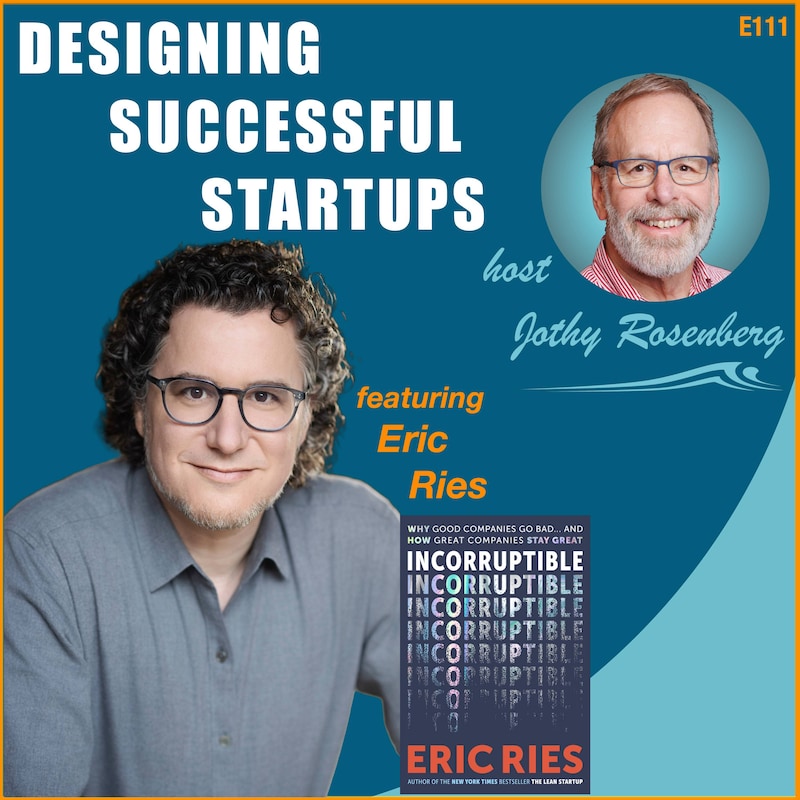
- In his new book 'Incorruptible', Ries argues for a paradigm shift in how we define and measure profit in business.
- Who Says You Can't Startup | Full Bundle | Incorrigible Entrepreneur - The online course for startup founders
- Jothy's TEDx talk - On why those with disabilities tend to overachieve
- Our YouTube channel
- Designing Successful Startups — Jothy Rosenberg | Author | Speaker | Podcaster - Site with all podcasts
- Tech Startup Toolkit book
- Please leave us a review
Transcripts
Please meet today's guest, Eric Ries.
Eric Ries:The mission is what makes a startup worth investing in in the first place. The mission is what attracts talent to join it in the first place.
The mission is what makes customers take that leap of faith to become early adopters.
Jothy Rosenberg:What if I told you that one of the most overused words in the startup world, pivot, didn't even exist before my guest today invented it. Eric Ries wrote The Lean Startup, which fundamentally changed how we build companies. He also gave us MVP. He gave us pivot.
He gave us a vocabulary that let us finally talk about what great founders actually do.
Jothy Rosenberg:He's back with a new book called.
Jothy Rosenberg:Incorruptible, and he's asking a question that might make some investors uncomfortable. What if we've been measuring profit wrong this entire time?
In this episode, Eric and I dig into why Mission isn't just a nice to have, it's a competitive weapon. Why the data overwhelmingly shows that purpose driven companies outperform.
And why he believes founders have far more leverage than they realize to resist the forces that surgically debone promising startups. This is episode 111. It's a good one. Let's get into it.
Jothy Rosenberg:Hello, Eric, and welcome to the podcast.
Eric Ries:Hey, thanks for having me on.
Jothy Rosenberg:I am thrilled to have you on. You're actually like the biggest celebrity I've had on my podcast. And by the way, you're episode number 111.
Eric Ries:Like Bilbo's 111th birthday in Lord of the Rings. Yeah, I like it.
Jothy Rosenberg:I'm going to ask you for context for everybody listening, where are you originally from and where do you live now?
Eric Ries:Oh, yeah, I grew up in. In sunny San Diego, California, and I'm up in the Bay Area now.
Jothy Rosenberg:Yeah. So it's not. Not quite as sunny all the time.
Eric Ries:You know, I'm one of the few people who lives here who feels like the weather is only. Okay. I'm insufficable about it. They definitely don't want to hear my opinion.
Jothy Rosenberg:Well, we spent 10 years living in Santa Cruz.
Eric Ries:Oh, lovely, lovely.
Jothy Rosenberg:And we loved it there. And. And we were just enough up into the hills that the marine layer was almost always below us.
So we weren't like, if you're down in Aptos, which is like the worst fog along the whole coast there, you just don't see the sun very much.
Eric Ries:Right, that's true.
Jothy Rosenberg:So far, you're probably best known for a book you wrote a few years back called the Lean Startup. And I think of it as both the title of your book but also the way a startup should be meaning lean.
Eric Ries:Yeah.
Jothy Rosenberg:And it's healthy to be really lean.
Eric Ries:Totally.
Jothy Rosenberg:But tell us what the foundational concepts of the Lean startup were.
Eric Ries:Sure, yeah, yeah. It's one of these things that's actually very simple to explain and quite difficult to do.
The idea is simply to apply the scientific method to entrepreneurship. So, you know, it's called Lean Startup because it borrows a lot of ideas from lean manufacturing and other domains.
But the core insight is that when you write a business plan, what you're doing is making a series of assumptions or hypotheses about the future.
And rather than just assume that those things are true, you know, like we were some kind of psychic or astrologer who can predict the future instead of, we admit to ourselves that we don't know which of them are true and which ones are not, and we want to go find out as quickly as possible. But we don't do it in the style of, you know, academic research that can take years because we can't afford. We don't have the time for that.
Entrepreneurship is about opportunities that exist in the present and requires speed.
So the idea is to break a business plan down into a series of what we call leap of faith assumptions, and then to rigorously test each of those assumptions with what we call a minimum viable product, an inexpensive, quick experiment that can help us learn whether the assumption is true or false and as quickly as possible to pivot to a new idea. And the pivot is a change in strategy without a change in vision. That whole cycle is called the Build, Measure, Learn, Feedback loop.
Jothy Rosenberg:There's another book that written by Dan Olson that also has Lean Startup in the title. Are you guys friends?
Eric Ries:Sure.
Jothy Rosenberg:Yeah.
Eric Ries:There's. There's so many people who have built.
One of my favorite things about Lean Startup is that there's a whole universe of people who have built their career on applying lead startup in different domains. So I really, I.
When I conceived the idea, when it started to become a movement, I didn't want it to be like Eric's personal domain cult of personality around me. Like, I didn't want it to be my thing. I wanted it really to be our thing. That was a big tent that a lot of people could participate in.
And I wanted people could build their career on it. I wanted consultants to feel like they could embrace it. I didn't want people to feel like they had to create their own separate terminology.
We wanted to use ours and to license it liberally. So it's been really awesome to See, so many different people build. There's. Yeah, there's so many spinoff books that have lean in the title.
Lean Product, Lean Enterprise, Lean Design, Lean ux, you name it. Some of those books, you know, I helped get published, but a lot of them I didn't, and I think that's great.
So, yeah, a lot of people have made a lot of money off Lean Startup, but the net effect of all those positive externalities is that we make the world a better place. I, I feel really good about it.
Jothy Rosenberg:Yeah, I, I agree. You just used the word pivot. And, and everyone uses the word pivot.
You, you actually invented the term in, in, in your book as, as well as mvp Minimum Viable Product. You. Those are two terms you just used, and you invented the both.
But I want to ask you if you remember what, what we call that thing before you started, you know, converting everybody over to use the word pivot.
Eric Ries:It was a big problem. It was actually very difficult to describe. And I'll tell you a funny story. A group of like, kind of senior statesmen of Silicon Valley approached me.
This is many years ago now. There's. I don't want to get into the details. A prominent startup lawyer had passed away. He had worked on many important Silicon Valley deals.
And he had been working on a memoir at the time of. The time of his passing.
And it was involved a lot of individual stories of, you know, basically essays, reflections on the different deals that he had worked on. And he was trying to explain entrepreneurship, you know, to a lay audience. He wanted.
It was kind of like, you know, my, my life and career and what I've learned. But, you know, this was written before Lean Startup, so he didn't have the word pivot. And the stories are remarkable. Like, I'm, They're.
I was, I was thrilled. They asked me to basically read the manuscript and give some advice on getting the book published.
And I was, I felt so honored to get to read it because, first of all, he had a lot of. He had an inside seat at many really famous deals.
But what was wild about the stories is how convoluted they were because he's trying to teach this concept.
He's like, you know, these great founders I've had a chance to work with, they do this amazing thing where they're super stubborn and they never give up. But on the other hand, they're very flexible, you know, because the initial idea turns out to be wrong.
And, you know, they realize that, like, you know, remember when Google was going to be monetized with the search boxes, the enterprise yellow search boxes they were going to sell, you know, but pre advertising, like Google's original business plan is unrecognizable from what it became, but the core vision of it remained anyway.
So he's having a really hard time describing this and he, since he has to do it for company after company after company, each company, he's trying to tell the story in a bespoke way that is true to those founders. And I just like, I remember reading it being like, wow, this is the problem.
We, we are missing some core conceptual vocabulary that once you understand and have a word for, makes discussing, debating, analyzing, studying it much easier. And so interesting to me about Lean Startup.
Even the people that don't like Lean Startup and criticize it have to spread the meme in order to do so because they're. The whole point of Lean Startup is people misunderstand this very often.
You know, I do recommend certain tactics and I do, you know, I tell these case studies, but people often think that the purpose of is to indoctrinate founders into building one kind of startup or doing things a certain way. And that's a misunderstanding.
The goal is to create these tools, these conceptual tools that allow founders to think for themselves, find opportunities on their own, make more informed decisions in their own life. And so yes, even when we get criticized, we, we absorb those attacks. That makes us stronger. I always say, please do do it more often.
That would be great.
Jothy Rosenberg: first startup in Sunnyvale in:But before people switched over to using the word pivot, I discovered it was a pretty good idea. But I was too early to market. And five years later, 10 years later, it was going to be great. And what we called it was bob and weave.
It was a strange phraseology, but it was, I think, you know, pretty much the same concept.
You talked about how it's really important to move quickly and, and a startup has to do a whole bunch of things really fast because if they don't, you know, they're going to, they're going to have a limited amount of money from, let's say they did a seed round and before they can raise their Series A, they're going to have to prove, have proven product market fit, right?
And there's a whole bunch of steps along the way to get there, including finding, defining their minimum viable product, which maybe they did with the help of a lighthouse customer and getting, you know, all the way to several paying customers and Proving product market fit. How do you teach founders? Because this is where I think every startup is extremely fragile when they haven't yet proven product market fit.
And how do you teach founders to get through that smoothly and quickly?
Eric Ries:You mean during the time when they don't have product market fit?
Jothy Rosenberg:Yeah, before that.
Eric Ries:This is the real problem with product market fit as a concept. And, and listen, product market is a very important concept.
You know, I think credit goes to Andy Ratcliffe for, for coining the phrase and, and Mark Andreessen really, for, for popularizing it. So I don't, I don't claim any credit there. But the problem with product market fit, it is a definition that is basically of the form.
You know it when you see it. So if you've never. People, a lot of people listening have never actually really lived through product market fit.
And it's so it seems a little confusing, like what could it be like? And I often get the question, like, do I have product market fit? I'm always like, if you're asking, you don't. Okay.
When you have it, it is like it is a tornado. It's an incredible thing when it happens. The problem is if you don't have it, you have no way of knowing how close you are to it.
So it's like you could be 5% away, you know, darkest before the dawn, and if you just push through a little bit further, boom, you're about to get there. Or you could be hopelessly far away and you can't tell.
So a big part of Lean startup in the tactical kind of section of it is really about how do we, how do we develop yardsticks or measurements that can help us figure out where are we on the pathway to product market fit? And the reason why that's so important. It's not just a vanity thing like, oh, I want to know that I'm 50% of the way there, 80% of the way there.
It's really important for sustaining momentum and morale. During the long flat part of the hockey stick, people always focus.
People say a hockey stick shape growth curve sounds exciting, but the long flat parts, way longer than the steep flat part could be quite long. And a lot of startups spend 2, 3, 4.
I worked on a startup where we spent six or seven years in that long flat part before we started to see the light at the end of the tunnel that that happens.
And in order to sustain that commitment, nevermind, to be able to raise money and stuff like that, it's helpful if we can develop rigorous mechanisms to see that we are in fact making progress.
Jothy Rosenberg:Sorry for the interruption, but in addition to the podcast, you might also be interested in the online program I've created for startup founders called who says you can't start up in it, I've tried to capture everything I've learned in the course of founding and running nine startups over 37 years. It's four courses, each one about 15 video lessons, plus over 130 downloadable resources across all four courses.
Each course individually is only $375. The QR code will take you where you can learn more. Now back to the podcast.
Jothy Rosenberg:You.
I'm sure you've heard the, the 40% rule when it comes to product market fit, which was a, which is a proposal that sort of makes sense to what you're talking about. You're surveying your customers in A. If 40% say that if, if you pulled the product away from them, they'd be very disappointed.
That's a definition of yes, you've achieved product market fit and it's held up pretty well.
And when you test it, the problem is that if you're like a, a significant B2B type product and really you only have time and you only have the resources to get three paying customers, it's hard to measure 40%.
Eric Ries:Yeah, it's not too helpful in that situation.
Yeah, no, no, I know that, I know that metric and, and you know, it comes, comes originally from Sean Ellis I think and it was really designed for mass mass adoption type products like, you know, on the either consumer products or like Dropbox, you know, which were like mass enterprise adoption products that are, that are ground up. So when you have thousands, tens of thousands, hundreds of thousands of customers, these kind of metrics are helpful.
The issue from my point of view is there's two kinds of measurements in this, in this domain. There are rules of thumb and then there are things that are kind of from first principles and rules of thumb are, have huge advantages.
First of all, they're based in people's real experience.
So the reason why that 40% number has stuck around is just because it's like a thing people have noticed tends to be true, you know, in a bunch of different situations. So it's kind of like almost like folk knowledge still very useful.
The downside and it's, and it's cheap and easy to calculate, which is a huge advantage. The downside is how do you know that it applies to your situation? Like if you ask people like where does this number come from? They know.
Like they don't know it's not, it's not like chemistry or physics where we actually understand the underlying law.
It's more just like, okay, we've noticed that when you take someone's temperature, their body temperature is a little too high, they're probably sick. You know, that's not bad, that's useful. But it's not the, you know, it's not as good as actually understanding the underlying disease mechanism.
So when we talk about metrics that are derived from first principles, we can actually understand the mechanics of how does it work. So when you look at something like take viral coefficient for a viral product in that number is not just a rule of thumb.
It is a expression of a mathematical form formula that has to do with the mechanics of how information is transmitted from person to person.
Same with, if we look at what's called net, net retention or sometimes called net value churn, where you have a churn rate and a word of mouth rate and we see those effects compounding like that is a mechanism that we can understand in greater detail. And in the case that you mentioned of an enterprise product with relatively few customers, then we have to do something totally different.
We can't rely on rules of thumb. We can't do surveys and stuff like that. We don't have enough data for that kind of quantitative analytical approach.
We have to trade off our advantage when we have few customers. That means we can get to know each individual customer extremely well. So if we understand the inner mechanics of an enterprise.
Steve Blank called this the Z selling strategy back in the day where you have the, you know, detractors and supporters and approvers and you know, the executives.
And it's like, okay, you have to understand inside, like we talk about, if I say people say I have three customers, I'm always like, you don't have three individual people. They're like, no, no, I got three enterprises. Well, how many people work at those enterprises? You know, 10,000 people each. Okay.
A lot more than three customers. It's just they're aggregated together in this enterprise structure. So tell me about all the different departments.
Who likes who, who's at war with, you know, you know how it is. You've, you've done this.
So, so anyway, my point is that I'm, I think it's much more effective when we can to develop metrics that are really deeply tied into the kind of product or industry that we're in.
Jothy Rosenberg:Now that we're all using AI so much, how do you think it can help during this early phase for the, you know, the Lean Startup. How does AI apply?
Eric Ries:It's, it's really fascinating. I mean, the good news is AI makes certain things a lot easier.
So, you know, a lot like the, the data crunching, the data analysis, the, you know, like even a problem we used to have in the old days is like, I go interview a bunch of customers and I have all these transcripts. Now what? Well, now what? We have an amazing summarizing machine. So have it, have it aggregate, summarize.
I think an underrated power of AI is as a sanity check. Today most people use AI quite poorly. They don't prompt it very well.
But as the skills for engineering with AI get better, a really valuable skill is to give it the context of what you're trying to think through and be like, just sanity check my thinking here. I think I have product market fit. I think these customers love my product. Is that true?
And you gotta be careful because if you're not prompted the right way, AI will just tell you what you want to hear. But if you print properly, it can just be helpful to have a second pair of eyes on it.
But the bigger, the much bigger effect is how much easier it is to build an mvp. MVP construction.
The costs of that are falling and we can now have extremely high fidelity prototypes or even fully working products that would have taken years can now be done in months, weeks or even days. So that's a huge, huge advantage. But I want to have a word of caution for people who are like, oh great, AI means I don't have to think anymore.
I'll do the AI think for me, I don't think that's very likely.
And I think the, the, the misconception people have about it is they're like, oh, AI is going to make entrepreneurship easier because it's making each of the individual steps of entrepreneurship easier, which it is. However, there's two problems with that way of thinking.
The first is one of the big insights of Lean Startup, going back to the very beginning, is that the value of a startup is in the learning, not in the artifacts. Because if you understand a business and an industry, a customer, a need, how a product is made, you can replicate the artifacts very easily.
We see this all the time when like somebody quits a successful company, you know, they get four. How many founders have been forced out by their investors and next thing you know they have a market leading product in that same industry.
Even though they had nothing, they gave up all the artifacts, they gave up all the money, the relationships, the code, everything. It can be replicated quickly so the learning is the value.
Making the sub steps more more effective or efficient doesn't make your learning more efficient necessarily. The second problem is entrepreneurship is a competitive domain.
So while everyone's excited that they can get an MVP out more quickly, so can everybody else. And that's not just every other startup in your who has the same idea as you is now going being accelerated by these tools just as much as you are.
It also is. It's an advantage that's also being given to the incumbents.
We used to say that new technology shifts disadvantaged incumbents thanks to disruptive innovation thesis and that's still true here in a lot of cases. I know a lot of big companies that are stumbling and bumbling and can't figure out AI at all. But this technology is different.
It's much more accessible. You know, it, it pretty much it will teach you if you want to learn how to use it. It's a teaching tool, so it will teach itself to you if you want.
So I predict that a lot of enterprises are going to get a lot of acceleration out of these tools too, which is going to just going to put startups at a relative disadvantage.
So I think it's very difficult to predict what the net net effect will be on entrepreneurship overall, even though I do think for individual entrepreneurs it'll be a great accelerator.
Jothy Rosenberg:It's definitely been helping me. I'm trying to build a bunch of materials that can help startup founders understand what they need to be doing and how.
So it started with the book and then this podcast is helpful too.
But I'm creating a set of it is ending up being 61 video lessons, everything from how to found a company, how to get it funded, all the way through to an exit.
But as it was, it took me just a little over a year to create it and I think it would have taken me five years without AI because I used it to create SVG versions of the of the diagrams and to make sure I, you know, hadn't missed anything in my outline. It's been, it's been a huge accelerator for me. So you have a new book coming out. It's called Incorruptible.
It's supposed to hit the shelves, so to speak, on May 26th. This podcast is scheduled by your team to come out the day after that. Excellent.
Eric Ries:Oh, well done team. Good timing.
Jothy Rosenberg:And one of the things that you.
There are a bunch of really interesting things that I like in the book, and one that's kind of surprising is that you have a new, more complete definition of profit. Can you share what that is and why it's so important?
Eric Ries:I will share it. And I got to warn people not to freak out when they hear it because a lot of people think this is out there.
But in the book I go through in great detail why I think this is the correct definition and why the way we currently think about profit has all these problems. So we'll get to that, I'm sure. But I'll give it to you very simple.
To me, to be a for profit company is simply an enterprise that attempts to maximize human flourishing and not necessarily to maximize how much money it takes in itself. Because a lot of ways of making money actually don't create value. They're value destroying, not value creating.
And when we talk about value, we have to talk about value to whom? I think a very big problem in business today is we're confused about what constitutes value creation.
So to me, I think it makes the most sense to say the purpose of creating value is to support human beings. And then as soon as you say that the purpose of this is to support human beings, you got to ask, well, to support them in doing what?
Making them sick, making them ill, making them miserable, making them addicted? Like, no, obviously not. So to me, I think the right way to think about it is simply as an attempt to maximize human flourishing.
Jothy Rosenberg:You're saying human flourishing?
Eric Ries:Yep.
Jothy Rosenberg:Obviously the cigarette companies never made a profit.
Eric Ries:Never, never impossible. Because it's like imagine, you know, I always think about the example of phyto lemonade stand. You never had watched a kid have a lemonade stand.
They're selling lemonade for 25 cents a cup. And at the end of the day, you know, they made, they said, you know, they said they sell a hundred, 100 lemonades. They made 25. They're very excited.
Now, do they make a profit?
You know, from the child's point of view, sure, if you don't have to pay for the lemons, the sugar, the water, the cups, the table, the labor, like, you know, you're a highly compensated parent, took a day off to be able to do this. Like was it, was it profitable? Like, yeah, from the child's point of view, sure, they have $25 when they didn't before.
But of course we as the outside observer can say, but wait a minute, what about all these other ingredients?
Well, I use that kind of trivial example, but it's actually like basically a lot of forms of business today are as sophisticated as a kid's lemonade stand where they're not paying for the inputs. So since you don't pay for the inputs, of course it looks super profitable on paper.
And so in the book I go through all the different ways that the inputs can avoid being paid for. And it's funny, economics has special terms for all of these defects in the profit definition. So this is like not new information.
This has been well studied. But you have deferred liabilities. So you know, imagine I don't, I, I, I get the lemons for free today, but I'm gonna have to pay for them later.
But then I don't pay for them, then it's super. I seem to be very profitable in the current period. So imagine I make a lot of money this quarter by pushing liabilities into the future.
You have issues like negative externalities where, you know, this is like in cases of pollution or you see this also like in secondhand smoke with cigarettes where I cause costs to be imposed on other people again that I don't pay for in order to make my thing look profitable. And the most important one is the destruction of inputs.
When I use up the lemons to make the lemonade, they're not usable by anybody else, so they're destroyed.
Now in conventional economic thinking, if I transform a lemon that's worth, you know, a dollar into lemonade that's worth $2, the destruction is worth it. I destroyed a dollar to make $2. That's a value added transaction.
The problem with cigarettes and a lot of other products in our world today is the thing, the input that is being destroyed is a human life. And they're only profitable if you value a human life at zero.
And I think when you put it that way, most people recoil in horror like that can't possibly be right. And so I think it's better to just say, and you know, then people are like, well, they're profitable but illegal, they're profitable but unethical.
They're this. And I just like, you know, Fred Reichel, that's a great, great book about good profits versus bad profits.
And obviously the, in the environmental world we have double bottom line businesses and triple bottom line. But we've, we've gone through all these gyrations to try and separate out the good kind of making money from the bad kind of making money money.
As if the bad kind of making money is still worthy of being kept around. And in fact it should be the default understanding of profit.
And then we who are trying to do the right thing have to kind of squeeze into the other bucket over here of good profits. And I Just say no. Not to me. To me, profit is about the good thing.
And people who are doing the bad thing, they can, they could do if they're, you know, if it's still legal, they can still do it. Fine. That's not my department. But I refuse to call it profitable. Yeah, I won't call a cigarette company profitable. That's ridiculous.
Jothy Rosenberg:Hi.
Jothy Rosenberg:The podcast you are listening to is a companion to my recent book, Tech Startup Toolkit, how to Launch Strong and Exit Big.
Jothy Rosenberg:This is the book I wish I'd.
Jothy Rosenberg:Had as I was founding and running.
Jothy Rosenberg:Eight startups over 35 years. I tell the unvarnished truth about what went right and especially about what went wrong. You could get it from all the usual booksellers.
I hope you like it. It's a true labor of love.
Jothy Rosenberg:Now back to the show.
Jothy Rosenberg:There's another principle that, that you talk about a lot, and it's, it's funny because a lot of us have gone through many companies or other endeavors where we try to hang our hat, hang the whole enterprise on a mission. I've had the, my interest in declaring what the mission is pooh, poohed, even by investors. They say, stop wasting so much time talking about mission.
That's. And, and, and, and you argue mission isn't a nice to have, it's a strategic advantage.
Eric Ries:The data is so clear on this point. Like, I understand most founders who are listening to this are going to think this sounds crazy, but I, I get it, okay?
And there's a bunch of stuff in the book that you're not going to believe the first time you read it.
And I really encourage people to check the footnotes, the endnotes, because I have incredibly detailed citations on every claim in the book because I know people are so skeptical that there's, that this evidence isn't out there because they're like, if it was true, surely someone would have mentioned it to me by now. So, so we're going to get to that.
But let's start with the basic question of whether being mission driven is a nice to have or a source of competitive advantage. The data is so unequivocally clear on this. This has been studied 12 different ways to 12 ways till Sunday with such expression. This has been studied.
Purpose driven companies, mission driven companies, companies that are trustworthy to their customers and employees have all of these outperformance indicators. Like it's not subtle, it's not like one cherry pick study. This is studied over and over and over and over again.
So being mission driven is a huge Source of competitive advantage. And I think most investors who say, oh stop talking about mission. We're just trying to make a product.
We're just trying to make product market fit completely misunderstand where the value in a startup comes from. The mission is the reason why people do it.
From an economic point of view, starting a startup, joining a startup, buying from a startup are economically irrational actions.
I, I remember someone once, someone once said to me, the advice I got, they were like, like if you, if you think you're going to make money from a startup, if you're doing it, if you're starting a company to make money, you have gotten high on your own supply. Like you need to go, you need to stop. This is crazy. The, the odds are so stacked against you.
And that same is true for joining a startup, buying from a startup, even investing in a startup. These are all irrational acts when viewed through a conventional profit and loss analysis. But they're not actually irrational.
Startups are one of the most important motive engines in our entire economic system and there are sources of tremendous change and reform if harnessed properly. The reason all that is true is because of the mission. The mission is what makes a startup worth investing in in the first place.
The mission is what attracts talent to join it in the first place. The mission is what makes customers take that leap of faith to become early adopters.
And what happens is when a mission is truly magnetic like that you can do these impossible things.
It's why we have these David and Goliath stories of tiny startups taking on massive incumbents where the, the economic logic of strategy would say they have no chance of taking them on and yet they take them down. Why? Because if you have, it's not just a better product, People often think it's just a better product.
But we, the startup graveyard is littered with better products that went nowhere. When you see these achievements, you will always find some kind of mission underneath it.
And it's funny, the same investors who talk who like will tell you to shut up about mission in a board meeting. If you go read their public statements or read their company website, they always have a like missionaries versus mercenaries section.
That's like a classic old fashioned and like you know, I think borderline racist statement. So you know, probably we should retire it.
But like the idea of missionary versus mercenary, I get what they're trying to get at is like there is this like deep understanding in the lore of startups going all the way back, Steve Jobs and the reality distortion field, you know, stuff like that, that when you like create a movement, you build this new thing, you get people excited about the future, about its potential. That's what makes the magic happen.
And I think what's sad is when investors become board members, they are trained to turn that part of their brain off and now start focusing on compliance, roi, efficiency, and just like just the, the sucking the soul out of the company. I don't blame them for that. I think it's really in the way they are trained and what they're taught is their job as board members.
And part of the goal in this book is to change this dynamic, to say, look, the mission is what makes a company worth investing in in the first place. We should work to preserve it.
Jothy Rosenberg:And in your explanation on this just a, just a minute ago, you didn't use the word. But there's a very tight connection in my mind between mission and culture.
Good culture is shown over and over again to be what makes a, a startup resilient. It, it makes it survive very difficult times. I mean, I had my current startup.
Eric Ries:Number, my number nine.
Jothy Rosenberg:Yeah, we had a very tough time because we, we right as Covid hit was when I was raising our series A and that was over immediately. I had to preserve cash, but I didn't want to let very many of the team go because I needed them all for what we were trying to do.
It was a pretty lean startup because we had a really good culture. I was able to ask everybody to take a 20% pay cut and not one person left for a period of 18 months. With that 20% pay cut, we're okay. After that.
The culture came out of my vision and the mission. We felt like we could actually stop all cyber attacks because of what we'd come up with.
And we felt like that was a really important thing and something that drove us all to take on a very tough building a hardware based startup because it was a hardware based cybersecurity.
Eric Ries:Such a pain.
Jothy Rosenberg:And they're very hard because everything takes 10 times as long as. If you're building software, what was it that made you. Cause there's always something that makes me write a book.
You know, this is my, this is my sixth book. My fifth was a children's book. So I've really been all over the, all over the place. You don't have kids, do you?
Eric Ries:Yeah, yeah, I have kids.
Jothy Rosenberg:How old are they?
Eric Ries:They're young kids. I got three. Three kids under 12.
Jothy Rosenberg:So the book is written for four to nine year olds?
Eric Ries:Oh yeah, sure.
Jothy Rosenberg:You're seeing some of the illustrations from the book on the wall. Oh, cool, I'll have to send you a copy. But anyway, I'm asking you the question. I lost my train of thought.
What was the thing that made you write this book, this new book? What was that spark?
Eric Ries:You know, I didn't really want to write another book, to be honest. Like, and this book was very difficult to write. And it's taken me, you know, more than two years, depending on how you count. More than that even.
And it's one of those things, I think, when it's when you, you feel driven to solve a problem, when the pain have it be unsolved is just too great, exceeds the pain of having to do the work to solve it. That's what this was like. You know, I built a startup called the Long Term Stock Exchange.
And through the work on that, you know, I learned a lot about corporate governance. I, and, and through the lean startup, I got to work with, I've helped people start hundreds and hundreds of startups.
I mean, really, no joke, have helped people create billions of dollars, probably tens of billions of dollars of wealth through my work with them. So I fer, I mean, I'm very proud of that. Like, I, I, I'm very proud of all the startups that we've created.
And yet I've also lived through the pain of watching them become surgically deboned. So many promising companies, as they grow, lose their soul.
And sometimes it happens because the founder is forced out, you know, by hostile investors.
Sometimes it happens because the founder basically loses control of the culture as you're talking about, and it just, the whole thing becomes bureaucratic and gross or even malign. Sometimes it happens because the founder dies and you fail the test of succession. Like that happens. And that is also very grim.
Sometimes it gets acquired by a company who basically shuts it down or debones. It's like it can happen a lot of different ways.
And of course, in the book I lay all the different ways always out, all the ways that companies can kind of fail to keep that initial vital spark alive.
And it's natural when we talk about startups to talk about them in terms of economic factors, you know, total available market and valuation and market cap.
And you know, when you read the press of these companies and their stories, it's all high drama, you know, will they, will the company be company X, win the takeover bid or company Y? Or like, ooh, we have an activist investor versus a founder, entrenched founder battle. Who's going to win it out?
Like, we're Playing Street Fighter or watching a cage match. But if you go under the hood, these are thousands of human lives who are affected by these decisions.
And to me, to watch these companies fall to corruption is really sad. Like, it's a profoundly sad thing.
Even the ones like I call companies that started out so idealistic and now they basically, they're like tobacco companies. They're, they're addicted to their quarterly growth and, you know, trying to suck as much profit out of the world as they can.
And they do that by creating customers who were addicted. In the book, I call them adex Crazy. Creating addicts. The whole thing is pathetic.
And I just, after a while, I was like, I don't want to do this anymore. I don't want to feed companies into a meat grinder. And I don't think this is right.
We who create new companies are the foundation of our entire economic system. If all the entrepreneurs in the world went on strike, it would be a disaster.
The current system, if you look at the public markets, for example, we have now less than half the number of public companies we had 20, 25 years ago. And it's a straight line decline. It's not like they all went away at one time. We are seeing more companies destroyed than created.
And if you look at the graph, you know, the American numbers are being propped up by foreign list issuers and stuff like that. So if you, if you strip that out, it's even more, it's even more stark.
So the current system, you know, which has a lot of strengths, net net, it destroys companies, which means it requires a steady supply of fresh meat to keep going. We are the ones who provide the input, the fuel that keeps this engine turning. And so we have the leverage to demand changes.
That's really what the book is about. What can individual founders do to resist these forces? And it seems they seem so big. Oh, we can't change the financial system.
I'm sure it would require an act of Congress or an international treaty or whatever. But no, every technique in the book is something that first of all can be implemented today unilaterally.
So companies don't need anyone's permission, and they could just do the things that I recommend on their own. And the second thing is every technique in the book, there's not a single one that is speculative.
You know, Eric's crazy random idea about the future. They're all based on real world examples that have been extensively studied.
So all the data is in the book of all the studies and all the academics who have looked at all These issues, there's a whole bunch of things we can do that are effective at resisting this corruption. And so part of what we have to do as entrepreneurs is just assert our own power and say, no, we are sick of this, we're not going to do it anymore.
That's why I wrote the book.
Jothy Rosenberg:That's a nice segue to what I wanted to ask you next, which is I want to talk about grit. Potentially everybody has different, Slightly different definitions, but the words that I think describe it are resilience and drive. Determination.
Courage. That's an important word.
Eric Ries:Yeah.
Jothy Rosenberg:And I've. I've met hundreds and hundreds of founders as well, and every single one has grit.
Eric Ries:Otherwise, why would they do it?
Jothy Rosenberg:Otherwise, why would they do it and.
Eric Ries:Have given up by the time they meet? Yeah, exactly.
Jothy Rosenberg:Well, yeah, they have two flaws. One, they're way too optimistic, and two, they have a lot of grit. Those are their flaws. That makes them a good starter.
Founder, you've done enough startups and involved in.
Involved with, as you said, hundreds and hundreds of others that you yourself have a lot of grit, which is actually surprising for somebody from San Diego, I think.
Eric Ries:True. Fair enough.
Jothy Rosenberg:No, no, but seriously, could you tell us your. Where'd your grip come from? What's your grip story?
Eric Ries:Yeah, I don't know. It's funny. Some. A member of my family was asking me the other day, you know, they were asking me some question about why things are the way they are.
And I just give them an answer. This is, you know, before the book was done. And they asked me something like, how do you know all this?
How come every time I ask you a question like this, you always know the answer? And I was like, well, remember all those times when, you know, everyone else was out.
Out playing and having a good time, and I was just sitting alone in my bedroom or doing something weird that you couldn't understand? These things are connected. It's not just, you know, these. These random obsessions are not random. This is. This is the work. This is what I do.
Well, I've been like that since I was a kid, not quite doing what the other kids were doing. You know, I. God bless my parents for being willing to put up with this and not, you know, not be too worried about it.
But, you know, I was programming a computer, you know, long before anyone knew what that was. That was when I was a little kid. I thought it was just the most amazing thing I could imagine.
And like a lot of tech people, you know, I was bullied at school. I had all Kinds of issues with the other kids. You know, I was young and precocious and had a big mouth and, you know, whatever.
So like I, even though I grew up in very idyllic external circumstances, you know, San Diego is a very beautiful place to grow up, let there be no mistake about it. And I got an excellent education, I have a loving family. You know, I was able to go to the best schools and go to the best college.
I mean, in one way I had a very easy and serene childhood. There were these other dimensions where I really didn't fit in and really like had a lot of stress and difficulty.
And in looking back on it, I can see how those traumas and those difficulties, you know, laid the foundation for what came after the other thing. But I think that, that, so there's like. But not everybody who gets bullied at school, you know, winds up doing the kinds of things that I do.
So I feel like that's not a nest, that's like, that's one layer of the solution. But the other element of grit that I think is underappreciated is that it requires being kind of principled and stubborn about the right things.
Can't be stubborn about everything. But there has to be certain non negotiable bedrock convictions. You have to be a person of a certain level of integrity.
Otherwise you just can't sustain it because you can't even remember what you're fighting for when you're in the middle of a fight. And for that I'm very grateful to my parents and to my family. Like I come from a family of doctors.
They had a real ethos of service and taking care of other people, but they were also intellectuals. They believed in ideas and the power of ideas and reading and science. And so I felt like I got a very valuable foundation, liberal arts education.
I was given a lot of room to read on my own, to explore the things that I was interested in, to really get to the truth of things. And at the bottom of all this stuff that we've been talking about to me is a commitment to the truth itself.
That's, that's really what this is all about. Science, art, business, these are truth seeking professions.
Entrepreneurship, this sounds nuts to a lot of people, but I think it's right up there with science and art as one of the most important truth seeking professions.
Because you cannot, you can, you can keep the reality distortion field going for a certain amount of time, but unless the underlying thing actually hits that bedrock of truth, it will all come crashing down around you. So I Think having that conviction, that. That sense that you. We want to know why things are the way that they are.
We want to get to the truth of things. That. That has been part of what has driven me through all these different phases of my career.
Jothy Rosenberg:That's a very interesting and good to hear grit story. I also come from a family of doctors.
Eric Ries:Oh, really?
Jothy Rosenberg:Dad was a surgeon. Mom was a path. A surgical pathologist. Dinner table conversations. And there were four kids sitting around the table too. We're not interesting.
They were kind of gross, sometimes morbid.
Eric Ries:Morbid, yeah.
Jothy Rosenberg:And they didn't even understand that they. Because they didn't call. What they were talking about people. They talk. They. They called them cases.
Eric Ries:Yeah.
Jothy Rosenberg:And so they're talking about this, you know, case, and, you know, they're describing the. The tumor or something. And we're all sitting there looking at each other like we can't eat our dinner anymore because it's not.
Eric Ries:Oh, my God. I can totally relate.
My father used to receive a publication from the cdc, which I'm sure now is electronic, but it used to be a physical publication called the Morbidity and Mortality Weekly Report. And it was just, you know, dinner table conversation. What's in the Morbidity and Mortality Weekly Report this week?
Jothy Rosenberg:Yeah, absolutely.
Eric Ries:I didn't know that wasn't normal until years later.
Jothy Rosenberg:It helped keep me away from medicine, actually. But my older brother followed right along and became a surgeon himself.
Eric Ries:Yeah. Yeah. I'm the black sheep of the family. My sisters and all my extended family and their spouse. Everyone's got an advanced degree but me. And.
Yeah, it's pretty funny. I've come. I made these.
Jothy Rosenberg:So good. I think we've done. We've put a nice episode together, Eric, and thank you. I'm thrilled to have.
Have this chance to talk to you and get to know you, but thank you for being on this podcast with me.
Eric Ries:Oh, thanks. Thanks for such thoughtful questions and congratulations on 111 episodes. That's actually no mean feat.
Jothy Rosenberg:Here are your toolkit takeaways. Toolkit number one. Mission is your moat, not your marketing. Eric was crystal clear. The data is unequivocal.
Purpose driven companies outperform across every metric that matters. Your mission is what attracts talent, converts early adopters, and makes irrational startup math suddenly work.
When investors tell you to stop talking about mission, remember they built their entire thesis on backing missionaries over mercenaries. Don't let them forget that. Redefine what profit really means.
Eric argues that true profit is about maximizing human flourishing, not just revenue extraction. If your business model destroys the very customers it serves. That's not profit. That's a lemonade stand that doesn't pay for its inputs.
Build something that creates genuine value and the economics will follow. Toolkit number three. You have more leverage than you think. Founders are the fuel that keep the entire startup ecosystem running.
Every technique Eric outlines can be implemented today, unilaterally, without anyone's permission. Stop feeding companies into the meat grinder. Assert your power.
Jothy Rosenberg:Now.
Jothy Rosenberg:Go reread your mission statement, and if it doesn't make you want to run through a wall, rewrite it until it does. And that is our show with Eric. The show notes contain useful resources and links.
Please follow and rate [email protected] designing successful startups. Also, please share and like us on your social media channels. This is Jothy Rosenberg saying TTFN Tata for now.

