Shownotes
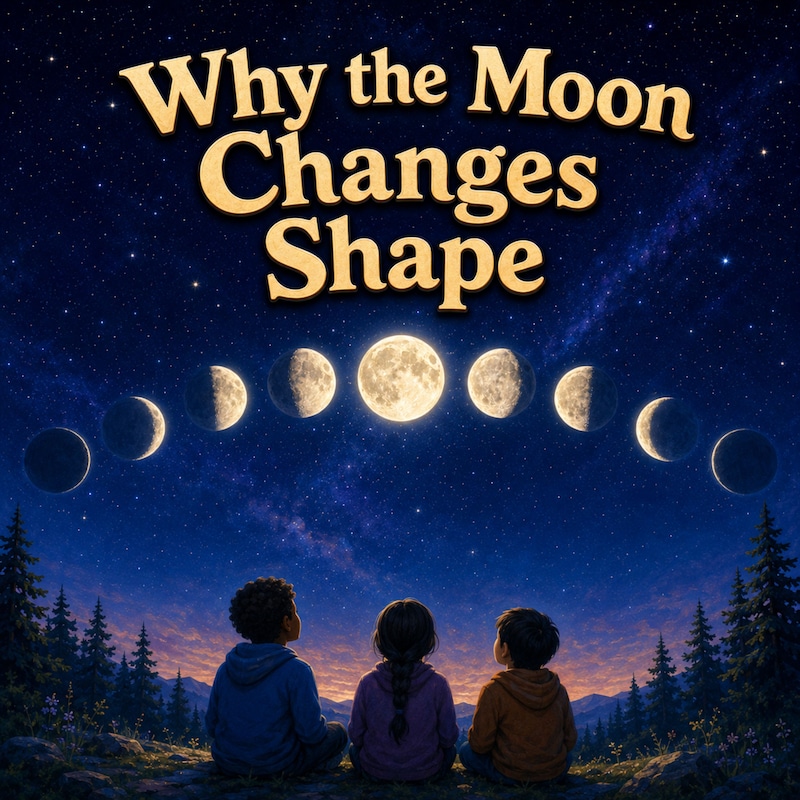
One night, the Moon is a glowing circle. A few nights later, it looks like half a cookie. Then it becomes a delicate crescent—or seems to disappear completely.
But is the Moon really changing shape?
In this episode of Faithfully Explore!, young listeners follow the Moon through its repeating cycle and discover what causes the lunar phases. Through vivid explanations, cultural connections, and playful riddles, children learn how the movement of the Moon around Earth changes the portion of its sunlit half that we can see.
Along the way, we explore how people have watched the Moon for thousands of years—not only to understand the night sky, but also to organize time, welcome new months, and determine the dates of meaningful celebrations.
Listeners will discover:
- Why the Moon always remains a round world, even when it looks like a crescent
- How the positions of the Sun, Earth, and Moon create the lunar phases
- The difference between waxing, waning, crescent, quarter, gibbous, full, and new moons
- Why Earth’s shadow does not cause the Moon’s regular monthly phases
- How Muslims watch for the first crescent, or hilal, to mark the beginning of Islamic months
- How the Hebrew calendar follows both the Moon and the Sun, with Rosh Chodesh welcoming each new month
- How the Chinese lunisolar calendar helps determine celebrations such as Lunar New Year, the Lantern Festival, and the Mid-Autumn Festival
- Why different calendars can follow the same Moon in different ways
Children can test what they have learned during a round of moon-phase riddles. Can they identify each phase using only the clues?
The episode ends with a Belief Backpack reminder inspired by the Moon’s dependable cycle:
Change is natural, and every phase has beauty.
Perfect for families, elementary classrooms, homeschool science units, bedtime listening, and anyone who has ever looked up and wondered, “Why does the Moon look different tonight?”
After listening, continue the adventure by observing the Moon over several nights. Sketch what you see, record the date and time, and watch for patterns as the bright portion appears to grow and shrink. You can also explore the episode’s companion books, activities, and learning resources at FaithfullyExplore.com.
Press play, look toward the night sky, and discover why the Moon changes shape.
Transcripts
Explorers, I need to tell you something strange.
2
:The moon is a shape-shifter.
3
:One night, it is a tiny silver smile.
4
:Another night, it is a half a cookie.
5
:Another night, it is big, round,
and glowing like a giant nightlight.
6
:Then a few nights later,
it starts shrinking again.
7
:Which brings us to today's
very important mystery.
8
:Is something nibbling it?
9
:Is there a giant space mouse
taking bites out of it?
10
:Is the moon playing peekaboo?
11
:I'm Laura, and today in our Faithfully
Explore series, Sky Stories:
12
:Wonder Written in the Stars, we're
exploring why the moon changes shape.
13
:We'll learn the science of moon phases
and discover how the moon helps shape
14
:Muslim, Jewish, and Chinese calendars.
15
:So grab your imagination telescope,
pack a pretend moon snack, and please do
16
:not accuse the moon of being dramatic.
17
:The moon is just going through a phase.
18
:Let's faithfully explore.
19
:Faithfully Explore! Intro:
20
:faithfully Explore!
21
:is the name.
22
:Learning together is our aim.
23
:Beliefs around the globe we'll track,
filling up our Belief Backpack.
24
:Laura: All right, explorers.
25
:Before we travel through
stories and celebrations,
26
:let's solve our moon mystery.
27
:Why does the moon change shape?
28
:First, here's a surprise.
29
:The moon is always round.
30
:Yes, always.
31
:Even when it looks like a tiny
crescent, even when it looks like a
32
:half circle, even when it disappears
and you can't see it at all, the moon
33
:itself is still a round ball in space.
34
:So why does it look different?
35
:Because of sunlight.
36
:The moon does not make its own light.
37
:It shines because light from the
sun reflects off the moon's surface.
38
:The sun always lights up half of the moon,
just like the sun lights up half of Earth.
39
:But as the moon travels around
the Earth, we see different
40
:amounts of its sunlit side.
41
:This is what makes moon phases.
42
:The whole moon phase cycle
takes about 29 and a half days.
43
:That's about one month.
44
:The word month even comes from an
old word connected to the moon.
45
:Moon, month.
46
:They're cousins.
47
:Now let's meet the moon phases
48
:First, we have the new moon.
49
:During the new moon, the moon
is between Earth and the sun.
50
:The lit up side is facing away
from us, so from Earth, the moon
51
:looks dark or almost invisible.
52
:It's still there.
53
:It's just doing a stealth mission.
54
:Then comes the waxing crescent.
55
:Waxing means growing.
56
:Crescent means a curved, skinny
shape, like a banana or a smile.
57
:This is when the moon first
appears again after the new moon.
58
:Next is the first quarter.
59
:This one can be confusing because it looks
like half a moon, but it is called first
60
:quarter because the moon is one quarter
of the way through its whole cycle.
61
:So it looks half lit, but
it is called a quarter.
62
:Then comes the waxing gibbous.
63
:Gibbous means more than
half lit, but not full yet.
64
:Let's try saying gibbous.
65
:Gibbous.
66
:Gibbous.
67
:Then comes the full moon.
68
:That's when the whole face of the moon
looks bright and round from Earth.
69
:Full moon nights have inspired stories,
songs, festivals, and calendars.
70
:After the full moon, the moon
starts to look smaller again.
71
:This is called waning.
72
:Waning means shrinking or getting smaller.
73
:So we get waning gibbous, still
mostly full, but shrinking.
74
:Third quarter, also called last
quarter, another half-looking moon.
75
:Then waning crescent, a
tiny silver curve again.
76
:And then we return to new moon.
77
:The cycle begins again.
78
:New moon, waxing crescent, first
quarter, waxing gibbous, full moon,
79
:waning gibbous, third quarter,
waning crescent, again and again.
80
:Now let's say it together.
81
:New moon,
82
:Annie: New moon
83
:Laura: waxing crescent,
84
:Annie: Waxing crescent
85
:Laura: first quarter,
86
:Annie: First quarter
87
:Laura: Waxing gibbous,
88
:Annie: Waxing gibbous
89
:Laura: full moon,
90
:Annie: Full moon
91
:Laura: waning gibbous,
92
:Annie: Waning gibbous
93
:Laura: third quarter,
94
:Annie: Third quarter
95
:Laura: waning crescent.
96
:Annie: Waning crescent
97
:Laura: Wonderful, explorers.
98
:Long before people had phone
calendars, they watched the sky.
99
:The moon helped people count days.
100
:A new moon meant a new beginning.
101
:A full moon meant the middle of the month.
102
:The changing moon became a
natural clock in the sky.
103
:Let's visit a few traditions
where the moon still helps shape
104
:important times of the year.
105
:First up, Islam.
106
:In Islam, Muslims follow a
lunar calendar called the Hijri
107
:calendar or Islamic calendar.
108
:Lunar means moon-based.
109
:Each Islamic month begins
with the sighting of the thin
110
:crescent moon called the hilal.
111
:That little crescent is very important.
112
:It is like the moon whispering,
"A new month has begun."
113
:The month of Ramadan begins when
the new crescent moon is sighted
114
:after the month of Sha'ban.
115
:Ramadan is a sacred month when many
Muslims fast from dawn until sunset,
116
:pray, read the Quran, give charity, and
focus on gratitude and self-control.
117
:Then when Ramadan ends, Muslims
look again for the crescent moon.
118
:The sighting of the new crescent
helps mark the beginning of
119
:the next month, Shawwal, and
the celebration of Eid al-Fitr.
120
:Eid al-Fitr is a joyful holiday
with prayer, food, family, giving,
121
:and celebration after Ramadan.
122
:Now, here's something important.
123
:Not all Muslim communities begin
Ramadan or Eid on exactly the same day.
124
:Why?
125
:Because the crescent may be visible
in one place and not another.
126
:The moon is in the same sky, but
people may see it at different
127
:times depending on where they live.
128
:That is a good reminder
for Faithfully Explore.
129
:Even within one religion, people
may practice in different ways.
130
:Now, let's travel to Judaism.
131
:In Judaism, the Hebrew
calendar is lunisolar.
132
:That means it follows the moon for
months and also adjusts to stay
133
:connected to the seasons of the sun.
134
:Each Jewish month begins
with Rosh Chodesh.
135
:Try saying that with me.
136
:Rosh Chodesh.
137
:It means head of the month
or beginning of the month.
138
:Rosh Chodesh happens at the start of a new
Hebrew month connected with the new moon.
139
:In ancient times, witnesses would
watch for the new crescent moon, and
140
:the new month would be announced.
141
:Today, the Jewish calendar is
calculated, but the moon is still
142
:part of the rhythm of Jewish time.
143
:Some Jewish communities also say a
special blessing called Kiddush Levana,
144
:the sanctification of the moon, during
the first part of the lunar cycle when
145
:the moon has returned to the night sky.
146
:I love that image.
147
:People stepping outside at
night, looking up, and blessing
148
:the moon as it grows again.
149
:The moon disappears.
150
:The moon returns.
151
:The month begins.
152
:The people remember.
153
:Many Jewish holidays also appear
around certain moon times.
154
:For example, Passover begins on
the 15th day of the Hebrew month
155
:of Nisan around the full moon.
156
:Sukkot begins on the 15th day of
Tishrei, also around the full moon.
157
:That means the full moon can shine
over important Jewish celebrations.
158
:The moon teaches rhythm.
159
:Begin, grow, shine, rest, begin again.
160
:Now let's travel to
Chinese lunar festivals.
161
:In Chinese culture, many important
holidays follow a lunisolar calendar, too.
162
:The Lunar New Year, also called
Spring Festival in Chinese culture,
163
:begins with a new lunar year.
164
:Families may clean their homes,
gather for meals, give red envelopes,
165
:enjoy fireworks or lion dances,
and welcome a new beginning.
166
:Then on the fifteenth day of the first
lunar month comes the Lantern Festival.
167
:This festival marks the first
full moon of the new lunar year.
168
:People may carry lanterns, solve
riddles, watch performances, and eat
169
:sweet rice balls called tangyuan.
170
:Think about that.
171
:The year begins in darkness and
newness, and about fifteen days later,
172
:the full moon arrives, bright and
round with lanterns glowing below.
173
:Sky lights above, lantern lights below.
174
:That is beautiful.
175
:Later in the year comes the
Mid-Autumn Festival on the fifteenth
176
:day of the eighth lunar month,
another full moon celebration.
177
:Families admire the moon, share
mooncakes, tell stories of Chang'e and
178
:the Jade Rabbit, and celebrate reunion.
179
:So in Chinese lunar festivals, the
moon helps mark new beginnings,
180
:full moon brightness, family
togetherness, and seasonal change.
181
:Now let's pause and notice something.
182
:Islamic moon sightings, Jewish lunar
months, Chinese lunar festivals, science
183
:of moon phases, different traditions,
different stories, same changing moon.
184
:Let's cross our Friendship Bridge.
185
:Today, our friendship
bridge is made of moonlight.
186
:On one side, we have science.
187
:The moon changes shape because
we see different amounts of its
188
:sunlit half as it orbits Earth.
189
:On another side, we have calendars.
190
:Muslims look for the crescent
moon to begin Ramadan and Eid.
191
:Jewish months begin with Rosh
Chodesh, connected with the new moon.
192
:Chinese festivals move with the lunar
calendar from Lunar New Year to Lantern
193
:Festival to Mid-Autumn Festival.
194
:All of these connect to one big
truth: people have always looked
195
:up at the moon and noticed change.
196
:The moon is not the same every
night, but every phase matters.
197
:The new moon matters
because it begins again.
198
:The crescent matters because it returns.
199
:The half-moon matters
because it's on its way.
200
:The gibbous moon matters
because it is almost full.
201
:The full moon matters because it shines.
202
:The waning moon matters
because it teaches letting go.
203
:Then the new moon returns, and
the whole cycle starts again.
204
:Isn't that a lot like life?
205
:Sometimes you feel bright
and full of energy.
206
:Sometimes you feel small and quiet.
207
:Sometimes you are growing.
208
:Sometimes you are resting.
209
:Sometimes you are letting go of something.
210
:Sometimes you are beginning again.
211
:And all of those phases
are a part of being human.
212
:You do not have to be full
moon bright every day.
213
:You are still you when
you are a tiny crescent.
214
:You are still you when you need rest.
215
:You are still you when you are changing.
216
:That is our friendship bridge.
217
:Different cultures honor the
moon in different ways, but
218
:many notice the same pattern.
219
:Change is natural, and
every phase has beauty.
220
:Now, I think our brains
are ready for a game.
221
:It's game time.
222
:Welcome to Riddle Me Moon.
223
:Today's game is a moon
phase riddle challenge.
224
:Listen closely, think like a
sky detective, and see if you
225
:can solve each moon mystery.
226
:Ready, moon thinkers?
227
:Let's begin.
228
:Moon riddle one: I look
round, bright, and complete.
229
:I am the phase people often notice first
because I can light up the night sky.
230
:I happen when the side of the moon
facing Earth is fully lit by the sun.
231
:What phase am I?
232
:Full moon.
233
:The full moon looks round and
bright because we can see the
234
:whole sunlit side facing Earth.
235
:Moon riddle two:
236
:I am only a little thin slice of light.
237
:I happen after the full moon when the
moon's bright part is almost gone.
238
:Soon, the moon will look dark
and begin the cycle again.
239
:What phase am I?
240
:Waning crescent.
241
:Waning means shrinking, and
the waning crescent is the last
242
:small sliver before the new moon.
243
:Moon riddle three:
244
:I look like half a moon,
but my name is different.
245
:I come after the new moon
and before the full moon.
246
:Each night after me, the
bright part keeps growing.
247
:What phase am I?
248
:First quarter.
249
:The first quarter looks half lit
from Earth, but it is called quarter
250
:because the moon is about one
quarter of the way through its cycle.
251
:Moon riddle four:
252
:I am more than half
lit, but I am not full.
253
:My bright part is getting
smaller each night.
254
:I come after the full moon
and before the last quarter.
255
:What phase am I?
256
:Waning gibbous.
257
:Waning means shrinking, and gibbous
means the moon looks more than half full.
258
:Moon riddle five:
259
:I am the moon phase
you usually cannot see.
260
:The moon has not disappeared, but
the side facing Earth is dark.
261
:I begin the moon's cycle again.
262
:What phase am I?
263
:New moon.
264
:During a new moon, the side facing
Earth is not lit by the sun, so the moon
265
:is hard or almost impossible to see.
266
:Moon riddle six:
267
:I am more than half lit,
but not quite round.
268
:I come before the full moon.
269
:Each night, my bright part keeps growing.
270
:What phase am I?
271
:Waxing gibbous.
272
:Waxing means growing, and the
waxing gibbous grows brighter
273
:on the way to the full moon.
274
:Moon riddle seven:
275
:I look like half a moon.
276
:I come after the full moon when
the bright part is shrinking.
277
:Even though I look half lit, I am
near the end of the moon's cycle.
278
:What phase am I?
279
:Last quarter.
280
:The last quarter moon looks half
lit, but it comes after the full moon
281
:as the visible light gets smaller.
282
:Moon riddle eight:
283
:I am a tiny curved sliver.
284
:I come after the new moon when the
moon's light is just beginning to grow.
285
:Each night after me, you
can see a little more light.
286
:What phase am I?
287
:Waxing crescent.
288
:Waxing means growing, and the
waxing crescent is the first small
289
:sliver of light after the new moon.
290
:Wonderful moon thinking.
291
:You solved the riddles
of the changing moon.
292
:What's inside our belief
backpack this week?
293
:Today, we explored why
the moon changes shape.
294
:We learned that the moon is always round,
but we see different amounts of its
295
:sunlit side as it travels around Earth.
296
:We learned the moon phases, new
moon, waxing crescent, first
297
:quarter, waxing gibbous, full moon,
waning gibbous, third quarter,
298
:waning crescent, then back to new.
299
:We learned that Muslims look
for the crescent moon to begin
300
:important months like Ramadan,
Shawwal, which begins Eid al-Fitr.
301
:We learned that Jewish months begin
with Rosh Chodesh, connected with
302
:the new moon, and that the moon helps
shape the rhythm of Jewish time.
303
:We learned that Chinese lunar festivals
include new beginnings at Lunar New Year,
304
:lanterns at the first full moon, and
family reunion under the Mid-Autumn Moon.
305
:So what goes into our Belief Backpack?
306
:Today's Belief Backpack takeaway is Change
is natural, and every phase has beauty.
307
:Let's say that together.
308
:Change is natural,
309
:Annie: Change is natural
310
:Laura: and every phase has beauty.
311
:Annie: And every phase has beauty
312
:Laura: You are allowed to change.
313
:You are allowed to grow slowly.
314
:You are allowed to have bright full moon
days when you feel excited and brave.
315
:You are allowed to have quiet
crescent days when you need rest.
316
:You are allowed to begin again.
317
:The moon does not apologize for changing.
318
:It just shines the light
it has, and that is enough.
319
:This week's challenge is
called My Moon Phase Check-In.
320
:Each day, ask yourself, "What
moon phase do I feel like today?
321
:Do I feel like a new
moon, quiet and resting?
322
:A crescent moon, just
starting something new?
323
:A half moon, halfway there?
324
:A full moon, bright and ready?
325
:A waning moon, letting
go and slowing down?"
326
:Then tell a grown-up,
draw it, or act it out.
327
:And remember, no phase is bad.
328
:Every phase belongs.
329
:Thank you for joining me for
another episode of Sky Stories:
330
:Wonder Written in the Stars.
331
:The next time you see the
moon, notice its shape.
332
:Is it hiding?
333
:Is it growing?
334
:Is it glowing?
335
:Is it letting go?
336
:Whatever phase it is in,
I hope you remember this.
337
:The moon is beautiful in
every shape, and so are you.
338
:I'm Laura, and this has
been Faithfully Explore.
339
:Until next time, stay curious, stay
kind, and keep faithfully exploring
340
:that wonderful world around you.
341
:Faithfully Explore! Outro:
342
:Faithfully Explore!
343
:is about you.
344
:Let's grow kinder together it's true!
