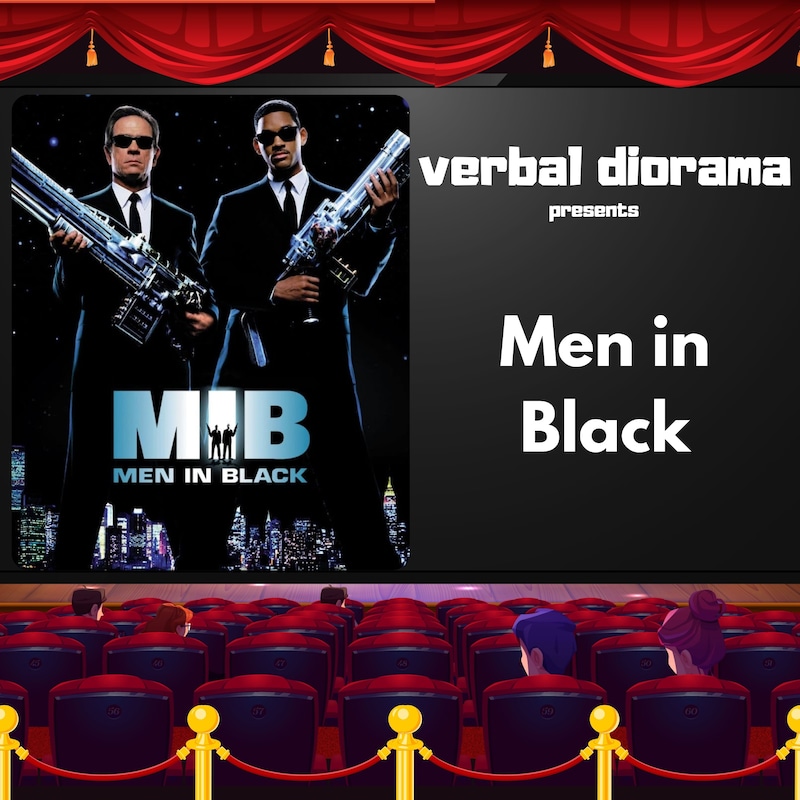
Shownotes
The Men in Black phenomenon started as rumours of a government agency, where strange men wearing black suits would visit witnesses of UFO sightings, and coerce and threaten them into silence. Real-life Men in Black sightings inspired countless conspiracy theories, making them a staple of UFO folklore since their first appearance in the late 1940s.
It was only a matter of time before these sinister men were turned into a comic book, and then adapted into a movie, but how did a dark, obscure comic get transformed into a summer blockbuster that would gross over $589 million worldwide and launch a franchise?
Director Barry Sonnenfeld and screenwriter Ed Solomon made the bold decision to completely reimagine Men in Black as a buddy-cop action-comedy, keeping only the core premise while building something entirely new around it, with the premise of New York being the hub of alien activity, and Earth a sanctuary for alien refugees.
Will Smith and Tommy Lee Jones' on-screen chemistry made the titular Men in Black iconic, with Jones bringing his signature stoic humour to create the perfect counterbalance to Smith's energetic comedy, resulting in one of cinema's most memorable buddy cop pairings.
Men in Black's impressive practical effects work earned Rick Baker's team an Academy Award, with cutting-edge animatronics and makeup seamlessly blended with CGI from Industrial Light & Magic, creating a visual experience that still holds up today.
It's the perfect summer blockbuster, that was never intended or seen as a summer blockbuster. The script was constantly evolving, even into post-production, and the movie's plot was changed after test screenings forced an edit, and those changes would make Frank the Pug one of the most important characters in the movie...
I would love to hear your thoughts on Men in Black !
Verbal Diorama is now an award-winning podcast! Best Movie Podcast in the inaugural Ear Worthy Independent Podcast Awards and was nominated for the Earworm Award at the 2025 Golden Lobes.
CONTACT....
- Twitter @verbaldiorama
- Instagram @verbaldiorama
- Facebook @verbaldiorama
- Letterboxd @verbaldiorama
- Email verbaldiorama [at] gmail [dot] com
- Website verbaldiorama.com
SUPPORT VERBAL DIORAMA....
Give this podcast a five-star Rate & Review
ABOUT VERBAL DIORAMA
Verbal Diorama is hosted, produced, edited, researched, recorded and marketed by me, Em | This podcast is hosted by Captivate, try it yourself for free.
Theme Music: Verbal Diorama Theme Song. Music by Chloe Enticott - Compositions by Chloe. Lyrics by Chloe Enticott (and me!) Production by Ellis Powell-Bevan of Ewenique Studio
Patrons: Simon, Laurel, Derek, Cat, Andy, Mike, Luke, Michael, Scott, Brendan, Ian, Lisa, Sam, Jack, Stuart, Nicholas, Zo, Kev, Heather, Danny, Stu, Brett, Philip M, Xenos, Sean, Ryno, Philip K, Adam, Elaine, Kyle, Aaron and Conner.
This podcast uses the following third-party services for analysis:
Podscribe - https://podscribe.com/privacy
OP3 - https://op3.dev/privacy
Transcripts
Hi everyone, I'm Em. And welcome to verbal diorama, episode 323, Men in Black.
This is the podcast that's all about the history and legacy of movies, you know, and movies you don't. That keeps getting eye exams from a weird government agency. I'm not sure why. Anyway, welcome to Verbal Diorama.
Whether you've a brand new listener, whether you're a regular returning listener, thank you for being here. Thank you for choosing to listen to this podcast. I'm so happy to have you here for the history and legacy of Men in Black.
There are lots of podcasts out there that all vine for your ears and for your attention.
I'm so happy that you've chosen to listen to this one and if you are a regular returning listener and you've continued to listen and support this podcast for however long you have been returning to this podcast. Thank you so much for returning to this podcast.
It genuinely means so much to me as a small independent podcaster who has literally done 323 episodes completely by herself. Like, it's just crazy. And it blows my mind that people still come back to this podcast, but I'm so grateful that you have.
There has been a slight delay on this episode and it's mostly due to me being a bit poorly recently. I'm not sure if you can tell by my voice. My voice is still not 100%. I've had a chest infection.
But I will be editing all of the coughing that I will be doing out of this episode, and I'm hoping that my voice continues to work throughout this podcast because unfortunately, you can't really have a podcast if your voice doesn't work. However, I will say the rumours I was visited by some gentlemen in black suits and told not to record this episode are completely untrue.
In this movie, the good guys might dress in black, but if you've ever experienced some strange phenomena and afterwards were visited by some men dressed in black suits, chances are they may not have been completely good. But this movie completely changed the public's opinion of them. So maybe this is all just great PR. Here's the trailer for Men in Black.
Em:Extraterrestrial refugees of all shapes, sizes and colors have been living secretly on Earth for decades, masquerading as humans and peacefully coexisting with the inhabitants of Manhattan. The rebellious and malevolent ones are kept under control by a secret government organization called the Men in Black.
Veteran Agent K enlists NYPD officer James Edwards as the agency's newest recruit, Agent J.
And they investigate an illegal landing and the murder of a member of the Arquillian royal family, protecting the Earth from the scum of the universe. Let's run through the cast.
We have Tommy Lee Jones as Agent K, Will Smith as James Edwards, aka Agent J. Linda Fiorentino as Dr. Laurel Weaver, Vincent D' Onofrio as Edgar, aka the Bug Rip Torn as Chief Zed. Tony Shalhoub as Jack Jeebs, Siobhan Fallen Hogan as Beatrice and Tim Blaney as the voice of Frank, the pug. Men in Black was written by Ed Solomon and was directed by Barry Sonnenfeld, based on the Men in Black by Lowell Cunningham and Sandy Carruthers.
The good guys dress in black. Remember that?
But while Tommy Lee Jones and Will Smith were the good guys and basically made the Men in Black cool, fun and stylish, historically, the myths and legends around the real Men in Black are undeniably more sinister. In UFO conspiracy theories.
Men in Black are allegedly government agents dressed in dark suits who question, interrogate, harass, and threaten UFO witnesses to keep them quiet about what they've seen, no government department has claimed them. And while this movie has an alien bug in a farmer's skin suit, there are many rumors that the Men in Black may not have been human at all either.
But aliens wearing human Disguises.
According to reports from alleged witnesses, men in black are tall and lean, typically wearing sunglasses and ill fitting old fashioned black suits, arriving in vintage black cars and speaking in strange stilted manners. They almost always have pale white skin, sometimes reported as looking milky, with expressionless faces.
They would know private details about the witnesses they visited, would know key items of the UFO sighting. The witness hadn't told anyone else and often witnesses would claim these men in black could read their minds.
But after a brief discussion, the men in black would intimidate these witnesses into keeping silent and not sharing evidence. The earliest known case of a men in black encounter was the Maury Island Incident.
June: nited States in June and July: has its own Wikipedia entry;: July:Was the advent of science fiction, cinema books and comic strips to blame? Or was it simply many alien ships coming to Earth for sanctuary? The Maury island incident would also later be called a hoax.
t major civilian ufo Club, in: n his organisation in October:The source is already known, but any information about this is being withheld by orders from a higher source. It's claimed he was pressured by men in black to suspend Activity off the group.
e famous Mothman sightings of: k the Mothman Prophecies from: In September:This was well before mobile phones, of course, and the man didn't appear to have come in a car either. According to Hopkins, the visitor wore a black suit, had no hair, eyebrows or eyelashes, had dead white skin and spoke in a monotone.
All this robotic voice. His lips were bright red. When the man smeared his lips, the red smeared across his face as if it were lipstick.
The visitor had no visible lips, just a mouth slit.
He allegedly already knew about a coin in Hopkins pocket that he could not have already known about, and made that coin change colour and dematerialise as a demonstration, and then warned Hopkins to destroy his UFO research.
In the: In May: Roswell incident in September:Convinced he'd found evidence of an extraterrestrial presence, as well as a secret alien facility called Dulce Base, Bennewitz contacted the Air Force. His claims weren't dismissed, but allegedly the Air Force, and with them, the men in black, encouraged Bennewitz and fed him false information.
It turned out that Merlin Hansen was also part of the disinformation campaign. The tactic was designed to discredit Bennewitz and for the public to see his claims as nothing but lies.
st of his life. Gray Barker's:It was the first book to allege that Men in Black were covering up the existence of flying saucers and cited the examples of Albert K. Bender and the Maury Island Incident, among others. They Knew Too Much About Flying Saucers would also notably influence the X Files.
es refused to die down and in:The comics were grittier, more noir influenced and played the concept straighter without the humor that became the film's trademark. The Men in Black themselves were more mysterious and bleak in line with their real life counterparts.
acquired by Malibu Comics in: In:And despite Steven Spielberg's involvement as executive producer, they only had one name in mind to direct Barry Sonnenfeld because of his adaptations of the Addams Family and Addams Family Values. Both previous episodes of this podcast too. Episode 119 for the Addams Family and 176 for Addams Family Values. I love those movies so much.
Barry Sonnenfeld had been trying to get Get Shorty made at the time and got the script for Men in Black and loved it. But he had some ideas that the producers weren't keen on and because he was attached to Get Shorty, he ended up declining to make the movie.
The producers then approached the director of Miracle on 34th Street, Les Mayfield, who joined the project but didn't have the sort of grasp on the movie they wanted, so he also moved on. John Landis and Quentin Tarantino were reportedly also asked to direct, but they also declined.
As a result, the movie adaptation of Men in Black became delayed, which worked in Barry Sonnenfeld's favor. He and his wife were having breakfast at the Ivy and on the Next table was Sony's head of production, Barry Josephson.
Sonnenfeld knew on the grapevine that Men in Black still didn't have a director. So he suggested to Josephson that if they would wait for him to finish Get Shorty, he would direct the movie.
Josephson agreed, and that meant Sonnenfeld was back on the movie.
But the producers always wanted Clint Eastwood to play the part of stalwart long serving agent K. But one of Sonnenfeld's original ideas that they hadn't liked was casting Tommy Lee Jones.
So once Sonnenfeld was back in picture, they got in touch with Tommy Lee Jones, who liked the idea and came on board with stipulations, one of them being director approval. Luckily for Sonnenfeld, Jones approved his hiring as director. The other stipulation was the script needed rewriting.
Five months later, the script was good enough for Tommy Lee Jones and he officially signed on. One of the other ideas that Barry Sonnenfeld had was to set the movie in New York. He wanted it to be like the French Connection but with aliens.
His thinking was that strange people can pass in New York. It's just that kind of city.
The script would evolve with all these new ideas, including making the character of J a New York city cop rather than a government agent or a member of the secret service. J was initially envisaged as a white man, the typical men in black suit with the very, very milky white skin type of men in black.
And Steven Spielberg really wanted Chris O' Donnell to play J. And at the time mid 90s, Chris O' Donnell was on a high. After Scent of a Woman, the three Musketeers, and Batman Forever.
Spielberg told Sonnenfeld to take o' Donnell to dinner to convince him to join the movie, even though o' Donnell was hesitant to play another sidekick role so soon after Batman. But Sonnenfeld's other idea for casting alongside Tommy Lee Jones, or his wife's idea, I should say, was Will Smith.
But when Steven Spielberg asks you to take someone out for dinner, you take them. So he did.
He took Chris o' Donnell to dinner and told him that he wasn't a very good director and he didn't think the script for Men in Black was very good. And if o' Donnell had any other options, he probably shouldn't do Men in Black. The next day, Chris o' Donnell officially declined the part.
A part David Schwimmer from Friends was also in the running for at one point. But Barry Sonnenfeld really wanted Will Smith. But he needed Steven Spielberg to sign off on Will Smith.
Sonnenfeld, who lived year round in Easthampton where Spielberg spent his summers, arranged for a helicopter to take Smith from a wedding in Philadelphia to New York where Smith and Spielberg met for the first time. And they really hit it off and Spielberg agreed that Sonnenfeld could hire him for the movie.
At that point, Independence Day hadn't yet come out and Will Smith was mostly known for the Fresh Prince and Bad Boys. Smith was concerned about taking on another alien themed movie so soon after Independence Day.
But at that time no one knew his career was about to go stratospheric. And on paper, Tommy Lee Jones and Will Smith shouldn't work. Jones was known for his gruff personality and Smith for being affable and funny.
But while Tommy Lee Jones had some reservations about their comedic pairing, they actually got on like a house on fire. Jones took a while to feel comfortable being the straight man.
He worried that only Smith's performance would be seen as funny, but him playing it straight was just as funny. And the pair riffed off each other perfectly. The rumor that Linda Fiorentino got the role after she won a poker game isn't technically true.
She did play poker and Barry Sonnenfeld was at the same poker table. But she didn't get the role because she won it.
She got the role simply because Sonnenfeld remembered her from poker and thought she'd be great for the part of deputy medical examiner Dr. Laurel Weaver. There are many other rumours that she didn't come back for the sequel due to a falling out with Tommy Lee Jones.
Apparently he could not sanction her buffoonery. Or maybe that was Jim Carrey.
But the simple fact of the matter was that they wanted to bring back Jones for a sequel, which at the time was obviously unplanned. And there was no role for Linda Fiorentino after they brought back Jones as Kay.
But in a movie full of memorable performances, one man truly sticks out. Well, not really a man, more of a bug, actually. Vincent d'Onofrio playing an alien bug playing a man. And it is a piece of comedy. Gold.
D'Onofrio's name came up early in the casting process because Sonnenfeld loved him in Full Metal Jacket. He offered d'Onofrio the part instantly without him having to audition or even ask questions about the movie.
They just spent the afternoon together in the Hamptons and as soon as d'Onofrio accepted, he flew to LA to meet the legendary Rick Baker at Cinevation studios. The record 11 time nominated and 7 time Academy Award winning for Best makeup, Rick Baker. One of those wins would be for his work on Men in Black.
I am going to come back to Rick Baker shortly. And all of the direction for how Edgar would move, walk, speak or behave didn't come from Barry Sonnenfeld, but from Vincent d'Onofrio himself.
He watched Bug documentaries and thought about how the bug would be folded up inside Edgar. He bought basketball knee braces and locked his knees and ankles so they couldn't move properly.
He would explain the character was constantly frustrated being in a measly human body, frustrated dealing with stupid humans, keeping the menace of being the bad guy, but also keeping the physical comedy intact. When d'Onofrio met Rick Baker and saw his concept art, he built the character himself from the ground up.
Only Baker saw and heard d'Onofrio's prep work until the first day of shooting. Sonnenfeld trusted d'Onofrio enough to take the character and run with it.
D' Onofrio combined George C. Scott and John Huston in Chinatown in his delivery. They did seven to eight takes at the sugar water scene, and he drank a full glass of sugar water in each one and then some.
Barry Sonnenfeld suggested he actually drank 11 or 12 glasses of water filled with sugar, because that's the sort of dedication you get when you get Vincent d' Onofrio in your movie. Back to Rick Baker's incredible prosthetics and makeup and the Oscar he shared with David Leroy Anderson for his work on this movie.
Because this is a movie that shines for a lot of things. The partnership of Smith and Jones, the comedy, the Practical Creatures, I'm coming to those, too.
But Edgar really is one of the greatest makeup creations ever, and that is because of the work of David Leroy Anderson and Rick Baker. It's things that you don't maybe notice on your first or second watch. Things like how decomposed Edgar's skin gets as the movie progresses.
You can see it go gray and dry. You can see human teeth dangling. Rick Baker did several iterations of the makeup, depending on which part of the movie they were filming.
He would glue actual parts of d'Onofrio's real face to other parts to stretch it up and then glue facial prosthetics on top. D'Onofrio's eyelids were glued down, as well as a neck appliance cast in loose silicon gel.
The makeup was completed with foggy contact lenses, decaying dental appliances and plunkers inserted into the mouth to distort its shape. At the start of the movie, when Edgar goes to investigate the explosion of his truck, supposedly in upstate New York.
They actually found a farm an hour and a half north of LA, dug a hole and used a crane to throw d'Onofrio's stunt double in the hole. That would obviously be edited out and replaced with a CG creature arm.
But Rick Baker did make Vincent d'Onofrio's skin to throw up outside of the hole. Sonnenfeld wanted scenes like this also to be done in one shot. Baker was involved in the design of all of the aliens, both practical and cgi.
And the CGI in this movie is used sparingly only for when you need to see creatures in wide shots or you need movements and stunts. Mikey, the alien would meet with K at the start is both of those things. But he starts as an incredibly convincing practical suit.
Baker spent 10 months creating an eight foot tall alien suit to be worn by a real actor with head and body parts controlled by 10 remote operators. Even so, the design team couldn't figure out a way for the creature to run quickly as was required by the script.
So the practical Mikey is replaced by a CG Mikey partway through his scene.
His design took inspiration from snails and other mollusks as well as reptiles with exaggerated and bizarre features such as eye stalks, retractable antennae and small flippers. And this movie knows when it's best to use the practical and when you need the cg. And it does it so well, it's actually kind of scary.
This movie holds up visually like Jurassic park holds it visually. And I'm not even being hyperbolic, because if you think the vast majority of this movie is cg, you are so incredibly wrong.
Just like people think Jurassic park is mostly CG because it hits the sweet spot of the best of both. It did mean that hard decisions had to be made, such as on the practical bug.
In the climactic finale, which Rick Baker and his team spent months building and perfecting, they built two highly detailed 15 foot versions. One was a full tip of nose to tail and warped, but the facial mechanics and arm mechanics were minimized.
Then there was an insert Edgar built from the waist up which was more detailed and could move more freely. These were both scrapped in favor of a CG bug when the script was changed to a more action packed finale.
And they would have had problems with the practical bug swallowing Tommy Lee Jones. But even the CG we did get in the movie still looks pretty great.
The Edgar bug was animated by Industrial Light and Magic, and many of the techniques used, the moist skin textures and liquid oozing were new pieces of software at the time. When his gut explodes, freeing Agent K, this was a practical effect.
Eric Brevig, Men in Black's visual effects supervisor, wanted everything CG to be complemented by practical effects wherever possible. Like an alien birth scene with tentacles grabbing and throwing Will Smith around, which were obviously cg, followed by a real practical alien baby.
Or Vincent d'Onofrio grabbing the back of his head and pulling it away, which was practical, to gradually revealing a huge gooey alien bug. D'Onofrio pulled the prosthetics so much that they actually ripped for real.
And the worm guys we meet as K gets coffee were live puppeteered with the puppeteers hiding behind the set. And they look so great. Not once do you think they're puppets.
The models were scanned and rebuilt as identical CG models for a later scene when they're walking in the headquarters again, because you can't do that with rod puppets.
Baker and his team built a one to one scale of the dead Aquilian prince's human head that would open to reveal the real Arquillian prince, a puppet named Chucky. They built a second, much larger head to puppet a more intricate Chucky.
The maquettes built by Baker's team were later digitized by Industrial Light and Magic for the more mobile digital versions of the aliens.
here, which was built for the:This was realized by a 1:6 scale miniature shoot at ILM stages. The nine foot long saucer was guided into the Unisphere using cables and the sphere was rigged to explode with pyrotechnic charges.
The ILM digital unit did wire removal for these shots. And Tommy Lee Jones and Will Smith just performed their parts on blue screen. Men in Black had nine weeks of preparation and 17 week production.
And it was a complex movie on many levels, mostly to do with the various special effects. Originally they were going to shoot the finale scenes on location at Flushing Meadows, but they ended up filming on a soundstage at Sony.
They started filming in March:Will Smith really loves filming on location in New York. See a couple of episodes ago for I Am Legend.
They also got permission to film inside the Guggenheim Museum, which coincidentally looks like a stack of spaceships, but they had restrictions on the type of lighting they could use in the museum.
The other incredible set built on stage 15 was the men in Black headquarters, a retro futuristic airport hangar like customs area filled with humans and aliens alike. Designed as an Ellis island for extraterrestrials, There were rooms filled with strange weapons and chrome instruments.
The modernist style headquarters with its 60s design elements was inspired by the work of Finnish architect Eero Saarinen, the designer of TWA's terminal at New York's John F. Kennedy Airport, and was designed by production designer Though Welch, who has appeared a few times on this podcast for his work on Beetlejuice, Batman Returns and Edward Scissorhands. Welch didn't want to make the set shadowy or dark.
He wanted it brightly lit, sterile, clutter free and incorporated a huge light wall into the design with a variety of alien creatures like a bit like the Star wars cantina.
To help with this, Rick Baker actually subcontracted some of the alien creation work to Steve Johnson, Bart Mixon and KMB Effects to make additional creatures for the headquarters check in area.
The team made seven extra aliens for that scene including the twins and the reason Baker needed to subcontract was due to all the work they put into the huge animatronic Edgar Bug which as I mentioned was never used.
The ventilation tower of the Brooklyn Battery Tunnel which connects Manhattan with Brooklyn was used as the now iconic entrance to MIBHQ for the third act where agents K and J raced through the Queen's midtown tunnel in their Ford Ltd was an exact 96 foot replica, 1/8 the size of the original structure, which was authentic down to the graffiti. The cars in that tunnel were 18 inches long and were photographically real.
Tommy Lee Jones and Will Smith were filmed on a blue screen in a real car cockpit that was really flipped upside down and the car was replaced with a CG car in the movie.
Designing the iconic black suits was costume designer Mary E. Vogt who has appeared on this podcast before for her work on Batman Returns and Hocus Pocus.
She borrowed the curve of a shoulder from Cary Grant and the cut of the waist from Marcello mastroiani for the skinny 60s style suits inspired by north by Northwest and the Dolce Vita. The suits are bespoke and not available to buy, unlike the Ray Bans, which Vogt got off the rack.
clude on Men in Black in July:Test screenings would lead to the ending being altered, though initially there were two warring alien races battling each other on opposite sides of the Earth, with Earth caught in the crossfire. Test audiences were confused by the two races, the Arquillians and the Baltians.
And so it became one alien race coming to Earth to retrieve the galaxy from Orion's belt. And much of the change was facilitated simply by editing and mostly by Frank the pug.
Frank was yet to be animated, and so the expositional part of the script was changed and Frank delivered the new plot.
With not much other change having to be done, save for a few ADR line reads, changing some subtitles to the Arquillians meeting and removing extra scenes. All of these changes were finished with only two weeks of post production left.
Frank was also a challenge in himself, being both a real pug and having to have a CG mouth. In a technique perfected by the film Babe.
One of the team at ILM had a pug which they brought into the studio and they studied the dog's mouth, teeth and jowls. And this led to them being able to model a PUG mouth and marry the practical and CG mouth, the Frank, which still looks great to this day.
And no cockroaches were hurt during filming. Will Smith was actually crushing mustard packets.
At the end of the day, they would actually count all of the cockroaches and make sure none were missing. Because it's not only alien bugs that care about insects on Earth.
And this is probably the best time to segue into the oblique GI Keanu reference of this episode. And if you're new here and you don't know what that is, it's where I try and link every movie that I feature with Keanu Reeves.
And this is a really simple connection. Ed Solomon wrote this movie and Ed Solomon also wrote Bill and Ted and who stars in Bill and Ted Keanu Reeves.
I know that I use that a lot because I featured a lot of Ed Solomon written movies on this podcast, but it's such an easy connection to make. And hey, Ed Solomon has written some really great films.
So a lot was happening in post production on this movie to completely change it and make it very different to the movie. That they actually made.
Another thing that happened in post production on this movie was the song by Will Smith, because I think Will Smith is kind of known nowadays for loving making themed songs for his movies, but he was actually never asked to write or perform a theme song for Men in Black until post production. The song and its accompanying music video were huge hits, with the video directed by Robert Caruso and also featuring the alien Mikey from the movie.
The song heavily samples Forget Me not by Patrice Rushen.
For the movie score, Sonnenfeld went to Mark Shaiman first because Shaiman had done the Addams Family and Addams Family Values, but he wasn't available, so he went to Danny Elfman.
Elfman was working on the set of the Frighteners with Peter Jackson when Vincent d'Onofrio, who was shooting Men in Black on the other set, invited both men to watch him perform the final scene. That evening, Elfman got a call from his agent saying that he'd been hired to compose the music for the film.
The first pieces of music Elfman wrote didn't feel quite right, and Sonnenfeld suggested a different direction. The next time Sonnenfeld visited Elfman's studio, the school was perfect.
nately old enough to remember:And you would think that Steven Spielberg, who obviously produced this movie under Ambling Entertainment, knows a thing or two about marketing movies with aliens. Think E.T. with its Reese's Pieces, which was never meant to happen, but that's a story for a future ET Episode, I guess.
But for a Men in Black movie, the marketing was quite limited actually. It included the iconic Ray Ban Predator 2 sunglasses, which meant a marketing tie in for Ray Ban.
But this was an aggressive summer blockbuster season that included many previous episodes of this podcast, including the Lost World, Jurassic Park, Batman and Robin, Disney's Hercules, and Austin Powers International man of Mystery.
But despite Columbia TriStar's account director at Saatchi Mike Cohen saying that Men in Black was the perfect crossover film, that it appealed to all sections of society.
It proved popular with men and women of all ages as well as with the all important families with children audience, and proving popular in areas with large black communities, Men in Black was not the top of the list of summer blockbusters when it came to companies putting together their marketing packages. Men in Black was seen as a bit of a gamble in the industry, with very few product placement deals within the movie itself.
It was seen as more of a minor summer hit and was passed over by most marketers in favor of the big franchise movies like the Lost World and Batman and Robin.
But on the strength of a very popular trailer and a positive reaction from cinema owners, the buzz over Men in Black grew and marketers became interested.
Two months before Men in Black came out, a $5 to $10 million ad campaign featuring Will Smith with the world famous Ray Bans saying, I make this look good, along with a Head and shoulders ad. Gotta keep those black suits black after all. But that marketing campaign with the Ray Bans kept Ray Ban stores sold out.
You even got a free black MIB baseball cap with your purchase.
Ray Ban's sales tripled that year to $5 million, purely thanks to being involved in Men in Black when very few other companies were involved in Men in Black.
July:Face off, another new entry, was second and Men in Black debuted third. It had technically only been out one day though in that week, because the figures run from 27 June to to 3 July, and it came out on the second.
That second week, Men in Black shot to number one, comfortably outperforming face off and Hercules. It would stay at number one for four weeks before being dethroned by Air Force One and George the Jungle.
Men in Black would stay in the US top 10 for 14 weeks on its $90 million budget.
ird highest grossing movie of: until Spider man came out in:Interestingly, despite being hugely successful and the start of a lucrative franchise, it seems that Hollywood accounting is responsible for Men in Black not actually making a profit for the studio despite grossing $589.3 million.
Hollywood accounting is something that I've spoken about a few times on this podcast, and I guess we'll never know where that money went, but if you look at the figures, you can't help but see this was a financially successful movie. Critically, it was also incredibly successful.
It has a 91% on rotten tomatoes, saying, thanks to a smart script, spectacular set pieces and charismatic performances from its leads, Men in Black is an entirely satisfying summer blockbuster hit. All of that is true.
Men in Black won Best makeup at the 70th Academy Awards and was also nominated for Best Original Musical or Comedy Score and Best Art Direction at the Academy Awards, but it lost those to the Full Monty and Titanic, respectively. It was also nominated for Best Motion Picture, Musical or Comedy at the 55th Golden Globe Awards, losing to as Good as It Gets.
And it was also nominated for Best Special Effects at the baftas, but it lost that to the Fifth Element. It, of course, has several sequels, Men in Black two, Men in Black three and Men in Black International.
There was also an animated series as well for a buddy cop trilogy. You can't really go wrong with Men in Black, Men in Black 2 and Men in Black 3. I can't say I'm a huge fan of international.
2 and 3 are good fun, though, and surprisingly poignant and emotional, especially Men in Black three. And once upon a time, the Internet was reporting on a potential sequel called MIB23.
This was an idea from Phil Lord and Christopher Miller, two people who I am incredibly fond of.
I think they make great movies and they had this idea for a big screen crossover between Men in Black and 21 Jump street, which was officially named MIB23. It was a lot closer to happening than you might think.
official logo at CinemaCon in:What if we could have had Tommy Lee Jones, Will Smith, Jonah Hill and Channing Tatum together on screen? It would have been kind of epic, but unfortunately, one of those it's never going to happen.
Men in Black stood at the precipice of cg, with its wonderful makeup and prosthetics and practical effects, put on a pair of Ray Ban sunglasses and said to the industry, you know what the difference is between you and me? I make this look good and boy does it. It's a movie that was never destined to be a huge mega summer blockbuster, despite having all the ingredients.
It so perfectly blends Jones and Smith, sci fi and comedy and practical and CG effects. So much so that all of them just work exceedingly well.
From the very first uttering of illegal aliens who happen to be a group of undocumented Mexicans, you think you're in for the typical treatment minorities get.
It perfectly establishes the character of K, the experienced agent with a veteran partner, treating the border crosses not with hostility or contempt, but with dignity and respect, reassuring them and inviting them into the United States.
And even when he unmasks Mikey as an alien in disguise, violating his parole, he still treats him with respect until Mikey tries to attack one of the other officers.
Men in Black's premise that the Earth is the sanctuary for many different alien races and New York is the hub of alien activity hits the ground running.
A bit like NYPD officer James Edwards, who chases down an alien masquerading as a human in the city, using his initiative to hunt him down before he warns of an incoming threat and then jumps off a high rise building. Men in Black came at that time in the mid-90s when CG was becoming high budget genre filmmaking's backbone. And the reason Men in Black works.
One of the many reasons is that this movie uses CG to enhance its practical effects, not replacing them completely. Many of the alien creatures are there on set in real life and brought to life in such a way that they feel completely real in that space.
Revisiting this movie years after I'd last seen it, with podcast eyes rather than regular eyes, they're different. I'm blown away by how genuinely, and I really mean this, genuinely underrated this movie is in so many ways.
We don't talk about it as much as we do say Jurassic park, but we should.
Visual effects Wise is one of the greatest examples of 90s practical and CG mix where you genuinely can't tell the difference for much of the movie, and despite the last minute script changes, the movie feels perfectly paced all the way up to the finale and delivers everything you expect from a summer blockbuster.
The performances are pitch perfect from Will Smith and Tommy Lee Jones, instant chemistry, a buddy cop pairing that feels like one of the best ever put to screen, and Vincent d' Onofrio's incredible and underpraised performance as Edgar.
It's not a surprise that many of this movie's most memorable moments and creations, the Worms and Frank the Pug, were given more to do in Men in Black 2 as well as bringing back Tommy Lee Jones because if it ain't broke, don't fix it. Ed Solomon's script is more than just your generic sci fi comedy. It's surprisingly poignant and moving in parts.
need help. A lot of humans in:We have no way of knowing how the original test screened edit would have played out, but likely it would have been a much longer movie with more alien politics and sci fi battles, with probably less of the human component between J and K. We'll never know for sure, of course, but it would have been different. And one test screening, as we've learned before on this podcast, can make or break a movie.
It made Men in Black it's hard not to feel sorry for Rick Baker. Designs he spent months building and perfected ended up scrapped.
But the designs that are here are so perfectly realized and are so good that often you can't tell where the practical ends and the CG begins. His team used every method available prosthetics, rubber suits, animatronics, and huge mechanical puppets.
will continue to look great.:And 15 minutes ago you knew that people were alone on this planet. Imagine what you'll know tomorrow is one of my favorite lines. Just because something is now doesn't mean it will always be that way.
Science is the evidence of the time, a best guess that could all change in future. Who knows what we will discover? Men in Black deserves to be praised for more than the Will Smith song. That's really catchy.
e, which opened to fanfare in: s what sci fi comedies of the:Maybe the real Men in Black are trying to get us all to collectively forget does intelligent life exist in the universe? Maybe there's more to the universe than just us. Maybe we all just need to Stop and look at the stars. Thank you for listening. As always.
I would love to hear your thoughts on Men in Black and thank you for your continued support of this podcast. If you want to show your support in multiple different ways, you could leave a rating or review wherever you found this podcast.
You could tell your friends and family about this podcast or you can find me and follow me on social media and you can share the podcast that way. I am at Verbal Diorama. You can share posts, like posts, comment on posts.
It all helps really to get the word out there and to hopefully get other people to know this podcast and know what I've been doing for, crikey, almost the last seven years now. How mental is that? But I genuinely love doing this podcast and anything you could do to help would be so appreciated.
If you like this episode on Men in Black, you might also like episode 119 on the Addams Family, episode 176 on Addams Family Values, and of course, episode 262 on Independence Day. As always, let me know what you think of my recommendations the next episode of this podcast. Put the cookie down Now.
I'm not going to do an impression. My voice can't really cope with that.
But it's turbo time as we get ready for Christmas on Verbal Diorama, starting with an Arnold Schwarzenegger festive classic. As a workaholic father whose son only wants the hottest toy of the year for Christmas. Except so does everyone else.
So join me next week for the history and legacy of Jingle all the Way as we start counting down to Christmas. How fun is that?
If you enjoy what I do for this podcast and you have some spare change and you want to support an indie podcaster who does literally all of this, everything on her own, I have no assistance. I have no one helping. I have no one doing research for me. I have to do it all by myself. And it's really hard sometimes. It's really tough.
But if you enjoy and you get something out of these episodes and you have the means to help, you're under no obligation, of course. But there are a couple of ways you can help if you have the means to.
You can make a one off donation at verbaldiorama.com tips or you can subscribe to the patreon at verbaldiorama.com/patreon and all money made goes back into this podcast by paying for things like software subscriptions and website hosting and sometimes even new equipment as well.
A huge thank you to the amazing patrons of this podcast, to Simon, Laurel, Derek, Kat, Andy, Mike, Luke, Michael, Scott, Brendan, Ian, Lisa, Sam, Jack, Dave, Stuart, Nicholas. So, Kev, Heather, Danny, Stu, Brett, Philip M. Xenos, Sean, Ryno, Philip K, Adam, Elaine, Kyle, Aaron, and Connor.
If you want to get in touch, you can email verbaldioramail.com you can also go to the website verbaldiorama.com and you can fill out the contact form.
You can say hello, you can give feedback, or you can give suggestions, or you can just say, I listened to this episode and I watched the movie and this is what I thought of the movie. I would genuinely love to hear from you. You can also DM me on social media as well.
I really love to hear from people and I always try to respond as quickly as possible. I'm hugely grateful to you all for your support.
All right, listeners, there was no episode, and certainly not one talking about aliens or men in Black. Your podcast app was briefly affected by swamp gas from a weather balloon trapped in a thermal pocket reflecting the light from Venus. And finally
Em:Bye.






