Shownotes
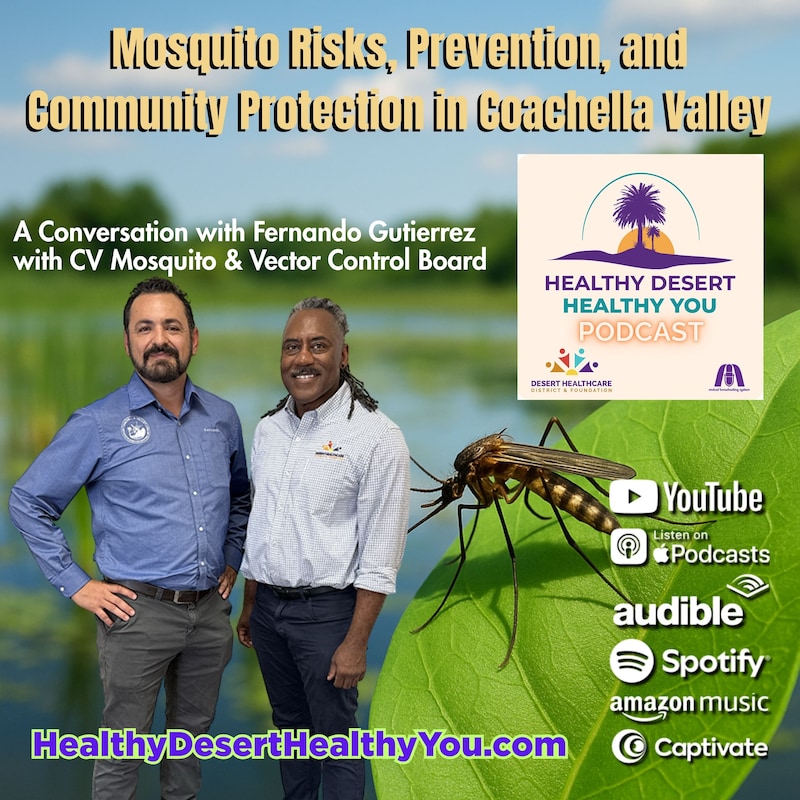
In this episode of the Healthy Desert Healthy You podcast, host Will Dean sits down with Fernando Gutierrez, Community Engagement Specialist with the Coachella Valley Mosquito and Vector Control District. Fernando explains the district’s nearly 100-year mission to monitor and control vectors—mosquitoes, rodents, fire ants, and more—that pose health risks to Coachella Valley residents. He discusses the region’s unusually active mosquito season, the spread of invasive Aedes aegypti mosquitoes, and the diseases they can transmit, including West Nile virus and St. Louis encephalitis. Fernando also highlights prevention strategies, the importance of eliminating standing water, and how residents can request services. Plus, he previews innovative district programs such as drone-assisted inspections and the sterile insect technique aimed at long-term mosquito control.
Takeaways:
- The district has monitored harmful vectors in the valley since 1928.
- Coachella Valley hosts more than a dozen mosquito species.
- Aedes aegypti is an aggressive, invasive daytime biter now found valley-wide.
- Standing water—even small amounts—creates mosquito breeding sites.
- Over 100 mosquitoes tested positive for viruses this season.
- Residents can request vector inspections and treatments at no cost.
- EPA-approved repellents (DEET, Picaridin, IR3535, OLE) offer reliable protection.
- New technologies like drones and sterile insect programs improve mosquito control.
#HealthyDesertHealthyYouPodcast #WillDean #DesertHealthcareDistrictAndFoundation #CommunityWellness #CoachellaValleyMosquitoAndVectorControlDistrict #MosquitoAwareness #PublicHealthEducation #AedesAegypti #WestNileVirusPrevention #StLouisEncephalitis #VectorControl #CommunityEngagement #MosquitoSeason #PreventMosquitoBreeding #StandingWaterPrevention #FireAntControl #DroneTechnology #SterileInsectTechnique #HealthAndSafety #CoachellaValley
Transcripts
ENGLISH followed by ESPANOL
TRANSCRIPT
Will Dean, Host: [:Fernando Gutierrez, Guest: Thank you Will. Thank you for having me. But it's a great honor to be here.
Will Dean, Host: So this is a very hot topic when it comes to mosquitoes in the Coachella Valley. Would you share with our listeners exactly what the district is and what it does its mission?
Fernando Gutierrez, Guest: Yes. We are a special district and we go back almost a hundred years for this area of the Coachella Valley. Our job is to keep an eye on the vectors, any insect or mammal that can affect our families, our community.
o as an agency. Going back to:Will Dean, Host: And you were telling me, we had a little bit of a discussion before the podcast and [00:01:00] you were telling me there are many different variants or species of mosquitoes.
Will Dean, Host: How many do we have in the Coachella Valley?
Fernando Gutierrez, Guest: Yes. In the Coachella Valley in this area, we have, we are special. We have more than a dozen of different species of mosquitoes, but our programs, our vector control programs, our mosquito control programs focus on three of those mosquitoes. Two of those are the Culex mosquitoes or the brown ones as we call 'em here.
Will Dean, Host: Okay.
Fernando Gutierrez, Guest: Those are the classic mosquitoes that we can find in. Let's think about irrigation channels. Let's think about areas where water is gonna sit there for a couple days. In our community also, we have the Salton Sea, which is one of the biggest bodies of water in California. We also keep an eye on those big bodies of water.
de the mosquito. And we also [:Fernando Gutierrez, Guest: And that mosquito in particular, we detected it in 2016, is now present in every single community of the Coachella Valley. So it's here and thriving.
Will Dean, Host: Here and thriving. So I mentioned earlier that a lot of people are talking about mosquitoes. Would you say it's been an unusually busy mosquito season and exactly what is the mosquito season in the Coachella Valley?
r can actually be a mosquito [:Fernando Gutierrez, Guest: So there's been an active mosquito season. Yes. Our data shows a little bit more than the average in regards to mosquitoes that we are trapping around our communities, and we also have will that new invasive mosquito, Aedes aegypti, which loves humans. It's a daytime biter. It's a mosquito that doesn't fly far and only requires a little bit of water.
Fernando Gutierrez, Guest: So that is the difference that our communities are seeing. Our families are during the day, are getting mosquito bites. We are sitting in our patios enjoying our, our lifestyle,
Will Dean, Host: right.
Fernando Gutierrez, Guest: And we are getting mosquito bites. And that is what our communities are also telling us. Yes, we have a longer mosquito season.
Fernando Gutierrez, Guest: And here in this area, I believe this, doesn't stop during fall season. We it just we have a longer mosquito season,
most familiar with West Nile [:Will Dean, Host: Could you talk a little bit about that and what are some of the other health risks besides West Nile virus?
Fernando Gutierrez, Guest: Yes. In this area, in the Coachella Valley, we do have some virus activity in mosquitoes. And that's exactly what our mosquito control programs do. Keep an eye on the mosquitoes flying in environment.
Fernando Gutierrez, Guest: So far this season we detected 13 positive mosquitoes with West Nile detected inside of them. And 96 samples of St. Luis Encephalitis, which is another mosquito-borne transmit disease. There's been over a hundred positive mosquitoes in the environment.
Fernando Gutierrez, Guest: And let me tell you this, Will, several human cases.
Will Dean, Host: Okay.
Fernando Gutierrez, Guest: There's been no human cases with West Nile here in this area in Chat Valley.
Will Dean, Host: That sounds like a tribute to the district in the work that you're doing.
Fernando Gutierrez, Guest: Thank you.
Will Dean, Host: Yeah,
Fernando Gutierrez, Guest: That's a difference our vector control programs make in our community.
Will Dean, Host: Yeah. How do you detect that there are mosquitoes carrying the virus here. What is that process like?
do Gutierrez, Guest: Yes. We [:Fernando Gutierrez, Guest: Once we, if we detect any virus inside the mosquito, our operations team. The size steps in and goes into that key location, looking for water sources, also doing treatments as needed. So everything, all program better control programs are based on science. Is we just don't select different parts of the city on this side, or we are gonna spray here or there?
Fernando Gutierrez, Guest: No, everything is based on science, on observation strappings, and we respond accordingly. We have been conducting treatments in different parts of the Coachella Valley. We did a few in Palm Springs. We did a few in Cathedral City, and this is in response to the high number of mosquitoes in that area as well.
if we detect a big spike of [:Will Dean, Host: But mosquitoes are present throughout the valley.
Fernando Gutierrez, Guest: That is correct.
Will Dean, Host: Okay.
Fernando Gutierrez, Guest: Yes. So yeah, and like I said, we have been experienced a little bit higher than the average in or especially in those culex Quin Facia, which is the Culex mosquito, and also in the Aedes aegypti mosquito, which is the invasive one that kind of transmit Dengue chicken Una and yellow fever. So it's an important mosquito to, keep an eye on.
Will Dean, Host: And that's the more aggressive mosquito
Fernando Gutierrez, Guest: That is correct. That's the daytime aggressive biters that I was describing prior. Okay.
Will Dean, Host: So what can citizens do to prevent mosquito bites? What are, what's your best advice?
Fernando Gutierrez, Guest: There's the best thing people can do is keep everything as dry as they can around, their dwelling, their home. It requires a quick inspection, no water, no mosquitoes. But if mosquitoes are already flying in the environment, mosquito repellent, we recommend four different products.
, Guest: Anything with DEET, [:Will Dean, Host: So that's anytime you go outside that you need to be sprayed and. Covered with DEET or some other type of repellent.
Fernando Gutierrez, Guest: Yeah I believe that's the best thing you can do Will, because when mosquitoes are biting you, oh, and by the way, only the female mosquito bites
Will Dean, Host: interesting.
Fernando Gutierrez, Guest: She's the one that looks at, needs that little boost of energy, that protein. To continue having babies.
Will Dean, Host: Ah
Fernando Gutierrez, Guest: so that way repellent is gonna make you smell different, less attractive to mosquitoes.
only provide a little bit of [:Fernando Gutierrez, Guest: So the best thing you can do, apply repelling to expose skin to protect you from mosquito bytes. And. That's approved by EPA and it's an effective way of keeping mosquitoes away from you.
Will Dean, Host: So we've been talking a lot about mosquitoes, but I know there are other vectors that you deal with as well.
Will Dean, Host: You mentioned rodents earlier, but what are some of the other types of insects, animals that you work with that through the district?
Fernando Gutierrez, Guest: Yes. We also have a additional program such as the Fire Ant program, which is a great one. We inspect and treat grass areas in the Coachella Valley. This is another good example of an invasive species.
Fernando Gutierrez, Guest: These are not native from this area, and now we're paying the price. They're, they are really hard to eradicate. They stay normally, stay in the grass areas, make little mounds. And our families are playing in the grass. Once you realize these aggressive ants are all over you and you can end up being in the hospital, if you are sensitive to bees, which, these are related to bees.
Will Dean, Host: Okay.
est: So that's a vector that [:Will Dean, Host: and the service is.
Fernando Gutierrez, Guest: It is a pesticide treatment in the grass.
Fernando Gutierrez, Guest: And that's gonna protect you suppressing this colony for a few months.
-:
Will Dean, Host: What is the most important information?
Will Dean, Host: What do, what should our listeners take away from this conversation in terms of dealing with this issue in the Valley?
Fernando Gutierrez, Guest: I say the takeaway message is keep everything as dry as you can. Mosquitoes fly, sometimes fly far, and they will find this area. And they will, if possible, make it a good habitat to continue their legacy.
have to start using mosquito [:Fernando Gutierrez, Guest: So this is one of the key missions that we all have to work together. So that's why our presence in community events, having that resource table. It's key. Also, Desert Healthcare District. You put together meetings where different agencies can, you know, gather resources, share, and work together with the same goal to provide these services for our residents of the Coachella Valley.
Will Dean, Host: Absolutely. And to clarify, so residents can actually call the district if they want their yard or an area in their home treated, right?
Fernando Gutierrez, Guest: That is correct. If you are experiencing something that is out of the ordinary you're keeping everything dry around your property and mosquitoes continue, call us. We can help you.
utierrez, Guest: We can send [:Will Dean, Host: I'm gonna go back to something you said earlier when I asked you about a season. You talked about the weather. We're here mid-November 2025. Beautiful weather. A little warm still. That seems ideal for mosquitoes, but earlier I believe that you said that they adapt as well, so they possibly would be around during the summer.
Fernando Gutierrez, Guest: That is correct. It's the cold weather. We slowed down mosquitoes a little bit.
Fernando Gutierrez, Guest: But they will be here. They'll continue being here. And like I said, mother Nature will find a way in our area. I say mosquito continue throughout the year.
Will Dean, Host: Oh, wow.
Fernando Gutierrez, Guest: We have to constantly keep in mind drive, keep everything as like we can.
k some repellent. That's the [:Will Dean, Host: Alright. Any other programs or projects that you wanna talk about the district is doing?
Fernando Gutierrez, Guest: Yeah. Lately I have the owner of working. We are getting some reports of brown dog ticks in the eastern part of the valley.
Fernando Gutierrez, Guest: So we, our teams are assessing some of these affected areas and we'll determine if we are gonna continue or create a program for that specific need. And I believe you're gonna have our laboratory manager, Jennifer Henke, here,
Will Dean, Host: yes.
Fernando Gutierrez, Guest: To talk about some of these interesting programs, but also we are conducting a special program, which is a pilot program about the sterile insect technique.
Fernando Gutierrez, Guest: In one of our areas where in this technique there's a male mosquitoes get sterilized with gamma ray and then release into the environment. And this male mosquito will find a female mosquito and mate, and their offering will not be viable. They will not, their eggs will not hatch.
Guest: And this is, has been [:Will Dean, Host: right.
Fernando Gutierrez, Guest: In addition to our vector control program. So that's really exciting.
Fernando Gutierrez, Guest: Also, the use of technology. Nowadays, our programs are using drones, which is a faster, more effective way of inspecting areas. Let's think about the Salton Sea where we send out some of our staff in the middle of nowhere. So this way a drone can go back and forward in a safe way fast and more effective.
Fernando Gutierrez, Guest: And we can also do pesticide applications in a precise way using this type of equipment,
Will Dean, Host: Oh wow. That's wonderful technology, but also the sterilization program. Sounds really interesting.
Fernando Gutierrez, Guest: Yes, it's been done going back to the sixties with flies. So now the mosquito control, vector control districts are doing this and I believe Orange County they're already doing some releases.
Fernando Gutierrez, Guest: And here we're still in the development of that program.
apping the mosquitoes in the [:Fernando Gutierrez, Guest: Actually, that is, it gets done inside the lab laboratory. So those mosquitoes are grown. Separated by gender and then treated and then released.
Will Dean, Host: Okay. I want to talk a little bit about the brown dog ticks. So these are ticks that, of course, affect dogs.
Will Dean, Host: And also humans. And what are the effects?
Fernando Gutierrez, Guest: Right now we just did a survey in some of these areas in the eastern part of the valley where this has been a report. And some things were collected.
Fernando Gutierrez, Guest: And that's where we're at right now.
Fernando Gutierrez, Guest: So there's no program in place. And Jennifer will elaborate more in regards to that.
Will Dean, Host: Yes, we are gonna have Jennifer on the podcast. I'm excited about that. So once again, for our listeners who have questions, want information, would you share the website again?
ing about repellent, talking [:Fernando Gutierrez, Guest: And this is a good way where people can get the good information, relevant information and to help us as a community effort.
Will Dean, Host: So listeners, you heard it, you just check out your social media for the Coachella Valley Mosquito and Vector Control District. Fernando, thank you for being here. Thank you for the great work that you're doing with the district.
Fernando Gutierrez, Guest: Thank you for having me. Will.
---------------------
TRANSCRIPCIÓN
Will Dean, anfitrión: [:Fernando Gutiérrez, Invitado: Gracias Will. Gracias por invitarme. Pero es un gran honor estar aquí.
Will Dean, anfitrión: Este es un tema muy candente cuando se trata de mosquitos en el Valle de Coachella. ¿Compartiría con nuestros oyentes exactamente qué es el distrito y qué hace su misión?
Fernando Gutiérrez, Invitado: Sí. Somos un distrito especial y nos remontamos casi cien años atrás para esta zona del Valle de Coachella. Nuestro trabajo es vigilar a los vectores, cualquier insecto o mamífero que pueda afectar a nuestras familias, a nuestra comunidad.
mos como agencia. Volviendo a:Will Dean, presentador: Y me decías que tuvimos una pequeña discusión antes del podcast y [00:01:00] me decías que hay muchas variantes o especies diferentes de mosquitos.
Will Dean, anfitrión: ¿Cuántos tenemos en el Valle de Coachella?
Fernando Gutiérrez, Invitado: Sí. En el Valle de Coachella en esta área, tenemos, somos especiales. Tenemos más de una docena de especies diferentes de mosquitos, pero nuestros programas, nuestros programas de control de vectores, nuestros programas de control de mosquitos se enfocan en tres de esos mosquitos. Dos de ellos son los mosquitos Culex o los marrones como los llamamos aquí.
Will Dean, presentador: Está bien.
Fernando Gutiérrez, Invitado: Esos son los mosquitos clásicos que podemos encontrar. Pensemos en los canales de riego. Pensemos en las áreas donde el agua se quedará allí durante un par de días. En nuestra comunidad también tenemos el Salton Sea, que es uno de los cuerpos de agua más grandes de California. También vigilamos esos grandes cuerpos de agua.
ro del mosquito. Y también [:Fernando Gutiérrez, Invitado: Y ese mosquito en particular, lo detectamos en 2016, ahora está presente en todas las comunidades del Valle de Coachella. Así que está aquí y prosperando.
Will Dean, presentador: Aquí y prosperando. Mencioné anteriormente que mucha gente está hablando de mosquitos. ¿Dirías que ha sido una temporada de mosquitos inusualmente ocupada y exactamente cuál es la temporada de mosquitos en el Valle de Coachella?
ser un problema de mosquitos [:Fernando Gutiérrez, Invitado: Ha habido una temporada activa de mosquitos. Sí. Nuestros datos muestran un poco más que el promedio con respecto a los mosquitos que estamos atrapando en nuestras comunidades, y también tenemos ese nuevo mosquito invasor, Aedes aegypti, que ama a los humanos. Es un mordedor diurno. Es un mosquito que no vuela muy lejos y solo requiere un poco de agua.
Fernando Gutiérrez, Invitado: Esa es la diferencia que nuestras comunidades están viendo. Nuestras familias son durante el día, están recibiendo picaduras de mosquitos. Estamos sentados en nuestros patios disfrutando de nuestro estilo de vida,
Will Dean, presentador: Correcto.
Fernando Gutiérrez, Invitado: Y estamos recibiendo picaduras de mosquitos. Y eso es lo que nuestras comunidades también nos están diciendo. Sí, tenemos una temporada de mosquitos más larga.
Fernando Gutiérrez, Invitado: Y aquí en esta área, creo que esto, no se detiene durante la temporada de otoño. Tenemos una temporada de mosquitos más larga,
el virus del Nilo Occidental [:Will Dean, presentador: ¿Podría hablar un poco sobre eso y cuáles son algunos de los otros riesgos para la salud además del virus del Nilo Occidental?
Fernando Gutiérrez, Invitado: Sí. En esta área, en el Valle de Coachella, tenemos cierta actividad viral en los mosquitos. Y eso es exactamente lo que hacen nuestros programas de control de mosquitos. Vigile los mosquitos que vuelan en el medio ambiente.
Fernando Gutiérrez, Invitado: En lo que va de la temporada detectamos 13 mosquitos positivos con el Nilo Occidental detectado dentro de ellos. Y 96 muestras de encefalitis de San Luis, que es otra enfermedad transmitida por mosquitos. Ha habido más de cien mosquitos positivos en el medio ambiente.
Fernando Gutiérrez, Invitado: Y déjame decirte esto, Will, varios casos humanos.
Will Dean, presentador: Está bien.
Fernando Gutiérrez, Invitado: No ha habido casos humanos con el Nilo Occidental aquí en esta área en Chat Valley.
Will Dean, anfitrión: Eso suena como un tributo al distrito en el trabajo que está haciendo.
Fernando Gutiérrez, Invitado: Gracias .
Will Dean, presentador: Sí,
Fernando Gutiérrez, Invitado: Esa es una diferencia que nuestros programas de control de vectores hacen en nuestra comunidad.
Will Dean, presentador: Sí. ¿Cómo se detecta que hay mosquitos portadores del virus aquí? ¿Cómo es ese proceso?
Fernando Gutiérrez, Invitado: Sí. Atrapamos mosquitos cada dos semanas en diferentes partes clave de la comunidad. Una vez que recolectamos esos mosquitos durante la noche, los llevamos a través de nuestro laboratorio, nuestras instalaciones, y tenemos los instrumentos para mirar dentro de esos mosquitos y detectar si hay virus dentro del mosquito.
Fernando Gutiérrez, Huésped: Una vez nosotros, si detectamos algún virus dentro del mosquito, nuestro equipo de operaciones. El tamaño interviene y entra en esa ubicación clave, buscando fuentes de agua, también haciendo tratamientos según sea necesario. Así que todo, todos los programas de mejor control se basan en la ciencia. ¿No seleccionamos diferentes partes de la ciudad de este lado, o vamos a rociar aquí o allá?
Fernando Gutiérrez, Invitado: No, todo se basa en la ciencia, en las correas de observación, y respondemos en consecuencia. Hemos estado realizando tratamientos en diferentes partes del Valle de Coachella. Hicimos algunos en Palm Springs. Hicimos algunos en Cathedral City, y esto es en respuesta a la gran cantidad de mosquitos en esa área también.
i detectamos un gran pico de [:Will Dean, anfitrión: Pero los mosquitos están presentes en todo el valle.
Fernando Gutiérrez, Invitado: Eso es correcto.
Will Dean, presentador: Está bien.
Fernando Gutiérrez, Invitado: Sí. Así que sí, y como dije, hemos experimentado un poco más que el promedio en o especialmente en esos culex Quin Facia, que es el mosquito Culex, y también en el mosquito Aedes aegypti, que es el invasor que transmite el dengue del pollo Una y la fiebre amarilla. Por lo tanto, es un mosquito importante que hay que vigilar.
Will Dean, presentador: Y ese es el mosquito más agresivo
Fernando Gutiérrez, Invitado: Eso es correcto. Esos son los mordedores agresivos diurnos que describía antes. Bien.
Dean, anfitrión: Entonces, ¿qué pueden hacer los ciudadanos para prevenir las picaduras de mosquitos? ¿Cuáles son, cuál es tu mejor consejo?
Fernando Gutiérrez, Invitado: Lo mejor que puede hacer la gente es mantener todo lo más seco posible alrededor, su vivienda, su hogar. Requiere una inspección rápida, sin agua, sin mosquitos. Pero si los mosquitos ya están volando en el medio ambiente, repelente de mosquitos, recomendamos cuatro productos diferentes.
do: Cualquier cosa con DEET, [:Will Dean, anfitrión: Entonces, cada vez que salgas a la calle, necesitas que te rocíen y. Cubierto con DEET o algún otro tipo de repelente.
Fernando Gutiérrez, Invitado: Sí, creo que eso es lo mejor que puedes hacer, Will, porque cuando te pican los mosquitos, ah, y por cierto, solo pica el mosquito hembra
Will Dean, presentador: interesante.
Fernando Gutiérrez, Invitado: Ella es la que mira, necesita ese pequeño impulso de energía, esa proteína. Seguir teniendo bebés.
Will Dean, Anfitrión: Ah
Fernando Gutiérrez, Invitado: así que de esa manera el repelente te va a hacer oler diferente, menos atractivo para los mosquitos.
roporcionan un poco de radio [:Fernando Gutiérrez, Invitado: Entonces, lo mejor que puedes hacer es aplicar repelente para exponer la piel para protegerte de los mosquitos. Está aprobado por la EPA y es una forma efectiva de mantener a los mosquitos alejados de usted.
Will Dean, presentador: Hemos estado hablando mucho sobre los mosquitos, pero sé que también hay otros vectores con los que se trata.
Will Dean, anfitrión: Mencionaste los roedores antes, pero ¿cuáles son algunos de los otros tipos de insectos, animales con los que trabajas en todo el distrito?
Fernando Gutiérrez, Invitado: Sí. También tenemos un programa adicional como el programa de hormigas de fuego, que es excelente. Inspeccionamos y tratamos áreas de césped en el Valle de Coachella. Este es otro buen ejemplo de una especie invasora.
Fernando Gutiérrez, Invitado: Estos no son nativos de esta área, y ahora estamos pagando el precio. Son, son realmente difíciles de erradicar. Se quedan normalmente, se quedan en las áreas de césped, hacen pequeños montículos. Y nuestras familias están jugando en el césped. Una vez que te das cuenta de que estas hormigas agresivas están sobre ti y puedes terminar en el hospital, si eres sensible a las abejas, que están relacionadas con las abejas.
Will Dean, presentador: Está bien.
vitado: Ese es un vector que [:Will Dean, anfitrión: y el servicio es.
Fernando Gutiérrez, Invitado: Es un tratamiento con pesticidas en el césped.
Fernando Gutiérrez, Invitado: Y eso te protegerá de la supresión de esta colonia durante unos meses.
-:
Will Dean, anfitrión: ¿Cuál es la información más importante?
Will Dean, anfitrión: ¿Qué hacen, qué deberían sacar nuestros oyentes de esta conversación en términos de tratar este tema en el Valle?
Fernando Gutiérrez, invitado: Yo digo que el mensaje para llevar es mantener todo lo más seco posible. Los mosquitos vuelan, a veces vuelan lejos, y encontrarán esta área. Y, si es posible, lo convertirán en un buen hábitat para continuar con su legado.
usar repelente de mosquitos [:Fernando Gutiérrez, Invitado: Esta es una de las misiones clave en las que todos tenemos que trabajar juntos. Por eso nuestra presencia en eventos comunitarios, tener esa mesa de recursos. Es clave. Además, Distrito de Atención Médica del Desierto. Organizas reuniones en las que diferentes agencias pueden, ya sabes, reunir recursos, compartir y trabajar juntas con el mismo objetivo de brindar estos servicios a nuestros residentes del Valle de Coachella.
Will Dean, presentador: Absolutamente. Y para aclarar, para que los residentes puedan llamar al distrito si quieren que se trate su jardín o un área de su hogar, ¿verdad?
Fernando Gutiérrez, Invitado: Eso es correcto. Si está experimentando algo fuera de lo común, está manteniendo todo seco alrededor de su propiedad y los mosquitos continúan, llámenos. Podemos ayudarte.
, Invitado: Podemos enviar a [:Will Dean, presentador: Voy a volver a algo que dijiste antes cuando te pregunté sobre una temporada. Hablaste sobre el clima. Estamos aquí a mediados de noviembre de 2025. Hermoso clima. Un poco cálido todavía. Eso parece ideal para los mosquitos, pero antes creo que dijiste que también se adaptan, por lo que posiblemente estarían presentes durante el verano.
Fernando Gutiérrez, Invitado: Eso es correcto. Es el clima frío. Ralentizamos un poco a los mosquitos.
Fernando Gutiérrez, Invitado: Pero estarán aquí. Seguirán estando aquí. Y como dije, la madre naturaleza encontrará un camino en nuestra área. Yo digo que los mosquitos continúan durante todo el año.
Will Dean, presentador: Oh, guau.
Fernando Gutiérrez, Invitado: Tenemos que tener en cuenta constantemente el impulso, mantener todo como podamos.
poco de repelente. Esa es la [:Will Dean, presentador: Muy bien. ¿Algún otro programa o proyecto del que quiera hablar sobre lo que está haciendo el distrito?
Fernando Gutiérrez, Invitado: Sí . Últimamente tengo el dueño de trabajar. Estamos recibiendo algunos informes de garrapatas marrones en la parte este del valle.
Fernando Gutiérrez, Invitado: Entonces, nosotros, nuestros equipos estamos evaluando algunas de estas áreas afectadas y determinaremos si vamos a continuar o crear un programa para esa necesidad específica. Y creo que van a tener a nuestra gerente de laboratorio, Jennifer Henke, aquí,
Will Dean, presentador: Sí.
Fernando Gutiérrez, Invitado: Para hablar sobre algunos de estos programas interesantes, pero también estamos llevando a cabo un programa especial, que es un programa piloto sobre la técnica del insecto estéril.
Fernando Gutiérrez, Invitado: En una de nuestras áreas donde hay una técnica en la que hay un macho, los mosquitos se esterilizan con rayos gamma y luego se liberan al medio ambiente. Y este mosquito macho encontrará un mosquito hembra y se apareará, y su ofrenda no será viable. No lo harán, sus huevos no eclosionarán.
Y esto es, se ha utilizado [:Will Dean, presentador: Correcto.
Fernando Gutiérrez, Invitado: Además de nuestro programa de control de vectores. Así que eso es realmente emocionante.
Fernando Gutiérrez, Invitado: También, el uso de la tecnología. Hoy en día, nuestros programas utilizan drones, que es una forma más rápida y efectiva de inspeccionar áreas. Pensemos en el Salton Sea, donde enviamos a parte de nuestro personal en medio de la nada. De esta manera, un dron puede ir y venir de forma segura, rápida y eficaz.
Fernando Gutiérrez, Invitado: Y también podemos hacer aplicaciones de pesticidas de manera precisa utilizando este tipo de equipos,
Will Dean, presentador: Oh, vaya. Esa es una tecnología maravillosa, pero también el programa de esterilización. Suena realmente interesante.
Fernando Gutiérrez, Invitado: Sí, se ha hecho desde los años sesenta con moscas. Así que ahora los distritos de control de mosquitos y control de vectores están haciendo esto y creo que el condado de Orange ya está haciendo algunas liberaciones.
Fernando Gutiérrez, Invitado: Y aquí todavía estamos en el desarrollo de ese programa.
rapas a los mosquitos en las [:Fernando Gutiérrez, Invitado: En realidad, es decir, se hace dentro del laboratorio del laboratorio. Así que esos mosquitos crecen. Separados por género y luego tratados y luego dados de alta.
Will Dean, presentador: Está bien. Quiero hablar un poco sobre las garrapatas marrones del perro. Así que estas son garrapatas que, por supuesto, afectan a los perros.
Will Dean, presentador: Y también humanos. ¿Y cuáles son los efectos?
Fernando Gutiérrez, Invitado: En este momento acabamos de hacer una encuesta en algunas de estas áreas en la parte oriental del valle donde esto ha sido un informe. Y se recogieron algunas cosas.
Fernando Gutiérrez, Invitado: Y ahí es donde estamos ahora.
Fernando Gutiérrez, Invitado: Así que no hay un programa en marcha. Y Jennifer elaborará más al respecto.
Will Dean, presentador: Sí, vamos a tener a Jennifer en el podcast. Estoy emocionado por eso. Entonces, una vez más, para nuestros oyentes que tienen preguntas, quieren información, ¿compartirían el sitio web nuevamente?
lando de repelente, hablando [:Fernando Gutiérrez, Invitado: Y esta es una buena manera en la que las personas pueden obtener buena información, información relevante y ayudarnos como un esfuerzo comunitario.
Will Dean, presentador: Entonces, oyentes, lo escucharon, solo revisen sus redes sociales para el Distrito de Control de Mosquitos y Vectores del Valle de Coachella. Fernando, gracias por estar aquí. Gracias por el gran trabajo que están haciendo con el distrito.
Fernando Gutiérrez, Invitado: Gracias por invitarme. Será.
