Shownotes
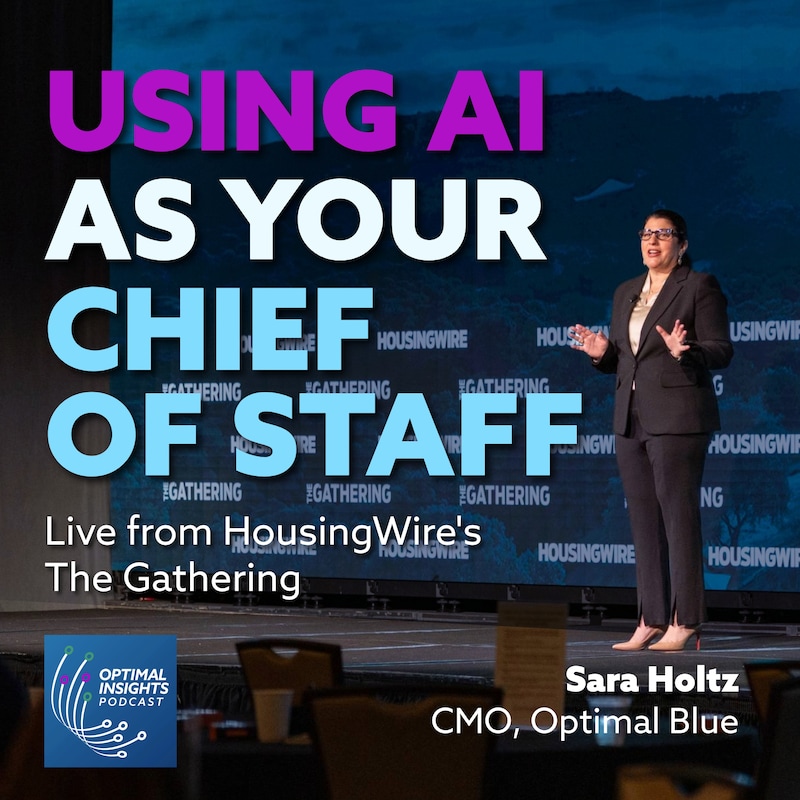
In this bonus episode of Optimal Insights, recorded at HousingWire’s The Gathering, Sara Holtz, CMO at Optimal Blue, shares a practical framework for how mortgage leaders can use AI to improve decision-making in a high-complexity market.
Sara reframes AI as a “chief of staff” that helps leaders organize information, surface insights, and create capacity when decision demands keep growing. She also outlines five principles leaders can apply immediately, including prompting with clarity, solving real problems, focusing on small repeatable wins, strengthening relationships, and cultivating decision confidence.
Sara also reflects on how these ideas connect to real innovation shifts over time, and why the opportunity with AI is often less about replacing expertise and more about supporting better thinking alongside it.
Commentary included in the podcast shall not be construed as, nor is Optimal Blue providing, any legal, trading, hedging, or financial advice.
Mentioned in this episode:
Get Ahead of What’s Next at Optimal Blue Summit 2027
The mortgage market keeps moving. Optimal Blue Summit 2027 brings together industry leaders, innovators, economists, and technology experts for three days of market intelligence, hands-on learning, and meaningful connections. Join us February 1–3 in Scottsdale, Arizona, to hear from Troy Aikman, Bob Broeksmit, Michael Fratantoni, Joe Tyrrell, and other influential voices shaping the future of mortgage. Optional training sessions and a championship golf experience are also available. Early-bird registration is just $199 through October 31. Register today at Summit.OptimalBlue.com.
Transcripts
Optimal Blue (00:18)
Welcome back to Optimal Insights. This is a bonus episode recorded at HousingWire's The Gathering featuring Sara Holtz, CMO at Optimal Blue. In this session, Sara shares a practical way to think about AI. Instead of treating AI as a shortcut or a replacement for expertise, Sara frames it as a chief of staff. And the idea is simple, use AI to help organize inputs, surface patterns, and support clearer decision-making, especially when complexity is high.
Sara also walks through five principles leaders can apply right away. If you are looking for practical ways to apply AI while keeping judgment and leadership at the center, this conversation is a strong place to start. Let's get into it.
Optimal Blue (00:59)
I am thrilled to be here and I'm especially thrilled to be here at the Women of Influence Forum because there's no better group to empathize that after three days of 85 % humidity I'm in a ponytail on stage.
It's not a surprise as leaders that our workload has multiplied. And not just in the tasks we have, but also in the decisions we have to make. What to prioritize, what to ignore, how we focus on what matters most. We're asked to move faster without getting it wrong. There's a real shift in how we think. In fact, researchers say that the average adult
makes 35,000 discrete decisions a day. I would venture to say that's even higher for the folks in this room. In an industry where we have variable data, unpredictable markets, and much more related to putting people into home ownership. At Optimal Blue, we spend a lot of time thinking about tools that help leaders and lenders make decisions and be able to focus on what matters most.
AI helps unlock amazing capacity. It reveals patterns, shows insights, and helps people make stronger decisions. Earlier this year at our summit, we launched a virtual economist, which is a comprehensive tool that allows leaders to look ahead in the market and help make better decisions. My responsibility in that development was to draft the descriptions for the avatars.
that personalize the experience for the user.
As my written descriptions morphed into faces, which morphed into voices speaking at the launch, I was reminded of the art of the possible. More importantly, it shows that decision complexity is real, especially for our industry. Now, as part of OB in the last two years, as I watched tools being developed, as I watched and realized that the purpose were all in this room,
is to increase availability of home ownership for many, I started to wonder about myself. How could I be leveraging AI better? But first, let me take you back to a time in my career when I had a similar innovation pivot. This is gonna age me. Back in the late 90s, I worked for the parent company of Monster.com. Remember that recruitment company? At the time, websites were just starting to take off.
And job hunting happened in a traditional way. You mailed paper resumes to companies in the address you found in the Yellow Pages. That's how I got this job. In fact, Monster Worldwide had a Yellow Pages division, an advertising division. That's the division I worked in. And at the time, there was a lot of question around what websites were going to do to this industry. At first, I was worried about my job as well.
But being young and being hungry, I said, wait a second, what if I pivoted my skill set into a digital medium and learned how to write and market through this thing called the website and thus launched a career that was built on changing and transforming channels backed by skills and experience. The lesson I learned back then stands true today. Technology transforms channels. It doesn't replace human value.
So back to today, I start thinking, all right, I'm not going to worry about my job as AI is starting to take a hold. I'm going to ask a different question. What if AI acted like my chief of staff? Who as a leader hasn't needed an EA at all times, right? Not a replacement for my thinking, but something to organize information, surface ideas.
support my decision making. The first step I did was I started with our marketing team. Now look, we have a small marketing team and we have big shoes to fill for Optimal Blue as a market leader. I didn't want what we needed in efficiency to replace what I value in our work, which has to be true and authentic, authentic of marketing, okay? So what we did is we took the tool that our company has,
And we created an agentic AI resource built on brand and style guidelines that we developed together. The entire team uses it to draft, to polish, and to help plan. In this way, every person in the department has a department intern. And it's truly, truly amazing. Now, as a marketer, and probably for many of us in this room, we know the first draft is never the final product. It still takes a lot of human effort
to turn early drafts into great outcomes. But there's no doubt we saved efficiency by using AI. I didn't stop with the team. You know, as leaders, the decisions we make every day are so immense. They happen at the same time and the same feeling of priority. In fact, I make the joke often that I feel more like a chaos coordinator than a leader. Now, I started asking again about this chief of staff concept.
How could I use tools available to me to make my life more efficient, more optimized, and more organized? I needed AI to be operationalized as a cognitive consultant. And as such, I decided to name how I was going to use AI, Coco. So I could say, let me ask Coco. Now, it also happens to represent my favorite brand. So it works on multiple levels.
But there's also a practicality to me using that name because I use it more intentionally. All right. So how does AI become your Chief of Staff? Well, through lots of trial and error, I've learned a few simple principles that have helped me leverage AI at work and at home. And I want to share those with you today. The first lesson I've learned is prompt with clarity. The clarity of what you put in the AI
impacts the quality of what you receive. At first, when I started using AI, I typed in, give me a marketing plan for this campaign. And I got what you expect, a generic, unusable, not very helpful response. So I tried again. I said, act like a CMO of a tech company who's leading the industry. Here's what we've tried before. Here's our target audience. Here's our competitors.
What are we missing? And I did, I brain dump. An output came that was amazing, helpful, and helped move our plan into a direction that innovated how we were marketing. That same principle can apply for anything you do with AI.
How you put clarity into your prompt is the quality of output you will get from AI. The second lesson I learned is solve the real problems. Do you remember when they did those memes for a while and you tried to follow the prompts to get the meme, but one arm was wrong? And then you tried to correct the arm, but it accidentally over-corrected the rest of the body? I'd spend hours trying to do ⁓ one entry and fix.
Not helpful, waste of time. So I reset. And on the day I was thinking about this, I had three critical meetings and two personal commitments, and I wasn't organized for any of that. We know that feeling, it's stressful. So I brain dumped into Coco again. I said, Coco, help me organize.
What was scattered in my brain was structured in seconds, and I was able to deliver at the best part version of myself throughout the day. That's when I learned solving real problems with AI is the true meat of using AI. The third lesson I learned is target small and repeatable wins. You know that time at five 30 when you're exhausted from making so many decisions and some
child who lives with you, walks in and says, hey, mom, what's for dinner? It suddenly becomes the hardest and most annoying question of the day. So I turned to Coco. I said, Coco, here's what we have in our pantry. Here's a typical grocery list. I have two children who are equally picky in completely different directions and a husband who needs to make a meal tonight.
And Cocoa output a matrix of meal options structured for how my husband makes decisions. It was unbelievable. I was clapping while it was happening. That's when I learned small repeatable wins actually do create capacity for you. The fourth lesson I learned is to supplement your relationships. I'm going to tell you a tale of two Joes. Joe Holtz, my husband, and Joe Terrell, my boss.
And I can tell you this, because neither of them are in the room.
My husband is amazing. He's dedicated to our family. He's a loving, loving man. And we operate very differently. Where I'm focused on strategy and planning, he wants to execute. And our honeydew list gets lost in translation. So I turned to Coco and I said, Coco, here's my list. need Joe to execute this week. Can you turn it into a list he can manage? And it did. And I gave it to him. Wow, you finally understand how I need this list.
So I tried again with my boss. Now for those of you who know, Joe Tyrell and I have worked together for a really long time at different companies. Well, he knew me back then in a different role. And as you rise to your executive roles, what gets you there is not the same thing you leverage when you're in the role. And I wanted to show up different to him. Now being Lebanese, half Lebanese, I'm very passionate, and I talk with my hands.
So I went to Coco and said, here's what I want to talk to Joe about. But I want to show up this way when I talk to him. And Coco populated a couple of bullets for me that I used to talk to him. And it was amazing. And I felt really good about the conversation. So AI helps you show up better in relationships. It really can. And don't be afraid to brain dump in it. The fifth thing I've learned is to cultivate decision confidence. As a leader,
There are often multiple paths forward. They all seem viable and none feel perfect. And I'm a type of person who will spin and spin on the right answer when nothing feels perfect. What will happen at D when I do ABC overthinking to the max. Now I leverage Coco and I say Coco here's what I need again brain dump. Here's what's happening. Tell me some options. Well Coco has started to learn how I work.
And I get replies like this. Here's my cocoa recommendation based on how you operate.
This is a real response from Coco AI on a flight I'm taking to New York next month.
By leveraging how AI reviews insights, data, and how it learns your patterns, it's all pattern-based, you really can help cultivate decision confidence in moments when there are different options for you to decide from. How relevant is that for our industry with the challenge of the decisions we're trying to make every day for not only people getting into home ownership, but also for our business?
incredible. Look, as leaders, we manage a lot of decisions. We burn a lot of capacity. We have a lot of priorities that we're managing. And there is no better way for us all to use AI than by these five simple things. Prompt with clarity, solve the real problems, target small and repeatable wins, supplement relationships,
cultivate decision confidence. If you think about it, those five things are not just about AI. They're about also how you show up as a leader. I've seen the power of AI at Optimal Blue. I'm going to continue using Coco to show up as a better leader at work and home. And in both cases, AI is fundamentally changing how we make decisions and show up. The future of leadership
is not about staying ahead of AI. It's about thinking better alongside it. Thank you, I'm thrilled to be here today.






