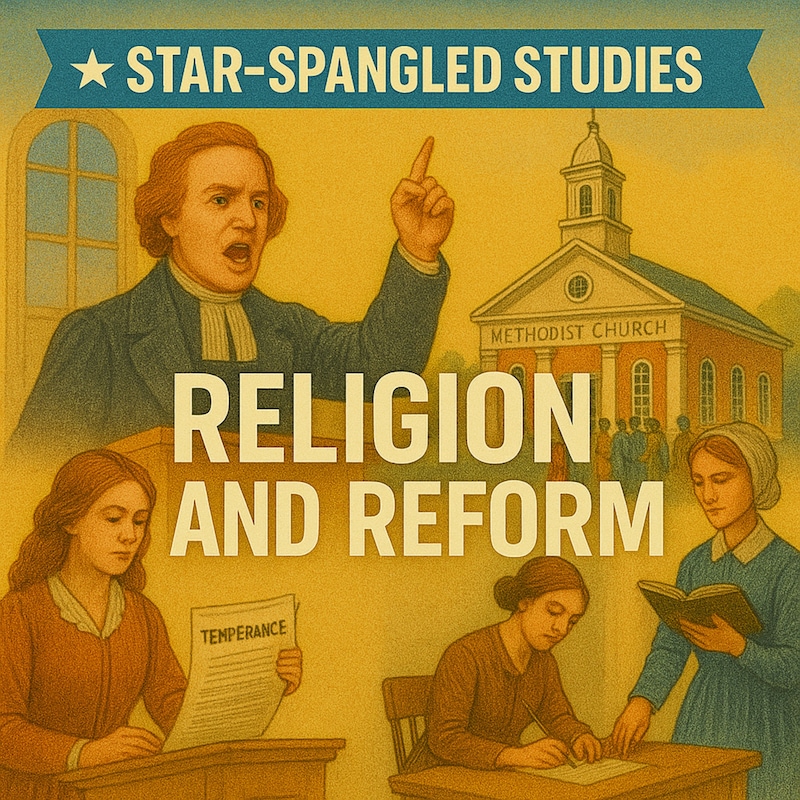
Shownotes
In Episode 10 of Star-Spangled Studies, Dr. G explores how faith ignited reform and shaped antebellum America. Key topics include:
• Second Great Awakening & Finney’s new theology
• Camp meetings, circuit riders & the rise of Baptists & Methodists
• “Burned-over District,” new sects & utopian experiments
• Transcendentalism: Emerson, Thoreau & self-reliance
• Benevolent Empire: temperance, asylums & public schools
• Radical abolitionism: Walker, Garrison & Douglass’s “What to the Slave…”
• Women in reform: Grimké sisters, Mott, Stanton & the 1848 Seneca Falls Convention
• Debates over social control vs. genuine revival
Stay connected with Dr. G and the podcast community:
📸 Instagram: @star_spangled_studies
Don’t forget to subscribe, rate, and share Star-Spangled Studies with fellow history lovers!
Episode 10 of Star-Spangled Studies dives into the Second Great Awakening and the reform wave it unleashed—revivals, utopian communities, transcendentalism, abolitionism, temperance, and the origins of the women’s rights movement.
Transcripts
Hello y'all.
2
:It's me.
3
:It's me.
4
:It's Dr.
5
:G, and welcome back to
Star Spangled Studies.
6
:Picture this, you are in Cain
Ridge, Kentucky, on the edge of the
7
:American frontier, but you are not
alone as far as the eye can see.
8
:There are people, 10,
maybe 20,000 of them.
9
:The air is thick with smoke
from a hundred campfires and the
10
:sound of a dozen preachers all
shouting at once from makeshift
11
:pulpits of tree stumps and wagons.
12
:People are crying, they're jumping.
13
:Some are speaking in tongues.
14
:Others faint dead away, overcome
by the sheer power of the moment.
15
:This wasn't just church.
16
:This was a religious wildfire.
17
:This.
18
:The second great awakening.
19
:So what's going on here?
20
:What lit the spiritual fuse that would
burn its way across the entire nation?
21
:The early 19th century was an age
of anxiety and optimism all at once.
22
:The country was expanding, the economy
was transforming, democracy was spreading.
23
:Well, at least for white men,
westward expansion, industrialization,
24
:and a flood of immigration were
radically altering how Americans
25
:saw themselves and their community.
26
:Amidst this dizzying change,
Americans began to ask
27
:themselves a profound question.
28
:Could we as individuals and
a nation become perfect?
29
:Could we build a literal heaven on earth?
30
:The answer for millions was a resounding
yes, and that belief would set in motion
31
:a tidal wave of reform that would change
everything from the bottle to the ballot
32
:box to the very chains of slavery itself.
33
:I'm Dr.
34
:G.
35
:Let's go.
36
:The heart of this firestorm was a.
37
:Fundamental revolution in American
religious thought for generations.
38
:The dominant theology, especially in
New England, was a stern unyielding.
39
:Calvinism.
40
:Calvinists believed that all humankind was
hopelessly marred by sin, and that an omni
41
:omnipotent God had already decided or.
42
:Predestined who would be saved
and who would be damned long
43
:before they were ever born.
44
:This was the faith of grim acceptance
where human action meant little
45
:in the face of divine decree.
46
:The second great awakening, however,
flipped the script completely on its head.
47
:It preached a new gospel, very
empowering because it emphasized
48
:that human action and individual
choice was what actually mattered.
49
:The most influential voice of this
new theology was a former lawyer who
50
:had turned into a fiery activist and
revivalist named Charles Grandes and
51
:Finney Finney argued that sin was not
an inescapable stain on one's soul.
52
:That it was actually a voluntary act.
53
:Therefore, salvation wasn't a lottery
ticket handed out by God at the beginning
54
:of time, long before you were born.
55
:Salvation was a choice, A
choice that any individual could
56
:make right here, right now.
57
:We can hear this radical message of human
agency in Finney's own words themselves.
58
:He saw conversion not as some
mysterious lightning strike, but as a
59
:rational decision taken on by humans.
60
:He challenged his listeners directly
telling them, quote, God requires
61
:you to turn and what he requires.
62
:Of you, he cannot do for you.
63
:These words were
revolutionary at the time.
64
:It took spiritual destiny out of the
hands of an inscrutable God and placed
65
:it firmly in the hands of the individual.
66
:So this new theology of
spiritual empowerment resonated.
67
:Perfectly hand in hand with the new
Democratic spirit of the age that we have
68
:been talking about in previous episodes.
69
:So it's no surprise then that the
biggest winners of the second Great
70
:awakening, if we can call them that were
the denominations that championed it.
71
:Those like the Methodists and the
Baptist with their populous structures,
72
:their use of itinerant or circuit
riding preachers who could reach remote
73
:frontier settlements, their passionate
emotional style of worship and preaching.
74
:These groups exploded in popularity.
75
:Meanwhile, the older, more formal
and hierarchical churches like the
76
:Episcopalians and the Congregationalists
with their university trained
77
:ministers and formal liturgies saw
their influence wane in this period.
78
:Its very style of the revival
itself was democratic.
79
:These massive outdoor camp meetings, like
the one I described at Cain Ridge, brought
80
:together people from all social classes.
81
:Preachers were often ordinary
men without the formal training.
82
:They were valued for their piety and
their passion rather than their econ,
83
:uh, educational or economic credentials
in a striking break from tradition.
84
:Women took on prominent public roles
as well, often exhorting the crowds and
85
:sharing their testimonies, claiming a
spiritual place and a spiritual authority
86
:in a society that otherwise denied them.
87
:This.
88
:This connection between religious and
political change was no coincidence, the
89
:spiritual egalitarianism of the revival.
90
:Dovetailed perfectly with the
political egalitarianism professed
91
:in the Jacksonian America.
92
:The old Calvinist model of predestination
with its fixed spiritual hierarchy
93
:mirrored an older, more deferential
social and political order that was.
94
:Not in time with the time, the new
message of the era, this evangelical
95
:message that any individual could choose.
96
:Salvation was the spiritual twin
of the Jacksonian political message
97
:that any white man could and should
participate in his own governance.
98
:The idea that you could save your
own soul was just as empowering as
99
:the idea that your vote mattered.
100
:This synergy created a perfect and
powerful cultural feedback loop,
101
:fueling a belief that if individuals
could perfect themselves, then they
102
:could certainly perfect their society.
103
:Historians love to argue and debate.
104
:Over big questions and little questions.
105
:And one big question that comes out of
this second great awakening in religious
106
:reform is, was this all genuine spiritual
revival or was something else going on?
107
:A prominent school of thought,
particularly influential from the sixties
108
:through the 1980s interprets these
revivals as, at least in some small
109
:part, a mechanism of social control.
110
:The argument goes something like this.
111
:As the market revolution created social
and economic chaos, a new middle class
112
:of managers, clerks, and business owners
felt the deep anxiety about the future.
113
:They embraced the new evangelicalism of
this powerful emphasis on self-discipline,
114
:sobriety industry in order they then
promoted this faith into the growing
115
:and often unruly urban working class.
116
:It was a way to instill middle class
values in their employees, creating a more
117
:stable, sober, and productive workforce
to serve the new industrial economy.
118
:So was it a heartfelt quest for God
or a clever tool for class discipline?
119
:The truth is, as often is the case we've
seen in previous episodes somewhere in
120
:that complicated, messy middle ground.
121
:This spiritual fire became so intense
in some places like the Erie Canal
122
:corridor of upstate New York that
preachers like Finney declared.
123
:There were no more souls there
left to convert the region.
124
:He said.
125
:Had been so thoroughly scorched by
the flames of revival that it was now.
126
:He called a burned over district,
but this fire couldn't be
127
:contained in traditional churches.
128
:It leapt from the revival tent
into the philosopher study and the
129
:Utopian Commune sparking radical
new visions for American life.
130
:The burned over district was more
than just a site of revivals.
131
:It was a laboratory of
religious innovation.
132
:The same energy, the spiritual energy
that fueled Methodist camp meetings
133
:also gave rise to entirely new religions
and radical social experiments.
134
:It was in this environment that a young
Joseph Smith claimed to have received
135
:visions from God and angelic beings.
136
:Leading him to publish the Book of Mormon
in:
137
:later named the Church of Jesus Christ
of Latter Day Saints or the Mormons.
138
:Other groups convinced that society
was too corrupt to be saved,
139
:chose to withdraw and build their
own miniature heavens on earth.
140
:These utopian communities
experimented with the most
141
:fundamental aspects of human life.
142
:Sex, family and property.
143
:The United Society of Believers in
Christ's second appearing better
144
:known as the Shakers practiced
strict celibacy, believing that
145
:the world was nearing its end.
146
:They lived in tightly knit communities
holding all property in common, and
147
:becoming famous for their ecstatic worship
services and their simple, beautiful,
148
:and functional furniture and design.
149
:And Stark contract to that was the one
community founded by John Humphrey.
150
:No.
151
:In New York.
152
:Now, Noyes preached a doctrine of
perfectionism, believing that true
153
:converts could become free of sin.
154
:He took this to his logical, and for
most Americans, shocking conclusion.
155
:The Edins rejected traditional marriage,
which they saw as a form of selfish
156
:ownership in favor of a complex marriage,
a carefully regulated system of free
157
:love, where every man was effectively
married to every woman and vice versa.
158
:If the shakers and Edins represented
the social frontier of the reform
159
:impulse, transcendentalism was the
intellectual and philosophical edge
160
:centered in the New England area.
161
:This movement included some of the most
famous names in American literature.
162
:Ralph Waldo Emerson, Henry David
Thoreau, and Margaret Fuller.
163
:Many were former Unitarian
ministers who found that even that
164
:liberal faith was too confining.
165
:They broke away to forge a new
spiritual path based not on scripture
166
:or doctrine, but on personal intuition.
167
:Their core belief was in a divine
universal spirit, which Emerson
168
:called the over soul, which connected
every person to God and to nature.
169
:Truth wasn't something to be found
in a Holy Book or in a Sunday sermon.
170
:It was something to be experienced
directly through introspection through
171
:your individual consciousness in a
deep communion with the natural world.
172
:Emerson.
173
:Urged Americans to stop looking to Europe
for their culture and ideas and to trust
174
:the divinity here and within themselves.
175
:In his 1841 lecture, the
Transcendentalist, he defined
176
:the idealist as one who insisted
on quote, the power of thought.
177
:And of Will on inspiration,
on Miracle on Individual.
178
:His most famous call was for radical
self-reliance for rejecting the
179
:soul, killing pressure of conformity.
180
:In his essay nature, he described
a mystical experience of
181
:becoming one with the universe.
182
:This intense focus on individualism,
however, created a fascinating
183
:tension within the broader
reform movement as a whole.
184
:While Transcendentalism grew from
the same perfectionist soil as
185
:abolitionism and temperance, which
we'll talk about in a minute, its
186
:primary focus was on self reform.
187
:Rather than social reform, the first
and more important project of a
188
:transcendentalist was not to change
the world, but to change oneself.
189
:This helps explain why some of
its leading figures were initially
190
:hesitant to join the organized
collective reform movements of the day.
191
:When F fellow transcendentalist
George Ripley founded the Utopian
192
:community Brook Farm in 1841.
193
:Emerson politely declined to join.
194
:He explained that he still had
far to travel on his own personal
195
:spiritual journey before he could
get so directly involved with the
196
:reformation of others' lives in society.
197
:The ultimate expression of this
impulse was of course, Henry
198
:David Thoreau's two-year retreat
at a cabin at Walden Pond.
199
:He went to the woods to quote,
live deliberately to strip down to
200
:its essentials and reform himself.
201
:Arguing that any meaningful society
change had to begin with the individual.
202
:It was only as the national crisis
over slavery deepened in the:
203
:figures like Emerson and Thoreau became
more outspoken activists, concluding
204
:that some social evils like slavery
were so profoundly corrupting that
205
:they made individual purity impossible.
206
:For many reformers, however, perfecting
the self was only the first step.
207
:The ultimate goal was to perfect society
by declaring war on society's sins.
208
:They formed what has been called a
benevolent empire to wage this war, and
209
:their first target was a foe found nearly
in every American town, the alcohol ball.
210
:Fueled by the righteous zeal of the
second great awakening reformers
211
:created a vast network of voluntary
societies aimed at eradicating social
212
:ills to create that perfect society.
213
:This interconnected web of organizations
became known as the Benevolent Empire.
214
:Its soldiers were the new
pious middle class, and they
215
:waged war on a dozen fronts.
216
:They sought to reform prisons to
build asylums for the mentally ill.
217
:A crusade famously led.
218
:By Dorothea Dix, as well as to promote
public education, to distribute Bibles
219
:and to stamp out prostitution, their
greatest and most immediate success
220
:came in the war against alcohol.
221
:In the early 19th century, Americans
drank staggering amounts of liquor
222
:far more than they do today.
223
:Um, and it's understandable why when
you could drink water and get any number
224
:of diseases drinking water itself.
225
:Wasn't a good social choice for you
personally or for society around you,
226
:but if you distilled that water and
made alcohol from it, somehow you
227
:didn't catch all of those diseases.
228
:So drinking alcohol in
that sense made sense.
229
:Now reformers, many of them women, linked
this rampant consumption to everything
230
:they saw that was wrong with society.
231
:Alcohol abuse led to poverty, domestic
violence, crime and economic inefficiency.
232
:The American Temperate Society
founded in:
233
:have over 200,000 members.
234
:They used powerful
propaganda including graphic.
235
:Lithographs by artists like
Nathaniel Courier that contrasted
236
:the disease, broken families of in
temperance with the prosperous, happy,
237
:churchgoing, families of temperance.
238
:The movement was su successful, it was
stunningly successful, and it helped
239
:to cut the average American's alcohol
onsumption by half during the:
240
:But perhaps the most divisive, the
most dangerous, and ultimately the most
241
:consequential of reform movements was
the one aimed directly at destroying
242
:slavery, and that would be abolition.
243
:For decades, the mainstream anti-slavery
movement had been dominated by
244
:cautious people that we would call
Gradualists, who advocated for a slow
245
:compensated end to slavery, and by
supporters of the American Colonization
246
:Society, which proposed sending freed
African-Americans back to Africa.
247
:This latter plan, while popular with
some prominent politicians, was fiercely
248
:condemned by most black Americans as a
racist scheme designed to get rid of them.
249
:Of its free black population.
250
:The 1830s, however, marked a
dramatic and crucial turning point.
251
:The movement for abolition shifted from
gradualism to imm or immediate abolition.
252
:The new radical demand was not for
a slow managed decline of slavery
253
:over several generations before.
254
:Its immediate, unconditional,
and uncompensated abolition.
255
:Slavery was not a problem to be managed.
256
:It was a sin to be eradicated.
257
:Now, the standard narrative on this shift
too often centers on white abolitionists
258
:like William Lloyd Garrison, but this
misses a very crucial part of the story.
259
:The move to IMM was profoundly influenced
and in many ways directly caused by
260
:the powerful and uncompromising voices.
261
:Of black abolitionists who shamed
and inspired their white counterparts
262
:into adopting a more radical stance.
263
:In the 1820s, Garrison
himself was a supporter of
264
:gradualism and of colonization.
265
:But by the end of that decade in
:
266
:David Walker published his appeal to
the colored citizens of the world.
267
:Walker's Appeal was a thunderous
denunciation of American hypocrisy,
268
:a scathing attack on colonization,
and a warning that God's justice
269
:would bring violence to the slave
holding states of the of the South.
270
:It was a revolutionary call
for black pride for unity and
271
:resistance to the slave states.
272
:Walker's words and those of other
black northerners like James
273
:Ford had transformative effect.
274
:And the historical record is clear.
275
:Reading these tracks
changed garrison's mind.
276
:Just two years after Walker's Appeal
st,:
277
:launched his own abolitionist
newspaper called The Liberator.
278
:In its very first issue, he made
a stunning and public reversal
279
:issuing an unequivocal recantation.
280
:His words of his former.
281
:Gradualist views.
282
:He wrote that he had publicly quote,
ask pardon of my God, of my country,
283
:and of my brethren, the poor slaves
for having uttered a sentiment so full
284
:of timidity and justice and absurdity.
285
:End quote.
286
:The radicalization of the white LED
abolitionist movement, therefore was
287
:not simply an internal evolution.
288
:It was a direct response to the moral
and intellectual leadership of black
289
:activists who refused to compromise
on the issue of their own freedom.
290
:The most powerful of all voices
belonged to a man who had lived
291
:slavery's horrors and escaped its grasp.
292
:Frederick Douglass, a brilliant writer
in one of the 19th Century's greatest
293
:orators, delivered a speech in Rochester,
th,:
294
:laid bare the nation's soul standing
before the white audience gathered
295
:to celebrate American independence.
296
:He asked the searing question
of them, what to the slave.
297
:Is your 4th of July, and he answered
his own question with breathtaking
298
:force Fellow citizens, pardon
me, allow me to ask, why am I
299
:called upon to speak here today?
300
:What have I.
301
:Those I represent to do with your national
independence are the great principles
302
:of political freedom and of natural
justice embodied in that Declaration
303
:of Independence extended to us and am
I therefore called upon to bring our
304
:humble offering to the national altar
and to confess the benefits and express
305
:devout gratitude for the blessings
resulted from your independence to us.
306
:I am not included within the pale
of this glorious anniversary.
307
:Your high independence only reveals
the immeasurable distance between us.
308
:The blessings in which you this day
rejoice are not enjoyed in common.
309
:The rich inheritance of justice, liberty,
prosperity, and independence, bequeathed
310
:by your father's is shared by you, not me.
311
:The sunlight that brought
light and healing to you has
312
:brought stripes and death to me.
313
:The fourth July is yours, not mine.
314
:You may rejoice.
315
:I must mourn to drag a man in Fetters
into the grand illuminated temple of
316
:Liberty, and call upon him to join you in
joyous anthems where inhuman, mockery and
317
:sacrilegious irony do you mean citizens
to mock me by asking me to speak this day.
318
:End quote.
319
:And he goes on to say even more, allow
me to quote in depth quote, what to
320
:the American slave is your 4th of July?
321
:I answer A day That reveals to him
more than all other days in the year,
322
:the gross injustice and cruelty to
which he is the constant victim to him.
323
:Your celebration is a sham.
324
:Your boasted liberty and unholy
license, your national greatness.
325
:Swelling, vanity.
326
:The sounds of rejoicing
are empty and heartless.
327
:Your denunciation of tyrants,
brash fronted impedance.
328
:Your shouts of liberty
inequality hollow mockery.
329
:Your prayers and hymns.
330
:Your sermons and thanksgiving
with all your religious.
331
:Parade in som the are to him mere bombast,
fraud, deception, and piety and hypocrisy.
332
:A thin veil to cover up crimes which
would disgrace a nation of savages.
333
:There is no nation on earth.
334
:Guilty of practices more shocking and
bloody than are the people of the United
335
:States at this very hour end quote.
336
:As you would imagine, this
new uncompromising radicalism
337
:provoked a furious backlash.
338
:Abolitionist presses were destroyed,
and activists like Elijah love, joy.
339
:Were murdered by pro-slavery
mobs in the North in Washington.
340
:A bipartisan coalition of Congress
passed the gag rule, which automatically
341
:tabled any position and petition
related to slavery without it even
342
:being read on the Congress floor.
343
:A direct assault on a
abolitionist freedom of speech.
344
:This fight for freedom forced
many to ask a critical question.
345
:Freedom for whom.
346
:As women poured their hearts, soul
and labor into the abolitionist cause
347
:they began to look at their own lives.
348
:Their own lack of rights for
women, their own legal subjugation
349
:and recognize their own chains.
350
:The battle to end slavery was
about to ignite another rebellion,
351
:one that began at a tea party.
352
:In Antebellum America, the lives of
most white, middle class women were
353
:governed by the powerful ideology that
historians call the cult of domesticity,
354
:or the cult of true womanhood.
355
:Women were expected to embody four
cardinal virtues, piety, purity.
356
:Submissiveness and domesticity.
357
:Their proper sphere was the home
where they were tasked with being the
358
:spiritual guardians of the family,
raising virtuous children, and
359
:creating a haven from the corrupting
influences of the outside world.
360
:This cultural ideal was reinforced
by a harsh legal reality under the
361
:ancient legal doctrine of curvature.
362
:A married woman had no separate
legal identity from her husband.
363
:Her legal existence was
covered by his existence.
364
:He gained legal control over any property
she owned when they married any wages she
365
:earned and had legal authority over their
children as the Declaration of sentiments
366
:would later put it in the eyes of the law.
367
:A married woman was civilly dead.
368
:Ironically, women skillfully use this very
ideology that can find them to the home
369
:to fashion a public role for themselves.
370
:If they were society's designated
moral guardians, then wasn't
371
:it their duty to confront the
moral evils plaguing the nation?
372
:This logic propelled thousands of women
in this time period into the reform
373
:movements of the benevolent empire,
especially temperance and abolition.
374
:So the link then to the fighting
to end slavery and the fight to
375
:gain women's rights was a direct.
376
:Personal powerful link.
377
:Women like Lucrecia, Mott Elizabeth,
Katie Stanton, Lucy Stone, and
378
:the remarkable Grimke sisters.
379
:And, uh, Sarah and Angelina were
tireless and effective abolitionist
380
:speakers and organizers as they
worked to break the chains of the
381
:enslaved men and women in the South.
382
:They were constantly
confronted by their own chains.
383
:As women, they were
criticized, they were heckled.
384
:They were condemned by ministers and
community leaders for speaking in
385
:public, for daring to step outside
of their proper domestic sphere.
386
:This opposition led them
to a profound realization.
387
:They saw the direct parallel between
the subjugation of black enslaved
388
:people and the subjugation of women.
389
:As Syria Grimke powerfully argued, quote,
whatever is morally right for a man to
390
:do is morally right for a woman to do.
391
:The final straw came at the 1840 World
Anti-Slavery Convention in London.
392
:After traveling across the Atlantic,
the American female delegates,
393
:including Lucrecia Mott, and a young
Elizabeth Ka Stanton were denied seats
394
:and barred from participating simply
because they were women outraged.
395
:It was there in London that they resolved
to hold a convention in the United
396
:States to discuss the rights of women.
397
:That brings us to the Seneca
Falls Convention in:
398
:That idea, born out of being.
399
:Disrespected in London came to fruition
eight years later at a tea party at the
400
:home of Jane Hunt in Waterloo, New York.
401
:Stanton Mott and a few other women
decided that the time was now they
402
:placed an ad in a local paper.
403
:And on July 19th, 1848, about 300
people, mostly from the surrounding
404
:area, gathered in the Wesleyan
Chapel in Seneca Falls for the first
405
:ever convention on women's rights.
406
:The centerpiece of the convention
was the Declaration of Sentiments, a
407
:document primarily drafted by Stanton.
408
:It was a stroke of rhetorical genius.
409
:She deliberately modeled it on the
Declaration of Independence to link the
410
:cause of women's rights directly to the
nation's most sacred founding ideals.
411
:But it began with a revolutionary edit.
412
:We hold these truths to be
self-evident that all men.
413
:And women are created equal.
414
:The document then laid out a long list of
quote, repeated injuries and usurpations
415
:on the part of man towards woman,
which included denying her the right
416
:to vote, the right to her own property,
and wages, and access to education,
417
:and profitable employments, all with
the direct object of establishing an
418
:absolute tyranny over her end quote.
419
:The convention passed a series of
resolutions, but one was far more
420
:controversial than all others.
421
:The demand for suffrage the right
to vote, the idea was so radical at
422
:the time that even the progressive
Lucrecia Mott feared it would make
423
:the entire convention look ridiculous.
424
:The resolution was on the verge
of failing until one man stood
425
:up to speak in its defense.
426
:Other than Frederick Douglass, his
passionate argument swayed the crowd and
427
:the resolution passed by a narrow margin.
428
:For more than the century.
429
:The Seneca Falls Convention was
enshrined in American history as the
430
:unambiguous singular starting point of
the organized women's rights movement.
431
:But in recent decades, some historians
have challenged this narrative with
432
:scholars like Lisa Tetra going so far
as to call it the myth of Seneca Falls.
433
:The argument is not that the
convention didn't happen or that
434
:it wasn't important, rather that.
435
:Elizabeth Katie Stanton and Susan B.
436
:Anthony, who were brilliant strategists
and masterful historians of their own
437
:movement later constructed an origin story
that deliberately placed their convention
438
:at the absolute center of the struggle.
439
:This powerful narrative shaping helped
unify their wing of the sufferers
440
:movement and wrote a clear, heroic,
and politically useful history.
441
:Other historians like Rosemary Zari.
442
:Argued that the debate over women's
political rights actually began
443
:much earlier in the ferment of
the American Revolution itself.
444
:So was the Seneca Falls birthplace
of American feminism, or was
445
:it a pivotal watershed moment?
446
:Was it an powerful and an enduring symbol?
447
:Created in hindsight, it's a debate that
remind us as, again, we've seen that
448
:history is not about what happens or just
about what happens, but is also about the
449
:stories we choose to tell about it later.
450
:Regardless though, these reformers,
the preachers, the philosophers, the
451
:abolitionists, and the feminists in
their quest for a more perfect nation
452
:had unleashed forces of liberation
that would reshape the United States.
453
:But even as they fought for the
nation's soul in the north, a
454
:different kind of revolution was
solidifying its power in the South.
455
:It was a revolution of production,
of wealth and of human bondage.
456
:A kingdom built not on ideals, but on a
simple white fiber that was tightening
457
:its grip on the nation in the world.
458
:So next time on Star Spangled Studies, we
are going to descend into the heart of the
459
:south, into the heart of King Cotton, and
we're gonna explore another revolution of
460
:the 19th century, the cotton revolution.
461
:I'm Dr.
462
:G.
463
:I'll see y'all in the past.