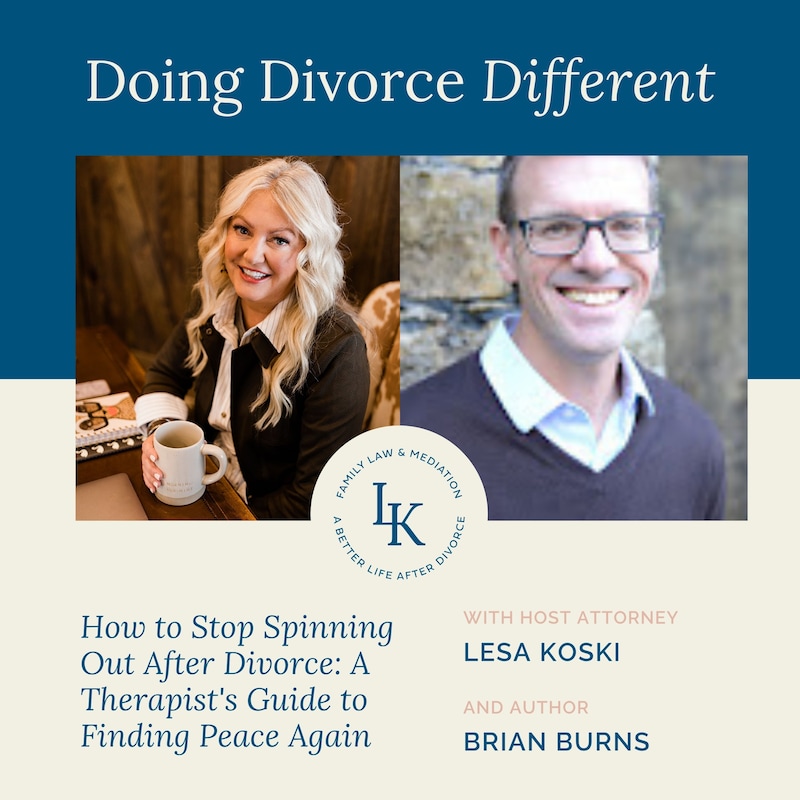
Shownotes
Divorce recovery, anxiety, betrayal, emotional healing, and finding peace after divorce—if you've ever felt like your mind won't stop spinning, this episode is for you.
Why do we replay conversations, obsess over the past, or constantly worry about the future after divorce or a painful life transition?
In this episode of Doing Divorce Different, I sit down with therapist Brian Burns to explore why our minds "spin out" after divorce, betrayal, grief, cancer, and other unexpected life events. We discuss practical tools for calming anxious thoughts, letting go of what we cannot control, and finding peace even when life doesn't go as planned.
As someone who has personally walked through breast cancer, difficult seasons in marriage, and years of helping women navigate divorce, this conversation deeply resonated with me. Brian shares simple but life-changing concepts that can help you stop carrying burdens that were never yours to carry.
Whether you're considering divorce, healing after divorce, navigating betrayal, or simply feeling overwhelmed by life, this episode will remind you that peace doesn't come from controlling everything—it comes from learning where your responsibility begins and ends.
If you've ever felt emotionally exhausted from trying to fix everyone around you, this conversation is for you.
🎙️ If this episode encourages you, please subscribe, leave a review, and share it with someone who may need a little hope today.
Timestamps
(00:00) Why women "spin out" after divorce and difficult life events
(03:15) Introducing therapist Brian Burns
(07:42) Why our brains become trapped in anxiety and overthinking
(13:28) Understanding what belongs to you—and what doesn't
(20:05) The connection between betrayal, fear, and trying to control outcomes
(27:46) Lesa shares her breast cancer journey and lessons about surrender
(36:30) Faith, acceptance, and learning to live with uncertainty
(45:18) Practical tools for calming your mind when you begin spinning
(54:40) Finding peace in the middle of life's hardest seasons
(1:02:10) Final encouragement and next steps
Key Takeaways
- Trying to control other people's choices often creates more anxiety than peace.
- Healing begins when we learn the difference between our responsibility and someone else's.
- Divorce, betrayal, illness, and grief can all trigger emotional "spinning," but there are healthy ways to interrupt that cycle.
- Faith, mindfulness, and healthy boundaries help us navigate uncertainty with greater peace.
- You don't have to have every answer today. Your next right step is enough.
Guest Bio
Brian Burns is a licensed therapist, speaker, and educator who helps individuals and couples navigate anxiety, relationships, emotional healing, and personal growth. His practical approach combines clinical experience with compassionate insight, helping people understand why they become emotionally overwhelmed and how to move toward healthier patterns of thinking, communication, and peace.
Transcripts
Welcome listeners to Doing Divorce Different.
2
:I am so excited today, truly, like
very energized to have my friend
3
:Brian Burns back on the podcast.
4
:Brian, it makes me feel
like I'm really back.
5
:You know, I feel like I took a little
break- Oh, yeah … from a lot of divorce
6
:work, and I've been doing this a while.
7
:But you're kind of the first of many
great interviews to come up solely about
8
:divorce and helping women through it.
9
:So I'm just grateful to have you.
10
:Thank you for being here.
11
:Speaker 2: Well, thank you,
Lisa, for that warm welcome.
12
:I, um, I'm happy to be back
after the, the brief hiatus,
13
:and- … it has been a while, so-
14
:Speaker: Yeah
15
:Speaker 2: this is fun.
16
:I think, um, I should change
my, uh, title on the, on the
17
:screen here to say Brian Burns I.
18
:There you go.
19
:I, I like, I like that.
20
:I'm not sure I believe it,
but I do- … I do like
21
:Speaker: it.
22
:No, it's true.
23
:There is like something turn…
24
:It's kind of a turning point.
25
:I've been slowly ebbing my way to really
getting back into this work, and I feel
26
:like today is a big day towards that.
27
:So-
28
:Speaker 2: Yeah.
29
:Well,
30
:Speaker: good for
you … it's kind of exciting.
31
:Yeah.
32
:So listeners, if you don't know Brian,
he's been on podcasts in the past,
33
:and he's like my favorite therapist.
34
:And, and if you're wondering why am
I here today, it's because I wanna
35
:talk, Brian, about spinning out.
36
:And I actually had a divorce coaching
client asking me, "How do I stop
37
:spinning out about my ex-husband?"
38
:And so I want to look at that, and
I think it applies to everything.
39
:I mean, I can spin u- spin
out about health issues,
40
:about money, about anything.
41
:So-
42
:Speaker 2: Yeah, yeah
43
:… Speaker: kind of what
I want to talk about.
44
:Okay.
45
:And I think when you're, when you've got
an ex-spouse and maybe there's betrayal
46
:or you don't know what happened- Mm-hmm
47
:um, maybe there's a little more to it.
48
:So would you mind just kind
of talking about tools?
49
:Speaker 2: Sure.
50
:Sure.
51
:Um, through, uh…
52
:Well, just the context for people
that maybe don't know me, um, I'm
53
:a marriage and family therapist.
54
:Most of my, uh, and I've been
doing this work for, boy, 25…
55
:I graduated from, uh, grad school in
:
56
:Speaker: Yeah.
57
:Speaker 2: 26 years.
58
:Um, and most of my work is with couples
who are, uh, on the brink of divorce.
59
:I do what's called discernment
counseling, helping people on the
60
:brink to make a decision about
the next steps in their marriage.
61
:Speaker: Mm-hmm.
62
:Speaker 2: And those that choose to
repair together, we work hard, we
63
:dig in and make the right changes.
64
:And those that choose to, uh, separate
or divorce, um, for their own good
65
:reasons, uh, I help set them up in a
collaborative, uh, uh, f- respectful,
66
:you know, effective- Mm-hmm … process.
67
:Um, so that's, that's sort of
me, uh, from a 30,000-foot view.
68
:Speaker: And I'm glad- Back to your- I'm
very glad that you brought that up, Brian.
69
:Yeah.
70
:Not to interrupt you, because we're
going to go back to our topic.
71
:Right.
72
:But a lot of our listeners, that
is always the big question, "How
73
:do I know if it's time to divorce?"
74
:You know?
75
:Oh, yeah.
76
:I mean, I've got people, I've got people
that come to me when they're ready, and
77
:I have people when they're like, "Ugh."
78
:I have one right now, a gal
out in California, she's
79
:trying to make that decision.
80
:Mm-hmm.
81
:So I just, I, I send
people to you all the time-
82
:Speaker 2: Well- … to
work with you … um, yeah.
83
:If you haven't, uh, posted something
on discernment counseling recently,
84
:then get that on your, uh, queue.
85
:Speaker: Yeah.
86
:Speaker 2: Because I think,
you know, that you won't…
87
:It's not a guarantee that you'll know the
right time to- To, to work on it still
88
:or not, but it's a really effective tool.
89
:Um, so listeners, if you
haven't heard that term, it's,
90
:you know, easily searchable on
Google and AI to find out more.
91
:Speaker: Yeah.
92
:Speaker 2: Experiment counseling.
93
:Speaker: Yep, and I will have you
in the show notes as well so people
94
:can just click there to find- Yeah
95
:yeah.
96
:And you're easy to find, so.
97
:Speaker 2: You go to my website, I've got,
you know, information about it and links
98
:to find out more, so that, that's great.
99
:Speaker: Wonderful.
100
:Okay, so good.
101
:Okay.
102
:So once the-
103
:Speaker 2: Spinning out
104
:… Speaker: yeah, the spinning out.
105
:Let's talk about spinning out.
106
:Spinning out over someone cheating on you.
107
:Spinning out
108
:Speaker 2: over- So this isn't…
109
:Yeah.
110
:So this just isn't just, um,
specific for a divorcing person
111
:or divorced person- Yeah … you
know, obsessing about their…
112
:I, I say obsessing.
113
:I mean, when I hear spec- spinning out,
it's like my emotions t- got control of
114
:me, hijacked my brain, and I just can't
keep thoughts of ex- Yeah … from not
115
:invading my, you know, my current reality.
116
:So that could be an ex-husband or
ex-spouse, or it could be your kid and
117
:the trouble they're in or the problem
they're having, or, um, in- infidelity.
118
:Could be anything.
119
:Speaker: Yep.
120
:Speaker 2: Yeah.
121
:And so I…
122
:You know, differentiating feelings from
fact and, um, differentiating what's-
123
:one's own business to deal with and what's
someone else's business to deal with.
124
:Uh, I think that those are two key
mantras or phrases that work for me
125
:and for clients that I work with, and
I'll tell you what I mean about that.
126
:Speaker: Yeah.
127
:Yeah, go, go deeper there because when
you say that, I question, like, okay,
128
:what do you mean what's my business?
129
:Speaker 2: Oh, yeah, yeah.
130
:Speaker: You know?
131
:Yeah.
132
:Speaker 2: Uh-huh.
133
:Uh-huh.
134
:Yeah, that's, that's, uh,
provocative language potentially.
135
:You know, like, if your
spouse is cheating on you, um-
136
:Speaker: It's your business
137
:… Speaker 2: definitely, definitely your
business- Yeah … um, to know about that.
138
:But here's what I mean, and I'll
start there 'cause that's, you
139
:know, got, got the attention here.
140
:Is that, um, what, what's my bus-
What I mean by my business versus
141
:your business is what is my business?
142
:W- what, what do I have control over?
143
:Mm-hmm.
144
:Um, what do, what are my
thoughts that happen in my brain?
145
:Speaker: Mm-hmm.
146
:Speaker 2: Uh, versus what do you
have control over, and what do…
147
:are the thoughts that
happen in your brain?
148
:And there's a clear line, uh, that's not
hard for rational people to differentiate,
149
:you know, where that line is.
150
:W- it's, uh, it…
151
:Because skin exists to demarcate that
line, you know, what I have control over
152
:and what I don't have control over and
what my thoughts are versus someone else.
153
:And so, um, like, for, like,
this is an example that I think
154
:could easily happen daily and
probably did earlier in my career.
155
:You know, I'm a young therapist sitting
in front of a tough couple, and they're
156
:arguing, and I'm unable to do or say
anything that derails that argument.
157
:I mean, that feels horrible.
158
:Speaker: Mm-hmm.
159
:Speaker 2: Um, and I rem- I d- I, I think
I remember these days well enough that
160
:I would spin out, to use that language,
afterwards, you know, in the evening- Yeah
161
:… thinking, "Man, you're so stupid."
162
:Like- … like, did you learn
anything in grad school?
163
:Uh, why are they even
seeing you, you know?
164
:They probably will fire
you after that meeting.
165
:Um, you're probably in the wrong
job, and you- Oh … should've been,
166
:you know, a truck driver 'cause
they don't have to talk to anybody.
167
:Speaker: Right.
168
:Speaker 2: Um, like, that's a, that's
kind of an example of, of spinning out.
169
:And what I did is that I made
it my responsibility that
170
:they were having an argument.
171
:Speaker: Right.
172
:Um,
173
:Speaker 2: I took on that job of something
that I don't have any control over,
174
:whether or not someone else argues.
175
:Um, you know, I have control over
what I say or what I do, but I don't
176
:have any, any responsibility there,
so it's really not my business-
177
:Mm-hmm … is, is what I'm saying.
178
:Um, here's another example,
or using the same example.
179
:How they think about me- As
a therapist, not my business
180
:Speaker: Mm-hmm
181
:Speaker 2: If they choose to tell
me how they think about me, well,
182
:then it becomes my business.
183
:Mm-hmm.
184
:You know, they made that,
that autonomous choice.
185
:If your ex-spouse chooses to share
something with you, then that
186
:becomes your business to deal with.
187
:But if they're not saying a thing, you
thinking about it, you know, what they're
188
:thinking, what they're doing, what they
think about you now, not your business.
189
:Speaker: Yeah.
190
:Speaker 2: Um, a- and, and even if it
were, you know, you'd have to figure
191
:out what you could do about it or not.
192
:Speaker: Right.
193
:Speaker 2: And, and in the, in the,
in most cases, you don't even know.
194
:Speaker: It- yeah, and it's
interesting what I've learned in
195
:my life is there's not a whole heck
of a lot that I have control over.
196
:Speaker 2: No.
197
:Speaker: No.
198
:And it's kind of freeing.
199
:Speaker 2: It's tot- well,
it, uh, I love this phrase.
200
:"Not my circus, not my monkeys."
201
:It just sounds…
202
:It's just fun to say.
203
:Speaker: Oh, yes.
204
:Speaker 2: And, and to think.
205
:Like, that, that…
206
:And what I mean is that's not my business.
207
:Speaker: Yeah.
208
:Speaker 2: Not my business to deal
with, not my business to change.
209
:Um, that person can try to make it
my business, and if I love and care
210
:about them, then I might take it on,
you know, 'cause I, 'cause I care.
211
:But if, uh, if I can't, even if I love
and care about them, then I shouldn't.
212
:And if I don't want them in my life or
they're not that important to me, then
213
:I definitely don't wanna make it my
business- Right … or take it on or spend
214
:any, you know, like, thoughts that invade
my mind, 'cause that's what it is- Mm-hmm
215
:like, thought invasion when we're
just not in good control of, of…
216
:'Cause nobody can control the thoughts
that pop in your mind or the feelings
217
:that you feel, but you can choose what
you do with them, what you do about
218
:them, and whether or not they stay there.
219
:Speaker: Yeah.
220
:I love what you're saying because
i- through my journey, I kinda
221
:ebb and flow, and it takes work.
222
:You know, like, I learned a big surrender,
and now I have to keep remembering that
223
:every day 'cause I am a people pleaser.
224
:And I might start spinning out
about, "Oh, I wonder what they
225
:think of me," and then I go, "Whoop.
226
:N- you know- Yeah … not mine.
227
:I'm a vessel here to do my work."
228
:Yeah.
229
:And that's it, and I g-
I need to let that go.
230
:Yeah.
231
:But I wanna talk a little bit, 'cause
I think about, like, some clients
232
:that I have and, and the, one of the
spouses betrayed through a lie, not
233
:necessarily an affair, but betrayed
the other spouse and then came
234
:clean after years of the betrayal.
235
:And the, uh, the husband is the spouse
that feels betrayed, and he cannot
236
:stop thinking and asking questions
about something that happened well
237
:before they were together but that's
something that she had lied about, right?
238
:Speaker 2: Yeah.
239
:Speaker: He, he…
240
:And, and, and the, the wife- is
sorry, has- Okay … forgiven herself-
241
:Speaker 2: Okay
242
:… Speaker: and wants to move on.
243
:Okay.
244
:And doesn't want to keep going back
and, and sometimes it does seem a
245
:little bit like the husband wants to
shame- Huh … maybe a little bit.
246
:Speaker 2: Yep.
247
:Yeah.
248
:Speaker: Um, so- Yeah … and it, and,
and yet, I, I always see both sides.
249
:Like, I kind of feel sorry for him too,
and it's like he cannot stop looking.
250
:He's not trusting anything that-
Yeah … she's saying even now.
251
:Speaker 2: Yeah.
252
:Speaker: Looking and digging and,
and just doesn't stop thinking
253
:about it, and it's been over a year.
254
:Speaker 2: So, you know, what you
described, and, uh, you know, there's a
255
:lot of, of not knowing the context, but
what, but, but just based on what you've
256
:described, um, that's one spouse who
very likely has had the chance to ask
257
:the questions and fully understand the
nature of what happened, the nature of the
258
:betrayal, understand what it was, why it
happened, why she did what she did- Yeah
259
:what she learned from it, how it impacted
her, and what she thinks about it now.
260
:Like, th- that's the important thing to
understand, uh, about a betrayal because
261
:then you can know what to do about it.
262
:If you- Okay.
263
:Speaker: So, interestingly enough It
seems as though when I've worked with
264
:them, 'cause I do marital mediation too
sometimes, that she is stating this,
265
:and he's kind of not willing to see it.
266
:Oh.
267
:He's kind of not, not going there.
268
:Speaker 2: Okay.
269
:So-
270
:Speaker: Not understanding
271
:… Speaker 2: yeah, yeah, yeah.
272
:And, and what is he…
273
:Well, um- Uh, so you know, like,
uh, that, those are the things one
274
:spouse would need to, to understand,
to get information, to ask questions.
275
:I mean, that's what you're looking
for, is the data, the important
276
:data so that you can decide what
to do about this, um, betrayal.
277
:'Cause some betrayals, you know, you
might d- with all the right information,
278
:you might decide to end the relationship.
279
:Many others, you know, we decide-
Yeah … to understand what that means
280
:and what to do about it, and it ends
up strengthening the relationship.
281
:What this spouse seems, you know…
282
:And people can ask questions
and want different things.
283
:He's asking questions,
um, to keep her down.
284
:Speaker: Yeah.
285
:Speaker 2: To
286
:Speaker: punish,
287
:Speaker 2: to keep her in a position
below him so that, you know…
288
:And, and not, I'm not
saying intentionally.
289
:Mm-hmm.
290
:Like, this is things that people do
intuitively without even knowing that
291
:that's what they're really doing.
292
:Um, so it's a punishment, you know?
293
:Like, in, maybe in his childhood
nobody ever let things go, so
294
:it's like, "This is what you do."
295
:And s- when you have something
over someone, you keep them
296
:down through bringing it up
again and, and punishing them.
297
:'Cause then I don't, you know, then
I don't really have to deal with
298
:the pain of having been a person
that is, stays in a relationship
299
:where there's been a betrayal.
300
:Um, I mean, in my mind,
there's no shame in that.
301
:You know?
302
:Like, there's great strength.
303
:Speaker: Well, and I
think that, yeah, this
304
:Speaker 2: is- That's something
that people tell themselves.
305
:Speaker: Right.
306
:There's, this is interesting too.
307
:There was a betrayal on his part
early on- Mm-hmm … that he admits
308
:he would have never told her, but
she found out through other means.
309
:And h- when, and it was a long time ago.
310
:And so when asked, "Why
would, why did that happen?"
311
:I don't know.
312
:Speaker 2: So not willing to
answer or, or able, you know-
313
:Speaker: Not willing or able, yeah
314
:… Speaker 2: to, to answer the same
kinds of questions about what, why-
315
:Speaker: Yeah
316
:… Speaker 2: and what to do about it.
317
:Yeah, the why question.
318
:It's so important to know how to handle
a betrayal is to understand the why.
319
:It's actually much more important
to understand the why than
320
:the what in my, in my work.
321
:Speaker: Okay.
322
:I love that.
323
:And
324
:Speaker 2: I really-
325
:Speaker: I love that, Brian.
326
:Yeah … per-
327
:Speaker 2: personally, I mean, I know
spouses care a lot, but I don't really
328
:care, you know, how many times they did
it or where- … or in what positions.
329
:I know other people care a lot about that.
330
:Speaker: Yes.
331
:Speaker 2: But I want to, I really
want to know why and what he was
332
:going for, or she, in, in your-
Yeah … in, and, and, and did he
333
:get it, or she, in that situation-
Yeah … and what do we do about it?
334
:That's what I want to know, and
often they will say, "I don't know.
335
:It's happened."
336
:So
337
:Speaker: then what, what
do you do from there?
338
:Speaker 2: Um, it's not, that's not true.
339
:It's not an acceptable answer.
340
:Like, how do you expect us to
heal and move forward if, uh,
341
:that's the best that you can do?
342
:And, you know, I, I don't say
that in quite such a shaming way.
343
:Um- Right … I, I would say it,
it, you know, like, if that's the
344
:b- best answer, if you really don't
know, then you really don't know.
345
:Can't force you to know
something you don't know.
346
:But would you be willing to dig deeper?
347
:Speaker: Right.
348
:Speaker 2: Um, because I don't know that
that i- answer will lead to healing.
349
:That will lead to- Right … you
staying exactly where you are in this
350
:relationship, which is a place of pain.
351
:Speaker: Yeah.
352
:So that's so good, and that's so
helpful when you're kind of working
353
:together and staying in that marriage.
354
:Speaker 2: Mm-hmm.
355
:Speaker: Now let's go to couple B.
356
:Speaker 2: Yeah.
357
:Speaker: And, and it's actually not
couple B because the other one's gone.
358
:The other, one spouse is gone, and
they've betrayed the other spouse.
359
:Let's just say the woman was betrayed,
not that that's always- Okay … the case.
360
:So she was betrayed.
361
:Speaker 2: Yep.
362
:Speaker: He's gone.
363
:He doesn't want to stay married.
364
:And she is spinning out.
365
:My word's spinning out,
and she doesn't want to.
366
:She doesn't wanna think about it.
367
:She feels kind of stupid that
she- Uh- … let it happen.
368
:Speaker 2: Totally.
369
:Speaker: Which I am like, what?
370
:That's not, you know, of course you-
Well- … trust your spouse … well,
371
:Speaker 2: cu- cult- culturally, you
know, like we feel- Yeah … like we're
372
:the stupid ones when someone betrays us.
373
:Speaker: Mm-hmm.
374
:Speaker 2: It's not true, but
it's, that's a normal feeling.
375
:Speaker: Yeah.
376
:Yep, yep.
377
:So how do we help someone
who's going through that?
378
:It, so I think, and I always think
it's kind of a betrayal even when
379
:someone hasn't maybe had an affair,
but they're done with the marriage.
380
:Oh, right.
381
:And they don't give a reason and-
382
:Speaker 2: Oh, there's lots
of ways we can betray our-
383
:Speaker: Yes
384
:Speaker 2: our vows.
385
:Yeah.
386
:Speaker: Yes.
387
:Speaker 2: Yeah, like infidelity
is just the, the big one.
388
:The wor- like considered the worst.
389
:But no, like we, we…
390
:Lots of ways.
391
:Speaker: Yeah.
392
:Well, and I just have to
say, this is so interesting.
393
:Have you read the book Strangers?
394
:Speaker 2: No.
395
:Speaker: I think it's called Strangers.
396
:Oprah had the author on and it was
about a woman whose husband left
397
:her, and she had three pretty grown
children, and she doesn't know why.
398
:Speaker 2: Hmm.
399
:Speaker: And she kind of spun out,
and she has to live with that.
400
:So how does somebody…
401
:And she just kind of told her story,
but she didn't give any advice
402
:on, "Oh, how are you going to…"
403
:You know, just- So she- I
guess you can't control it.
404
:Is that it?
405
:Speaker 2: So she ha- wait, she had
three adult children and didn't know why?
406
:Well, they're not
407
:Speaker: adults.
408
:Thre-
409
:Speaker 2: They're older … okay, three,
three children that didn't know wh-
410
:and didn't know why she had children?
411
:Speaker: And he wouldn't…
412
:Well, he, she knew he had an affair.
413
:I think it's called Strangers.
414
:I'll correct this in
the intro if I'm wrong.
415
:Speaker 2: Oh, like she was- she
wasn't the biological mother?
416
:Speaker: No, she is.
417
:She's the mother.
418
:He's the father.
419
:They've been married forever, okay?
420
:And so, and, and she thinks
their marriage is going great.
421
:And all of a sudden during COVID, she
finds out that he's cheating on her.
422
:The husband of the other woman calls
her, and she tells him, and he said,
423
:"Oh, it was just a one-time thing."
424
:And then the, the affair
woman tried to commit suicide.
425
:The other lady, not the,
the one that wrote the book.
426
:Mm-hmm.
427
:And the guy just decides right then and
there he's done with the marriage, and
428
:he leaves her, and she doesn't know why.
429
:And she spun out- Oh … for years-
430
:Speaker 2: Okay
431
:… Speaker: about what was wrong.
432
:Yeah, yeah, yeah.
433
:Like, yeah.
434
:She thought they had-
435
:Speaker 2: Yeah
436
:… Speaker: such a great marriage.
437
:Um, and she doesn't know why.
438
:And so when you say when you're working
together to stay with someone- Oh,
439
:Speaker 2: yeah … knowing
440
:Speaker: the why is so important,
but what if that person's gone and
441
:they're not gonna tell you why?
442
:Speaker 2: Yeah.
443
:I, well, not, you know, like-
444
:Uh, my hunch, I don't know if this is
right, but it's a self-esteem problem.
445
:It's that you're…
446
:This person that you're, you're using
as an example feels like, "If I just
447
:knew why, um, if I had answers, if I
could answer that question, I would
448
:know what it was that I was wrong about
me that I could do- Yeah … better-
449
:Speaker: Yes
450
:… Speaker 2: and not have this happen
to me again, 'cause this is horrible."
451
:Speaker: Mm-hmm.
452
:Speaker 2: And, um, that's…
453
:It, it is…
454
:It's a non-answerable question, and it
indicates probably a self-esteem problem.
455
:So if, if…
456
:I would say to her, "That sucks, you know,
that you were with somebody who either by
457
:choice or ability was unable to give you,
um, information that you deserve to have,
458
:and would have been very helpful to you."
459
:Speaker: Mm-hmm.
460
:Speaker 2: Um, but that's a self-esteem
problem on his side, that he either
461
:couldn't or wouldn't, worse wouldn't-
462
:Speaker: Yeah
463
:… Speaker 2: sh- share with you
this important information.
464
:Um, and that's on him, you know?
465
:Mm-hmm.
466
:Like, that's a failing of his, which
to me vindicates you even more.
467
:Speaker: Mm-hmm.
468
:Speaker 2: Like, you can walk away from
this marriage knowing that- There's
469
:nothing that I can learn from this other
than life can be shitty and you throw
470
:you curve balls sometimes and you- Yeah
471
:don't even know it, it's happening.
472
:And, and you don't need the answers
that you're looking for, uh, to
473
:be a happy, healthy, good person.
474
:You don't need those answers from
him because he's already revealed
475
:to you that he's not, that they're
not trustworthy in the first place.
476
:Speaker: Right.
477
:Speaker 2: It's a corrupted vessel-
478
:Speaker: Mm-hmm
479
:Speaker 2: that you're getting it from.
480
:And so making that your business to
know, he's not either able or willing.
481
:Right.
482
:So that's his business.
483
:Leave it, leave it with him.
484
:Speaker: Okay.
485
:Speaker 2: His problem to deal with.
486
:His circus and his monkeys.
487
:Speaker: Yes.
488
:And so, so that all makes complete
sense, and it's interesting,
489
:Brian, 'cause I'm just gonna bring
my own little story into this.
490
:So I mean, I'm a life coach too, right?
491
:So I'm all about mindset, and I felt like
I had things so figured out where I'd
492
:go, "Oh, is that true what I'm think…"
493
:You know what I mean?
494
:I would just que- go through and
question things and be able to kinda
495
:tame my mind and maybe let things go
by changing the stories in my head.
496
:And then when they caught that stage
one breast cancer, holy Catalina.
497
:I like, there…
498
:I, I'm like, I can't s- I
didn't even do coaching, my own
499
:coaching for probably a year.
500
:I just walked my trails.
501
:Speaker 2: Yeah.
502
:Speaker: And I, you know, and that's the
thing that's interesting, like, we can…
503
:It's great.
504
:Like, I love being able to look at
how I'm feeling and try to change it,
505
:but sometimes, and I, and I feel like
when someone leaves you, when you get
506
:diagnosed with something, when something
happens to your child, I mean, those are
507
:big moments where you're like, "Ugh!"
508
:Like how…
509
:And, and I guess, like, advice,
now you jump in with your advice.
510
:Here's advice that I've gotten, is
breathe and, like, move your body.
511
:Yeah.
512
:Because you kind of can't…
513
:And what, and then we talked before
too about that's where I learned
514
:the surrender, the letting it go
because it was such a eye-opener
515
:because I thought I was so healthy.
516
:I had everything figured out.
517
:I was doing everything I could, and yet-
I don't have control over everything.
518
:No.
519
:Enjoy your fricking life.
520
:Speaker 2: Yeah.
521
:Speaker: Be as healthy
as you can, have fun-
522
:Speaker 2: Yeah
523
:… Speaker: love people, and
then let her go because-
524
:Speaker 2: Yeah
525
:… Speaker: but it's hard to do.
526
:It's hard to get there, and I had to
go through something really hard to
527
:get there, and I don't want everyone
to have to go through that hard.
528
:Speaker 2: Well, I think we all sooner
or later go through, you know, stuff-
529
:Yeah … that, that, uh, where our old
coping strategies just aren't sufficient.
530
:Mm-hmm.
531
:And then it sound- sounds
like that happened to you.
532
:Speaker: Mm-hmm.
533
:Speaker 2: And good for you
for, um, having the wherewithal
534
:to go on a lot of walks.
535
:Just, just move.
536
:Yeah.
537
:'Cause, yeah, you can't fix that.
538
:Speaker: Mm-mm.
539
:Speaker 2: A- and you certainly
can't feel good about it.
540
:Speaker: No.
541
:Um- Well, that was the thing
that was so interesting, Brian,
542
:is I learned how to be patient-
543
:Speaker 2: Yeah
544
:… Speaker: in affliction, and
there's a Bible verse about that.
545
:Speaker 2: Mm-hmm.
546
:Speaker: I just was patient.
547
:I had hope.
548
:I had great hope.
549
:That was the thing.
550
:Uh, like everyone was like-
551
:Speaker 2: Yeah
552
:Speaker: "You're gonna…
553
:You're fine.
554
:You're gonna be fine.
555
:It's cu- " You know what I mean?
556
:Mm-hmm.
557
:But it was kind of this waiting and
not feeling great, but there was a
558
:weird peace that came in that waiting
by holding onto that hope, and I
559
:guess that's what I can give you.
560
:If someone has betrayed you or left
you and you're s- you're spinning
561
:out in that, yep, it's gonna suck.
562
:You're gonna just have to be patient
in that affliction and keep hoping.
563
:Keep remembering that there's still hope.
564
:Yeah.
565
:You still can have a great relationship.
566
:Yeah.
567
:I don't know.
568
:What are your thoughts?
569
:Speaker 2: Well, what…
570
:You know what, what people tend to do that
the- these coping strategies that work
571
:for, for a time, or sometimes a long time,
you know, work harder, keep yourself busy.
572
:Uh, dive into a project.
573
:Uh, get love from your, from your
spouse or your parent or your kids.
574
:Speaker: Mm-hmm.
575
:Speaker 2: Um, you know, uh, drink a lot-
… 'cause that, I mean, like that, you know,
576
:that can help get you through a tough day.
577
:I'm, like, I'm not gonna
say it's 100% evil.
578
:There's consequences, but-
579
:Speaker: Yes … y-
580
:Speaker 2: you know, like, um…
581
:But what you're talking about, uh, uh,
a serious illness, a divorce, a serious
582
:betrayal, I mean, those are things
that you can't work your way out of.
583
:Um, and so what you do, uh, I think
is, is, is just be honest that- There's
584
:nothing you can do to control this
or fix it, and feeling bad about it
585
:is exactly the right way to feel.
586
:Right.
587
:Like if you didn't grieve or feel
pain or feel fear, then you're a
588
:robot or like someone brainwashed
you out of those feelings.
589
:Right.
590
:So that would be…
591
:That, and that wouldn't be wanted.
592
:So to ac- not only accept that this
is how you're, how you feel, like
593
:I'm maybe pushing the boundary here a
little, like be grateful that you're
594
:human and that you can respond with
all of the range of human emotions.
595
:And then as you say, Lisa, be patient with
yourself, that these things take time.
596
:And that, you know, just because you
feel horrible, pain, fear, sadness,
597
:grief, whatever it is, uh, that
you won't feel that way always.
598
:Speaker: Right.
599
:Speaker 2: And that's hope.
600
:That's, you're instilling hope.
601
:I feel that way now, but I
won't feel that way always.
602
:I may, I may feel that way tomorrow.
603
:I may feel that way a month from now.
604
:Speaker: Mm-hmm.
605
:Speaker 2: But a year
from now, I don't know.
606
:I might feel actually very different.
607
:I might feel good.
608
:I was, uh, working once with a guy,
um, your example reminded me of this,
609
:and his, uh, wife cheated on him
And I think they mutually decided
610
:to divorce, but he was devastated.
611
:Like it was- Yeah … um,
his second marriage.
612
:He put a ton of in, you
know, emotional investment-
613
:Speaker: Yeah
614
:… Speaker 2: in this, this one working,
had children, you know, very int-
615
:uh, intentionally through IVF, um,
knowing that he could count on the
616
:relationship and then that happened.
617
:It's just devastating.
618
:Speaker: Yeah.
619
:Speaker 2: Um, and what he did was he
listened to the same song on Spotify.
620
:It w- I don't remember.
621
:Raindrops.
622
:It, the, the song popped into
my head, so listen- Raindrops
623
:Speaker: Keep Fallin' On My Head?
624
:Is that-
625
:Speaker 2: Uh, no.
626
:No, it's
627
:Speaker: like-
628
:Speaker 2: No?
629
:No.
630
:You know, this, this pod, this
podcast episode sponsored by
631
:the song Raindrops on Spotify.
632
:Um, it's a, it's a instrumental,
it's just- Okay … a catchy
633
:little instrumental with like t-
uh, synthesized music probably.
634
:Speaker: Uh-huh.
635
:Speaker 2: No words.
636
:Um, very repetitive, soothing.
637
:Um, and he, uh, listened
to that constantly he said.
638
:He just couldn't stop because it helped
his, it helped his brain not spin.
639
:He would work out, take care of his kids,
go to- Yeah … go to his job, um, talk
640
:to friends when he could, and then listen
to his, the song in his, in his earbuds.
641
:Yeah.
642
:He said his kids just learned to know,
"Yep, Dad's listening to Raindrops."
643
:Oh.
644
:That's, that's how he got through
a period of about six to 10 months
645
:that were very, very difficult.
646
:But today he's, you know, not doing that.
647
:I don't think he's listening to
Raindrops in, you know- Uh-huh.
648
:Right … years and he has a
very, very, very good life.
649
:I think he would agree with me.
650
:Speaker: Yes.
651
:Speaker 2: Um-
652
:Speaker: And I think when you go through
that hard stuff, my life is better.
653
:Speaker 2: Mm-hmm.
654
:Speaker: I've learned so-
and it, and it's interesting.
655
:I will say one thing.
656
:I did take care of myself.
657
:It became my number one priority,
and I did amazing through all the
658
:treatment because I just focused
on resting and walking and working
659
:out as much as I could- Mm-hmm
660
:and doing all the things, and
even though I felt a little
661
:bit of a scared dullness in me.
662
:So but here was another thing.
663
:I'm just going off here now on
my little story, on a tangent.
664
:It's your
665
:Speaker 2: podcast.
666
:You can do whatever you want.
667
:Speaker: All right.
668
:So at the same time that that happened
to me, a friend of mine we thought
669
:was going through the same thing.
670
:You know, we thought, "Oh, it's stage one.
671
:You know, it's gonna be…
672
:You're gonna have to go through
junk, but it's gonna be fine."
673
:Well, as it turned out for
her, um, it was stage four.
674
:It was a different story.
675
:Speaker 2: Mm-hmm.
676
:Okay.
677
:Speaker: And mine, like I feel kinda
like almost- Like I didn't have the
678
:right to feel that bad about it because
everybody kept saying, "This is nothing.
679
:We've got this.
680
:It's cured."
681
:You know, don't…
682
:A- and she doesn't get to hear that.
683
:She still- Yeah … is living with-
684
:Speaker 2: Yeah
685
:… Speaker: it, it's her number one priority.
686
:Speaker 2: A more serious element.
687
:Speaker: How do you deal with that?
688
:Yeah.
689
:How do people deal with that?
690
:And I know, I, I talked to the
oncologist about it, and she said,
691
:"You would be surprised, Lisa, a lo-"
And this is interesting to me, a lot
692
:of women can live years with this-
693
:Speaker 2: Okay
694
:Speaker: cancer-
695
:Speaker 2: Yeah
696
:… Speaker: and, and do great.
697
:But just to think, I just, I feel so
blessed that I didn't have to go through
698
:that, maybe a little guilty that she is.
699
:Speaker 2: Sure.
700
:Sure.
701
:Speaker: And, um, I just don't
know how you deal with something
702
:like that because I had hope.
703
:Where's her hope?
704
:Speaker 2: It's the same.
705
:I don't think it's different.
706
:It's just- Okay … it's just harder.
707
:Yeah.
708
:Well, you know, your question about
hope, and thanks for bringing that
709
:up again, I, I think it's crucial.
710
:Um, this is something
religion does very, very well.
711
:You know, religion doesn't do everything
well, but I think it does hope very, very
712
:well, in giving something greater than
oneself to have to place your hope in.
713
:So if you don't have something in
your life that is bigger than you,
714
:and it doesn't have to be religion.
715
:It can, or, and, or,
or, or your form of God.
716
:It could be your, your family.
717
:Speaker: Mm-hmm.
718
:Speaker 2: It could be,
um, your flower garden.
719
:Yeah.
720
:It could be, um, getting up in the
morning and being alive is, um,
721
:im- like a humanistic a- approach.
722
:Um, like something that, uh, you,
the, the, strengthens you, you know,
723
:as a foundation that you stand on.
724
:I think that's crucial.
725
:Uh, but the, but the recipe is the same.
726
:Like, you get up every day and you
accept what you have to deal with
727
:in that day that you can't control.
728
:It's the- Yeah … you
know, the serenity prayer.
729
:Just this morning I learned, uh, from
a couple that I'm working with in
730
:their early 60s that he was diagnosed
with stage four prostate cancer.
731
:Um, which isn't a death sentence.
732
:Um- No … uh, but it is, uh, learning,
you know, from one day to the next that
733
:you may never ever again have an erection-
734
:Speaker: Right
735
:… Speaker 2: or build, you know,
muscle, uh, or, you know, be able
736
:to do the things that you used to be
able to do that required testosterone
737
:to be present in your body.
738
:Um, so you know, that's a death
sentence to certain aspects of your
739
:life that are- Right … very important.
740
:And what, you know, what is a person that
is paralyzed from the neck down- Yeah
741
:… do one day to the next to, you know…
742
:Well, you can give up, and
that is a viable o- I mean-
743
:Speaker: Mm-hmm
744
:… Speaker 2: we can choose to do that.
745
:I'm not gonna judge someone.
746
:Um, uh, although I'd be deeply
sad, you know, and, and hope, wish
747
:that they made a different choice.
748
:But you get up the next day and you
go through the motions that you're
749
:able to, which are limited by your,
you know, outside of your choice,
750
:and have hope in what's i- in, in,
in there's a reason I'm doing this.
751
:Speaker: Yes.
752
:Speaker 2: It's not just 'cause
I have to, it's because I choose
753
:to because there's a reason.
754
:Either God or my family or my dog or
my flowers, or th- there's gonna be a
755
:blue day, um, after two weeks of clouds.
756
:Like, that's just, um, science or
life experience tells me that's true.
757
:You won't always feel tod-
tomorrow how you felt, feel today.
758
:Speaker: Right.
759
:Speaker 2: That's…
760
:I mean, take that to the bank.
761
:If you don't wanna feel a certain feeling
but you can't get rid of it, accept that.
762
:And go through the motions and, and
have hope that you will not feel
763
:that feeling forever in the same way.
764
:Mm-hmm.
765
:And I promise you that is true.
766
:Speaker: It is true, and I love that.
767
:That's so true.
768
:Mm-hmm.
769
:'Cause there does come a point
when that coaching comes in
770
:and you can surrender it.
771
:You can let it go at some point.
772
:Speaker 2: Yeah, yeah.
773
:Speaker: It just- It won't
774
:Speaker 2: stay with you
forever … it sticks
775
:Speaker: with you for a little
776
:Speaker 2: while.
777
:Mm-hmm.
778
:Some events evoke strong feelings,
and they take a long time.
779
:Speaker: Mm-hmm.
780
:Speaker 2: Absolutely.
781
:And some are a lifetime, let's be honest.
782
:You know, some, some events affect the
rest of your life and you grieve forever.
783
:But that doesn't mean it takes away the
parts of your life that are good and that
784
:you enjoy and that bring you happiness.
785
:And, and over time, if you
want to, the grief does change.
786
:Uh, people describe it as fading or
becoming more dull, and h- and, you know,
787
:less sharp edges, less clear edges, and
just sort of in there in the background.
788
:Speaker: Yeah.
789
:Speaker 2: Um, but not heavy or, or sharp
the same way that it was in the beginning.
790
:Speaker: Yeah.
791
:I'm so…
792
:I- it's interesting that you're
talking about grief because the
793
:podcast episode coming out next after
you- Mm-hmm … the week after you,
794
:is, um, with a woman who's a widow.
795
:Mm-hmm.
796
:And she'll talk a little bit
about grief and a little bit
797
:about other stuff too in the mix.
798
:Yeah.
799
:All right.
800
:But yeah, so it's probably…
801
:We've been…
802
:I've been blabbing a lot, but I,
I'm so thankful for you, Brian.
803
:We've gone just a little bit over time.
804
:Okay.
805
:Speaker 2: Yeah.
806
:Speaker: But, um, I so appreciate you,
and I would love to have you back 'cause
807
:I just love, I love chatting with you.
808
:And I just hope that people listening
out there are gonna get something that's
809
:gonna just help them have a better life.
810
:Speaker 2: Yeah.
811
:I hope so too.
812
:I'm happy to talk to you too.
813
:This has been a fr- a rich discussion.
814
:I like talking about these topics,
so thanks for, uh, initiating this.
815
:Speaker: Yeah.
816
:Yes.
817
:I'm so happy.
818
:Thanks so much for being here, Brian.
819
:We'll see you soon.
820
:Speaker 2: All right.
821
:Take good care.
822
:Speaker: You too.