Shownotes
We don’t talk about death, but we should. Our culture has pushed death out of sight, making it something to fear rather than understand. But what if embracing death could actually help us live more fully?
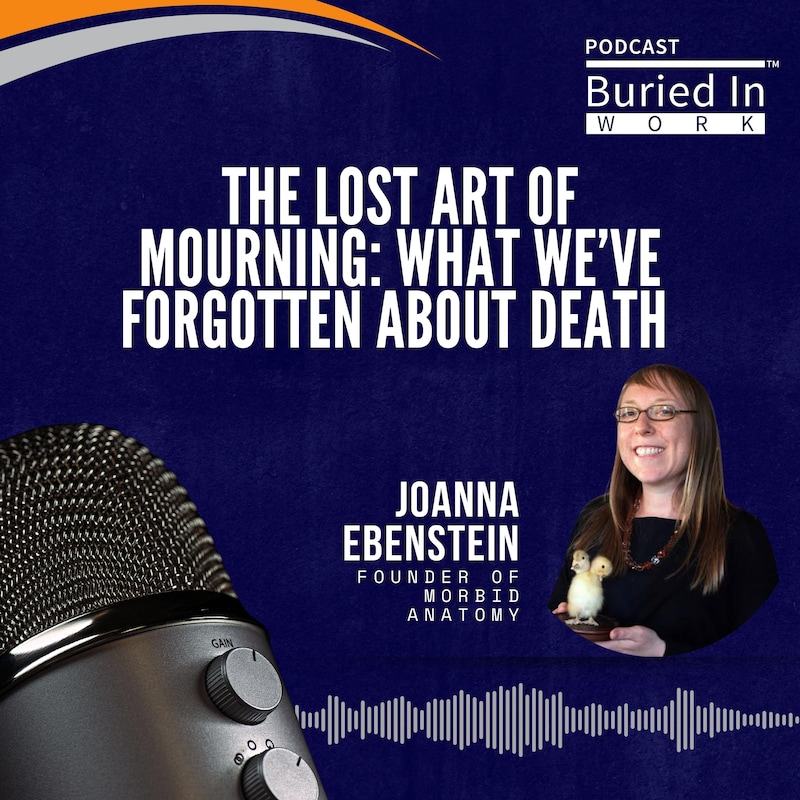
In this episode of the Buried in Work Podcast, Joanna Ebenstein, artist, author, and founder of Morbid Anatomy, uncovers the forgotten history of mourning, why we’ve become disconnected from death, and how reclaiming lost traditions can bring meaning back into our lives.
Click the link for FULL SHOW NOTES
Did this episode change how you think about death? Share your thoughts with us by leaving a review.
Transcripts
What about our current culture shapes that fear in a way that maybe hasn't
Jared Rizzi:existed in the past? What is a uniquely 2024 fear of death?
Jared Rizzi:And how is that different than the fear of death that you've spent your academic and
Jared Rizzi:artistic life curating?
Joanna Ebestein:It's a death without, without religion, honestly, in mythology or meaning.
Joanna Ebestein:You know, I think that's what makes this time unique.
Joanna Ebestein:I don't, I have not in my studies found any other time in history where a majority of the
Joanna Ebestein:population, or a large portion of the population, let's say, believed that death was
Joanna Ebestein:simply the end and that there was no meaning and that we didn't mean anything.
Joanna Ebestein:Right, because God is dead for many of us, or we don't believe in that anymore.
Joanna Ebestein:But for the vast, vast, vast, vast majority of our ancestors, there was a spiritual
Joanna Ebestein:understanding of life.
Joanna Ebestein:And I think that is what creates meaning for many people.
Joanna Ebestein:This is the Buried in Work podcast where we share tips and interview experts to help you
Joanna Ebestein:simplify estate planning and end of life tasks.
Jared Rizzi:Welcome to Buried in Work podcast.
Jared Rizzi:I'm your host, Jared Rizzi.
Jared Rizzi:Today we have Joanna Ebenstein with us.
Jared Rizzi:She's an author, an artist, designer.
Jared Rizzi:There's, there's a lot of.
Jared Rizzi:We're going to get through all of that.
Jared Rizzi:First of all, Joanna, thank you so much for
Jared Rizzi:spending some time with us.
Joanna Ebestein:Barry and Warren, thanks for having me.
Joanna Ebestein:It's my pleasure.
Jared Rizzi:I was thinking about this in the context of we never know how much time we have
Jared Rizzi:left.
Jared Rizzi:And so I just, in the macabre tone that I am
Jared Rizzi:embracing for this conversation, I just want you to know how much I appreciate not only you
Jared Rizzi:spending some of the most precious resource that any of us has here with me right now for
Jared Rizzi:this, but also just that you've spent so much time curating and cultivating this to give
Jared Rizzi:meaning to an experience that we all have, but that most of us spend a lot of time.
Jared Rizzi:I really appreciate you.
Jared Rizzi:Thank you so much.
Joanna Ebestein:Oh, that's really kind of you to say thank you.
Joanna Ebestein:It is, as you can probably tell, it's a labor of love.
Jared Rizzi:That is a perfect launching off point for how I wanted to begin, which is how
Jared Rizzi:do you love death?
Joanna Ebestein:That's a great.
Joanna Ebestein:No one's ever asked it to me quite like that.
Joanna Ebestein:And the why is a question too.
Joanna Ebestein:I mean, to say I love death might not be
Joanna Ebestein:exactly how I would put it, but I think this material makes me passionate and having
Joanna Ebestein:conversations around this material makes me feel very good.
Joanna Ebestein:And why that's the case, I can't say.
Joanna Ebestein:But I can say from my time sitting in public
Joanna Ebestein:spaces that I've arranged that are around death and speaking to people.
Joanna Ebestein:When you're in a space where conversations around death are likely to occur and you have
Joanna Ebestein:a conversation around death and you're nodding because I think you know what I mean.
Joanna Ebestein:There's a sense when you have a conversation like that with another human being that really
Joanna Ebestein:cuts through everything and is a real human connection.
Joanna Ebestein:And I think I really love that feeling of a real human connection with someone else.
Joanna Ebestein:And for me, there's nothing that takes you closer more quickly there than to go into
Joanna Ebestein:death.
Joanna Ebestein:Everyone has a story.
Joanna Ebestein:Everyone has an experience or a fear or something.
Joanna Ebestein:And it's so essentially themselves that it's beyond Persona.
Joanna Ebestein:It's like soul to soul, human to human.
Jared Rizzi:The mask, really.
Jared Rizzi:I mean, the mask.
Jared Rizzi:I mean, even then I'm thinking of the metaphors here, but the mask comes off really
Jared Rizzi:when we're talking about something so intrinsic to our human experience, I would
Jared Rizzi:imagine.
Jared Rizzi:Yes.
Joanna Ebestein:Yeah. So intrinsic.
Joanna Ebestein:And something we all share.
Joanna Ebestein:A fear we all share, a. A foreknowledge we all share.
Joanna Ebestein:And that, you know, many people have thought, and I would argue that foreknowledge is what
Joanna Ebestein:even creates the sense that life has such great value, is that it ends right.
Joanna Ebestein:So it's a part of all of our awareness, whether it's conscious or unconscious.
Joanna Ebestein:That's a different question.
Jared Rizzi:While people are still feeling, if they are like me, that kind of back of the
Jared Rizzi:neck prickle as we're having this conversation, let me take that and point them
Jared Rizzi:to your work online, which is@morbidanatomy.org
Jared Rizzi:and also I know a book that you have that's.
Jared Rizzi:That's really just.
Jared Rizzi:Just out, which is Memento Mori A let's see, the Art of Contemplating Death to Live a
Jared Rizzi:Better Life.
Jared Rizzi:And I'm so grateful for that.
Jared Rizzi:This is.
Jared Rizzi:This is out.
Jared Rizzi:People can get this.
Jared Rizzi:Now, when we are contemplating this, when we're talking about that universal experience,
Jared Rizzi:the way you just said it a minute ago, that we have that foreknowledge and you talked about
Jared Rizzi:fear.
Jared Rizzi:When you are creating art or writing your book or what are the things that you are trying to
Jared Rizzi:include that are wide in that experience, the things that, you know, that people, whatever
Jared Rizzi:their cultural tradition, wherever they've come to, they're going to think about death,
Jared Rizzi:what are the widest parameters that you can set for talking about and making art about
Jared Rizzi:death?
Joanna Ebestein:Yeah, for me, at least, as I'm understanding your question, I think the
Joanna Ebestein:widest parameters for Me are history.
Joanna Ebestein:And for me, that's my background.
Joanna Ebestein:I studied intellectual history at college.
Joanna Ebestein:And a historical lens onto looking at death in
Joanna Ebestein:different times and places, and that includes now, basically from prehistory to the present,
Joanna Ebestein:helps for me to relativize fear of death and to relativize how we think about death in this
Joanna Ebestein:particular time and place.
Joanna Ebestein:So you'll see pretty quickly if you start looking at the historical record that as
Joanna Ebestein:recently as the 1800s, right.
Joanna Ebestein:Death was a very visible part of everyday
Joanna Ebestein:life.
Joanna Ebestein:Women dressed in mourning bodies were
Joanna Ebestein:displayed in the home parlor.
Joanna Ebestein:This is only 150 or so years ago.
Joanna Ebestein:Right.
Joanna Ebestein:So to me, using that lens and thinking about, how is it that we have gotten to this
Joanna Ebestein:particular place? How is this different than it's been at
Joanna Ebestein:different times in the past?
Joanna Ebestein:Is this the inevitable way that it needs to be?
Joanna Ebestein:Is this something that's just kind of a flash in the pan?
Joanna Ebestein:Are we gonna go back to other ways of thinking?
Joanna Ebestein:That kind of larger cultural context for me, helps me to look more critically at our own
Joanna Ebestein:attitudes about death.
Joanna Ebestein:And by critically, I don't mean necessarily
Joanna Ebestein:negative.
Joanna Ebestein:I just mean to see it as a product of the time
Joanna Ebestein:and place we were born with a culture we happen to be born into.
Joanna Ebestein:If I'd been born 200 years ago, I'd be in full mourning, probably, if my husband died, you
Joanna Ebestein:know.
Joanna Ebestein:So, again, it's just.
Joanna Ebestein:That's so much of it for me, is the cultural aspect that we're born into and tend to see as
Joanna Ebestein:inevitable unless you pull back and look at other times and places.
Jared Rizzi:The metaphor that I always think about is, you know, the fish don't know that
Jared Rizzi:they're in water kind of thing.
Jared Rizzi:It's like, exactly.
Jared Rizzi:We don't know that.
Jared Rizzi:The way we think about death is really just
Jared Rizzi:now the ph, the temperature has all been set by the water that we're all in, this cultural
Jared Rizzi:water that we're all in.
Jared Rizzi:And that brings me to where we are kind of the bookend of the other side of this conversation
Jared Rizzi:is the work that we do at Buried in work, which is, I think, a lot of it on the
Jared Rizzi:logistics side, but really just helping people kind of get through that hump of, I've got
Jared Rizzi:this to do.
Jared Rizzi:I don't want to be buried in work.
Jared Rizzi:I want to get through this.
Jared Rizzi:And I imagine that you have a lot to say about the cultural moment we're in right now and why
Jared Rizzi:that work is so much and so onerous and so emotionally poignant in ways that are
Jared Rizzi:different, I imagine, than even I don't know, 20 years ago, 50 years ago, 100 years ago.
Joanna Ebestein:Yeah. You know, looking at history, I began to see that a lot changed
Joanna Ebestein:around the late 19th into the early 20th century.
Joanna Ebestein:That was what I studied at university, too.
Joanna Ebestein:I studied intellectual history of that time.
Joanna Ebestein:And as I studied it, I began to think, oh, this is really the birth of our type.
Joanna Ebestein:And I think right now we're transitioning to something else.
Joanna Ebestein:So ask me in 50 years.
Joanna Ebestein:I don't know what I would say.
Joanna Ebestein:But right now, the culture that we're in is
Joanna Ebestein:the same culture that was created in the early 20th century in this kind of the end of the
Joanna Ebestein:Victorians and the beginning of modernity.
Joanna Ebestein:Right.
Joanna Ebestein:And what you have at that time is you have,
Joanna Ebestein:first of all, you have a lot of mass death.
Joanna Ebestein:You have World War I, and then you have the
Joanna Ebestein:influenza epidemic, which is even more pertinent now after we've gone through Covid.
Joanna Ebestein:Right.
Joanna Ebestein:And you'd see almost nothing written about
Joanna Ebestein:that.
Joanna Ebestein:Even when you're reading the modernist
Joanna Ebestein:writers, they're writing about World War I, but the influenza epidemic no one really
Joanna Ebestein:writes about, and many, many people were lost.
Joanna Ebestein:So Western culture went through, like, this really intense one, two, you know, and then
Joanna Ebestein:simultaneously, you have the development of hospitals.
Joanna Ebestein:So people.
Joanna Ebestein:There were hospitals before, but they were
Joanna Ebestein:more like charitable institutions.
Joanna Ebestein:And then it becomes a place where you go when you're sick and when you're trying to combat
Joanna Ebestein:death, essential, you have death kind of disappearing.
Joanna Ebestein:Until this time, death is taking place at home, surrounded by your loved ones, including
Joanna Ebestein:your friends and family, including the children.
Joanna Ebestein:This was seen as an appropriate, kind of an important thing for children to be at.
Joanna Ebestein:So you can see how much in 150 years that idea has changed.
Joanna Ebestein:Right.
Joanna Ebestein:And so then, in addition to that, you have
Joanna Ebestein:something really interesting going on, which is the change over from a religious to a
Joanna Ebestein:secular culture.
Joanna Ebestein:And of course, that's not complete.
Joanna Ebestein:You know, there are still very religious
Joanna Ebestein:people, and bless them, they're very lucky.
Joanna Ebestein:But for many of us, we no longer have a belief
Joanna Ebestein:system that explains why we die, where we go after we die.
Joanna Ebestein:And so the scientific model is the assumption that death is simply an end.
Joanna Ebestein:So I think the fear of death is also much greater because it's not kind of blended with
Joanna Ebestein:this idea of heaven and hell and being able to communicate with your ancestors after they're
Joanna Ebestein:gone in some way.
Joanna Ebestein:Really.
Joanna Ebestein:It's this idea of materialist science is it's
Joanna Ebestein:over.
Joanna Ebestein:That's it.
Joanna Ebestein:Right? Game over, brain off, game over.
Joanna Ebestein:Which is actually a pretty terrifying thought.
Joanna Ebestein:So I think you have this kind of perfect storm
Joanna Ebestein:of all of these things.
Joanna Ebestein:And then what they say is, you know, in the 19th century, women were making all these
Joanna Ebestein:incredible crafts to commemorate the dead.
Joanna Ebestein:They were making things out of human hair.
Joanna Ebestein:They were taking photos of the dead and putting them in the parlor.
Joanna Ebestein:This all disappears because women also are going to the workforce, right.
Joanna Ebestein:So because all the men are gone.
Joanna Ebestein:So all of these things are happening at the same time.
Joanna Ebestein:And to my understanding, like, the number of deaths is just so great that the old systems
Joanna Ebestein:cannot hold anymore.
Joanna Ebestein:There is no time to mourn the way they were when there's so many.
Joanna Ebestein:So many.
Joanna Ebestein:If you imagine between World War I and the
Joanna Ebestein:influenza epidemic, people dying.
Joanna Ebestein:Right.
Jared Rizzi:I'm allowing myself to feel the things that I think sometimes I
Jared Rizzi:intellectualize, you know, my background.
Jared Rizzi:I. I'm used to talking about a lot of things
Jared Rizzi:that are easier to intellectualize.
Jared Rizzi:I'm really trying in this conversation right now to feel the things and to kind of allow
Jared Rizzi:that cultural memory to pass between us as we're having this conversation.
Jared Rizzi:And I'm fascinated by these objects that you've just described.
Jared Rizzi:And I want to know.
Jared Rizzi:I know that a lot of the work that you've done
Jared Rizzi:in this study, this very academic study, has also been about curating and art.
Jared Rizzi:Can you just talk about some of the pieces that you've held, You've displayed, curated,
Jared Rizzi:and some of the ones that have really made a difference to you?
Jared Rizzi:Because I know that experience of being.
Jared Rizzi:I've never curated an art museum exhibit, but
Jared Rizzi:I know that feeling of.
Jared Rizzi:Of finding something that really does speak to
Jared Rizzi:me and just allowing it to change, you know, really just write a line of.
Jared Rizzi:In the register of my life.
Joanna Ebestein:Yeah.
Jared Rizzi:Can you talk about some of those objects?
Jared Rizzi:Because I. They're gone in so many ways, as you've described, and I want.
Jared Rizzi:I want to know more about them.
Joanna Ebestein:Yeah, well, I'll backtrack a little bit and say, the first time I really
Joanna Ebestein:started thinking about death in the way that has now manifested through Mormon anatomy.
Joanna Ebestein:And ultimately, this book is.
Joanna Ebestein:I went to Europe for the first time after I graduated college, and I had studied
Joanna Ebestein:intellectual history, I'd studied European history, but no one had talked about the kind
Joanna Ebestein:of things that I saw in the churches and museums of Europe.
Joanna Ebestein:And so I saw paintings of saints who had been decapitated, who were holding their heads up,
Joanna Ebestein:pictures of whole fields of saints, you know, in crucifixion scenes with dripping blood.
Joanna Ebestein:And then these objects that are called memento mori, which is what I named My book after.
Joanna Ebestein:So I have a photo I took on that trip in 1994 of this very strange wax figure.
Joanna Ebestein:It's about a foot long maybe, and it's hyperreal.
Joanna Ebestein:And it depicts a decaying corpse that is also Jesus Christ.
Joanna Ebestein:And so you lift the breastplate off and you.
Jared Rizzi:I mean, I grew up Catholic.
Joanna Ebestein:Ah, you grew up Catholic.
Joanna Ebestein:So this is very familiar to you.
Jared Rizzi:This is very familiar.
Jared Rizzi:You're a. But for the people who didn't, like
Jared Rizzi:you will be shocked at the amount of detail that they've included in this wax figure
Jared Rizzi:that's just there in the middle of an otherwise very beautiful and not death
Jared Rizzi:obsessed building.
Joanna Ebestein:Yeah. And the focus on the corpse, this like beautiful human corpse.
Joanna Ebestein:And so growing up in suburban California, my introduction to death was like in the goth and
Joanna Ebestein:heavy metal subcultures and horror movies.
Joanna Ebestein:So I was into all that stuff.
Joanna Ebestein:But seeing beauty mixed with death was
Joanna Ebestein:something I had never even suspected.
Joanna Ebestein:And I had studied art history in college and
Joanna Ebestein:high school.
Joanna Ebestein:My teachers never said a word about this tradition, you know, but they filled the
Joanna Ebestein:museums, they were everywhere.
Joanna Ebestein:And they, you know, so there are many other
Joanna Ebestein:memento.
Joanna Ebestein:More there.
Joanna Ebestein:If you go to the Metropolitan Museum of Art in New York, they have this incredible ivory
Joanna Ebestein:there.
Joanna Ebestein:It's a set of ivory rosary beads.
Joanna Ebestein:And the center bead is.
Joanna Ebestein:You're nodding.
Joanna Ebestein:I think you know exactly what I'm talking about.
Joanna Ebestein:Half living, half dead, centerpiece.
Joanna Ebestein:And then all of these were meant for very
Joanna Ebestein:wealthy people to contemplate their own death so they could live a life true to their own
Joanna Ebestein:values.
Joanna Ebestein:Right.
Joanna Ebestein:So that's like the older stuff, that kind of
Joanna Ebestein:baroque and beyond.
Joanna Ebestein:But then in the 19th century, our first
Joanna Ebestein:exhibition at the Morbid Anatomy Museum was called the Art of Mourning.
Joanna Ebestein:And so we were really thinking about the intersections of art, beauty and mourning.
Joanna Ebestein:And what we showed in that exhibition.
Joanna Ebestein:We had death masks.
Joanna Ebestein:So death masks are when, you know, before photography, but then also long after
Joanna Ebestein:photography, when someone died, people would take a cast, a plaster cast of their face and
Joanna Ebestein:then make little copies of it, sometimes in bronze, sometimes in plaster that you could
Joanna Ebestein:own.
Joanna Ebestein:And so we had a few of those.
Joanna Ebestein:We had memorial photographs.
Joanna Ebestein:So from the beginning of photography until.
Joanna Ebestein:Well, it seems like it's coming back now.
Joanna Ebestein:But certainly up until the early 20th century, it was very, very common to take staged
Joanna Ebestein:professional photos of the dead, often in poses that were called Sleeping Beauty,
Joanna Ebestein:basically looking as if they were just asleep in bed.
Joanna Ebestein:And there are many, many photographs.
Joanna Ebestein:We worked with an amazing collector named
Joanna Ebestein:Stanley Burns, who maybe you've heard of he runs an archive where he specializes in these
Joanna Ebestein:photos, and he very generously lent us many of them.
Joanna Ebestein:And then we also had pieces of memorial jewelry.
Joanna Ebestein:So people would make jewelry in the shapes of a dove ascending, which was to commemorate a
Joanna Ebestein:soul, or clasped hands, which meant the everlasting bonds between the living and the
Joanna Ebestein:dead.
Joanna Ebestein:And in black, often in jet or other sort of black stone.
Joanna Ebestein:And then you have hair art, which is probably my favorite.
Joanna Ebestein:And so this is a tradition that goes back to the 18th century, but really goes popular in
Joanna Ebestein:the 19th century, where people would make objects and artworks and jewelry out of the
Joanna Ebestein:hair of the beloved.
Joanna Ebestein:And this could be the dead beloved, often was the dead beloved.
Joanna Ebestein:But it could also be someone you were separated from or someone you had a strong
Joanna Ebestein:bond with and you just wanted a sentimental token of them.
Joanna Ebestein:And we actually have at Morbid Anatomy a woman named Karen Bachman who kind of reverse
Joanna Ebestein:engineered how the Victorians did it, and she teaches it for us.
Joanna Ebestein:And I took that class.
Jared Rizzi:Really?
Joanna Ebestein:Yes, really.
Joanna Ebestein:And it's fantastic.
Joanna Ebestein:And I took this class and I was really struck by how difficult it is to work with human
Joanna Ebestein:hair.
Joanna Ebestein:You really need to concentrate, you need to go
Joanna Ebestein:slow.
Joanna Ebestein:It's a very finicky medium.
Joanna Ebestein:And doing this for a long period of time, it
Joanna Ebestein:was so meditative that I began to think.
Joanna Ebestein:I think these morning arts were also about
Joanna Ebestein:mourning itself.
Joanna Ebestein:You know, it was a way of soothe, like in a very quiet, gentle way, working with this
Joanna Ebestein:material piece of your loved one.
Joanna Ebestein:In a way, you have to go slow and you have to
Joanna Ebestein:take your time.
Joanna Ebestein:And then you have this beautiful object at the end.
Joanna Ebestein:But I really think it's also about the process.
Jared Rizzi:This is literally under the.
Jared Rizzi:The category of morbid fascination.
Jared Rizzi:So forgive the follow up question, but would the hair traditionally be taken before or
Jared Rizzi:after the person had passed?
Joanna Ebestein:After, if you were commemorating the dead.
Joanna Ebestein:But then there was also, like I said, a lot of stuff with the living.
Joanna Ebestein:And there were even these family trees made out of hair.
Joanna Ebestein:So while someone was.
Joanna Ebestein:While the family was alive, you see all these
Joanna Ebestein:pieces that are labeled, all these different colors.
Joanna Ebestein:So you have the children, the adults and the dead all woven together.
Joanna Ebestein:If your listeners look up hair art and look on Google Images, you'll see incredible,
Joanna Ebestein:incredible things.
Jared Rizzi:Joanna Ebenstein is with me.
Jared Rizzi:Memento Mori is the book.
Jared Rizzi:Morbidanatomy.org is the website.
Jared Rizzi:I'm Jared Rizzi, and this is Buried in Work,
Jared Rizzi:the Buried in Work podcast.
Jared Rizzi:The way you've described this arc of the, you know, this entrance into modernity and all the
Jared Rizzi:objects you've just described, I'm thinking about.
Jared Rizzi:We spend so much of our modern lives scrubbing and perfuming and clipping and doing things
Jared Rizzi:just to kind of denature, you know, the.
Jared Rizzi:The kind of soft animal of our.
Jared Rizzi:Of ourselves.
Jared Rizzi:And yet I feel like whether it's the worn finger.
Jared Rizzi:Well, of a rosary bead or the, you know, brittle hair that has been intricately woven
Jared Rizzi:over time, there's this real understanding and appreciation of the kind of the grist and bone
Jared Rizzi:and just oil and grease of being a human being.
Jared Rizzi:That is powerful stuff, and it is not in the culture right now.
Jared Rizzi:How do you deal with that disconnect when you're talking about something that is so
Jared Rizzi:present and then so absent?
Joanna Ebestein:I think it's a great point.
Joanna Ebestein:I think we've become very uncomfortable with
Joanna Ebestein:the materiality of the body, and maybe that is part of the reason why we've turned away from
Joanna Ebestein:death, because it really does bring up unpleasant materialities, too, sometimes.
Joanna Ebestein:Right.
Joanna Ebestein:Smells or watching the face of your loved one
Joanna Ebestein:transform from a human to something that does not feel like them anymore.
Joanna Ebestein:Yeah.
Joanna Ebestein:And maybe there's a sense in which, because we
Joanna Ebestein:don't really trust our own materiality and other materiality makes us uncomfortable.
Joanna Ebestein:That might be part of why death has moved off stage a little bit as well.
Jared Rizzi:Have you ever done or worked with, like, a death doula or someone in that
Jared Rizzi:capacity as part of how you're thinking about either the pieces that you're curating or the.
Jared Rizzi:Or creating or curating or the work that you did for the book?
Joanna Ebestein:Yeah, for sure.
Joanna Ebestein:So for the chapter on.
Joanna Ebestein:Is it just the chapter on grief? There were a few chapters on the book that I
Joanna Ebestein:realized I wasn't really qualified to write without help, and so I did.
Joanna Ebestein:So the Morbid Anatomy community is full of death doulas, which won't surprise you.
Joanna Ebestein:And so I was friends with a lot of them, and so I interviewed them and asked them questions
Joanna Ebestein:about what they would recommend people do and what they thought people most regretted on
Joanna Ebestein:their deathbed.
Joanna Ebestein:So I have the wisdom of death doulas, and also my husband.
Joanna Ebestein:He is a death doula and also a. He has a lot of experience with meditation in India.
Joanna Ebestein:So he's kind of bringing those two things together.
Joanna Ebestein:He does a.
Jared Rizzi:You are like a stygian power couple.
Jared Rizzi:That's like, I don't understand.
Jared Rizzi:I want to go to one of these parties that
Jared Rizzi:you're throwing.
Jared Rizzi:That's.
Jared Rizzi:That's all I've decided.
Joanna Ebestein:Hong Tu is weekly death meditations are Fantastic and beloved.
Joanna Ebestein:And so basically what he explains, which I think is super interesting, is that in the
Joanna Ebestein:Indian tradition he studied in embodiment is really seen as an opportunity to prepare for
Joanna Ebestein:death.
Joanna Ebestein:And so by becoming aware, you know, meditation itself is to try to help you through the death
Joanna Ebestein:process.
Joanna Ebestein:Because basically from this perspective, when
Joanna Ebestein:you die, you leave the body.
Joanna Ebestein:And this is like an unprecedented experience for us.
Joanna Ebestein:And so this being able to stay calm in any circumstance is what meditation allows you,
Joanna Ebestein:the ultimate circumstance being disembodiment and having to make the choices that will
Joanna Ebestein:decide what your next destination is after death.
Joanna Ebestein:Right.
Joanna Ebestein:So yeah, he does this for us every Sunday
Joanna Ebestein:morning at this point.
Joanna Ebestein:And they're really fantastic.
Joanna Ebestein:And so, yes, death doulas.
Joanna Ebestein:And I would also just say, and I wonder if you
Joanna Ebestein:feel the same.
Joanna Ebestein:Thank God for death doulas.
Joanna Ebestein:You know, like, I definitely, when I'm dying
Joanna Ebestein:or sick, will make use of a death doula, whether that's my husband or someone else.
Joanna Ebestein:I think what they're offering is amazing.
Joanna Ebestein:There's this concept that I talk a lot about in the book called the psychopomp.
Joanna Ebestein:And the psychopomp is literally, it's Greek for soul guide.
Joanna Ebestein:And a soul guide is a figure that guides you from the end of this life into whatever is
Joanna Ebestein:next.
Joanna Ebestein:So in ancient Greece, Hermes was a God who would escort you, et cetera, et cetera.
Joanna Ebestein:There are all these different psychopomps that could be animals, that could be deities.
Joanna Ebestein:Also priests, of course, work as psychopomps.
Joanna Ebestein:If you think of the last rites.
Joanna Ebestein:Right.
Joanna Ebestein:And you think of shamans and rabbis and all of this.
Joanna Ebestein:And I think that what's so beautiful about the death doula is they've taken over this role of
Joanna Ebestein:being a psychopomp, but in a secular way.
Joanna Ebestein:You don't need to be religious to have the services of someone who will be by your side,
Joanna Ebestein:who will help you prepar, who help you be ready to let go.
Joanna Ebestein:I think what they're doing is just incredible.
Jared Rizzi:I have to ask, because you had the temerity to mention your own kind of end
Jared Rizzi:is.
Jared Rizzi:As someone who's thought a lot about this,
Jared Rizzi:what do you want to include? What do you want to exclude?
Jared Rizzi:And how have you.
Jared Rizzi:Given the nature of that process, how have you organized your thoughts.
Joanna Ebestein:Yeah.
Jared Rizzi:And your emotions about something.
Jared Rizzi:That obviously takes up a. I mean, not many of us get to get to do this in our professional
Jared Rizzi:time.
Jared Rizzi:This is, this is mostly an off clock
Jared Rizzi:experience for most, but this is really something that, that I imagine you've put in,
Jared Rizzi:you know, kind of, you're in the top 1% of all people who've ever lived who've thought about
Jared Rizzi:how they're going to go.
Joanna Ebestein:I don't know about that.
Joanna Ebestein:I'd say maybe in our era, I would say.
Joanna Ebestein:But I think the Egyptians spent well, think of the Egyptians.
Joanna Ebestein:They spent a lot of time thinking about how they were going to go.
Joanna Ebestein:Right.
Joanna Ebestein:That's what the pyramids were about.
Joanna Ebestein:That's, you know, so for us, yes, probably today I'm one of the people who thinks about
Joanna Ebestein:it the most.
Joanna Ebestein:Well, first of all, I would say I have gotten
Joanna Ebestein:so many great ideas from.
Joanna Ebestein:So I started at the beginning of COVID I started teaching a class, the beginning of
Joanna Ebestein:lockdown.
Joanna Ebestein:I should be more specific, teaching a class
Joanna Ebestein:for morbid anatomy called make youe Own Memento.
Joanna Ebestein:Befriending death with art history and imagination.
Joanna Ebestein:And I taught many, many iterations of this.
Joanna Ebestein:And I worked with people around the world and
Joanna Ebestein:I got so many great ideas from my students.
Joanna Ebestein:And one of my students was someone who had a terminal illness.
Joanna Ebestein:And her final project was to create the room she wanted to die in.
Joanna Ebestein:And she took a picture of it and it was beautiful.
Joanna Ebestein:And that really inspired me.
Joanna Ebestein:So that's her idea that I've taken into my own
Joanna Ebestein:life.
Joanna Ebestein:I would love to create the room I want to die
Joanna Ebestein:in.
Joanna Ebestein:I don't want it to be in a hospital.
Joanna Ebestein:I want to die at home with my friends and family.
Joanna Ebestein:That's what I can tell you.
Joanna Ebestein:That's what I feel very certain about.
Joanna Ebestein:And I will say I don't want to have a traditional.
Joanna Ebestein:Well, I would say if my family members feel different, I think it's really.
Joanna Ebestein:They trump it because it's really about their act of closure.
Joanna Ebestein:But left to my own own device, I would rather have a Green Burial of some sort, be buried in
Joanna Ebestein:a forest and have my body decompose and become other life.
Joanna Ebestein:That would be my preference.
Jared Rizzi:Well, as someone who has spent a lot less time than you and yet has arrived at
Jared Rizzi:a similar conclusion, especially about the Green Burial, I only feel like I must be
Jared Rizzi:doing.
Jared Rizzi:I've done a lot less work and yet I'm getting to the same answer.
Jared Rizzi:So I can only hope that I've done a good job of looking at your paper during the exam.
Joanna Ebestein:I think it's a bigger thing, though.
Joanna Ebestein:Let's look, you know, go back to what we were saying about how much things have changed in
Joanna Ebestein:the last 200 years.
Joanna Ebestein:Embalming didn't even exist until.
Joanna Ebestein:Until around 1870, you know, so this is.
Joanna Ebestein:I think this is A flash in the pan.
Joanna Ebestein:And it's not good for.
Joanna Ebestein:We know it's not good for the earth.
Joanna Ebestein:We know it's not good for nature.
Joanna Ebestein:You know, I really feel there's something
Joanna Ebestein:perverse about taking and taking and taking from nature and not even giving back in that
Joanna Ebestein:final where we could give our body.
Joanna Ebestein:Not even that.
Joanna Ebestein:You know, like there's something so small
Joanna Ebestein:minded and petty about withholding the final gift that we could give back that could
Joanna Ebestein:generate new life.
Joanna Ebestein:So I think it's fascinating.
Jared Rizzi:Yeah. To talk about it in that context of like, why I want to ask about a way
Jared Rizzi:in which there's a socioeconomic component to this too, which is that you mentioned ancient
Jared Rizzi:Egyptians, this giving back so much of what we know.
Jared Rizzi:And I imagine this has informed the scholarship.
Jared Rizzi:Part of what you've done is about what happens to wealthy people.
Jared Rizzi:You know, the pyramids aren't made for regular, you know, Egyptian schmos.
Jared Rizzi:I really, really struggled with the word there.
Jared Rizzi:But now we're thinking about it.
Jared Rizzi:There's a cultural awareness of all of these
Jared Rizzi:strata of how we want.
Jared Rizzi:And for people who are thinking about buried
Jared Rizzi:in work, you know, they know that wherever they're coming into this process, they have a
Jared Rizzi:lot of money.
Jared Rizzi:They have a little money, they have a lot of time.
Jared Rizzi:They have a little time.
Jared Rizzi:They, they don't want to get into a deep
Jared Rizzi:philosophical conversation or they desperately do.
Jared Rizzi:They want to be able to enter this process and exit it and be better.
Jared Rizzi:They just want to do a process and be better.
Jared Rizzi:How much has that democratization changed
Jared Rizzi:death and how much do we know now about poor people and middle class people dying that we
Jared Rizzi:just don't even know about anything older than, I'm guessing, 150 years ago?
Joanna Ebestein:Yeah, that's a great question.
Joanna Ebestein:I mean, the first thing I thought of when you asked that is thinking about the idea that we
Joanna Ebestein:now have of a cemetery being a place of permanent interment.
Joanna Ebestein:Right.
Joanna Ebestein:And that's.
Jared Rizzi:Which is an American thing in some ways.
Jared Rizzi:Right.
Jared Rizzi:Like that's a European thing.
Joanna Ebestein:Well, I think it's, I think it might have started in England, I can't
Joanna Ebestein:remember anymore.
Joanna Ebestein:But it's like definitely a Western world
Joanna Ebestein:thing.
Joanna Ebestein:And it's a recent thing.
Joanna Ebestein:I want to say it's 1840s or 50s.
Joanna Ebestein:And until then, unless you were very wealthy, to your point, unless you were pretty much a
Joanna Ebestein:king or a queen or a noble person, you were just thrown into a, you know, you were thrown
Joanna Ebestein:to the churchyard and then you were dug up to make room for new burials.
Joanna Ebestein:Right. And Then those bones would be used to create these ossuaries or charnel houses,
Joanna Ebestein:where I'm sure you've seen them in the Catholic world, right, that were anonymous.
Jared Rizzi:This is one of the better things that we're known for.
Joanna Ebestein:I think it is a wonderful thing.
Jared Rizzi:You're noticing the art is pretty much, you know, we could talk about the art
Jared Rizzi:all day long.
Joanna Ebestein:Oh, and the death culture.
Joanna Ebestein:I think Catholic death culture is pretty
Joanna Ebestein:profoundly great.
Joanna Ebestein:But, yeah, this idea that normal people would
Joanna Ebestein:even have a permanent internment is super new, you know, so like the last 150 or so years or
Joanna Ebestein:200 years, I guess we could say at this point.
Joanna Ebestein:So, again, I think people didn't.
Joanna Ebestein:If you were a commoner in the Western world, I
Joanna Ebestein:don't know about the east, but I will also say, like in the indigenous world, like, I
Joanna Ebestein:know that when the Spanish came to Mexico and tried to establish Catholicism, right.
Joanna Ebestein:And abolish the old ways in the Mayan area that I live in in the Yucatan, people would
Joanna Ebestein:bury their dead under the thresholds of their homes, and they would continue to consult them
Joanna Ebestein:as ancestors.
Joanna Ebestein:And this was one of the main things that the Spanish complained about, is that that people
Joanna Ebestein:were very, very resistant to the idea of putting them in cemeteries and would actually
Joanna Ebestein:go back, dig them up, and take them back home again because they felt they were lonely and
Joanna Ebestein:in this cold and dark place.
Joanna Ebestein:So I don't know about every culture, but I think probably a lot of indigenous cultures
Joanna Ebestein:have a more personal relationship with the bones of the dead.
Joanna Ebestein:They're not just in some space that they go and pray to or visit with once in a while that
Joanna Ebestein:it's much closer to home.
Jared Rizzi:I want to ask about this process.
Jared Rizzi:And now, you know, for people who are thinking
Jared Rizzi:about this from the perspective of their own future passing or trying to advise a loved one
Jared Rizzi:who might be thinking about this.
Jared Rizzi:In many ways, the people who come to Buried in work and have these questions kind of burned
Jared Rizzi:in the back of their mind with a lot of urgency, I imagine.
Jared Rizzi:What are some cultural or philosophical jumping off points?
Jared Rizzi:You know, I think about, you know, I. I had.
Jared Rizzi:I had to officiate a friend's wedding
Jared Rizzi:recently.
Jared Rizzi:And before I did, just to kind of vent some steam, I watched the.
Jared Rizzi:The Fleabag episode, the last episode of Fleabag that includes a wedding.
Jared Rizzi:And I was like, as long as I don't.
Jared Rizzi:I don't do some of those things, I'll be fine.
Jared Rizzi:I'm just.
Jared Rizzi:What are.
Jared Rizzi:What are some launching off points that you
Jared Rizzi:would recommend for people who want to delve into this a little bit more intentionally.
Joanna Ebestein:Yeah, well, first, I mean, that's really what I wrote the book to do.
Joanna Ebestein:So I'll just say, you know, the book that we're here to talk about today, I had a bunch
Joanna Ebestein:of early readers read it.
Joanna Ebestein:And one of them is a historian, Catholic historian of religions named Diana Pasulka.
Joanna Ebestein:And when she responded, she said, what you've done is you've written a modern book of the
Joanna Ebestein:dead.
Joanna Ebestein:And so basically, what is a book of the dead? A book of the dead are books that have helped
Joanna Ebestein:people navigate a good death experience.
Joanna Ebestein:And I would say, traditionally, also a good
Joanna Ebestein:afterlife experience.
Joanna Ebestein:This is a secular version.
Joanna Ebestein:Right.
Joanna Ebestein:So we're not talking about an afterlife, but basically there were different times in
Joanna Ebestein:history when these books were needed.
Joanna Ebestein:So for example, during the bubonic plague,
Joanna Ebestein:when there were so many dying and there weren't enough priests to go around.
Joanna Ebestein:And as you know, from the Catholic tradition.
Joanna Ebestein:Right.
Joanna Ebestein:To die properly in the Catholic tradition, you need to have the final rites by a priest.
Joanna Ebestein:And when that couldn't happen, people began to produce these books.
Joanna Ebestein:They were really popular books.
Joanna Ebestein:Some of them were almost like comic books.
Joanna Ebestein:They were for the illiterate that would tell you what to do without a priest in order to
Joanna Ebestein:navigate a good after, you know, a good death and afterlife experience.
Joanna Ebestein:The Egyptian Book of the Dead is another example, and there's also the Tibetan Book of
Joanna Ebestein:the Dead.
Joanna Ebestein:So my book is really trying to provide.
Joanna Ebestein:It's like a 12 week program that is meant to help people get over their fear of death and
Joanna Ebestein:also help move towards what they think is a positive death, clarify what that is for them
Joanna Ebestein:and move in that direction.
Joanna Ebestein:And in that I also draw on the wisdom of death doulas, as I mentioned.
Joanna Ebestein:And what my husband would say is death doulas have this acronym they use, I think that's the
Joanna Ebestein:right word, called rugs, which is basically the things that hold people back from a good
Joanna Ebestein:death can usually fall under these four categories.
Joanna Ebestein:So R is regret, U is unfinished business, G is guilt, and S is shame.
Joanna Ebestein:And so one of the jobs.
Joanna Ebestein:Yeah, right.
Joanna Ebestein:Of a death duel is to help people work through that.
Joanna Ebestein:And so this book is also giving you prompts that will help you kind of at least start to
Joanna Ebestein:think about those things.
Joanna Ebestein:And for find a way to reconcile your life and
Joanna Ebestein:what a death doula also provides sometimes, which I think is really inspiring.
Joanna Ebestein:And I make.
Joanna Ebestein:One of the prompts is to create your own
Joanna Ebestein:legacy project, which is a project that sums up your life as you see it kind of it could be
Joanna Ebestein:left for your loved ones, it could be for yourself.
Joanna Ebestein:But I think these are beautiful things to do to help people see the bigger picture and to
Joanna Ebestein:forgive themselves and to, you know, I think so many people, again, without a religious
Joanna Ebestein:tradition.
Joanna Ebestein:And again, for those listeners who have a religious tradition, I envy you.
Joanna Ebestein:It's wonderful, you know, but for many of us in the modern world, we have to struggle and
Joanna Ebestein:find our own meaning around something that culture has provided no meaning for.
Joanna Ebestein:And yet it is something that each of us faces.
Joanna Ebestein:Right.
Joanna Ebestein:With very little preparation, emotional or spiritual or even material, as you're dealing
Joanna Ebestein:with, with your business.
Joanna Ebestein:Right.
Joanna Ebestein:So that would be my advice, is trying to have an honest reckoning with yourself and start
Joanna Ebestein:looking at what might be holding you back and what you might be afraid of.
Joanna Ebestein:And that's, again, what this book is meant to do, is help you in a very gentle way through
Joanna Ebestein:12 weeks of reading.
Joanna Ebestein:And then also writing these journal prompts
Joanna Ebestein:and doing exercises, help you figure out if you are afraid of death.
Joanna Ebestein:What is that fear? Exactly.
Joanna Ebestein:And how could one face that or how could one think about it differently?
Joanna Ebestein:How one can prepare in, like I said, through kind of this way of dealing with psychology.
Joanna Ebestein:But also there's a form in the back for filling out to leave to your next of kin that
Joanna Ebestein:has, you know, you know, there's lots of practical advice as well.
Joanna Ebestein:So there's all these things that you can do that I think can make you feel less anxious
Joanna Ebestein:about it.
Joanna Ebestein:Yeah, I hope it's hard for me to sum up
Joanna Ebestein:because it really is like the meat of the book is like 12 weeks of exactly that question.
Jared Rizzi:Let me ask one final question about that fear and the anxiety, I think,
Jared Rizzi:around this kind of how we began the conversation, and I'll end the same way, which
Jared Rizzi:is, what about our current culture shapes that fear in a way that maybe hasn't existed in the
Jared Rizzi:past?
Jared Rizzi:What is a uniquely 2024 fear of death? And how is that different than the fear of
Jared Rizzi:death that you've spent your academic and artistic life curating?
Joanna Ebestein:I don't know if I could say it's 2024, but I could probably say the last
Joanna Ebestein:50 years, probably.
Joanna Ebestein:And I think it's a death without religion,
Joanna Ebestein:honestly, in mythology or meaning.
Joanna Ebestein:I think that's what makes this time unique.
Joanna Ebestein:I have not in my studies found any other time
Joanna Ebestein:in history where a majority of the population, or a large portion of the population, let's
Joanna Ebestein:say, believed that death was simply the end and that there was no meaning and that we
Joanna Ebestein:didn't mean Anything, Right, Because God is dead for many of us, or we don't believe in
Joanna Ebestein:that anymore.
Joanna Ebestein:But for the vast, vast, vast, vast majority of our ancestors, there was a spiritual
Joanna Ebestein:understanding of life.
Joanna Ebestein:And I think that is what creates meaning for
Joanna Ebestein:many people.
Joanna Ebestein:So another thing that I really draw heavily on
Joanna Ebestein:this book is the work of Carl Jung, because I feel like he did a really beautiful job of
Joanna Ebestein:bridging kind of the old ways of thinking into the modern age into a more scientific
Joanna Ebestein:perspective, but at the same time acknowledging the importance of myth and
Joanna Ebestein:belief and not ever knowing that that could be capital T true, but nevertheless, living your
Joanna Ebestein:life according to your beliefs and your myths.
Joanna Ebestein:And so I think we're in a much more difficult time, and we all have to come up with our own
Joanna Ebestein:meaning.
Joanna Ebestein:And that's a big job.
Joanna Ebestein:It takes time.
Joanna Ebestein:You know, Jung would say it took suffering,
Joanna Ebestein:you know, like that.
Joanna Ebestein:The answer you come to, to this question of what happens after death comes from your own
Joanna Ebestein:suffering, your own struggles, and then ultimately you come up with your own answer.
Joanna Ebestein:And again, that can't be proven in this world, but it.
Joanna Ebestein:It can be lived into and died into and give your life meaning and death meaning.
Jared Rizzi:I think about the creation of that meaning and the work that we all have to
Jared Rizzi:do and how we live in a culture that is not just averse to that fear of death, but also
Jared Rizzi:very averse to suffering.
Jared Rizzi:We've tried to eliminate.
Jared Rizzi:Just like we've tried to eliminate all the bad
Jared Rizzi:smells and ointments that come out of ourselves, we've also tried to eliminate so
Jared Rizzi:much.
Jared Rizzi:And it's, you know, we consider it a great
Jared Rizzi:success as a society where we've eliminated, you know, poverty for so many people and
Jared Rizzi:lifted.
Jared Rizzi:But there is a grist that is provided there that allows us to feel that satisfaction of
Jared Rizzi:meeting at the end of.
Jared Rizzi:Is hard work.
Jared Rizzi:It feels hard because it is hard.
Jared Rizzi:And I just, I'm so appreciative of the.
Jared Rizzi:The work that you've done, the curation, the
Jared Rizzi:scholarship, and this book, the.
Jared Rizzi:The book Memento Mori, the Art of Contemplating Death to Live a Better Life.
Jared Rizzi:Again, I would point people to morbidanatomy.org which is your.
Jared Rizzi:See some of the art there and a lot of the other work that you've.
Jared Rizzi:That you've worked on.
Jared Rizzi:Joanna, I really appreciate you.
Jared Rizzi:I desperately want an invite to one of your
Jared Rizzi:dinner parties to talk about death.
Joanna Ebestein:Next time you're in Mexico, let me know.
Jared Rizzi:We'll have you over.
Jared Rizzi:But most importantly, I just thank you for
Jared Rizzi:providing a little bit of context for the place that we are both on, on this river right
Jared Rizzi:now.
Jared Rizzi:So I just really appreciate it.
Joanna Ebestein:And I just like to say one final thing, which is it is hard work.
Joanna Ebestein:But what I've really tried to do with this book is also make it fun.
Joanna Ebestein:It can be fun.
Joanna Ebestein:If we can be open minded and think of the mystery of death as both kind of astoundingly
Joanna Ebestein:fascinating and terrifying, then at least we can have a different entry point.
Joanna Ebestein:And so, you know, it's not scary work.
Joanna Ebestein:It doesn't need to be scary work to look at
Joanna Ebestein:this stuff.
Joanna Ebestein:In my opinion, at least that's what I've tried
Joanna Ebestein:to do in the book is make it gentle and fun.
Joanna Ebestein:So that I just want to say that don't be scared.
Joanna Ebestein:It's not that bad.
Jared Rizzi:Well, it's, it's actually this is where the two missions really do dovetail.
Jared Rizzi:Because whether it's Joanna Ebenstein and her book Memento Mori or the Buried In Work
Jared Rizzi:website, which has of course not only the free resources but also the games, the, the, the,
Jared Rizzi:the booklets, everything that you can provide, we want to make it easier, we want to make it
Jared Rizzi:fun if we can, with the games to have these, these really challenging conversations.
Jared Rizzi:I think this is one of the reasons why I'm so grateful for this, is that it does feel hand
Jared Rizzi:in glove that what we're trying to do, although from very different perspectives and
Jared Rizzi:hopefully people will come to either or both and feel that as well.
Jared Rizzi:Again, the book Memento the Art of Contemplating Death to Live a better life.
Jared Rizzi:Morbidanatomy.org I'm Jared Rizzi.
Jared Rizzi:This is Buried in Work.
Jared Rizzi:Thank you so much much for spending some time with us, Joanna.
Joanna Ebestein:It was so much fun.
Joanna Ebestein:Thanks so much for having me for the great
Joanna Ebestein:conversation and thanks everyone for listening.
Joanna Ebestein:I hope you enjoy.
Joanna Ebestein:Thanks for listening to another episode of the
Joanna Ebestein:Buried in Work podcast.
Joanna Ebestein:Remember, you can save 10% on our estate preparation package and Games with Code
Joanna Ebestein:podcast 10@boundedinwork.com.
