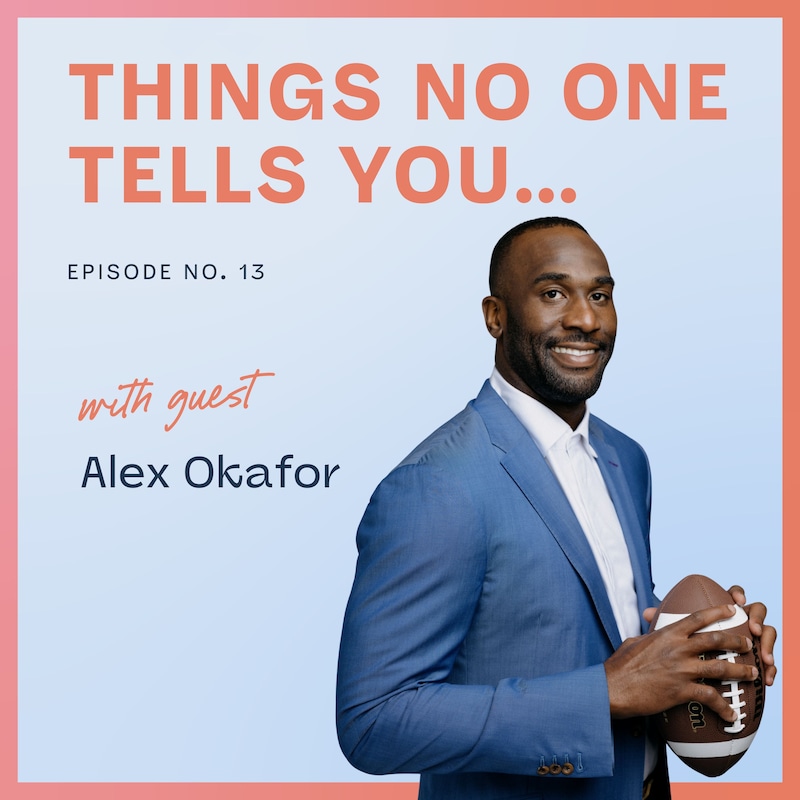
Shownotes
When you think of a Super Bowl champion, you probably picture confetti, rings, and a perfect ending. But for Alex Okafor, the story was much more complicated.
There’s a part of Alex’s story that gave me chills. It happened during the national anthem at the Super Bowl. He wasn’t suited up. An injury had taken him out of the game. But in that moment, sitting with his family, Alex’s mom wrapped her arm around him and reminded him that he’d already helped his team get there. Months later, she was gone, taken suddenly by leukemia.
In this conversation, Alex talks about what it’s like to go from the highest high to the lowest low in the span of weeks. He opens up about the uncertainty of draft day, the grind of an NFL career, and the grief that nobody really prepares you for. And he shares how he’s taken that pain and turned it into purpose: mentoring kids, serving his community, and helping families impacted by blood cancer.
What You’ll Discover:
- How Alex’s dream shifted from basketball to football (10:00)
- The lessons in culture and swagger from the Chiefs’ Super Bowl run (26:43)
- How an injury shifted Alex’s perspective and his seat in the stands (31:30)
- The last gift of time Alex got with his mom (37:13)
- Why nobody tells you what grief is really going to feel like (45:16)
- How Alex is carrying his mom’s legacy forward through service (50:56)
This is a story about football, but it’s also about faith, family, and finding your footing after life changes in an instant.
You can watch this interview on YouTube: https://youtu.be/hnRlMTt4mGg
For a full transcript and more, check out our blog post: https://www.lindsaycz.com/show-notes/alex-okafor-13
Connect with Alex Okafor
Follow Alex on Instagram: https://www.instagram.com/alexokafor/
Learn more about Alex’s work with the Leukemia & Lymphoma Society: https://bloodcancerunited.org/
To read Alex’s article that he shared in Player’s Tribune, click here.
Transcripts
[00:00:25] There was a sense of almost helplessness within me because I couldn't go out there and help my team, and my mom saw me crying during the national anthem, and she put her arm around me, hugged me. And, told me that Alex, they wouldn't be here without you. You helped get 'em here. Now let them go finish the mission.
[:[00:01:11] Lindsay: Hey everybody, I'm Lindsay Czarniak, and this is. Things No One Tells You. This is a podcast about the behind-the-scenes moments that shape who we are, those things that are also really relatable and really connect us. So each week I'm gonna talk with Newsmakers trailblazers in the worlds of sports, entertainment, all things, but also everyday folks, people who are talking about the real stuff that no one intends to share.
[:[00:01:59] My guest today is a former Kansas City Chief. So Alex Okafor is someone who has become a good friend. I'm gonna talk more about him in a moment, but. Before we get started, I wanna share a little levity. Why did the kid throw the clock out the window? He wanted to see time fly. So ironically, Alex's story and one of the reasons that I'm so excited that he's gonna kind of share his journey with all of us today.
[:[00:02:54] I feel like summer came and went in the blink of an eye, and now. Our kids are off to two different schools for the first time in a few years because now we have a middle schooler, and I'm like, hold on, because we know it's gonna go so fast from here anyway, can you relate? Okay. Back to this episode today.
[:[00:03:42] So that has always been an organization, an event that is near and dear to my heart. And. I've co-hosted it sometimes; I do it on my own. And last year they said, Hey, we actually have an idea. We would love to bring in Alex Okafor, who has become a really key member of our board. And I was like, I know that name.
[:[00:04:19] And the reality is, Alex, shortly after winning the Super Bowl, was basically struck just by a gut punch because his mother was diagnosed with a rare form of leukemia, and she ended up passing away just months later. So his story is just a complete mind-blowing situation of being at your highest high and then enduring your lowest low.
[:[00:05:08] It's amazing, and I'm really excited to be called his friend. So, I hope that you learn something from this. I know I did. I hope you enjoy it. I would love to hear your thoughts. But, tenters, I give you Alex Okafor. I am so excited to welcome my friend, Alex Okafor, to Things No One Tells You. Alex, where are you?
[:[00:05:31] Alex: It has been a while. I am currently in Austin, Texas. This is home base for me. Whenever I finished my playing career back in 2022, I knew Austin was always gonna be where I would settle down. So my wife Kaylee moved out to Austin, and we've been out here for, I guess, three years now.
[:[00:05:55] Alex: Yeah, so I grew up around this area, so I grew up in a little suburb just north of Austin called Pflugerville. So I've always been close to the Austin area. Went to school at the University of Texas. You could see it in the background helmets.
[:[00:06:19] Lindsay: I was sharing how we came to know each other through the leukemia ball. And there's so much I want, I can't wait for you to share and to learn more about your story.
[:[00:06:49] Alex: Yeah, so like I said, I retired from the NFL in 2022. I had played nine years, professionally, four years for the Arizona Cardinals. I was drafted in the 2013 NFL draft by the Cardinals. So played there, like I said, for four seasons. Went on to the New Orleans Saints and played there for two more seasons, and then finished off my career with the Kansas City Chiefs, the last three years of my career in which we won a Super Bowl back in 2020.
[:[00:07:44] So, for me, I just wanted to dive back into my community and dive back into, you know, acts of service that mean something to me. And I lost my mom to blood cancer. So for me, giving back to the blood cancer space, creating opportunities for families that have been affected by blood cancer, and just that whole environment I wanted to have an impact on.
[:[00:08:13] Lindsay: I was so excited to talk to you because, first of all, I just love in general the concept of things that people wouldn't know about the life of an NFL player.
[:[00:08:46] And when we dove in and talked about your story, I was absolutely blown away to hear what you went through. But now also just what? You're doing on the other side. So I really am interested too in just hearing what your perspective and your takeaways of what you went through are. But I would love to hear, like how this all began for you, like as a kid, like when did football become the thing that you were chasing?
[:[00:09:39] But my first time playing actually organized football was in the seventh grade, and obviously, I played backyard football with my friends, and we'd play jackpot and stuff like that. But in terms of putting the pads on and playing organized football, that didn't happen until the seventh grade, and even from seventh grade, probably all the way to my sophomore year in high school.
[:[00:10:21] I did in basketball, and it made sense because I was super tall as a kid, and I am still super tall. But I tell people all the time the position I, the position I wanted to play, I actually wasn't tall enough, which is crazy 'cause I'm six five. But if you, I mean, if you see some of these basketball players, you know that they're 6'10, 6'11, 7 feet.
[:[00:11:04] So I'd say probably since my sophomore year.
[:[00:11:23] Like, what did you learn from it? Is it like, yeah, do everything you kind of did, lean into what you love 'causeit'st what is gonna happen happens, or you know, or is it more like, you learned this and this is what you advise?
[:[00:11:44] I wish, as a young kid, that I had learned how to dribble a lot better than I did. So when I played basketball and I had hoop dreams, I was a post player like I was, I played the same position as Shaq, Tim Duncan, Dwight Howard, these types of guys, they don't really dribble the basketball.
[:[00:12:27] and then kind of transitioning from deciphering between two sports, kind of like you said, you highlighted it already. You'll naturally it'll naturally come to you. Like it. The sports will naturally start to divide as you get older. Whether you're getting more looks in one sport from colleges, or whether one sport is more fun for you, or whether this sport, you're seeing more success than that sport.
[:[00:12:56] Lindsay: This is gonna sound like a really Pollyanna question, but did people, like, were you surprised when. When football was the thing that they contacted you for? I know you said it wasn't surprising, but when that first contact happened, about like, Hey, you could do this with us in college, was that sort of intentional in any way on your, like, did you have to do something to get that feedback?
[:[00:13:37] You knew all the coaches. All the recruits, the scouts were gonna be at these Nike camps, and they'd be regional. So you might have three or four camps in the Texas area, hitting a couple of regions, so I knew I needed to get an invite from that Nike camp in order to. Put myself on the scene, recruiting-wise.
[:[00:14:21] And since that day, that's kind of when. Recruiting and stuff really started ramping up for me.
[:[00:14:41] What was it like when you first got to the NFL?
[:[00:15:07] Just because everybody thinks higher of themselves than what the world does. So everybody feels like they should go higher than wherever they're picked, including myself. So I thought I was gonna be a second-rounder. We get to the second round. My name wasn't called. We get to the third round. My name wasn't called in the fourth round.
[:[00:15:49] So that part is tough. But I will say as soon as you get that call from the team that picks you. It's like all is right in the world. Like all that feeling of animosity, that feeling of anger, being overlooked. It dissipates as soon as you get that call, and then now you're like, okay, I have a home team.
[:[00:16:32] So, whether it's massages, whether it's muscle work, soft tissue work, recovery stuff, all of that stuff is given to you. It's given to you to a certain extent at the NFL level as well, but you have to kind of do your own work at the NFL level. Like they don't baby you anymore. You have to go out and get your own resources.
[:[00:17:11] Lindsay: In my world, maybe that relates to going from elementary school to middle school. Like they say like, all 'cause we're prepping my son for that. It's That's the difference. They don't baby you anymore. You've gotta do the time management, the resources, you know what I mean? Like, I know that sounds weird, but it's, I get that a lot.
[:[00:17:46] Who was around you, and were there people that were?. You know, talking, you sort of off the ledge, so to speak.
[:[00:18:06] So I was very comfortable. I had a lot of love there, a lot of support there. My old college teammates were there to support me as well. My agent was there, so I had a lot of love and a lot of support in that room, and honestly. That kind of made it maybe a little bit tougher because all eyes are on you, and if you're just waiting, and everybody's just looking at you, it's.
[:[00:18:48] I wouldn't trade it for the world. It happened.
[:[00:18:51] Alex: Yeah, it happens quite frequently. Like you'll get a telemarketer calling you and you think it's a team, and it's, yeah,
[:[00:19:19] Lindsay: Yeah. That's so cool. And so then, so you're with the Cardinals. What happens next?
[:[00:19:42] led the team in sacks, had eight sacks that season. We go on to I wanna say the second round of the playoffs. So we have a really good year, third season, I have a decent year, and then in my fourth season, I get hurt again. So my career with the Cardinals was kind of up and do. But we had a lot of team success.
[:[00:20:28] I can't say that I was leaving that organization at the top of my career.
[:[00:20:36] Alex: Just between the injuries, also, I had a little bit of off-the-field drama. I was drinking too much. Just being a young player, I was going out too much. I didn't have my personal life in order. So, just trying to balance my personal life, coupled with the injuries, just didn't spell out a ton of success for me after that second year.
[:[00:21:02] Lindsay: And so is that something that, do you feel like a lot of people probably deal with that, that it's the off-the-field part two, because you're kind of navigating. The camaraderie may be of a team. Is that tough?
[:[00:21:37] and you have to lean on people, and I guess trying to. Deciphering and navigating through that situation can be tough, and sometimes you lose yourself doing that.
[:[00:21:59] You know, like if I go to a new job, it's like I want everyone to think I'm working hard, you know? And because you are working hard, but you want to. Do well and do. And I think in football, there's probably an added level of like, everyone's so good at what they do that it's like so much competition, right?
[:[00:22:39] and then you get to, when I got to ESPN, it was like, oh wow, like this is, like, people are rewarded on how they're doing their job, the perceived, how they're doing. And it's, it's a very interesting thing when I look back and I think about that time, 'cause sometimes I'm like. I wish I hadn't been as competitive as I was, and, wasn't negative competitive, but I was like, there was, I don't know.
[:[00:23:09] Alex: No, I, you know, I connect a lot to what you were just saying, just because, like you said, it is both industries highly competitive and. What separates the top person and essentially, let's call it the bottom person on the totem pole, is a very slim margin, like the top and the bottom are separated by such a small margin that you gotta find a way to separate yourself.
[:[00:23:50] Lindsay: Yeah. And I think I found like having that, figuring out who your support system is around you.
[:[00:24:17] Because oftentimes. People who are in positions to continue to rise. Or when you're climbing the ladder, people are afraid to tell them what you know? Yeah. What they could do better. And so with the support system around you, obviously, family comes into that too, and I know that's big for you, and I would love to just.
[:[00:24:58] So let's start there. Like, what was that run like for you leading up to the Super Bowl as that team was realizing that? This was something special that could actually come to fruition.
[:[00:25:18] And the reason why I'm bringing it back to the Saints is because I was on that 2018 Saints NFC Championship team. I don't know if you're a member, but. We, the refs, made such a bad no-call. There's a pass interference call where one of my teammates got like drilled in the head, and the ref did not call it essentially, and it was so flagrant, and essentially, we lost the game because of that call.
[:[00:26:05] and the mentality around the Chiefs was the same mentality around the Saints. Like, man, we're one play away from getting over that hump. So we knew how close we were, in Kansas City, to winning a championship, but ultimately we had to get it done, and we had to get over that hill.
[:[00:26:41] Lindsay: So, what it is basically swag.
[:[00:27:01] We had to study like champions, recover like champions, all that good stuff. So we had little wristbands made that said championship swagger during that training camp. And we used that theme, that mantra, to kind of carry us throughout the whole season. And it was ugly early on. We had one of the worst defenses in the NFL that season.
[:[00:27:37] And once we get into the playoffs, anything can happen. We just gotta start playing our best ball. And that's what we did defensively. We were able to pull together some of our best games in the playoffs and ultimately push to get that championship, that Super Bowl.
[:[00:28:15] How do you execute that?
[:[00:28:33] But at the same time, defensively, we're giving up 40 points as well, a game. It was tough for us. But to answer your question on how to pull it all together, you just gotta keep the ultimate goal in mind. We knew that a Super Bowl was what we wanted to achieve, and we knew that was the end goal, and we knew we didn't have to win a Super Bowl in week three.
[:[00:29:13] So that was kind of our mindset and how we balanced the poor play early on in the season.
[:[00:29:34] You know, they don't really bother you about that, and they, you know, are they at your games?
[:[00:30:01] You know, treating me as Alex Okafor, not Alex Okafor, the Kansas City chief. So they always made sure they checked up on me as the person, checked in on my mental health. Whenever I got home, my wife Kaylee would just, we just keep it family talk. What's going on in our lives currently, what's going on in her life currently, what's going on amongst our friends and stuff like that.
[:[00:30:35] Lindsay: So, and Kaylee, at that point, that season was, you guys were not married yet?
[:[00:30:43] Lindsay: So, can you take me through, so you guys are in the conference championship game with an opportunity to go to the Super Bowl?. What was that like?
[:[00:31:09] And I get a sack on the quarterback at the time, which I wanna say was Drew Lock, which, yeah, that was 2019. It was Drew Lock. We were playing in the snow. I get a sack on Drew Lock. He falls on my arm, and I wanna say like my shoulder separated, and I end up tearing my pec. So I was out the rest of the season.
[:[00:31:53] Lindsay: Yep. That's wild.
[:[00:32:05] Alex: It was so tough because. I mean, whenever you play sports to win championships. Even as a young kid, and I mean as a kid growing up, a Super Bowl's the ultimate like dream as a kid, and I had put the work into my career to be a starter for the Chiefs to be a starter for that defense.
[:[00:32:43] And that really messed with me 'cause I felt like I deserved the opportunity to be able to compete in the playoffs and the Super Bowl, and it just wasn't my time.
[:[00:33:02] 'Cause I know obviously you want your team to win, and you're, it's great to be there for support, but that must be really difficult.
[:[00:33:22] He helped me grow my faith, and we created a strong bond, a strong relationship. And ultimately, Marcellus ended up being the chaplain at our wedding. That's how close we got. So that's, he was the guy that I leaned on whenever I did get hurt and kind of had to vent and really, strengthen my faith some, and he helped me with that.
[:[00:33:50] Alex: Yep.
[:[00:33:53] and walk me through winning the Super Bowl and where you were at that moment.
[:[00:34:14] I'm out there for a week, but granted, I'm not practicing. I'm out there rehabbing. But the good thing is that my family comes down there as well, and I'm not tied up with that strict, like demanding football schedule 'cause I'm not essentially playing. For me, it was more, it was more so of getting my rehab in, going to practice, and once practice wraps up, I can go, kind of go along with my business and my day.
[:[00:35:04] So I did get to capitalize on that moment and really spend some much-needed time with my family before the game. Then once the game comes, I'm also able to sit with my family during the game. I'm in the stands with my family. I got us all tickets, so we're watching the game from the stands. Oh, wow. And we all get to.
[:[00:35:46] There was nothing like it. Getting to hug Kaylee, getting to hug my mom. High-fiving my pops. Sharing that moment with my little brother. It was obvious; it's one thing to celebrate with your teammates on the field. But it's another thing to be able to celebrate on the field with your family and your teammates.
[:[00:36:29] Lindsay: In that week.
[:[00:36:52] Like, you know, things that maybe you look back on and just take as moments or conversations that mean something to you?
[:[00:37:13] I started crying, crying because I was, you know, excited for my teammates, but mostly crying because there was a sense of almost helplessness within me because I couldn't go out there and help my team. So that was a whole lot of emotions going through me during the national anthem.
[:[00:38:01] So I just look back at the time. The isolated time that I did get to spend with my family at the game, specifically my mother, and sharing emotional moments like that. I look back on that experience, nd now I see why. I see why I was hurt early, because she did get taken away from me, a short period after the Super Bowl, and I did need that personal time with her and that powerful moment from her.
[:[00:38:37] Alex: So man, my mom was loving. And that's where I get my servitude personality from is her. She was a probation officer when I was young. Then she transitioned and started working for a nonprofit as I got older. So I learned how to serve from him, and she just had a big heart.
[:[00:39:16] Lindsay: So, you go through winning the Super Bowl?
[:[00:39:22] Alex: So, win the Super Bowl, like I said, celebrated with family in the stands, ran down to the field, and celebrated with teammates and coaches. Then the next week or two. Nonstop celebration. We go to the parade in Kansas City, and in this amazing moment, and then after that two-week period, everything starts to settle down a little bit.
[:[00:40:02] So, COVID happens, the world stops for a short second, and my mom gets really sick around the time that the COVID outbreak happens. So, my family and I're just thinking it's COVID this whole time. So at this point, we've given, we've had her take about four or five COVID tests, and they keep continually coming back negative.
[:[00:40:54] So that was obviously terrifying for me and my family. We've never gone through it, and we haven't been affected by blood cancer at this point. My auntie passed away from breast cancer, which was traumatic, but we didn't have anybody who had a blood cancer tie. So this was all new for us, and we were terrified.
[:[00:41:37] Now she's a warrior, she's a soldier, so she was calling us every single day, giving us updates, and we could hear it in her voice that she was tired, so the calls wouldn't be long. But she was fighting, and that's what we are really, that's what we really appreciated about her. And we were ready for her to come home and beat this thing.
[:[00:42:16] That was not the case. The doctor, it was honestly the opposite nose. The doctor called and said she had caught an infection, and she was in the emergency room, so we had to meet her down there. So I basically went from winning the Super Bowl to a month later, having to drop my mom off at the hospital.
[:[00:43:00] Lindsay: So from the infection.
[:[00:43:26] losing your mom and realizing the reason you didn't play at the Super Bowl was because the Lord was trying to make up for borrowed time by giving you a little extra emotional moments with my mother, and I appreciated that.
[:[00:43:48] How did that decision come to be for you?
[:[00:44:08] That's where I wanted to be. I love that. And, looking back on the situation like it felt like the right decision, and yeah,
[:[00:44:28] For the Player's Tribune, but writing about the experience and I, there was something where you said, I actually spent a lot of time after her death trying not to think about her. 'cause all it did was make me cry. And I was, you know, I was just thinking about for people out there that go through, everyone goes through grief in different ways, you know, and experiences it through different people.
[:[00:45:02] Alex: Yeah. The thing about loss is you don't know when it's gonna hit, and you don't know when it's gonna be your last final moments with that person or what the road looks like up leading.
[:[00:45:37], I couldn't allow myself to look back at those memories because they were too emotional. Like, I would just break down and cry on the spot every time I would think about her. So it almost got to the point where. I was blocking out memories of my mom, and that didn't feel right either. So it's just grief or grieving; the process of grieving is just a weird space.
[:[00:46:18] Lindsay: Wow. And you went back and you played that following year, too?
[:[00:46:37] Like everything that I'm doing right now, I'm blessed to be doing this. Like I'm walking this earth. I'm healthy. My mom is looking down on me. She's my angel. I have nothing to be upset about. I have nothing to frown upon. Let me go into this season. With full gratitude, just being grateful for everything that I've been given and whatever happens, and luckily enough, I dealt with some injuries, but luckily enough, I was able to play enough games, and I was able to compete in that Super Bowl against the Tampa Bay Buccaneers. And even though we didn't win, it was still a full-circle moment for me to be able to play in that game, knowing that my mom was watching, and that was special for me.
[:[00:47:36] Alex: Yeah. I think so. My mom passed away in 2020. I'm involved with the Leukemia and Lymphoma Society. I've been working with them since, I wanna say 2021, but. I joined the National Board of Directors of the Leukemia and Lymphoma Society a little over a year ago. I wanna say that moment, of joining the board, was kind of like my, I want to say, I wanna say it was the end of my grieving, that to me, that marked the end of my feeling sorry for myself.
[:[00:48:39] Just a very emotional moment, and it marked the moment where, for me, I can continue life without my mother on this earth.
[:[00:48:53] Alex: Yeah. So whenever I did lose my mom in 2020, a staff member from the Dallas chapter.
[:[00:49:18] I think we can do some amazing work together. Anything that you're willing to contribute, we're here and we can do this together. So, slowly but surely, I started ramping up my involvement with LLS first. I might've started with just sending a video to a patient who was recovering from Blood cancer.
[:[00:50:01] So that was kind of my journey leading up to. My board work
[:[00:50:19] Alex: Yeah. So we, man, when, so when I talked, so when I first started with LLS, like I said, they were like, any way or any form of capacity that you want to contribute, we're here for you.
[:[00:50:56] When I heard about this program, I was like, This is amazing. Like, I wanna do whatever I can to help get this off the ground. They expressed to me that they hadn't raised any money or anything like that, and they needed, they basically needed a catalyst to get this thing moving. I reach out to my personal network, raise as much money as I can.
[:[00:51:35] And now every single year we're giving out over a hundred scholarships and renewing the scholarships that we gave out in the past. So it's a, it's an amazing program, and I'm blessed to be a part of it.
[:[00:51:55] Correct. That she wanted you to continue the service. Is that right?
[:[00:52:19] It was just unspoken words, like just being around her. You knew that if you wanted to continue her legacy, if you wanted to represent her the right way, then you needed to find a way to serve and benefit others. And that's what I did.
[:[00:52:39] Alex. Is there anything that you wanna share before you go, or, you know, is there one big picture thing no one tells you that you've experienced that you think would be valuable for people watching or listening to this episode?
[:[00:53:02] and it looks different for every single person, and I really. I was beating myself up early in the grieving process because I was blocking out memories of her. I was intentionally not trying to think of her, and I really felt bad doing that. But tying into the theme of this podcast, nobody tells you how to grieve nobody.
[:[00:53:38] Lindsay: That's awesome. I'm so glad I got to know you.
[:[00:53:45] Alex: Yeah. I appreciate you giving me this platform today. This was an awesome conversation.
[:[00:54:05] But Alex, I had to process. Really, that's about how he said that he had the choice to sit in the stands with his family and watch that Super Bowl while he was injured. Because at first, when he told me, I was like, That's rare. You know, you typically would see players on the field. But I think as he said, it's like, of course it's not a coincidence, and gosh, how powerful the fact that he was able to be there with his family and.
[:[00:54:49] Because I also think that is just such an interesting conversation in itself about, you know, how do we push our kids, what is like the healthiest way to get them involved in things, but also. When should your child play tackle football? What did they say? What is, anyway, a whole different conversation, but I really appreciated Alex's story about starting in basketball and what he thinks about the importance of when to start, football, if that's what your child is into.
[:[00:55:34] I know I'll be there on the couch with my son, who I'm sure will be decked out in a chief skier. But anyway, thank you so much for joining. Let me know what you think. Let me know what. Topics you would love to hear covered. And as always, we appreciate you being here on things no one tells you. See you next time.
[:[00:56:06] We are so grateful that you're a part of it. See you next time.




