Shownotes
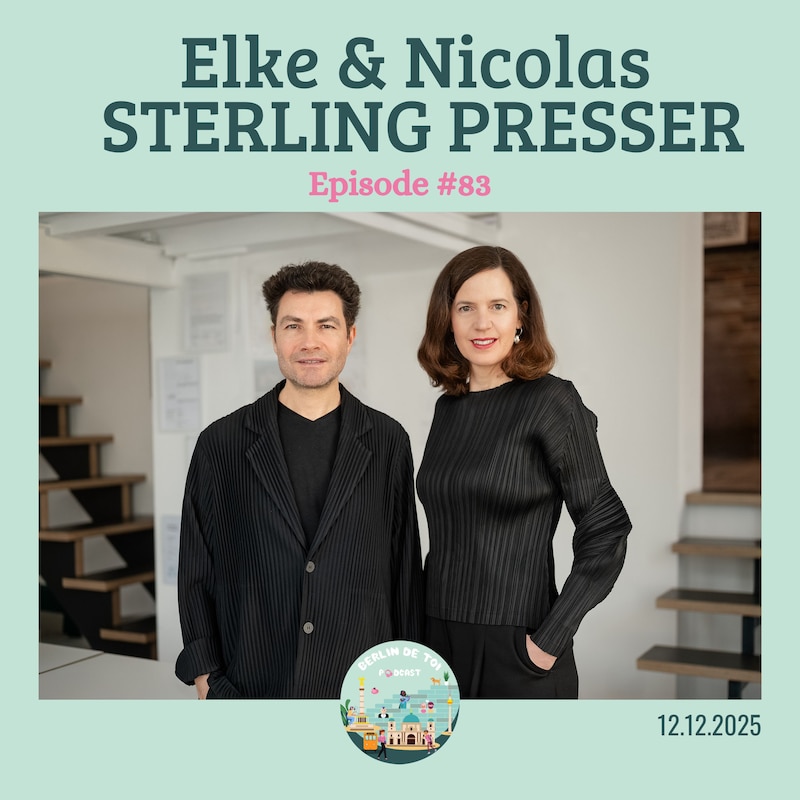
In this episode, we meet Elke Sterling-Presser and Nicolas Sterling, architects and engineers, co-founders of a Berlin-based studio STERLING PRESSER, where creative thinking and cultural translation are the base to building meaningful spaces 📐🏗️
Elke and Nicolas shares how her path from multidisciplinary training to collaborative practice shaped their approach to design: one that listens deeply to the singularity from places and people 💫
We explore how architecture becomes a language of connection, the art of translating across cultures and ideas, and what it means to hold space with humility, curiosity, and joy 🌱
From international collaborations to insights on creative partnership and the role of technology in practice, Elke and Nicolas reflect on the art of constructing not just buildings, but relationships with clients, contexts, and the world around us 🗺️🤝
✍️ Notes on https://www.berlindetoi.com/elke-nicolas-sterling-presser/
💌 Subscribe to the newsletter (FR) at https://berlindetoi.substack.com/
🔎 Share your story https://forms.gle/gtqoAjCTzT4RkTkf9
⭐️ 5 stars and a kind comment ⭐️
00:03:42 Crossing paths: Germany, France, London
00:07:07 Architecture, culture, and a shared language
00:11:03 Designing abroad: the Outdoor Water Theatre in China
00:14:33 Collaborating as a duo: creative abrasion and finding balance
00:24:00 Carrying a shared vision with clients
00:26:17 Building a legacy: seven years of projects and reflection in a book
00:29:11 Creating with AI without loosing control
00:34:52 La Comtesselation in France: building with the living and the sacred
00:40:41 Art, philosophy and nature as sources of inspiration
00:43:36 End of the Year rituals and walking the line
Transcripts
Hello, everyone, welcome on the podcast show.
Speaker:My name is Gabrielle, and I'm delighted that you're joining us for this conversation.
Speaker:When I arrived in Berlin a few years ago, I was struggling creating a network, professional
Speaker:as personal, and I would have loved to hear discussion and conversation from inspiring
Speaker:and engaged people living here.
Speaker:This is the purpose of the podcast Berlin de Toit.
Speaker:In French, German, English speaking conversation, we're going to meet these incredible people,
Speaker:which makes this place so awesome.
Speaker:So thank you for tuning in and see you soon.
Speaker:Play here, play here, play here, this is so much fun, I'm really enjoying it.
Speaker:Okay.
Speaker:I really love the experience to sit here.
Speaker:Yeah, no.
Speaker:So I asked each of you to write three words to describe your partner, professional partner,
Speaker:collaborator, friend, whatever you name it.
Speaker:And I'm going to ask you, please, Elke, to start with which word you choose to describe
Speaker:Nicola.
Speaker:So I was choosing passionate because Nicola is very passionate about his work and about
Speaker:what he's doing as well, like about everything, I would say, his life and also his ideas.
Speaker:And then I was choosing honest as well, because, yeah, I think he's always trying, whatever
Speaker:he's doing, to be honest to himself and honest to others as well, and then focused as well.
Speaker:So also, again, in his work or in our projects we are doing, he's trying to focus very much
Speaker:on the specific topic and try to make it happen.
Speaker:Thank you.
Speaker:That's a great choice of word, I guess.
Speaker:Yes, nice to hear.
Speaker:Would you have picked them for yourself?
Speaker:Would you have picked up these three words for yourself?
Speaker:I think they picture very well.
Speaker:Yeah.
Speaker:Maybe a personality or some characters.
Speaker:I think it's a nice choice, it's a nice choice.
Speaker:On my side, I picked up interesting words, I think creative came first.
Speaker:I think we are working together in the creative industry, which is architecture, engineering,
Speaker:art together.
Speaker:And I think creative is one of the key aspects of Elke.
Speaker:She just always sees things differently.
Speaker:One of the other words is visionary alternative, two words, because she always finds ideas
Speaker:outside the box.
Speaker:It's a strong character, it comes with passion, it comes with a long-term vision.
Speaker:And one other character is perseverance.
Speaker:So it's linked to focus, maybe it's something we have in common.
Speaker:She doesn't let it go, we just achieve something up to the end.
Speaker:Love it.
Speaker:How do we feel?
Speaker:Warmed up?
Speaker:It's a nice exercise, actually.
Speaker:Thanks for the warm-up.
Speaker:Very glad you have heard your perspective from each other's, also.
Speaker:Thank you therefore.
Speaker:Elke, Sterling Presser, could you please present yourself?
Speaker:I'm Elke, I'm born in Germany and I grew up in Germany and I'm from Heidelberg.
Speaker:I spent my childhood in this area and then I studied architecture in Heidelberg and also
Speaker:in Frankfurt at the Städelschool.
Speaker:And after this, I went to London to work there for a big company, Zaha Hadid.
Speaker:That's also where I met Nicola then.
Speaker:My journey started, let's say, very local and in a very, let's say, comfortable family
Speaker:field as well.
Speaker:And I went out from this protected field and went, let's say, away from Germany to discover
Speaker:other things as well.
Speaker:After London, I moved then as well back to Germany, not really back to the area where
Speaker:I'm from because now we are in Berlin, but it was also, for me, an important step, again,
Speaker:to go a little bit back to the roots, even if it's not exactly the roots, but to have
Speaker:this connection again.
Speaker:Could you do the same?
Speaker:Please, Nicola.
Speaker:Sure.
Speaker:I'm Nicola Sterling.
Speaker:I'm trained as an architect and structural engineer in France, so I come from France
Speaker:in the area of Fontainebleau.
Speaker:I'm an explorer, so I started the journey from Fontainebleau to Paris, where I studied.
Speaker:Very interested in French artisan, I come from a stone builder family, interested in
Speaker:kind of local knowledge, how to build.
Speaker:And my journey to explore was going through Paris, architecture, engineering, discovering
Speaker:the big project in Paris at that time for Mitterrand, the work of Peter Rice.
Speaker:And I had a dream is to travel the world and just to explore the world of constructions.
Speaker:And at one point, Paris became too small.
Speaker:I just went to London intuitively to continue my journey after the studies, where I worked
Speaker:for a large company like Arab and a small team led by Cecil Balmon, where I kind of
Speaker:realized what I was looking for, working at the cross over between disciplines, between
Speaker:art, architecture, engineering, geometry, which was making me meet so many interesting
Speaker:architects and artists and professionals.
Speaker:London gave me this momentum of more universal work, not just working locally in France,
Speaker:but also I became a bit more aware of international skills.
Speaker:And from there, I met Elke.
Speaker:She was in Zaha Hadid and I was at that time in an engineering office.
Speaker:We had the idea to first work together just to explore maybe different things.
Speaker:We've been traveling in India and Nepal, which was the start of the first book, the start
Speaker:of the first project together.
Speaker:And we had this idea of collaboration that started growing, but it took time to nurture.
Speaker:And we set up our office in 2018, just learning in Berlin.
Speaker:Both of you studied architecture in different countries and met in a third one, which was
Speaker:also directed from people from other countries.
Speaker:Would you say that architecture has its own language or did you have to go through this
Speaker:cultural barrier to work together first in this international team?
Speaker:No, not so much.
Speaker:It's not very specific.
Speaker:Let's say there was a certain type of language there, which was not so specific to the place.
Speaker:It was just, let's say, a formal language developed in this office.
Speaker:And in our office, we try to do it differently.
Speaker:For us, it's also very important that the project is connected to the place, to the
Speaker:culture, to the people.
Speaker:I don't think that we had a culture barrier.
Speaker:We had somehow the same ideas, the same concept or the same procedure.
Speaker:I think it helped because we were before, let's say, in London and working in a very
Speaker:international office.
Speaker:I would even say it's a cultural openness to go beyond being defined by your own culture.
Speaker:When you grew up, you're educated and you're just working there.
Speaker:London gave maybe a different point of view.
Speaker:You understand that architecture is linked to a place and context and it's not dependent
Speaker:on the city where you work.
Speaker:So it's how we have been educated professionally at that time.
Speaker:And with full office, it keeps going because we are not really working only on mainly in
Speaker:Berlin or Germany or not only in Europe.
Speaker:So we always have a strong sense of connection with the culture and the context.
Speaker:And obviously, it does define how we approach a project.
Speaker:It's not a method which is disconnected from the place.
Speaker:So we work in China, we work obviously in Europe, we work back in France and Germany
Speaker:regularly, but we just sometimes land in Estonia, in Norway, it can be in Saudi Arabia
Speaker:or Oman.
Speaker:And we always adapt each other to all these different climates, cultural, feel, emotions.
Speaker:And this is also what is interesting for us.
Speaker:That's why we also like to not to work only, let's say, in Germany and France, because
Speaker:we like to get to know other cultures and other countries and other people.
Speaker:And that's why we are pushing to get projects abroad as well.
Speaker:And for us, it's a great opportunity to get to know other people, a new culture.
Speaker:Please correct me, but architecture is also bringing a vision to life.
Speaker:How does this symbiotic between vision, place, culture, expressing it and put it into motion?
Speaker:How does it work, first of all?
Speaker:And how does it work when you are two of you?
Speaker:It's a different aspect.
Speaker:So first thing is the aspect of working together, the idea of creative abrasion.
Speaker:It's not a linear process.
Speaker:We have ideas that we exchange.
Speaker:The idea doesn't go against each other.
Speaker:Quite often we say they rub, they test each other.
Speaker:We don't try to conflict them.
Speaker:We just try to test them to the limit.
Speaker:And sometimes we follow the flow of, we find a kind of common understanding, a balance
Speaker:between these ideas.
Speaker:Collaboration is based as well on different expertise, different disciplines.
Speaker:So it's not only one way of thinking architecture, which is only artistic.
Speaker:So we are very different and this makes us very special because we test our ideas in
Speaker:different ways.
Speaker:And we learn how to work together with that.
Speaker:Architecture is not coming out of the blue from a picture which doesn't belong.
Speaker:So we always say that architecture is meant to be inhabited.
Speaker:Yeah, for example, when we did this project in China, the theater there, we started to
Speaker:have the local office as a contact as well.
Speaker:Then we were traveling a lot there to meet the client, to meet the people, to also visit
Speaker:the place, the site.
Speaker:And for us, yeah, it was very important to understand the different culture, you know,
Speaker:because they have a completely different way how they see things and their aesthetic
Speaker:as well.
Speaker:So for example, in the theater, this lotus flower was very important for them and they
Speaker:wanted to have it somehow integrated in the design.
Speaker:And for us, maybe in the beginning, we found it a bit cheesy, but then we tried to see
Speaker:so how can we translate it, you know, that it's still clear for them, but still like
Speaker:an architecture and design which we like or which we can support.
Speaker:We got this idea project right, I would say, because they were happy and we were also
Speaker:happy about the outcome.
Speaker:But also to get to know, you know, how people in China, how do you talk with them and how
Speaker:you communicate, what are their values, what is important to them.
Speaker:And also because it was a water theater, so it was a place for people to meet there
Speaker:and to celebrate and to come together and how you are in the city where the water theater
Speaker:is.
Speaker:It's a very industrial city and the water theater is a little bit outside, like in the
Speaker:landscape, within a park, and this is for them like a relaxing place where they can
Speaker:come on the weekend.
Speaker:And so we had to understand the whole context, obviously, to integrate everything in the
Speaker:design as well.
Speaker:For them, sure, it's also helpful to get another input, which is maybe not from their
Speaker:culture, you know, like this combination.
Speaker:So you have like two cultures somehow merging together and then you get something
Speaker:interesting out of it.
Speaker:That's not only a great experience for ourselves, it's a recreated experience.
Speaker:One of our first projects abroad, built to large scale in China, and it was defining
Speaker:how can we work from Europe with a culture, different way, different understanding, different
Speaker:symbolic.
Speaker:And it's true that at the beginning, they had an idea in 2D and we came up with our
Speaker:toolkit or vision to put their ideas into an experience, into the right position on
Speaker:the site.
Speaker:We had 15 kilometers of river to develop and we placed on a duneslope in the meander
Speaker:this theater strategically.
Speaker:This happens only if you travel there because it's a theater for 3,000 people outdoor.
Speaker:What do they mean with the lotus representation, the moon, the symbolic of water, relationship
Speaker:to nature?
Speaker:And this is something you learn from being there, sitting together at this round table
Speaker:in China, eating, humor, misunderstanding, code of practice, the politeness.
Speaker:And as well, the moment of sketching, coming on the table and just getting the feeling
Speaker:that you understand them.
Speaker:You mentioned that you had different fields of speciality.
Speaker:How exactly did that work?
Speaker:I come from architecture and engineering, so I studied both, which means I've got a
Speaker:more constructive approach to architecture or understanding of, let's say, technical
Speaker:aspects.
Speaker:I studied architecture, but also I studied architecture, like my second study was architecture
Speaker:at an art school.
Speaker:So my approach is more artistic, more conceptual.
Speaker:This is what is great because we have these two backgrounds.
Speaker:Like each project we start, we think together, you know, like it's not only about the form
Speaker:or the aesthetic.
Speaker:So we also think about how structurally it could work.
Speaker:And also, obviously, we are thinking about the program, we are thinking about who it
Speaker:is, which are the users.
Speaker:But all these components, to put them together and to also think about it at the very beginning,
Speaker:it's very important because then the project also develops in a better way.
Speaker:And for the client, you don't need to make steps back anymore.
Speaker:You know, you have already tried to consider all of it from the start on and then it's
Speaker:an easier or the project gets more clear somehow.
Speaker:It's great to have these two visions come together because very often in practice, you
Speaker:have different offices, different teams, exchanging ideas, but conflicting or not thinking
Speaker:together.
Speaker:And I think we always think that when the art of architecture and structure comes together
Speaker:in one flow, together with other consultants, but at the early stage, when we just sit with
Speaker:a client and we just watch for expertise and think that a certain form, a certain program
Speaker:is feasible, but not only from an aesthetic or external point of view, but constructively.
Speaker:The project gets further.
Speaker:Take it through it in this creative process.
Speaker:That is, when you start a project, you go alone into it and then you think, oh, this
Speaker:is going to be for Nicolas.
Speaker:This is going to be for Elke.
Speaker:No, we are both shaking heads.
Speaker:It is so good.
Speaker:How do you approach this exactly?
Speaker:It's not that linear, let's say.
Speaker:Hopefully, that's the beauty of it.
Speaker:It's chaotic as well.
Speaker:First of all, we are going to see the site, to visit the site, to get also the connection
Speaker:to the site and the connection as well for whom the project is, to talk to the people,
Speaker:to understand what they want and what is important for them and also their pattern, their living
Speaker:pattern.
Speaker:You can then translate it into architecture and you have to interact as well with the
Speaker:surroundings to understand as well how you can integrate.
Speaker:Let's say if there would be a tree, for example, could you maybe integrate this tree into the
Speaker:architecture?
Speaker:Nicolas is doing the sketching part.
Speaker:It's a mix of analog and digital, all the way through.
Speaker:I prefer to sketch digital and he prefers to sketch with his hand.
Speaker:And then we put our ideas, our sketches together as well and then it also develops.
Speaker:Then you go back to the site, you talk again to your clients and you try to understand
Speaker:again what is important and what you need to change.
Speaker:Basically, we are looking for something which is always new because each project is a prototype.
Speaker:We don't copy any ideas from the past and just plug them.
Speaker:We spend a lot of time analysing the brief.
Speaker:We challenge the brief.
Speaker:This is already started as well before sketching and touching the paper.
Speaker:We have to develop an idea through analysing the constraints and this we do it together.
Speaker:We write as well.
Speaker:We have keynotes in English, sometimes in French or German, but we write with keywords
Speaker:because they influence the way we anchor the project on that site.
Speaker:I wanted to ask, of course, about the language because I don't know what is your experience
Speaker:having at least three different languages used probably in different ways.
Speaker:But still, it personally very humbled me to learn a different language because it gave
Speaker:me also a different perspective, understanding how people see the world, understand it,
Speaker:interact with it.
Speaker:What is your take on this?
Speaker:It humbled me because I have to let go my prejudgment about German cultures by understanding
Speaker:the words that I could not at the beginning just figure out.
Speaker:It was a huge step.
Speaker:I came to London with some English, so it was different.
Speaker:It's already working in the English context in a specific business was already challenging
Speaker:because I had to shift the way of working.
Speaker:German language was for me one step further.
Speaker:I would say we were working language is still English because it's kind of we are defined
Speaker:by international work, but we still work in Germany.
Speaker:I still work in France.
Speaker:We learn a lot from this subtle misunderstanding, but judgment on the meaning of words.
Speaker:Yeah, I mean, in our office, we have like, OK, it's mainly English, but we also we talk
Speaker:German if there are some German projects or as well French.
Speaker:And also in our team, we have people from Germany or from France or like from all over
Speaker:the world.
Speaker:And that's why English is then, let's say, the office language.
Speaker:For Nicola, I could imagine that, let's say, doing the German projects in the German language
Speaker:and also specific words in German and also all the regulation, the dean and whatever
Speaker:you need to consider.
Speaker:Yeah, I would say it's not so easy, but then I do it.
Speaker:And then the projects we do in France, for example, that's then up to him to do them
Speaker:because, yeah, I can't do it in French.
Speaker:So for sure, we always come back to our own language sometimes where we grew up or cultural
Speaker:language when we want to pass an emotion.
Speaker:And it's the same thing when I sketch.
Speaker:I sketch in French.
Speaker:It's because it's deeply who I am and there's no issue to work in Germany or to work
Speaker:internationally.
Speaker:But there's a deep feeling that comes with the understanding of light and where I was
Speaker:educated in the architectural school and the landscape influenced me in my early time for
Speaker:20 years in France.
Speaker:And do I understand this correctly, that even though you have more your own specific territories
Speaker:of work, working in different language, maybe sometime you have to do a bit more engineering
Speaker:in German and then you have to be a bit more creative in French.
Speaker:Is that right?
Speaker:Do you have to translate it to the other one?
Speaker:You use the important word translation, which is not only a pure vocabulary topic, way of
Speaker:working, you have to translate different way of thinking.
Speaker:We have to bounce back with cultural baggage.
Speaker:It's not always easy as well, because you have, I said that a couple of minutes ago,
Speaker:misunderstanding.
Speaker:In German, misverständnis.
Speaker:It comes with it.
Speaker:But I would say what rescues everything is humor.
Speaker:If you don't have a sense of humor in your process by the narrow means of what you could
Speaker:have understood at that time, but your brain didn't connect in the other language, humor
Speaker:rescues everything.
Speaker:You agree on that?
Speaker:You need to allow things a bit, not in the way you would have done in your country or
Speaker:even when we work abroad.
Speaker:And also what is interesting to work, let's say in different countries, because you have
Speaker:different systems, you know, how you work.
Speaker:For example, in Germany here, you have all the Leistungsphasen, you have to stick to
Speaker:it.
Speaker:And you have certain regulations here.
Speaker:And this you need to learn how it works here, let's say for someone who has not done it
Speaker:before in Germany.
Speaker:And also to do collaboration, because let's say in China, we could not just deliver on
Speaker:our own.
Speaker:So you have to do the collaboration there.
Speaker:And but also to understand and learn from them.
Speaker:We have strong ideas, point of view, we are owning a creative process, but it would never
Speaker:work without a team internally, but without partners.
Speaker:And this as well maybe is the key alchemy to find the right collaborators worldwide,
Speaker:because we work internationally.
Speaker:So we have to be anchored to some specific project, specific cultures, regulation.
Speaker:It was important was the ability to share your vision with other partners.
Speaker:Staying on this topic of words, how do you come to the customer, the client, the person
Speaker:as a team of two person?
Speaker:Usually, when we see our clients, we go together.
Speaker:And then we also sometimes bring as well from our team, whoever is supposed to work on this
Speaker:project.
Speaker:We didn't set it up that one is running, for example, the business or administrative
Speaker:part, the other one would just run the creative part or vice versa, because it was not the
Speaker:essence of what we want to create.
Speaker:At the front of a creative process, we want to keep ourselves together as a shared vision
Speaker:between art and science.
Speaker:You have talked about this first book that you have written.
Speaker:Now you're writing a new one.
Speaker:What is the idea behind it?
Speaker:And how do you work through this kind of project?
Speaker:The book at the moment, what we are putting together is a book from what we did the last
Speaker:seven years, basically.
Speaker:So we are putting all the projects we worked on, like we did a lot of competitions and
Speaker:we have some build projects as well to also kind of remind us what was the way we did
Speaker:so far and also to see what all our ideas we had, basically.
Speaker:What is important to us, so all the essays we have written and all the philosophy, because
Speaker:for each project we are specifically thinking as well what is the concept about this project
Speaker:and what is important to us doing this project.
Speaker:Like Nicola was saying, so each project is really a prototype.
Speaker:It's something very special we are trying to develop for the place and for the people
Speaker:there.
Speaker:And this has a lot of thinking behind and that's what we are all putting in this book
Speaker:at the moment and reminding us what we did in the last years.
Speaker:Seven years of work and I think it's a time for reflecting.
Speaker:For now, we chose three words for this book, sensing, connecting, constructing.
Speaker:It's a reflection of a method of working and we are trying to have a look at what was
Speaker:our impact in terms of creative spirits coming together with a large team.
Speaker:In the end, we just realized a large team was working together for seven years.
Speaker:What is as well our impact on the planet, on our creative ideas.
Speaker:So we had a lot of reflection, cross-reflection about materials and how we do things and it
Speaker:helps us a lot to wrap up seven years into a new step and we love this because you don't
Speaker:want to be in a creative process with not looking back and forth.
Speaker:You always want to be on the cutting edge, just need to look a little bit back and project
Speaker:yourself further.
Speaker:If you're just on your one line with no reflection, you don't learn from yourself.
Speaker:So the book is helping this because we are gathering all our sketch, all the drawings,
Speaker:all the 3D models, all the pictures we're rendering, the built project.
Speaker:There's a little bit as well of lessons learned.
Speaker:It's important what we could do better, what we could do differently because sometimes
Speaker:we see a project from seven years ago, I think we would do it differently.
Speaker:It could happen.
Speaker:Even the team working on it with us are excited to wrap up on just selecting materials, to
Speaker:be able to talk about it and to as well to share with others.
Speaker:You don't do only a book for yourself, you want to share your ideas and we can even
Speaker:influence the way others could work because I think architecture has a huge impact on
Speaker:people like users and as well other designers.
Speaker:It's also interesting because let's say ourselves, we are maybe not so much thinking
Speaker:about it, but then the feedback of our team is that they say it's very consistent what
Speaker:you are doing, you know, like it's a kind of consistent language somehow, even if we
Speaker:are not really thinking ourselves that it's like one language, but maybe it seems for
Speaker:others it is and also the approach.
Speaker:So, how we approach each project.
Speaker:So, it looks like for our team that it's very consistent and it's also for us a good
Speaker:feedback to get because if you are yourself in your work, you are not reflecting at this
Speaker:moment, but to get the feedback from others and see how they see us, it's helping us
Speaker:as well.
Speaker:Because we are always trying to get the notion of elegance and beauty together with
Speaker:constructive aspects.
Speaker:Talking about constructing, you mentioned a few of the tools you have been using and
Speaker:are using and you have chosen to go very deep into using AI, still, as you mentioned,
Speaker:also going back to more digital or more manual or analog.
Speaker:How did you approach this?
Speaker:Because, I mean, there have been a lot of different reactions to AI, a lot of people
Speaker:having fear and I have the feeling you went the other way around, embracing it.
Speaker:If you don't use AI, you will be out of the game at one point because, I mean, it will
Speaker:develop so quickly and it's also for us already so helpful that you have to somehow
Speaker:integrate it in your workflow.
Speaker:You are, let's say, kind of the creative director when you use AI, so you still need to
Speaker:know what you want and you have to, I mean, we have like different tools at the moment
Speaker:we are using and also the AI tools, they are developing very quickly, so we are often
Speaker:changing them as well.
Speaker:It's a process which goes back and forth between also analog, digital and also some
Speaker:ideas and input we get.
Speaker:The main thing is that you have to be in control of everything, so you have to be, let's
Speaker:say, the creative director of the project and then I don't think you need to fear so
Speaker:much about the AI.
Speaker:The tool is helping to get our vision together, but it's just only one process.
Speaker:As Silke mentioned, it's very important that we always keep ourselves creative and use
Speaker:new technology, whatever comes.
Speaker:AI is giving us a huge platform at the moment to experiment prompts, pictures, pixels, 3D
Speaker:models.
Speaker:As creators, we just always want to experiment.
Speaker:With one bemol, I would say, sure, you have the credits and the copyright.
Speaker:The open source is a risk.
Speaker:Having said that, having new opportunities to create further and be surprised by your
Speaker:own creation is amazing.
Speaker:You need to have a certain focus to make sure you're not iterating so many ideas that you
Speaker:don't see what's important to you on the need.
Speaker:As we're talking right now in December 2025, AI is also a lot based on prompt and I have
Speaker:the feeling you have kind of a good advantage using different languages and having to formalize
Speaker:your ideas and discussion and all.
Speaker:Do you also use it in different languages?
Speaker:For sure.
Speaker:Yeah, we do.
Speaker:Sometimes even AI is confused.
Speaker:He replied to me in French last time and a bit of English and German came in the end.
Speaker:It happens, I don't know.
Speaker:It happens because we are inputting different sources and we experiment.
Speaker:The world and storytelling is important.
Speaker:But again, a good output is always based on clarity and interesting input.
Speaker:I think this is our understanding up to now.
Speaker:We use it a lot, but not only.
Speaker:We even experiment other techniques.
Speaker:But it's important not to lose control on your original ideas.
Speaker:And this is essential.
Speaker:And as you're working also as a team with different members from different generations
Speaker:or age, how do you make sure that even though we have a big revolution right now of the
Speaker:tools, you still get to transmit also different ways of thinking?
Speaker:That was maybe before AI or with it.
Speaker:Do you have construct a method about this?
Speaker:Yeah, I mean, what we do, we talk a lot to our team.
Speaker:So, I mean, we exchange a lot and we explain.
Speaker:And so I think for them, it gets quite clear what we are looking for.
Speaker:And obviously, we are also open to get their input as well.
Speaker:It's great we are not too large, but we can be agile and communicate easily.
Speaker:It's important that we stay grounded.
Speaker:Again, you can test so many options and iterations with these new tools, not knowing what you
Speaker:are looking for.
Speaker:Being grounded means you have the feet anchored, the tree, the roots.
Speaker:And we are somehow, through our work, we are teaching them that.
Speaker:Through design, what grants a good design?
Speaker:What are the roots of an idea?
Speaker:It's just you can't.
Speaker:We have examples of younger students or graduates.
Speaker:They come and they are just outputting 200 options quickly.
Speaker:But we don't want to choose.
Speaker:We can't choose.
Speaker:We don't know.
Speaker:And there is a lot of doubt on what could be good.
Speaker:You need to educate your tests, your needs.
Speaker:And this needs to be strongly rooted.
Speaker:You need to build up your experience.
Speaker:So if you lose control, it's a bad race.
Speaker:It's just you're creating new pictures, but not really knowing where they are going.
Speaker:Talking about roots, at the same time as you are embracing this high tech,
Speaker:you also went very deeply far away and then back in France for a project that inspired
Speaker:me a lot, which is named Constellation.
Speaker:It's true.
Speaker:Am I saying that correctly?
Speaker:La Constellation, yeah.
Speaker:It's a mix of La Contesse and Constellation of a lot of cultures and links.
Speaker:In this project, you worked with a community called Kogi.
Speaker:And I was inspired because they came to visit the site.
Speaker:So as you were talking, always with this traveling and working on the location,
Speaker:and they designated the place as sacred, while you are embracing high technology
Speaker:and also going back to cultures with no technology at all
Speaker:and adding this spiritual dimension.
Speaker:How do you work this all together with this word?
Speaker:That's a very good question.
Speaker:Yeah, so for us, I mean, how we started, it was basically,
Speaker:I was reading some books about the Kogi, like the indigenous people in Colombia,
Speaker:in the Sierra Nevada.
Speaker:And I found it just very fascinating how you can have like a community,
Speaker:which is completely living, sustainable,
Speaker:and also not being in contact for such a long time with the outer world somehow.
Speaker:So only in the 70s or so,
Speaker:they started to be in contact with the outer world because they had to.
Speaker:And so I found it very fascinating to get a completely different input
Speaker:because, I mean, they see the world very different how we see it.
Speaker:And they see themselves as well as the older brothers and us as the younger brothers.
Speaker:I made this contact with the writer of the book,
Speaker:and we organized this workshop in Berlin in the architect's chamber.
Speaker:And then they came over and we had this workshop for two days.
Speaker:And also before we were doing a lot of, like they were here for a week,
Speaker:and we were going with them together to the forest
Speaker:and trying to understand as well their way of being.
Speaker:And this project now in France, it's with another author
Speaker:who also was writing about the Kogis.
Speaker:And he wanted to develop this project there in France,
Speaker:also together with the Kogi.
Speaker:And what is interesting to us as well is like
Speaker:this deep connection they have with the landscape or with the earth, let's say,
Speaker:because they see the earth as a living being.
Speaker:For them, the earth, it's alive.
Speaker:And whatever you touch basically on the earth,
Speaker:you need to get an agreement before somehow.
Speaker:You know, you cannot just build wherever you want
Speaker:because you might destroy some important lines.
Speaker:And they know where you are supposed to build
Speaker:and where you're not supposed to build.
Speaker:And they would ask as well for permission,
Speaker:and they would understand what is the best way to do something here
Speaker:and how this could support the earth.
Speaker:And we found a practical project
Speaker:where they wanted to extend a community center in La Drôme,
Speaker:so in the south front.
Speaker:But they wanted to keep a sacred space.
Speaker:They had just already built a Nui,
Speaker:which is a sacred place for the Kogi that visited this space.
Speaker:And there was full discussion, went into tradition
Speaker:on how to build the Nui and to keep a sacred space together
Speaker:through the translation of architecture
Speaker:with sacred geometry and local materials.
Speaker:And as we speak, we are moving ahead of refurbishment,
Speaker:which is a beautiful stone refuge,
Speaker:so a place in the mountains,
Speaker:which is going to be covered and just unified
Speaker:by a timber net in the form of a womb.
Speaker:So they have all this interesting symbolic
Speaker:and we try to rebuild this project in the way they would do it,
Speaker:but with the local knowledge,
Speaker:with as well the understanding here in Europe.
Speaker:And it's a beautiful experience
Speaker:because it's helping us to bridge the old and the new,
Speaker:the tradition and the new technology,
Speaker:but very respectful.
Speaker:Again, we felt a humility
Speaker:and we learned a lot through Elke's experience
Speaker:when we had this workshop in the architecture chamber.
Speaker:And now we are trying to build this project.
Speaker:So again, merging different languages and culture in a new place.
Speaker:I really love it.
Speaker:I think it's very exciting and interesting
Speaker:to have so much different mix
Speaker:and still at the end, a common vision that you can build in.
Speaker:Because as I said,
Speaker:if you're only discussing and putting options out there,
Speaker:you're not getting anywhere.
Speaker:What is interesting as well is for them also,
Speaker:they also think,
Speaker:and we are thinking this as well,
Speaker:that the building itself,
Speaker:like the form and the material of a building,
Speaker:it's also influencing your thoughts.
Speaker:So for them, a lot of buildings here in Germany,
Speaker:they are dead buildings.
Speaker:They feel like being in a dead building.
Speaker:And they were also asking us,
Speaker:how can you live in a dead building?
Speaker:In terms of material,
Speaker:but also in terms of form
Speaker:and how the building is designed somehow.
Speaker:But it's a shift.
Speaker:I think there's a new knowledge,
Speaker:there's new knowledge of old knowledge to learn.
Speaker:That's the thing.
Speaker:What can we rediscover?
Speaker:But maybe we lost connection.
Speaker:So we understand there is a lot of dialogue and communication,
Speaker:whereas it is people living right now,
Speaker:or nature, places.
Speaker:Do you have other sources of inspiration?
Speaker:As creative, I always have inspiration from other disciplines.
Speaker:Art is a big one.
Speaker:I love, for example, the work of Christo and Jean-Claude,
Speaker:because they are doing land art.
Speaker:It's an aesthetic expression in landscape.
Speaker:Such a beautiful thing.
Speaker:Sometimes it doesn't need to be even built.
Speaker:It's just the expression of scale,
Speaker:of materiality, colors.
Speaker:And I love watching this.
Speaker:Or other sources are obviously other architects and engineers.
Speaker:I love the work of Frioto,
Speaker:because he introduced again optimization of form-finding,
Speaker:which I find very inspirational.
Speaker:Understanding of nature principle of lightweight structures,
Speaker:I find it very inspirational.
Speaker:And sometimes other disciplines like poetry or music.
Speaker:Or also science,
Speaker:kind of biology.
Speaker:Or I don't know, if you try to think about what is important.
Speaker:And yeah, or also even ethnology,
Speaker:you know, like other indigenous cultures as well,
Speaker:to understand how they are thinking.
Speaker:And yeah, to come as well a bit back to the roots
Speaker:and to understand, yeah, like even in our culture,
Speaker:you know, we have lost a lot of connection to our past somehow.
Speaker:And to discover this again
Speaker:and see what we have forgotten somehow.
Speaker:And reading a lot is important.
Speaker:I mean, I always love reading again,
Speaker:Michel Serres or Bachelard or Merleau-Ponty.
Speaker:Phenomology is a bit philosophy.
Speaker:We can't maybe put them in practice easily.
Speaker:But to have a different level of understanding,
Speaker:maybe sometimes sentence or words are resonating.
Speaker:It's enough to inject new ideas.
Speaker:And I think architecture should not be sourced from architecture.
Speaker:People now for the culture of pictures and even with AI,
Speaker:they are just copying pixels.
Speaker:This is not the way.
Speaker:You need to be inspired by other disciplines,
Speaker:other way of thinking.
Speaker:And art is a big source of inspiration
Speaker:because sometimes people create free from scratch.
Speaker:They have new ideas.
Speaker:We want as well, importantly, we are inspired,
Speaker:but we always create original things.
Speaker:We never copy.
Speaker:There's a big shift between being inspired, being influenced.
Speaker:We're always influenced by something.
Speaker:But we always straighten our shoes with new ideas that we embed.
Speaker:The inspiration comes from nature in the end.
Speaker:A lot of things come from non-human activity.
Speaker:This is important to come to the roots of beautiful concept.
Speaker:We talk about impermanence.
Speaker:We talk about philosophy, something which is universal.
Speaker:Wabi Zabi philosophy is amazing.
Speaker:Teach you imperfection.
Speaker:It's another word.
Speaker:All what is rooted in this inspired us a lot.
Speaker:Now that 2025 is coming to an end,
Speaker:do you have some end of the year rituals?
Speaker:Do you have something particular planned?
Speaker:That's a good question.
Speaker:I think now we have a good...
Speaker:It's not a ritual, but as we are putting a book together
Speaker:the last few weeks towards the end of the year,
Speaker:this is a ritual to bring us together.
Speaker:Because we are almost stopping producing new architecture,
Speaker:we are wrapping up.
Speaker:As we are thinking about others and doing a gift,
Speaker:we are trying to understand what is our own gift
Speaker:of architecture and creation.
Speaker:We are wrapping up everything.
Speaker:And then we have for sure our Christmas party with the team.
Speaker:It is more, let's say, almost a formal aspect of things,
Speaker:but we have a lot of joy of coming together.
Speaker:I love the word in German, Begeisterung.
Speaker:Such a nice word.
Speaker:It is surely very inspiring to hear both of you
Speaker:with your different aspect and vision and perspective
Speaker:and see how you are growing this legacy about your vision
Speaker:that you're building and putting out there.
Speaker:So thank you so much therefore.
Speaker:Do you have any final words?
Speaker:Something to add?
Speaker:I wish us to keep working on this thin line
Speaker:between disciplines that keep us passionate.
Speaker:So I like always this picture of this wire worker artist,
Speaker:Philippe Petit.
Speaker:I always talk about him because he inspired me so much.
Speaker:Being able to put a string between the twin towers
Speaker:and work with his own freedom and create his own space.
Speaker:And I wish us with passion to keep working the string.
Speaker:To be in balance, let's say,
Speaker:that you find as well the time to be together as a couple too.
Speaker:So to continue on that part too.
Speaker:Yeah, but it's a wire worker.
Speaker:It's about balance.
Speaker:So it's a good resonance.
Speaker:Thank you so much.
Speaker:For your questions and time.
Speaker:We keep working.
Speaker:Congratulations, you made it to the end of the conversation.
Speaker:Thank you so much for your attention.
Speaker:You will find the whole show notes on the website of the podcast
Speaker:under www.berlindetroit.com
Speaker:and you can find us on Instagram at berlindetroit all together.
Speaker:Thank you so much.
Speaker:See you soon and have fun.
Speaker:Bye.
Speaker:Bye.