Shownotes
Join us Tuesday, June 9th, at Macro ‘n Chill, the online gathering where we’ll listen to and discuss this episode. 8pm ET/5pm PT. Register with this link: https://us06web.zoom.us/meeting/register/L40tjKhOSCGCJTR-R-QJvw
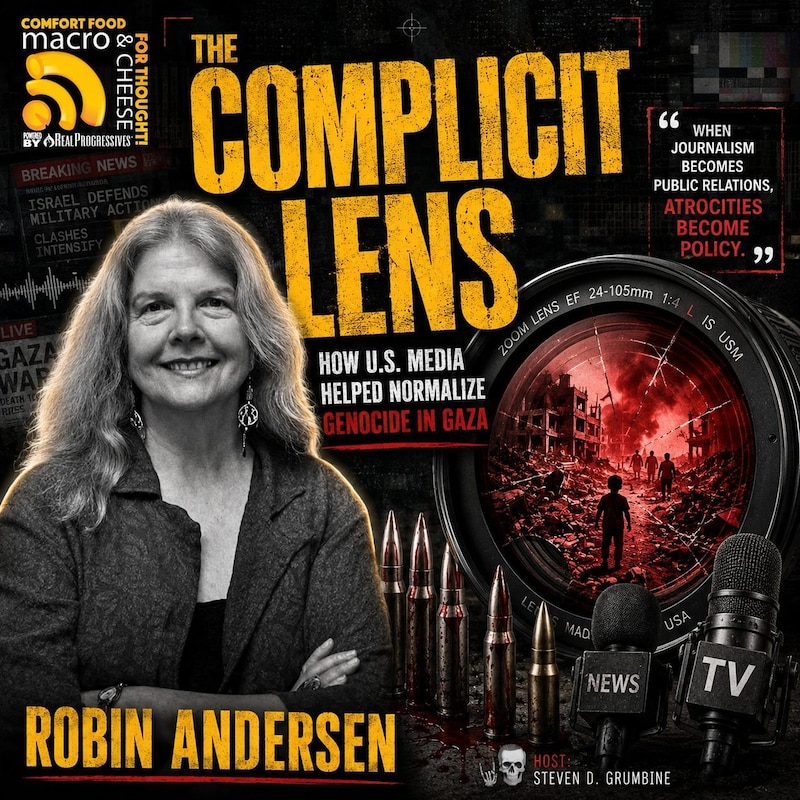
The title of Robin Andersen’s upcoming book (published next week) is The Complicit Lens: US Media Coverage of the Genocide in Gaza. You can see why Steve wanted to talk with her. Their conversation looks at how the corporate media helped manufacture consent for Israel’s war on Gaza by erasing historical context. It is tasked with enforcing cultural hegemony à la Gramsci, and defending the interests of the imperial core.
Robin goes into examples of how the media has been used to erase Palestinian history and justify war crimes. Terms like "occupation," "apartheid," and "genocide" are scrubbed from discourse to maintain ideological control. It allows the ongoing dispossession and ethnic cleansing of Palestinians to go unchallenged.
As MMTers we understand – and Steve emphasizes – how state resources are mobilized without hesitation for war and geopolitical control, while austerity is imposed at home as a political choice rather than an economic necessity.
In this time where journalists are under attack (literally) the episode urges solidarity with truth-tellers like Francesca Albanese who confront imperialist violence.
Robin Andersen is professor emerita of media studies at Fordham University and an award-winning author of a dozen single- and co-authored books. Her work examines film, television, and media coverage of war, the environment, politics, and elections. She edits the Routledge Focus Book Series on Media and Humanitarian Action, serves as a Project Censored Judge, and contributes to the annual State of the Free Press. Andersen is on the Board of Directors of Fairness and Accuracy in Reporting (FAIR), where she also writes regularly, and is an Izzy Award Judge for the Park Center for Independent Media. Her writing has appeared in CounterPunch, LA Progressive, The Progressive, Salon, Common Dreams, and ScheerPost, among others.
@MediaPhiled on X
Transcripts
All right, folks, this is Steve with Macro and Cheese. Today's guest. Let me. Before I say today's guest, let me preface what we're about to talk about.
So a lot of you guys out there have talked about the need for a media commons, a public media commons. Oh, if we only had a media Commons, we could get the word out to everybody. And you're not wrong, but you just don't have a path to make that happen.
We're out here as independent media trying to get the word out on what I consider to be really important things, which is part of what my guest discusses today. But folks, you've got to work in solidarity with us. We need your help sharing. We need your help getting the word out.
Because we are fighting media empires, social media algorithms that are brutal and cruel and intentionally silencing of important voices and narratives in their effort, as Gram, she would say, to enact cultural hegemony here. Folks, this is cultural hegemony, what we're seeing with the media, okay? And you know, guys like Errol Colossi and Errol, I know you listen.
So I want to give you a big, huge shout out. There's never a time that Errol does not share the podcast because that's our advertising, folks.
Without a means of distribution, without some billionaire sitting there bankrolling us, this stuff doesn't get out. And I think the information we're saying, it isn't said elsewhere. I'm just going to be honest with you. It's not said elsewhere.
So we really need your help and erald. Once again, I want to give you a big, huge shout out.
My buddy, Stanley Cole, a number of folks that constantly make sure that they put this podcast out there. Jim Byrne, you too, my friend, thank you so much for always making sure this stuff gets out there.
So with that preface, I am going to be talking today to Robin Anderson, who wrote a book called the Complicit Lens.
And the Complicit Lens is a very, very important book because it centers the media coverage on Gaza, on Palestine, on the genocide, folks, the genocide that the quote unquote, mainstream, corporate, acceptable media, the official channels, sits there and gives you the most repulsive, backwards, incorrect Terrible narratives about what are going on, that they whitewashed the deaths of those children of the people over there, while what, I don't know, Greater Israel is busy selling their land out from under them to kids in New York City and SoHo that are trying to move out there. I mean, it is repulsive and ridiculous. And documented, by the way. These are facts. Documented.
And my guest, Robin okay, who is a professor emerita of media studies at Fordham University and an award winning author of a dozen single and co authored books, who has written this book, the Complicit Lens speaks to extremely eloquently.
And let me just say this, while she may have toned it down for readability purposes, when you read the words to this book, if you can do it without yelling and screaming in your head and your heart and realizing how absolutely captured media is, how absolutely uninformed most people are, and by design, you will absolutely lose your mind. So without further ado, I bring on my guest, Robin Anderson. Welcome to the show, Robin.
Robin Anderson:Thanks, Steve. I'm happy to be here. Thanks for inviting me.
Steve Grumbine:Absolutely. Listen, your book, and I want to start off with, I mean, I read these books before I do these interviews.
I try very hard to make sure that I am aware of the information. And before we say yes to these interviews, usually I try to make sure. And this is so powerful.
And I think what is even more powerful before we even get into the book itself, is how you came to even write the book up front. In the beginning of this book, you were on quite a journey to get to where you had written about this.
And somebody said, hey, you know, you really should write an article about this. And it was like, oh, how about writing a book about this?
And I just want you to lay out first of all what you stumbled onto, how you put this out there and how you came to write this book.
Robin Anderson:Thanks. Thanks, Steve. Yes, I work with Project Censored and I have for show readers.
I also write for FAIR and I had a number of articles already about the genocide. Well, later. But basically at Project Censored they asked me to write a dispatches right after October 7th.
So for their dispatch and I, I wrote it pretty quickly and it came out two or three weeks. It was like the first thing out there about the media coverage of what we were seeing.
And don't forget in the first 25 days, 5,000 people were killed.
You could tell right away that this was going to be a horrible thing because of the incitement language, the insightful rhetoric that the Israeli officials were using, the Biden administration defend themselves full stop. What does that mean? Anything goes. So anything goes.
And Israel, with its history of war crimes, that human rights groups kept saying, we've got to investigate these things where Israel, whenever, you know, whenever they protest peacefully in East Jerusalem, for example, in the Al Aqsa neighborhood, you know, you come down on them heavily and then it ends up into, you know, bombing Gaza and four buildings. So we knew this stuff was going to happen. So having seen war coverage right off from the start, I wrote the piece and it went everywhere.
It really got widely distributed and that kind of did it for me. I. I had gotten really kind of had enough of Israel. Well, I think a lot of us did for a very long time.
But what really got me was the assassination of the Palestinian American journalist Shrina Abu Akleh, who worked for Al Jazeera, you know, in the west bank, and they just assassinated her. And I wrote a number of pieces for FAIR about that.
So I think that portended to the future of how all the journalists were going to be killed as well, because Israel was never held accountable by the Biden administration. So that's kind of how it started.
Kind of people at Project Censored, I think, kind of looked at me and said, well, Robin, you're the one who does media and war write this. And so, and then I thought, this needs to be a book.
And I pitched it to Rashid Khalidi at the Institute for Palestine Studies, which is the co publisher of the book. And. And then from there on it went forward.
Steve Grumbine:So, you know, one of the things that I think I want to get out in the open before folks have a chance to, you know, stop listening. You know, I want to get right up front is one of the things.
I mean, the book is called the Complicit Lens, and it's about the media's coverage and how they frame things and how they don't frame things and how they ignore inconvenient things. And moreover, you know, war is always told from the view of the victor. But in this case, the victor hadn't even happened yet.
It was already prefabricated.
I mean, let's call it hasbara, I mean, whatever we want to call this, ultimately we are talking about a coordinated, absolute precision, you know, coordinated with every media outlet. The narratives that came out were all the same.
And for those folks that want to tell me that I'm crazy, because when I say we don't live in a democracy, I say, how could you have voted this away?
You had Joe Biden in office you had AOC lying her ass off that they were working tirelessly for a ceasefire, lying outrageously in people like, gulping it down like mother's milk. And I say we don't live in a democracy. So the normal official channels for taking action were already prescribed by oligarchic entities.
This is not conspiracy. This is history. This is reality.
And the idea that these people carried the water, and it wasn't just the media, it was the politicians who were there to sell a narrative, too. All of them were selling this lie.
And really, at the end of the day, people like you, God bless you for putting the word out, and for all those folks out there who risked their livelihoods and risked their lives in many cases to get the word out, to get those tiktoks out, to get all the footage out that helped us see the brutal war crimes that were going on. I mean, we are small but mighty.
But reality is, it's very hard to overcome the cultural hegemony, the absolute stranglehold that this regime, if you will. It's not even a regime, the oligarchy. It's the best way I can say, because it doesn't matter what administrations in power.
At the end of the day, you'll get the same exact result. I want to understand, how can we say we live in a democracy when we don't have any means to the truth? We don't have access to real journalism.
There's no watchdogs, there's no nothing. If you say anything against it, you are branded an enemy or a liar, or you're put to pasture, you're ignored.
Help me understand how people think that this is democracy.
Robin Anderson:Right? Right. Well, the cornerstone of democracy is a free press.
We have a long history of battling in this country, you know, for over 200 years to make sure that we have freedom of the press, that our professional media have a set of standards by which they are supposed to bring us information.
And it's supposed to be information that is accurate, relatively fair, but mostly accurate, so we can make our own decisions about the bills we want to see passed, the politicians we want to represent us, all of those things. That's the core of democracy. What I tried to do in this book, everything that you say is true. We've got this hegemon at the highest levels.
So just in terms of the media conglomerates, you've got the same people who are heading the corporations, the media conglomerates, the military industrial complex. They're on the boards of directors of these increasingly centralized media conglomerates, where few and Fewer owners are at the heads.
Now you can't expect a free press in the ways in which we define it. And historically we have also, the other aspect of a democracy is human rights. We need.
The journalists have to be able to do their jobs and citizens have to be able to do what they, what they want to do. That is to say, get together, express themselves, protest without being, you know, smashed by the government.
We see all of these things being rolled back in this modern era that corresponds really to the distribution of resources and wealth in our country and the globe where fewer and fewer billionaires own more and more of the wealth. These things go together. You can't have a functioning middle class, you can't have a democracy while these things are going on.
So in terms of writing this book and trying to point that out, my job here was to point out the mechanisms by which we have arrived at this place where we understand that America is more for only the rich people, where we are disenfranchised and, and increasingly we are, we do not have a voice. So right away we have, you know, you point out that right from the start they were all the same story. Well, it wouldn't come out until January.
The staff at CNN and then later, April 1, the staff at the New York Times linked the material that they were given from their editors at the highest level of these two very important legacy media.
The paper of record, the agenda setting newspaper, the New York Times, the longest, you know, the, the most important international broadcasting service, cnn, also legacy media. They were following what the Israelis were dictating.
So for cnn, the first set of leaks that came out of there, the staff told them that every bit of their copy from the Middle east and from what was going on in Gaza was going through their Jerusalem bureau. And the IDF had eyes on it. So their material was being vetted by the idf.
Now there were particular missives and directives that they were told what they could and could not say. They could not humanize Palestinians. It was literally said that the Palestinians and Hamas might.
We can't speak about them in emotional terms because with, you know, we don't want to be a propaganda platform for Hamas. And don't say massacre, don't say slaughter, don't say brutality.
All of those words then were only applied to the Israeli citizens at that point who were killed or taken hostage. Now that. So that's how the. October 7th, and I hope we can get back to that.
Yes, What I want to point out also right now is to talk about the New York Times, how this Uniformly standardized type of coverage came about. And at the New York Times they basically told them the same thing.
And you can read the Israeli Hasbara stamp, you know, between the lines of this stuff. And again, these are the agenda setters, right? So yes, we see this standardized frame going throughout.
What the New York Times pointed out and the staffers at the New York Times emphasized, I think, or what I got from what they were saying was that they took out an entire lexicon of humanitarian rules, the rules of war.
Any understanding of the genocide convention that was put in place after World War II to prevent these kinds of masses murders and genocide that had happened. All of this stuff was banned from. You couldn't say occupation, you certainly couldn't say apartheid, you couldn't say refugee camp.
So for example, when Hamas goes into on October 7th, and that narrative right there was already stunted because Israel called in the Hannibal Directive and they killed their own citizens. And we can go back to the details of that if you want. Oh, yes, so.
So that the story, the origin story of the genocide was in itself a constructed paradigm where supposedly Israel had done nothing in the years past.
And Hamas was just this, it was such a surprise and it was out of nowhere and gosh, that must mean that it was just these brutal terrorist, knife wielding rapists who came in and did all of this to poor innocent Israel. They were the victims. When if you look at the numbers.
ans and Israelis killed since:We know that they were making the civilian populations pay.
We know that they had been called up, that human rights organizations had reported their actions time and again to the ICC and demanded investigations into war crimes. So all of that got erased when you conveniently pull this one action out of this historical flow.
And then, and here's the ironic thing, and then I'll stop.
Steve Grumbine:Steve.
Robin Anderson:There was plenty of indication Hamas was posting on social media, that they were practicing with balloons, they were doing all this stuff. But the Israelis somehow didn't see that. Right? So they weren't prepared. Right. And they allowed it to happen.
But they were ready, right, right from the start with their incendiary propaganda rhetoric about that incited things that labeled Hamas the worst terrorist ever to be on the earth, just like isis. And they had their stuff together. And what the media did was not call this out.
So when you've got these military people in Israel saying, you wanted hell, we'll give you hell. You were celebrating while you should have been appalled by Hamas's actions.
Well, we're going to take you out, we're going to stop all of your food, we're going to stop your electricity, we're going to stop your water. All of those threats are genocide. They're threats against genocide.
And the American media and Western media did not provide any skepticism, any caution at that time. And so this false structured narrative October 7 becomes embedded and becomes a media mantra.
Steve Grumbine:So let me ask you, obviously we know that Zionists are in very, very high levels of government. Zionists own most of the media companies. We see. Zionists own many of the tech firms.
We see Zionists being appointed to positions that control the narratives. We see so much about, like even the Epstein files, etc, that have been allowed to take our eyes off of what is going on.
And I'm, you know, I've oftentimes want to make very, very clear that we're not talking about Jewish people, we're talking about Zionists and we are talking about the apartheid state of Israel and their fascist regime, their ethno fascist regime. And this is not about people who are Jewish. This is not about Jews in general. This is a very specific target.
And I want to make clear, you know, we're simply reporting here what's going on. This is not some sort of, oh, you know, but do you condemn Hamas? No, I don't. And guess what?
If a slave, during American slavery slit the slave owner's throat in the middle of the night to free his family, guess who I'm blaming? The slave owner. I'm not blaming the guy trying to get his freedom. So, you know, what does that make me?
I don't know, it feels like it makes me a human being. What is it that you feel, based on your research and not just for the book, but overall, I mean, you've been doing this for a while.
What is it you think that. How were they able to make so much continuity of messaging?
How were they able to capture so much to be able to make politicians dance their dance, to make the media dance their dance? How did they do it? How did they pull it off?
Robin Anderson:Well, I've been writing about media and war for a very long time. And so I see a historical progression.
And while we do have at this point some Zionist billionaires and I do think ultimately what we're facing now and we really do need to face it and have some alternative structures and we need a Plan, for example, you do have David Ellison, you know, the son of a billionaire Zionist and he's now one at the head of a huge conglomerate that owns cbs. And so he can put Barry Wise, as a self proclaimed fanatical Zionist at the head of cbs.
So, so there is this elite capture that we have to worry about.
I see this other aspect of war and the militarization of American culture very much to do really with American media and its ties to the military industrial complex.
I think that, yes, we've got parallel, if you want to talk about the two threads that you just laid out, you know, media ownership and then the ways in which the Zionist lobby has been successful in framing a pro Israeli frame.
I think that over the course of these years we have honest reporting, which is nothing but a propaganda organ, you know, in Israel as much as it is in here. And then we have also the Canary Mission, which finds students in universities.
Anybody who protests against Israel, they get doxxed and they can actually destroy their ability to find a job after they graduate. So students and faculty have been being attacked by Canary Mission for a long time, even before Trump. Right.
So a lot of this stuff also goes back before even our mad idiot king in the White House.
So not only have they had a huge effect on our, on the public sphere and civil society closing down, you know, and also funding, of course, politicians, museums, all kinds of the arts, things like that, and really managing to crowd out.
But you know, and at the same time, this emphasis on the right wing, growing Islamophobia that has been going on and then you have media conglomeration and research and development tying itself to the military industrial complex.
And that happened throughout the end of the 20th century, at the beginning of the 21st century, where you have the same computer based technologies that are now directing the weaponry, the same computer based technology also creating the first person shooter war games, and also an unholy marriage between Hollywood and the Pentagon where you've also got all the action adventure heroes now wielding the weapons of war because the Pentagon gives it to them for free because they're willing to allow their scripts to be transformed. So you've got this really powerful threat of militarism through American culture and then really accelerating in the 21st century.
And then you've got the Israeli lobby coming in and really promoting Israel and they grow closer together. But I don't look only at Israel for the situation in which the American military, oh yes, and Donald Trump wages war.
And then at the other hand, we've got these warframes Right. So after Vietnam, you know, through the first Gulf War, you know, the Nintendo war, that was a video game war.
And then all through the 21st century with the War on Terror, you've got a warframe. You've got media learning, too, and. And reading the war in certain ways.
But the first and characteristic thing, if you want to start a war, invade somebody for oil, you demonize the enemy. And that's exactly what happened. And they always get demonized. Saddam Hussein, Muammar Gaddafi, you know, that's how it works.
And so the Palestinians were demonized absolutely, in the worst possible way that allowed a genocide to occur.
Steve Grumbine:Let's go back to, you know, October 6th and 7th. You know, obviously the stories have been told a million times.
When you brought up the Hannibal Directive, can we start this off with a little bit of a story about what happened, not just the media complicity, Because I want to show how the media was complicit in this. And I think it's important to tell the story that they didn't tell. I think it's also important for folks to understand.
I mean, you're not crazy when you start looking at things and they don't add up. You know, they want you to feel like you're crazy, that it's gaslighting. It is the literal definition of gaslighting.
And the population has been completely and utterly like, I mean, we're a bunch of birds that have had our wings clipped. I mean, we're a bird name, only we can't fly. And they have literally taken away our ability to have truth.
And, you know, every study I've seen, I mean, the Guardian put out a. Ironically, the Guardian put out a great one about neoliberalism creating mental illness and the isolation and the it's my fault mentality, or I didn't succeed because it's my fault. These messages are part and parcel with this overarching theme.
Take us back to October 6th and 7th, with all the stories that came out, and woe is Israel. And just sort of break that down for people to understand what is real and what is Memorex.
Robin Anderson:Right? So right after October 7, when within the first few days, this. It was surprise, it was out of nowhere, pulled from its historical context.
October 7th became the origin story, the starting point.
So then how that narrative works, if you've got violence from these extremists, the response, and therefore the solution to the violence, is always belligerency. And this is a constructed media frame, right?
So we're talking about the real, but we're also talking about how it fits into an encapsulated narrative. So everything that the Israelis did was always defensive and it was retaliatory. Right?
starvation. By the spring of: th, when Hamas killed:And it was used throughout the coverage to just as this overarching thing that was said to justify and deny everything. Right. And what happened actually on October 7th was that Hamas, the Israelis weren't there.
I mean, you know, I'm going to be detailing from Richard Sanders film, who is a British filmmaker, and it aired on Al Jazeera.
And he Talked, he did October 7th, and he looked at all the webcams and all of the helmets that the Hamas fighters were wearing and he put together, you know, how it happened. And the Hamas went to all the military bases first, right?
And so many of the people who were killed, only about half of them were civilians, others were worried or settlers, Some of them were hanging out the military bases and. Or now you. It's true that you're not supposed to attack, even if it's soldiers, you're not supposed to attack them in their beds.
And some of the guys were just getting up and they weren't even in their uniforms and they did get killed by Hamas. So it's true that Hamas did commit some violations of the rules of war, but as it turned out, nothing like what Israel would do.
And the meeting was actually hysterical. This is the worst since the Holocaust. They burned babies that, you know.
And what Richard Sanders says in his film is, isn't it interesting that the media did not report on what Hamas actually did do. They reported on what Hamas did not do, which is take out 40 babies and behead them and tie them up and burn them, just like the Holocaust.
Like Netanyahu lied to President Biden saying. And then President Biden continued with it by saying, oh, I saw a picture.
He never saw any pictures because there were no pictures of beheaded babies or babies being birthed. Right. So all of these things were lies.
What Richard Sanders then documents and what many people have pointed out, Jonathan Cook, you know, the British journalist, that in Israeli media, a number of different testimonies from military people, but also from some of the hostages so there's this one woman named Yasmin Borat who was at Kibbutz Barry. They were taken hostage. She says, actually the Hamas guys were okay to her. They weren't treating them badly or threatening.
They let them go out into the garden. They waited for 10 hours for no Israeli response.
Then when the Israeli military do come in full force, and she says there's a hail of gunfire, it's terrible. Cross fire, and all of the hostages except her were killed.
And on the radio, on the Israeli media, Hebrew radio, it's very interesting to listen, she says. The announcer goes, well, you mean. You mean our. But certainly the Israeli soldiers didn't kill them. And she goes, you don't understand.
This was heavy crossfire. Yes. Israelis killed, you know, our people too. Most importantly, at the rave, most importantly at the music festival.
Israel sent up helicopters in Apache. US Supported Apache helicopters. They didn't know who they were. They couldn't tell who they were bombing. This was the raid ground.
And Hamas was trying to get some of their hostages across that area, back over to the border. And as they flee to the border, the helicopters rained. I mean, they emptied their bellies with all of these ordinances, you know, for several hours.
We'll never know how many were killed by Hamas and how many were killed by Israel. But, you know, this is very well documented in Israeli media.
It's been written about by the Gray Zone, electronic Intifada, Mandawas, you know, so this is not a secret in people who consume a certain type of media or read and view certain types of media. And I just want to point out, Steve, what we did find and what, if you think about it, we. We.
You were mentioning before, we as Americans aren't aware of how we are being propagandized. And indeed, we.
We view ourselves as a very free people, and we mostly believe the media, except for now, I think that the Gaza genocide, when especially young people, we have huge divides generationally here. You know, young people don't read the New York Times. They don't watch legacy media.
They get their news on their handheld devices in lots of different ways over social media, but also alternative sources. What we saw were two different realities.
We saw the Palestinian journalists documenting this, putting this all over the Internet through international outlets, and our international alternative and independent outlets picking it up.
And then you had these obscured, deliberately misdirecting fabrications on the part of establishment media over and over again for every massacre and for everything that happened.
And people in the American public looked at it and they decided they didn't like it and they weren't going to vote for the likes of someone who was actively involved in a genocide.
So the people, the way Biden lost the election, he they basically knew, I think that that forensic or autopsy of the Democratic Party and the reason that they won't let it out is because it's going to show that it was Biden's support for the genocide in Gaza that lost them elections. And I was writing about that at the time and that was very obvious then.
So anyway,
Intermission:you are listening to Macro and Cheese, a podcast by Real Progressives. We are a 501c3 nonprofit organization. All donations are tax deductible.
Please consider becoming a monthly donor on Patreon Substack or our website realprogressives.org now back to the podcast.
Steve Grumbine:Can I jump in there real quick?
Robin Anderson:Yeah, go ahead.
Steve Grumbine:I think it's super important to understand this, right? You know, like, let's just say nominally we voted for Joe Biden or we voted for Jill Stein or we voted for Donald Trump or whoever.
In the end, Gillens and Page and folks, forgive me for being a broken record, but until it sticks, I'm going to keep repeating it.
Gillens and page in:You don't get to ignore it. That's reality. Just like this conversation we're having about the media cover up of a genocide. I'm not going to let you ignore that either.
To the best of my ability, I am going to force you to reconcile these differences as you run out there and say we're going to vote for a few more this, that and the other. We're going to have a Green New Deal. We're going to have an anti austerity program. We're going to have this, we're going to have that.
Folks, Biden full throatedly swallowed the lies about decapitated babies. He fully supported and funded the US Military actions that supported this genocide.
And whether or not Kamala Harris lacked the spine or whether she was just a prop in a kayfabe play, whatever it is, she stood by her man and kept the same narrative going. In fact, when people tried to bring up what was happening in Gaza. She did the whole hand to the face. I'm speaking.
And then as people were walking outside of the Democratic National Convention protesting a genocide, people walked out of that convention going, la, la, la, la. Covering their ears up, laughing, mocking them, et cetera. I want to be crystal clear, that's not Donald Trump.
This is your beloved democracy at play here. This is the fraud of democracy. Go ahead.
Robin Anderson:I'm sorry, No, I will confirm, and I think you're right, Steve, that what we like to call bipartisan support for Israel's genocide.
Steve Grumbine:Yes.
Robin Anderson:And yeah, so it's true that we are represented by a minority that actually does not represent our interests.
And they've gotten there through all kinds of means, but certainly through, you know, we could talk forever about the Supreme Court and Citizens United, where it started and all of that stuff. But I do think that the Israeli lobby is now starting to crack.
I think there are openings and there are counter forces, because when you get something like this, where the, where, yes, the oligarchy.
And so oligarchy, and I like to say government elites and those in power who are benefiting and who, as the money transfers to the top through all of their policies and their directives, you know, I think what happens is that it starts to be complete. They start to get out of control.
They believe their own propaganda and they, and they, they do what Donald Trump just did, like, you know, go in, close down, allow the Iranians to close down the Strait of Hormuz, which they always said they were going to do for years. This was a surprise to Donald Trump and he's ruining the global economy and the petrodollar.
But, you know, you're a Gromski, and if you recall his also, this is the age of monsters. When you tear something down and you, you don't have the structures in place to keep the monsters at bay.
You know, you've got that awful, ugly interregnum. And I think we're going to be seeing it pretty soon.
I don't know, I don't like to make these kind of predictions, but sure, getting back to our politicians, and I do believe that the Biden administration was more willing to hand.
I think they had to be aware of it, at least some in that cabinet, that they were handing over this election to Donald Trump, but they could not, not support Israel.
And, you know, frankly, I don't purport to know all of the connections between the politicians, between aipac, between the amounts of money, between Jeff Epstein, and I don't think we really need to know that. I think what we need to know at this point is that their propaganda didn't work. We know we want something very different.
And getting there, as I think as a peaceful globe and a global population, we see signs where things are starting to fall into place with different configurations. And I think that's what we have to look forward to.
Steve Grumbine:Well, I'm hopeful something good happens, how.
Robin Anderson:We're going to rebuild these structures.
Steve Grumbine:Yes, I'm with you there. Absolutely. And see there in which you have to believe that you need to rebuild them. You have to believe that they're broken.
And I think that there is a. It's like a dissonance. Right.
Where the tuning fork of your life and your brain is out of sync with reality and the pain of accepting new information and what that will do to you and your place in society, what that will do to all the little synapses you've formed over the years and how you interpret the world you know, and how you live your life. Fundamentally change when information, this destabilizing is brought to you.
And I think that there's a, you know, I'll use a little bit of recovery thinking here. Right.
You know, when you haven't come to grips with the fact that you are powerless over alcohol and you still think that you can drink a little here and a little there, and the evidence suggests that every time you drink alcohol, you break out in handcuffs and jail cells, there's a problem. Right.
And I think we've got a similar thing going on here where people are afraid to see what's at the end of the line, to really follow the logic all the way from A to Z. And I think that fear buffers folks from looking deeper. Because what happens if I don't like what I see when I dig deeper?
What is that going to do to me? And I know my interactions on a one on one scale, much less broader scale, through the podcasts and the discussions that come from them.
I think people are genuinely afraid to not just hear the truth, but to bring that truth into the way that they process information, because it's alienating. Once you leave the popular narrative, you're on your own. And that's scary. I think people are terrified to be outmoded.
Robin Anderson:Right, Absolutely. Well, if we go back to the media coverage of the way that the media.
Steve Grumbine:Yes.
Robin Anderson:Following Israeli directives, invented a language to justify what was happening in Gaza. So, for example, explosions. They were never supposed to identify the idf. Right. And until the IDF confirmed that, oh, they got a Hamas leader.
So when they bombed The Jabalia refugee camp, killing, you know, upwards of 600 people. They weren't really bombing them, they were just looking for hamas.
Of course, 2,000 pound bombs were being supplied by the US and those are human being destroyers. That's what they're made for. And infrastructure destroyers.
So if you look at the coverage which I do in the book and say it was an explosion unexplained, you don't really know the consequences at first also, Right, So the New York Times, you know, feigned that, oh, look, there's a picture there that shows there are some bodies and there is sheets and I guess they must be bodies. Well, what are they? Sandbags. Right.
nd by this false narrative of:So I think when you, when you have this kind of brutality presented in this way, where there's seemingly nothing you can do about it, right? Because you can't even identify where it comes from at first. It's all retaliatory.
So you're not even supposed to get mad because, gosh, they were the victims. Right? And you talked about the my fault ism of media and people's mental health these days.
What we know is when you look at that kind of coverage over and over again, where you get those awful representations that offer you no pathway, there's nothing you can do to help those people, there's no political participation that you can be in that's going to help that stop. Right? And I think that accounts for this absolute outpouring globally.
We still have people in the streets in, mostly in European cities and in the Middle east.
But, but we, you know, but for so much of the genocide, hundreds of thousands of people were coming out in all the major cities from, you know, London to, to Oslo, to everywhere. And because they were demanding that it stopped, because who can watch this stuff? But the media kept telling you no.
And when you don't have an outlet for it, you do carry that guilt. You say, God, we're, we're funding this. These are our bombs. This is my fault. And that is debilitating.
That is something we really have to fight against because we're the only ones that are going to stop this. Go ahead.
Steve Grumbine:This is an additive that I think is important. The United States government doesn't go to banks to get money. The United States government creates money. When it spends.
It is the owner of its dollar, so it never goes broke. It could never go broke, no matter how much, whatever.
So when it spends money to fund a genocide, when it spends money to fund a war in Iran while simultaneously snatching Maduro from Venezuela, et cetera, it's not using your tax dollars. It wants you to believe it's your tax dollars because that way you feel like you're responsible. Like what you were saying. I want to be clear here.
Whether you voted for it or not, whether you sat on your hands, whatever, whether you never got a job and you didn't pay a single nickel in taxes, even sales taxes, the United States government can fund all of these things. That's why we always are like, shock. Why do they always have money for war, but they never have money for the poor?
Why do they never have money for schools, but they have money for war? Why do these rich people always get bailouts?
The reality is the tax serves as a means to keep the monopoly of the dollar alive and well, not to fund things. And as a result of that, I want to give people personal permission to know that your government is doing it. Whether you pay a nickel of taxes or not.
Your government creates money, spends it where it wants, and that's how people like Elon Musk are approaching trillionaire status. I want to be crystal clear that's.
It's an important part of what we do here at Real Progressives and Macro and Cheese is understanding modern monetary theory, understanding the way a fiat currency works.
And really, it's important to know not just what the government could do, but what it does.in the name of taxpayers, while simultaneously not really needing taxpayers, but as a means of manufacturing consent and manufacturing ownership, so that people feel like they have an ownership stake in it. The government's going to do it whether you wanted it or not.
And it's really important to understand that Congress and the powers that be could fund all this stuff all day long, and they could fund every university if they wanted to. And they choose to do the things that the military wants to do, and they choose to leave us starving and dying on the streets on the other side.
I just needed to insert that because I feel like it's an important element there. Please continue. I'm sorry for the interruption there.
Robin Anderson:Oh, no, that's okay. That's, you know, certainly a good amount of truth is there, but they need an austerity narrative. Again, this is a narrative that is about control.
It's about control trolling us.
And they have to have an austerity narrative that the media go right along with, you know, but wasn't it interesting when Trump said, well, this is the federal government. We can only. We can only fund war. You know, Medicare, Medicaid, food stamps. That, that has to be done at the state level.
Steve Grumbine:Yeah, yeah, yeah, yeah. It was such an ass. Yes. Wait, keep going. I'm so sorry. It is weird because there's.
When you are trying to tie all these threads together, you know, that's saying, follow the money. It's important to follow the money because the United States isn't necessarily sending all their bombers and their warplanes into.
They're sending their money. And they're sending, not just the money, but more importantly, access to the weapons. They're sending weapons.
They're sending contract, you know, support, material support for that effort to destroy and slaughter Gaza and turn it into, you know, whatever the hell they're going to turn Greater Israel into. It's disgusting. But anyway, keep going. I'm very sorry.
Robin Anderson:Well, I wrote a piece and I called it the Gaza Genocide Syndrome. You know, usually the United States has functioned to, at least on the surface, appear to be a democracy.
Seemingly, the polls matter what public opinion. And if the United States, you know, if you think of the war, of the invasion of Iraq, Bush made sure that he had NATO on his side.
I mean, they, they really prepped with a lot of propaganda, particularly for the first invasion of Iraq, the Nintendo war, where there was the famous, if you recall the member of the Kuwaiti family who testified before Congress that the 300 babies were thrown about on the, on the floor, taken out of their incubators. And that is classic war propaganda.
And historically, the United States has relied on war propaganda to turn the public against the enemy so they could justify going into war. I think what Trump is, he's exposing all of these factors now because this war was unpopular when he started.
And interestingly, usually when you start a war, the American public thinks, oh, gosh, you remember the yellow ribbons. I can't be against this war because now US Troops are there. We don't have that attitude now.
We have the attitude that we don't want you to send troops to Iran because we know they're going to get wiped out.
So we're a little bit, in terms of our ability to read the narratives and not fall for them again, I think it's very important now, but I think it's come at a really terrible cost to the Palestinians and to our own psyches. And if you think about, we relied so heavily on the Palestinian journalists in Gaza to document all of this stuff for us.
This is the most well documented genocide in the history of genocide in the history of anything. And it's also the most contested.
And that's because it is a key foreign policy idea based in belligerence and based in the military industrial complex, that we have to stay in the Middle East. We need to dominate that area because we need their oil, and it's essential that we do that.
So now the United States just openly understands that these are wars for oil and their wars to support a foreign government that we no longer want to support. And that is, I believe, because we saw the real face of war. War was no longer a game. It was no longer a first person shooter game.
It was no longer an entertainment film like act of Valor, where that started out as an advertisement for the army and then turned into a feature film sent out theatrically, and it also starred Navy seals. So they really were successful in breaking the idea that all of this weaponry you were talking about is fun and powerful.
No, this weaponry is about killing people. It's about killing innocent civilians. And we saw the Palestinians suffer because of the Palestinian journalists.
Israel was more afraid of those Palestinian journalists. You know what, it's hard to say who's Israel's more afraid of, you know, the UK now, you know, or here at every aspect of our civil society.
But they were so afraid of the Palestinian journalists that they targeted. They labeled them as terrorists and they deliberately targeted journalists. And that's why I talked about Shereen Abu Akli.
They got away with it with her.
The Biden administration did not hold them accountable, and they have continued not to hold in the most brutal slaughter of journalists again ever seen in modern warfare. So all of these precedents, and you know what, we saw it on our handheld devices.
And I don't think there's going to be a war that Americans are going to be real positive about for a very long time. And I think that's significant.
Steve Grumbine:I do too. I think what is really significant is the work that you've done here in terms of, you know, I want people to really put the eye off.
You know, we've talked about the government, we've talked about the Zionist lobby, we've talked about the impetus and the Hannibal director and all the other factors of, you know, propagandizing the narrative and getting out there with uniformity. Take us out, if you will, with understanding the actual complicity of the media itself in terms of the people.
We did see people leak those documents out like you were saying to show that they are, in fact being forced, if you will, editorially to report on things in a certain way. Help me understand specifically what the complicity looks like in praxis. You know, what exactly is the.
I mean, what is the alternative to quit your job to start your own, you know, independent news agency where people can ignore you because of algorithms? I mean, what is the actual pathway out of media complicity? Is that a pipe dream or is it just all of us independent folks supporting each other?
Robin Anderson:Well, you know, there's so many ideas out there. One is that, you know, we really need to support alternative media at the federal level. My first hope is that we can break up the monopolies.
I think we need to get people in the FCC that will break up the monopolies. That would be a huge step forward, especially since we're looking at billionaire capture now of our major legacy media.
I think that the, the New York Times doesn't really know what to do with itself.
I think the recent example where Nicholas Kristoff, on May 10th, I think, or you know, well, maybe it was 11th, he came out and he, he understands finally, and he finally noticed that Israel has been torturing and raping Palestinian prisoners in a whole system of their prison complex. That Beta Salam, the human rights organization within Israel, has called a system of torture, a systematic places of torture.
And now we also understand that they imagine the sickness of these people. They train a dog to rape somebody. I mean, I, I'm sorry, I. I shouldn't even bring this up, but they. What is it go through to train a dog to do that?
Sorry, I'm getting heated now.
Steve Grumbine:No, it's. This is, this is the stuff that I, We. You know, when I read your book, this is what made me go crazy. I mean, like, this is what we need to hear.
Robin Anderson:And it just gets worse, right? So. So Nicholas Kristoff finally discovers that the Israelis have been raping the Palestinians. And the next day, what do they do?
They balance that story with somewhat.
I wrote about in the book in the compromised media landscape where the history of the New York Times and their Jerusalem bureau, you know, and how slanted and pro Israeli it is.
e mass rape story of December:Not one bit of eyewitness, that of credible eyewitness, no actual witness testimony or Victim testimony, not one shred of forensic evidence, not one visual evidence, all done and compiled by people tied in some way to the Israeli government. I mean, this was a horror of journalism. And so justice to allow Nicholas Kristoff. And then, you know, they went crazy.
The Israeli lobby went crazy when they saw that. And they protested and they. They said they were going to sue the New York Times for defamation and, you know, all of this stuff.
And then the next day, and you know, these two stories had to be pushed at the same time. Right.
w York Times, who we hired in:So these are the kinds of connections that in the New York Times that makes them a paper that is so imbalanced, egregiously imbalanced against Palestinians. And it was a pro Israeli frame. It's pathetic. And now they're struggling. Look what happens when they do this.
They have to reprise this story that is just going to make them look worse. And they don't know what they're doing now. So it's kind of interesting to sit back and watch it.
If the content wasn't so awful and wasn't so important and inhumane, we could view it differently, but sadly we can't. But I just think that we need to do all we can to stop this military machine that is the power behind the US empire.
And we're talking about an empire here. And that really needs to rethink itself, shall we say?
Steve Grumbine:I could not agree more. Your final words as we go out. First of all, before I give you that, I just want to thank you. I.
There are moments in time where you feel like you're validated or you feel like you're not crazy. And I truly appreciate not only your book, but your words here.
I mean, the fact that you see things and you're willing to say things to me is commendable.
There's a lot of people that play this access politeness that, you know, they're happy to tell a comfortable lie to maintain access journalism or access academically or access politically. And they're not to be trusted. They will mislead you. And I feel really, really grateful to have had the opportunity to talk to you.
So with that, I'd like to give you an opportunity to give your final word, not only in your book, but the conversation as a whole.
Robin Anderson:Oh, well, thanks, Steven. I just would say that my role model. My role model. And it's. It's Francesca Albanese, the actual intrepid truth teller. And, you know, I feel like.
I feel like we just have to keep telling the truth. You know, it's kind of like the plague. Remember that novel?
The doctor goes in, everybody's going to die, but he goes into the street because that's all he can do. He's a doctor and he needs to try to help people. And that's all I can do. I'm a media critic. I need to try to keep telling the truth.
I have Francesca Albanese on my side and that's how I feel good about it. She just keeps telling the truth. They tried to take her down.
Now a federal judge has blocked the Trump administration sanctioning of her, which was really making her life miserable. The UN is starting to change its tune. So there are great people out there and there are many of them. The.
And you know, and these kinds of discussions help us see that, I think.
Steve Grumbine:Well, Robin Anderson, the book is the complicit lens. I really appreciate the conversation. And folks, please do go out and get this book. It is worth your time. I mean, you have to be willing to hear it.
And if you read it, it's impossible to unknow it. I don't think you can go backwards once you've read it. So with that, I'm going to go ahead and take us out. My name's Steve Grumbine.
I'm the host of this podcast, Macro and Cheese, and the founder of Real Progressives. We are a 5 01c3 not for profit. We are not funded by the big dogs, folks.
We got little teeny friends all over the place, but they're little teeny friends. So we really need your support. If you'd like to become a donor, you can go to patreon.com realp Progressives become a monthly donor.
You can go to our substack at Real Progressives and become a monthly donor. You can go to our website, real progressives.org become a one time or a monthly donor there as well.
And the challenge I'm going to give you all is this. Please On Twitter x whatever you want to call it on blue sky, on Facebook, on YouTube and Substack, all of these platforms. We need your support.
It's free to click, like to click share. And if these episodes have moved you, if you feel there's some value to them, leave a comment.
Those comments are the best advertising we can get and it's free, it just requires a few minutes of your time. And we also do something every Tuesday night after each podcast is released. Tuesday nights, 8:00pm Eastern Time, 5:00pm Pacific.
We have a webinar on that week's podcast called Macro and Chill. It's a zoom format. We listen to the podcast in 15 minute increments and then we collectively talk about it and it has been growing leaps and bounds.
We would love to have you there and honestly Robin, if time allows, we'd love to have you come. A lot of times we have our guests come and join us for those as well. So there's an open invitation if you'd like to join us.
When we go to do this, we'll be happy to get you the information. And for folks that don't know where you can find the information for that, it's on our website.
At the very top of the page there is a banner and you can go ahead and click on that register and join us Tuesday night. So without further ado, on behalf of my guest, Robin Anderson, myself Steve Grumbine, the podcast Macro and Cheese we are out of here.
End Credits: with the working class since:






