Shownotes
What happens when a heart-to-heart gets a digital co-pilot?
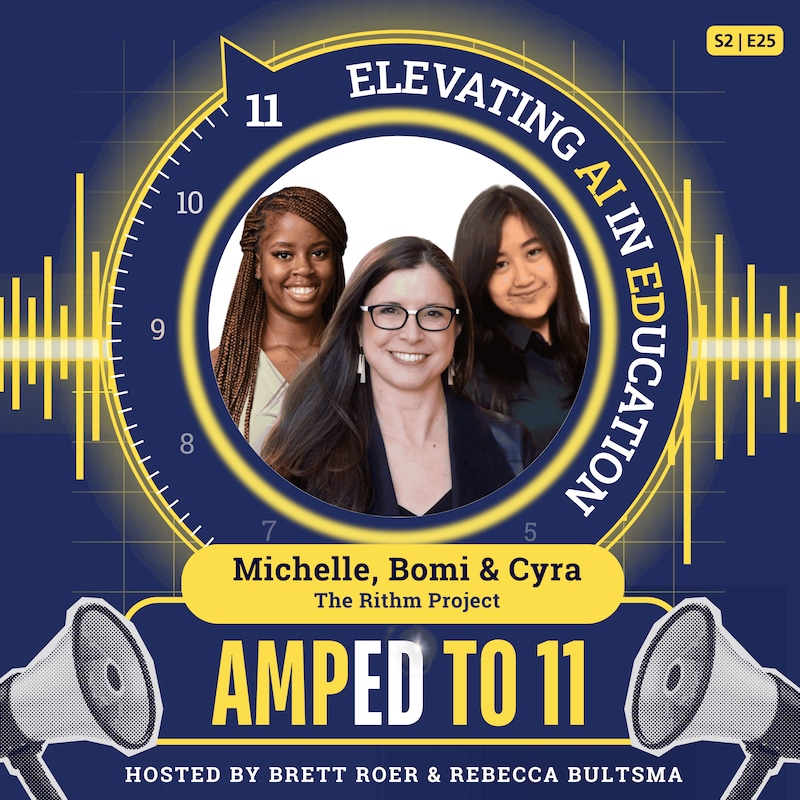
In this bold, boundary-pushing episode of AmpED to 11, Rebecca and Brett dive deep into the tangled intersection of AI and human connection with three trailblazers from the Rithm Project—a visionary effort aiming to preserve humanity in the age of artificial intelligence.
Michelle Culver (Rithm Project founder and former Reinvention Lab lead at Teach For America) is joined by Rithm Fellows Bomi Akarakiri and Cyra Alesha, both powerhouse youth advocates working at the sharp edge of policy, mental health, and emerging tech. Together, they bring passion, clarity, and a whole lot of nuance to one of the most urgent questions in education right now: If AI is becoming a co-author of our relationships, what does that mean for how we connect, collaborate, and care?
The crew doesn’t just talk about this—they play The AI Effect: a provocative card-based game that sparks unflinchingly honest discussion around AI use cases—from romantic chatbots and AI grief companions to whether students should use AI to write friendship speeches. Every round stirs disagreement, vulnerability, and even some unexpected revelations. And that’s the point.
You’ll learn:
- Bold ways to explore AI's impact on relationships and student well-being
- How educators and students can use tools like The AI Effect to build critical AI judgment, together
- Why pretending to be more “human” with AI might actually cost us authenticity
- What real trust and transparency look like in a world of synthetic friends and smart lenses
- How to support young people in developing emotional regulation and empathy in an AI era
- Why “it depends” is the most radical answer in education today
This isn’t your average policy talk or tool review—this is a deep, decidedly human conversation that leaves you feeling more connected, more curious, and honestly, a little more hopeful.
Tune in, subscribe, and share if you’re ready to turn up the volume on what’s possible in education.
Transcripts
Michelle Culver: And we're seeing this collision between the decline in human connection and the arrival of generative AI.
Michelle Culver: These, these forces are about to collide and something big is going to unfold. And we, we, the collective us have an opportunity to, to shape it for good.
Brett Roer: It's grounded in values and humanity and connection. And I have watched people like become so passionate about topics that they couldn't before express.
Brett Roer: And this somehow is bringing it out in people. And they're not angry afterwards. They're, they're grateful for disagreement. And that doesn't happen anymore.
ed by the incredible Rebecca [:Rebecca Bultsma: It was a great week. I'm glad to be back home and catching up, but it was so fun to see us spend some time with you.
Rebecca Bultsma: We never did get to the Johnny Cash Museum, which was on our list, but we found some great barbecue places and we had a lovely fall walk all around the city, and I think it's in my top three at this point. Great city, and it's always great to see you in person instead of as a floating head on our podcast, Brett.
Brett Roer: Same here. And definitely gives us a reason to have to get back to Nashville, right? We spent a lot of time with that barbecue. Next time Johnny Cash and a little more honky tonk, but we are so excited that we came back to, I'm back in New York, Rebecca's back in Canada, and we are here with three incredible guests.
Brett Roer: Today we have three members of the Rithm Project. We are joined by Michelle Culver, Bomi, and Cyra. How are y'all doing today?
Michelle Culver: Good. Thrilled to be here.
oer: All right, well, we are [:Brett Roer: More on that in just a moment. But I'd love to start off as always by just introducing these incredible guests and letting them share in their own words, their passion, their purpose, and how they got to this, uh, AmpED to 11 podcast recording today. So first Bomi, could you please share with our millions of listeners around the world who you are?
Brett Roer: And what you're all about.
Bomi Akarakiri: Yes, of course. Thank you, Brett. My name is Bomi Akarakiri, and as Brett mentioned, I am with the Rithm Project. As a fellow, we do some amazing work around social interactions and AI in that intersection. Outside of my work with the Rithm Project, I am the research and policy director for the Young People's Alliance or YPA.
ard through policy outcomes. [:Bomi Akarakiri: So thank you so much for having me here. I'm looking forward to our conversations.
Brett Roer: Absolutely. And the only takeaway I'll let our listeners know is I think everyone at the table was both equally impressed by Bomi and Cyra at how much they had accomplished at, uh, their young age in relative relativity to us.
Brett Roer: And how we all realize how inadequate we were in comparison to them at that age. 'cause they are changing the world. Cyra, if you could please share with the world your passion, your purpose, your why.
and I'm also a research lead [:Cyra Alesha: So my why or how I started to get into this work is I started as someone who played with kind of machine learning models for fun, building things like recognizing sign language and things like that. And then when I see that large language models are starting to become more and more popular. There were a lot of effects that I see in my community, especially in young people.
Cyra Alesha: However, in the engineering spheres that I was in, I didn't hear any conversation about how this is affecting young people, how this is affecting the social aspect. A lot of it is more in terms of productivity and work, and so when I heard about Center for Youth in ai, who's looking to showcase these kind of perspective, I had the amazing opportunity to join, and that's how I got connected with the Rithm Project because.
he social connection aspect, [:Brett Roer: Yeah, thank you for joining us and Michelle Culver, if you could please also share your passion, your purpose, and why with everyone listening today.
Michelle Culver: Hi everyone, I'm Michelle. I lead the Rithm Project and as you can tell, rhythm is spelled like an algorithm, R-I-T-H-M, and it's intended to signal that we do have agency in our relationship with technology, um, and we want that to be alongside the heartbeat of humanity and that. I should say I come to this work as an educator.
ike Yusef and Mike Yates who [:Michelle Culver: And part of what I started to observe very quickly is that in education, you know, all of the conversation about ai, at least the time and still to Cyra's point too, too often, is about how AI is gonna change the way we work and teach and learn, all of which I care about and remain committed to. But there was that lagging or that nagging feeling that maybe think, well, but where's the conversation about how AI is gonna change the way we relate to each other as humans?
Michelle Culver: Um, and so we, and we sure missed the mark on that 20 years ago with the arrival of the smartphone and social media. Uh, and our schools are racing to play catch up now. So, uh, we just kept thinking, you know, we are at a moment where young people are telling us they're lonelier and we're disconnected than ever before.
to, to shape it for good. So [:Brett Roer: Oh, that's incredible. Thank you all for sharing how we all got to this, uh, incredible podcast recording. And what we're about to do shortly will reveal and Serena, our incredible producer of the AmpED to 11 podcast is joining us. Uh, you're getting to see her, you're gonna get to hear from her. Serena, can you tell everyone a little bit about your background and, uh, the work you lead as producer, and anything else you wanna tell our audience today?
Serena Reynolds: Okay. So Brett's given away the pump punch line here. I am producer of AmpED to 11 and I get to meet these amazing people backstage of our podcast. And I get to speak to lots of different people about ai, um, about their journeys. And I, I get to be part of this story and behind the scenes a lot of the time, I, I started in a.
o build applications and was [:Brett Roer: Rebecca, anything you wanna share with the audience coming out of Nashville or just thoughts about today?
Rebecca Bultsma: Looking forward to it. A lot of the work I do, like as an AI ethicist is very human centered. And I do a lot in K 12 and with youth and with educators. So I think this will be really, uh, enhance and make me think more deeply about the work that I do.
Rebecca Bultsma: So I'm really looking forward to this,
months especially, and by my [:Brett Roer: I think by the end of next month, we will have done this live with 1,435 educators across the country, more or less, you know. Here or there might have missed a person or added a person there. But, uh, Michelle, if you could share with everyone this incredible game that, uh, the Rithm Project has developed called the AI Effect, that I can personally attest to, you know, thousands of educators now have told me like this is a great way to really talk about where we are as a society around AI and how to keep humanity at the heart of education in the age of ai.
Michelle Culver: We're gonna have some fun. So here's the game. This is what it looks like. It's called the AI effect. And it's a game to uncover how AI can strengthen human connection and win. It might pull us apart. And the whole purpose of this game is to help you hone your own point of view. And we do that through conversation where we get to surface.
of this game is there is no [:Michelle Culver: 'cause this is, it's not actually, um, enabling you to get closer to your aspirations. That's the kind of critical thinking and intentionality that we want to develop, uh, in both young people and all of the adults who are in relationship with them too. So this game helps us act our way into that. So in any given deck, um, you basically get two colored cards I'm gonna show us, so we can get ourselves set up as players on this side too.
es it erode human connection [:Michelle Culver: So I'm gonna read a couple just to be illustrative and then we're gonna play around. So you might ask yourself, does checking in with your AI romantic partner throughout the day, does that strengthen erode, or it depends. Preparing to have a tough conversation by practicing it first with an AI bot. Using a friend's photo to create a deep fake video as a joke.
Michelle Culver: So these are illustrative. We're gonna play a couple rounds, but it gives you a sense of the range already in this deck. The purpose is to have, you know, rigorous discourse if you are one of those people who like to play to win, which turns out a lot of people like gamified winning. In fact, Eric Chan from Charter School Growth Fund said to me, I only wanna play it.
Eric and all of those people [:Michelle Culver: Let me ask you, do you always wanna play a winning round or just have really rich conversation?
Rebecca Bultsma: I'm always about conversation and spoiler alert, like my life motto with AI is, it depends. So I have a sneaking suspicion that that will be the only card I use, but. I'm all about the discourse.
Michelle Culver: Okay? So we'll just do some really rich conversation.
Michelle Culver: But if you get this deck and wanna play to win, what you could do at the end of a round is vote to see who pushed the conversation the most and that person would get that round point. So that's the spirit of those who are actually keeping score. But for today, we're just gonna have some fun and people who are um, listening can, um, play along by asking when we give a prompt, what do you think?
your, your reflections, uh, [:Brett Roer: We are ready. I'm ready.
Michelle Culver: So here's what I'm gonna do. Typically, if I was playing this and we were in person, I would deal out these blue cards and I would give everybody probably three cards, and then I would invite them to say, of those three cards you were dealt, which is the juiciest conversation you most wanna have.
Michelle Culver: Um, and so Cyra, I'm gonna start with you actually and invite you to share which card do you wanna play and don't yet reveal what you think the answer is. Cyra is gonna read out the card, and you'll think to yourself and select which card you want to, to share. When you have it, hold it up. So I know, but don't show us.
Michelle Culver: After we do that, then we'll count down and make the reveal at all together at the same time. Okay, so Cyra, what, which one, which one should we start with?
have a tough conversation by [:Bomi Akarakiri: Okay.
Cyra Alesha: Once more, preparing to have a tough conversation by practicing it first with an AI bot.
Cyra Alesha: Okay. Everyone has a card.
Bomi Akarakiri: I'm using a post-it because my deck of cards is actually in my suitcase, ready to use for Thanksgiving.
Michelle Culver: Oh, I love that.
Michelle Culver: Okay. 3, 2, 1. Oh, I love it. We have some dissent and I just wanna say, this is the best part. So when you each play with teens in particular, there's a tendency to wanna go to whoever speaks first, or the most popular person.
Michelle Culver: But here we can actually see immediately that we do actually have some differences of opinion. And even those of us who have the same cards, we might have the same card, but for different reasons. So Cyra, do you wanna start by sharing us why you put support and then we'll go to some, does anybody have a road?
Michelle Culver: I can't [:Cyra Alesha: think so. Yeah,
Michelle Culver: Cyra, get started.
Cyra Alesha: Yeah. So the reason I say support is I've met so many people, especially in middle school and high school, who shared to me. How they were so scared to confront their friend or to mention things that hurt them. And because they were able to practice it with ai, that ended up giving them the confidence they need to reach out.
Cyra Alesha: And sometimes just reaching out is not necessarily confrontation. It's sometimes things like, oh, I think my friend is struggling, but I don't know how to word things, or how to reach out without making them, you know, feel bad or feel like they're not, you know, being their full self or something like that.
not. I hope that it passes. [:Michelle Culver: Great. And I'm just gonna open it up. I may sort of direct, uh, us to surface differences, but open it up. What, where did you offer something distinct from what you heard Cyra say? So don't repeat or, uh, um, add on, try to offer something different that will advance the thinking.
Serena Reynolds: I put up support because I feel as though thinking it through, even with a chat bot, is better than being reactive.
Serena Reynolds: So I, I feel as though it just gives people time and distance to actually think about really what their true message should be. So that's my support.
a different perspective. Um, [:Rebecca Bultsma: And the reason they don't like to answer the phone or have in-person conversations is because they like that rehearsal space. You draft a text, you show it to your friend, how does this sound? And I think it, um, e evades the messy human conversations that need to be had in the moment that push us outside of our comfort zone.
Rebecca Bultsma: And I think that that's a really, really having those conversations not on a timeline is important. Plus what I know about synco, fancy and bias embedded in chatbots makes me worry that having those conversations ahead of time may lead you a certain direction. Uh, when they should be had in real time.
Rebecca Bultsma: That's my position.
ions in the moment, it helps [:Bomi Akarakiri: You have to listen to sometimes hard realities that you don't want to hear, but I think overall it really can help you with conflict management in general.
Brett Roer: I found, uh, I did put it depends. And so while again, I love that answer because everything everyone just said really resonate and is valid from their own perspective, um, I think the thing that I'm most worry about is, um, people that have had that lived experience and have kind of developed some of that EQ that we're hearing.
Brett Roer: This is a great way to, you have a way to use as a sounding board and know like, oh, I've been in those situations. You can actually like put yourself back in those and know whether this is kind of a good sounding board or not. Whereas as Rebecca already mentioned, if it's just not a well calibrated tool, it might actually give you really not great advice and you wouldn't know that because you haven't actually had that lived experience yet.
Brett Roer: So [:Michelle Culver: Beautiful. Cyra, I'm gonna give you a chance to do final word, anything that was stirred for you by listening to other people talk about this before we go to the next round.
Cyra Alesha: Hmm. I think one thing that was a question for me, what I consider between support, and it depends, is whether having an imperfect sounding board that has a tendency to be co but that pushes someone to have a conversation is better than. Nothing but then that leading into the person, avoiding the situation or just staying silent.
Cyra Alesha: I think that's uh, my line between support and it depends. And so that's not really saying anything. I think it's just what I've been thinking when I hear love all of the different perspectives.
helle Culver: So good. Okay. [:Brett Roer: Follow up was incredible. You all have your own podcast.
Brett Roer: That's way better Follow up questions than I can do. Rebecca's good at that. I'm not. That was awesome.
Michelle Culver: Bomi. Let's go to you next. Which card do you wanna play?
Bomi Akarakiri: Yeah, so I am reading off of the online version, which I think has more cards than the like physical copy. So this is one we haven't done before either, which I'm excited about.
Bomi Akarakiri: My prompt is an AI that creates a memory bank. That you and your friends share and can look into for years to come. So an AI that creates a memory bank that you and your friends share and can look into for years to come.
Michelle Culver: Okay, so
Brett Roer: may I ask when it's time to reveal, can we all put it on our heads, like when we play, uh, I forget what that game was.
re of it this time. Just let [:Michelle Culver: Okay. You've got your card. Get it ready. Serena, do you have your opinion set? Beautiful. Okay. 3, 2, 1. And then kind of lean in so we can what? We can see what you put. We've got a couple.
Michelle Culver: It depends. Oh, a lot of it depends.
Cyra Alesha: It might be all. Oh, Bomi support.
Michelle Culver: Let me support. And Rebecca, what's yours? Support. No. Depends. Okay. Bomi. Great. Well you are gonna take the lead because you are a dissenter in this and we wanna hear where you're starting.
Bomi Akarakiri: Okay, there we go. You can see, I put support, um, as a huge sentimental person.
in general, it's so easy to. [:Bomi Akarakiri: Having a collection, almost like a digital, um, photo album, I think that is something this generation could really benefit from, especially because of how quickly things are moving just in terms of World Developments technology, being able to look back maybe in 50 or 20 years time and be like, oh my gosh, this is me and my friends during the COVID Pandemic.
Bomi Akarakiri: Who would've thought that that would've happened? I think that's really cool.
Rebecca Bultsma: Hmm. I actually have two. It depends thoughts. Number one is that when we look at the original creation of Facebook and its purpose, its purpose was to create shared memories with our friends in photo albums.
Michelle Culver: Mm-hmm.
Rebecca Bultsma: And now that same tool is almost being weaponized against us as a data collection tool, used to then harvest data and now manipulate us based on that information.
chat. And part of the reason [:Bomi Akarakiri: I would delete Snapchat purely because of the memories.
Rebecca Bultsma: Exactly. That's what happens. It's a freemium service, right. They capitalize on the fact that now you can't get rid of it and figure out how to make money. But that's what happens with a lot of platforms. So great concept, but there's also other ways that it can
Brett Roer: be, I would to show my support first by saying like, I agree completely with what Bomi's mentioning about, like I love things where we can all look back, laugh, you know, especially in this virtual space.
e your friends, but like one [:Brett Roer: And so that would be the only thought of like. Uh, just what could be like a negative impact for people's social emotional development is like not being able to escape their past either.
Michelle Culver: Hmm.
Serena Reynolds: See, I, I was really sitting on the fence between support and, um, it depends. And my final decision came down to, I really liked my youth without the mobile phones, without people knowing where I was, knowing what I was up to.
Serena Reynolds: I kind of, I, I think that's a freedom that, uh, the youth today doesn't have, and I partially mourn for them because of it.
Michelle Culver: It's interesting, my thought was related to that in that, um, I love the idea that it brings people together, period. You know, it's like that just feels like we need more things that bring us together.
er: But I was also similarly [:Michelle Culver: And it makes me wonder, to your point, Serena, like when, when do you just want to be yourself without having anything captured? Um, particularly as new ways and new developments for capturing. Um, our lived experience starts to become the norm versus the exception. Um, so yeah, that's why kind of where I was at and it depends as well.
where does the data for this [:Cyra Alesha: And I don't think an AI, when selecting memories have that context about what kind of moments are the ones that mean, you know, a lot to us and the ones that are worth remembering. And so I love the idea of like a curated photo album, um, of like. People instead of a machine doing it. 'cause what I see right now with like the photo albums, the ones that we personally chose are photos that looks like a regular, nothing is going on, but the story behind it is what makes the memory special.
l, like the photo album that [:Cyra Alesha: But I think the loss of, um, the choosing what moments you want to commemorate. Can impact that first and then second. I agree so much with Michelle about, um, if that moments capture everything, like if it takes your voice or if it takes your camera, it might show you, me, like bad memories or memories where you embarrass yourself and then you might think like, oh no, now I need to restrict myself.
Cyra Alesha: Or maybe not laugh as weirdly or something like that. And so, yeah, I think it depends. There's a lot of positive. Possible positive ways, a lot of negative ways, depending on the product and how it's used.
ord, but I also wanna get to [:Michelle Culver: So in this one, I'm just gonna speed us to the next round just to get more, uh, content into the, into the discussion. Okay.
Brett Roer: Yeah.
Michelle Culver: Uh, with me, I know you have a final word, but I'm gonna move less. So, um, Rebecca, what's a card that you're longing to talk about? Tell us. Oh, you don't have cards? Okay. We're gonna, we're gonna move to Brett and then let you jump in, uh, on that card first, Brett.
Michelle Culver: All right.
Brett Roer: Well, I, what my favorite card already got taken, but I am actually curious because this has come up recently with interviews we're doing with students across the nation. So asking AI to write a heartfelt speech for a friends special occasion.
Michelle Culver: Read it one more time.
Brett Roer: Absolutely. Asking AI to write a heartfelt speech for a friends special occasion.
Michelle Culver: Great.
Bomi Akarakiri: Can I [:Michelle Culver: I'll allow it.
Bomi Akarakiri: Okay. No, it depends. This round. Do you have to,
Brett Roer: oh, I love it.
Michelle Culver: Okay.
Bomi Akarakiri: Ooh, sent over.
Michelle Culver: Okay.
Brett Roer: That is such a cool way, by the way, to play it. You kind of like, you have to remove that card for certain rounds, like a special round. Okay. Ready?
Michelle Culver: 3, 2, 1.
Michelle Culver: Ah, that's good. Okay.
Brett Roer: Gro up. Gro up. Support it.
Michelle Culver: Rebecca, get in there first.
t will be the most important [:Rebecca Bultsma: And I do think it's beneficial to people who would not feel comfortable doing that otherwise. It gives them a tool that they may not already have
Michelle Culver: who has something distinctly different, a disagreement. Make the case for the opposite. Who was the uh, uh, I think Bomi, you were the other side, is that
Bomi Akarakiri: right?
Bomi Akarakiri: Yeah, it was. Cyra and I, I feel like, I don't know, correct me if I'm wrong, Cyra, but I feel like, I think I know what you are thinking about too. When we were in the western PA AI summit, we had this card, and initially it was kind of around the same sentiment in terms of it widens accessibility for people who may struggle, um, or not be as confident in terms of their abilities.
someone who might not be as [:Bomi Akarakiri: I think that is more powerful in itself than the actual content being a hundred percent. Perfect. Mm.
Rebecca Bultsma: If I may, um, I just would be interested in wondering your, your thoughts on, I guess it depends on what the value is. Are we trying to say, is it valuable for the person creating it or for the. The friend, because I know some of the most famous speeches in history delivered by powerful presidents, they did not write, they were written by speech writers or ghost writers, and it didn't negate their impact.
Rebecca Bultsma: So that would be the counter to that.
Serena Reynolds: I would also counter counter that. Yeah,
Brett Roer: counter, counter.
about that person and that's [:Cyra Alesha: I wish I could have said it depends because I think it depends on the level of tool usage that you're using. Because there are people that are writing speeches and they're like, Hey, my friend's name is a, write me a speech. And then it's spits out a generic and probably true, um, speech about that person.
Cyra Alesha: And when they say it out then nobody knows. But it's different when they're putting in, you know, the things that they actually value about the person in it. And what the AI does is kind of. Improve about the words or polish the words. So that's why I'm really on, it depends, but I lean more on your road because I feel like in terms of one by one, to your point, Rebecca, in terms of impacting speeches, I think that's amazing.
by one, one person saying to [:Michelle Culver: Okay, let's do two speed rounds. So in these two, I'm gonna offer provocative ones, and I want you to, um, offer the most succinct and distinct ideas in response to each other. So if, um, if you, your instinct extends or is similar to somebody's perspective, hold it and just offer challenge. Okay. So we can get a little bit more speed round this time.
AI companion in your ear to [:Michelle Culver: Hold 'em in close so we can see. Um, okay, let's start with Serena. You have support. Let's begin with you.
Serena Reynolds: Well, I'm just putting in supports, um, only because I'm being completely and utterly honest. And if there was such a device, I would own it.
Rebecca Bultsma: There is. I'll tell you all about it later.
Serena Reynolds: Well, Rebecca, see,
Michelle Culver: say tell us about it now.
Rebecca Bultsma: Well, the Meta Ray Band glasses, I show them as demos in all of my keynotes, but they have headphones built into the arms and kids use 'em to cheat by having their friend in the hall or a recorded thing playing in their ear. And it does perfect audio right into your ear while you're writing a test, and then also takes photos and video.
Rebecca Bultsma: Right? So, um, that's amazing. That would be very, very easy.
Rebecca Bultsma: But
Michelle Culver: Cyra
Michelle Culver: just held them
Rebecca Bultsma: up.
as purely on own selfish. I, [:Michelle Culver: , Cyra. Let's go to you because you literally held them up next, right alongside Rebecca. Tell us what you put and why.
Cyra Alesha: Um, I put erodes because I think in conversation what you chose to ask someone and how you respond, I feel is something that's authentic and that comes from you.
Cyra Alesha: I feel like when you ask a question, I assume in a way that you are curious about the thing that you're mentioning, and if it's feed into you by some sort of device. I feel that authenticity and connection, um, is less there.
Michelle Culver: Anyone have distinct ideas that have not yet been added, and if not, I'm gonna move us to another round.
Brett Roer: Yeah, I'm gonna, uh, shout out somebody, me and Rebecca met down in, uh, in Tennessee.
Rebecca Bultsma: I know exactly who you're talking about.
see, I walked, I walked from [:Brett Roer: And Harl brought up that, um, this question. He was like, you know, I grew up on a farm. He's like, I didn't really interact with people like all day. And he is like, my son graduated from school with 13 students in his graduating class. So he is like, I am very socially awkward and I would love to be more engaging with people.
Brett Roer: It's just not my nature. It was how I was raised. He said, so if I could know about people in advance of one of these events, I would wanna talk to you about what you're excited about. And then I would feel like I'm doing good by you, by like knowing what you wanna talk about. And then I'd love to talk to you, but I wouldn't know what to bring up otherwise.
Brett Roer: And I wound up not talking to anybody and not meeting anyone new. So that's where my mind goes there about how it could support certain types of people.
Michelle Culver: Beautiful. Okay, let's do another round. Speed round. Thank you guys. Here we go. Participating in a virtual AI facilitated group therapy session. I'll read it again.
in a virtual AI facilitated [:Serena Reynolds: Okay.
Michelle Culver: 3, 2, 1.
Michelle Culver: Yes, we have some good descent. Um, all right. Let's see who, Brett, why don't you get us started on this one?
Brett Roer: Sure. Um, okay, so I would've obviously chose, it depends if we weren't playing Bomi style, but with this one ai, it said AI facilitated. If it was AI co-facilitated, I would definitely support it because I think this is a great example of, you know, we've all alluded to.
Brett Roer: It really depends on the tool and the quality of it, because that tool could lead a group of people who authentically need like expertise down the wrong, down the wrong pathway and misread it. Whereas if it was co-facilitated with a, a therapist, a licensed therapist, I would like that, that would be my ideal of group therapy in the future.
and reference things or you [:Michelle Culver: Beautifully said, Cyra, you had a disagreement. Where was your head?
Cyra Alesha: In my head, the first thing that comes to my mind is those apps that we would use in groups to show you prompts or like, you know, like the AI card effect.
Cyra Alesha: These are prompts. And so I think that what comes up in my head first of being an AI facilitated group therapy session because it is still a group and so that's why I'm leaning more towards board.
Michelle Culver: Anyone have a distinct idea that they wanna get into the mix on this round?
Bomi Akarakiri: I just think with ai, AI, as much as it tries to have human-like features, it can never replicate energy.
Bomi Akarakiri: And I think for something as intimate and powerful as therapy, there's like energy in the room that I don't think could be replicated with ai.
y that I would ever trust in [:Rebecca Bultsma: So maybe in the future. Um, but at this point, when you look at the most successful kind of group, like AA or all of these, the most successful kind of group experiences, they're very human dependent and depend on that context with other people. So that's why I put a road for now. I reserve the right to change my mind, depending on tools in the future.
Michelle Culver: Third and final speed round, are you ready? Talking to an AI preserved version of a beloved deceased relative or ancestor. I'll read it again. Talking to an AI preserved version of a beloved deceased relative or ancestor.
Serena. I know it's so hard. [:Michelle Culver: Ah, I love this. Just, okay. You get us started.
Bomi Akarakiri: Um, I've been thinking about this card a lot, especially because I really do love my grandparents and it's never nice to think about the possibility of any family member or someone close to you in your life passing on. But I feel like the grieving process, it teaches you so much about yourself and it's a way to heal the family or the com your circle essentially.
o as much as it is a painful [:Serena Reynolds: Hmm. I think that's beautifully said. And, um, you are wise beyond your years. That's exactly my sentiment.
Brett Roer: Uh, uh, the only thing I would caveat that with is like during the pandemic, I reached out to a lot of my, uh, uncles parents and wanted to kind of like jot down history just from, maybe from a pessimistic or maybe from, they were on lockdown, but I, now that AI exists, like, and I have it at my fingertips, I wish I had done that in AI for some of those reasons you just mentioned.
Brett Roer: Like, I have all these rich stories, but like I'm frantically was typing them. So was I really present listening? No, I was trying to type to preserve it for. I don't know what.
Cyra Alesha: Mm-hmm. So
Brett Roer: I would've loved to have that. But the one caveat I would say is this would be a great example of, you know, I know sometimes AI tools hallucinate.
t an AI tool to hallucinate. [:Brett Roer: I don't recall that. So like, it's clear that you are always getting their truth.
Michelle Culver: Hmm.
Rebecca Bultsma: I totally agree, Brett. I think that it would be important to do it authentically in the context of the person. Like I wouldn't want anyone to do that to me in a way that would rewrite my history or my stories or have me do or say things I wouldn't usually do.
hear their words from their [:Serena Reynolds: Can I just, I, I just want to ask one question.
Serena Reynolds: So, so we're all talking about AI and normally ai, um, I'm not, I'm not going to talk about hallucinations or anything here, um, but it does embellish stories. Um, and fills in gaps. Not so much hallucinates, but fills in gaps, and that's what would make me uncomfortable with the gaps.
Bomi Akarakiri: And it also has a way of disproportionately.
ops these tools, but then it [:Bomi Akarakiri: Hmm.
Rebecca Bultsma: Something really interesting, a case study just for your, you've probably heard of it in New Zealand, there was a tribe that built their own learning, large learning model specifically, they brought in all their elders and built it all on the language and the stories strictly on their content. I'm curious about like the gaps or how that's worked long term, but I think for that exact reason you mentioned so very cool.
Brett Roer: One thing I
Brett Roer: just wanted
Michelle Culver: Ally on, our team actually talks about how, um, this could be an act of also reclaiming or protecting family history. And, and, uh, she describes, you know, having come to this country and a lot of her own, uh, history and culture being whitewashed as they assimilated into the American expectations.
Michelle Culver: And if she could pull forward some of that wisdom and tradition that she would, she would long to do that. So she really pushed my thinking in offering that contribution in a prior conversation.
Brett Roer: Yeah,
k to me that the interesting [:Cyra Alesha: Kind of like video a format. Uh, my, okay, this is just a random idea, but I feel like a good mix of AI and true story would be more like a retrieval, um, a rag AI system. So a rag AI system takes in parts of a document instead of creating their own words, or they can be trained to be like, Hey, this is the actual code from the person.
Cyra Alesha: Um, and maybe they can explain extra and this is what's generated. So I feel like maybe that, so AI is a tool to retrieve the information that's true to, um, the person rather than generating a response on them. I feel like that might swap me over to support.
Rebecca Bultsma: Agree.
h, the very first time I met [:Brett Roer: The very first tool I made was this tool. I said, I wanna make a tool 'cause my mother-in-law is from Ecuador. And I said, and I've been there And they always tell the stories about what it was like for her growing up there and how, how different that is for my children right now. So I actually said, this is the person's age.
-year-old in: w people lived, um, from the [:Michelle Culver: Hmm. I love this so much. I just wanna pause because we could probably go on forever because these conversations are so juicy. But I just wanna take, make a moment of gratitude. Um, and maybe just invite you for a second yourself to think about a moment where somebody else pushed your thinking, your own point of view evolved and changed as a result of this conversation.
Michelle Culver: And how lucky we are to proactively take pause and say, well, what are the kind of relationships we want in our life? And then in what ways might this be in service of that? And in what ways might that ero it? Because one of the most powerful things we have is our ability to, to choose how we wanna be in relationship, both with each other and with technology.
like this. Reground me, make [:Michelle Culver: And it makes me long to have more human conversations where we get to feel like it's not only safe, that we're okay as a result of disagreeing, but we're made better because of our disagreements. And that in doing so, we all get better together. And so I'm just having a lot of gratitude in this moment.
Michelle Culver: So I just wanna maybe bring our game to a, a, a, not an end, but a, um, a pause with just a moment appreciation for you all. So thank you guys.
Brett Roer: This has been so much fun. One because it was such an amazing game. So again, thank you, Michelle, the Rithm Project for creating this, and I, I will attest again, having done this in multiple states, every conversation I've ever seen literally feels like this.
Michelle has done an amazing [:Brett Roer: Um, we're gonna ask our, one of our traditional questions, which, um, is me and Rebecca are in the hot seat. We're the guests on the AmpED to 11 podcast and we today have two amazing co-hosts, Bomi and Cyra. Could you think of a question that you'd like to ask me and Rebecca
Bomi Akarakiri: in every episodes I do, what would you want the common thread to be that people can take away and impart into their communities?
Rebecca Bultsma: Honestly, as we're sitting here, I'm wondering if we add a card to every single one of our episodes to generate this kind of discussion. I think this is what needs to happen and I think it should be a tradition because. The reason I listen to podcasts is I wanna hear differing views and opinions. I just don't wanna hear somebody talk about the one thing that they're doing.
o what we do moving forward. [: that or bring, yeah, so plus:Brett Roer: Um, if not a standalone podcast, then definitely incorporating it really everywhere you go, that would just be fun. So, uh, the rationale for that though is as Rebecca said, I want people to feel, and also I love that this, as Michelle closed this out. It's grounded in values and humanity and connection. And I have watched people like become so passionate about topics that they couldn't before express.
ove about this game and, uh, [:Rebecca Bultsma: I also think, as I reflect on our experience today, if I would've been running all of my answers through an AI before I responded, or I was wearing met Ray bands where someone was queuing me up, or I had time to work with an AI ahead of time to vet my answers, um, I just don't think it would've been the same experience.
Rebecca Bultsma: So on. Macro scale. It just taught me, uh, even more about the importance of that in the moment messiness of humanity and how much more valuable that is when it's not AI assisted.
Cyra Alesha: Talking about perspectives, I'm curious, maybe in this month, this year, have you had any perspectives of conversation that still is stuck in your mind and that changed your opinion, maybe regarding AI or something else that you want to share?
ike, the student in New York [:Brett Roer: And so this is where I want to credit Rebecca for the one who at least taught me the perspective on like, if people think you're using ai, you lose their trust. But if you are explicit or open about how you're using ai, it can actually enhance your trust. And I'm paraphrasing, you know, Rebecca's brilliance in research, but I say that because that has stuck with me where once we talked through, like we're doing now as humans at a table with making eye contact, I was like, well, what if.
Brett Roer: The person was just having a horrible experience. But they told you like they told the AI tool like, please make sure my friends know like I love them. I'm only using this because I'm spiraling and like, like tomorrow I'll call each of you or like, let me know if you want me to call you individually.
that, I wouldn't feel bad at [:Rebecca Bultsma: That's a good one. I would probably second some of that. That's based on a study that came out, I'd say in the last six weeks. And it talked about how if people find out that you've used ai, um, they trust you less. It doesn't even matter if you used it in a way that the content was correct or you used it in a way that would make sense.
Rebecca Bultsma: What you need to have is legitimacy, which is people understand why you used it in the way you did and you didn't use it in a way that, uh, they would consider to be, um, morally inappropriate. And that's a gray moving line, right? Like that leads to people being outraged about how dare you use ai. We've seen that happen.
as to how we explain, 'cause [:Rebecca Bultsma: I tell the story all the time, but one of my, the most interesting story, this is it, this is the one that stuck with me, this is my answer. Um, when Sally ride, the first American woman to go to space, went to space before she left the, um, all the male rocket scientists around her asked her if 100 tampons would be enough for her three day journey into space.
Rebecca Bultsma: And that stuck with me because even though they were brilliant rocket scientists, they had no lived experience in her shoes. They had, they couldn't relate. They didn't understand what it was like to be her or in her circumstance. And that stuck with me because I realized I can know a lot, but there's so much of lived experience, I don't know.
lutely nothing about certain [:Rebecca Bultsma: So that's one
Brett Roer: we are gonna conclude, right? Because this is a very special episode with one of our really most important shared values that Rebecca and I have, right? Like, there's so much brilliance out there and you know, the three of you know people in the space, and this is a great chance to amplify people that others need to know about their work, right?
Brett Roer: Whether it's for the person, the organization, the cause, but any of you can start. And also because there's three of you, um, if one of you starts going and then you someone else goes, and that gets you to think of another great person or organization, like there's no, there's no time limit to this. Well, you know, people wanna, this is our favorite part, so you're gonna speak great about people behind their back.
hem and say, check this out. [:Cyra Alesha: Last week I met Sam from, oh yeah, from, well Bomi's also here from Young People's Alliance.
Cyra Alesha: And I just think that they're doing such amazing work in kind of AI policy and it is just amazing the things that they're doing right now, especially in terms of AI and mental health. So I just wanna shout them out and also bow me here. So, hey, not exactly fully behind their back, but.
Michelle Culver: There's actually, um, a whole handful and you guys can help me name them, of youth led organizations that are really trying to be proactive in on the policy front and the legislative front to say there are, um, ways in which we can design technology that are more in service of our vision for how we want to be.
Michelle Culver: And so, [:Bomi Akarakiri: I was also going to say definitely the Young People's Alliance have to shout my own organization. Um, shout to Sam and Ava Sparkle and Alex for their amazing work, but also recentering youth Voices, youth organizations in this space.
Bomi Akarakiri: So, as Michelle said, there's so many, there's like AI consensus innovation for everyone. Um, end code, there's a bunch. And I think it's so important, especially because AI is an emerging technology industry to really center and leverage those youth voices in this space because young people, everyone, like older generations like to call us the most tech savvy generation.
Well now we can actually put [:Michelle Culver: I'll, um, I'll add to others organizations that I see really, um, thinking about how to keep young people safe in the midst of a lack of guardrails on this. Um, I think the Jed Foundation is doing some really good work.
Michelle Culver: Um, I think Julia Freeland Fisher, uh, is doing a lot to better understand what is the evidence base like why are young people. Being drawn to this technology and what can we understand about that so that we can, uh, create healthy alternatives. And so in the spirit of raising the floor so that all young people can engage safely, those are some of my favorites.
about Nitzan at Climb Hire, [:Michelle Culver: Um, Kanyak future coach, uh, Tiffany, up uprooted. So all of these folks, I think are, um, again, trying to imagine a world where we use is technology in service of, of the kind of human relationships we want.
Brett Roer: Well, I'm gonna let y'all buy some time here. Rebecca, name one person you wanna talk good about.
Rebecca Bultsma: Oh, there's so many.
Rebecca Bultsma: Um, I would, we always end up having them on the podcasts. So, uh, I, I think maybe Wayne Holmes is a guy who's doing great work with UNESCO and I follow his work closely in developing kind of AI policies for K 12 education. Uh, someone who's doing great work. There's actually somebody that I, I really enjoy following on LinkedIn.
ional standpoint. She's a, a [:Brett Roer: Thank you. And I've heard you say those people, and I'm glad you said it again because now I'm gonna go, actually, I literally am gonna go follow any final people, speed round.
Brett Roer: Anyone else you wanna make sure you don't forget so that when they hear it, they're like, what me? What about me?
Cyra Alesha: Um, Neha Shukla is doing amazing work in like AI research and reaching out in terms of ai and I think she works with a lot of different, um, organizations and schools as well. So she's doing amazing work, but she go to
Bomi Akarakiri: shout out to the other Rithm Fellows as well.
Bomi Akarakiri: So, Hannah, Cyra, Jose.
ple. Because I always think, [:Michelle Culver: The harms are so much more seductive when we don't have those kinds of healthy human relationships ourselves. And so, um, gosh, there's so many places where Valor, collegiate, um, da Vinci schools, um, outta school programming like our leaders, uh, E and Otis at, uh, YMCA who are thinking about afterschool programming Live Oak Jack Harriet Live Oak Camp, where they're bringing, you know, young people from, uh, new Orleans across different.
Michelle Culver: Racial and economic backgrounds to be in real relationship together during the summer camp. So I think there's a whole nother category of people who are preparing us for the arrival of generative AI by doubling down on, um, what my beloved friend and colleague Sarah Seline talks about as the ancient technologies.
y leaders who, who I respect [:Bomi Akarakiri: Also from the Youth Power Project, Zamaan at Design it for us. 'Cause we're my extra two.
Brett Roer: That, that was incredible. And also when this does come out, feel free to tag those other people, uh, when it comes out on LinkedIn and social media, Rebecca.
Brett Roer: So this is a good example of us having, we, we changed technology so we weren't able to have our usual, uh, side convo on the other side. That's how, that's the magic behind it. We're just side convo to make sure it seems seamless. But, uh, Rebecca, were you able to see my alternative method of communication just now?
Rebecca Bultsma: Uh, yes I did. And
Brett Roer: amazing.
Rebecca Bultsma: Uh, Brett actually wants me to take the lead and ask you, uh, Michelle, about if people wanna get their hands on these cards or learn more about the rhythm project. Tell everybody exactly what to do, where to go, and how to make this happen because I have a lot of fans.
Michelle Culver: I love that.
g wait list for a while, and [:Michelle Culver: Um, if you're typing it in, put Rhythm plus AI and we'll show up. And then there's a place on our website where you can, um, let us know that you're interested how many sets that you want, whether you want a single set for your dinner table or a class set for, um, a teacher program, teacher professional development, or for your, you know, your communities.
Michelle Culver: So you let us know and then we'll make them available. And we do this by donation currently, so you can, um, if you don't have the opportunity to have the resources, we still want this conversation happening everywhere. And if you are, um, in a place of abundance and can make that conversation available for others, you have the opportunity to do that as well.
ther cards you wanna add and [:Michelle Culver: And we look to do that in partnership with all of you. So thank you.
Brett Roer: I wanna first, again, thank all of our amazing guests today. I want to thank Serena for always being an amazing producer, but this time also being an active participant, Rebecca, for being the best podcast co-host any, any guy could ask for.
Brett Roer: And last week, um, Rebecca Serena and our guest pushed me to come up with, um, a closing, right? I don't have like a signature closing, so I was like, wow, it is crazy. Sometimes you don't come from a place of gratitude and abundance. You're like, you have a podcast, right? We never like think about that. So it's like, well, who do I wanna make sure ultimately, like who am I doing this for?
one's perfect, but a lot of [:Brett Roer: I'm like, no, you are the best Sammy in the world. You're the best Annabel in the world. So I'm giving that preface. I'm not gonna use that in the future, but I just wanna say thank you to everyone for listening to the AmpED to 11 podcast, and I hope tonight and beyond you find those special people and you make sure you tell them that they are the best people in the world.
Brett Roer: Thanks for listening. Have a great day.