Shownotes
Drs. Alok Nimgaonkar and Rebecca Kumar provide an update on definitions for VAD infections!
Also mentioned in this episode is a call for the new Febrile Editorial Board!! You can find more information at https://febrilepodcast.com/editorialboard/
Episodes | Consult Notes | Subscribe | Twitter | Merch | [email protected]
Febrile is produced with support from the Infectious Diseases Society of America (IDSA)
Transcripts
Hi everyone.
Sara Dong:Welcome to Febrile, a cultured podcast about all things infectious disease.
Sara Dong:We use consult questions to dive into ID clinical reasoning, diagnostics,
Sara Dong:and antimicrobial management.
Sara Dong:I'm Sara Dong, your host and a Med-Peds ID doc.
Sara Dong:Before we get started in this episode, I just have a quick announcement.
Sara Dong:As Febrile is approaching its fifth anniversary later this year, I've
Sara Dong:been reflecting on how much this community has grown, really from
Sara Dong:a project that I started in my basement during ID fellowship to
Sara Dong:a resource that I'm very proud to continue to work on as junior faculty.
Sara Dong:My goal has always been for Febrile to be your go-to for engaging and up-to-date
Sara Dong:ID education, as well as a platform that spotlights ID trainees, our community,
Sara Dong:the diverse career paths within our field.
Sara Dong:But I also wanna make sure that we are adapting along the way,
Sara Dong:expanding what we cover, and I have been considering how we can improve.
Sara Dong:To do that, I need your help.
Sara Dong:I am assembling a Febrile Editorial Board.
Sara Dong:I'm looking for enthusiastic, thoughtful, and committed contributors
Sara Dong:who want to take a longitudinal role in shaping Febrile's future.
Sara Dong:You will truly have a direct and genuine impact on the content
Sara Dong:and decisions related to Febrile education moving forward.
Sara Dong:I'm looking for Podcast Editors, Visual Editors, so those who may work on
Sara Dong:infographics or educational videos, and also Social Media Directors.
Sara Dong:Although I have a few projects and positions that I would love to find
Sara Dong:individuals for, I'm very much open to suggestions and ideas for roles
Sara Dong:that I have not even imagined yet.
Sara Dong:This will not replace our model where individuals or teams of episode writers
Sara Dong:and guests join for one time or short series of episodes, so I still encourage
Sara Dong:you, you know, please reach out to discuss your episode ideas if you have them.
Sara Dong:This is really a great way to learn more about the process in
Sara Dong:a more time-limited commitment.
Sara Dong:But this editorial board will hopefully create a more sustainable model for this
Sara Dong:resource and allow it to cover all of the amazing topics and people in ID.
Sara Dong:I have posted more details.
Sara Dong:You can find them at febrilepodcast.com/editorialboard.
Sara Dong:There's information on roles, responsibilities, expected time
Sara Dong:commitment, and suggested skills that would make you a good match.
Sara Dong:If you're interested or have additional questions, also
Sara Dong:please reach out to me directly.
Sara Dong:Thank you so much for being a part of Febrile and listening.
Sara Dong:Okay, back to the episode.
Sara Dong:Let's meet our guests today.
Sara Dong:First up, we have Dr. Alok Nimgaonkar.
Alok Nimgaonkar:My name is Alok.
Alok Nimgaonkar:I'm a third-year Internal Medicine resident at Georgetown.
Alok Nimgaonkar:Really longtime listener of Febrile, and really happy to be here.
Sara Dong:He will be starting his ID fellowship at Columbia this summer.
Sara Dong:And next is a return visitor to Febrile, Dr. Rebecca Kumar.
Rebecca Kumar:I'm Rebecca.
Rebecca Kumar:I am also a big Febrile fan.
Rebecca Kumar:I am an ID attending at Georgetown specializing in transplant.
Rebecca Kumar:Excited to get started.
Sara Dong:Well, as everyone's favorite cultured podcast, we always ask if
Sara Dong:you would be willing to share a little piece of culture, just something
Sara Dong:that you like outside of work.
Sara Dong:What have you guys been interested in recently?
Alok Nimgaonkar:So, yeah, I'm a longtime lover of film.
Alok Nimgaonkar:I think one movie I saw recently that was really good was
Alok Nimgaonkar:called, It Was Just An Accident.
Alok Nimgaonkar:It was nominated for Best Foreign Feature.
Alok Nimgaonkar:J ust a very moving portrait of contemporary Iran, and the
Alok Nimgaonkar:past and memory and, and trauma.
Alok Nimgaonkar:So would high-highly recommend for anyone interested.
Rebecca Kumar:For me, I have been listening to a lot of Turnstile recently.
Rebecca Kumar:They won a Grammy and they're just like a, I don't even know, I guess
Rebecca Kumar:they're post-punk or hardcore, but it's a little bit more pop-y than I
Rebecca Kumar:would say most of the hardcore that I've heard before in the past is so,
Rebecca Kumar:um, I've enjoyed their new album.
Sara Dong:Nice.
Sara Dong:I can't remember what you recommended last night.
Sara Dong:I think it was an album of some kind.
Sara Dong:It's been a while.
Sara Dong:We'll have to go back.
Sara Dong:Um, all right, well I heard we have a consult question about a
Sara Dong:potential drive line infection.
Sara Dong:So Alok, I'll hand it off to you.
Alok Nimgaonkar:Yeah so this is a, uh, sixty-three-year-old man with
Alok Nimgaonkar:history of HFrEF from non-ischemic cardiomyopathy of unknown origin.
Alok Nimgaonkar:He had a HeartMate 3 LVAD placed two years ago.
Alok Nimgaonkar:He's presenting with redness, pain, and drainage surrounding his driveline site.
Alok Nimgaonkar:ID is consulted for evaluation and management.
Alok Nimgaonkar:So I think before diving into this case, I think it would be helpful to
Alok Nimgaonkar:review, definitions of MCS and LVADs.
Rebecca Kumar:So, when we talk about MCS, what that stands for is
Rebecca Kumar:mechanical circulatory support, and that really describes a range of
Rebecca Kumar:devices but essentially all of these devices enhance systemic perfusions
Rebecca Kumar:in patients who have cardiogenic shock or advanced heart failure
Rebecca Kumar:that's refractory to interventions.
Rebecca Kumar:And then when we think about it even further, these MCS systems
Rebecca Kumar:can be classified into short term and long term support devices.
Rebecca Kumar:So for short term devices, these are ones that support patients through
Rebecca Kumar:these high risk, procedures or periods, like cardiogenic shock, for example.
Rebecca Kumar:To allo w us to have time to understand their prognosis, to
Rebecca Kumar:guide definitive treatment or serve as a bridge to transplant.
Rebecca Kumar:And these devices include, the Impella, which is essentially a short term
Rebecca Kumar:VAD, um, ventricular assist device, the intraaortic balloon pump or ECMO.
Rebecca Kumar:And then long-term support devices are typically used for patients
Rebecca Kumar:who have end stage heart failure.
Rebecca Kumar:And they can be used as a bridge to transplant, a bridge to decision
Rebecca Kumar:on whether or not somebody will qualify for a transplant, or it could
Rebecca Kumar:be used as a bridge to recovery.
Rebecca Kumar:And really bridge to recovery is pretty rare.
Rebecca Kumar:It only occurs in about one to 3% of patients.
Rebecca Kumar:And then finally what we're seeing more commonly is that it's being used
Rebecca Kumar:as destination therapy, meaning that this is just a device that they will
Rebecca Kumar:live with for the rest of their lives to help support their cardiac function.
Rebecca Kumar:Long-term support devices are also known as durable mechanical circulatory
Rebecca Kumar:support, and the most common one, and the one that we're gonna be talking
Rebecca Kumar:about today is the left ventricular assist device . But you can also
Rebecca Kumar:get biventricular assist devices or total artificial heart implantation`.
Alok Nimgaonkar:So how do LVADs work, what are their different components?
Rebecca Kumar:So, you know, we talked about this back in 2022 in
Rebecca Kumar:the episode Shape of My VAD, so if you wanna go into more detail, please
Rebecca Kumar:listen to that podcast episode.
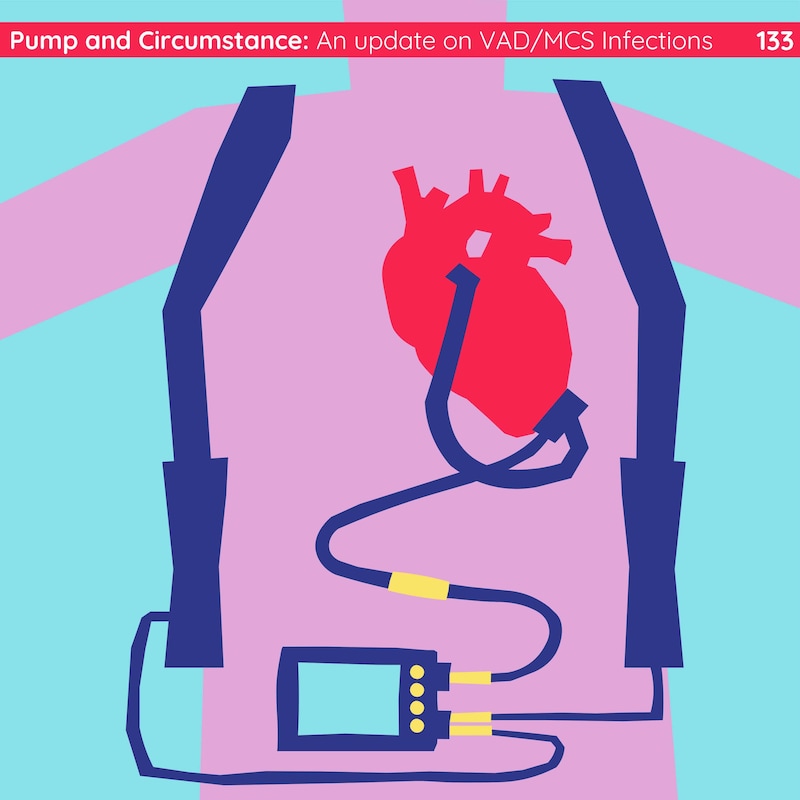
Rebecca Kumar:But just very briefly, from the inside out, we have the pump, which if you think
Rebecca Kumar:about it, has a component that's in contact with the blood, where the actual
Rebecca Kumar:blood goes into the device, and then there's an external surface which doesn't
Rebecca Kumar:have any direct contact with the blood.
Rebecca Kumar:So the blood goes from the pump into this outflow cannula, which again also has
Rebecca Kumar:an area in which blood travels through.
Rebecca Kumar:And then there's the outside of the device.
Rebecca Kumar:And from there, it goes into the aorta and to the rest of the body.
Rebecca Kumar:And the pump itself is powered by an external battery that is connected
Rebecca Kumar:to the device via a driveline and the driveline tunnels from outside in
Rebecca Kumar:the abdomen through the, through the abdominal cavity into the thoracic
Rebecca Kumar:cavity where it connects to the pump.
Alok Nimgaonkar:So, how have trends in utilization of LVADs
Alok Nimgaonkar:as bridge to transplant versus destination therapy changed over time?
Alok Nimgaonkar:And what are the implications?
Rebecca Kumar:There's the INTERMACS study which stands for the Interagency
Rebecca Kumar:Registry for Mechanical Assisted Circulatory Support, which noted that
Rebecca Kumar:since 2022, that these newer devices like the HeartMate 3 are are exclusively
Rebecca Kumar:used compared to older devices, like the HeartMate, like two, et cetera.
Rebecca Kumar:Um, and, roughly 80% that were being put in from the years 2021 to 2023
Rebecca Kumar:were actually destination therapies.
Rebecca Kumar:And again, an LVAD is helpful because essentially there is a shortage
Rebecca Kumar:of donors throughout the country.
Rebecca Kumar:We know this.
Rebecca Kumar:And for patients who don't qualify for a transplant, this is an option
Rebecca Kumar:for them in order to live longer.
Rebecca Kumar:But LVADS do come with their own risks.
Rebecca Kumar:Stroke, thrombosis, infections, these are all complications that can happen
Rebecca Kumar:in patients who are living with LVADs, but since the adoption of the HeartMate
Rebecca Kumar:three, the risk of stroke, the risk of thrombosis have all decreased.
Rebecca Kumar:But, with regards to infection.
Rebecca Kumar:The risk is still about the same.
Rebecca Kumar:And the longer that you have the LVAD in, the more likely
Rebecca Kumar:you are to develop an infection.
Rebecca Kumar:So this really means that with the utilization of LVA DS for
Rebecca Kumar:destination therapy, that we're having patients who are living longer
Rebecca Kumar:with an LVAD in place and are thus more likely to develop infections.
Rebecca Kumar:And so I think as ID physicians, we need to have a good understanding
Rebecca Kumar:of these durable mechanical circulatory support devices and an
Rebecca Kumar:understanding of the infections that are associated with these devices.
Alok Nimgaonkar:So how has the long-term durability of LVADs impacted patient's
Alok Nimgaonkar:ability to move up on the wait list?
Alok Nimgaonkar:And why is this an issue if LVAD outcomes have improved at a comparable level
Alok Nimgaonkar:that of transplants?
Rebecca Kumar:Yeah, so prior to 2018, UNOS listed patients with LVA DS as
Rebecca Kumar:either status 1A, if they had any sort of complication or 1B if they did not.
Rebecca Kumar:In 2018, essentially UNOS deprioritized patients with long-term LVADs such
Rebecca Kumar:that only patients with essentially like a life-threatening ventricular
Rebecca Kumar:arrhythmia got moved to status 1 or a device malfunction or mechanical failure.
Rebecca Kumar:Those patients ended up as status two, but for everybody else, no
Rebecca Kumar:matter how long you had the LVAD in for you were considered status 3.
Rebecca Kumar:So even if you have an infection associated with your LVAD, the highest
Rebecca Kumar:you can go is only a status three.
Rebecca Kumar:So now what we're seeing is that these LVAD patients, even though
Rebecca Kumar:they were initially implanted with the thought that it was gonna be a
Rebecca Kumar:bridge to transplant, now it's more like a bridge to a complication.
Rebecca Kumar:but I do believe that there's been an update in the policy.
Rebecca Kumar:And Alok, I know that you have a passion for policy.
Rebecca Kumar:Do you wanna update us on it?
Alok Nimgaonkar:Yeah, there's actually a recent proposal that's
Alok Nimgaonkar:been accepted in June that that will allow patients with LVADs to go up
Alok Nimgaonkar:on the listing, um, based on the time that they've had their LVAD in place.
Alok Nimgaonkar:So they, if they've had their LVAD in place for six years, they'd go up to
Alok Nimgaonkar:status three, and then if they've had it for eight years, they would go up
Alok Nimgaonkar:to status two, regardless of whether they've had complications or not.
Alok Nimgaonkar:This should go into effect in September of 2026, with another phase to be
Alok Nimgaonkar:rolled out a year and a half later.
Rebecca Kumar:In that other phase, if I'm not mistaken, shortens
Rebecca Kumar:the duration of time the patient needs the LVAD for, correct?
Rebecca Kumar:It goes to five years, then they'll be considered status three
Rebecca Kumar:and then seven years, and then they'll be considered status two.
Alok Nimgaonkar:That's exactly right.
Alok Nimgaonkar:Um, now shifting gears a bit to the case.
Alok Nimgaonkar:This patient was recently hospitalized for COPD exacerbation, received a course of
Alok Nimgaonkar:antibiotics and steroids with improvement.
Alok Nimgaonkar:He lives alone and gets dressing changes frequently.
Alok Nimgaonkar:Unfortunately he got his battery caught on a chair when he was walking and
Alok Nimgaonkar:the drive line was tugged and the velour of the drive line was exposed.
Alok Nimgaonkar:He then developed redness, warmth, and pain, increased drainage
Alok Nimgaonkar:from his drive line site Um he hasn't had any fevers or chills.
Alok Nimgaonkar:No alarms have gone off on his drive line.
Alok Nimgaonkar:He denies any chest pain, urinary symptoms, cough or other symptoms.
Alok Nimgaonkar:Quickly going through his medical history, so he had HFrEF from
Alok Nimgaonkar:unknown non ischemic cardiomyopathy.
Alok Nimgaonkar:His EF declined until about 10%, he failed medical management
Alok Nimgaonkar:and required inotropic support.
Alok Nimgaonkar:He then had a HeartMate three device placed about two years
Alok Nimgaonkar:prior and since then has had a relatively uncomplicated course.
Alok Nimgaonkar:He's been on aspirin, warfarin and his INRs has been in therapeutic range.
Alok Nimgaonkar:And his LVAD is listed as destination therapy.
Alok Nimgaonkar:Other medical problems are obesity, his BMI 35 and diabetes with an A1C
Alok Nimgaonkar:of 7.1 In terms of his social history, nothing particularly relevant.
Alok Nimgaonkar:And then on exam, his vitals so he is afebrile temperature of 98.8.
Alok Nimgaonkar:His MAP is 80 and he's satting well in room air.
Alok Nimgaonkar:On exam we noticed that there's a confluent area of redness associated
Alok Nimgaonkar:with warmth, induration surrounding the driveline site with mild white-ish
Alok Nimgaonkar:drainage from the site itself.
Alok Nimgaonkar:The area's tender and without any fluctuance.
Alok Nimgaonkar:So how would you think about the initial approach to a patient with
Alok Nimgaonkar:suspected LVAD infection based on the original 2011 definitions of infections
Rebecca Kumar:So back in 2011, the ISHLT released guidelines on the different
Rebecca Kumar:types of infections, really to help guide research, diagnosis and management.
Rebecca Kumar:These were further divided into VAD specific infections, which are
Rebecca Kumar:essentially infections that are occurring because you have the VAD in place.
Rebecca Kumar:So that would be something like a pump infection or a driveline infection.
Rebecca Kumar:So it's really things that only a person with a VAD can have.
Rebecca Kumar:In addition to those infections, they also had VAD related infections.
Rebecca Kumar:So these are infections that are made more complicated by the presence of a VAD.
Rebecca Kumar:So bloodstream infections, endocarditis, mediastinitis, all of these things can
Rebecca Kumar:happen even if you don't have a VAD, but because there's a VAD in place,
Rebecca Kumar:the infection is made more complicated.
Rebecca Kumar:And then there are of course non-VAD infections.
Rebecca Kumar:So like even if you have a VAD, you, you can still get a UTI.
Rebecca Kumar:And then in addition, they basically further subclassified the infections
Rebecca Kumar:into definite, probable and possible based on microbiologic, clinical,
Rebecca Kumar:radiographic, and pathologic criteria.
Alok Nimgaonkar:So what have have been some problems with these definitions
Alok Nimgaonkar:and what is the rationale for an update?
Rebecca Kumar:So the uptake of these guidelines were not
Rebecca Kumar:as strong as had been hoped.
Rebecca Kumar:There was a meta-analysis of 132 studies that found only 38% use
Rebecca Kumar:the ISHLT guidelines for reporting infections, which makes it hard to
Rebecca Kumar:accurately research the epidemiology, the diagnosis, and the management of
Rebecca Kumar:these different types of infections.
Rebecca Kumar:And additionally advances in technology like such as the HeartMate 3, where
Rebecca Kumar:there's no longer a pocket mean that the definitions that were created,
Rebecca Kumar:such as a pocket infection are no longer relevant in this day and age.
Rebecca Kumar:And then additionally, with things like a driveline infection, the
Rebecca Kumar:categorization of deep versus superficial doesn't quite capture the complexity
Rebecca Kumar:of treatment associated with driveline infections, just based on the depth.
Rebecca Kumar:Um, because you could still have a superficial driveline site that has a
Rebecca Kumar:multi-drug resistant organism, or it could have a fungal infection that really makes
Rebecca Kumar:the management much more complicated.
Rebecca Kumar:And then in addition to this, one of the other rationales for
Rebecca Kumar:updating was so that the temporary devices could also be included.
Rebecca Kumar:So things like ECMO, the Impella, et cetera.
Rebecca Kumar:Um, that these definitions could be standardized across devices.
Alok Nimgaonkar:Makes sense, so what are the 2024 definitions?
Rebecca Kumar:Yeah, so these definitions that have been
Rebecca Kumar:published by ISHLT encapsulate both durable and acute MCS devices.
Rebecca Kumar:I did mention the acute MCS device infections, but we're
Rebecca Kumar:not gonna cover them here.
Rebecca Kumar:That's like a whole other episode, but in terms of what's
Rebecca Kumar:changed from a LVAD perspective.
Rebecca Kumar:So they've changed superficial and deep driveline infections to describe
Rebecca Kumar:them as complicated or uncomplicated.
Rebecca Kumar:And the idea is that the depth of the infection doesn't capture the complexity
Rebecca Kumar:of the condition, it's more like what's the organism associated with it?
Rebecca Kumar:There's also been a change to include blood contact surface
Rebecca Kumar:infections and endocarditis.
Rebecca Kumar:So this is essentially an infection in an area that blood flows through.
Rebecca Kumar:And in order to make this diagnosis, you need positive blood cultures.
Rebecca Kumar:You'd get radiographic or echocardiographic evidence of a
Rebecca Kumar:vegetation or a thrombus in the intravascular aspect of the device.
Rebecca Kumar:And then you could also look for septic emboli as well.
Rebecca Kumar:And systemic signs are likely to occur and appear, but aren't
Rebecca Kumar:always there for the diagnosis.
Rebecca Kumar:And then there's device specific bacteremia.
Rebecca Kumar:So this is a positive peripheral blood culture in a patient who has a
Rebecca Kumar:device and it's related to the device.
Rebecca Kumar:So an example for this would be like if somebody developed a bacteremia from a
Rebecca Kumar:driveline, or if they have persistently positive blood cultures greater than
Rebecca Kumar:72 hours apart with the same organism.
Rebecca Kumar:Then you also have infections involving the external surface
Rebecca Kumar:of the implanted device.
Rebecca Kumar:So this is what we would've considered previously, maybe like a pocket infection.
Rebecca Kumar:So the outside of the device itself is infected.
Rebecca Kumar:Usually to make this diagnosis you need some sort of positive
Rebecca Kumar:culture from the tissue or a fluid collection surrounding it.
Rebecca Kumar:And again, there may not be systemic signs present.
Alok Nimgaonkar:So we'll apply and then discuss the implications of management
Alok Nimgaonkar:for these definitions later in the case.
Alok Nimgaonkar:What is what's the typical diagnostic approach for patients with suspected LVAD
Alok Nimgaonkar:infections, and what is your threshold to look for deeper source of infections?
Rebecca Kumar:I have a pretty low threshold to look for deeper sources
Rebecca Kumar:of infections, but essentially when this patient comes in, I'd wanna
Rebecca Kumar:make sure that there's a CBC, a CMP.
Rebecca Kumar:I'd wanna make sure that we get cultures from the driveline exit site,
Rebecca Kumar:especially because of the fact that you're telling me that there is drainage.
Rebecca Kumar:And then in terms of blood cultures, I'd get three sets of blood cultures.
Rebecca Kumar:And I generally, again, would recommend getting CT chest/abdomen/pelvis, you
Rebecca Kumar:could potentially get an ultrasound, but I prefer looking at CT, so I'll
Rebecca Kumar:usually get a CT chest, abdomen, pelvis.
Rebecca Kumar:And then you can also consider getting an echocardiogram.
Rebecca Kumar:I think the important thing to keep in mind is that in larger studies of
Rebecca Kumar:LVAD infections, SIRS criteria only occurred in about like 39% of patients.
Rebecca Kumar:And so just because somebody doesn't look like "SIRS"-y based, based on labs,
Rebecca Kumar:like you still need to consider infection when you're evaluating the patient.
Rebecca Kumar:So what did the labs end up looking like for him?
Alok Nimgaonkar:So, CBC was a pretty unremarkable white count was 5.4,
Alok Nimgaonkar:hemoglobin was 13, platelets were 118.
Alok Nimgaonkar:CMP was also um unremarkable.
Alok Nimgaonkar:Electrolytes and liver function were at baseline and renal
Alok Nimgaonkar:function was also at baseline.
Alok Nimgaonkar:So the cultures we got actually ended up growing Pseudomonas which is
Alok Nimgaonkar:resistant to cefepime and ciprofloxacin, but was sensitive to meropenem.
Alok Nimgaonkar:The CT chest abdomen pelvis that we got was fortunately unremarkable for fluid
Alok Nimgaonkar:collections around the device, but did show some mild fat stranding at the
Alok Nimgaonkar:area surrounding the driveline insertion.
Alok Nimgaonkar:There wasn't any evidence of deeper infection like an abscess.
Alok Nimgaonkar:So so what are some typical pathogens that can cause infections in LVADs?
Rebecca Kumar:So, usually what, what I think of is gram-positives
Rebecca Kumar:like Staph epi and Staph aureus.
Rebecca Kumar:And Staph aureus is the most common pathogen overall, but
Rebecca Kumar:Pseudomonas is actually the culprit in about 25% of cases.
Rebecca Kumar:And, we do know other gram-negative organisms can
Rebecca Kumar:also cause infections as well.
Rebecca Kumar:Gram-negative rods in general, tend to cause drive line exit site infections.
Rebecca Kumar:The longer the patient has had the VAD in place for, and there could
Rebecca Kumar:be environmental factors that, that are thought to contribute to this.
Rebecca Kumar:Hearing that this is Pseudomonas, I would think maybe some sort of
Rebecca Kumar:water exposure likely led to this.
Rebecca Kumar:Data regarding the percentage of MDR organisms and LVAD
Rebecca Kumar:infections is pretty sparse.
Rebecca Kumar:There has been a single center study where it was estimated to occur in about
Rebecca Kumar:31% of patients, and I think it's also important to keep in mind that these
Rebecca Kumar:organisms can form biofilms and that can lead to high rates of recurrence.
Alok Nimgaonkar:So let's say the patient had systemic signs of infection
Alok Nimgaonkar:and other sources have been ruled out, um, and you're worried that
Alok Nimgaonkar:there's a deeper infection, but a CT is indeterminate or negative.
Alok Nimgaonkar:How useful are other modalities like a PET scan or a white cell tag scan
Alok Nimgaonkar:in these cases?
Rebecca Kumar:I mean, my personal opinion is that white cell scans in general
Rebecca Kumar:are trash, but I think, um, you know, CTs can have limited specificity for
Rebecca Kumar:ruling out deep drive line infections.
Rebecca Kumar:And white cell tag scans have poor sensitivity and positive predictive
Rebecca Kumar:values, but a PET scan on the other hand has good sensitivity
Rebecca Kumar:and positive predictive value.
Rebecca Kumar:The problem is, is that it can be very difficult to get one while a
Rebecca Kumar:patient's hospitalized due to the financial hurdles associated with it.
Rebecca Kumar:I think it can be very helpful if you're very worried that the pump or the
Rebecca Kumar:cannula itself is truly infected, but you have to be prepared to fight for it.
Alok Nimgaonkar:So, so bringing it back to the case, how would you
Alok Nimgaonkar:classify this patient according to the new 2024 definitions, and how would
Alok Nimgaonkar:you go about treating their infection?
Rebecca Kumar:So, even though what this is being described
Rebecca Kumar:as it's a superficial infection.
Rebecca Kumar:It does have the presence of MDR Pseudomonas, which would
Rebecca Kumar:cause this infection to actually be considered complicated.
Rebecca Kumar:Most simply, they'd receive two weeks, likely longer of
Rebecca Kumar:IV meropenem for treatment.
Alok Nimgaonkar:So, let's say this patient had a deeper
Alok Nimgaonkar:infection of the drive line.
Alok Nimgaonkar:How would you approach
Alok Nimgaonkar:management in that case?
Rebecca Kumar:At that point, management would involve a longer
Rebecca Kumar:duration of antibiotics, so like six to eight weeks or longer.
Rebecca Kumar:I think the other important thing is talking with your surgical
Rebecca Kumar:colleagues about whether or not debridement is possible.
Rebecca Kumar:Because he has a HeartMate three, the drive line is a modality that
Rebecca Kumar:is replaceable, you don't have to remove the whole device itself.
Rebecca Kumar:You can exchange the drive line.
Rebecca Kumar:So, talking to them, especially for somebody like this who's an older
Rebecca Kumar:gentleman, he's living by himself.
Rebecca Kumar:Putting him on long-term meropenem would be difficult for him to
Rebecca Kumar:have to administer to himself three times a day for a long time.
Alok Nimgaonkar:Makes sense and, let's say that, it was actually
Alok Nimgaonkar:susceptible to ciprofloxacin.
Alok Nimgaonkar:Would you give him chronic suppression given the high rates
Alok Nimgaonkar:of resistance for Pseudomonas.
Alok Nimgaonkar:resistance for Pseudomonas?
Rebecca Kumar:With Pseudomonas, essentially the fluoroquinolones
Rebecca Kumar:are only oral option.
Rebecca Kumar:Mutations and resistance are common with Pseudomonas, but I think
Rebecca Kumar:taking all of it together, this is somebody who I would consider giving
Rebecca Kumar:long-term suppressive therapy to.
Alok Nimgaonkar:How do you think about chronic suppressive antibiotics in general
Alok Nimgaonkar:for patients with these deeper infections?
Alok Nimgaonkar:What are, what are some antibiotics that you might choose?
Rebecca Kumar:so the data's pretty sparse and mixed with regards to
Rebecca Kumar:the choice of chronic suppressive antibiotic therapy for LVAD infections.
Rebecca Kumar:And the guidelines actually don't specifically make any
Rebecca Kumar:specific recommendations.
Rebecca Kumar:I think as long as you keep in mind that there's really not much data, and
Rebecca Kumar:that the two larger studies looking at LVAD infections have shown that there's
Rebecca Kumar:like a roughly 30% rate of relapse.
Rebecca Kumar:I think when you keep that in mind, you can counsel your patient and
Rebecca Kumar:make sure that they're aware that this is likely to still reoccur.
Rebecca Kumar:And then for something like Staph I'd use something like doxy or bactrim.
Rebecca Kumar:You could also use Keflex as well.
Alok Nimgaonkar:And then coming back to the definitions, broadly
Alok Nimgaonkar:speaking, what are the implications for management of LVAD infections
Alok Nimgaonkar:with these new definitions coming out?
Rebecca Kumar:In the
Rebecca Kumar:short term, it may cause you to think about the duration of antibiotics.
Rebecca Kumar:For previously defined superficial driveline infections that are actually
Rebecca Kumar:more complicated like the MDROs.
Rebecca Kumar:I think that in the long term though, it's gonna help with unified
Rebecca Kumar:research of devices, especially across the acute and durable mechanical
Rebecca Kumar:circulatory support devices.
Alok Nimgaonkar:Is there anything else coming along the horizon that
Alok Nimgaonkar:might alter the infection risk of M CS and LVAD specifically?
Rebecca Kumar:There's a lot of interest in transcutaneous electronic transfer
Rebecca Kumar:systems, which are basically not having a drive line in place, and I think
Rebecca Kumar:that because infections predominantly occur because of the drive line, this
Rebecca Kumar:would essentially reduce the risk of infections in our LVAD patients.
Sara Dong:Thanks so much for Alok and Rebecca for joining
Sara Dong:this update on VAD infections.
Sara Dong:Don't forget to check out the website, febrilepodcast.com, where you'll find
Sara Dong:the Consult Notes, our library of ID infographics, a link to that info about
Sara Dong:the editorial board applications, as well as a link to our merch store.
Sara Dong:Febrile is produced with support from the Infectious Diseases Society of America.
Sara Dong:Please reach out if you have any suggestions for future shows or want
Sara Dong:to be more involved with Febrile.
Sara Dong:Thanks for listening.
Sara Dong:Stay safe, and I'll see you next time.




