Shownotes
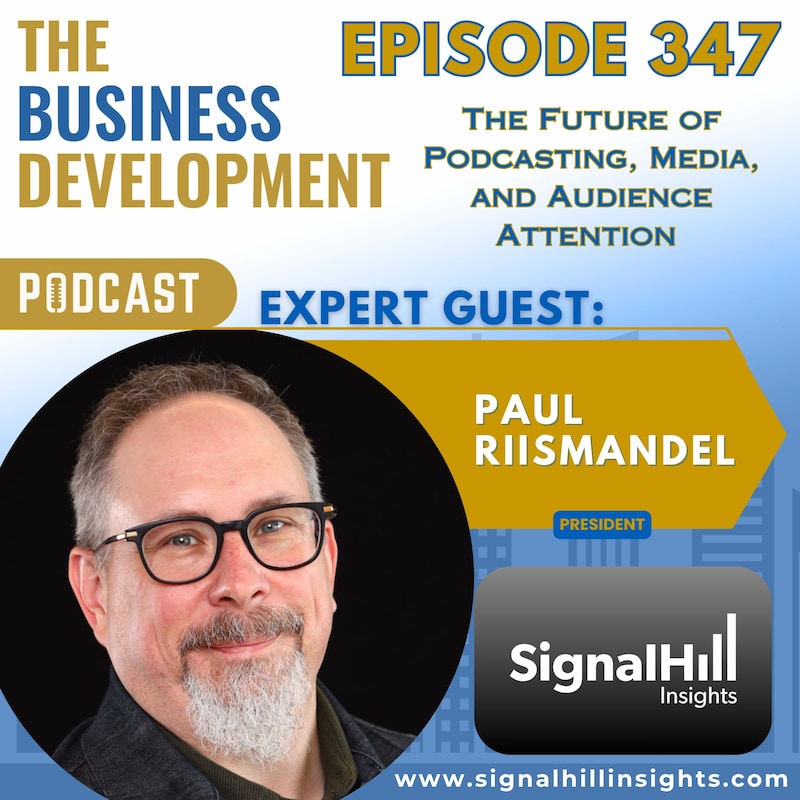
In Episode 347 of The Business Development Podcast, Kelly Kennedy sits down with Paul Riismandel, President of Signal Hill Insights and one of the leading voices in podcast audience research, to explore the future of podcasting, media, and audience attention. Drawing on more than two decades of experience in digital audio, podcasting, advertising, and audience measurement, Paul shares what creators, entrepreneurs, marketers, and business leaders need to understand about where the industry is headed and how audiences are consuming content in 2026 and beyond.
From the myth that everyone skips podcast ads to the reality of audience growth, community building, content discovery, and the evolving relationship between audio and video, this conversation is packed with practical insights and thought-provoking perspectives. Paul challenges conventional wisdom around virality, explains why community matters more than most creators realize, and reveals what successful podcasters are doing differently to build loyal audiences in an increasingly competitive media landscape. Whether you're a podcaster, content creator, thought leader, marketer, or business owner, this episode offers a valuable look at the forces shaping the future of attention and influence.
Key Takeaways:
- Audience quality matters more than audience quantity.
- One podcast listener is not the same as one passive TV or radio listener.
- A hundred downloads can represent a room full of people who chose to hear from you.
- Podcasting is a long game, not a viral lottery.
- You need to know who your audience is and why they should listen.
- Discovery starts by finding the audience, not just finding podcast listeners.
- Audio is not dead, but creators need to remind people how and when to listen.
- Short form content may be losing some of its hold as people want their attention back.
- Community is one of the strongest drivers of podcast growth and loyalty.
- Podcast ads work better than many people think because listeners do not skip them as much as they say they do.
Want to learn more from Paul?
Check out Signal Hill Insights and subscribe to Paul's newsletter. If you care about podcasting, media, audience growth, advertising, and the future of audio, it's one of the best sources of industry insights available.
Signal Hill Insights Newsletter
🎸 Sponsor Shoutouts: Thank You Colin Harms for your steadfast support of The Business Development Podcast! 🫶
The Business Development Podcast is proudly supported by Hypervac Technologies & Hyperfab, 🎸⭐
🔹 Hypervac Technologies: North America’s leader in vacuum truck manufacturing, building high performance hydrovac and industrial vacuum trucks designed for the toughest field conditions. www.hypervac.com
🔹 Hyperfab: The custom fabrication division of Hypervac, delivering engineered solutions and specialized builds tailored to demanding industrial applications. www.hyperfab.ca
Join The Catalyst Club Community
If you are serious about growth, community, leadership, and surrounding yourself with high-level, human-centric thinkers, The Catalyst Club is where you need to be.
Join us here: www.kellykennedyofficial.com/thecatalystclub
Mentioned in this episode:
Hypervac - Revolution Vacuums
Transcripts
Everyone skips ads.
Speaker A:Almost nobody skips ads as much as they think they do or tell people they do.
Speaker A:Right.
Speaker B:Interesting.
Speaker A:And how do I know this?
Speaker A:I know this because if that were the case, podcast advertising would have crashed a long time ago.
Speaker C:The great Mark Cuban once said, business happens over years and years.
Speaker C:Value is measured in the total upside of a business relationship, not by how much you squeezed out in any one deal.
Speaker C:And we couldn't agree more.
Speaker C:This is the Business Development Podcast, based in Edmonton, Alberta, Canada, and broadcasting to the world.
Speaker C:You'll get expert business development advice, tips and experiences, and you'll hear interviews with business owners, CEOs and business development reps. You'll get actionable advice on how to.
Speaker B:Grow business brought to you by Capital.
Speaker C:Business Development, CapitalBD CA.
Speaker C:Let's do it.
Speaker C:Welcome to the Business Development Podcast.
Speaker C:And now your expert host, Kelly Kennedy.
Speaker B:Hello.
Speaker B:Welcome to episode 347 of the Business Development Podcast.
Speaker B:Today, it is my absolute pleasure to welcome Paul Riesmandel.
Speaker B:Paul is the president of Signal Hill Insights, one of the leading audience research firms in podcasting, digital audio, and of course, the creator economy.
Speaker B:For more than two decades, Paul has been at the forefront of audio media, helping brands, publishers and advertisers understand not just who is listening, but why they listen to.
Speaker B:From helping pioneer podcast advertising at Midroll Media to leading insights and measurement initiatives at Sirius xm, Paul has spent his career studying what makes podcasts one of the most trusted and effective forms of media in the world today.
Speaker B:Paul oversees one of the industry's largest audience insights programs, advising some of the biggest names in podcasting, while helping shape the future of how the medium is measured, monetized, and understood.
Speaker B:If podcasting is entering its next era, Paul Riesmandel is one of the people helping the industry understand what that era actually means.
Speaker B:Paul, it is an honor and a privilege to have you on our show today.
Speaker A:You're hired, Kelly.
Speaker A:Whatever it is, whatever it is you're selling, you're hired.
Speaker B:I'm pleased to be here.
Speaker A:Pleased to be here.
Speaker B:No, super, super cool.
Speaker B:If there's one thing that I've learned in my podcasting career, it's that I love talking about podcasting.
Speaker B:And, you know, there's not a lot of people, frankly, more knowledgeable about, you know, what the future of podcasting looks like than you.
Speaker B:And so having you on is truly an honor and a privilege.
Speaker B:And I just want to say, you know, you're one of the kings of podcasting.
Speaker A:Well, thank you.
Speaker A:Let's hope.
Speaker A:And partly it's Just because they can't get rid of me.
Speaker A:I just won't.
Speaker A:I just won't go away.
Speaker B:It really ropes you in, doesn't it?
Speaker A:Yep.
Speaker B:So, Paul, obviously our listeners might be meeting you for the first time in the podcasting world.
Speaker B:You're insanely well known in the business world.
Speaker B:You're probably getting there, too.
Speaker B:But, you know, for people being introduced to you for the very first time.
Speaker B:Who is Paul Rees Mendel?
Speaker B:How the heck did you end up on this path?
Speaker A:How did I end up on this path?
Speaker A:Like most people, by accident.
Speaker A:I don't think you can plan it, but, you know, lifelong media guy, since I was a kid, into high school, into college, I was in college radio, decided not to pursue a career in radio, which probably worked out okay for me.
Speaker A:I'm not sure I had the talent for the for to be entirely on mic and perhaps could have had one of those jobs that used to exist back in the back office.
Speaker A:I attempted a couple of PhDs, and neither really stuck.
Speaker A:Either the academy wasn't for me or I wasn't for the academy.
Speaker A:But where I ended up in was educational media production.
Speaker A:So what I ended up doing is working in some of the early days of digital media and online media at universities.
Speaker A:So basically saying, hey, we've got to get this video and audio off of tapes.
Speaker A:For those of a certain age may remember when you would wheel a VCR and television into a classroom, you betcha.
Speaker A:And to kind of get this into the realm at which people were getting it on their devices, whether at, you know, desktops, laptops, eventually mobile devices.
Speaker A:So I worked at that for a good 20 years until I burned out on working in.
Speaker A:Working in universities.
Speaker A:You know, I'd been kind of, I like to think, a bit at the cutting edge, and things are changing rapidly in terms of it becoming much more common at universities.
Speaker A: I felt like, you know, in the: Speaker A:And so now, of course, today, you know, if a university isn't using digital media, that's because they're teaching the Amish.
Speaker A:I'm not certain who, you know, what they're doing right, but someone had to be there early on, you know, in scrapping away without budgets.
Speaker A: And I was lucky enough in: Speaker A: g since it began in the early: Speaker A:I would have thought, this is a great way to deliver audio on the Internet.
Speaker A:And I was very excited about it.
Speaker A:I continue to be involved in community radio, and I was the advisor to a college radio station.
Speaker A:And I could just see like there was something here, like, that was really going to take radio at the time to the next level to allow people to not have to set an alarm, to remember to listen to this American Life on Saturday afternoon at 2pm or something, and instead be able to just download and listen to it on their commute on their ipod or their MP3 player.
Speaker A:So I immediately saw like this was an exciting development and started playing with the technology.
Speaker A:So I was a podcast consumer from then on, basically, and had been following the business and actually had been blogging about it, if you remember blogs.
Speaker A:Some of them still exist.
Speaker A:I still write one.
Speaker A:And Jeff had read my post writing about Midroll Media, because I just learned about it and said, wow, okay.
Speaker A:Really trying to organize the advertising because at that point there were ads on podcasts.
Speaker A:But it, you know, it seemed very kind of, there's some pioneering brands perhaps, but it didn't seem very organized, if you will.
Speaker A:And the idea of starting this network to help lots of podcasts monetize by sort of centralizing their sales and, you know, making it easier seemed interesting to me.
Speaker A:He invited to be me to be on his podcast called the Wolf Den, which was the podcast about the business of podcasting.
Speaker A: And again, this is: Speaker B:Wow.
Speaker B:Yeah.
Speaker A:And he called me a few months later and said, you know, we're trying to find someone to do content marketing, someone to help teach the ad community.
Speaker A:One, what is a podcast?
Speaker A:And two, what is a podcast advertisement?
Speaker A:Yeah, we can't seem to find any marketers who know what this stuff is.
Speaker A:You know, a lot about it.
Speaker A:Can you be a marketer?
Speaker A:And I said, yep, I can.
Speaker A:And I wasn't just blowing smoke.
Speaker A:Part of my remit had been in working in instructional media, had been working closely with communications department departments and marketing departments on putting together, you know, media assets to promote academic programs, promote the achievements of schools and things like this.
Speaker A:So I was very familiar with a lot of that.
Speaker A:And.
Speaker A:And I also, in my time in higher ed, I'd been a teacher.
Speaker A:I taught university courses on communication and media.
Speaker A:So I was familiar with, like, what it takes to kind of help sell a concept.
Speaker A:Right.
Speaker A:And bring things through.
Speaker A:So that's where I got my start.
Speaker A:And as I was working through that, you know, we were getting some Success.
Speaker A:But ultimately, some of the bigger brands, you know, very big household names, said, sure, this sounds great.
Speaker A:You're.
Speaker A:You know, what you're telling us about podcasts that are intimate, that people are really leaned in.
Speaker A:Prove it.
Speaker A:That's when it turned into a research job.
Speaker B:Yeah.
Speaker A:And since I attempted a couple of PhDs, one of which was in communication, I had some research jobs at my disposal and so just dived in to help.
Speaker A:Help do that kind of research.
Speaker B:That's amazing.
Speaker B:You know, one of the things that was most confusing for me when I first started a podcast is what the hell all the numbers even meant.
Speaker A:Yeah, yeah, absolutely.
Speaker B:And you don't know what's good or what's not good.
Speaker B:Like, you know, one of the goals earlier on and.
Speaker B:And me and you both know her, but I brought on Fatima Zadie, who runs co host and Quilling, and ultimately was kind of picking her brain, like, what the heck does all this stuff mean?
Speaker B: nfo than we had back in early: Speaker B:But I think I found myself as a new podcaster not knowing what was good and what was bad.
Speaker B:And I think in the beginning, I found it a little bit disheartening because you look at your numbers and you're like, I'm getting 30 or 50 downloads a day.
Speaker B:It's like, oh, that's not very much.
Speaker B:But, you know, over time, you start to realize that's actually, you know, pretty normal for a new show.
Speaker B:But there wasn't a lot of information out there to even tell you what was good, what was bad, or what anything even meant.
Speaker A:One of the most pernicious developments in the Internet has been the like button.
Speaker A:And you say, well, why is that?
Speaker A:Well, because we all of a sudden started putting metrics on things that didn't necessarily need to have metrics.
Speaker B:Yeah.
Speaker A:So I, you know, and just let me just say that the impulse to do so was benevolent.
Speaker A:Right.
Speaker A:That we're literally.
Speaker A:It's kind of nice to have someone say, hey, I like that post on Facebook, or I. I like that picture you put on Instagram.
Speaker A:But it immediately means now if you don't get a like or you don't get so many likes, you're like, oh, what did.
Speaker A:What did I do?
Speaker A:Right.
Speaker B:Yeah.
Speaker A:And on the one hand, if you're.
Speaker A:If you're creating media that you hope to monetize.
Speaker A:Yes, you need to know about audience, but the question isn't always quantity of audience, it's quality.
Speaker B:Yes.
Speaker A:Right.
Speaker A:There are different things between being Joe Rogan or being the best biz dev podcast.
Speaker A:Those are.
Speaker A:Those are different audiences and there's different numbers of people involved.
Speaker A:And if you're going to make the best podcast for dentists, that's a smaller community than making the best podcast for bowlers, for instance.
Speaker A:And you need to really define who it is you're trying to reach, first of all.
Speaker A:And then why.
Speaker A:Why are you reaching them?
Speaker A:And it can be reasons, can be just because I enjoy doing this.
Speaker B:That's right.
Speaker A:That can be a great reason.
Speaker A:But you need to therefore modify what your expectations are based upon why you're doing it.
Speaker A:And that helps to kind of tune it so that we're not just looking at these individual tick marks.
Speaker A:One download, one download, one download.
Speaker A:But understanding what's the perspective on that?
Speaker A:And one of the perspectives I like to share, very often someone says, hey, you know my podcast, I only got like a hundred downloads.
Speaker B:Yeah.
Speaker A:And let's just imagine that in this particular case, that's.
Speaker A:That's actually 100 people.
Speaker A:Well, what if you threw an event and 100 people showed up?
Speaker A:How would you feel?
Speaker B:Pretty frigging great.
Speaker A:Would you feel good?
Speaker A:Would that be great?
Speaker B:Yeah.
Speaker A:Now we've got a thousand downloads, I threw an event and a thousand people showed up.
Speaker A:How would you feel?
Speaker A:You need to think of it that way.
Speaker B:Yes.
Speaker A:We get stuck in the old paradigms of broadcast.
Speaker A:Right.
Speaker A:Where with a radio transmitter or TV transmitter, you're just, by very nature of it existing, you're reaching hundreds and thousands and millions of people.
Speaker A:But what we forget is, yeah, it used to be really hard to do that.
Speaker A:When you had a TV channel, you were one of five, 10, 12.
Speaker A:Depends on where you live, right?
Speaker B:That's right.
Speaker A:Radio stations.
Speaker A:One of 20, maybe in a bigger city.
Speaker A:Yeah.
Speaker A:Okay.
Speaker A:Well, and so, and then when someone turns on a radio, they only have 20 choices.
Speaker A:So you're going to be one of them.
Speaker B:Yeah.
Speaker B:Right.
Speaker A:For somebody, podcasting isn't like that.
Speaker A:Podcasting is opt in.
Speaker A:People seek out, but it means that they are very directed.
Speaker A:If they tune in and they listen and they follow your podcast, it's something they really want to do.
Speaker A:It's not so passive.
Speaker A:It's not just, I clicked it on and it's there 100%, and that's important.
Speaker A:So it means that, that one listener of a podcast means something different than One viewer of.
Speaker A:Of television or one listener of radio.
Speaker A:And some ways, I would argue, even is different than one viewer on.
Speaker A:On Demand, on.
Speaker A:On, say, Netflix, where, yeah, people are, you know, there.
Speaker A:But they're also.
Speaker A:They're looking to fulfill different things with.
Speaker A:With these.
Speaker A:With.
Speaker A:With what you're doing.
Speaker A:And that's why it's really important to go back to that.
Speaker A:What is it I'm looking to accomplish?
Speaker A:Why am I doing this?
Speaker B:Yes.
Speaker A:And critically, what do I want that listener to take away?
Speaker A:Or rather, what does it fulfill for them?
Speaker A:What need does my podcast fulfill for this listener?
Speaker A:And it can be several different needs.
Speaker A:But you need to start thinking about that if what you want to do is to grow a podcast and to grow an audience.
Speaker B:Yes, absolutely.
Speaker B:I actually made a series starts around episode 260 last year, where I just started teaching everything that I knew about podcasting so far.
Speaker B:And like, let's get real, you know, I'm two and I'm three and a half years into my show now.
Speaker B:At that point, I was about two and a half years into my show, but we'd already achieved quite a bit of success, at least here in Canada.
Speaker B:And so I was like, okay, well, I think I have, like, a good idea on how to do this.
Speaker B:I'm going to lay it out.
Speaker B:But one of the things that I did mention earlier on is podcasting is dedication.
Speaker B:It is absolutely a long game.
Speaker B:You know, it's very rare that you launch a show and in the first, you know, 10 episodes, you just blow up.
Speaker B:It's.
Speaker B:Unless you're a celebrity or get lucky.
Speaker B:You know, I think on some level, we did get a little lucky with the latest show.
Speaker B:We had a right idea, right concept at the right time.
Speaker B:It got pulled automatically by.
Speaker B:By Apple Podcast, and we got promoted.
Speaker B:And.
Speaker B:And the rest is history.
Speaker B:You have that big download spike.
Speaker B:But that was not the case with the bdp.
Speaker B:The BDP was absolutely a slog for the first year.
Speaker B:We got, you know, we.
Speaker B:We did okay, but I think it was about six to eight months, the first six to eight months of the show, Paul, before we broke 80 downloads in a single day.
Speaker B:And, you know, I remember.
Speaker B:I remember being in the kitchen with Shelby, my wife, and just saying, like, I don't know, like, what to do here.
Speaker B:I don't know how to get more people.
Speaker B:But, you know, at the time, it just all seemed like numbers.
Speaker B:I never thought about it.
Speaker B:Like, 80 people in a room on a single day is a lot of frigging people.
Speaker A:Right.
Speaker A:It's a small Business.
Speaker B:Yeah.
Speaker A:You know, it's lots of people open small businesses and a lot of them close small businesses.
Speaker B:Yes.
Speaker A:Because it's not build it and they will come.
Speaker A:It's not throw open the doors and people are going to flood in.
Speaker A:You know, you can't compare yourself to opening up, you know, a new Chipotle.
Speaker B:Yeah.
Speaker A:Or a new Tim Hortons.
Speaker A:There's no built in audience.
Speaker A:Right.
Speaker A:So if you're opening, opening up a sandwich shop, you're going to have to prove yourself.
Speaker B:Yeah.
Speaker A:You're going to have to prove yourself one way or another.
Speaker A:And sure, there are places in town where maybe there's more foot traffic, you're near a lot of businesses, maybe, you know, more people will stop in and just wander by, but you're going to pay a lot more for that real estate.
Speaker B:Absolutely, absolutely.
Speaker A:You're paying for that foot traffic in a different way.
Speaker A:And if you don't prepare for that beginning, for that ramp up and understand that you may have to carry it for quite some time before they start queuing at your door, or there may be the one day that you, for whatever reason, some influencer mentions your sandwich shop on Instagram and they're lined up out the door.
Speaker A:But you, as much as people think you can, you really can't plan for that.
Speaker B:No, no.
Speaker B:Like I said, you might get lucky.
Speaker B:Right.
Speaker A:You might get lucky and you can put yourself in a position to catch the luck when it comes.
Speaker B:Absolutely.
Speaker A:But you need to think about it.
Speaker A:It's a small business.
Speaker A:And I think, you know, social media and the notion of virality have done a disservice to not just podcasting, but to creators in general, to giving people the sense that virality, getting lucky is the key to success.
Speaker A:I think you said it right.
Speaker A:It's a long game.
Speaker A:And I think that's true not just of podcasting.
Speaker A:It's true of a YouTuber, it's true of a tiktoker.
Speaker A:You might get lucky and you might hit it at the right time, but yeah, but you got to keep delivering.
Speaker A:You got to keep doing it 100%.
Speaker B:Like, even if you were to get super viral, Right.
Speaker B:If you stop, it's all over.
Speaker A:It's all over.
Speaker A:I mean, remember the Hawk to a girl.
Speaker B:Yeah.
Speaker B:Yes.
Speaker A:Right, right.
Speaker A:Seemed like, like she was sitting on the world's shorter shoulders for a minute or two.
Speaker A:But easy come, easy go in a way.
Speaker A:And that's, you know, and that's, I think, an object lesson.
Speaker A:And I think when you see even the celebrities who've been successful at podcasting, what you're going to see is that they've done the work well and they.
Speaker B:Probably really enjoy it.
Speaker B:Right.
Speaker B:I think if I have to look at podcasting as a whole, it's one of my favorite things to do.
Speaker B:I absolutely love doing it.
Speaker B:I love producing the shows.
Speaker B:You know, my.
Speaker B:My newest show I used to work there is just.
Speaker B:It's hilarious, and I get to laugh the whole time that I'm making it.
Speaker B:Right.
Speaker B:And so it adds a lot of value to my life even before, you know, we make a dollar.
Speaker B:And I think that's the way you have to look at podcasting to truly find success.
Speaker B:You have to podcast about things you enjoy.
Speaker B:You have to really have a good time doing it, and that will allow you to keep coming back for as long as it takes to actually find the success you're looking for.
Speaker A:Absolutely.
Speaker B:So take me back to.
Speaker B:You know, we talked about this ahead of the show.
Speaker B: id you got into podcasting in: Speaker B:Is that correct?
Speaker A:Yeah.
Speaker B:So obviously, you've been with podcasting now for what.
Speaker B:What does that work out to be?
Speaker B:23 Years, roughly 23 years of podcasting.
Speaker B: t was podcasting like back in: Speaker B:Cause I think it's a little bit hard for me to even imagine it was a hobby.
Speaker A:I mean.
Speaker A:Right.
Speaker A:I mean, it was.
Speaker A:It was, but that was the Internet.
Speaker A:I mean, we'd been through the dot com.
Speaker A:Boom, okay?
Speaker A:So, you know, we had, you know, pets.com, we'd had, you know, the big spike, the IPO in Netscape, and people had thrown a lot of money at the Internet, and you throw a dot com on it, it's all of a sudden worth ten times as much.
Speaker B:Yeah.
Speaker A:And it.
Speaker A:And then.
Speaker A:And then it crashed.
Speaker A:Right.
Speaker A:So so much was people podcasting, was people saying, hey, would it be cool if we did this?
Speaker A:In the same way that the original web was.
Speaker A:Hey, wouldn't it be cool if we did this?
Speaker A:And I. I was at graduate school at the University of Illinois when the World Wide Web was invented.
Speaker A:Okay.
Speaker A:So that was Tim Berners Lee, you know, who was in Europe.
Speaker A:But the first Mosaic browser was created at University of Illinois.
Speaker A:Wow.
Speaker A:I was there.
Speaker A:I had no role in it.
Speaker A:Right.
Speaker B:Still, I was to be.
Speaker A:I was there, you know, going, oh, this is really cool.
Speaker A:Let me look.
Speaker A:You know, I got access to one of the computers that was connected to the Internet that I could try Mosaic on.
Speaker A:Yeah, okay.
Speaker A:And see the World Wide Web for the first time.
Speaker A:So.
Speaker A:And that was all.
Speaker A:All of that was built on.
Speaker A:Would it be cool if we did this?
Speaker A:How about if we try this?
Speaker A:And that's exactly the foundations of podcasting.
Speaker A:It was, hey, you know, it looks like we can distribute audio files on the Internet now.
Speaker A:We have this thing called MP3.
Speaker A:Yeah.
Speaker A:That makes them easier to move around the Internet than it used to be before, where the files would be really big and the Internet was very slow.
Speaker A:And it's like, okay, but then, you know what I have to do?
Speaker A:I have to go back and just check this person's website every week, every day, to see did they post a new thing.
Speaker A:Yeah.
Speaker A:And it already been this creation of the RSS really simple syndication standard, which was for websites.
Speaker A:I could subscribe to a RSS feed and using a piece of software, say, hey, there's all these different blogs.
Speaker A:And now when this person posts a new entry to their blog, I see it in my reader.
Speaker B:Okay.
Speaker B:It was like a notification system.
Speaker A:Exactly.
Speaker A:Not even notification.
Speaker A:You actually get the text.
Speaker A:Right.
Speaker A:You actually get to read it.
Speaker A:Because no one was making any money on their blogs.
Speaker B:Yeah.
Speaker A:You know, they're doing it for the love of it, for the love of sharing and community.
Speaker A:And all of a sudden, being able to publish to the world when it used to be to do that was extremely difficult and expensive.
Speaker B:Yeah.
Speaker A:You know, where either you had to become a published author or you would invest a lot in photocopies and postage.
Speaker A:Right.
Speaker A:I mean.
Speaker B:Yeah.
Speaker B:You're like.
Speaker B:You're up there on bulletin boards.
Speaker A:Precisely.
Speaker A:Absolutely.
Speaker A:Absolutely.
Speaker A:I mean, it's hard to kind of recapture how revolutionary that was.
Speaker B:Yeah.
Speaker B:In.
Speaker A:In, say, the.
Speaker A:In the 90s that we went from, anybody could publish something to anybody else in the world, and it wasn't anybody else in the world because a much smaller percentage of the world was on the Internet at that point, whether at home or, you know, back then, you may or may not remember dial up, and people had to use their phones very much.
Speaker A:You might remember dial up with your siblings over, and my mom was screaming.
Speaker B:At me, get off the Internet.
Speaker A:Exactly right.
Speaker A:So not being always on and just in your pocket.
Speaker A:Yeah.
Speaker A:So it's in that spirit that it was created.
Speaker A:And so immediately I'm like, well, let me figure this out.
Speaker A:And I hand coded my first RSS feeds because it wasn't hard to do.
Speaker A:You could just do it in a.
Speaker A:In a text.
Speaker A:In a text file.
Speaker A:And then, you know, shortly thereafter, you know, they created software, you know, that you could put up on your own, you know, server account and make it easier to distribute and that's ultimately what I, what I did.
Speaker A:And I did a radio show on a community radio station.
Speaker B:Okay.
Speaker A:And I started distributing it as a podcast.
Speaker A:And I would just record it on mini disc.
Speaker B:Yeah.
Speaker A:And digitize it and put it up.
Speaker A:It was a, it was a process.
Speaker A:Like.
Speaker A:Yeah.
Speaker A:You had to just do it because you, you love doing it.
Speaker A:And if I had 25 downloads ever, I felt very successful because I was just like, hey, you could, you know, not everybody's available at Friday at 5:30, which is when my, my show is on the air.
Speaker A:So now if you miss it, you can go and you can listen to, to a very low bit rate MP3.
Speaker A:But, but, you know, but that, that was fun.
Speaker B:Yeah.
Speaker B:Yeah, it's funny, man.
Speaker B: like, I'm thinking like early: Speaker A:Right.
Speaker B:Right off the LimeWire.
Speaker A:LimeWire and Napster and, And Bear Share.
Speaker A:Right, exactly.
Speaker B:But that was how it worked, right?
Speaker B:Like you had to actually physically download the file and upload it onto your 128 megabyte of B3 player with all 11 songs you could maybe fit on the damn thing.
Speaker B:And that's how you listened.
Speaker A:Yeah, and that's how I listen to my podcasts for my commute.
Speaker A:I would just load them onto, you know, whatever portable media device I had.
Speaker A:And, but, you know, I had to remember to download it and do the transfer.
Speaker A:And it just was my habit and took a few minutes.
Speaker A:And they, you know, there was specialized software called a podcatcher.
Speaker A:Yeah, that's what we called them back then, that would do that download for you.
Speaker A: Until: Speaker B:Okay.
Speaker A:That route made it like, integrated, you know, into something that was easier to use.
Speaker A:And if you had a Mac, then it was, you know, just part of your operating system.
Speaker A:And if you had an ipod, you connected your ipod and it would take care of it somewhat more automatically.
Speaker A: as podcasting until well past: Speaker B:That's amazing.
Speaker B:Yeah, like I would say the very.
Speaker B:I always thought, like, I was so dumb to it.
Speaker B:I always thought that Apple had invented it because I think the very first time I ever saw a podcast was on my.
Speaker B:Was on my, my, my, my ipod.
Speaker B:And I was like, what is this podcast thing?
Speaker B:Like, I'd never even.
Speaker B:And I assumed because I had an ipod, it was clearly Apple's thing.
Speaker A:Right, yeah, yeah.
Speaker A:No, it was just because that was what people were using.
Speaker B:Right.
Speaker A:You know, that was the most dominant portable media player.
Speaker A:I suppose that's.
Speaker B:Yeah.
Speaker B:So cool.
Speaker B: listening myself until about: Speaker B: n I launched the show back in: Speaker B:But maybe not so much.
Speaker A:No.
Speaker A:I mean, look, what is the first mover advantage in podcasting?
Speaker A:You know, there are podcasts that have been around that long, and most of them are not seen up high on the charts at this day and time.
Speaker A:You know, you have your public radio shows in the US and Australia and Canada that have distributed by, you know, podcasts for a long time, and they've sort of managed to stay up in a charts, but it's.
Speaker A:That's a different thing than.
Speaker A:Than sort of, you know, the average podcaster.
Speaker A: lly been around since the mid: Speaker A:Like this Week in technology.
Speaker A:Twit.
Speaker B:Yeah.
Speaker A:Is one that comes to mind just off the top of my head.
Speaker A:That was never a radio show.
Speaker A:Right.
Speaker A:It was never otherwise on some other media that is really born in podcasting and it's still very popular, of course, but, you know, it's a tech show.
Speaker A:It's not a general audience kind of show.
Speaker A:There isn't.
Speaker A:We have to kind of disabuse ourselves of that.
Speaker A:There's a zero sum game here.
Speaker A:There isn't.
Speaker A:It isn't like, I'm too late to the party.
Speaker A:Right.
Speaker A:It's sort of saying, well, you know, ever since the Lumiere brothers first filmed a train coming at you and people ducked into their chairs, the opportunities in film are really.
Speaker A: ally too late to the party in: Speaker B:They did it then.
Speaker B:Yeah.
Speaker A:They did it in the 19th century.
Speaker A:I mean, that's right.
Speaker A:No one thinks that.
Speaker A:No one thinks I shouldn't try to get it, try to write a book today.
Speaker A:There's just too many books.
Speaker A:I mean, you know, I can't possibly, you know, top R and P, so why should I even try?
Speaker A:Right?
Speaker A:No.
Speaker A:So the same thing with podcasting, there's no.
Speaker A:Too late.
Speaker A:The thing is, is that podcasting in.
Speaker A:In.
Speaker A:In Canada, you know, is reaches.
Speaker A:I Wish I had the number off top of my head.
Speaker A:We're getting.
Speaker A:It's 43, 46% of the adult population every month.
Speaker B:Wow.
Speaker A:Okay.
Speaker A:Well, that's still half the population.
Speaker A:It isn't listening.
Speaker A:Yeah.
Speaker B:And is that a little bit hard to believe at the moment?
Speaker B:I find that hard to believe, actually.
Speaker A:I, I don't, because I've, I've been.
Speaker A:I've been, you know, watching that needle tick up year after year after year.
Speaker B:Yeah.
Speaker A:And, you know, so it's sort of amazing to me that we've reached those sorts of heights.
Speaker A:And, you know, we don't know what, we don't know what the ceiling is.
Speaker A:Right.
Speaker A:We, you know, we don't know if, if it's going to become as ubiquitous as radio once was or as broadcast television once was.
Speaker A:But I'm, I'm.
Speaker A:I will hazard to guess it's certainly going to grow to well past half the population in, in, in most countries and certainly in most of this sort of Anglosphere.
Speaker A:You know, that's a lot of opportunity left.
Speaker A:And, and one of the reasons a lot of people have never listened to podcasts, or rather kind of haven't made it a habit, is because they haven't found the show, the content.
Speaker A:Sure.
Speaker A:That turns it into a habit for them.
Speaker B:Yes, yes.
Speaker B:And it's like.
Speaker B:Yeah, I, you know, I mean, I don't know how many podcasts are out there.
Speaker B:There's gotta be somewhere in the neighborhood of 5 million by now.
Speaker A:Yeah, but there's not 5 million in regular production.
Speaker B:Okay.
Speaker A:That's the thing.
Speaker A:I, I don't have the number off top of my head, but you greatly reduce it.
Speaker A:You're in, you're into the, you're into the tens to hundreds of thousands when you're talking about things that are in regular production.
Speaker A:How you define that?
Speaker A:So, you know, because it's, It's a real commitment.
Speaker A:It's a real commitment to be in regular production to week after week or month after month, whatever your cadence is, to continue to produce and put it out there.
Speaker A:So there's a lot of podcasts that have been there for 10 episodes and someone's got discouraged or.
Speaker A:Yeah, you know, or that was it.
Speaker A:I had 10 episodes worth of stuff to share, and that was the end of that.
Speaker A:And there's nothing wrong with it, and it could still be out there in the Internet and maybe somebody will find it.
Speaker A:You know, I mean, it's, you know, there's nothing wrong with that.
Speaker A:There's no, there's no failure here.
Speaker A:You know, it is really defining what is it you're trying to accomplish, what is it you wanted, and being honest with yourself about it.
Speaker A:Yeah.
Speaker A:And then, you know, doing an honest assessment of what might, what might be possible.
Speaker B: build a successful podcast in: Speaker A:It takes.
Speaker A:I mean, it takes knowing what audience, who is it that will and should listen to your podcast and why they should listen, what need will it fulfill?
Speaker A:That's the two biggest things.
Speaker A:As content creators, we tend to start with, here's my cool idea.
Speaker A:Is this a good enough idea?
Speaker A:And that's certainly part of the process.
Speaker A:You need that.
Speaker A:However, if you want to be successful, and I guess by success I mean potentially make money.
Speaker B:Yeah.
Speaker A:You know, whether it's side hustle, beer money, or, you know, quitting your job and making a living at it, then, yes, you need to really think about what.
Speaker A:What will my podcast do for people, for my audience?
Speaker A:What.
Speaker A:Why will, why would they listen to my podcast instead of turning on YouTube, instead of scrolling TikTok for an hour, instead of picking up a book, Maybe.
Speaker A:Yeah, right.
Speaker A:That's what you're competing.
Speaker B:That's.
Speaker B:Yeah, you're competing against every other form of entertainment they could possibly handle.
Speaker A:But very critically, to, to a large extent, you're not kind of competing against other podcasts.
Speaker A:Now, hardcore podcast listeners, they tap out at some point, meaning their queue gets full, they can't keep up with it.
Speaker A:And we all know that feeling.
Speaker B:Right.
Speaker A:We all know our, you know, the, our cue on, on Netflix that we, you know, or, or just the, the stack of books we haven't gone to.
Speaker A:We all have it, and it is natural and, and such.
Speaker A:So, so certainly if you're going after people who are like hardcore podcast listeners for the last five, 10 years, getting them to try a new podcast is tough.
Speaker A:Definitely.
Speaker A:They only.
Speaker A:They don't have a lot of time left for a new podcast.
Speaker A:They kind of gotta swap one out.
Speaker A:And then we've done, I've done the research where we've asked people that, and they basically say, yeah, this, this looks great, but I'm, I'm, I'm, I'm, I'm topped out.
Speaker A:I got 10 podcasts a week.
Speaker A:I don't have time for more.
Speaker A:But you have to think about, well, what about the person who's only listening to one podcast a week?
Speaker A:They exist.
Speaker A:We've got an average of.
Speaker A:I think three is what most people say they listen to a week.
Speaker A:But that's an average.
Speaker A:Right.
Speaker A:Which means that we have people who do a whole lot more and people who do a whole lot less.
Speaker A:Yeah.
Speaker A:And when you talk about someone who maybe is listening to three podcasts a week, they likely have time for more, but you need to provide them with that incentive.
Speaker A:What are they going to get out of this experience?
Speaker A:Why is it going to be worth half an hour, Hour, two hours of their time on any given week?
Speaker A:That's what you need to communicate, and that's what you need to aim for.
Speaker A:And you know what you hope is that there's overlap with what you want to do.
Speaker B:Yeah.
Speaker A:As well.
Speaker B:Yeah.
Speaker B:I would say that, like, if I have to look at the biggest challenge I have as a podcaster, no matter what the show I'm working on, it is discovery.
Speaker B:A hundred percent.
Speaker B:How do you get that person who listens to, let's say, three or five shows a week to try your show?
Speaker B:I think that might actually be the hardest thing for any podcaster, period.
Speaker B:Because like you said, I'm that guy, too.
Speaker B:I have about five podcasts I listen to regularly.
Speaker B:I go to them all the time, and I'm rarely looking for a new show.
Speaker B:Something really has to.
Speaker B:Has to come across my page and be like, oh, okay, that looks really interesting for me to even consider it.
Speaker B:I think the last time I brought on a new show was probably six months ago.
Speaker B:Just to give you an idea of, like, where I'm at.
Speaker A:Where did you find it?
Speaker A:How did you find it?
Speaker B:I want to say it was a recommendation from another podcast that I listened to.
Speaker A:That's still, you know, an important avenue.
Speaker A:Another important avenue, of course, is the editorial in the podcast apps.
Speaker A:Whether it's, you know, like Apple podcasts you mentioned, and they'll feature different shows.
Speaker B:Yeah.
Speaker A:People increasingly are finding them on YouTube, of course.
Speaker B:Yeah.
Speaker A:And so they're getting it recommended in their algorithm.
Speaker A:And YouTube is its own beast.
Speaker B:Yes.
Speaker A:That is.
Speaker A:It's podcasting, but it behaves a little differently.
Speaker A:And.
Speaker A:And, you know, the hypothesis that we haven't fully researched it is that people interact with YouTube differently.
Speaker B:Interesting.
Speaker A:I mean, I can just give you the anecdotal evidence is if you use YouTube, you mostly interact with that main home screen.
Speaker A:And if you quit watching a channel or a creator for a little while, what happens?
Speaker A:They stop popping up.
Speaker B:Oh, interesting.
Speaker B:It stops recommending it.
Speaker A:And so you can go.
Speaker A:And you'll say, hey, whatever happened to this show?
Speaker A:And you go look at it.
Speaker A:You're like, oh, they released like 15 episodes.
Speaker A:And you do have a subscriptions tab that you can go to.
Speaker A:In which case you can look at all everything you've ever subscribed to.
Speaker A:But it.
Speaker A:The indication is most people don't do that very often.
Speaker A:And so you could.
Speaker A:If you fall out and for whatever reason, you just quit clicking on a few times, it'll get lost.
Speaker A:Versus the way kind of Apple podcasts work and a lot of other podcast apps work, they say, hey, here's your new episodes from every.
Speaker A:From the things that you follow.
Speaker A:Right?
Speaker B:Yeah.
Speaker A:And if you, if you quit.
Speaker A:But they're also, if you quit listening for a while, it'll quit downloading and it may.
Speaker A:And it'll quit bubbling it up into your feed.
Speaker A:Right.
Speaker A:So there is.
Speaker A:But with YouTube, it's a bit more.
Speaker A:It's harder to predict.
Speaker A:Yeah.
Speaker B:And.
Speaker A:But there's some sense of like.
Speaker A:Yes, that's.
Speaker A:That constant engagement is kind of what.
Speaker A:What keeps people coming back to their YouTube podcasts.
Speaker B:Correct.
Speaker B:Yeah.
Speaker B:I think the thing that I've always struggled with with the YouTube aspect of it is first off, what's the difference between a YouTube video and a podcast?
Speaker B:I think that's gotten very blurred.
Speaker B:Right?
Speaker A:Well, because it's.
Speaker A:I don't think I said blurred, actually.
Speaker A:So.
Speaker B:Okay.
Speaker A:People intuitively know what a podcast is.
Speaker A:People intuitively know that the business development podcast is a podcast, despite having podcasts in its name.
Speaker A:They intuitively know.
Speaker A:And sure, there's some blurry edges.
Speaker A:There are always going to be some blurry edges, but they get it and they know that like watching the Drew Barrymore show is on a podcast because it's got this other format.
Speaker A:Sure.
Speaker A:It's people talking to each other.
Speaker A:You know, they know the national is not a podcast.
Speaker A:They get it even if it's on YouTube or even if it's released as a podcast.
Speaker A:They get that there's something to the form.
Speaker A:Right.
Speaker A:And then it being very audio first and it tending to be long form.
Speaker B:Yeah.
Speaker A:And attending to be not snippets and less so, you know, just we get three minutes on the couch to talk about my next new movie.
Speaker A:Right.
Speaker A:Then instead I get to talk an hour about my next new movie.
Speaker A:And then all the funny things that led up to me getting in that movie.
Speaker A:Right.
Speaker B:Yeah.
Speaker A:People really do intuitively get it.
Speaker A:It's.
Speaker A:It's not, it's not as blurry as, as, as you think it is.
Speaker A:You know, when, when, you know, it's about three years ago when we had our first piece of research here, Signal Hill Insights.
Speaker A:It is in the US and something.
Speaker A:It's a study we do called the download, we do it twice a year, which is nice because it allows us to kind of track things over time.
Speaker B:Yeah.
Speaker A:And one of the questions is, we asked, what is the podcast platform you use the Most?
Speaker A: And in: Speaker A:Now, the majority, I always have to remind people, it took the number one slot in people saying that it's.
Speaker A:That they use it the most.
Speaker A:But it's still under 40%.
Speaker B:Okay.
Speaker A:Usually.
Speaker A:And we had seen it creeping up.
Speaker A:It had bypassed Apple and Spotify.
Speaker A:It was kind of competing with Spotify.
Speaker A:2023 Established its number one status that it's kept since then.
Speaker A:And we reported on this, and I had so many people inside the industry basically say, no, that can't be.
Speaker A:That.
Speaker A:That's just wrong.
Speaker B:Right.
Speaker A:Yeah.
Speaker B:And we.
Speaker A:We've been tracking it.
Speaker A:Right.
Speaker A:So if it had just out of nowhere, they'd become number one.
Speaker A:We'd have been skeptical.
Speaker A:Like as a researcher, when you get something that just, you know, all of a sudden up with a bullet, you.
Speaker A:It doesn't mean it isn't.
Speaker A:It isn't.
Speaker A:Right.
Speaker A:But you really have to check yourself.
Speaker B:Yeah.
Speaker A:Are we asking the question the right way?
Speaker A:Is there an error in the research or something?
Speaker A:But since we'd seen a creep up, it wasn't like a.
Speaker A:It wasn't a shock, a Shazam moment out of the sky.
Speaker A:Right?
Speaker B:Yeah.
Speaker A:But people said to me things like, no, people are just watching Mr.
Speaker A:Beast and calling the podcast.
Speaker B:Yeah.
Speaker A:And I'm like, I don't think that's true.
Speaker A:So I was able to work on another piece of research later that year called Sound, you can see, which is a study put together by Sounds profitable.
Speaker A:I think you're probably familiar with them.
Speaker A:They're very industry organization for podcasting.
Speaker A:We at Signal Hill Insights where their research partner.
Speaker A:So I'm.
Speaker A:I'm utterly privileged to get to work alongside Tom Webster, who is an eminent authority in podcasting research.
Speaker A:He's been researching podcasting since it existed.
Speaker A:So.
Speaker B:Wow.
Speaker A:So, you know, to be able to work with him is another privilege.
Speaker A:But we put together a study to look at video podcasting for the first time.
Speaker B:Yeah.
Speaker A:And as part of that, we asked Our sample of 2,000 video podcast consumers in the US list off all the video podcasts that you.
Speaker A:That you watch.
Speaker A:And we just open text box.
Speaker A:Just do it.
Speaker A:Right.
Speaker A:So that we wouldn't be accidentally biasing them.
Speaker B:Sure.
Speaker A:And we went and we, to the best of our ability, we matched every single thing people wrote in to a YouTube channel.
Speaker A:You can't Always.
Speaker A:Sometimes people would put in someone's name and said the podcast name, whatever.
Speaker A:But we were able to get a pretty good hit ratio.
Speaker B:Yeah.
Speaker A:Getting on, you know, close to 90%.
Speaker A:And through all of this.
Speaker A:So we had maybe.
Speaker A:I think in the end, some people mentioned one podcast, some people mentioned 12, but overall we had a database about 5,000 podcasts that people mentioned individual or individual responses.
Speaker A:I'm sorry, that people put in.
Speaker A:Mr.
Speaker A:Beast got mentioned like twice.
Speaker B:Wow.
Speaker A:And Mr.
Speaker A:Beast is like the biggest.
Speaker B:The YouTube guy.
Speaker A:Anyone was gonna be making that mistake.
Speaker A:We'd have thought we'd have seen it.
Speaker A:Sure.
Speaker A:But two mentions, three mentions out of 5,000.
Speaker A:No.
Speaker A:We were able to map almost anything grokable because sometimes it's just gibberish or you just can't make sense of it.
Speaker B:Yeah.
Speaker A:To.
Speaker A:To what we would call a podcast.
Speaker A:Do we.
Speaker A:Either it had an RSS feed, so was in audio too, or it was a YouTube only podcast.
Speaker A:But when we looked at it, we're like, yep, podcast.
Speaker A:That's a podcast.
Speaker A:People weren't.
Speaker A:Weren't confused.
Speaker A:Yeah, right.
Speaker A:They get it.
Speaker A:They know.
Speaker A:They know what this thing is.
Speaker A:They can feel it in the same way that people, they know what a sitcom is.
Speaker A:They know what a mystery is, even if it stretches the genre or crosses over.
Speaker A:People know what a TV show is as opposed to a movie.
Speaker A:Yeah, right.
Speaker A:They get it.
Speaker A:Right.
Speaker A:And so, you know, and there used to be, you know, the TV movie of the week, and sometimes it was just a longer version of Colombo, but people got the difference.
Speaker A:There's the Colombo movie and then there's Colombo, the TV show.
Speaker B:Yeah.
Speaker A:People get podcasting.
Speaker B:Fair enough.
Speaker B:Fair enough.
Speaker B:I guess one of the questions that I have regarding, you know, podcasting in general, though, is are we seeing the end of the audio only show?
Speaker A:No.
Speaker A:No.
Speaker A:I mean, as long as there are people who need to do something with their eyes and keep their ears engaged at the same time, then.
Speaker A:No.
Speaker A:Right.
Speaker A:So the, the, the Google Glass, you know, the VR future hasn't hit us that we're watch that.
Speaker A:We're.
Speaker A:We're wearing VR goggles while we're mowing the lawn.
Speaker B:Yeah.
Speaker A:Okay.
Speaker A:We're going to be watching.
Speaker A:God, I hope not going to be watching podcasts while we're driving.
Speaker B:Right.
Speaker A:Yeah.
Speaker B:That could get a little dangerous.
Speaker A:Right.
Speaker A:There is a firm place for audio media, and there has been ever since it was invented.
Speaker B:Yeah.
Speaker A:That's where podcasting falls in.
Speaker A:However, some of that growth and that opportunity is in the hands of podcasters themselves, because people need to be told and reminded of that way to use podcasts.
Speaker A:So for those of us who've been in podcasting a long time, we take for granted that it's an audio media and that it's something for your ears when your eyes are busy.
Speaker A:The person who first stumbled upon podcasting on TikTok may or may not know this.
Speaker B:Yeah.
Speaker A:It doesn't mean they're not open to the opportunity, but you need to tell them.
Speaker B:Yeah.
Speaker B:I can't tell you the last time I told my audience to listen to a show.
Speaker B:So listen to a show.
Speaker B:You can, you can find us where you can listen.
Speaker A:Yeah.
Speaker A:I mean, you really do.
Speaker A:So, I mean, this is the advice I would give to any podcast who is on Instagram, TikTok.
Speaker A:Yeah.
Speaker A:YouTube, whether it's, whether you're posting full episodes.
Speaker A:Obviously you can't get a full 30 minute episode up on TikTok, but you can put 10 minutes up.
Speaker B:Sure.
Speaker A:And there are 10 minute podcasts.
Speaker A:Is you on all of those other platforms.
Speaker A:You should be saying, if it's a clip, get more of this conversation on my main channel or look us up on Spotify or Apple podcasts.
Speaker B:Yeah.
Speaker A:And if you're putting long form up on your YouTube channel and that's where people are seeing it, then you should be telling them, hey, for your next commute, for the next time you're mowing the lawn, you can just, you can listen to the audio version or let us remind you, there's an audio version of this show.
Speaker B:Yeah.
Speaker A:We need to tell people, we can't just expect today that everyone knows it because you got to go into it with the beginner's mind.
Speaker A:There's people starting podcasts for the first time right now.
Speaker A:And so what they know of podcasting is that first podcast that they watch or listen to.
Speaker A:And so maybe it's on Apple podcasts and it's obvious to them how to do this.
Speaker A:Although, you know, there's no video on Apple podcasts and you know.
Speaker A:And there's video on Spotify.
Speaker B:Yeah.
Speaker A:And then some of them are seeing, you know, a podcaster clip on TikTok for the first time.
Speaker A:And unless you tell them, they don't know that that wasn't just the podcast.
Speaker B:Yeah, I know.
Speaker B:And I think that's maybe the problem that I have with clips.
Speaker B:Right.
Speaker B:I feel like I'm not a fan of clips.
Speaker B:I feel like clips are a bit of a disservice.
Speaker B:I know they're really great for like, you know, introducing your face and maybe a short message, but I hate being a podcaster, where everything really does tend to have, you know, it takes time to convey the true message behind whatever you were saying, whether it's a guest, me, someone else.
Speaker B:And I find that, like, all of these limited clips, 30 seconds, one minute you're getting, you're not understanding the context behind the message.
Speaker A:I think that people, generally speaking, are starting to wear out on short form.
Speaker A:Yeah, I think short form has peaked.
Speaker A:It doesn't mean that short form will not continue to exist.
Speaker A:I don't think it's like there'll be a crash or something.
Speaker A:I think there is some backlash, is maybe too strong of a word.
Speaker A:People are starting to feel like, man, I kind of want my attention back.
Speaker B:Yeah.
Speaker A:Or I've, you know, I sat down, I opened my phone, and it's an hour later in what happened to me, and people are starting to kind of go like, hey, maybe I don't.
Speaker A:Maybe that's not how I want to spend all of my time.
Speaker A:Not to say that you shouldn't spend some of your time.
Speaker A:Right.
Speaker A:And they're starting to say, hey, I want to kind of be a little more thoughtful of how I'm consuming media and how I'm spending my time, and.
Speaker A:And maybe I want to get into a place where I can dig more deeply and concentrate and pay attention for a while.
Speaker A:And I think what you're seeing, though, is partly in response.
Speaker A:You see Instagram and TikTok increasing the amount of time you can put into a video or reel.
Speaker A:Sure, sure.
Speaker A:What we forget is that early YouTube, you could only post five minutes.
Speaker B:Okay, I didn't know that.
Speaker A:And so it was a big deal.
Speaker A:You had.
Speaker A:And initially you had to be a really.
Speaker A:You had to earn getting long form onto YouTube.
Speaker A:They didn't just give it to everybody.
Speaker A:So, you know, there's been.
Speaker A:We've seen these developments before.
Speaker A:Right.
Speaker A:And so part of my education is.
Speaker A:Is basically as an historian of media, these things.
Speaker A:It's not that history repeats itself, but there are always echoes.
Speaker B:Yeah.
Speaker A:And we can learn a lot by looking back and seeing that very rarely has any particular form, format or medium.
Speaker A:Shut up.
Speaker A:Become dominant and stay dominant.
Speaker A:The turnover tends to be faster these days.
Speaker A:Well, you know, we'll give it that.
Speaker A:But, you know, so I think that we're seeing some burnout with.
Speaker A:With short form.
Speaker A:That said, what I would say, you know, perhaps with regard to using clips for your podcast is, you know, use that as your permission, and maybe you don't have to boil everything down to 30 seconds or a minute.
Speaker B:Any longer.
Speaker B:Absolutely right.
Speaker B:I mean, there's also done doing that.
Speaker B:I, I completely.
Speaker B:We've done it.
Speaker B:And you know what?
Speaker B:I just don't think it provides a ton of value.
Speaker B:I think giving people the full four minutes or five minutes of a segment is so much more valuable than a 30 second or one minute clip.
Speaker A:You said the value.
Speaker A:Right.
Speaker A:And again, that gets back to like, what value are you providing?
Speaker B:Yeah.
Speaker A:And you really have to.
Speaker A:Have to think of it that way, which is why when people say, do I have to be on video?
Speaker A:And I'm like, well, will it be valuable to your audience?
Speaker A:Will they find value in it?
Speaker A:Or are.
Speaker A:Or rather are the people who you want to reach there on video and will they find value?
Speaker A:And that's the thing about, you know, the death of audio.
Speaker A:There's no death of audio.
Speaker A:Like, audio continues to be a very, very popular medium and very, very popular way to consume podcasts.
Speaker A:What we forget is that the podcast audience continues to grow and grow, which means more video viewers and more audio listeners.
Speaker B:Yeah.
Speaker A:Now there's a choice in a way that, that was less prevalent.
Speaker A:I mean, the choice has existed for 20 years, but it has become more prominent in the last three or four.
Speaker B:Yeah.
Speaker A:You know, and it's a push pull situation, you know, in that there's an audience, but there's an audience because there's content and then people are chasing the audience that are making the content.
Speaker A:Right.
Speaker A:Yeah, it is a bit of a.
Speaker A:Bit of a loop there.
Speaker A:But does that mean that audios.
Speaker A:No, it does not mean audio is dead.
Speaker B:Yeah.
Speaker A:Right.
Speaker A:And.
Speaker A: be a chart topping podcast in: Speaker B:Okay.
Speaker B:And.
Speaker B:And that was maybe what I was going to get into because one of the questions that I had.
Speaker B:And we can talk about it because actually we just, we just had like kind of a, A monumental run with our new show.
Speaker B:I used to work there, which has been awesome, been a lot of fun.
Speaker B:We're six episodes out.
Speaker B:We hit.
Speaker B:We peaked out at 65 in U.S. society and culture last week during an Apple New and Noteworthy promotion, which was freaking amazing.
Speaker B:So we, like I said we won the lottery a little bit with that one.
Speaker B:Apple New and Noteworthy is pretty hard to get.
Speaker B:We managed to get it.
Speaker B:They promote the crap out of your show.
Speaker B:And we had a great run in the US and we're an audio show still.
Speaker B:We do share stories, individual stories as video clips, the whole story, because that's the way I want to do it.
Speaker B:But primarily it's an audio show, and it did make the charts.
Speaker B:But, you know, one of the things that I questioned was, is Apple and Spotify, are they starting to prioritize shows with videos?
Speaker A:I mean, that's.
Speaker A:It seems that Spotify does not in terms of the charts, I think.
Speaker B:Spotify.
Speaker A:I mean, not in terms of the charts, but in terms of.
Speaker A:In.
Speaker A:In app promotion.
Speaker B:Yes.
Speaker B:Yeah.
Speaker A:Yeah.
Speaker B:I mean, so that was why I was kind of questioning, do you think potentially people that only make audio shows are going to find themselves at a disadvantage to people who are making either an audio and a video show or strictly a video show?
Speaker A:Hard to say.
Speaker A:I mean, and, and, and.
Speaker A:And the reason why is, is that if you're only relying on a podcast app for your promotion, then you need a new marketing plan.
Speaker B:Yeah.
Speaker B:So bring me into that.
Speaker B: e growing their shows here in: Speaker A:Find the audience.
Speaker A:Find the audience.
Speaker A:So if I am making a podcast for bowlers, where are the bowlers?
Speaker A:Not, where are the podcast listeners?
Speaker A:Where are the bowlers?
Speaker A:That's the question.
Speaker A:And, sure.
Speaker A:Do I want to find the bowlers who are already podcast listeners?
Speaker A:Sure, I do.
Speaker A:Absolutely.
Speaker B:Yeah.
Speaker A:But first, find the bowlers.
Speaker A:That's where you want to go.
Speaker A:And that's important.
Speaker A:That's really important because you want them to feel like, hey, there's something here I wouldn't otherwise get somewhere else, that this podcast is offering me something interesting, different, educational, whatever, with regard to what I'm most interested in.
Speaker A:That's what you want to do.
Speaker A:You want to find them.
Speaker A:Now, you know, it's tough to convert somebody to a new medium, but if not you, then who?
Speaker B:Yeah, well.
Speaker B:And you kind of made the case that, honestly, it might actually be easier to convert somebody who isn't already following a bunch of shows.
Speaker A:Yeah, exactly.
Speaker A:Exactly.
Speaker A:Because that may have the time.
Speaker A:They may be the person who isn't following a bunch of shows because they haven't found a bunch of shows that they're that interested in.
Speaker B:Yeah.
Speaker A:And so while, you know, you know, if they're on a bowling podcast and you've got a bowling podcast, you may want to do exchanges with them, but, you know, you're sort of keeping a fairly narrow field in that way.
Speaker A:Right.
Speaker A:You may want to figure out what's some adjacent things here.
Speaker A:Who else can I run a promo swap with but really, are there bowling Facebook groups?
Speaker A:What about the bowling Reddit?
Speaker A:Right.
Speaker A:And not just go in there and spam.
Speaker A:Listen to my podcast.
Speaker A:Right.
Speaker A:No one likes that stuff.
Speaker A:It's, are you part of that community?
Speaker A:Are you part of a community and are you serving that community?
Speaker B:Yeah.
Speaker B:And where's the value?
Speaker B:How are you adding value?
Speaker A:There's a lot of value there.
Speaker A:So an example I'm going to give is there's a podcast called Office Ladies, right.
Speaker A:Hosted by two stars of the Office, Jenna and Angela.
Speaker A:And that podcast, I worked at Earwolf when, when it was debuted.
Speaker B:Yeah.
Speaker A:And that podcast was an immediate hit.
Speaker A:Right.
Speaker A:And people, then we, people go by, well, that celebrity podcast, blah, blah, blah.
Speaker A:And I said no, because inside we had looked at other celebrity podcasts and I'd seen other celebrity podcasts that, that whimper out.
Speaker A:You think, oh, this person's real popular.
Speaker A:They got a big name.
Speaker A:We'll release a podcast.
Speaker A:Nah.
Speaker A:So what was different?
Speaker A:Right.
Speaker A:First off, this is one of the first rewatch podcasts.
Speaker A:So they rewatching the Office together.
Speaker A:They were on set and so they got some inside information.
Speaker B:Yeah.
Speaker A: podcast debuted, it was about: Speaker B:Yes.
Speaker A:Very, very popular with millennial women who were following these two actors on Instagram.
Speaker A:But it wasn't just following them because the actors were very responsive.
Speaker A:They engaged, they took questions, they did Q and A's, they did all the things you need to do to engage and create a community.
Speaker A:And they had created a community around their involvement in the Office and their lives and everything else.
Speaker A:It was not strictly about it, but that's how their fans came to them, was because of this show that they had fallen in love with and become their comfort watching on Netflix.
Speaker A:And they had, you know, managed to create a community around it on.
Speaker A:On social media.
Speaker A:So when they created a podcast, that was going to bring something new to the equation.
Speaker A:So not just Jenna and Angela sit around and talk about whatever random thing comes to mind.
Speaker B:Yeah.
Speaker A:But no, let's rewatch the Office together.
Speaker A:It was an immediate hit.
Speaker A:Yeah, but it was because they created a community, not because they were just two famous actresses.
Speaker B:Yeah.
Speaker A:It's because they created a community, and that's where podcasting lives.
Speaker A:And if you think about, you know, so many popular podcasts, especially ones maybe created by people who weren't terrifically famous beforehand, you'll see it's the community aspect that is, that is fairly important to their development.
Speaker A:And to their ongoing popularity.
Speaker B:Oh, 100.
Speaker B:If I look at like all the stuff that I've done in the podcasting world, I couldn't have done any of it without the support of my community.
Speaker B:Right?
Speaker B:Like, without the community, you might as well not even, not even have a bot.
Speaker B:Like, there's no point really.
Speaker B:It's.
Speaker B:What impact are you making?
Speaker B:Regardless of whether that impact is entertaining people or educating them?
Speaker A:You know, I, I had to, I, I was just at the podcast show.
Speaker A:It's a podcasting conference in London, which is a really fun conference.
Speaker A:It's super dynamic and it's nice, it's international.
Speaker A:So there's people from around the world.
Speaker A:And I was asked to participate in these kind of one to one kind of advisory sessions.
Speaker A:And so it was just for like an hour.
Speaker A:And I talked to three different podcasters and this one gentleman, you know, about my age, middle aged guy, sat down and said, you know, I'm looking to grow my audience.
Speaker A:So I asked him about his podcast and he's like, well, it's just like me and my middle aged friends and we sit around and we talk and I'm like, okay.
Speaker A:You know, I'm starting to, I'm starting to prejudge, to be honest.
Speaker A:I mean, like, okay, well, good luck with that.
Speaker A:But, you know, so I push on.
Speaker A:Why would you like to do it?
Speaker A:Well, eventually, you know, we'd like to, you know, whatever, you know, like to do it more professionally, make some more money, et cetera.
Speaker A:So great.
Speaker A:I said, so, so what do you know about your audience?
Speaker A:And he's like, oh, yeah.
Speaker A:I mean, they're basically blokes like us, but.
Speaker A:And I said, well, how do you know this?
Speaker A:I said, well, you know, we've got a Facebook group and people are super active and we have a lot of discussions and they suggest ideas and they give us feedback and they love the in jokes.
Speaker A:And I said, oh, okay.
Speaker A:And then it's like, you know, about how many people in there?
Speaker A:He said, oh, we've got several hundred.
Speaker A:And I said, wow.
Speaker A:I said, that's an accomplishment.
Speaker B:Yeah.
Speaker A:And I, and I.
Speaker A:And he said, yeah, yeah.
Speaker A:You know what's really cool is we did this last year, we did a pub night and we went out to a pub and we had like 70, 80 people show up to the pub.
Speaker B:Wow.
Speaker A:And I said, okay.
Speaker A:I said, I said, now, all right, now we're talking.
Speaker B:Yeah, you.
Speaker A:I said, you, you, you're actually done a lot of the groundwork you need to do.
Speaker A:You created a community.
Speaker A:He said, so here's the question, though.
Speaker A:It's like, really?
Speaker B:Why?
Speaker A:Why do they listen to your podcast?
Speaker A:And, you know.
Speaker A:And he's saying, you know this.
Speaker A:And I said, well, how do you know this?
Speaker A:He's like, well, I guess it just makes sense.
Speaker A:I said, have you thought of asking them?
Speaker A:He's like.
Speaker A:I said, yeah, ask them.
Speaker A:Why, why.
Speaker A:Why do you listen?
Speaker A:Why do you keep coming back?
Speaker A:Because what that tells you now is what role does that podcast play in their life?
Speaker A:That tells you why somebody else might listen to the podcast.
Speaker A:I said, have you ever asked them to invite a friend?
Speaker A:Have you ever asked them to turn into your street team?
Speaker A:Yeah, you could gamify.
Speaker A:You could turn it into a contest.
Speaker B:Absolutely.
Speaker A:I said, have you ever asked him to do that?
Speaker A:Oh, no, I never thought.
Speaker A:Anyway, and he was delightful because, you know, instead of telling me all the reasons why he couldn't do that, which is what, how the conversation sometimes goes, he was very much like, oh, no, that's something we should definitely consider.
Speaker A:I said, yeah, you know, I mean, it's work.
Speaker A:It's going to be work.
Speaker A:It's not.
Speaker A:There's no magic snapping your fingers.
Speaker A:Here's the one simple trick to grow your podcast that doesn't involve bot farms on about downloading your show, which will.
Speaker B:Do you no good anyway, so don't even bother.
Speaker A:You know, it's.
Speaker A:I said, you know, but he.
Speaker A:But clearly he was willing to do the work and had already done some of the work and so just needed some.
Speaker A:Some fresh ideas into just a shift in perspective on thinking about audiences, which is, you know, really what.
Speaker A:Why you need to be.
Speaker A:What you need to be thinking about.
Speaker B:Yeah, Yeah, I love that.
Speaker B:Right.
Speaker B:Like, when I hear that 80 people show up to an event, it's like, you know, those are 80 people who are going to show up week over week over week to listen to your show.
Speaker A:Yeah, absolutely.
Speaker B:Until maybe another, you know, 180, 200 people.
Speaker B:Right.
Speaker A:Like now maybe you want to get a pub as your sponsor.
Speaker B:Yeah, absolutely.
Speaker A:You don't need to sell ads to Squarespace and BetterHelp, who are great advertisers and have done a lot for podcasting, but it's a different economic situation selling a basic CPM to a commodity advertiser versus developing a relationship with a sponsor.
Speaker B:Yes.
Speaker A:Who's probably going to see a hell of a lot more value out of the relationship than just a click.
Speaker B:100%.
Speaker B:And actually, this is where I wanted to go next with you, because I think one of the questions that I start to get asked a lot about was how do we get sponsors.
Speaker B:Right.
Speaker B:And, you know, I mean, I can say, like, for us, we've always looked at service companies with people we knew and we reached out to them and said, we're building this great thing.
Speaker B:We're having a big impact.
Speaker B:We have listeners here.
Speaker B:We show them the data.
Speaker B:We would love for you to be a partner with us.
Speaker B:And so far, every sponsor that we've had on the BDP has been somebody that we knew, has been somebody that we've worked with, built relationships with.
Speaker B:Our longest sponsor, Hyper V Technology, is Colin Harms.
Speaker B:We've become great friends.
Speaker B:Right.
Speaker B:Like, that's the level of relationship that we've went.
Speaker B:And we recognized early on we were never going to hit the CPMs we needed with.
Speaker B:With, you know, a show like this.
Speaker B:And, you know, I would say now we're doing pretty damn good.
Speaker B:We have a thousand download days on the regular now on the show.
Speaker B:But it took years to get there.
Speaker B:We were not going to get there fast enough to make any real money, and we had to find partners.
Speaker B:What are advertisers looking for on your side?
Speaker B:What are you seeing?
Speaker A:They're looking for audience.
Speaker A:That's why you need to know who your audience is.
Speaker A:That's why you need to know who the audience you want to reach is.
Speaker A:That's what they're looking for.
Speaker A:They're looking for audience.
Speaker A:So, you know, if I am a general sort of advertiser, I'm looking to hit everybody I can, Right?
Speaker B:Yeah.
Speaker A:Which is great.
Speaker A:But I'm not, you know, I don't.
Speaker A:I don't want to pay a lot for each incremental person I reach.
Speaker A:Sure.
Speaker A:Right.
Speaker A:You know, if I'm McDonald's, I want to reach as many people as I can, but I'm not going to pay a ton for each and incremental person.
Speaker B:Yeah.
Speaker A:You know, but if I'm making custom bowling balls, then.
Speaker A:And I want to reach hardcore bowlers, each incremental person I reach is worth a lot more.
Speaker B:Yes.
Speaker A:If they're a bowler and they're hardcore and might want what I'm selling.
Speaker A:You see the difference there?
Speaker A:Big difference that fit between audience and advertiser and sponsor and who they're trying to reach and why they're trying to reach them.
Speaker A:And when you find that sort of alignment, that's what unlocks.
Speaker A:That's what unlocks it all.
Speaker A:So it doesn't mean you shouldn't do commodity advertising.
Speaker A:Yeah, right.
Speaker A:But that commodity advertising, by its very nature being a commodity Requires relatively large audiences to return decent amounts of money.
Speaker A:Yeah, but niche is what podcasting has always had as a superpower.
Speaker A:And there are so many niche businesses out there.
Speaker A:I mean, I run a niche business.
Speaker A:Signal Hill Insights is not a business where we could possibly serve millions of people or billions of people.
Speaker A:Right.
Speaker A:We're serving a fairly discreet, well known community.
Speaker A:People who advertise on podcasts and people who make podcasts.
Speaker A:Yeah, it's, it's a big community, but it's not as big as the number of people who, you know, stop by Tim's for a double double in the morning, right?
Speaker B:Yeah, yeah.
Speaker A:It's radically different numbers.
Speaker A:Or even the number of people who, who created a website in Squarespace.
Speaker A:Right.
Speaker A:So knowing that, you know, you know, where I'm going to, if I'm going to market and I'm going to do paid marketing, it really changes how I'm going to approach it.
Speaker A:Compared to, to a big consumer brand, they're just, they're very different.
Speaker A:And so that's why understanding that connection there is important.
Speaker A:And you could say even like, you know, a podcast, you know, say, you know, the guy who is, you know, the four, his four friends who sit around, drink beers and do their podcast.
Speaker A:Right.
Speaker A:So maybe they're, you know, they'll have a direct kind of on the nose fit like the, like my bowling example.
Speaker A:Yeah, but you know, that's where I say like, well, look, if you still, if your listeners are sort of concentrated in one area, maybe it's that pub, right?
Speaker B:Yeah, 100%.
Speaker B:Yeah, maybe it's that microbrew or that.
Speaker B:Or that beer company or that microbrew, right.
Speaker A:The one, you know, that doesn't have, you know, massive nationwide distribution, but is, you know, pretty well known in your county.
Speaker A:Right.
Speaker A:That's your opportunity there.
Speaker A:And they're going to be willing to pay way more from a CPM basis.
Speaker A:Right.
Speaker A:Cost per mia, you know, cost per thousand.
Speaker A:Yeah, because it's like the old newsletter business.
Speaker A:It's like the old newspaper business, right.
Speaker A:In your newspaper.
Speaker A:When we had local newspapers, right, they sold ads to local businesses at a rate per eyeball that was way above what you pay for digital ads today.
Speaker A:And why was that?
Speaker A:Because they were guaranteed to reach people in the local community who are more likely to walk in and see the sale and see, you know, and see what?
Speaker A:Just even the fact that they exist.
Speaker A:Right.
Speaker A:Very good alignment between audience and advertiser.
Speaker A:So they were willing to pay far greater rates on per eyeball than what, you know, digital ads are Today.
Speaker A:And that's, you know, that's unfortunate the way that, that, you know, the, the proliferation of digital advertising and the relative ease and the perceived ease of targeting has kind of watered down, you know, been this sort of downward pressure on podcast ads, unfortunately, bring me into the.
Speaker B:Understanding of companies, the power of podcast advertising.
Speaker B:Because I kind of feel like there's still an education out there happening.
Speaker B:It's like there's still, especially with these smaller service based companies that are not necessarily used to being approached by a podcaster, not to mention most of the time they're being approached by independent shows.
Speaker B:Because there isn't exactly a conglomerate business that represents 10,000 podcasts.
Speaker A:There might be, actually, they exist, but they're probably not reaching out to that niche business.
Speaker A:Right.
Speaker A:Yeah, yeah, that, that's, that's really the, the difference.
Speaker B:Where are we at with regard.
Speaker B:Because to me, I think the opportunity is still.
Speaker B:Absolutely, absolutely.
Speaker A:Yeah, absolutely.
Speaker A:Absolutely.
Speaker A:It's there.
Speaker A:So, I mean, so kind of.
Speaker A:What's your question then?
Speaker B:I, I guess the question is, are companies becoming.
Speaker B:Obviously they're becoming more receptive, but like, I think there's still, there's still a lot of work in educating companies.
Speaker A:Absolutely.
Speaker B:On the power of podcast advertising.
Speaker A:Yeah, yes, absolutely.
Speaker A:It's hard, you know, and part of it is, you know, it's a very, it's the very nature of podcasting is that it's, it's extremely diverse, extremely heterogeneous and extremely flat.
Speaker A:Meaning it is a long, flat tail.
Speaker B:Yeah.
Speaker A:And yeah, there's a big difference between the, the advertiser that has, you know, hundreds of thousands of millions in their budget versus an advertiser who has thousands for the year.
Speaker B:Yeah.
Speaker A:And you know, the person who's thousands for the year, they're probably a niche kind of business and that's where they should be looking.
Speaker A:Niche.
Speaker A:Right.
Speaker A:They should be looking to.
Speaker A:Where's the podcast that serves my audience?
Speaker A:The problem is.
Speaker A:Yeah, it's not, it's not necessarily obvious in, right in front of you.
Speaker A:Right.
Speaker A:Not in the same way.
Speaker A:That kind of meta has made it very easy to log in, buy some Facebook ads.
Speaker B:You can buy some ads in your sleep with meta.
Speaker A:Yeah, exactly.
Speaker B:Right.
Speaker A:And you click off on here's, you know, here's my, my profile.
Speaker A:And you, you trust them that that's who you're hitting and you get your clicks or you don't.
Speaker A:Right.
Speaker A:And you can figure out from there and optimize from there and people do very well with it.
Speaker A:Customer.
Speaker A:Like if you think about it again, the way I've asked people to think about their podcasts is what is your product going to do for your customer?
Speaker A:Okay.
Speaker A:Podcasting is a great way to explain that in a way that's harder to explain in a display ad.
Speaker B:Yeah.
Speaker A:In a way that kind of happens a little bit on social media.
Speaker A:It happens in TikTok and it happens in Instagram reels and things.
Speaker A:But also, you know, by the very nature of, you know, the medium, no one really wants to sit on an ad for 15 or 30 seconds.
Speaker A:Right.
Speaker A:In the same way, the people will gladly sit with a good podcast ad for 30 or 60 seconds or more.
Speaker B:Absolutely.
Speaker B:Not to mention, especially if you're mowing the lawn because you're not gonna pull, you're not gonna pull your, your phone out of your pocket to skip the ad.
Speaker A:Absolutely.
Speaker A:I mean, and that's.
Speaker A:Right.
Speaker A:I mean, and that's, you know, I mean, everyone skips ads.
Speaker A:Almost nobody skips ads as much as they think they do or tell people they do.
Speaker A:Right.
Speaker B:Interesting.
Speaker A:And, and, and how do I know this?
Speaker A:I know this because if that were the case, podcast advertising would have crashed a long time ago.
Speaker A:Right.
Speaker A:It wouldn't work because people wouldn't hear them.
Speaker A:They have to hear.
Speaker A:This is the critical thing.
Speaker A:They have to hear the ad for it to work.
Speaker B:Yeah.
Speaker A:And podcasts wouldn't be as popular and successful as they are if people weren't listening to the ads.
Speaker A:And the amazing thing about podcasting, and this is something that we've tested with, with our friends, it sounds profitable.
Speaker A:Is that, like, still listeners get that there's an exchange going on.
Speaker B:Yeah.
Speaker A:That the advertisers are, what, allow them to get this show for free.
Speaker B:Absolutely.
Speaker A:And that's increasingly important, I think in the day now when, you know, people were like, got the idea of, like, okay, well, I, I would pay for Netflix.
Speaker A:I understand.
Speaker A:And I don't get ads, but now I pay for Netflix and I get ads.
Speaker B:Yeah.
Speaker A:Now I play for Hulu and I get ads.
Speaker B:Yeah.
Speaker A:Now I pay for all these things and I get ads.
Speaker A:And with podcasts, it's like, well, at least, by and large, no one's really asking you to pay.
Speaker A:And in cases that, you know, people run great, you know, shows on Patreon and don't have ads, or there are some definitely ad free services.
Speaker A:But the, the vast majority of monetized podcasting is still through advertising.
Speaker B:Yeah.
Speaker A:And listeners get it.
Speaker A:And they, they, and they, and what they understand is that their favorite podcasters usually don't abuse their attention and their Time they get the exchange.
Speaker A:And you know, back when I was at Midroll Media, so, you know, one of the first successful podcast ad networks.
Speaker A: So this is again: Speaker A: Yeah,: Speaker A:We were explicit about it.
Speaker A:So we represented hosts and we ran surveys to understand the audience because we knew that was really important factor.
Speaker A:And we were explicit in having the host, as part of asking people to take surveys, say, hey, you know, we run ads on the show.
Speaker A:We'd like to learn more about you to help hook you up with the advertisers.
Speaker A:The advertiser, you know, the advertisers are what help us keep this show free for you.
Speaker A:We'd like to learn more about you so we can make sure you're getting the kind of, the ads for the kind of things you'd like to hear about.
Speaker A:We were explicit.
Speaker A:No, no games here.
Speaker A:We're not trying to put.
Speaker A:Pull the wool over anyone's eyes.
Speaker B:Yeah.
Speaker A:We're telling you why we're running a survey.
Speaker A:So if you don't like that idea, then you don't take the survey.
Speaker A:Right?
Speaker A:Yep.
Speaker A:Unlike having your data harvested without your consent or with consent that you gave but you didn't know you were giving because how many of us read all the terms and conditions of everything we go through or read every email from Spotify that says you've changed your terms or conditions.
Speaker A:Okay, explicit about it.
Speaker A:You want to give us your info.
Speaker A:And we never asked for, you know, we never wanted your, your name and address and things.
Speaker A:We just wanted you to take the survey.
Speaker A:Sure.
Speaker A:You opt in and you've done it.
Speaker A:You've done it with full knowledge of why we're doing it and we've told you what we're doing.
Speaker A:And we did have real terms.
Speaker A:So you understood what we did with the data, which was not share it, which is very important.
Speaker A:Yeah, one to one relationship.
Speaker A:Still there, explicit.
Speaker A:And people get this still.
Speaker A:And it's, it's a fantastic advantage that podcasting has in this understanding and this kind of, you know, brokered agreement with the listener that in exchange for the content, we ask a little bit of their time for the advertiser.
Speaker B:What was the response of the survey?
Speaker A:Generally pretty good.
Speaker A:So I mean, you know, we, we, we had discipline.
Speaker A:So meaning we had to have a certain number of responses in order to use the data because otherwise too small of a sample and one, just one response either which way throws what it was, throws the what we have.
Speaker A:So no, we had and we were generally able to, to get a response.
Speaker A:So signal hill.
Speaker A:We, we do audience surveys for podcasters all the time.
Speaker A:Yeah.
Speaker A:We do them for ad effectiveness.
Speaker A:We do them to help them understand their audience.
Speaker A:We generally know, based upon downloads, reviews, what kind of response rate we can expect.
Speaker A:We know how often you should run the announcements and everything.
Speaker A:And, you know, we don't run into too many podcasts where we can't get a good sample, where we can get people, and people really will.
Speaker A:Will participate.
Speaker A:And we always.
Speaker A:We incentivized it, but we incentivize it with a contest, you know, when.
Speaker A:One of three certificates or something like that.
Speaker B:Yeah, yeah, yeah.
Speaker B:So there's.
Speaker B:There's still value in incentives.
Speaker B:A hundred percent.
Speaker A:And the incentive, it's less.
Speaker A:The incentive itself, it's the further demonstration that I'm respecting your time and energy.
Speaker B:Yeah.
Speaker B:And I think that is like, that is a piece of podcasting that is very important, is that there is respect and there is trust.
Speaker B:Right.
Speaker B:I think that's something that podcasting has, maybe over other advertising mediums, is that.
Speaker B:I think there's a lot of trust that happens between a listenership and a host of a podcast.
Speaker A:Yeah, we've.
Speaker A:I think you'll see me seeing some more research about that this year.
Speaker A:I can't say much more about it, but digging really, really into that trust factor, because that does seem to be an X factor and.
Speaker A:And one that it's important to understand and for us to understand more deeply because it's also one that can be violated.
Speaker B:Okay.
Speaker B:Yeah.
Speaker A:Right.
Speaker A:I mean, we cannot take trust for granted.
Speaker A:Of course, you know, podcasting has developed as it has in part by historical accident.
Speaker A:It's not by design, but it is upon, to some extent, the monetization taking 11 years, 12 years to really kick in.
Speaker A:Yeah.
Speaker A:Right.
Speaker A:For having this long gestation before anyone really was thinking, hey, I'll make money in podcasting.
Speaker B:Yeah.
Speaker B:Well, it's funny because even if you look at, like, I think in the beginning, I kind of thought like, you know, you could probably do this in a couple years.
Speaker B:Right.
Speaker B:Not.
Speaker B:Not knowing anything or doing any research.
Speaker B:That was just a best guess.
Speaker B:But when I did some digging, what I realized is if I look at all of the shows that I am absolutely in love with that I listen to religiously, they've been at this a fricking long time.
Speaker B:I think even.
Speaker B:Even the youngest of the podcasts that I listen to have to be pushing 8 years old.
Speaker A:Wow.
Speaker A:Yeah.
Speaker A:Yeah, exactly.
Speaker A:And you don't have.
Speaker A:I mean, you know, look, if you.
Speaker A:If you want to create a podcast and make it A business, you want to keep making money, you got to kind of keep doing it, right?
Speaker B:Sure, that's right.
Speaker A:You know, although people, I mean, it is certainly the opportunity, you know, there is still an opportunity to do things that are bounded, to have things that come in seasons, or to have stories that end.
Speaker A:Like, not every podcast has to be always on.
Speaker A:You need to sort of, you know, set your expectations appropriately.
Speaker A:But not, you know, not everything has to be an always on podcast.
Speaker A:There is a lot of still room to develop things that are narrative, that tell stories.
Speaker B:Yeah.
Speaker A:At some point, if you want to make ongoing money, you need to figure out a way to continue doing it, but there's no one way.
Speaker A:And, and, and, and what's important is, is there's a lot of great examples and yet there are a lot of great podcasts yet to be made, and we've never conceived of what they will be.
Speaker B:Absolutely.
Speaker B:Absolutely.
Speaker B:One of the other things that I wanted to pick your brain about as well is the concept of a follower.
Speaker B:Like, let's, let's bring it into the metrics a little bit, because I think, for instance, we still don't know what to value as podcasters.
Speaker B:You know, we can see a download, but what is a download?
Speaker B:Is it somebody has actually spent some time listening?
Speaker B:Maybe not.
Speaker B:Maybe all they did was click on the damn show accidentally and now you got a download, but it didn't mean they stuck around.
Speaker B:The other thing is a follower.
Speaker B:And the reason I want to talk to you about a follower is because we looked at a statistic the other day on Apple Podcasts.
Speaker B:We have a massive amount of new influx to our show, but only 13 or 14% of the people listening had followed the show.
Speaker B:And one of the questions that I kind of had was, well, are there people who are listening to shows but they're not following them?
Speaker B:Are there regular listeners of shows who have not hit the follow button?
Speaker B:It is not happening.
Speaker A:I mean, you just answered your own question.
Speaker B:Yeah, well, that's what I thought.
Speaker B:Right.
Speaker B:But it seems a little bit hard to believe because I follow every show that I listen to.
Speaker A:Well, it's the discovery kind of thing.
Speaker A:Right.
Speaker A:So, you know, you've have some people who discovered you by your feature Apple podcast.
Speaker A:Right.
Speaker A:And so what they've done is, is there, they sampled it.
Speaker B:Okay.
Speaker A:I mean, that's the way you need to think about.
Speaker A:They sampled it.
Speaker A:And how often have you watched something on, on, on Netflix or, you know, on Apple TV and watched episodes that was fine.
Speaker C:Sure.
Speaker B:Right.
Speaker A:Like, you know, even though it's a new.
Speaker A:You know, and then, Alvin, are you going like, oh, no.
Speaker A:Okay, there's six episodes.
Speaker A:Well, there goes the weekend here.
Speaker A:Here I am diving in.
Speaker B:Yeah.
Speaker A:And, and, and, and so you.
Speaker A:You have to think about the same way that.
Speaker A:Yeah, there, there are people who are, who are just testing and tasting what in the podcast industry.
Speaker A:Right.
Speaker A:So many of us have been at this for so long, we have to remind ourselves actively to have that beginner's mind again to think about podcasting fresh and not just with the assumptions we had.
Speaker A:And the assumptions we had 10, 11 years ago, which were, you know, were correct.
Speaker A:Ish.
Speaker A:We didn't have the research to really, you know, necessarily validate it, but we thought, you get these hardcore fans of these earwolf shows where I used to work.
Speaker A:Comedy bank.
Speaker A:How did this get made?
Speaker A:Right.
Speaker A:And there, you know, and if, for whatever reason, we had production problems because we tended to be like, you know, things are a little rough around the edges then.
Speaker A:And a show went up late that day, we'd hear from the fans, right.
Speaker A:We'd get emails and Twitter.
Speaker A:They'd be, they'd be complaining.
Speaker A:They'd be in message forums.
Speaker A:Right.
Speaker B:Yeah.
Speaker A:Where's.
Speaker A:Where's my comedy bag bank today?
Speaker A:Right.
Speaker A:So we, you know, developed this sort of model of like, yeah, you know, podcast listeners, like, they are hardcore.
Speaker A:And I think more so you had to be, because it was harder to listen.
Speaker A:It was harder to know how to listen.
Speaker A:Yeah, all of those things.
Speaker A:It wasn't so front and center.
Speaker B:We're jumping through the hoops.
Speaker B:So they wanted their show.
Speaker A:So, you know, develop this kind of model that we had of thinking that the podcast listeners are followers or back.
Speaker A:Back then we call them subscribers in the same way you do on YouTube.
Speaker A:Right.
Speaker A:And that you were all in or all out.
Speaker A:And I don't think that that is persisted in the same way.
Speaker A:As podcasting has become more ubiquitous, as we welcomed in new listeners and viewers, as we.
Speaker A:As we brought in the audience, podcast consumption is starting to look a bit more like other media consumption.
Speaker A:It's less specialized.
Speaker A:You don't have to be quite as hardcore.
Speaker B:Yeah.
Speaker A:It's the same way.
Speaker A:If you think about comic books, you know, comic books 30 years ago, and even comic book superheroes and the Marvel universe weren't what they were what they are today.
Speaker A:Right.
Speaker A:You had to be a little tuned in and hardcore because in some extent, right.
Speaker A:You're looked down upon a little bit.
Speaker A: , in: Speaker B:Yeah.
Speaker B:Yeah.
Speaker A: in: Speaker A:Just want to say the rest of the.
Speaker B:I still love Iron man.
Speaker B:Iron man.
Speaker B:I'm 37.
Speaker B:So it was a little.
Speaker A:But, you know, there was a little.
Speaker A:A little bit of a thing, right?
Speaker A:And then as.
Speaker A:As the, you know, they built out the movie franchises and.
Speaker A:But, you know, it was a little bit of like, you know, there was this sort of great, you know, certain Lives sketch.
Speaker A:I must have been in the 80s or 90s.
Speaker A:Remember words.
Speaker A:William Shatner goes to a Trekkies convention is basically like, you losers get a life.
Speaker A:But today, right, people, you know, there's a widespread love for these franchises.
Speaker B:That's right.
Speaker A:But it doesn't necessarily mean that every single person who's kind of into it is hardcore and it never misses a new installment in the universe.
Speaker A:Right.
Speaker A:It's a bit more like, oh, yeah, maybe I'll catch the new.
Speaker A:You know, I'll catch the new Avengers.
Speaker A:I'll catch the new.
Speaker A:Whichever, you know, but.
Speaker A:And that's me.
Speaker A:I mean, I like this stuff, but I don't catch every single one.
Speaker A:I don't always have four hours, five hours.
Speaker A:How long does it take to get through an MCU movie now?
Speaker B:No kidding.
Speaker B:They're getting long.
Speaker A:But, you know, and I think people are now consuming podcasts more so that way, because they're coming to it fresh and new, but they're just approaching it like they approach everything else they consume.
Speaker B:Okay, amazing.
Speaker B:So that being the case, we got, you know, some changes in the way that people are listening.
Speaker B:Changes in the way that maybe people are choosing to follow or not follow a show for our podcasters out there.
Speaker B:What should they be paying attention to?
Speaker B:What are the numbers that really matter?
Speaker A:Yeah.
Speaker A:So here's where I'm gonna.
Speaker A:I'm gonna name drop my friends Dan Meisner and Jonas Woost at at Bumper, which is a consultancy, and they've done a lot of really hard work at trying to help podcasters of all stripes understand what it is they should be paying attention to.
Speaker A:And one of the metrics that they are working on, and I believe working on a dashboard to allow people to understand, is by looking at your sort of your Apple podcast metrics and your Spotify metrics, they're looking at listen time, right?
Speaker A:And that's sort of looking at.
Speaker A:You can see by episode, basically where your fall off is, like, how much people are completing.
Speaker A:And then you can see by episode how many people listened, Right?
Speaker A:So you look at that time, multiply by how many people listen now you have listen time.
Speaker A:And so looking at this listen time, you know, and there's something equivalent you can do on YouTube dashboards, and this isn't my specialty.
Speaker A:Right.
Speaker A:So I, I just want to be very clear that the people should go and look up bumper and look up their blog and read a bunch of what Jonas and Dan have written because I think they've, they've really thought long and harder how trying to help podcasts understand, Podcasters understand this, but right, it's really looking at like, are people, are they drive bys or are they sticking around?
Speaker A:Are they consuming minutes and minutes and minutes or are they just downloads?
Speaker A:Downloads are a number, you know, they're not useless.
Speaker A:They do tell you kind of how many people have tried to listen, how.
Speaker B:Many people, how many people at least clicked it?
Speaker A:How many people clicked it?
Speaker A:I mean, the thing is that some of those are going to be bots and not malicious bots, but just bots that are out there, you know, trying to understand podcasting.
Speaker A:So, you know, but, and to some extent you're depending on your host, they probably help to filter out some of that, some of that traffic.
Speaker A:But yeah, it's worth noting.
Speaker A:But yeah, the more if you can log into these different platforms and look, are people, are they completing, are they listening?
Speaker A:Right, yeah, that helps you understand and it'll give you a better understanding of, of how many listens, right.
Speaker A:Or how many views you have on say, YouTube.
Speaker A:And look, are, you know, are people viewing five minutes, are they viewing two minutes?
Speaker A:And again, YouTubers, YouTube tends towards people dip in for a minute and they leave, tip in for a minute and they leave.
Speaker A:People in podcasts tend to give it a little bit more time to take root and hold on before, before dipping out if they're going to.
Speaker A:Yeah, you have a little bit more time to kind of catch people's attention and hold it.
Speaker A:But yeah, that's what, that's something you should be looking at.
Speaker A:And then the other parts are what other points of engagement?
Speaker A:Am I encouraging?
Speaker A:Am I encouraging any and am I getting it?
Speaker A:Yeah, that tells you, am I, you know, am I poised for some growth?
Speaker A:Am I fulfilling something?
Speaker A:And I encourage every podcaster out there to find that way to engage.
Speaker B:Yes.
Speaker A:Whether it's through an online community of some sort, a Reddit, a, a subreddit, a Facebook group, or your own message board.
Speaker A:You know, lots of podcasters have those too.
Speaker A:Email lists, et cetera, find ways to engage and find that engagement.
Speaker A:And of course, some of that can be kind of Organic on YouTube.
Speaker A:YouTube comments aren't all terrible.
Speaker A:In fact, it can be quite good, especially if you're willing to engage there.
Speaker A:Right.
Speaker A:And.
Speaker A:And to reward people for.
Speaker A:For reaching out and to.
Speaker A:And to making positive and constructive contributions to the dialogue.
Speaker A:Running and running your own surveys can be great as well.
Speaker A:Just to get that picture.
Speaker A:People want to tell you like, people who like your podcast want to tell you they like it, they want to tell you why they like it, and they maybe want to tell you about.
Speaker B:The thing they don't like, which is just as valuable.
Speaker A:Which is just as valuable.
Speaker B:Absolutely, Absolutely.
Speaker B:Paul, this has been absolutely incredible.
Speaker B:Take us into your work with Signal Hill Insights.
Speaker A:Absolutely.
Speaker A:So, you know, we have two big pillars of work.
Speaker A:One is this audience research.
Speaker A:And so our audience research, we do what we call landscape studies.
Speaker A:These are studies where we're trying to understand podcasting in a certain region.
Speaker A:We have a study we call the Canadian Podcast Listener, which we do annually.
Speaker A:It is the longest running and really only comprehensive survey of podcast consumption in Canada.
Speaker A:Wow.
Speaker A:We run it in the fourth quarter, so we usually release those results in December as a subscriber kind of thing, where all the major podcast networks in Canada do subscribe.
Speaker A:But we also release a public report so people know, hey, where is podcast listening in Canada this year?
Speaker A:And we do this in a number of different territories.
Speaker A:We also dig in deeply then on specific questions.
Speaker A:So we recently released a report we did in the UK called Podcasts in the Living Room, where we're looking at the growing trend of people consuming podcasts on smart TVs.
Speaker A:And it appears that that is taking root in UK, more so than in North America or Australia at this point in time.
Speaker A:Yeah.
Speaker A:And is a new.
Speaker A:Is a new consumption pattern.
Speaker A:And then we.
Speaker A:We try to get our hands around it, really.
Speaker A:When we start to see, like, that little bit of, like, something's changed here.
Speaker A:That's the benefit.
Speaker A:Doing these year after year after year studies.
Speaker A:And we see the change.
Speaker B:You can see the difference.
Speaker A:We don't have to just go on our gut.
Speaker A:We can see it.
Speaker A:Then we can go, okay, we need to dig and ask some new questions and get deep, more deep into that.
Speaker A:And then we also work individually with podcasters to help understand their audiences or help to understand potential audiences.
Speaker A:We sit on a lot of data.
Speaker A:We.
Speaker A:We surveyed 65,000 podcast consumers globally last year.
Speaker B:Wow.
Speaker A:So it means we have a lot of stuff that we can pull from.
Speaker B:Yeah.
Speaker A:That we might be able to answer the question.
Speaker A:You're saying, wow, is there any opportunity in in this niche, is there any opportunity in this other niche, or if I'm looking to get to this audience, what do they like, what are they into, and what are their shopping habits?
Speaker A:We can tell you some of that stuff.
Speaker A:The other half is we do ad effectiveness.
Speaker A:So do the ads work?
Speaker A:And we work with something that's called Brand Lift, which is really all about hearts and minds.
Speaker A:So there's a type of ad measurement called attribution that basically is like, did you visit the website?
Speaker A:Did you buy something?
Speaker A:What we measure is, did a podcast ad influence people and their perception of a brand?
Speaker A:Okay, at the very top, are they more aware of this brand because of this podcast ad?
Speaker A:Do they have better opinion of it?
Speaker A:Are they considering it the next time they're in the market?
Speaker A:Let's say it's a car brand.
Speaker A:Next time they're in the market for a car, are they considering this car, or are they maybe even going to make a purchase?
Speaker A:Do they remember things about it?
Speaker A:Do they take away things from the ad itself?
Speaker A:And that's what we work on, Brand Lyft.
Speaker A:We work both with the advertisers themselves and we work with podcast networks to help them demonstrate the effectiveness of their.
Speaker A:Of their podcasts.
Speaker B:Interesting.
Speaker B:You know, one of the.
Speaker B:I knew that you did that, but one of the things that I wasn't aware of is just some of the information you might be able to help a company understand before they launch shows.
Speaker B:Because you're actually seeing a lot of big brands now, obviously, like, the banks have been doing it for a long time, but you're seeing a lot of big brands recognizing that launching a show could actually be pretty good for them.
Speaker B:But I think potentially consulting with a company like Signal Hill could give them a lot of insight onto how to be more effective before they start that path in the first place.
Speaker A:Yeah, I. I wish more podcast networks did that.
Speaker A:And I worked inside of a podcast network.
Speaker A:You know, a lot of these decisions still get made by a gut, and it doesn't mean that people's guts are wrong.
Speaker A:But often, you know, there might be a slightly different reality out there.
Speaker A:Or you'll make a podcast and maybe there's a different audience for it than you think.
Speaker B:Yes.
Speaker A:Which is something that I've experienced and also help producers with and sort of saying, maybe there's a broader target.
Speaker A:Maybe you should broaden your marketing beyond what your narrow kind of view of this is and its appeal.
Speaker A:And that is something often we can help with as well.
Speaker B:I've never once had a bunch of the Right.
Speaker B:Data.
Speaker B:And made a bad decision with it.
Speaker B:There's this thing about data.
Speaker B:It's just pretty great, you know, I.
Speaker A:Mean, it's data, but it's the insights behind it.
Speaker A:Yeah.
Speaker A:You know, data on its own.
Speaker A:I mean, we can throw, I can throw a lot of data at you.
Speaker A:I can throw a ton of data at you.
Speaker A:But it's the story that's going to matter.
Speaker A:It's, why is this important?
Speaker B:What does it, how do you interpret that?
Speaker A:It's the question that you ask of it.
Speaker A:Right.
Speaker A:And that's why I think where people, you know, they can log into their dashboard sometimes and they look at this and they're like, okay, well that's good to know, but what do I do with it?
Speaker A:Right.
Speaker A:And it's tough, right.
Speaker A:It's, you know, that's why, why we exist as people who've been looking at this and trying to make find a story in there over and over and over again.
Speaker A:And believe me, there are times when we do a, and we've asked a new question, we come back and we look at this data, we're like, I don't know what this means.
Speaker A:Like, yeah, it's not what I thought it would be.
Speaker A:Did I ask the wrong question?
Speaker A:Are we, are we detecting, is it just noise?
Speaker A:And, and, and there are times, honestly, we will do a study, we won't release some of the data because we, we can't in good faith put it out there because we can't help to explain it.
Speaker A:Right.
Speaker A:And, and we can't also assume that maybe we didn't make a mistake, you know, in some way in our design or, you know, the way we went about it.
Speaker A:And we, you know, sometimes we leave it at that, or we rinse and repeat, we take another shot at it and we see like, maybe there's something underlying this we didn't even think was there.
Speaker A:And it's going to take us a little while to uncover it.
Speaker B:I know that a lot of our listeners love data, love insights, and obviously you have a lot of insights on podcasting, probably the most insights in podcasting nearly in all of the Canada, at least if not North America.
Speaker B:You offer newsletters and reports like you said, a few times a year.
Speaker B:Is there a way for our listeners to get a hold of those things?
Speaker A:Yeah, absolutely.
Speaker A:So go to our website, signalhillinsights.com and you can sign up for our newsletter.
Speaker A:We come out every other week and so what we usually have is a bi weekly blog post where we dig into some particular topic of interest.
Speaker A:In podcasting or digital audio.
Speaker A:The most recent one was about this smart TV study.
Speaker A:Yeah.
Speaker A:And both getting not just into the data itself, but getting into the why.
Speaker A:Like what why did we even think to explore this question and exploring some of the implications behind it?
Speaker A:And we may take up other different questions that are kind of in the air in the zeitgeist around podcasting to help people give them a frame of reference and we hope maybe sometimes fill in some gaps in understanding, you know, what is, what does this all mean?
Speaker B:Amazing.
Speaker B:And if people want to get a hold of you directly, Paul, they're resonating with this.
Speaker B:They want to chat more.
Speaker B:They might actually have some opportunities that they want to chat with you about with Signal Hill.
Speaker B:What's the best way for them to get.
Speaker A:Yeah, again, go to our website, just click on the menu, go to our contact page right now.
Speaker A:That still goes right to me.
Speaker A:So I will, I will see your, I will see your email and I will respond and I'd love to hear from you.
Speaker B:Amazing.
Speaker B:I'll Also link your LinkedIn as well.
Speaker B:Paul, send a few followers your way.
Speaker B:This has been incredible.
Speaker B:If you've enjoyed this episode, I'm going to take Paul's advice.
Speaker B:Listen to this show anywhere, anywhere you want to.
Speaker B:Also, please do follow us wherever you're listening.
Speaker B:Paul.
Speaker B:Incredible.
Speaker B:Thank you so much.
Speaker B:Thank you for the hard work you've done and thank you for pioneering this industry, which I love so much.
Speaker A:Well, thank you, Kelly.
Speaker A:Thank you for your kind words, but also really thank you for the fun, fun conversation.
Speaker B:Likewise, looking forward to the next one.
Speaker B:Until the next time you've been listening to the Business Development Podcast and we will catch you on the flip side.
Speaker C:This has been the Business Development Podcast with Kelly Kennedy.
Speaker C: business development firm in: Speaker C:His passion and his specialization is in customer relationship generation and business development.
Speaker C:The show is brought to you by Capital Business Development, your business development specialists.
Speaker C:For more more, we invite you to the website at www.capitalbd.ca.
Speaker C:See you next time on the Business Development Podcast.



