Shownotes
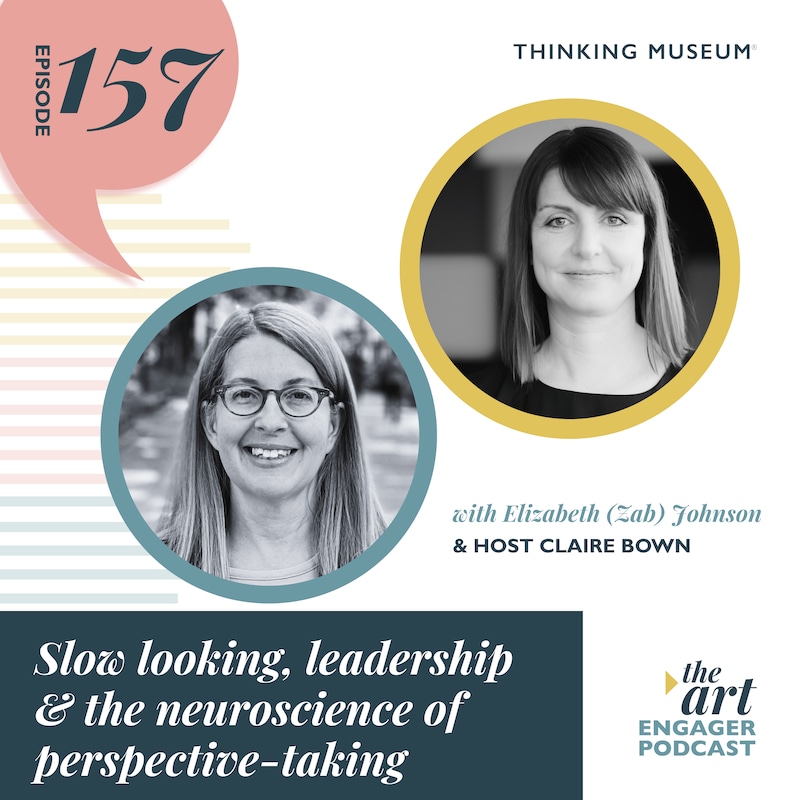
In this episode of The Art Engager, I’m talking with Dr Elizabeth (Zab) Johnson, Executive Director of the Wharton Neuroscience Initiative and a visual neuroscientist whose work explores the intersection of art, perception and leadership.
Zab’s research asks one key question: how does what we see guide our decisions, actions and behaviours? Her work combines neuroscience, visual perception and museum-based learning to show how what we see shapes how we think, communicate and lead.
At Wharton, Zab leads sessions for business executives that bring slow looking and perspective taking together — helping leaders strengthen empathy and communication through shared experiences of looking at art.
We talk about her journey from researching colour and form processing in the brain to designing slow art experiences that build leadership skills. You’ll hear why museums are ideal for practising perspective taking, what happens when groups spend an hour with a single artwork, and how slow looking in dialogue with others fosters deep learning and connection.
We also discuss the neuroscience behind these practices, the ‘no pointing’ rule, and why words like ‘obviously’ can shut down conversation.
This episode offers plenty to think about for anyone interested in how collective looking can enhance empathy, attention and leadership.
The Art Engager is written and presented by Claire Bown. Editing is by Matt Jacobs and Claire Bown. Music by Richard Bown.
✨ If you've enjoyed this episode, please consider supporting The Art Engager on Patreon: https://www.patreon.com/c/TheArtEngager
Or pick up a copy of my book, The Art Engager, for step-by-step guidance on creating meaningful, interactive guided experiences https://www.theartengager.com/
Buy it here on Amazon.com: https://tinyurl.com/buytheartengager
Episode Links
Visual Marketing: A Practical Guide to the Science of Branding https://www.routledge.com/Visual-Marketing-A-Practical-Guide-to-the-Science-of-Branding--Retailing/Kahn-Johnson/p/book/9781032731322
Dr Elizabeth (Zab) Johnson on LinkedIn: https://www.linkedin.com/in/elizabeth-johnson-phd-a3160932/
Wharton Neuroscience website:https://neuro.wharton.upenn.edu/
Transcripts
Hello and welcome to The Art Engager podcast with me, Claire Bown.
Claire Bown:I'm here to share techniques and tools to help you engage with your audience
Claire Bown:and bring art objects and ideas to life.
Claire Bown:So let's dive into this week's show.
Claire Bown:Hello and welcome to a new episode of The Art Engager.
Claire Bown:I'm Claire Bown, and today I'm chatting with Dr. Elizabeth Zab Johnson.
Claire Bown:We are talking about slow looking, perspective taking and the fascinating
Claire Bown:neuroscience of looking at art together.
Claire Bown:Now, one quick thing before we start.
Claire Bown:I started this podcast in 2021 thinking I'd make perhaps 25
Claire Bown:episodes, and here we are at over 150.
Claire Bown:Now creating each episode is pretty much a solo endeavor, and your support
Claire Bown:helps cover hosting, editing costs, research, and interview time, and helps
Claire Bown:to keep the podcast ad free for everyone.
Claire Bown:If you found this podcast helpful and would like to support what
Claire Bown:I do, you can become a friend of The Art Engager on Patreon.
Claire Bown:There are three different tiers to choose from with monthly support starting from
Claire Bown:less than the price of a cup of coffee.
Claire Bown:Thank you.
Claire Bown:Now let me introduce today's guest, Dr.
Claire Bown:Elizabeth Za Johnson is executive director of the Wharton Neuroscience Initiative
Claire Bown:and a visual neuroscientist whose research focuses on vision and visual behavior.
Claire Bown:Her work centers on a key question, how does what we see guide our
Claire Bown:decisions, actions, and behaviors?
Claire Bown:This drives everything from her research to her teaching to the
Claire Bown:museum sessions she leads for business executives at the Wharton School.
Claire Bown:Her journey into this work began during her doctoral research at
Claire Bown:New York University where she discovered that color and form are
Claire Bown:processed together in the brain.
Claire Bown:This finding led her to realize that visual artists were the original
Claire Bown:experimentalists with perception, and this sparked a passion for
Claire Bown:using art to reveal how we see.
Claire Bown:At Duke University, she co-created the neuro humanities in Paris program,
Claire Bown:experimenting with how museums could become spaces for learning
Claire Bown:about perception and cognition.
Claire Bown:At the Wharton School, she's extended this museum based
Claire Bown:approach to leadership development.
Claire Bown:She partners with institutions like the Barnes Foundation in
Claire Bown:Philadelphia, leading sessions where business leaders spend one hour with
Claire Bown:a single artwork in small groups.
Claire Bown:Her focus here is perspective taking an important leadership
Claire Bown:skill that research shows actually declines as people gain power.
Claire Bown:In today's conversation, we explore why museums provide the ideal space
Claire Bown:for practicing perspective taking.
Claire Bown:We explore what happens when business leaders spend an hour with a single
Claire Bown:artwork and the fascinating neuroscience behind collective slow looking.
Claire Bown:We discuss sabs ground rules, including why pointing is forbidden, and why words
Claire Bown:like obviously shut down perspective.
Claire Bown:Taking this episode is perfect if you want to understand the
Claire Bown:neuroscience of perspective taking.
Claire Bown:Are curious about how museums can develop critical leadership skills or
Claire Bown:are interested in what happens in the brain when groups look at art together?
Claire Bown:Enjoy.
Claire Bown:Hi, Zab and welcome to The Art Engager Podcast.
Zab Johnson:Hi, Claire.
Zab Johnson:Great to be with you.
Claire Bown:So could you start by explaining who you are and what you do?
Zab Johnson:Yes, absolutely.
Zab Johnson:So I'm Elizabeth Johnson, and I am the executive director of the
Zab Johnson:Wharton Neuroscience Initiative.
Zab Johnson:I am a visual neuroscientist and I do many, many things.
Zab Johnson:But one of the things that I hope we'll talk about today is is that I have long
Zab Johnson:led sessions in art museums and other museums for leaders and executives and
Zab Johnson:student learners at all different levels.
Zab Johnson:I use art as a way of giving insight into leadership into attention,
Zab Johnson:into perception, um, and into how we see and navigate through the world.
Claire Bown:Brilliant.
Claire Bown:And could you explain for the benefit of our listeners what the
Claire Bown:Wharton Neuroscience Initiative is, maybe their mission and the role?
Claire Bown:Yeah,
Zab Johnson:absolutely.
Zab Johnson:So the Wharton Neuroscience Initiative is a comprehensive research, educational
Zab Johnson:and engagement outreach center at the University of Pennsylvania at the Wharton
Zab Johnson:School, which is a business school.
Zab Johnson:And and our goal is to bring neuroscience brain science into direct application
Zab Johnson:within business in the hopes of making business actually more efficient, more
Zab Johnson:effective, and actually more humane.
Claire Bown:And we got in touch through a mutual friend and now
Claire Bown:colleague Sasha Igdalova, who is, a guest on episode 132 of the podcast.
Claire Bown:And she told me, oh, you need to talk to, Zav.
Claire Bown:She's my new colleague.
Claire Bown:And she's doing some amazing work.
Claire Bown:So maybe we could start right back at the beginning, and as you explained
Claire Bown:in your introduction, you're doing a range of things, super exciting work in
Claire Bown:the field of, uh, visual neuroscience.
Claire Bown:But you are also teaching marketing.
Claire Bown:You're taking business leaders into the museums.
Claire Bown:How does it all connect up?
Claire Bown:What's the thread running through your work?
Claire Bown:The thread really
Zab Johnson:is about how we see, how what we see guides our decisions,
Zab Johnson:our actions, our behaviors.
Zab Johnson:Um, this is sort of a passion point of both my, both, my research
Zab Johnson:and my engagement with with, people at all different levels.
Zab Johnson:I really think that one of the, one of the things that I realized early on in my
Zab Johnson:own neuroscience experience and education was that we take reality as a given.
Zab Johnson:And that's sort of in the realm of philosophy, but I really think that when
Zab Johnson:you understand how we see, you understand actually that cognition is both optimized
Zab Johnson:and challenged in interesting ways that we are always navigating through uncertainty.
Zab Johnson:And that how we interpret the world comes from our experiences
Zab Johnson:and knowledge with it.
Zab Johnson:So, um, so that's sort of the running thread.
Zab Johnson:And so when I teach, um, I teach a visual marketing class to, business
Zab Johnson:students and to others at the university.
Zab Johnson:Um, and it really is to bring that sort of awareness into the idea
Zab Johnson:of how the visual landscape can be both optimized and challenged.
Zab Johnson:Um, and so thinking about the ways that people interpret the world, whether
Zab Johnson:that's through packaging or advert um, and other kinds of communications you
Zab Johnson:know, it really does require something, some knowledge around visual cognition.
Claire Bown:Brilliant.
Claire Bown:And as museum people, we are really interested in the visual as well, so I
Claire Bown:see a great link there with your work.
Claire Bown:But I'd like to go back a, a few years and talk about your doctoral research
Claire Bown:because you discovered some really interesting things about color processing
Claire Bown:and that led you onto finding a passion for visual art and color as well.
Claire Bown:So can you talk a little bit about that?
Zab Johnson:Yeah.
Zab Johnson:So my doctoral research was really focused on the very early cortical
Zab Johnson:mechanisms of how we perceive color.
Zab Johnson:And this was actually using, non-human primate model, you know, they
Zab Johnson:share 98% of our brain constructs.
Zab Johnson:And allows you to sort of, see more of the inner workings, the inner
Zab Johnson:mechanisms, of how the brain is processing particular kinds of signals.
Zab Johnson:And one of the things that I discovered and was reinforced by work from
Zab Johnson:other researchers was that color and form were processed together.
Zab Johnson:And that is from the earliest sort of cortical areas of the brain that are
Zab Johnson:processing information about how we see.
Zab Johnson:And up until that point, people really had been in the field of
Zab Johnson:neuroscience, had been struggling with this idea that color seemed like a
Zab Johnson:separate feature from form and shape.
Zab Johnson:And and that never sat very well with me because I actually realized
Zab Johnson:that, um, that these things are, are quite tethered together.
Zab Johnson:And when I started to think about that construct, it actually
Zab Johnson:led me to this appreciation of visual art and visual artists.
Zab Johnson:Because I feel like through that discovery process, I began to actually see their
Zab Johnson:work in a completely different light.
Zab Johnson:And realized that they had been the empiricists, the sort of
Zab Johnson:experimentalists all along with color.
Zab Johnson:And so that, you know, many of the effects that neuroscientists were then
Zab Johnson:trying to scientifically ground had been explored and played with and experimented
Zab Johnson:on from the visual art perspective.
Zab Johnson:And so once you know that, then you realize that like edges really matter, you
Zab Johnson:know, that they fundamentally can change and shift the colors that we perceive.
Zab Johnson:And so of course, shape and form are and color are bound inextricably together.
Zab Johnson:And so that really led me to you know, from a person that wasn't
Zab Johnson:particularly like visually artistic, I'm a musician, not a visual artist and
Zab Johnson:but that led me to sort of navigate, I was in graduate school in New York.
Zab Johnson:And so I, I would go and visit museums and I, I was really captured by seeing,
Zab Johnson:you know, those works reflect some new understanding that I had from
Zab Johnson:my graduate work in the sciences.
Zab Johnson:Um, and that really, began a passion for that and a passion to bring
Zab Johnson:that kind of perspective to others.
Zab Johnson:so flash forward a few years and I was at Duke University and one of the
Zab Johnson:best experiences of my early life as an academic, was being able to take
Zab Johnson:students undergraduate students to Paris for the summer for a program that
Zab Johnson:was called Neuro Humanities in Paris.
Zab Johnson:And my section of that course was was about four weeks long, and I co-instructed
Zab Johnson:with an art historian, um, who was an academic curator at Duke's museum.
Zab Johnson:She still does that.
Zab Johnson:She directs the College of Worcester's Art Museum now.
Zab Johnson:And we co-instructed a section of that program called Art Vision and the Brain.
Zab Johnson:Um, and we spent the morning every day, of that month in the classroom
Zab Johnson:really learning the science and the different art historical approaches.
Zab Johnson:And then every afternoon the students would go to a different museum in Paris.
Zab Johnson:It was a really hard gig, as I like to say.
Zab Johnson:Like it's one of the things that I miss the most in my summers now
Zab Johnson:was the sheer joy of being able to bring students that were coming from
Zab Johnson:very different disciplines together.
Zab Johnson:to really explore that together And what an awesome playground that was
Zab Johnson:for them to have a deep dive into all of the art museums in Paris.
Zab Johnson:And we would then go on a trip to Provence, and they would see Suzanne's
Zab Johnson:studio and it would all sort of start to come together and, you know, and Van
Zab Johnson:Gogh's environment, they could really understand the influence of light and air
Zab Johnson:on the art that was produced at the time.
Zab Johnson:Could really think about the context and how that influenced the way
Zab Johnson:that people constructed and wanted to reflect, uh, aspects of visual
Zab Johnson:information in novel, new artistic ways.
Zab Johnson:So it was really one of the most fun things ever.
Zab Johnson:And co-instructing, of course, with someone from from an art history
Zab Johnson:background, when that really was not my background was just also such a
Zab Johnson:learning and growing experience for me.
Zab Johnson:Um, it really gave me a footing and even a vocabulary to really begin
Zab Johnson:to think from a new direction.
Claire Bown:So interesting.
Claire Bown:As you say, a complete joy and, not a hard gig to have at all.
Claire Bown:And you said to me, off air that you had been gravitating towards
Claire Bown:slow, looking long before people thought about it as a thing.
Claire Bown:So perhaps we can talk a little bit about that, because I know we
Claire Bown:also spoke about Jennifer Roberts.
Claire Bown:People listening may know Jennifer Roberts, the three hour long
Claire Bown:exercise that she makes her students do with one artwork.
Claire Bown:So perhaps you could talk a little bit about when you discovered slow
Claire Bown:looking, or do you feel it's always been a part of your approach?
Zab Johnson:I think it, it began in those graduate years, you know, which
Zab Johnson:for me was in like the late 1990s.
Zab Johnson:So this was definitely before slow looking was a termed thing.
Zab Johnson:And it was about my own experience of really having to take that time, that
Zab Johnson:extra time to, to think and reflect in place, in a museum setting, right?
Zab Johnson:About how my science informed and vice versa, this experience
Zab Johnson:of seeing visual art.
Zab Johnson:And what I realized very quickly, intuitively for me was that
Zab Johnson:although we often think that we perceive the world at a glance.
Zab Johnson:There is so much that's actually hidden from us.
Zab Johnson:And, nowadays I think we pay even less attention to things around us.
Zab Johnson:We're sort of more focused on, on very specific things like our smartphones and
Zab Johnson:other things as we walk through the world.
Zab Johnson:And as someone who also understands the mechanisms of attention, I
Zab Johnson:realized that like we are not, we're not passive, recorders of our visual
Zab Johnson:experience the way a camera is.
Zab Johnson:We are very actively processing and trying to determine and predict what might be
Zab Johnson:most relevant and interesting to us.
Zab Johnson:And what we do with our attention is to highlight the things that we have
Zab Johnson:pre-processed as being most relevant and interesting and suppress all the
Zab Johnson:rest of the information in the world.
Zab Johnson:And so we are sub sampling the world in a very profound way.
Zab Johnson:And I think when I realized that, then I realized that of course this
Zab Johnson:assumption of being able to extract information from how we see at a glance
Zab Johnson:was wrong and that there is a discovery process that has to unfold with time.
Zab Johnson:And that if you allow yourself more time, then your active process can extract
Zab Johnson:new, different information from the world around you, whether that's, when
Zab Johnson:you're on a walk outside or in a, one of these sort of laser focused viewing
Zab Johnson:experiences of looking at visual art.
Zab Johnson:And so that's really what began the process of, of understanding
Zab Johnson:the nuances of slow looking for me.
Zab Johnson:And when I found Jennifer Roberts' work, with this three hour exercise and her aha
Zab Johnson:moment, that students were experiencing something profoundly new, sometimes 20, 30
Zab Johnson:an hour, you know, into that experience, um, it really resonated with me.
Zab Johnson:And so our first dalliance with that formally was in the Paris program,
Zab Johnson:was asking our students individually.
Zab Johnson:To sit and spend an hour, not three hours, but an hour in
Zab Johnson:the Museum of Modern Art there.
Zab Johnson:And watching that process unfold for them and realizing that they would
Zab Johnson:come back and say, well, we thought that this was going to be really hard.
Zab Johnson:But by minute 20, I had discovered this whole new relationship with
Zab Johnson:the artwork that I had chosen.
Zab Johnson:And now I can tell you many more of the details about it and the
Zab Johnson:connections that it made to me, both personally and academically.
Zab Johnson:And then I began to think about a modification of that, which
Zab Johnson:is what happens as other minds come together in dialogue.
Zab Johnson:And I think that's one of the things that hasn't really been well documented
Zab Johnson:or studied is the role of how social communication might actually unlock a
Zab Johnson:whole new dimension of slow looking.
Claire Bown:Yeah.
Claire Bown:And, in that article about the power of patients with Jennifer
Claire Bown:Roberts, she calls it a, a painful experience, the three hours.
Claire Bown:But I think also that kind of individual aspect of the
Claire Bown:looking, it can be much harder.
Claire Bown:It can feel longer.
Claire Bown:And when you get together with others, it feels as though the process is easier.
Claire Bown:There's some kind of flow that happens to it, and there's all sorts
Claire Bown:of things that we can note as well.
Claire Bown:I can note anecdotally, and I think you are researching this as well, what
Claire Bown:happens when groups get together and they spend time looking at visual art?
Claire Bown:But it's so, so interesting, isn't it, seeing what happens when you have a group
Claire Bown:of people who may or may not know each other, discussing visual art together
Claire Bown:in the museum environment over time.
Zab Johnson:Yeah.
Zab Johnson:It's been a profound experience for me as an educator to watch that
Zab Johnson:unfold and to watch it unfold for people at all different ages and
Zab Johnson:all different levels of experience or non-experience with visual art.
Zab Johnson:I think it's just incredibly powerful actually.
Zab Johnson:So, so I've become a, a true believer in it as as something that we should all do.
Zab Johnson:And I think, much like what Jennifer Roberts says, we really
Zab Johnson:do need to instill in young people, you know, this idea of patience.
Zab Johnson:And how better to do that than through an active discovery process that actually
Zab Johnson:can be quite engaging once you relinquish some of the baggage or the, predisposition
Zab Johnson:to think that this is going to be boring or painful or, uncomfortable.
Zab Johnson:And I have actually seen that in the business execs that I take
Zab Johnson:into these experiences as well.
Zab Johnson:I always query each group, like, how many people think that this
Zab Johnson:is going to be impossible to spend an hour with an artwork?
Zab Johnson:And I think one of the most incredible experiences that I have witnessed
Zab Johnson:is that all of them in this social environment say time just flew
Zab Johnson:in a way that they didn't expect.
Zab Johnson:And that rather surprised them and that they found, you know,
Zab Johnson:was just an incredibly unlocking experience and not a painful, boring
Zab Johnson:academic, uh, experience at all.
Claire Bown:And, I would say also I've experienced the same thing taking
Claire Bown:groups of, teams from business and corporate world into the museums.
Claire Bown:Could you tell us a little bit about how your work started with
Claire Bown:business leaders in art museums?
Claire Bown:Why did you want to focus on this audience?
Claire Bown:And how is it set up?
Zab Johnson:So I'm in a business school and I'm educating future business leaders.
Zab Johnson:And Wharton actually has a very longstanding lifelong
Zab Johnson:learning program for executives.
Zab Johnson:And so there are many kinds of engagements that one can do within the school to, just
Zab Johnson:reach and do education for all different levels, including lifelong learners.
Zab Johnson:And so to me it was a natural extension of having taken, even
Zab Johnson:high school undergraduates, graduate students into these kinds of
Zab Johnson:experiences to think about lifelong learners as well in that construct.
Zab Johnson:And so, I think that the hardest part of the whole process was collaborating
Zab Johnson:with the local institutions here in Philadelphia, because of course, you know,
Zab Johnson:who am I, I'm just this neuroscientist that serves as this executive director of
Zab Johnson:a research center at a business school.
Zab Johnson:And many of the conversations in the beginning, or many of my emails, to these
Zab Johnson:relevant people, you know, was trying to introduce myself, trying to give a bit
Zab Johnson:of my background, including, all of those past experiences that I'd had while at
Zab Johnson:Duke University and and teaching in Paris.
Zab Johnson:And, as those things worked there, there were just some assumptions I think being
Zab Johnson:made about what I was asking to do.
Zab Johnson:And so there was some reluctance, you know, that I wasn't a docent that I
Zab Johnson:hadn't been trained, that I didn't come from that particular pedagogical
Zab Johnson:perspective et cetera, et cetera, that, that tours were forbidden.
Zab Johnson:And I had to keep explaining, oh no, I'm not trying to lead tours.
Zab Johnson:So I think that was the challenge number one.
Zab Johnson:And my breakthrough finally happened, um, when I finally made
Zab Johnson:contact with the director of adult education at the Barnes Foundation.
Zab Johnson:Here in Philadelphia.
Zab Johnson:And of course once we had a conversation, he realized that my method sort of
Zab Johnson:organically had developed very similarly to the Barnes pedagogy, in that.
Zab Johnson:And once that understanding came through, then we began to really collaborate
Zab Johnson:and learn from each other as well.
Zab Johnson:So that's how it began.
Zab Johnson:And I would say that yeah, being, being at Wharton now and having
Zab Johnson:these relationships with now a number of amazing art institutions
Zab Johnson:within the city, it has really grown.
Zab Johnson:And I think now even on the business school side, they now understand what
Zab Johnson:this sometimes unlocks for leaders and executives at different levels.
Zab Johnson:And we can maybe talk a little bit more about that specifically.
Zab Johnson:Yeah,
Claire Bown:absolutely.
Claire Bown:And before we talk about that, a little bit about how the the sessions are set up.
Claire Bown:So do you take people from one team, one organization, or are
Claire Bown:they from multiple organizations?
Claire Bown:How do you choose the artworks?
Claire Bown:How long are the sessions?
Claire Bown:All those kind of practical details that I think listeners might be interested in.
Zab Johnson:Yes.
Zab Johnson:So I lead sessions within open enrollment programs.
Zab Johnson:Those are open to anyone.
Zab Johnson:And so those are often just an assortment of different kinds of people with
Zab Johnson:very different kinds of roles at their businesses, or even just people that have
Zab Johnson:a personal interest in their own lifelong learning as, as well as custom programs.
Zab Johnson:So Wharton has both those kinds of programs.
Zab Johnson:And I am enlisted within that scope, in both of those contexts.
Zab Johnson:And so sometimes for very specific groups and sometimes they're not.
Zab Johnson:And the way that I have usually or, orchestrated my exercise is
Zab Johnson:to have some classroom learning that helps to ground the approach.
Zab Johnson:And I often ground that in the science of perspective taking
Zab Johnson:and the assumptions that we make.
Zab Johnson:And as a visual neuroscientist, I have lots of examples that I can
Zab Johnson:use that that I think very quickly are understandable that we do
Zab Johnson:leap to assumptions very quickly.
Zab Johnson:Everything from, you know, by stable illusions like the like the base illusion.
Zab Johnson:I mean, there are better examples of those.
Zab Johnson:Um, but even like seeing patterns from, you know, noisy or really ambiguous
Zab Johnson:kinds of stimuli, I always say visual neuroscientists always have a lot of these
Zab Johnson:kinds of visual illusions up their sleeve.
Zab Johnson:Not because it makes them popular at parties, but because they actually
Zab Johnson:give real insight into the shortcuts, the cognitive shortcuts that we make.
Zab Johnson:All the time, rather than being these sort of one-off visual tricks
Zab Johnson:they teach us something about how we actually are processing the world in
Zab Johnson:real time, you know, all the time.
Zab Johnson:But those are very useful because people can see something
Zab Johnson:change right before their eyes.
Zab Johnson:And so there's usually a classroom portion.
Zab Johnson:And then we head into the galleries.
Zab Johnson:And my usual guide is that groups will be in small teams of about
Zab Johnson:three individuals per team.
Zab Johnson:They can choose the artwork.
Zab Johnson:I don't prescribe it for them, but I ask them to stay in a local area
Zab Johnson:just so that I don't have to find everyone throughout the museum.
Zab Johnson:And then I have written instructions and they spend an hour with an about
Zab Johnson:an hour with an artwork in teams looking on their own in the beginning.
Zab Johnson:And then in dialogue with one another.
Claire Bown:So they have an hour with one artwork.
Claire Bown:It's self-selected within their groups of three.
Claire Bown:And then they have written instructions, which are a mixture
Claire Bown:of individual looking to start with.
Claire Bown:And then they go into some group discussions about the artwork.
Claire Bown:And you mentioned the word perspective taking there, and I know
Claire Bown:super important to these sessions.
Claire Bown:So perhaps we could, first talk about what perspective taking is.
Claire Bown:We do talk about it a fair amount on this podcast.
Claire Bown:But just if we start with a simple explanation for listeners who might
Claire Bown:not be familiar with the term.
Zab Johnson:So, so perspective taking, of course is seeing the world
Zab Johnson:through someone else's eyes, right?
Zab Johnson:So what we have to do in that capacity is to don someone else's or our assumptions
Zab Johnson:about someone else's knowledge, experience and beliefs about the world.
Zab Johnson:Now there are some layers in there to unpack but it's sort of
Zab Johnson:taking one's own expertise and one's own knowledge out, right?
Zab Johnson:And being able to think through how someone else might
Zab Johnson:be experiencing something.
Zab Johnson:That's one way of thinking about perspective taking.
Zab Johnson:And there are nuances there that I highlighted.
Zab Johnson:There are many assumptions that we make about other people.
Zab Johnson:And, uh, and I always say that there are three critical
Zab Johnson:aspects of perspective taking.
Zab Johnson:One is to shed your own beliefs, um, in order to be able to embody
Zab Johnson:the mindset of someone else.
Zab Johnson:The second is is to take a beginner's eye, right?
Zab Johnson:To just to think through that process pretty concretely.
Zab Johnson:And the third is that it's really important to actually ask people
Zab Johnson:what their perspectives are.
Zab Johnson:So, because otherwise again, we make these assumptions that we can jump
Zab Johnson:into another person's experiences, um, which isn't always the case.
Zab Johnson:And so it's always good to, to ground our own assumptions by checking to make
Zab Johnson:sure our perspectives when we're doing perspective taking is a better reflection.
Zab Johnson:There are always gonna be assumptions and there will always be a lack of direct
Zab Johnson:knowledge of someone else's experiences and knowledge and memories and emotions.
Zab Johnson:But that's, the most critical, I think part of perspective taking.
Claire Bown:And it's, it's incredibly hard for us to do, isn't it?
Claire Bown:To not place ourselves at the center and to try and see something
Claire Bown:through someone else's eyes.
Claire Bown:So, when we talk about perspective taking, quite often we talk about it as
Claire Bown:a skill and it's something that we can practice and improve with effort and time.
Zab Johnson:Yes, that's right.
Zab Johnson:I mean, it, it is one of the core concepts of our social cognition, right?
Zab Johnson:And what we know about social cognition is that about half of
Zab Johnson:that comes from your genetics.
Zab Johnson:So half of that is what you inherit from your family.
Zab Johnson:But that leaves a lot of room for practice and doing other
Zab Johnson:things to really reinforce it.
Zab Johnson:And you can really lose it.
Zab Johnson:So I often say that perspective taking is like a muscle, social
Zab Johnson:cognition is like a muscle.
Zab Johnson:You have to use it or you will lose it.
Zab Johnson:and what we know from the science is that as you rise in your subjective
Zab Johnson:perception of your own social standing in the world, you're less
Zab Johnson:likely to take others' perspective.
Zab Johnson:And so it is our leaders and people who are at the top that
Zab Johnson:we have to really insist, do more practice in perspective taking.
Zab Johnson:And it is in essence what allows us to be more empathetic to to understand
Zab Johnson:others' experiences, and even to avoid common mistakes about layering
Zab Johnson:our own only experiences about the world onto the idea that others will
Zab Johnson:have exactly that same experience.
Claire Bown:So, having power actually decreases your perspective taking
Claire Bown:ability if you're not using it, correct?
Claire Bown:Yeah.
Claire Bown:So as people gain power, they become less, perhaps attuned to other
Claire Bown:people's viewpoints and they're not seeking out as a practice per se.
Claire Bown:That's
Zab Johnson:correct.
Zab Johnson:And I mean, it's sort of intuitive in a way, but of course this is
Zab Johnson:subjective self-report, right?
Zab Johnson:So that's very important is that you can of course get people who have a lot of
Zab Johnson:power who are still great at this, right?
Zab Johnson:But it is a pitfall , that can be fallen into, and in a sense, it makes sense for
Zab Johnson:us as social creatures to have to navigate more social complexity when we're lower
Zab Johnson:in social standing or power standing.
Zab Johnson:So we are already trying to integrate what people's motivations and
Zab Johnson:expectations are about the world.
Zab Johnson:And then as we rise, we can make more and more assumptions rather
Zab Johnson:than try to embody that ourselves.
Zab Johnson:And so the risk is that as you rise up in a hierarchy that you're
Zab Johnson:not practicing it as as much.
Claire Bown:And so, my next question is gonna be why art museums?
Zab Johnson:So, two reasons.
Zab Johnson:One is that it is neutral.
Zab Johnson:So this is not a normal business context.
Zab Johnson:These are not a normal business experience.
Zab Johnson:And so it's a neutralizer.
Zab Johnson:So with the rare exception of someone who has a very formal background
Zab Johnson:in art history and visual art most people in this landscape, business
Zab Johnson:leaders are quite inexperienced on the formal level of really doing deep
Zab Johnson:looking and and discussing art, right?
Zab Johnson:There are of course business leaders that are, you know, very fond art collectors
Zab Johnson:and all the rest but even there, right?
Zab Johnson:I think that that tends to not be a ubiquitous binding.
Zab Johnson:Um, and so it is an environment where everyone can take a beginner's eye.
Zab Johnson:So that's one reason that I think it's particularly effective.
Zab Johnson:And the second reason is that unlike abstract ideas.
Zab Johnson:During this kind of perspective taking exercise, people can
Zab Johnson:literally see something shift right in front of their eyes.
Zab Johnson:And and it doesn't matter whether the art is representational or abstract, right?
Zab Johnson:Actually the category doesn't really matter.
Zab Johnson:And, uh, you can even use archeological objects, right?
Zab Johnson:But when you get new information about something, whether that's through
Zab Johnson:time or through dialogue with others, you can suddenly understand that
Zab Johnson:you can see it in a different way.
Zab Johnson:Some new information emerges.
Zab Johnson:And when I think you have that approach from.
Zab Johnson:A business lens or a business challenge lens, it is mostly abstract.
Zab Johnson:You don't necessarily see that change right in front of your eyes.
Zab Johnson:Of course.
Zab Johnson:Like I have an exercise in my visual marketing class where they do slow
Zab Johnson:looking with an advertisement.
Zab Johnson:So there are ways to do it in those contexts as well.
Zab Johnson:But you know, in that case, you know, I'm using an advertisement as
Zab Johnson:equivalent actually to visual art.
Zab Johnson:Right.
Zab Johnson:As that process for slow looking.
Zab Johnson:So, so those are the two main reasons why I find it particularly useful
Zab Johnson:to do this in a museum context.
Claire Bown:Yeah.
Claire Bown:And there's maybe something about.
Claire Bown:Stepping out of your own environment, as you say.
Claire Bown:Um, we know there's a change in atmosphere as people enter a museum anyway, but
Claire Bown:entering a museum and doing an exercise would be very different to doing it
Claire Bown:in your boardroom or, you know, going to a training day going to an offsite.
Claire Bown:Yeah, and I think if we're thinking about visual art as well, and as you said, this
Claire Bown:can be applied to objects as well, you know, archeological, historical objects.
Claire Bown:So why is visual art particularly effective for revealing how we see,
Claire Bown:you know, what makes it different from other ways of learning about perception?
Zab Johnson:So I mean, I think one of the things is that it very quickly
Zab Johnson:reveals that we make very quick snap decisions about the information
Zab Johnson:that's being presented in front of us.
Zab Johnson:And so oftentimes through the process, I'll give an example.
Zab Johnson:Someone will say, well, you know, the boy in the left corner, and one of the
Zab Johnson:people might say, 'oh, is that a boy?'
Zab Johnson:And suddenly you're now observing new features, right?
Zab Johnson:And trying to reconcile whether your assumption was an assumption and
Zab Johnson:whether you have enough evidence for it.
Zab Johnson:And you have the perceptual aspect of that unfolding in real time.
Zab Johnson:So again, it can be as abstract and objective as it can be more subjective
Zab Johnson:and more layered with, you know, our expectations around objects and labels.
Zab Johnson:And so I think that's one of the powers of visual art is that you have the
Zab Johnson:stimulus in front of you that is, you know, not actually representational,
Zab Johnson:completely representational.
Zab Johnson:And of course, what we know is that like as you go out into the quote unquote
Zab Johnson:real world, it's exactly the same.
Zab Johnson:They're exactly the same assumptions that we make about
Zab Johnson:how we're extracting information.
Zab Johnson:And but visual arts sort of helps condense that in a very
Zab Johnson:quick kind of learning lesson.
Zab Johnson:I think.
Claire Bown:Yeah, and I completely agree when I do, um, exercises in workshops
Claire Bown:in getting people to look at photographs and artworks or objects for a number
Claire Bown:of seconds and a number of minutes, and really thinking about what they saw
Claire Bown:and what they noticed when they were doing that on their own and what they
Claire Bown:saw and what they noticed when they were doing that with others, and really
Claire Bown:getting them to reflect on how they see.
Claire Bown:And what's quite astonishing is the insights people come back with, oh,
Claire Bown:I didn't notice that person halfway up the stairs until this moment.
Claire Bown:So yes, I've seen exactly the same thing unfolding in, in real time.
Claire Bown:And then there's this and you use this lovely phrase, the consortium of others'
Claire Bown:minds when we spoke off air as well.
Claire Bown:So, could you talk a little bit about that?
Claire Bown:'cause I thought that was fascinating.
Zab Johnson:Yeah.
Zab Johnson:I think I think that there has been only a very recent kind of exploration around how
Zab Johnson:others' minds work together with your own.
Zab Johnson:And so from the neuroscience perspective, I'm really fascinated by that.
Zab Johnson:Um, mostly because we really don't, we don't have a lot
Zab Johnson:of understanding about that.
Zab Johnson:We have more fun, fundamental understanding about how, one brain
Zab Johnson:processes information and makes decisions and acts but actually as
Zab Johnson:social animals there's a real relevance to how others minds influence ours.
Zab Johnson:And there's such a tremendous amount of work now coming out about how this
Zab Johnson:alters communication and cooperation and competition and human social interactions
Zab Johnson:that I think is so fundamental to who we are and how we experience the world.
Zab Johnson:That's just one of the areas of, of work that I'm just really keen to,
Zab Johnson:to learn as much as I can about as both a researcher and as someone
Zab Johnson:who, you know, reads other works.
Claire Bown:Yeah.
Claire Bown:And I think again, thinking about how that happens with groups as well, um,
Claire Bown:and seeing people, you know, as we talked about getting that joy of discovering
Claire Bown:things together and feeling that there are all sorts of perspectives in the
Claire Bown:room other than their own, literally from where people are standing and
Claire Bown:looking at things, but the other perspective of they're bringing their own
Claire Bown:thoughts, their ideas, their experiences to their looking at this artwork.
Claire Bown:And that's sometimes like a light bulb going off in people's
Claire Bown:heads when they realize that.
Zab Johnson:That's right.
Zab Johnson:And I think it's very clear.
Zab Johnson:Through this practice, right, of slow looking in dialogue with one another.
Zab Johnson:That you come to recognize that others have unique mental states, right?
Zab Johnson:Beliefs, desires, knowledge, emotions intentions that might
Zab Johnson:profoundly differ from our own.
Zab Johnson:And how that can actually be celebrated.
Zab Johnson:And how that can actually be at a human advantage, right?
Zab Johnson:That's at the root sometimes of what we call our most creative,
Zab Johnson:aha, eureka moments, right?
Zab Johnson:Is that someone else's knowledge can shift how we think and interpret
Zab Johnson:something in a profound way that can lead to breakthrough discovery, right?
Zab Johnson:And I often think about that.
Zab Johnson:As we are, embarking on this new relationship with ai, right?
Zab Johnson:Uh, is, is really like how others' minds working together has been less recognized
Zab Johnson:actually as being , a fundamental part of any discovery, human discovery process.
Zab Johnson:And really we should know much more about it.
Claire Bown:Yeah, absolutely.
Claire Bown:Um, I'd love to move on and talk about your rules.
Claire Bown:So you have some guidelines, um, which I think are really interesting for
Claire Bown:your sessions and will be interesting for listeners to, to talk about too.
Claire Bown:So, can you talk about your ground rules for how these sessions are approached?
Zab Johnson:So, yes one of my ground rules is no pointing.
Zab Johnson:And of course, you know, gesticulating and using hands as
Zab Johnson:part of your emphasis is fine.
Zab Johnson:But I have a particular aversion to pointing.
Zab Johnson:Because that pointing actually assumes that others see out of your eyes.
Zab Johnson:And even though it's a shortcut.
Zab Johnson:And it's hard actually to navigate just using words.
Zab Johnson:So instead of pointing, it's fundamentally important when you're
Zab Johnson:trying to emphasize the nature of perspective taking and dialogue.
Zab Johnson:And so no pointing.
Zab Johnson:It also makes all of the museums security people very nervous, so Exactly.
Zab Johnson:With the art at risk, especially if people are holding pencils, I
Zab Johnson:mean, that's even worse, right?
Zab Johnson:And so that ground rule, what I tell people is that, you know, if they
Zab Johnson:catch their teammates doing that, they can deduct virtual points from it.
Zab Johnson:And so they become their own, moderators of pointing behaviors.
Zab Johnson:And many people realize how much they have relied on pointing.
Zab Johnson:And I want people to actually understand that.
Zab Johnson:It's hard to say, you know, that little green blob of paint in the
Zab Johnson:upper right corner is a lot of words.
Zab Johnson:But again, helps everybody make sure that they're confirming that they're
Zab Johnson:looking at exactly the same thing and, you're not trying to have them
Zab Johnson:only look from your perspective.
Zab Johnson:That's number one.
Zab Johnson:Um, and the other ground rules is that I say that you cannot say the
Zab Johnson:words 'clearly', or 'obviously'.
Zab Johnson:Or 'of course', even though sometimes I say that in the dialogue,
Zab Johnson:because those are negating words.
Zab Johnson:Those make assumptions that what is clear and obvious to you is clear
Zab Johnson:and obvious to everybody else.
Zab Johnson:I actually think that those words should just be struck
Zab Johnson:from our communication practice.
Zab Johnson:And I think once, you know, again, when I, because I have access to business
Zab Johnson:leaders, when I say that, they realize how much that's been layered into their own
Zab Johnson:memos, into their own communications with their own teams, their own organizations.
Zab Johnson:And really how much that is, layered in this idea of the
Zab Johnson:assumptions that one has about.
Zab Johnson:Whether these things are obvious and intuitive to everyone around them,
Zab Johnson:which of course most things aren't.
Zab Johnson:And I emphasize that as a business learning that, again, like to just
Zab Johnson:even think about how, how you use those words, right, when you use those
Zab Johnson:words and again they police themselves.
Zab Johnson:And it's sort of a beautiful thing to watch groups you know, struggle
Zab Johnson:with how language is so profoundly influential on how we assume other states.
Claire Bown:Yeah, I think, language is, is so powerful.
Claire Bown:And those words that obviously, and clearly they can so often
Claire Bown:shut down conversation from other members of the group.
Claire Bown:They almost make you wince when you hear them because it's such a firm
Claire Bown:statement of someone's perspective.
Claire Bown:Um, and the pointing thing yes.
Claire Bown:Of course it makes museums nervous, but I think also there's there's a
Claire Bown:real skill in being able to observe and describe something in such a
Claire Bown:way that another person can see clearly what you are referring to.
Claire Bown:And I think that really helps us develop our descriptive language, and there are
Claire Bown:all sorts of other reasons why, observing and describing is such an important
Claire Bown:skill that we tend to kind of lose.
Claire Bown:I think as we get older as well, we fall back on things like
Claire Bown:pointing and gesticulating.
Claire Bown:So super interesting.
Claire Bown:Ground rules and what do you generally observe happening during the sessions?
Claire Bown:You mentioned time right at the very beginning, and I'd love to talk a little
Claire Bown:bit about that because I've observed similar things in my sessions, but Yes.
Claire Bown:What typically happens.
Zab Johnson:So I first ask them to note the first five things that they
Zab Johnson:first notice, uh, independently.
Zab Johnson:So to take a slow look around one or two minutes, just to note those things down.
Zab Johnson:And then to begin to share with one another.
Zab Johnson:In turn taking, I think it's really important to have turn taking because
Zab Johnson:you can always, in, even in small groups, have people who like to
Zab Johnson:manipulate, be the prime speaker.
Zab Johnson:And of course this is all on perspective.
Zab Johnson:And so I wanna try to help balance that as much as possible.
Zab Johnson:And then I ask them to go sort of a, sort of a critique.
Zab Johnson:Did they all identify the same things?
Zab Johnson:Did they, did anybody notice something different?
Zab Johnson:And so that begins a conversation.
Zab Johnson:And then I ask them to take a, another deep look for several minutes.
Zab Johnson:And think through, some additional layers, layers to that.
Zab Johnson:And then come and then again, take turns.
Zab Johnson:You know, share an open question that one of them has.
Zab Johnson:I think this is really important, this question idea rather than knowledge.
Zab Johnson:I know I have the evidence for this instead.
Zab Johnson:It is this idea of how to stay curious how to again, proceed as
Zab Johnson:if one can learn something new.
Zab Johnson:And so that's how that sort of ground gets started.
Zab Johnson:And then to really begin to discuss amongst the group, whether they've all
Zab Johnson:been very interpretive or more objective.
Zab Johnson:Are they, you know, who in the group is sort of highlighting things that are
Zab Johnson:more like lines and edges and contours and color versus, someone who is like
Zab Johnson:diving right deep into, you know, the emotions or the artistic intent and
Zab Johnson:to recognize that different people are approaching that quite differently.
Zab Johnson:And maybe people, some people are right in the middle, highlighting both.
Zab Johnson:And again, rather than prescribing how people should look I let
Zab Johnson:that sort of unfold naturally.
Zab Johnson:And then and then, they just go on to keep being in conversation.
Zab Johnson:So one of the things that emerges very quickly is that they enjoy it,
Zab Johnson:that there's this discovery process.
Zab Johnson:And as we talked about before that, that there's almost a flow state
Zab Johnson:that happens that has something to do with the consortium of others' minds
Zab Johnson:coming together in a discovery process where you are integrating brand new
Zab Johnson:evidence into your own perceptions and knowledge and experiences and real time.
Zab Johnson:And that's can be very profoundly expansive.
Zab Johnson:You have to decide whether you agree or you disagree.
Zab Johnson:You have to decide whether you're integrating or changing your mind.
Zab Johnson:And that process, I think is, is actually one that is what
Zab Johnson:human cognition is all about.
Zab Johnson:And so I think that that is, one of the reasons, I don't have the
Zab Johnson:scientific evidence for it yet, but it's hard to measure flow states
Zab Johnson:in real time in a group dialogue of of the experience, right?
Zab Johnson:We can ask people about their perceptions of time afterwards.
Zab Johnson:But that's rather limited because you're not in the moment, right?
Zab Johnson:Yeah.
Zab Johnson:Um, and so I think, that there is that process that unfolds.
Zab Johnson:And I think it's joyous actually because of the discovery about new knowledge.
Zab Johnson:We love seeking new knowledge.
Zab Johnson:And so when we have that, and even if we have assumed that we should know it
Zab Johnson:all right, within 20 seconds, what I think the participants understand very
Zab Johnson:quickly is that's not at all the case.
Zab Johnson:And I always remind them that like, wouldn't an artist love to have the
Zab Johnson:knowledge that someone was willing to invest an hour with their artwork?
Zab Johnson:I mean, it's amazing.
Zab Johnson:And the other thing that I have witnessed is that people will then
Zab Johnson:go back to those artworks as if they're old friends, their favorites.
Zab Johnson:That there's even more to discover and to discover with other people
Zab Johnson:rather than being done, you know, like, okay, checked that box
Zab Johnson:moving on to the next new stimulus.
Zab Johnson:Right?
Zab Johnson:And I think that that process is also such an important one in this
Zab Johnson:landscape where we're inundated with visual information all of the time.
Zab Johnson:And there's this idea that capturing attention needs to
Zab Johnson:be about novelty and newness.
Zab Johnson:And that there is fundamentally still things that we can discover
Zab Johnson:through getting to know the environment that we're being part of.
Zab Johnson:Right.
Zab Johnson:And I think that's one of the powerful lessons that people
Zab Johnson:take out of those gallery spaces.
Claire Bown:And so powerful as well.
Claire Bown:And, um, a really positive message.
Claire Bown:I think when we are bombarded with messages about the fracturing of attention
Claire Bown:spans and short form videos and all sorts of things, the fact that we have groups
Claire Bown:of people who are initially perhaps skeptical about being able to spend an
Claire Bown:hour with an artwork, as you said, and then finding that not only time goes
Claire Bown:fast with the process, but they really enjoy it and then possibly may even
Claire Bown:go back to the artworks afterwards.
Claire Bown:I mean, yeah, I've witnessed all of these things as well in my sessions.
Claire Bown:And I'm really fascinated about this time question.
Claire Bown:Time does seem to behave differently during slow looking,
Claire Bown:during these types of sessions.
Claire Bown:Do you have any explanations why people feel that?
Claire Bown:Is it because of engagement?
Zab Johnson:I think that engagement is part of it.
Zab Johnson:I think that you lean in, right?
Zab Johnson:And so we know, we know something about the brain activity of people
Zab Johnson:as they become engaged, right?
Zab Johnson:Versus disengaged.
Zab Johnson:And I am guessing , we haven't yet measured it, but one could
Zab Johnson:see how engagement is shifting, during a session like this.
Zab Johnson:And I know this is of interest and can be actually more practically done,
Zab Johnson:within the museum context by scientists.
Zab Johnson:The other thing I think is something that is just emerging in the brain science
Zab Johnson:literature around neural synchrony.
Zab Johnson:And so this is this powerful aspect of of brain resonance when groups,
Zab Johnson:teams of people come together.
Zab Johnson:And I think that there is likely to be a shared experience that leads to
Zab Johnson:more neural synchrony where essentially your brains and your bodies, because
Zab Johnson:this percolates down to respiration, heart rate, all of the other kinds of
Zab Johnson:physiological, signals of sharing minds.
Zab Johnson:And we know from some of the research that this is what happens when people have
Zab Johnson:a shared understanding and perhaps are, coming together to, to discover and learn
Zab Johnson:something new, uh, cooperate, et cetera.
Zab Johnson:And so I suspect that we would also see this kind of neural signature
Zab Johnson:or even physiological synchrony emerging over this process as well.
Claire Bown:Super interesting.
Claire Bown:So tell us about what you're hoping to research in the future around this.
Zab Johnson:So I'm working together.
Zab Johnson:Sasha Igdalova is now here as a postdoc working with me and
Zab Johnson:Katherine Kora and James Pawelski.
Zab Johnson:And we are really thinking about this aspect of human
Zab Johnson:flourishing through visual arts.
Zab Johnson:And thinking about how putting more concrete research measures into the
Zab Johnson:idea of, especially around social slow looking we have these intuitions
Zab Johnson:that there is something profoundly different about that experience
Zab Johnson:from even independent slow looking.
Zab Johnson:And from the sort of normal viewing experience where, where people might spend
Zab Johnson:only a few seconds with the each artwork.
Zab Johnson:And so now we're trying to quantify that.
Zab Johnson:The beginnings of that project are more focused around survey instruments,
Zab Johnson:asking people about their experiences.
Zab Johnson:And then the hope is that we can go into these more physiological kinds of
Zab Johnson:constructs once we understand a little bit more about how these experiences
Zab Johnson:might actually differ from one another.
Zab Johnson:So that's what we're up to next.
Zab Johnson:So
Claire Bown:exciting.
Claire Bown:So, I should wrap up.
Claire Bown:But where can people find out more about your work?
Zab Johnson:So, a number of different ways.
Zab Johnson:Most of my work is, is done through my work channels, but
Zab Johnson:people can follow me on LinkedIn.
Zab Johnson:I do post things there and of course, please follow the work of
Zab Johnson:the Wharton Neuroscience Initiative.
Zab Johnson:I think that, that all the time we are trying to put out information
Zab Johnson:that I think matters to people.
Zab Johnson:We want more people to understand how their own brains guide their
Zab Johnson:own behaviors, actions, decisions.
Zab Johnson:And so this shouldn't just be in the realm of when things go awry for their brains.
Zab Johnson:And is a sort of a celebration of how we wanna empower people to
Zab Johnson:understand and be encouraging of neuroscience's application writ large.
Zab Johnson:So you can join our general mailing list and follow our work and and also come to
Zab Johnson:our website and I think that there will be a few articles around these kinds
Zab Johnson:of ideas of perspective taking that we can share with listeners as well.
Claire Bown:Fabulous.
Claire Bown:Well, I'll put all the links in the show notes.
Claire Bown:That just leaves me time to say thank you so much, Zab, for coming on the podcast
Claire Bown:and sharing all your wonderful knowledge.
Claire Bown:Thank you.
Zab Johnson:Thank you.
Zab Johnson:It's been really fun.
Claire Bown:So a huge thank you to Zab for being on the show today.
Claire Bown:You can find out more about zab and the Wharton Neuroscience Initiative at their
Claire Bown:website, or follow zab on LinkedIn.
Claire Bown:Go to the show notes for all the relevant links for today's episode.
Claire Bown:If you've enjoyed this episode, or if any of our previous episodes
Claire Bown:have helped you in your work, please consider supporting The Art Engager.
Claire Bown:You can become a friend of the podcast on Patreon, or you can pick up a copy
Claire Bown:of my book, The Art Engager Reimagining Guided Experiences in Museums.
Claire Bown:Available now, wherever you buy your books.
Claire Bown:That's it for today.
Claire Bown:Thank you so much for joining us.
Claire Bown:See you next time.
Claire Bown:Thank you for listening to The Art Engager podcast with me, Claire Bown.
Claire Bown:You can find more art engagement resources by visiting my website,
Claire Bown:thinking museum.com, and you can also find me on Instagram at Thinking
Claire Bown:Museum, where I regularly share tips and tools on how to bring art
Claire Bown:to life and engage your audience.
Claire Bown:If you've enjoyed this episode, please share with others and subscribe to the
Claire Bown:show on your podcast player of choice.
Claire Bown:Thank you so much for listening, and I'll see you next time.


