Shownotes
Even with Ken Burns and Don Henley attached, funding a PBS documentary is brutal. So what hope do the rest of us have?
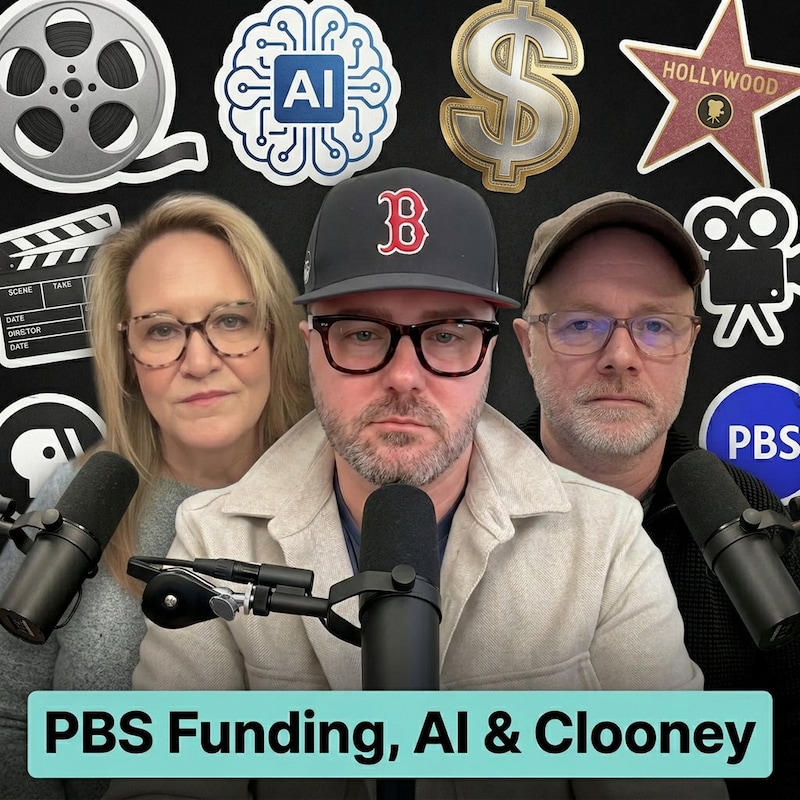
Erik and Christopher Ewers get real about PBS funding, AI’s impact on filmmaking, and how they landed George Clooney, Jeff Goldblum, Ted Danson, Tate Donovan and Meryl Streep for their new PBS documentary Henry David Thoreau.
In Part 2 of this conversation, the Ewers Brothers open up about the financial realities of documentary funding, even with Ken Burns and Don Henley attached, why Chris sees AI as the next revolution instead of the apocalypse, how broadcast is giving way to streaming, and the stories behind casting some of Hollywood’s biggest voices. This is Part 2 of a two-part conversation.
In Part 2, you’ll learn:
— Why having Ken Burns and Don Henley as executive producers doesn’t make funding easy and who actually made the Thoreau film possible
— Chris’s case for why AI is the digital camera revolution all over again, not the death of filmmaking
— The best professional advice Chris ever received and why it will never change
— How Chris kept his mouth shut on a commercial set with Jeff Goldblum and how that silence led to Goldblum voicing Thoreau
— The story of how Don Henley quietly recruited George Clooney as narrator and Clooney’s reaction when asked how long he’d known Henley
— Ken Burns’s advice on directing Meryl Streep: “You don’t.”
— How streaming is changing episode length and why “the director’s cut” isn't what it used to be.
— Erik’s approach to pre-planning edit cuts for PBS broadcast time slots without sacrificing the story
— Why Ken Burns treats his mentorship like tough love — and why Erik is grateful for it
— One thing filmmakers need to know about getting a documentary on PBS
Timestamps:
0:00 Introduction
1:21 Unpacking the Thoreauvian mindset
2:46 Thoreau’s prescience on consumerism
3:50 Erik on Thoreau’s “cost of life” quote and the iPhone
4:40 Thoreau and the birth of the Industrial Revolution
6:03 Christian’s advice: think from the end back
6:50 Chris on the state of the industry — Industrial Revolution to AI
10:20 Christian: as a voice actor, AI is a challenge
10:53 The best professional advice Chris ever received
11:36 Christian on the struggle to fund the next film
12:54 Money is always the biggest hurdle
13:15 How the Ewers Brothers fund PBS docs without federal money
14:49 Ken Burns’s two binders of rejection letters
15:07 The Movies That Made Us — encouragement for indie filmmakers
16:26 The reality: it’s hard for everybody
17:52 Erik on Ken Burns’s legacy projects and the privilege of the brand
20:58 Erik on earning the gift — Ken’s tough love mentorship
22:00 Broadcast vs. streaming — why episode length is changing
23:52 Erik’s editing strategy for PBS time slots
25:37 Celebrity voice talent — how they landed Jeff Goldblum
27:43 Don Henley’s connections — Ted Danson and Meryl Streep
29:09 The George Clooney reveal — “If Don Henley calls, you say yes”
30:43 What it’s like to direct celebrity voice talent
30:55 Jeff Goldblum in the booth — pure instinct
31:26 Ken Burns’s advice on directing Meryl Streep
31:52 George Clooney: “Tell me if I suck”
32:42 DocuVue Deja Vu — Erik’s picks and Chris’s all-time favorite
DocuView DejaVu Picks:
Erik Ewers: Crumb (1994), Hearts of Darkness: A Filmmaker’s Apocalypse (1991), Jiro Dreams of Sushi (2011), The Thin Blue Line (1988)
Christopher Loren Ewers: Man on Wire (2008)
Christian Taylor: Buy Now: The Shopping Conspiracy (Netflix, 2024)
This episode is supported by Virgil Films Entertainment.
About the Guests:
Erik Ewers — Director, Editor. Ken Burns’s senior editor for 33+ years. Multiple Emmy winner. ACE Eddie Award winner (The Roosevelts, 2015). Based in New Hampshire.
Christopher Loren Ewers — Director, DP. 20+ years behind the camera. Commercial clients include Apple, Coca-Cola, Tiffany & Co., Stella Artois, Volvo, Peter Millar. Based in the NYC metro area.
About Henry David Thoreau (PBS):
A three-part, three-hour documentary — the first full-length documentary biography of Thoreau. Executive produced by Ken Burns and Don Henley. Narrated by George Clooney. Voices by Jeff Goldblum (Thoreau), Ted Danson (Ralph Waldo Emerson), Meryl Streep (Lidian Emerson, Margaret Fuller, Mary Merrick Brooks, Maria Thoreau), and Tate Donovan (William Ellery Channing). Available now on PBS and PBS Documentaries on Amazon.
Resources Mentioned:
— Henry David Thoreau (PBS, 2026)
— Buy Now: The Shopping Conspiracy (Netflix, 2024)
— The Movies That Made Us (Netflix)
— Walden; or, Life in the Woods by Henry David Thoreau (1854)
Listen & Follow:
Apple Podcasts: https://tinyurl.com/DocFirstApple
Spotify: tinyurl.com/DocFirstSpotify
YouTube: tinyurl.com/DocFirstYouTube
Amazon Music: tinyurl.com/DocFirstAmazon
Support the show on Patreon: tinyurl.com/DocFirstPatreon
Connect:
Ewers Brothers Productions: ewersbrothers.com
Connect with Christian Taylor on LinkedIn: linkedin.com/in/meetchristiantaylor
All Documentary First platforms: linktr.ee/doc1st
Transcripts
And on that note, Chris, why don't you explain a little bit what you meant by that?
2
:Because I'd like us to unpack that Thoreauvian mindset, just what this film talked about,
what he meant.
3
:so unpack that a little bit.
4
:Well, the big takeaway as Michael Pollan says it beautifully in the film
5
:Thoreau
6
:asks us to wake up,
7
:politically, environmentally, but personally, he asks us
8
:to stop and recognize where we've been sleepwalking through life, right?
9
:What we allow that quietly diminishes us, But also where we have agency, his work is a
call for us to live deliberately, And to constantly ask questions of society and of
10
:ourselves, most importantly.
11
:and to reevaluate our values, our choices, our opinions, and to freely change course when
we realize through paying attention, Freely change course to something that feels right or
12
:feels more right or feels better, feels truer.
13
:So when Eric says that
14
:he's been very confident as an editor for a long time, but never really knew himself.
15
:You know, that's the whole point.
16
:Thoreau, through the exercise of his life, through the experiments of his life, knew
himself better and in a way that most people never do.
17
:and in doing so, he's able to have a fresh perspective on the outside world.
18
:and
19
:It's shortcomings for all intents and purposes, but it's very Theruvian.
20
:What I thought was remarkable is how prescient it was for today.
21
:He talked a lot about how consumerism was beginning to consume his culture.
22
:early on, he was remarking how the dams were beginning to destroy the fishes habitats and
migrating.
23
:he saw it was all in the guise of
24
:more clothing that we really didn't need.
25
:it was people just wanting to have more.
26
:And I just watched I don't know if you've seen the documentary, Buy Now, which isn't
necessarily a fantastic documentary, even though it's on Netflix, but the concept behind
27
:it is completely true just outrageous, which is what the world is doing to, trick us into
buying more.
28
:BUY, buy now.
29
:Got it.
30
:Clever.
31
:because the woman that perfected the one click buying on Amazon and curated all of the
pages to make sure that as soon as we thought we needed something, we would go to Amazon
32
:and put it in our cart, she's on there because she got fired from Amazon from trying to
hold them accountable for stuff, telling how she did those things.
33
:and here's a guy from the the 1850s Who who wrote the cost of the thing is the amount that
I will call life.
34
:Which is required to be exchanged for it like okay you want that that new iPhone How much
do you really want it?
35
:Are you really are you willing to sacrifice all of this time Just generating another
iPhone that you could be using
36
:in Thoreau's Therovian world to be appreciating nature or exercising or making art or
whatever it is that makes you happy.
37
:And it's just uncanny that he is seeing all this at the birth and this is the important
part of what you're saying, It's the actual birth of the Industrial Revolution.
38
:It's just starting.
39
:There aren't any trains.
40
:Trains only to him.
41
:He's like, this is speeding up life.
42
:This is not good.
43
:Yep.
44
:And yes, he takes it 70 times.
45
:it is interesting because it does make our life livable.
46
:There is that contradiction.
47
:And wait till you watch this show and you learn the facts about the iPhones and how they
make them and what they do for our lives or the computers and what's happening in terms of
48
:nobody planning for the end of life of these things.
49
:And you begin to see our responsibility, which is...
50
:what he's talking about, the concept of living to work versus working to live, we've lost
that.
51
:We've completely lost that life balance And that's actually something I want to move into
next off this philosophical discussion.
52
:Chris, you and I had this discussion offline before we started, which is as filmmakers, we
are in a very difficult time.
53
:We're living this out right now.
54
:We can't just make the things that we're passionate about because it costs an incredible
amount of money.
55
:And right now our industry is completely upside down and it's very difficult to sell
anything and make any sort of return even if it's a narrative film, but much less a
56
:documentary film if you're an independent filmmaker.
57
:But even if you're an established filmmaker at a studio, it's difficult these days.
58
:I always encourage people on this podcast, to think from the end, back.
59
:You cannot think, I want to make this thing.
60
:I want to make this thing and let's get started.
61
:Wouldn't want this to be great.
62
:And you can't if you actually want to be successful and make a living being a filmmaker.
63
:So why don't you talk to me about, how you,
64
:have walked this line or your thoughts about this whole part of it.
65
:Because I know it's something you're really passionate about.
66
:Yeah, I think that, well, two things, first and foremost, if, if you're passionate about
storytelling, and you leap so far ahead that you're thinking about, How am going to pay
67
:for this?
68
:where is it going to end up?
69
:Where's it going to live?
70
:Who's going to distribute it, whatever, you may start thinking about it logically, or you
may just never start,
71
:That's true.
72
:We're in a unique place for our lifetime, right?
73
:But it's not unprecedented.
74
:I go back and forth and anytime that I start to get really nervous about the state of the
industry, film, television, I have to pause and remind myself about a handful of things.
75
:And we'll start with Henry,
76
:You know, humankind, our society has gone through several revolutions, and at each point,
I have to put myself in the mindset of the people that were alive at that time, to use
77
:Henry as an example, he's growing up as a boy, very agrarian society.
78
:And then the industrial revolution kicks in, And all of a sudden,
79
:It seems to the people who are alive at the time that their ways of life are dissolving,
uh Everything is changing.
80
:Everything is new.
81
:Nothing is safe.
82
:we talk about it in the film that at this point, you know, many farmers, generational
farmers, their children would end up leaving the farm for the first time in five
83
:generations.
84
:and looking for work in factories because there was not enough land or the economy has
changed to the point where they're forced to do this.
85
:They're forced to break out and do something completely unnatural and new to them.
86
:And of course, that's got to seem like an absolute crisis at the time.
87
:But fast forward 40 years and all of a sudden, collectively, we're acclimated to the
Industrial Revolution and now we can't live without the train, et cetera.
88
:the same thing happened.
89
:So I went to film school in now moving in directly to relate to the film industry.
90
:I went to film school in the late nineties where, you know, and Eric was the same.
91
:Like we were filming with 8, 16 or 35 millimeter.
92
:I never shot with 35 millimeter because that's super fucking expensive, but like eight
millimeters, 16 millimeter and cutting on a steam Steenbeck you know, like we're actually
93
:cutting and splicing the film together, you know, whatever else.
94
:And right about the time that I was leaving film school, the digital sort of revolution
was taking place in cameras.
95
:And for me at that time, it was a godsend because I wanted to immediately, I wanted to
start making films.
96
:I wanted to start telling stories.
97
:But coming out of film school, knowing that I couldn't afford film,
98
:I couldn't gather the crew together that I needed, cetera, et cetera.
99
:It was almost impossible for one person to tell a story.
100
:In come digital cameras, right?
101
:So the industry at large bemoans digital cameras and thinks that it's going to be the
death of film, et cetera.
102
:It wasn't, it's a new tool and it revolutionized, democratized in a large sense, how we
tell stories, how filmmakers or photographers can work and work.
103
:faster and better and cheaper, It's going to change the art.
104
:Here we are at an AI revolution, you know, and of course, yes, it's super disruptive.
105
:The film industry is reeling right now for a number of different reasons, whether it be,
you know, COVID or strikes or fires or tax incentives or, whatever else.
106
:Now boom comes AI and everybody's, I shouldn't say everybody, vast majority of the
industry.
107
:is, crying wolf.
108
:We're all up in up in arms saying that this is going to be the death of acting, the death
of creation, the death of film, the death of this, that and the other thing.
109
:And I just I just I disagree.
110
:think I felt that way at first.
111
:I was seeing, Nano Banana and these image generating AI models coming out and the stuff
that they could do in five minutes.
112
:Like, yeah, it's going to it will ruin certain professions, you know, like
113
:I wouldn't want to be a retoucher, know, like stuff like that.
114
:It's creating.
115
:a voice actor, it's a challenge.
116
:Sure, absolutely.
117
:But it's going to be a challenge for everybody, in the creative industry for a while.
118
:But then we're going to figure it out, I believe, just like we did in the Industrial
Revolution and the digital revolution.
119
:100%.
120
:100%.
121
:Yeah.
122
:But we're going to realize that the AI is going to be the new tool to help propel
storytelling.
123
:So I'm not as doomsday about it as some of my colleagues are, some of my friends.
124
:agree.
125
:Go ahead.
126
:You know what still is, and always has been, super important?
127
:Best piece of advice I've ever been given in my life professionally, was that - the true
reward for a job well done is the opportunity to do it again.
128
:Has nothing to do with pay or credit or acknowledgement or you know, what have you.
129
:is, if this is the industry that you want to work in and you want to continue to work in
it.
130
:repeatedly over and over and over again, the most important thing you can do is a good
job, is to be like a team player and to be somebody that other people want to collaborate
131
:with, want to interact with.
132
:That is just invaluable advice because that's never going to change, ever.
133
:very, very true.
134
:Now, I will say it is still challenging.
135
:the reason I say that is, I've done a film.
136
:It's done very well, And I'm still having difficulty.
137
:getting funding for the next one.
138
:It's halfway done.
139
:I have lots of stories to tell and the ability to do it and a team that can help me and
having the ability to do that now in today's society is incredibly difficult.
140
:Now, does that mean it can't be done?
141
:No, I'm not giving up.
142
:I'm not gonna quit.
143
:I'm doing what I can do while I'm continuing to look for the next opportunity.
144
:And my point is, that's what we have to do now.
145
:we have to look and plan.
146
:I'm not going to stop, with my projects or my plans, but I am going to be super
intentional about the budgets and developing relationships for distribution and trying to
147
:figure out.
148
:how to solve this puzzle.
149
:we just have to be intentional networking and making our budgets smaller because we're
going to be making less money as documentary filmmakers.
150
:we have to educate ourselves on the industry, who the people are, what is happening out
there, reading the trades.
151
:There's just a lot of simple things that we can do.
152
:m
153
:to educate ourselves about what the changes are.
154
:Learn AI.
155
:Don't be afraid of it, right?
156
:100 % yeah, I mean in any creative endeavor Money is always the biggest hurdle And it
continues to be and it's getting worse and worse
157
:I wanted to ask you about that because you guys did it with PBS and I think before you
came out or maybe maybe it was after CPB got their funding cut.
158
:Was it before you had funding or after?
159
:So we're in a unique position because none of the films that we make, so far they're all
for PBS, uh none of the films that we make rely on federal funding.
160
:of the films that we make are either funded because it's through a nonprofit, WETA, PBS of
course is nonprofit.
161
:So all of the funding for our projects thus far
162
:are essentially charitable donations.
163
:know, they're, the money is raised through grants, through foundations, the money is
raised through individuals of wealth who are passionate about the topic.
164
:And it has become admittedly extremely difficult to do.
165
:Whether it's our responsibility, which makes it even harder because we are not good at it.
166
:Or we have executive producers.
167
:mean, in this case, speaking of the Thoreau film, our two executive producers, Ken Burns
and Don Henley, with names like that attached to the film, you would think that it would
168
:blow the doors open to funding.
169
:But it's the exact opposite.
170
:say the single reason, the only reason
171
:that this film has been made and is now being promoted and will be aired is Don Henley.
172
:Not that he personally funded the film, but he was responsible.
173
:He had the lion's share of the responsibility because of his passion for it and because of
his connections to open doors to pathways for funding for the project.
174
:Eric and I can't overstate that.
175
:anymore than, than is absolutely the reason why the film is being made.
176
:I remember when I was watching Ken Burns' master class and I was in the middle of my own
fundraising and he told me that he has two binders sitting on his desk of rejection
177
:letters from fundraising and I started bawling my eyes out.
178
:I was like, what?
179
:Ken Burns, you've got to be kidding me.
180
:How is that possible?
181
:But, and that was back when, but I guess it still happens.
182
:Super interesting, and then we can move on to whatever you want.
183
:I just want to say if you or your, listeners have ever seen, a Netflix series, or at least
it lives on Netflix now called the Movies That Made Us It is a phenomenal look behind the
184
:curtain at some of the most culturally significant,
185
:Touchstone films of our time, ET Raiders of the Lost Ark, etc, etc, etc and it is the
stories about how these films were almost not made and in and watching I devoured this
186
:series and I go back to it frequently because When I watch this and I see that Steven
Spielberg has a hard time sometimes getting films made George Lucas was almost unable to
187
:do X Y & Z that you know
188
:It makes me feel better about my own shortcomings and my own struggles.
189
:Because I mean, it's this way for almost everybody.
190
:Yeah, it is encouraging.
191
:That's so true.
192
:Thank you for that.
193
:Okay, I do wanna move on.
194
:We're going over time, but this is just such a fascinating conversation.
195
:The next thing I wanna ask you is, so many people Google how to make money with PBS
documentaries or how do I get my documentary on PBS?
196
:Can you help us with that question?
197
:I would love to find that website myself.
198
:If you know of it, please let us know.
199
:Yeah, that is I mean, for real, like, you know, we it's a what we do is it's full of
integrity and responsibility and and ultimately, satisfaction, personal and social
200
:satisfaction.
201
:But it is I mean, I can't sugarcoat it for anybody.
202
:I mean, it is fucking hard.
203
:as it's always the case, with film and television, who you know, can be
204
:crucial to the success or failure of a project.
205
:How persistent you are also is crucial to the success or failure of a project.
206
:one of our great friends David Cieri, who's our longtime composer and just an absolute
fucking genius.
207
:we were talking one time 12 years ago.
208
:somebody was asking him how, because he's a musician and he lives a breathes music and
it's his passion.
209
:Someone asked him because they were astonished that he was able to make a living as a
musician and how do you do it?
210
:He says well I'll tell you, the the first thing and most important thing, is to live
cheaply.
211
:He was living in Harlem at the time.
212
:He's like, you got to have an inexpensive apartment because that's the sacrifice right?
213
:I echo eric if somebody can figure that out i mean is in the in the time of a i, believe
me, i have used Chat G P T to answer that question.
214
:It is not worthwhile
215
:Then somebody must have taken the mantle of getting your show on PBS away from you and did
it themselves, yeah?
216
:Well, Ken is executive producing and by virtue of him executive producing, we have the
privilege of being associated with his brand, if you want to call it that.
217
:That's why at the beginning of all our films, it starts with Ken Burns presents.
218
:He also is doing this with his daughter and her company.
219
:And he has also done it with, Barrick.
220
:Barrick Goodman, another filmmaker.
221
:And for all I know, there are others that he's doing this with.
222
:These were kind of what they loosely call legacy projects within the Ken Burns world.
223
:And I think that is 1000 % a privilege.
224
:And we are able to develop relationships with WETA in Washington, the PBS affiliate that
does all of Ken's films.
225
:And it exposes us to the intricacies and the at times inherent obstacles that come along
with the territory of a broadcast partner.
226
:So I kind of liken everything that Ken has done for Chris and I as tough love with the
best of fatherly intents.
227
:Just like your own father would, it's a process we have to realize how difficult the
filmmaking world is.
228
:We have to realize how hard funding is.
229
:I think a lot of people probably assume that we've been fed on a silver platter.
230
:While we're definitely not at that level of having to do everything by ourselves, this has
not been an easy 20 years developing our company, developing our films.
231
:And honestly, my appreciation for Ken just continues to go up and up and up because he
knows that, and he knows it's hard and he does not want us to have a silver spoon in our
232
:mouth.
233
:It's a gift that you have to earn.
234
:So I do think that we face a lot of the same and similar obstacles that a lot of
filmmakers face.
235
:And it's for all the right reasons.
236
:So how to negotiate PBS?
237
:Well, it's on a case by case basis.
238
:There's no one path.
239
:We've had to stand on our own
240
:with WETA and PBS often.
241
:And we face the same challenges.
242
:So I think we can relate to a lot of people out there, even though in some ways here I am
a 37 year veteran of Ken almost full time.
243
:I think maybe a year and a half of unemployment downtime.
244
:in since 1990.
245
:uh Some could say I'm a spoiled brat in some ways.
246
:No, I'm just lucky and I'm privileged and it doesn't fall short on me that gift that Ken
and his company and Paul Barnes as the senior editor and my mentor have given me is
247
:something that I just try to take forward and do what I can to help other people.
248
:and grow other people in the same fashion.
249
:The true reward for a job well done is the opportunity to do it again.
250
:Absolutely, great, great quote.
251
:The only thing I can contribute to this conversation about this issue is my distributor,
Joe Amodei of Virgil Films Entertainment, who I adore and must thank him for supporting
252
:our podcast, did get us in with American Public Television and they were willing to take
The Girl Who Wore Freedom if I would cut it down.
253
:to 56 minutes, which I couldn't do because I had made a 89 minute film, not with the idea
of putting it on public television.
254
:And had I cut it down to that it would have destroyed the integrity of the film.
255
:And so I could not, within that framework,
256
:put it on American public television.
257
:So that was a hard lesson.
258
:I should have made a shorter version.
259
:No.
260
:Exactly.
261
:Also, you may want to revisit that conversation, as we're all very well aware of, like the
broadcast model is it the this this concept that the vast majority of us are still relying
262
:on broadcast television.
263
:for our content is just factually inaccurate.
264
:we have already transitioned from broadcast to streaming.
265
:true.
266
:mean, I watched your documentary.
267
:Well, I guess I watched it.
268
:I watched a streamer copy, but I mean, I watched the American Revolution on PBS
documentaries on Amazon.
269
:Yeah, and so what that means for us for creatives for projects is that of course with with
broadcast television.
270
:Yes, there are very strict time limits time constraints.
271
:one of our episodes for the Thoreau project Eric did cut five minutes out of it just to
fit the broadcast time slot, but
272
:the streaming version has that five minutes added back in.
273
:my wife and I love The Pit.
274
:We just watched the most recent episode last night.
275
:it just does my heart good when I go to, like, all episodes and one's 33 minutes, one's 45
minutes, one's an hour and seven minutes.
276
:It's like, you yeah, right, exactly.
277
:So we're moving away from, and so is PBS, mind you.
278
:Like, as I just mentioned,
279
:Yes, we have a shortened version for broadcasts of one of the episodes, but the full, it's
no longer the director's cut.
280
:mean, it's like you just have streaming content that can live in the cloud, in perpetuity,
at whatever length it needs to be.
281
:So again, another one of these concepts that has taken.
282
:the industry maybe a little bit of time and maybe no time at all but like one of these
concepts that we've come to embrace that it is a benefit to our creative endeavors.
283
:And I think the big difference between what you described in your experience and ours is
that, first of all, we got lucky.
284
:The arc of each episode was perfect for us.
285
:Episode one being his childhood up until he's a mid-20s kid who doesn't know what to do
with his life.
286
:So what does he do?
287
:He goes to Walden Pond and tries this big experiment living alone in nature.
288
:That's episode two.
289
:And then at the end he says, perhaps I have several other lives to live.
290
:That's episode three, the later part of his life.
291
:They all fell, the arc all fell beautifully, but A, Chris and I didn't wanna make a two
hour film per episode.
292
:I think attention spans change and I think the expectations of your audience change.
293
:So we endeavored
294
:part of our vision was to create our episodes.
295
:And I think the difference is that as I was editing, unlike yourself, I was very mindful
of length, knowing it has to be at the most 52 minutes and 45 seconds before end credits
296
:for it to fit the PBS time slot.
297
:And ultimately when we got to episode three and realized that
298
:if we cut any more out of this, we're actually cutting important content.
299
:Then in the last three months of editing, I made sure that I incorporated little latches,
if you will, where I knew I could end this scene and start the, and have a moment and then
300
:start the next one and be able to lift it out effortlessly.
301
:So I actually pre-planned while we were getting ready to lock the film, I pre-planned
those five minutes
302
:so that it would not hurt the overall arc of the story.
303
:when you have that ability, yes, and you have that ability to do it in process rather than
finish it and say, oh crap, I gotta go and take 89 minutes to 60, that would be a whole
304
:different story.
305
:All right.
306
:Well, this has been a Sunday of a conversation and now I need the cherry on top, I have to
ask you about working with these celebrity voice talent.
307
:mean, George Clooney and Jeff Goldblum and Meryl Streep.
308
:I mean, just some of my favorites.
309
:And I know there is a interesting story about Jeff Goldblum.
310
:So let's start with him.
311
:How did that happen?
312
:Yeah, I mean, this was an embarrassment of riches, I mean, like we got we couldn't talk,
you know, again, who, you know?
313
:Yeah, never, never imagined.
314
:Yeah.
315
:So, I mean, you know, we Thoreau is a very enigmatic and interesting character, you know,
and we, Eric and I, at least always were keenly interested in.
316
:Jeff as the voice for Thoreau because he himself has just such a great character and
personality and idiosyncratic nature and the way that he imbues how he speaks and the
317
:words that he uses with feeling, with meaning.
318
:We just thought he'd be perfect.
319
:Several years ago, in the commercial world, I had worked with Jeff on a spot and in
between takes, he
320
:This was right around the time that Ken's Country Music series had come out.
321
:So in between takes he's like, God, guys, has anyone seen Ken Burns' Country Music?
322
:Oh my God, it's so amazing.
323
:And know, how he goes and it goes on and on and on.
324
:And I kept my mouth shut.
325
:I never said anything, you know, at the time.
326
:cut to, we're looking for voice talent for this project.
327
:I was like, well, I think Goldblum could be amazing.
328
:And I know he's a huge Ken Burns fan.
329
:So threw caution to the wind reached out to his agent and, told him the story and the
backstory, whatever else.
330
:lo and behold, after a couple of emails back and forth, we get this very curt email from
his agent says, Jeff would love to do it.
331
:It's like, yeah, mean, you know, it's total happenstance.
332
:It's serendipity.
333
:And then the rest, know, Mr.
334
:Henley has lots of connections.
335
:He lives in LA and in Dallas.
336
:but he we would we would chat with him and we would brainstorm different ideas for other
people.
337
:And, you know, again, we're we're very lucky and very privileged.
338
:it's not lost on us that, you know,
339
:Don said, I know this agent for Jeff, but he's also for Ted Danson.
340
:And Ted has been a very big supporter of the Walden Woods Project and other environmental
groups.
341
:And it was a very easy ask and a very, very straightforward, absolutely.
342
:Ted and Mary called us, Chris and I, to
343
:talk about the project and come to find out.
344
:Yes.
345
:And you come to find out that Mary wouldn't have, this is her own words, I wouldn't have
been, probably been an actress if it wasn't for Thoreau.
346
:She played the role of Lidian Emerson in a play in college and she did it so well.
347
:It was a play on Thoreau that she
348
:her, you know, the department head for the theater department or something said, you need
to go to a different school.
349
:You're really good.
350
:And she did.
351
:m Also their son-in-law wrote his graduate thesis on Henry David Thoreau.
352
:So there was this like wonderful little, you know, serendipitous connection to Thoreau.
353
:And then
354
:Don was willing to reach out to Meryl Streep and he went off and succeeded in that.
355
:And then the best was when he called us and said, I have this great idea for a narrator,
but I'm not going to tell you, would you give me permission to explore on trust?
356
:And we're like, of course, of course.
357
:And he came back and he's like, yeah, George Clooney is willing to do it.
358
:And when we go to do the, two day session with George.
359
:George loves to chat.
360
:is such a, they're all wonderful gentlemen.
361
:And Meryl Streep is a wonderful lady.
362
:But he, very genuine people, but he, I said, so, you know, how, how long have you known
Don Henley?
363
:He's like, I don't know Don Henley.
364
:We're like, what?
365
:And he said, yeah, I got, I got a call one day and you know, and someone handed me the
phone said, would you
366
:speak to Don Henley of the Eagles.
367
:And George was like, if Don Henley calls and asks you for anything, you say yes.
368
:And so it was just this wonderful, know, it was Don's passion for the film.
369
:He wanted it to be the best it could be.
370
:And he, he really, like all other aspects of this project, were so indebted.
371
:to him and to Kathy Anderson, his executive director of Walden Woods, the two of them,
there wouldn't be a film without them.
372
:amazing.
373
:Yeah, those voices really uh elevated the story.
374
:same was true for American Revolution.
375
:Every single time they come on, I'm like, that's Tom Hanks.
376
:that's Meryl Streep.
377
:They are just are so gifted at their job.
378
:And it doesn't matter who they are.
379
:They fully inhabit the character.
380
:What was it like to direct them?
381
:do you direct them or do you just let them do their thing?
382
:a little of both.
383
:I think
384
:depending on who it was.
385
:Yeah, depending on who it was.
386
:was hardest to wrangle?
387
:I'm guessing Jeff.
388
:No?
389
:no, not at all.
390
:uh
391
:so great about him?
392
:Like he'd be in the booth and you know, we're prepping the next paragraph, the next bite,
right?
393
:And Jeff would ask for like a little backstory.
394
:It's like, what do you think?
395
:Like what was happening in Thoreau's life and what do you think?
396
:And then, and you know, very Goldg blum y he'd be like, we tell him and he'd be like,
okay.
397
:Hmm.
398
:Hmm.
399
:And he's like, you know, got his eyes closed and he's speaking into the mic.
400
:I am this then.
401
:feeling this.
402
:Okay, great.
403
:And then he would just go and it would be perfect.
404
:You know, it was like, okay, well, this is easy.
405
:Yeah.
406
:Ken gave us great advice.
407
:I asked him about Meryl Streep and I was like, when she was Eleanor Roosevelt and I asked
him back then, I said, how do you direct Meryl Streep?
408
:And he goes, oh, you don't.
409
:He says, no, you sit back and you enjoy the ride.
410
:And every once in a while you make a comment, but I can personally guarantee that the
comment almost always is,
411
:Wow.
412
:my God.
413
:wow.
414
:And, I think you have to, with any kind of celebrity, you have to see where they, you
know, how, what they're comfortable doing.
415
:George said to us, tell me if I suck.
416
:And he said it that way.
417
:If I suck, tell me I suck.
418
:And, and he didn't suck.
419
:He was, I couldn't believe how much of a natural he was.
420
:We just told him what kind of style.
421
:gave him some examples and off he went to the races.
422
:Wow, that was amazing.
423
:Well, your directing was impeccable for all of those voice talent, I gotta say, for sure.
424
:Well, this was just such a delightful series to watch.
425
:I thank you for making it.
426
:This conversation has been enlightening and inspiring.
427
:I just have loved getting to know you.
428
:I know our audience will as well.
429
:We're gonna have to divide this into two podcasts.
430
:We've gone a little bit over.
431
:I'm gonna let you go.
432
:But first, we do have to do everybody's favorite segment, DocuVu Deja Vu.
433
:All I'm gonna do is ask you for a documentary that our audience might love.
434
:I'm starting with Eric.
435
:Come on, Eric.
436
:Okay, okay.
437
:It's more appropriate, Chris, because my answer will be very quick.
438
:I do love documentaries, obviously, but I also have a hard time watching documentaries
sometimes.
439
:So my list is very short, but the ones that stand out in my mind way back, Crumb, ah it's
Terry, is it Zwigoff I think it's...
440
:uh
441
:it's crumb is the story of a very eccentric odd 60s cartoonist and sometimes rated nearly
rated X material, hysterical and the guy was so off the beaten path.
442
:was it was a fascinating character study.
443
:I would also say Hearts of Darkness is a given.
444
:The documentary behind the making of Apocalypse Now.
445
:Yero Dreams of Sushi is one of my favorites.
446
:It's a slice of life about this guy who creates some of Japan's greatest sushi and it's
like in a subway.
447
:It's beautiful.
448
:You started off by giving me the disclaimer that you wouldn't give me any and now I have
three.
449
:Alright, one more, Thin Blue Line.
450
:Barnes edited it, my mentor, um so those are mine.
451
:one.
452
:All right, Chris, you're up.
453
:I'm only gonna give you one.
454
:It's my favorite of all time.
455
:uh Man on wire.
456
:I haven't seen that one.
457
:Man on wire.
458
:Man on Wire?
459
:it's about Philippe, I forget his last name, he's the gentleman, the tightrope walker who
the World Trade Center towers:
460
:walking back and forth and lying down.
461
:I mean, it is masterful filmmaking.
462
:It is, it's a phenomenal.
463
:film, I would recommend it to anyone and everyone.
464
:the whole story, of course, is told after the fact, right, in remembrance.
465
:And even though we know that he lives and even though we know that it was a successful
coup, the manner with which sort of
466
:that recreated situations is handled is nothing short of perfect.
467
:the filmmaker's ability to imbue the visual components of the film with information is a
master class in storytelling, visual storytelling.
468
:It is
469
:sweating just thinking about it.
470
:It's making me so nervous.
471
:of the most beautiful and well-made and most interesting documentaries that I have ever
seen.
472
:gracious, that is a huge recommendation.
473
:Well, I'm just gonna leave you with Buy Now.
474
:I think you need the information.
475
:I don't think it's a stellar documentary, but I think the information is what everybody
needs.
476
:So, all right, gentlemen, thank you so much.
477
:This has been amazing.
478
:I can't wait to have you back for your next documentary.
479
:Is there one in the works?
480
:Several.
481
:Yes, you need to listen.
482
:Glad to hear it.
483
:We just need funding.
484
:Yeah, join the club.
485
:All right, everybody.
486
:Thank you so much for listening to Documentary First, where we believe everybody has a
story to tell and you can be the one to tell it.
487
:All you gotta do is get some money.
488
:All right, see you next time.
489
:Bye, everybody.






