Shownotes
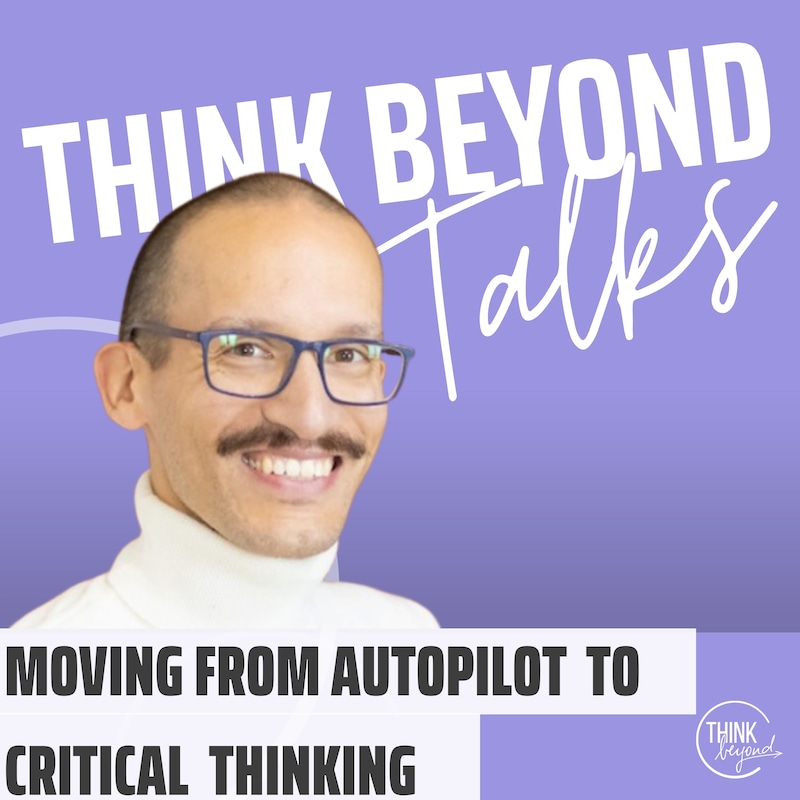
From Assumptions to Awareness: Matteo Martinuzzi on Applied Critical Thinking
Clear thinking is harder than ever in a world full of noise, speed, and instant reactions. In this episode of Think Beyond Talks, Anne Barnea speaks with Matteo Martinuzzi — leadership developer, team coach, and Think Beyond Impact Partner — about how leaders and teams can move from assumptions to awareness and make better decisions together.
Matteo shares practical ways to strengthen critical thinking, reduce cognitive blind spots, and navigate emotions that influence clarity more than we admit. He also explores how psychological safety and collective intelligence can transform the way teams think, challenge ideas, and work with complexity.
In this conversation, we explore:
- Why so many decisions are based on untested assumptions
- How to distinguish facts from beliefs we treat as facts
- The role emotions play in shaping our thinking
- Why psychological safety is essential for honest dialogue
- Practical tools to help teams avoid groupthink
- The fine line between intuition and emotional reactivity
- How leaders can slow down the pace of thinking to improve decisions
- What intentionality looks like in a world of information overload
About Matteo Martinuzzi
Matteo is an international leadership and team development practitioner with a focus on critical thinking, collective intelligence, and decision-making. As a Think Beyond Impact Partner, he supports organizations across Europe in strengthening clarity, collaboration, and high-quality thinking.
Transcripts
Welcome to Think Beyond Talks. I'm Anba Neher and in this podcast, I sit down with leadership development experts from our global network at Think Beyond. We explore what leaders, teams and organizations need to thrive. And you walk away with practical tips you can put into action right away. Listen, reflect and think beyond.
Anne (:We all think, but do we always think beyond? The way we think isn't just a theoretical question, it's a practical one. Because how we think shapes how we navigate complexity, make decisions and spark innovation. No surprise then that analytical thinking still ranks among the most critical skills for the future of work. How we can strengthen our critical thinking is what I'll explore today with Matteo Martinuzzi.
one of our Think Beyond Impact partners from Italy. Matteo brings over a decade of international experience in leadership and team development and helping organizations build collective intelligence. He also serves on the board of the Young Entrepreneurs of ConfComercio in Novara, part of Italy's largest business association, where he supports initiatives for the next generation of entrepreneurs.
Together we'll dive into applied critical thinking, why it matters for leaders and teams, how it connects to emotional and artificial intelligence, and how it can sharpen not only our individual clarity, but also our collective decisions. Matteo, nice to talk to you this morning. Yeah, it's great because we tried, I think, three times now to speak to each other and every time...
Let's talk to you, Anne.
Anne (:Something happened last time, was a spontaneous construction work in the apartment underneath your. So really, really wanted this conversation to take place and here we are. And let's hope all will be fine with the recording. I told our listeners that you work with critical thinking, supporting leaders, teams, organizations. And yeah, first of all, how has it become such an important focus in your work?
Yes.
Matteo (:Well, everything started with my continued will to explore, really, and to go deeper on the leadership and in dynamics field. So this really pushed me to continue to learn day after day, to explore and to really also challenge myself. And on the other side, the continuous dialogue with my clients.
So through the coaching session and beyond them. And these always gave me and give me a lot of information that I then use to support them even more, even better. So these two elements integrate always in sometimes strange ways. And about critical thinking, I was really reflecting about some missing parts.
because I observed them during also the decision-making process and I really understood that something was missing. They were not using their brain power 100 % from one side and from the other side, in lot of ways, they were not using their collective intelligence. So the people that they were working with.
And in:to look in a different way at things and also to challenge even more my clients in a positive way of course. And this was very, very helpful for both sides. So now everything is integrated. So critical thinking is embedded in my practice.
Anne (:And when you say your practice, do you mean when you coach clients or when you work with teams, like all kinds of activities you do?
Yes. So when I work with clients one to one, when I do trainings, when I do team coaching and so on, I always have this critical thinking side into my mind and in the way I work. So it's like one of the pillars of my approach really.
Yeah. And I told you before, I'm also very, very interested in the topic and reading a lot about it. Lately, I started third millennium thinking I would be so interested to hear in all the knowledge you said you acquired over time, pushing yourself. How do you then translate it into working with teams, clients? I mean, it's one thing to know how our brains work, how we think.
but it's another to teach others to think better. Can you let us in a bit about into your practice?
Yes, sure. Well, I always want to translate evidence and theory into practice because I'm a very practical guy and I work with business and so with entrepreneurs and teams, I know that they want this. They don't care about theory. They want results. They want tools. This was an important
Matteo (:This is an important part of my work and about critical thinking, one of the key elements that is one of also of the simplest but or impactful is talking about assumptions. So really all the things that we take for granted that we believe they are true, but they are not really facts because they are beliefs that we have.
based on our past experience, something that we have read, we have also forget and so on. And these are elements that at the end we use as facts, so as pillars to really create and update our beliefs and also take decisions and so act.
And this is a simple way to start to really shape the way we think in a different way because it's about, is this an assumption or is it a fact? And it's a question that is simple, but you need to really be humble and to challenge yourself and embrace a different perspective.
to give yourself the freedom to explore more what is happening and to go even beyond what you are thinking in general. this is something that is one of the first thing that I usually share during trainings and is also one of the first thing that I usually try to look for when I'm with the teams or in the one-to-one practice because a lot of
times the sure people sure things like facts, but it's like, okay, I think that no stop stop you think what do you mean with this? What are really the facts? No, the evidence. Well, I don't have it. I am thinking about this on and okay, we need to really verify and understand what is happening.
Anne (:Yeah, that reminds me of a podcast I listened lately with Daniel Kahneman, who wrote Fast and Slow Thinking. And he said something like, we think that each of us, that we're more rational than we actually are. And we think we make our decisions because we have good reasons to make them, even when it's the other way around. So, and also the more I look into research and how we think, it seems
we make our judgments and opinions in an instant, almost like, do we like this piece of art or we don't? So as you already mentioned, it's very humbling to think about our often big lack of critical thinking. So how do the clients you speak to receive when you kind of humble them and say,
You say you think, but do you really know the facts? I assume not everyone is happy and open to hear that. How's your experience?
In general, I have a positive experience with my clients because I created a context where there is the relationship at the center. So there is enough psychological safety to really challenge them. And I do it in a gentle way, even if it's...
very firm. So I will continue consistently ask them these type of questions and then we can reason together. So it's about also thinking together about this and helping them go also beyond what are their general beliefs and verify them and help them understand the importance of this.
Matteo (:and usually during the session they change how they think and the perspective they use about topic, about something that is happening and at the end they are happy. Then there is also the difficulty to do it every day. So in the session is of course easier, but then I always give them the like...
I call them experiments. So they needed to really create the space to use this type of tools, approaches and so on in their daily life. And then we explore what is what was the results of these experiments. So in general, I have a positive experience, luckily.
Even if then the most difficult part could be the use in the daily life and of course then we work on it. It's more difficult in teams because of course you are not working with a single person so you really need to align. in that side, I usually, when I see that there are a lot of assumptions and they,
influence the way they are and the way they relate also with other teams and the relationships I do some specific works with them.
And when you say, because you mentioned you are more in technical field, entrepreneurship, innovation. So can you give us an example? What kind of assumptions? Because I come more from the social science world. So I'm kind of having assumptions about the assumptions. Give us one assumption that people might have.
Matteo (:This is a great question. I can give you an example about an assumption that it can be present and leaders can have when they need to, for example, give some feedbacks to people. one is that, well, this person doesn't care about the project. And this comes from the observation of some behaviors.
Maybe they don't finish the project by the deadline or they have some issues but they didn't share them. And there is this big assumption that then create a lot of different actions that are direct or indirect. And maybe also feedbacks about this to the person that are based on thoughts. Nothing more, nothing less.
The point is to really understand what is happening, why this person is doing that. And then support the person, but also the leader, the environment to do the changes that are needed to really create something different. I had an example yesterday during a training. It was training with one of companies that is a leader in his market in Italy and also in Europe.
and I had the possibility to work with 20 of the city managers in Italy. During this training, one of the manager was using the cell phone during the training. It's something that I don't like. It's something that I usually also immediately ask
not do during the first part of the training, the introduction. So I was observing it but I choose to not do anything. During the break my willingness was to really explore what was happening. But a lot of times happened that participants start to ask me questions.
Matteo (:So I was in that situation and this person came to me and told me, I know that I'm using my cell phone, but I have these type of issues because in two days we will open a new office and so on. And I also have some issues with the delegation. So these create a lot of challenges.
But now I try to delegate so that I can be really focused on the training. So sorry for my behavior. I don't want to disrespect you or do negative or have a negative attitude. So this is a clear example. I could have a lot of thoughts about this, but the reality was very, very different.
yes. Yeah, that's a very excellent example. basically by interrogating if the assumptions are accurate, accurate picture of reality, you kind of peel away whatever they, every one of us brings from our experiences and how we interpreted the world, right, into just exploring what is real. That's how I understand. And
You mentioned earlier the concept of psychological safety. Can you first explain for listeners who haven't heard of this concept yet and also why it is so important to actually apply critical thinking and also how to build it?
Okay, well, I give you a very practical explanation, it's not the official one, that is about creating an environment where people can be themselves. This means that they can speak always with respect and so on, but they can share their thoughts without any type of fear. So it's about, okay, I'm not, I think I have a different perspective.
Matteo (:from the team leader and I share it because I know that they can do it. So this is a very simple example. And a lot of times critical thinking can help because we can create processes in the teamwork where people can express themselves also in a very calm and secure way. And this is important because a lot of times
also during my team coaching or training experience, I don't know how much psychological safety is present. So I can, I need to build it through the process and I can use tools to really help people participate. So it's also about knowing that we have different types of people and people
can be more assertive, more extrovert, they can speak more or less and it's not because they don't want to participate a lot of times, but because of other thousands of reasons, I and we need to really, when we have this type of position where we are leading a group, we need to create the environment to help them speak.
And I think also bringing the awareness to a group that there might be a multitude of opinions, of backgrounds, of personality types, introvert, extrovert, that already raises awareness that not everyone will participate probably immediately in the same way. So can you share a tool of how to create more psychological safety when you work with a group you mentioned you use tools?
Well, one simple tool is a team-co-write-share. This means that when you ask something to a group, maybe because you want the perspective, you want some type of information from the team members or the group, you ask the question, you give them like one of two minutes to reflect, so they don't need to write anything. And then they write, they answer, usually on paper.
Matteo (:if we are in presence, of course. And then they can share it. Maybe they can share their own perspective or if we want to really cultivate psychological safety because we are not sure about it or because we know that we need to work on it, we can then collect this piece of papers and
I can read it, so I can read the answer or I can give them to them and they will read not their answer, but the answer of any other person. In this way, we can really have all the voices and we have all the perspective and we can start to really then use them to do another step.
So everyone reads what someone else wrote down.
Yes.
Earlier you mentioned that while in seminar, in training, it's kind of easier to create a space for critical thinking, but then when people go out into the real world, it gets more difficult and that you give them little experiments. So that made me curious to hear what is an experiment you would give them.
Matteo (:Okay, well for usually they create this type of experiment so it's like one action that they can start to do to really apply what emerged during the training and could be like, okay every day I will When I need to do a decision an important decision I slow down and I do a check about the assumptions for example of
or if we are a group of people that participated to the training, so we have the same vocabulary and knowledge, we can start to use ThinkRightShare together. Or I can start to explain it to my team and start to use it, and then we can understand what happened and what are some elements that they can...
do to integrate the tool, the practice in a better way, what are the challenges and so on. These are all experiences that are gold because they will give me all the information to support them even more and also to put in practice everything. So it's usually, it's something that I ask them to create so that they can really do it.
thinking about their environment, their situation, their daily life. It's not a top-down approach.
When you teach critical thinking to adults, here at Think Beyond, we obviously work in the field of working with leaders, so adults. But as far as I'm aware, at least in Germany, there is no teaching of critical thinking in schools or for younger people. Maybe you can share how it is in Italy, because it strikes me as weird that we start educating
Anne (:students maybe or adults in how to think clearly, but we don't start in school.
This is a great point. No, we don't have also here in Italy a specific focus on it. I was lucky because during my last years of school, I had a teacher that in some way started to teach us critical thinking.
even if not in a formal way. So it's something that we need to really push. And now we are starting in Italy some projects in general that can support this. But I think that we need as adults really to be aware of the importance of this type of approach, of way of thinking and to support it.
first of all with young people. I do some workshops with the high schools, some high schools here in Italy, the last year of their journey. the older people, because we need also to understand that young people need also...
have also an evolutionary phase, so we need also to respect it. And I share some of these tools with them, and usually they are very happy and receptive because they are curious and open. So it's interesting.
Anne (:Yeah, and for me, it's just also such an important tool to strengthen democracies. If people make sound decisions about voting, about all kinds of interaction, we could also improve our living together, I assume.
Yes, yes, it's also about how we really manage and process the informations because this is critical thinking, nothing more and nothing less because we have a lot of noise in general from social media but in general because we are in a world where we have a lot of informations and critical thinking helps us
really discern what is the noise and what are really the sources that we can use to have high-quality information. Because high-quality information is the starting point to do great decisions.
And what would you say where someone could start to get high quality information from?
Haha, it's easy.
Anne (:I don't want you to recommend newspapers or something, but...
I think that the point is to start to really create the habit to find out the assumptions that are present in what we read. So this is the starting point and to challenge them because it's also the best maybe
paper publication can have or can make some mistakes. So we need always to think about it and to reflect. So it's not about I need to read or listen to or watch a lot of information. It's also about the speed. So if I can slow down a bit to process it,
And when I listen to things, understand why I give this importance to this information and not to this other information that is present also in the podcast, I can understand a lot more about me because it's also about biases. So I, in some way, filter all the information.
the question, why is this one information so important to me, also connects to emotions. Because I mean, we know that algorithms, social media works with getting our attention. They are driven by heightened emotions, often negative emotions. Often you get something very positive like a dog video and then something very negative, right? To keep scrolling, keep our attention. But then, I don't know, one hour later,
Anne (:Are you really that much more informed? Big question mark. But you definitely, your emotions are definitely raging high. So, well, that makes our time definitely more difficult. We are surrounded by click bites, social media, all of this, and also obviously actors that distort information that have their own agendas, bots. I mean, this is a very, very noisy world.
which makes critical thinking even so much more important. So how can you work with your clients or schools or leaders to help them reduce the noise? What is your advice to them?
is to really start to question themselves about what they are doing. When I work with, for example, university students, I use critical thinking as a topic to reflect to how they use social media, for example. But not because I think that social media are in general negatives or an able thing.
but because we need to understand how we use it and to start to use them in an intentional way. That it's really different because they are built to really hug us, hook up us and continue to engage us and in some way continue to use them. So we need to understand why I'm using it. Okay. And
to give us the possibility to use them, but with an intentionality. So I want to spend five, 10 minutes scrolling. That's okay because I decided like, and it is a break for me. It is something that I do because I watch some videos about dogs and I laugh and it's great. That's okay. That's perfect. No, it's different when I do it.
Matteo (:because I'm bored, I don't know what to do, I start to do it and I spend a lot of time in it and I also spend, also in some way absorb a lot of information that are not useful for me. So it's really to start to act with intentionality and to start to question myself about how I'm spending the time, why I'm spending the time in that...
what I really want in general, what I value, and how can I use the time in a better way so that I can really connect with the things that I really care. Now I do a summary of everything, but...
Yeah, it's just, it's very fascinating because I think hearing critical thinking, you think of a skill. But as you said, to actually reach the skill, you need to first do a lot of self-reflection and gain a lot of self-knowledge. It's not something that comes natural to human beings. We know our brains are wide evolutionary to actually work with a lot of shortcuts, a lot of biases.
I think it's fascinating to connect it also to self-discovery and ask yourself, why do I feed myself with things that actually keep me maybe from critical thinking? What has it to do with my state of emotions and how I use my time? So yeah, I wondered how you explore the emotional side that connects to critical thinking with your clients.
This is a good point because usually when we think about critical thinking, we think about the brain, so about the rational part, the neocortex and so on. But this is true, but not completely true because we are a whole being. So we are interconnected. Even if we like to think about us as a system with
Matteo (:different parts that we can in some way analyze separately, but in the reality everything is interconnected. So we need to think about it as a wellness. And emotions are part of us, an important part. And we need to really understand that there is a direct connection between critical thinking and emotions because every time we have an emotional click,
Maybe because we are very, very happy, there is joyful, or because we are maybe sad or angry. The point is that this emotion will influence the way we think. So we need to create awareness about it. It's not that, okay, emotions are negative, so I don't need to have them because then I will not be able to think. It's that...
Okay, when I have emotion, can feel them, I can leave them because they are important and at the same time, I need to understand that when I have this peak of, this emotional peak, I need to slow down, I need to feel them and postpone my decision because every time I have this peak of emotion, my rational part in some way is...
switch off. So I needed to give me the permission to take the decision in another moment, maybe a few minutes after, later, or maybe in another moment of the day and to be aware of it. So it's about self-regulation, about awareness of what I'm feeling and to remember always that
If I'm too happy, for example, it's not a great moment to a decision, a good decision. And this is one side. The other side is to use what I'm feeling, that could be also like label, like intuition in some way, to inform my decisions. So to reconnect also these with intentionality, I'm...
Matteo (:during a meeting and we are using our critical side and critical thinking in a functional way. At the same time, I'm feeling something. Okay, what I'm feeling and how this feeling can help me take the decision. What are the information that these feelings can give me about what is happening and start also to explore it.
in my mind, but also with other people, because if we are together, maybe this feeling is something that is present in you. So we can really explore it and use it to give to our decision, like a three-dimensionality, and it could be very, very positive.
So in a more like collective sense to understand what is the mix of emotions in a room? Yes. Yeah. I feel like you're touching two fine lines that I would like to explore a bit further. You know, there is this advice, just follow your gut. And it strikes me as a very difficult advice, because as you said, like if you're very happy or very having negative emotions, don't make decisions. But then on the other side, you also said that
emotions can give us information. So can you explore a little bit this fine line?
It's very fine line and I think that there is no answer that can comprehensively give us a direction that is always true, but we can extract some first principle maybe that we can use to really navigate them. So the point is, first of all, to understand how our brain functions and we function. So high emotions means that
Matteo (:something is happening and also that our brain from a rational point of view is not so active. So it's better to not take any decision or any important decision. This is like a starting point, a foundational point. And this doesn't mean that we don't need to follow our gut.
This means that we are aware of how human being works and to use ourselves in a better way, because then we can use our gut when we are in a situation where the starting point is more neutral. So it's different to enter in a situation and when you are really happy, so there is this joy inside of you and you will activate a lot of
biases, it's like you will look to the situation from a specific perspective and you will filter all the information. And this is not functional. So when you enter in a more neutral way, then you can navigate what is happening also inside you. Okay, we are talking about this. This is the decision, but my gut is giving me another type of
information because I'm feeling something that it's strange and I can give voice to it. I can share with you. I know I have these type of feelings. Okay, it's something that is present also in you and maybe you can answer yes. Yes. Okay. So maybe we need to slow down a bit and to understand why we have this type of sensation.
and how we can use it to update our decision. So in this way, we are filling our gut, but we are filling it, are following our gut, but we are following it, connecting it also with all the other elements that are present. So it's not only one part or the other, but it's about both. It's about integration.
Anne (:I assume when people in such a setting give voice to their gut feeling, you make the emotions transparent and you don't also let them internally overwhelm you. you can, as you said, consider them one element of many.
Yes, it's also about observation because I can feel something, but it's also about, I'm observing something, something is happening in you. So it's about really awareness on what is happening in my side, inside me, but also in the room or in the other person. So it's, it's about emotional intelligence and we need to understand that this is an integral part of the decision making.
because if we are not able to really listen, but not listen only with our ears, with our whole body, we will miss a lot of information and so our decisions will be worse.
So now I want to touch upon the other fine line that I mentioned, which is the idea of collective or swarm intelligence, actually making better decisions as a group versus groupthink or our historical experience that a lot of people can also just go into a wrong direction. Can you explore a little bit the dangers, the upsides, the advantages to improve?
group intelligence and how you work with that.
Matteo (:Yes. Well, first of all, we need to understand and remember that group and teams are the key elements that really help us create this world. So all the achievements, all the great discoveries are the results of group or teamwork. Even if we can remember that specific person, but always that person
have worked with other people. So about sharing information, research and so on. So it's always the about the results is about people and not a single person. And this is important because a lot of times we think about everything from a singular perspective, but it's not true.
And this is even more important today because we are in a world where there is a lot of noise, a lot of complexity, a lot of velocity, and we need to really be able to handle everything. And the best way is to work in teams because we have a lot of perspective, a lot of brain power and
in general, lot of richness. The point is that working teams, it's not easy. diversity is a richness if you can use it, but if you are not able to use it, it's a problem. That's true. So group thinking is one of the elements that can influence in an invisible way. The way we are
are together. For example, we can create narratives that are based on assumptions, that are collective assumptions, and we can from there build everything. We can also take decisions and we can filter all the information because when we have group thinking we are also able because we are
Matteo (:very very skilled in this to read the data that are completely in contrast with what we are thinking and telling people and saying. But we are also able to in some way change the meaning of the data so that the data matches what we are thinking. So this is magical.
at the same time is very, very dangerous. So we need to be aware of all these elements and start to create also processes that help us in some way destroy or mitigate, because the point is to mitigate really, this type of hidden influences. So for example, we can have a person that is the devil's advocate.
So in an explicit way, so we nominate in every meeting where we needed to have or to take an important decision, the devil advocate. And the function of this person is to really look at the assumptions, for example, that are present in the rule. To ask difficult questions. Okay, is the opposite true?
and to push this type of reasoning and to present different perspectives and to help the other team members to reflect about them. So all these elements can be done and of course you cannot take a decision in 10 minutes. You need to take time but if this decision is important, well, you will have a lot of value.
from the time you have spent and invest in this phase. And the person that does this type of role doesn't need to really think or believe about the perspective that he or she shares, because it's not about this. It's about really creating this type of skill.
Matteo (:and it's important also to have this type of people. And in general, to give this role to all the team members, because in this way, we are also building the skill in a more collective way, and so we can use it in a more informal way also.
That's an incredible practical tip that I will soon suggest my team as well. No, I love the idea of not from your personal standpoint be the Advocatus Diabolis, but actually in a role. So it's don't kill the messenger, don't kill the Advocatus Diabolis, you're doing it for the sake of the group. It's very nice. Yeah, I wonder if you consult or coach executive leaders. So
leaders that need to make a lot of important decisions, would you always recommend to use some sort of collective intelligence or are there situations where you also suggest you need to make this decision alone in different circumstances? Like, yeah, how do you help them make good decisions?
Well, the real answer is it depends. So it depends on the situation and the person and the phase also. So it's very, very subjective. There are guidelines, but the point is to understand the person, to help the person continue to develop their skills. Because when we think about executives, we think usually, or in my experience, are brilliant people that
at the same time has the difficulty to have around them people that really challenge them. So this is a key point for them to have really and create really an environment where people will share the perspective without any type of fear or any type of other type of thoughts. So the key point here is yes, use collective intelligence.
Matteo (:always because it can give you a lot of information and different perspective that you can use for your decision. And about the decision, it depends on the situation. If the decision needs to be taken by you alone, or you can take it with the team. This is something that depends. But in general, collective intelligence is a key point and we need...
to really use it always.
Yeah. And now I want to make a leap from collective intelligence, challenging assumptions to artificial intelligence. We lately had a sharing, a scaring meeting at Think Beyond where all the impact partners who wanted shared a nugget. And I used my sharing time to share a prompt that all of us could put into whatever AI we use, basically being the Advocatus Diabolis. Always like...
asking, please, you know, challenge me, make sure I'm aware of assumptions and so on. So I want to know how you use AI in your field of work and how you see the relationship between critical thinking, improving critical thinking and AI.
Well, thank you. I think it's a great support and partner if you use it intentionally. Intentionality is always the key point for me and in general also for particular thinking. I'm using it from one side and they will start to look at it. So sometimes I share with artificial intelligence some elements that I
Matteo (:I have in mind or some also pieces of information that I will use in trainings to really challenge them so that I can think about them and I can improve them. I use them for example, I use Artificial Intelligence for example to help me create specific case scenarios for the trainings. So I know some elements that I want to put.
and it's like having an assistant that can help me create it quickly. Then I review it, I update it because I always change what artificial intelligence gives me. But it's a key element to create also some material that I can create, but using a lot of more time and
I prefer in this way to delegate some of my tasks and to review them and through this process I understood that it's faster and I can use my skill in a better way. So I always then review, update and reorganize, but some tasks are done.
in a better way by them, by the artificial intelligence. And then I add the human layer, create to finalize it.
So, Mattea, you gave so many practical tips throughout this conversation already. I'm thinking of playing the advocate's Diabolis, sharing the emotions that you feel while in a decision-making process or writing down your thoughts and then someone else reads them. Can you share with our listeners one last practical tip that they can apply in the next three days in leadership positions or as team members at work?
Matteo (:Yes, I think that one element is when you have an idea about something what else could be true beyond my first idea. This is a very simple question that you can use to really start to think more. And another way that is a bit different, but it's in the same line, it could be that when you have
in a strong position to really start to think to the opposite perspective and to embrace the opposite perspective. Okay, I think this for example, I think that critical thinking is very very useful and everybody needs to really use it. But I can also embrace the opposite position, okay.
What are the thesis? What are the arguments? What are the elements that I can really create to support the opposite position that critical thinking is useless? Okay. So to really embrace this opposite perspective, help you also be in the shoes of other people and look at your point of view.
in a different way and their rituals to it. You can evolve it.
Great. Thank you so much, Matteo. Yeah, it was a great conversation to have as it reminded us that critical thinking is more than about sharpening our minds. It's also about how we manage our emotions, challenge our assumptions, be aware of why we do certain things like scrolling endlessly, and also how to connect better with others and understand how we can improve our
Anne (:collective intelligence. And I think that's a very empowering message for leaders and teams at every level to continue this journey because it's a never ending journey, right? I mean, the world gets noisier, more complex. We need to be ready to make sound decisions as good as we can. And for that we need as we learn critical thinking.
Yes, that's true. And thank you, for this conversation, because you also asked me great questions, and I hope that what I and we shared is useful for everybody.
Anne (:Thanks for listening to Think Beyond Talks. If you enjoyed today's episode, share it with someone who inspires you. And if you'd like to explore how you and your organization can grow your leadership and impact, visit thinkbeyondgroup.eu. Until next time, keep thinking beyond.
