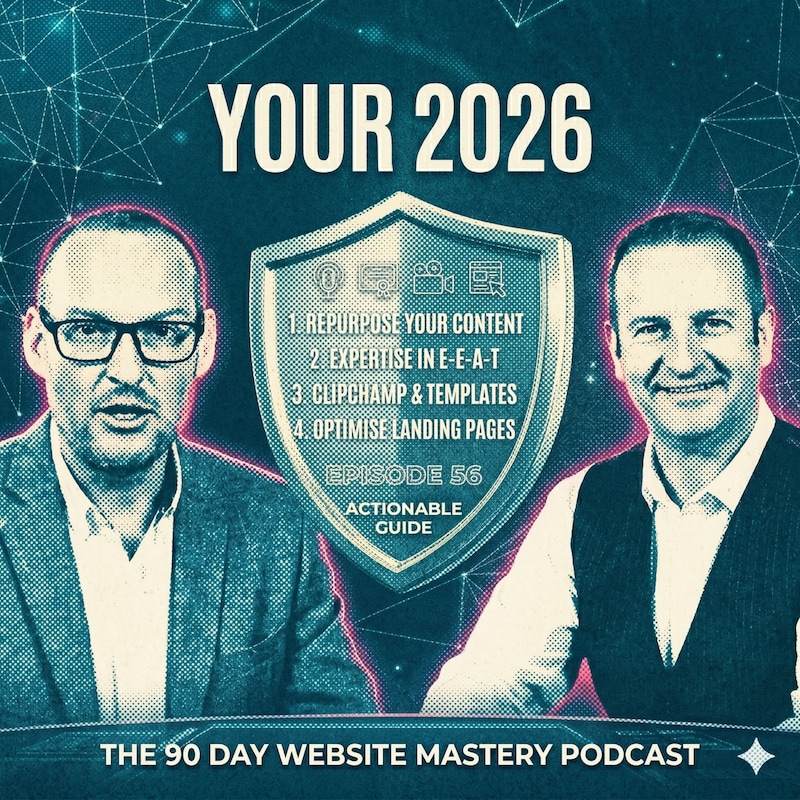
Shownotes
In this episode of the 90-Day Website Mastery Podcast, Jonny Ross and Pascal Fintoni explore one of the most underused growth tactics in digital marketing today: repurposing podcast interviews into long-lasting website content.
If you've ever been a guest on a podcast and let that hard-earned conversation disappear into the archives, this episode will completely change how you approach your content strategy.
The episode also continues the four-part mini-series unpacking Google's E-E-A-T framework — Experience, Expertise, Authoritativeness, and Trustworthiness — with a deep dive into Expertise, inspired by an excellent article from Mateusz Makosiewicz and Joshua Hardwick at Ahrefs.
Jonny and Pascal break down the crucial difference between experience and expertise, and explain how to demonstrate both on your website to win trust with visitors and visibility in AI-powered search results.
Plus, the duo shares two powerful new content creation tool discoveries, and rounds off the episode with two actionable website calls to action you can implement straight away.
❓ How Do I Repurpose a Podcast Guest Appearance Into Website Content?
Jonny and Pascal share a complete workflow for transforming one 45-minute podcast interview into months of valuable content:
- Request the transcript from the podcast host so you have a full reference document, plus access to audio and video clips.
- Embed the audio and video directly onto your website to demonstrate thought leadership and credibility.
- Create a dedicated "As Featured In" or "Appeared On" section showcasing podcasts, PR mentions, and speaking engagements.
- Write a companion blog post that tells the story of being invited and highlights the key takeaways.
- Use the "edit down" approach to create short extracts — clips for LinkedIn, YouTube Shorts, Instagram Reels, and Facebook posts.
- Use the "edit up" approach to expand on points you didn't have time to cover fully — write a deeper article, add steps, build a checklist, design an infographic.
- Pull out memorable quotes to create LinkedIn carousels and graphic posts.
- Pace yourself — set weekly repurposing goals rather than trying to do it all in one go.
- One 45-minute interview can comfortably deliver 90 days (or more) of high-value content.
❓ What's the Real Difference Between Experience and Expertise on My Website?
As part of the EEAT mini-series, Pascal explains the distinction with a brilliant analogy:
- Experience = "I've been driving a car for 30 years" (longevity).
- Expertise = "I'm a trained F1 driver who has won five championships" (credentials, depth, proven results).
- Visitors silently ask: Does this person have the skills, knowledge, and credentials — or have they just been doing it a while?
- Expertise is demonstrated through credentials, formal education, and a proven track record.
❓ How Do I Demonstrate Expertise on My Website?
Jonny and Pascal share practical, explicit steps you can take today:
- Expand your About Us biographies far beyond a couple of lines.
- Make qualifications, certifications, and trade body memberships visible, and don't let modesty hide them.
- Link out to authoritative sources, original research, and the membership pages of organisations you belong to (citations matter for SEO and GEO).
- Build genuine, deep FAQ pages and not superficial ones.
- Document and republish your speaking engagements and public appearances.
- On product and service pages, be explicit about testing, regulations passed, founder involvement, and real customer scenarios.
- Write expert buying guides that show genuine depth of knowledge.
- Cite experts and methodologies you respect within your articles.
- Organise your content into topical clusters to signal authority around specific subjects (for AI visibility).
Remember: your ordinary is someone else's extraordinary. Don't let modesty get in the way of explicit, helpful communication.
❓ What New Tools Can Help Me Create Better Content Faster?
Etsy Canva Templates (Jonny's pick):
Browse Etsy for affordable, downloadable Canva template packs.
- Search "social media templates" or industry-specific options.
- Templates come in cohesive families/packs which is perfect for brand consistency.
- Costs only a few pounds or dollars, and uploads directly into Canva.
- Solves the overwhelm of Canva's vast template library by giving you a curated set.
ClipChamp by Microsoft (Pascal's pick):
Microsoft's recently re-launched video editing software.
- Designed for simplicity, so perfect for quick repurposing without bells and whistles.
- Ideal if you're already in the Microsoft ecosystem.
- Strong contender for businesses needing to add more video content to their site without becoming a full production studio.
❓ What Quick Website Tweaks Should I Make This Week?
Jonny's Call to Action — Optimise a Key Landing Page:
- Pick one high-traffic landing page (especially one tied to ad spend or email campaigns).
- Step back and assess: Is the messaging clear? Does it look great on mobile?
- Review headlines, layout, calls to action, and the offer itself.
- Speak in your audience's language — align with your ICP and personas.
- Small tweaks can dramatically increase conversion rates, phone calls, and form fills.
Pascal's Call to Action — Embrace Long-Form Storytelling:
- Revisit your About Us page and biographies and go deep with long-form content.
- Use an AI assistant to interview you about your professional journey across multiple sessions.
- Create both a "TL;DR" short-form intro and a full long-form story.
- Add photos, videos, and supporting media to bring it to life.
- Long-form content gives AI overviews more snippets to surface you in the best possible light — a critical move for AI visibility in 2026.
🎯 Key Takeaways (with timestamps)
00:19 – Welcome to Episode 56 with Jonny Ross and Pascal Fintoni
01:31 – You Ask, We Answer: How do I repurpose a podcast guest appearance?
02:13 – Jonny's repurposing workflow: transcripts, embeds and "As Featured In" sections
03:58 – Pascal explains the "edit down" vs "edit up" content techniques 0
06:48 – Website Stories: Part 2 of the EEAT mini-series — Expertise
08:30 – The F1 driver analogy: experience vs expertise explained
10:57 – Being explicit, not implicit, on your service and product pages
14:46 – Citations, authoritative sources and topical clusters for AI visibility
16:27 – Website Engine Room: Etsy Canva templates and ClipChamp by Microsoft
20:47 – Jonny's Call to Action: optimise a high-traffic landing page
23:53 – Pascal's Call to Action: long-form storytelling for your About Us page
🔎 SEO Keywords & Tags:
repurposing podcast content, EEAT framework, Google expertise signals, About Us page optimisation, AI visibility, ClipChamp video editing, Canva templates Etsy, landing page optimisation, long-form storytelling, AI overviews SEO
--
👉 Subscribe to the 90-Day Website Mastery Podcast for more expert insights on SEO, content marketing, and website growth.
👉 Leave us a review — your feedback helps others discover the show!
👉 Book a discovery call: 90daymarketingmastery.com
👉 check our book "WebProud" on Amazon for more website mastery strategies
👉 Connect with us on LinkedIn:
About the Hosts
Jonny Ross is a leading digital marketing consultant and SEO strategist with decades of experience helping businesses transform their online presence.
Pascal Fintoni is a digital skills trainer and video marketing expert, known for making complex tech topics accessible and actionable.
Transcripts
Jonny Ross
-:Hello, welcome. It's the 90-Day Website Mastery Podcast, the perfect companion to our 90-Day Website Mastery Program and our recently published book, Web Proud, available on Amazon. It's episode 56. We're excited to bring you even more valuable insights and practical advice to help you enhance your website's performance.
Jonny Ross
-:Join us as we explore strategies to make your website work harder for you, reigniting your pride in your online presence. Pascal, hello.
Pascal Fintoni
-:Hello, everyone. Thank you very much. Listen, I've had a quick look at the show notes for today. I'm loving what we've done here by accident because, you know, we do work separately in preparing our own notes and ideas, but it's going to be a very much a content focused episode, very practical looking at different ways in which you can reconnect with the joy of content
Pascal Fintoni
-:creation, but of course, making sure that this serves you well in terms of appealing to your customers And nowadays, of course, Johnny, the AI overviews.
Jonny Ross
-:Let's get episode 56 going with You Ask, We Answer.
Pascal Fintoni
-:So this one is interesting, Johnny, because this is a question that I received via email. It could have been a LinkedIn message, sorry, from someone who came to the Notebook LM4 website masterclass. So we did that in Leeds, and it was absolutely a brilliant, brilliant participation from everyone. And I'm going to read it out, because actually, word for word, I think, makes a lot of sense.
Pascal Fintoni
-:And I hope I'm not going to put you on the spot, but this is what you and I love doing anyway, this idea of content repurposing. So here it goes. I've been a guest on a few podcasts, and during the masterclass and in a previous episode, you mentioned about repurposing the conversation into content for my website. Can you remind me how to do that?
Pascal Fintoni
-:So I'll see you, Jonny Ross.
Jonny Ross
-:Yeah, I mean, this is what we do most weeks, to be fair, because we repurpose this podcast. And whether it's our own podcast or whether it's a podcast that I'm a guest on, there's so many things that you can do to repurpose that content. So my typical workflow would be to take that podcast to perhaps get the transcript of that so that I've got what was said and I've got reference points. And I can either take cuts of the video I can I can take cuts of the audio or I can take take the actual transcript so they've got the actual copy and and those things are you know they're so valuable that you can turn them into so many
Jonny Ross
-:different things. So just as a starting point I mean you know you definitely need to be embedding this onto your website and say look I was a guest here this is what I was saying you know demonstrating that you were a a thought leader demonstrating your experience. But as a sort of starting point, you need to, you know, perhaps write a blog, embed the audio, embed the video. But then you could, you know, you could even have a section on your website where, you know, appeared in, and that could be any PR you've had, any speaking opportunities that you've had or any podcasts.
Jonny Ross
-:But for me, it doesn't stop there. There's just so much you could turn that into because it could easily turn into a LinkedIn article. It could turn into posts on Facebook or Instagram. You could cut it and create little shorts for YouTube.
Jonny Ross
-:But yes, as a really good starting point, it's, you know, the basic here is get it on your website, embed it, embed the video, embed the audio, talk about it on there, and even consider, you know, other service pages or products that actually would add some value by having that even on some of those pages.
Pascal Fintoni
-:Yeah, no, thank you very much. So I think you're right. And I'll start by, actually, the easiest way to say, as it is, your host, I would imagine, would have published this on YouTube, on Spotify and other. So as it is, you can re-embed that and just essentially tell the story of being invited, share a bit of the key elements that you've done and so on.
Pascal Fintoni
-:And that's kind of your first pass. And then what you can do then is what you described, which is kind of what I called to edit down. So that is to say to create extracts that can be used for different things. But then what I tend to do then, and what I tend to teach my customers, because repurposing suggests that you change sometimes the purpose of the content, not just the format of the content.
Pascal Fintoni
-:So you could, for example, realize that there was something that you shared that you had to do in a very succinct way. and you wish you'd had more time to expand. So what you can do, therefore, is almost write an article to say, listen, I was a guest. We had this exchange.
Pascal Fintoni
-:And since then, I've been thinking about it. And there's more. There's more that I want to share with you. Sometimes what I tend to do with the edit up is to add the steps or the actions that you should be undertaking.
Pascal Fintoni
-:So you and I could be a guest. We could be explaining, for example, how to repurpose content. Because we have to be sensible to the time we spend on the subject matter, we have to move on to the next thing. But actually, in a written form, you actually write, or as an additional bit of video or podcast, you could say, by the way, you know, I was explaining this bit.
Pascal Fintoni
-:This is how you do it. These are the steps you can do it. You can create a checklist after this. You can create an infographic.
Pascal Fintoni
-:You mentioned about extracts, and they could become pull quotes that could become a carousel on LinkedIn and so on. So the challenge in a way nowadays, because of the tech, it's so very easy to repurpose by editing up or down, there could be a sense of overwhelm. So what I would suggest people do is that they give themselves a goal of the essentials, and then maybe weekly, you kind of go back to it and do something because you could try and do all those things that we've listed, Johnny, in a day or in a morning, I think that's too much.
Pascal Fintoni
-:And actually, by pacing yourself, you will come up with better ideas anyway. So I tend to give my clients like a weekly target or in week four, we'll do this version of repurposing and in week five, we'll do this version. And suddenly for one 45 minute conversation, you could have three months worth of content by doing the editing down and editing up.
Jonny Ross
-:And that is exactly the point that this isn't just content for this week by any means. In most cases, you can easily get, you know, 90 days out of it, uh, or, or more or more. Uh, and so, um, uh, yeah, I love the, I love the idea of, of people thinking about not just editing, but editing down or editing up. Very clever, very clever.
Jonny Ross
-:Now then, what I've realised is that this episode is also part of a mini-series, and we're doing a four-parter, and let's find more out about that in Website Stories.
Pascal Fintoni
-:So as you alluded a moment ago, we started last time looking into the EEAT. So this stands for Experience, Expertise, Authority and Trustworthiness. And that's from the Google Search Quality Guidelines. Now, this was mentioned by you and I many a time, but we felt it was maybe time to go for something very, very clear.
Pascal Fintoni
-:And as good luck would have it, the team behind AH Refs, Mateusz Makusiewicz and Joshua Hardwick, have written a really deep dive article into it. The link is in the show notes. And so what we've done really is using that as a source of inspiration. We're breaking down each of the letters EE18 to a four-parter.
Pascal Fintoni
-:So last time we looked at experience and today we're going to be looking at expertise. And again, a massive thank you to Matthews and Joshua from AHRefs for almost starting this conversation. So, and the reason why we wanted to do this as well everyone is because actually, if you were to be put on the spot, What is the difference between experience and expertise? That's a tough one, really, because is it not quite the same?
Pascal Fintoni
-:Is it not, Johnny, a potato-potato moment there? And how do we use that? And frankly, how does Google use this? So Matthew has done an amazing job.
Pascal Fintoni
-:Imagine that you are a driver, a car driver, and you say, I have 30 years experience in driving a car. But actually, your expertise is the fact that you are a F1 car driver, that you've won six kind of, I would say tournament, that's not where they are, I can show my failing in terms of F1, five competitions, and you've been trained professionally by those individuals. So that's kind of the way, it's two sides of the same coin, but that's very much the difference. And when you think about expertise, the question a visitor could have when they go on your website is as follows.
Pascal Fintoni
-:Does the professional, does the business owner, have the skills, the knowledge, and the credentials, or they just got lucky and they've been playing with it for a while, which is kind of the experience? And you can't just go, yes, I do, by the way. You need to obviously expand. So how do you do that?
Pascal Fintoni
-:Well, it's all about credentials. It's about education. And it's about a proven track record. So many ways you can do that.
Pascal Fintoni
-:So all of you, you know this now, your About Us section has become so very important, and particularly if you're authoring the content on your website. So expand biographies beyond a couple of lines. i'm the organization johnny will have qualifications or the big members of trade bodies and i can things i think i took maybe modesty or no no what to do that usually in the future and the argument by matthews and google just make it very old make it more visible pops right about right about what does that mean to be a member of this organization i will be part of your expertise Going for, you know, deep content, not superficial content is very, very important.
Pascal Fintoni
-:You know, I've explained this many a time, an FAQ and a real one, a proper FAQ page on the website makes it very, very important. And oddly, we mentioned this a moment ago, if you've been speaking publicly, make sure that you retell, you know, that event, that moment onto your website as well. you kind of begin to see the difference between experience and expertise. You could say experience is about maybe the longevity, you know, how many times you've done this, but the expertise is a depth in which you can argue and demonstrate that that is the case.
Jonny Ross
-:Yeah, and whilst you were talking, I was just making some notes because one of the things that we're talking about here is not just the content that you're producing, but also the content that you've already got. And so the content that you've already got on service pages, on about pages, on product pages, How can you inject some of this EEAT, and today we're focusing on the second one, which is the expertise. How can you inject some of this into the content? And it's about being explicit.
Jonny Ross
-:So, you know, we have all this magic that goes on behind the scenes, but we don't always talk about it. And so we need to make sure that, you know, for example, in a B2C environment, that if we've done some testing on the product, that we're talking about that. We need to bring the founder perhaps into the product as well. i'm done talk about you know real customer scenarios or you know the building trust basically so this has been.
Jonny Ross
-:This product has been created by this particular this person and the sort of bio of that person understanding about that person and perhaps. Making sure that you've got a really detailed, well, you absolutely should have a really detailed about page, but going deeper into giving the founder a really clear voice so that people understand the why of how the business has even got there. And finally, just one thing, another thing I wrote down was writing expert buying guides. So being really helpful with the content, but going deep into, sharing some real good expertise in terms of you know if you if you're looking to buy this product these are the things that you need to be thinking about so yeah it's we need to be explicit that's
Jonny Ross
-:why i'm finding myself saying a lot at the moment when we took money it's about you know making sure that the sort of all the obvious stuff that we know about. I was talking to a food manufacturer selling online, and they haven't even considered, so they have passed many food regulations, but in the content, they don't really mention it a great deal, because for them, that was what we had to do. Well, we couldn't create a yogurt until we'd done that. And, and yes, you might mention it somewhere on your website, but are you being explicit enough on, on, you know, all your pages?
Pascal Fintoni
-:Do you remember when, because that feels to me like, you know, what, what we're saying is. This is what you would do face to face. If you were to, to have a conversation with a client who was interested generally by your business, about the, why, about the, how you do what you do, uh, in a case of food, you know, that could be something very important by the provenance of your, uh, and the supply chain and all those things that is your day to day.
Pascal Fintoni
-:something that you and I used during the masterclass sometime, you know, which is as follows, your ordinary is someone else's extraordinary. And the hardest thing for all of us in business is to try not to let modesty get in the way of, you know, good content and communication, but also to get to the habit of what is bleeding over just to you is actually probably one of the most important bit of information you should be sharing on your website. Because remember, you know, the role of the website from the visitor's perspective is, are they worthy of my time?
Pascal Fintoni
-:Or should I go and look elsewhere? So if you are implicit, as opposed to explicit, as you heard Johnny say a moment ago, you may be losing out on very, very important interaction. Just very quickly, Matheus and Joshua recommended a couple of things which I thought was very interesting, because I have forgotten about those, if I'm being honest. So as part of your content effort throughout the whole website, they were saying actually, Google will pay attention as part of expertise to links to authoritative sources and original research to substantiate your claims so if people are vouching for you if you are for example joining a member
Pascal Fintoni
-:of an organization and you have a page on the membership site you should link to that page so that's what we call call citation in our SEO GEO parlance. Obviously, oddly, if you are writing articles citing experts, you know, methodologies and quoting experts that you look up to is helping your expertise as well, which I thought was interesting, and something that you're a massive, massive fan of, Johnny, organizing your content into topical clusters.
Jonny Ross
-:Oh yeah, absolutely. If you want to be seen as the expert, well, if you want to be found in AI, AI visibility, then you need to create clusters around some very important topics that relate to your business. And so it is about the depth of content, and it's about making sure that we're continually using that EEAT framework. So yeah.
Jonny Ross
-:I like that we're doing this over the four episodes, giving it the breadth that it needs and going into them. So we covered experience last week, expertise today, and then I assume in the next one, we'll be doing authority and then trust. We will indeed. Thanks, Pascal.
Jonny Ross
-:Let's move on to our next segment, the website engine room.
Pascal Fintoni
-:Now in this segment of the show, Johnny and I surprise each other with a new discovery from the interweb, something that can make life easier as a content creator or website manager. What is your discovery, Johnny?
Jonny Ross
-:Well, I was looking on Etsy, as you do. I do not.
Pascal Fintoni
-:I like Etsy.
Jonny Ross
-:I like, what, what do I find? I find that you can buy convert templates so you can, uh, you know, for, for a really small amount of money as well. Um, so there's lots of social media and blog graphic templates and, and even for certain sectors and certain industries as well. And we're talking, you know, only a few, few pounds, few dollars.
Jonny Ross
-:Um, so. My advice is if you're looking to spruce up your social media presence, the look and feel of what's going on on your social media, or even your blog graphics, have a look at Etsy, the shopping platform, and type in something like social media templates. And you'll find packs that you can literally download and upload into Canva. with hundreds of different templates for just a few pounds or dollars.
Jonny Ross
-:And yeah, that was my find. I highly recommend having a look at it.
Pascal Fintoni
-:Do you know what's interesting is, in a way, someone could say, well, why bother? Because Canva gives me all the templates. But you've got two issues. Sometimes there's overwhelm.
Pascal Fintoni
-:And I, yesterday, was delivering a master class on video marketing and AI. And I didn't mention Canva. And I didn't mention the template and so on. But when people had a look, they went, oh my goodness, there's a lot there.
Pascal Fintoni
-:And in a way, sometimes it's a bit like when you go to a restaurant and the menu is vast and you can't make up your mind. Well, I think with Etsy, and you're right, the cost can't be that punitive, you make a decision to go for that family of templates and they become yours. And I've got a feeling that would work well for some people.
Jonny Ross
-:And you're absolutely right, it's a pack. And what was most interesting was that there's some different sectors and industries on there specific to potentially your business. And that was for me, the really interesting bit, because what you don't find on Canva is things like that. And there's just sort of everything and anything on Canva, and you don't have that, what you've called family or pack, so.
Pascal Fintoni
-:Thank you. So for myself, I'm forever on the quest for mobile phone app or laptop solutions that will help you edit video clips easily. It's been kind of for years and years and years because for the vast majority of our customers, Johnny, they don't have the aspiration to be a film producer or videographer or video production company. They just need to get things done fast.
Pascal Fintoni
-:Now with mobile phones, people will know by now I'm a massive fan of Quick by GoPro. But I was very surprised to discover via a newsletter that Microsoft have re-re-re-launched their video editing software. It's now called ClipChamp, as in clip, video, clip, and then champ, I'm guessing champion. And I had a quick look, and I love the simplicity.
Pascal Fintoni
-:It's almost back to what we were saying a moment ago. There's not too many options to kind of get you to waste time. And I think that that should be a strong contender if you want to add more video content and you need to do the kind of repurposing that Joni and I mentioned a moment ago, and you don't need all the bells and whistles of a pro kind of editing solution.
Pascal Fintoni
-:And if you're very familiar already with Microsoft packages, it feels like to me it should be part of your toolkit. So that's ClipChimp by Microsoft.
Jonny Ross
-:Fabulous. Yeah, I mean, you know, there's lots of tools, but sometimes, especially if you're in that Microsoft ecosystem, it does make sense to be using tools in that ecosystem. I find it with, you know, I'm deeply immersed in Google and, you know, yeah, it makes a lot of sense. Good find, Pascal.
Jonny Ross
-:Thank you. Nice one. Let's take us to our final segment. We always finish with a call to action.
Jonny Ross
-:Of course, you have to. Content has to have a call to action. Here's our call to action, the website call to action.
Pascal Fintoni
-:This is about the one change, the one adjustment you should be making right now to your website. Jonny Ross, what is your recommendation?
Jonny Ross
-:Well, when did you last have a look at your landing pages? I would suggest pick one key landing page where you're hoping, either hoping people land, or you're paying for people to land. So perhaps it's a Google Ads campaign, a Facebook campaign, you know, some type of email campaign. Where are you sending people to?
Jonny Ross
-:Where are you hoping them, where they land? And I want you to Really stand back from that page and think, are we giving the right message? Does it look good? Are people arriving to it on mobile?
Jonny Ross
-:What does it really look like on mobile? And are we making it easy to really understand what the offer is, what the product, what the service is, and why they should buy it? And are you talking in their language? So pick one high traffic page.
Jonny Ross
-:Think about the layout think about the headlines think about the call to actions and think about. How you gonna what we call squeeze people into the funnel the right people talking really understanding your icp your personas the target audiences and think about you. what little optimizations can I make to that page that's ultimately going to increase the conversion rate. And it's amazing by just doing a few tweaks on a page like that, the difference that you can make in terms of getting more phone calls, getting more contact form fills, or getting more emails, and ultimately turning that into customers or clients.
Jonny Ross
-:So yeah, optimize a key landing page.
Pascal Fintoni
-:Thank you, Johnny. And you know, what's interesting is I have this conversation with clients where what has happened is, you know, they put a lot of work into the website, all the pages, including the landing page, and therefore the landing page for launch, I would say it's functional. There's nothing that is bad, but it's very, very functional. And I would say to them, you know, give yourself a break now, because you've been working so hard on this website.
Pascal Fintoni
-:Go back a few months later. and walk in the shoes of a first-time visitor and how does it feel and get feedback from people use AI and you and I actually do this on the notebook LM4 website masterclass where we get you know a critique of some of those key pages because you'd be quite surprised those small adjustments but once you've done all that I think the ultimate way to optimize is to have a welcome video add to deal with what we call the fear of the unknown and you and i tackle this a lot don't we we say okay so that you know if there is one reason why people are not going ahead with whatever the request is on this page is because actually deep down they're still not sure what's going to happen when they do And the best way to tackle that is to tell them.
Pascal Fintoni
-:Now, if you're a bit camera shy, you can still write it. You can just listen. We understand, ideally, a welcome message from you to explain what happens once they do go ahead. It's going to transform that landing page.
Pascal Fintoni
-:So you're right. And that's the role of being the website manager, is to give yourself moments in time across the year to go and revisit those key elements of the website. Oh, so important. What's your call to action this week?
Pascal Fintoni
-:Well, actually, this one was written before I received the question from a very good friend about repurposing and that kind of things. But for me, I want people to revisit their biographies, their about us sections, and so on and so forth, and actually go for long form storytelling. Now, we're going to hear very quickly, people say, no, no, no, Pascal, we can't, because people don't like long form. I said, well, you don't know that.
Pascal Fintoni
-:And if I may be as blunt, John, if you read Webb Pround, the book that John and I have co-authored, you'll know that there are some archetypes that do favor long form anyway. I'm looking more for the AI overviews because the more you tell your story, the more snippets AI overviews can borrow to present you in the best possible light. It's been absolutely fascinating to see the behavior of the AI mode on Google over the time. So my recommendation is actually, because this is harder to do than you might think, is to actually use your AI, your digital assistant, to interview you literally you know you're going to craft um your prompt in such a way there's going to be an interview you may want
Pascal Fintoni
-:to do it over a number of sessions so that the um ai has your professional and career kind of journey and then can start to put together two things the short form almost too long did not read moment at the top of the abandoned section but then below would be your full journey that you can then supplement with lovely pictures and videos but Telling your story in full, that's what I'm doing next week with my web design agency. And I think it's enjoyable, because you'll be surprised, all of you, how much you've done already that you're not telling the world.
Jonny Ross
-:Nice. Long form, definitely. You know, I'm always thinking about AI visibility and that's ticking a huge box. So, yeah, I like that.
Jonny Ross
-:Well, this was part of our mini-series exploring the EEAT framework that Google has has been talking about for quite a while and this week was number two the expertise and we'll be going into authority and trust in the next podcast coming up but yeah we also covered repurposing i mean so you know we spend all this time you know these people asked you that question They will have been prepping, they'll have been panicking. Some of them haven't been on camera before. Some of them haven't been on audio before.
Jonny Ross
-:They'll have spent a lot of time preparing, thinking, what should I say? They'll put all that work in. They'll do the podcast or the audio and then business will carry on and they'll move on to the next thing. Repurposing is so important because all of that work and energy that you've done can turn into so many things and what you don't need to do is then think about, you don't need to create all that energy again because you've already got it there and it's about repurposing
Jonny Ross
-:it. So, you know, we highly, it's so important, isn't it? So valuable. Thanks, Pascal.
Jonny Ross
-:It was, you know, we've covered lots again.
Pascal Fintoni
-:We did indeed, yes. Looking forward to the next one.
Jonny Ross
-:That is a wrap for episode 56 of the 90 Day Website Mastery podcast. Your audio companion to the 90 Day Website Mastery program. For more information, visit 90daymarketingmastery.com where you can book a discovery call with myself or Pascal. It's goodbye for now.
Jonny Ross
-:Thanks if you were joining us live. Thanks if you were listening on the podcast on the replay. However you joined us, we are delighted you were here and let us know what you think. We'll see you all soon.
Jonny Ross
-:Take care, guys. Bye-bye.



