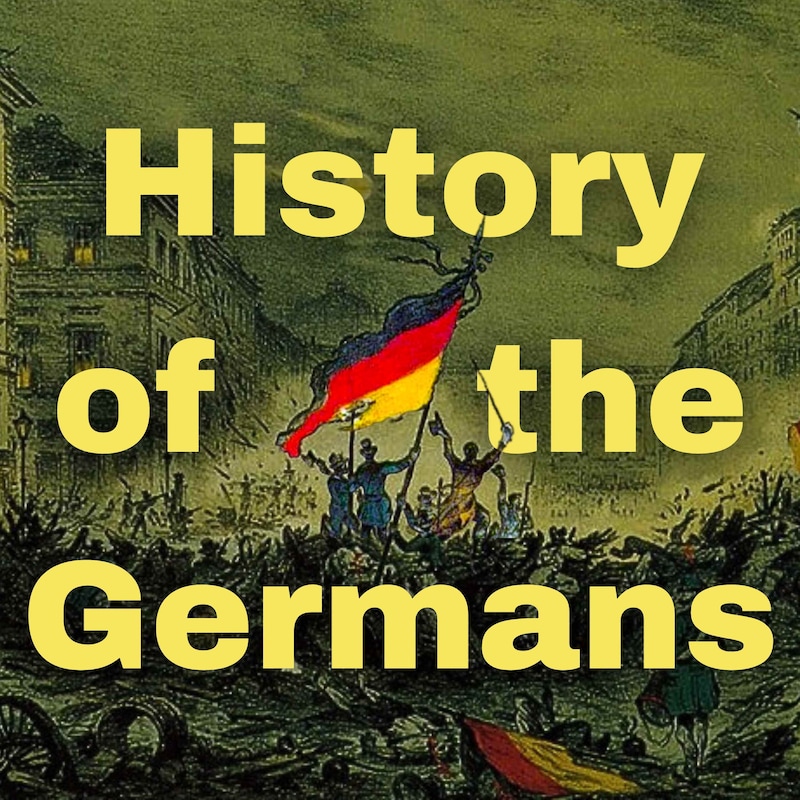
Hello and welcome to the History of the Germans Podcast, the podcast that does exactly what it says on the tin. What you get here is a narrative history of the German people from the early Middle Ages to German Reunification in 1991 in 35-40 minute episodes coming out every Thursday.
We are 200 episodes in, but do not worry, you do not need to listen to all 200 for it to make sense. The show is now split into seasons which are almost stand alone. So you can listen to any one of theose and skip the rest. Let me tell you a little bit about these season....
The music for the show is Flute Sonata in E-flat major, H.545 by Carl Phillip Emmanuel Bach (or some claim it as BWV 1031 Johann Sebastian Bach) performed and arranged by Michel Rondeau under Common Creative Licence 3.0.
To make it easier for you to share the podcast, I have created separate playlists for some of the seasons that are set up as individual podcasts. they have the exact same episodes as in the History of the Germans, but they may be a helpful device for those who want to concentrate on only one season.
Why would you want to come along to this journey? Can German history reach places, other histories cannot? Oh yes, it can.
Geographically Germany sits in the centre of Europe sharing borders with Denmark, Poland, Czechia, Austria, Switzerland, France, Belgium, Luxemburg and the Netherlands. And if you take the Holy Roman empire, which is a major feature of German history there is also Hungary, the Polish-Lithuanian commonwealth and Italy. The Hanseatic League was active in Norway, Sweden, Russia, Lithuania, Latvia, Estland and England. The Habsburgs ruled Spain, Portugal, South America and the Balkans.
As we follow the continuous exchange of projectiles, peoples and cultures we will not just get a better understanding of German history, but also Austrian, Swiss, Dutch, Belgian, Italian, French, Danish, Czech, Polish and Hungarian history and lots more besides.
Basically German history is European history. It features pagans, popes and protestants, emperors and hermits, warriors and writers, merchants and megalomaniacs, and – not even all of them are Germans.
In terms of style, I am modelling myself on Mike Duncan’s History of Rome (aren’t we all), Robin Pierson’s History of Byzantium, Jamie Jeffer’s British History Podcast, David Crowther’s History of England and others, who have created and shaped an entire genre. Where we differ though is that it being German the podcast is entirely devoid of humour. Nada, zippo, zilch!
The other specifically German thing is that you cannot look at its history without reference to the moral abyss this country entered into - by and large voluntarily and with the tacit and sometimes not so tacit support of most of its population. It will be a long while before we get there, but we will.
As far as the current episodes are concerned, I want to tell the stories of the events as they happened and -to the extent that is at all possible – through the eyes of the people who were there at or near the time. I am a believer in the philosophy of the great Gregory of Tours who observed in the 6th century that “a great many things keep happening, some good, some bad”. History has no purpose, aim or natural outcome. But unfortunately, historians, and German historians in particular have a habit of harnessing historical events to prove the inevitability of their current regimes, be it the Kaiserreich, the Nazis, the GDR or the Bundesrepublik. Hence, we will from time to time look at how protagonists or events have been perceived through the centuries and their stories altered. Something that can be almost as fascinating as the actual history itself.
Each episode will be between 20 and 30 minutes long and should be published weekly, normally on a Thursday. The podcast will run in seasons, and I may take a few weeks of rest between seasons to recharge and do research.
Season zero is the Prologue, where I give a super rapid rundown of the earlier Germanic history from Julius Caesar to Charlemagne. The reason I skip this period is mainly because I can. I am just simply not very excited by Germanic hordes running here or there, creating oddly named states that disappear as quickly as they have appeared.
cuses on the Salian emperors (:
In the following 3 season we looked at events in the northern parts of the empire. Season 5 (episodes 95-108) deals with the eastern expansion of the empire as German settlers cross the Elbe in the 12th century to make a living in these former Slavic lands. Season 6 (episodes 109-127) looks at the Hanseatic League, the association of merchants and cities that dominated the trade in the Baltic Sea for centuries. Season 7 (episodes 128-137) takes on the Teutonic Knights whose conquest and reorganisation of Prussia remains a cornerstone event in Polish-German history.
that starts in Autumn:
ue bit of German history, the:
So come along and listen. Either start the whole show from the Prologue episodes onwards, or, if you are only interested in some of the seasons, I have released each of the seasons as a separate podcast. You can find links to those in the show notes. You can listen on any podcasting platform or on my website, historyofthegermans.com which has all the transcripts, maps, book recommendations and lots more.
And – the show is entirely advertising free thanks to the generosity of our patrons who have signed up on historyofthegermans.com/support