Shownotes
What if heading toward the hardest part of life—your “rocks”—was the key to real momentum and peace?
Olympic gold medalist Joe Jacobi joins Michael to talk about how navigating literal whitewater rapids reveals the deeper truths about resilience, perfectionism, and starting again. Whether you’re in recovery, midlife transition, or simply feeling stuck, this conversation offers a new way to look at growth—by embracing the current rather than fighting it.
- Discover why start lines are more important than finish lines, especially when beginning again
- Learn the power of “course correction” and why adapting beats perfection every time
- Find out how to create your own version of peak performance—especially in midlife
Take a deep breath and discover how to release perfection, embrace the current, and find your own flow with Olympic-level insight and heart.
Receive my free text messages by texting Whole Again to 866-612-4604
Did you know that stickers are wonderful visual cues to help you create healthy habits? You can get one of my free Pause Breathe Reflect stickers by clicking sticker.
To discover more and sign up for My RIPPLE EFFECT newsletter by clicking Ripple Effect.
We can also connect on LinkedIn. or at [email protected]
Subscribe to be sure you don’t miss any of the micro-meditations, wellness tips, and guidance that I publish every Monday, Wednesday, and Friday at 7:11 am.
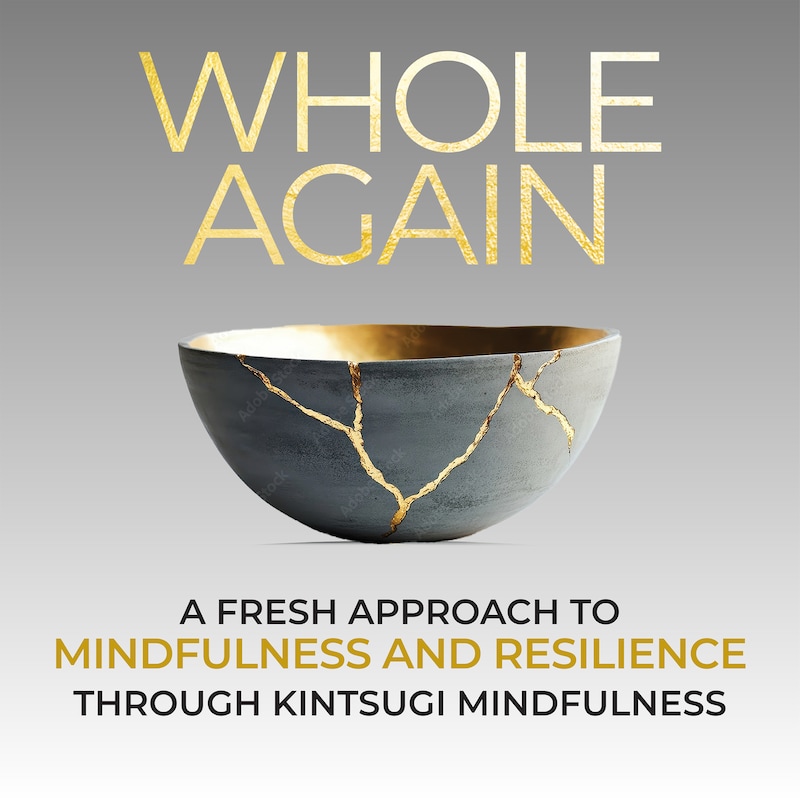
With Whole Again: A Fresh Approach to Healing, Growth & Resilience after Physical Trauma through Kintsugi Mindfulness, listeners explore resilience through personal stories of trauma, scars, and injury while learning to overcome PTSD, imposter syndrome, self-doubt, and perfectionism with self-compassion, self-love, and self-worth. Through insightful discussions on building resilience, resilience building, resilience and fitness, fitness and resilience, stress management, mindfulness practices, and digital wellness, the show offers practical tools like breathwork, micro-dose meditation, grounding techniques, visualization, and daily affirmations for anxiety relief and stress relief. Inspired by the art of kintsugi, the podcast embraces healing as a process of transformation, encouraging a shift in perspective from worry and being overwhelmed to gratitude and personal growth. By exploring the mind-body connection, micro-dosing strategies for emotional well-being, and holistic approaches to self-care, this podcast empowers listeners to cultivate emotional resilience and live with greater balance and intention.
Transcripts
this episode, you'll discover why heading towards the rocks is the best way to go downstream. Hey there, it's Michael. During the early days of my recovery when I was still in the hospital, my wife would bring me lemonade with lunch. Besides being super delicious, it was a reminder that we can take lemons and make lemonade.
And we are gonna do just that over the next seven weeks on our Friday episodes. During this period, I'm going to be helping one of my family members recover to help them feel whole again. That's the lemon part of it. The lemonade is. It gives me an opportunity to reintroduce to you some of the amazing guests I had on the podcast when it was known as the Kintsugi Podcast, and in this episode I'm so happy to share one of them with you with.
But before we get to the episode, I first wanna say thank you for being here and thank you for being a survivor. And as I've mentioned over the last couple weeks, if you wish to receive those great text messages that are just the right message at the right time, and they're all free. Will text me whole again to 8 6 6 6 1 2 4 6 0 4.
I'll say that one more time. 8 6 6 6 1 2. 4 6 0 4 and I'll set you up. Now let's get into today's episode. I sat down with Joe Jacobi, an Olympic medalist from the Barcelona Games, right around the Paris Games. He is a fantastic human. Such great energy. I know you're gonna love this conversation. In it you'll discover why heading towards the rocks is the best strategy as we go through life.
Why start lines are actually better than finish lines, and how to let go from the whole notion that we need to be perfect. So if you're ready to discover these three gems and more from Joe. Take a healthy breath in and a slow releasing breath out and get to know Olympic gold medalist. Joe Jacoby.
Joe, good to see you, my brother. How are you feeling?
Michael? It is so great to be here. I've been so excited about this conversation. Let's get into it.
So as we sit here, the Paris Games are going on. I know you just got finished up watching the canoe competition, your Yeah. You know your history. Yes. I would love for us to start our conversation.
I, I would love for you to bring us to Barcelona and the Barcelona Games and you and your partner Scott, are right there at the start line. Yeah. Can you share with us what was going through your mind at that time or. In addition, your body.
I love that you are starting with this question because so many people wanna talk about the race and talk about the finish line, and one of my mantras in life, Michael, is start lines over finish line.
I think how you are when you cross the start line is what matters, not how you are when you cross the finish line. So Whitewater canoe slalom is, this is interesting in that you're navigating wrap Whitewater River Rapids, which is challenging enough, but in the slalom, you're navigating. These sets of poles called gates and you can't touch the poles with your boat body or paddle or you get penalty seconds at into your time and it's just one boat down the course at a time.
So to your question about the start, before you get into all the action, get into all the chaos of the river. Every athlete gets at least 60 seconds in the start line in this just quiet, peaceful place. And. You just strip down all of the bravado, the talk, the uniforms, it's, you are like naked in the start is, that's the best way to describe it.
But I also describe that area. It's the most, some of the most sacred space on earth that I've ever experienced in my life. It's 60 seconds of just. It, it can be if you're prepared for it to be really serene. I found it to be just a part of that 60 seconds to be wrapped around gratitude and like just a moment of gratitude and thankful for the people who helped to get me to that place.
And then part of that time was really spent thinking about this connection with my doubles canoe partner, Scott STRs Ball, and then. I think you have this moment, at least we did when we crossed the start line. It was about five seconds, six seconds of sprinting across flat water before you dropped into the Whitewater River Rapids, and.
had won a bronze medal in the:And I remember we were having a team meeting before the games and we were just, I, every time Jamie talked, you just soaked up whatever he said, but he always used to say that. Crossing the start line is like a relief. Even at the Olympic Games where you're there to really nail this really big performance.
But he said there's just something about starting and just getting going, that it's just like you can breathe again and then you start to work your way into the course, and then the race unfolds as it unfolds. But that's what the start line really looked like to me. And because of having had that experience, you can look outside my window where I live in La Deje, right?
I live next to the 92 Olympic venue, and you can see that same start area. And when I'm talking to leaders and I'm talking to people like I'm obsessed with how they start. I am obsessed with how they create that little bit of kind of sacred space around them before they go out and do what they want to do with intentionality and focus and with some purpose.
But I, I don't think it just happens. I think managing that start is really important.
Absolutely. I think start lines are a place of courage to pin a number. Love that. And. You're right there. You're towing the line, if you will, to pull from track and field. You don't know how the race is going to unfold.
You've put so much into your preparation. It takes courage then to show up and say, we're gonna do this. So as you and Scott are there, what were your goals? Because. In popular culture, especially here in America, it's like we're gonna go for the gold medal. But we also know intellectually a whole bunch of athletes.
I think there are 11,000 athletes in Paris right now. Some are just tickled pink that there, they're actually at the games and they just want to compete and they wanna represent their country and a small percentage of those athletes. Have a chance to win gold. Where were you guys? What was that thought pattern?
Because as kids go growing up in this sport, I imagine you had dreams about being an Olympic athlete and being on the top step of the podium.
We should circle back to that in a moment about what happened today, and if you wish to further enhance your digital health, I'll invite you to take my smartphone wellness check and you can access it through the link in the show
notes, or you can visit my website, any of those, which is Michael O'Brien shift.com.
And it's absolutely free. It'll help you scroll less and learn more.
Of course, I
hope you'll join us here and whole again every Monday, Wednesday, and Friday, and discover how to heal and become more resilient and celebrate our scars as golden symbols of strength and resilience.
We certainly did that as well.
Until then, realistically results, look, you can always come back to your breath. We were good. We were, you've got this consistent, we had a lot of top five. We've got results, uh, world Cups World Championships. We had won a World Cup race. We had medaled in the United States. We had medaled in Europe in World Cup races.
We had a lot of good, we had won. The thing was there were two boats from one from Czech Czechoslovakia. They were still together at the time, and one from France. They were just. Killing it the whole spring leading up to the nine two Olympics. So they were favored to take gold and silver in some way, shape or form.
doubles canoes in the:And the thing is, I can't control the other 16 performances like it did. We had no, we had worked with sports, a sports psychologist around a couple of different is issues, but one thing that was just so apparent to Scott and me was that it's a bit, it's a bit crazy to set goals that you really can't control.
So the only goal that you really can control is your own performance. So this idea of going and doing the very best you can do. Sounds a little bit vanilla, but it's not. I mean, it's just like you're, this is what it's all about, is like all you can do is do what you've practiced to do and what you're capable of doing and really try to bring out your best on race day and race to your potential on race day.
And we did a really good job of that.
What I hear in your answer, Joe, and I'm not sure if your sports psychologist referenced it in this way. But it was outcome detachment. You had a goal, you put that goal out. There could be a medal, right? We dream of medals, but then we back away from that goal. And what I hear you sharing is in that moment, that one paddle and then the next paddle or the this gate, we're gonna focus on how we navigate this gate.
Right, and we're not gonna get too far upstream, and we're not gonna go back upstream regretting how we went through the landscape, but the whole concept of having goals and then easing our grip on the goal, so you can be in the moment to do the very best you can. I,
I love that expression, outcome, detachment.
I just, I wrote it down and I would say, I don't even think it's, I think if you can, it's even more so than just. Loosening your grip on it. I think that peak performers let it go. I don't think there's some part inside of you that's not gonna forget that you really would like to win if possible. You're not gonna forget how to do that.
But I think you could look at the Tour de France. I don't think it does anyone any good to sit there and just wish the yellow jersey onto themselves at some point. They've gotta be tactical and run out. A strategy, they gotta do something that's within their control. They gotta make their moves that are designed for them.
And the same thing at the Olympics. I think that's what the best people do, is that they let go of the goals and they trust. Just because you're not obsessing, you're not like looking in the mirror saying a hundred times I'm gonna be an Olympic gold medalist. I'm gonna be an Olympic gold medalist. That wishing that on yourself is not gonna move you closer to it.
And I think you're right. I think it's letting go of it and it's so counterintuitive, but that opens up the space. To then start taking steps and really figuring out where you're gonna push up, where you're gonna take some rest and kinda let go a little bit and take a, recover some energy and yeah, I think that's the way that gets done.
I don't think anyone does it by just talking and thinking themselves into it.
I totally agree. I, this is one of the hardest concepts I've had to. I was gonna say master, but I haven't mastered it. But yeah, just trying to dance with it because with a lot of the people that you work with, current day and a lot of the people I work with current day, there is, there are clear goals, KPIs, key performance indicators, smart goals for performance reviews.
We're so goal oriented, we can really latch on onto those. In a lot of ways it helps guide people, but it can get us too far out in front of things so we lose the present moment. So you guys are gold medalists, so. Going in. You weren't favorite as you just mentioned, right? So what was the key for you guys?
How, how did you do it? Give us the tee. Joe, how did you win the gold?
It's so interesting. We were not the biggest. We were not the fastest. We were not the strongest. There were people who had us beat in that category. What we ended up doing is we ended up correcting mistakes better. And more quickly and just, just more on top of that than the other boats in the race in the moment, or as Michael O'Brien might say, we put the pieces together, back together a little bit more quickly before other people did when we made mistakes and we anticipated mistakes a little bit better before they happened.
And. It's really easy to talk about that where someone says, and they're thinking about the application of that to their life, to a relationship, to performance at work, to their re even recreational athletic pursuits, but. Uh, uh, we're living proof that in certain situations like that can be good enough to win a gold medal at the Olympic Games.
And so specifically what happened in our race, Michael, was that the athletes in our sport at the time, the rules. Then you got two runs down the course and they take the faster of the two runs. So after the first run. We had a huge lead. We had a six second lead on the rest of the field after the first run.
So those top boats, I, I don't know, they were nervous, but they just didn't get the performance they want. We got a pretty good one and six seconds up. In a two minute race, that's like being 30, 40 points up at halftime in a basketball game. Like it, it's a big lead, but you gotta start over and do it again.
And I write, there's a chapter in the book that I write in my book, slalom, which is less about us, but and more about navigating the river of life. There's a, it's called the Anatomy of Bold Coaching, and it tells a story of the, what our coach did in between runs, and instead of just taking this very congratulatory way with us, he had us, he cleared out the US team tent and it was just us.
When we got there, we thought something had happened and everyone had gone home. And he comes in and he slams the clipboard down on the table, makes this loud th whack. And he's, I'm sure you guys are happy, but let me tell you something. If you don't figure out a way to improve that second run, you guys are not gonna leave here with a medal today.
But he goes, I counted five mistakes here on my clipboard, and if you're ready to fix those five mistakes, he goes, I think we'll get a better run out of you guys on the second run. And we're, that just took us from. Way up high, Michael, to just bringing us back down quickly. And it was such a bold move by a young coach to do that and to have that trust, that emotional trust to do that with us.
reset everything. And at the:And had we not improved. We would've dropped to the bronze position too. So we were the only boat at the 92 Olympics to win both runs and we, it was a really big credit to our coaches, but it was all about correcting mistakes. And as Michael O'Brien would say, putting the pieces back together.
There's so much goodness in what you just shared.
I love what your coach did. Yeah. Because you could have, maybe not at the moment, you who knows you. It was, but yeah, a little deflated because you guys are on a high. But this whole notion of going after incremental or marginal gains as a way to continue to shape your craft and get closer to mastery and that gold medal.
For a lot of folks out there moving it from the Olympics to just everyday society.
Yeah, we can
make a lot of different marginal gains, just small, little adjustments that can make a huge difference. The other thing I loved what you about what you shared was this whole concept, of course correcting often in life and often in sport, we visualize great success, that everything's gonna go smoothly.
Yeah. And we know though intellectually that things don't always go as planned, right? I think Robert Burns wrote the best laid plans of mice and men often go awry. Yeah. And so when I rode my bike across the country, part of my visualization was to visualize things going wrong and how I was going to respond to them.
And that's not being pessimistic, that's just being honest and realistic. Maybe pragmatic that things are gonna go not as planned. And so if you can meet those moments with a little bit more grace, then you can prevent, I guess my language, a bad moment from turning into a bad run or a bad day, or even longer.
I think. I love that. I think. This is a really hard, I think you're right. I think this is a really hard one for people. I think people are really trying to visualize perfection and like what the really good days look like. And I don't know that we have to imagine every bad scenario that might happen to us, but I think what it, what I try, the way I try to approach it is.
How can I just be more ready for a, a variety of responses, like a number of different responses, so I'm not trying to predict what's gonna go wrong as much as like, how can I practice in small, very minimally consequential ways to course correct and ways to fix things. And I think that. You'd be surprised, like I think in our heads we wanna go to the biggest things that could go wrong, and the reality is that there's all these little things happening to us when we get on the road and drive a car.
It's, I mean, isn't it what we're doing? We're just course correcting the car a little bit and how we respond to things around us, and we don't always get it right. Sometimes we get it a little bit wrong, we hit a curb or something and it's, oh, it's like an alert and it's how you respond to that. But I, people really hold onto this idea of something being perfect.
That is a really grippy way to go through things. And I don't think in the end that helps anyone's performance, that there is that idea of letting go, loosening that grip, letting go of the big goal. You're not gonna forget what that is. And then you're just a little bit, you create a little bit better disposition to bring out a variety of different response responses in a variety of different scenarios.
That's a, a place I enjoy being.
I really appreciate what you said about perfection. 'cause you often hear from sports commentators really around the Olympics. That was a perfect run or that was a perfect routine and the athlete knows that there are probably many flaws or imperfections in the routine, but they were able to course correct as you guys did back in 92.
Yeah, to turn it into a gold medal performance. And I love the analogy you've made with your sport as it relates to life. So I wanna transition now from your sporting world, your gold medal performance to life, because your sport much like cycling my sport, yeah. There are no timeouts like. It keeps going.
The river keeps flowing. I use that all the time,
by the way. Yeah, there's no timeouts.
There are no timeouts. Like you're in the rapids. The river keeps on flowing downward, downstream, no timeouts outside in, in all the conditions. Much like cycling in a bike race like the Tour de France or no timeouts.
They're doing it outside in all the elements. And so how do we then use this analogy when we think about life? Because with life, the river keeps on flowing downstream. How can we better navigate the river, navigate all the different gates that may be popping up in our way? So
I, yeah, I love this. I think there, there's a lot to this.
Is that. I think the first thing that, a couple things come to mind for me as you ask the question, and there really are a lot of ways to to answer this, but the first thing that comes to mind is that I think sometimes. Is how we believe the river is going to behave, especially in the future. I think we always believe that like Killer Death Fang Falls is right around the bend and we're gonna go over this a hundred foot waterfall and we're all gonna die and we, we don't have any paddles in life jackets, and we're gonna land on rocks and that's the end.
And in reality. The best predictor of the water that's ahead of you is navigating the water you're on in the present moment. Usually what people are, I think are most scared of is not that. This idea that they're headed towards a horizon line with a hundred foot drop off below it. But I think most people, in reality, they're just navigating a bend in the river and they can't see around the bend.
No one can, you cannot see around the bend of a river. But the best way to navigate the bend is to be as present as you can on the water that you're on in the moment. That will actually. Put you in the best disposition to create the most speed, the most opportunity, the better dis disposition. You can always cut back speed that you don't want from the river, but it's very hard to get speed that you don't have from the river.
And so you can only do that by being present on the water where you are. And then secondly, the other thing that comes up for me in your question, so it's a river of life thing is. The rocks in the river. I think when we were young, we, when we were kids, we liked playing with mistakes. We didn't know any better.
We didn't have the, the reference, and then we started to get scared of the rocks. And then what The problem is, Michael, in navigating the river life is that we get so. Put off by the rocks in the middle of the river is that we start going way over to the side of the river where it's these little SHOs and the water is so shallow and you can't get any paddle strokes, and the boat is scraping over the rocks on the side of the river.
It's a horrible place to navigate the river of life. The thing about being out in the middle of the river and what I call aiming for the rocks, is that when you aim for the rocks, and these are the challenges, these are the consequences. These are the things that sort of make you feel a little bit nervous, bring a little bit of friction into your life.
Is that every time we confront one of those situations, we almost always pass it feeling a little bit better. And I believe there's actually like a hydraulic reason for this is that the water in the middle of the river is not only deeper and faster, but when it piles up on a rock, on the face of the rock, it looks like really scary.
And you have this concrete rock. You have this big. Fixed obstacle in the middle of the river. No, I don't wanna be there, but if you actually go close to it. The water is just energy. So eventually what happens is that water releases really quickly around the side of the rocks, and you often find more speed, more power to align with next to the rock.
So instead of running from the things that you know that you need to confront and avoiding them. If you go closer to them, yeah, there's gonna be some hard conversations. There may be some hard feelings, there may be some discomfort, but you know what else there is. There's faster water with which to align.
There's more growth opportunities, and this is the magic of the river and talking about flow in this way. We gotta get ourselves back into the middle of the river where the rocks are. And by the way, rocks are not only just these fixed points, if you start to think about a rock, what does it really do?
All it's doing is deflecting the energy in a slightly different direction, and it's just putting you on a slightly different course where the good flow of life is. Yeah, that's where we like to be. But it's so easy to catch yourself, and I don't mean a few days, a few weeks, a few months, some, for some people it's like years and decades of avoiding something that really needed to be confronted a while back.
But you get so used to being hung up on those shallow shoals on the river of life, and I'm trying to get people back out into the middle of the river again.
So good. Oh, I love what you just shared. And there are a whole bunch of people that are not only just on the sides of the river, near the banks, they're up on the banks, they're not even touching the water.
They're checked out of life so much they're, they're back at the boathouse watching other people do their dancing on the river. So I love the fact that you're committed. At this point in your life, really your whole life.
Yeah. Of getting
people on the river. Yeah. In the deeper water. In the faster water.
One more thing that I think is really important, I think this plays into both the cycling and the paddling metaphor, is you, I love the no timeouts, like people can drop all the football and basketball analogies on me. You want? But I'm like, oh, you mean that sport? When things get really hard, you get to stop everything.
I like, I'm sorry, but like I love those two sports as well, but you don't get to stop in cycling and paddling, so the transitions become on the move. So the success really becomes in that seamless transition of plan A to plan B. And beta plan C to D, E to F. It just keeps going down the line. And I know this to be as true in cycling as it is in paddling.
I think that is a huge skill, that ability to adapt. And it doesn't mean you're not gonna. At some point, take a rest At some point the Peloton is gonna keep moving and there will be times where you know it is moving and you'll rejoin it, but it's, you're not always gonna be with it. There are times where we catch an Eddie on the side of the river and the river flow keeps on going.
The goal is not to be out there all the time. It's to be, to start to give yourself the intentionality and the awareness. To catch Eddie's. That's the slack water in the river. When you want it to either redirect your boat, take a quick rest, or be at peace with where you are at the moment. I mean it, the whole thing is an experience.
I just had one of those experiences yesterday, Joe, so I was with a local ride. It's called the rocket Ride, so it's a pretty quick ride. We're going over some pretty bumpy asphalt. And my second water bottle popped out of my cage. Ah, we're going about 28 miles an hour at the time. So what's that? 47 k thereabouts per hour.
It's fast. Yeah. So there was no way to stop to get the water bottle. The temperature was about 90 degrees, so it's a hot, humid day. You need your hydration. And so in this moment, again, no timeouts in this sport. What do you do? You can freak out that you've lost your water bottle. You might wish to stop and go back, but if you do the Pelotons up the road, you've lost the ride.
So I decided, hey, the ride right now is on this current pedal stroke. If I lose my attention in a group of other cyclists on Rough Road, I could end up crashing. So we focus in on where we are right now. And I'm gonna ride with these guys as long as I can until I run out of water in my first water bottle.
And eventually I had to stop and went to a convenience store to get some water. It wasn't a big race, so I could do that. But to your point, the Peloton went up the road. But I made the call for safety at that point in time, just for my own hydration. Didn't wanna get dehydrated and bonk and all that jazz, but in that moment.
I could have easily f had a freak out and I would've lost my attention on all the wheels around me. So I lo I love what you just said. So on this concept of speed though. Yeah. One cool thing that I think you get to see is that you no longer live in the States. As you mentioned, you live in Spain, you can look over the pond at America.
And it seems to be going pretty quickly, as is the rest of the world going pretty fast. I know you work with leaders and corporations in Europe, in America. How do we get more comfortable with how quickly things seem to be going? Because it feels like we're not fluid with the speed. We're not one with the speed, but we're almost.
Reacting to the speed in a chaotic way. So I'd love for you to share what are some of you, what's some of your guidance you provide to people to, in, in the quickness of the water, be able to still slow the boat down, if you will.
I think your story about the second water bottle was actually really instructive and really interesting here to, in a, in answering the, this question.
Because what I heard you say when you told that story relative to looking around you, let's just say that rocket ride, the Peloton. Let's just call that the speed of life in the US right now, move. I think what I heard you say was, or what I felt from you was that losing the second water bottle, you treated it just as new information.
That's all it was. It just became new information for you. There was a moment where you had to decide and, okay, that's it. That's information. I've got this. Let's just see how we go. And then secondly, and this is where I think your question really gets answered, Michael made a decision based on what's best for Michael.
Ride ride for a while. See how far it works out. Maybe it'll get you to the finish line. Maybe it'll get you to a convenience store. The main thing is that if you really wanna escape, I think some of those feelings that you're alluding to and those feelings that I notice about the us, the only way this happens is for you to figure out, I, I call it.
Developing your competitive edge, learning how to win, but in a way that works for you, your own way. And that sounds good. That sounds, oh, I wanna do that mindset shift, but it, the behavior change is really different. And it's so cool because you just articulated the behavior change today of, of what happened in that ride.
New information and you made a decision based on what's best for you. By the way, you're not someone that's trying to win the Tour de France right now. You're literally, you wanna come home to have dinner with your family. At the end of the day, like that's a huge part of going out and doing this. You make choices based on what's best for you, not on what the best tennis player in the world, the best golfer in the world, the best gymnast in the world, the best whatever in the world thinks.
The 10 things that they do before five in the morning. Come on is that is not gonna help develop your competitive edge. We were talking about this before we, we recorded. It takes a lot of patience to learn how it is for you to compete. And by the way, when I say compete, I think there are some challenges when you come.
Completely go overboard and be like, I wanna win everything. And you do a tight grip, double fisted. And on the other side, I think it's a pretty dark place to be like, I never compete. I just want, you know, I think there's, we go back and forth on this competitive edge, but I think if I can help show people like a sliding scale.
A scale that was created by them and for them and put them in that zone and help them start to get more comfortable based on what they decide is best for them and not what other people decide is gonna be best for them. I think that is going to go. A lot closer to what I call this term, this midlife peak performance.
And it's just a coin that I've been playing with. But I think the difference between that midlife peak performance and like peak performance when I was an Olympian, the only difference is that in midlife, you better define it for yourself and figure it out for you or else someone is gonna do it for you.
And that's gonna be, that's gonna be more challenging. That's gonna be more problematic. O over time, that's what I believe.
I love, I love that term, peak performance for midlife. Yeah. I totally buy into it, and I know you would agree with this one. One little secret of top performing athletes that can be applied to midlife is the importance of recovery.
We don't see it a lot. 'cause a lot of the stories that we see in the montages that we see on the Olympics or ESPN. Is everyone getting after it? The sweat, the gym time, the weights, the intervals, it's all the work. And for a lot of corporate leaders, we over index on the work piece of it, like work, hustle, grind, hustle, grind.
But there isn't a slide or a snippet in that B roll. I'm the athlete recovering. And as we get a little bit older. That recovery is ever so important. If we wanna keep in the game, if not, we can end up getting hurt pretty quickly.
I've actually, I'm working on something I, I'll describe it right now. It's a model one is very, it combines two models into one.
So the one is called the performance pyramid. And if you imagine a triangle, top point of the triangle, think of that as game time. And then on the lower left hand side of the triangle, you have practice time. And then on the lower right side of the triangle, you have recovery time, right? So there's gonna be these three points of the triangle.
You need to be in all three. And by the way. In sport, you typically have a lot of time to practice for a little bit of game time. Most of the sales leaders I coach, they have a lot of game time and very little practice time. So my message there is the sales leaders have to be really deliberate about what they get to practice.
Like when you're athlete, you get to make a lot of things up as you go along, but in sales there's less time, but it's gotta be there. The second part, now you've got this triangle, and I want you to imagine three. Areas inside of the triangle. At the lower level, you have what's called training to train the middle level.
You have training to compete, and at the top level you have training to win. And I love this. I think what happens is everyone believes they wanna operate at the top of that triangle. I want to be in game time and training to win mode all the time. You know this, the only way to be successful in cycling is that you better be good at coming down the mountain if you want to.
If you're gonna be good at going up the mountain, you better be good at coming down the mountain. There will be no yellow jerseys. There'll be no winds unless you figure that out. So I think it's really hard for people to understand that there's this bouncing up and down, that you're not designed to stay in at game time and training to win for very long.
That's why that triangle is so small up there. You gotta not just. Understand you're gonna come down. You gotta love coming down to training, to train, training to compete. That means loving practice time and loving recovery time. And when you get that bottom part, and that's where most of the work is gonna be done, is in the lower half of that triangle, you just gotta pick your moments of where we're gonna really try to go a little bit bigger, take a little bit more risk, and try to get a kind of an outcome.
And that's what we're seeing in the Olympics. And you're right. These are carefully crafted moments for television that just show the very peak of the wave, the performance on that. And oh my gosh, if you're an athlete, number one, that doesn't love working at the bottom of the wave, that's gonna be a problem.
And number two, if you don't. On some level just appreciate that waves are not these permanent features. They rise, they collapse, and they rise again. And if you don't figure out what happens in the collapse of a wave, you are, there will not be gold medals in your future. Like getting the collapse is a huge part of the process ish.
That's a beautiful transition, Joe, to talk a little bit further about ways, but before we do, I wanna echo. Underscore amplify what you said about sales leaders as a former sales leader, as a former sales professional before. Yeah. I got into what we're doing today. We do not practice very well. One, we don't spend enough time on practicing, as you mentioned, but the quality of the practice is atrocious for most organizations and.
If they really wanna get better at their craft, there is a need to practice, better practice with intention and really use that time. So when it is game time, when they are in front of their customers, they're just better off. So I just wanted to capture that because I think you're spot on. So let's talk about waves.
So you've traded the river for a larger body of water and. I would love for you to share what you're currently experiencing or, or really what your current relationship with the water is and what you're learning about yourself and about life, because some of the things I've seen you share online are really beautiful and I think there are a lot of great takeaways for.
Us ground animals that may be so not on the water.
Thank you. So, first of all, I, I, I think it is, first I wanna say, 'cause we have talked a lot about the river today, have not given up completely on the river. And my girlfriend Maria and I paddle a racing canoe, a doubles canoe on the river quite often during the year.
Especially at this time of year in July and August, we are at the Costa Bravo on the Mediterranean at a spot that is really popular for a sport called surf ski kayaking. And these surf skis are these specially made boats designed for surfing offshore ocean waves off way offshore sea waves that typically go in the direction of the wind.
And there's some carryover, there's some things that being. Being skilled in the river, you can bring over to surfing waves in the sea. But it is, it's so different and it's so enjoyable and Maria and I do that also together. We do that in a double surf ski. We do that in single surf ski. It is so much fun to be out on the water.
I think we have an amazing surf ski coach down in southern Spain who has a process, like a seven step process for surfing a wave. And when I initially heard it, I was challenged by this, what a process for surfing a wave. Because you normally think of a wave as this very creative, artistic endeavor. Dude, I'm surfing a wave.
And you don't wanna lose that, right? You wanna keep that creative space. And this coach's name, his name is Boyan, and Boyan would say, listen, the idea of having a structure, it actually will help you to be more creative. It will let you know where you are in different parts of the process with more clarity and where you are when you make mistakes.
And so. I started to think about this idea of boy on's, seven steps to Surfing a Wave. And it really reminds me, Michael, that inside of us, I believe we have an inner artist and an inner scientist and we're, we may lean stronger towards one or the other, but we need both. We need to develop both. And what the waves have really taught me is that when you embrace the.
How the waves work and why they work and the different conditions, how you prepare yourself to be the best you can at the in the waves, then you actually have more creative expression to surf. The better what sort of get what I call you, acquire what I call the free energy. That's what we want in life.
We want more free energy. There's a lot of free energy in the Peloton, right? Like there's a lot of windbreak, there's a lot of drafting you can do. You can go so much faster with less work. The concept is really similar in the waves as well, but you still have to have a basic level of speed to benefit from.
The from the features of the Peloton, and the same thing is true in waves, and I think that gets missed so often. So what's happening in the waves right now? I'm never gonna be world champion at the sport. It's not my goal to be world champion in the sport, but I'm sharing what I'm learning as best I can as I'm learning.
So I'm writing a weekly essay called Thinking in Waves. It's been just a neat way to process my experiences and then transfer those experiences in ways that are more helpful to people and start with a new metaphor. I did the river once and now I'm doing the waves.
That is so cool. I love it. And to your point, it's so much
fun.
Yeah. To your point, going back to the Peloton at low at at slow speeds, 10 miles an hour or 12 miles an hour. There isn't much benefit from drafting, but the faster you go, what it does is it amplifies the need to ride together, right? 'cause now we can go even faster together. We can go further together.
And I love that whole concept of the artists within us and the engineer within us. And it's just that fluidity to pull from the water, but just. This relationship and it's not one or the other so much in life. It's this or that. It's good or bad. And we lose sight of what's in between. And what's in between is the dance.
And it's the dance that we do on the bike. It's the dance we do on the river or in the Mediterranean or on the ground, wherever we happen to be. And if we can figure out that dance. Just a little bit better, with a little bit more ease. It opens up so many doors to what life can be for all of us. So I love that you just shared that.
I am having so much fun. I think at the root of so much of what we're talking about here, I think the more that we can plot out. More of the things we would like to see in our lives on a scale as opposed to just a spot on the map. Yeah. And give ourselves that space to, to just notice where we are on a particular scale.
I try to do this all the time. It's just to figure out ways to check in with myself and not judge myself if I'm not, if I wake up not feeling great. I am happy to journal about that. I'm not trying to move that needle. I'm not trying to change it. I'm just trying to notice where I am so that I can make better choices based on that.
And that's really not that different of what we do on the river or what we do in the sea. And by the way, to. Have a good day on the bike. You don't have to be perfect, like you don't have to feel amazing, like you have so much experience and you've got so many miles in your system all already, but then if you just say, Hey.
This is where I am today and knowing that I can make a few choices and a few adjustments and put position myself a little bit differently on this day. And you know what? As you do that, you'll probably notice that disposition you notice a couple of hours ago is really different a couple hours later.
And I think that is really important. I think a lot of young athletes want to move themselves into kill it mode, and if they're not in kill it mode, they can't win the Olympics. It's just not true. It's just not true. Their bo, if their brain wasn't a factor, their body wouldn't know any different. They've trained their body perfectly to win.
So if you just get over of making peace with where you are, it's probably gonna work itself out for most people. I've seen a lot of medals, one in the Olympic games with people that weren't feeling a hundred percent great. You don't have to feel a hundred percent great to win the Olympics. What you gotta do is you can't pretend you're a hundred percent.
You're actually like at 45.
I think that's true for athletes and leaders and humans alike. I think just, yeah, this opportunity to check in with ourselves during the day to see how we're doing without going crazy with the judgment, but just checking in, listening to the body, connecting with the breath, and then from there we can map our course as we continue into the day.
And Michael, we need those moments.
That seems to be the premise of your work today. And I think if, just from what I can tell by having listened to your conversation with Rich, having listened to the, to this podcast is I think the app, I think your community, it seems to be all going towards trying to create just a couple of more moments of pause during the day.
And I think if we can ju I love that about what you're doing. Like I cannot say what a gift to the world. That is, but that from what little I know about you. That seems to be the thing that seems to be the gift. You are creating all these mechanisms to help people just stop what's going on here? Where am I on the performance pyramid?
Where am I on the sliding scale? Where am I on anything? And by the way, my, my spouse over there, where are they? My. My sales team, where are they? And it's just that little bit of pause. Oh my gosh. It just changes the intentionality and performance of everything. You are doing it in incredible ways, my friend.
Thank you, Joe. I should hire you as my chief marketing officer because that's exactly what we're, I'm trying to do, is I'm trying to help people give themselves permission to take a few more pauses during the day. Connect with the body's regulator, the breath, and then in that moment of reflection, be thoughtful about how we're gonna go forward.
And in that moment of reflection, it can be about gratitude, it can be about game planning, it could be about course correcting, but if we pause frequently throughout the day as opposed to just trying to front load everything in the morning routine. Right, which many of them have gotten out of control. We sprinkle it throughout the day.
Little bite-sized pieces, just, Hey, let's check in how we're doing. Mid-morning, lunchtime, mid-afternoon, dinnertime, evening, look back on the day. What it does is it helps us see the day more completely. We see more options.
Yeah,
we can let go of some stress, we can better focus and we can meet our moments with a little bit more equanimity, which just a little bit of that just sliding right into that, and it's what I learned through my recovery and what I learned throughout my career.
If I can slow the game down, I can feel more at ease when I'm going faster. Whether you're in a canoe or riding a bike or in a conference room somewhere.
Michael, I just, one question I've been wanting to ask you, I'd love to be able to do this on the podcast, in this conversation. I listened to your conversation, the whole conversation with Rich Roll, which was amazing.
So I know about your story from that day as you told it, and I see you now. And by the way, I love like heartedness. I've been using that so much with all credit to you. I love that expression. What, how. How were you before the act? Like I, we can feel that heart today. Was it similar? Was it like that before the accident as well?
What? I'm just curious like what, how were you in this way? I can see who this human, I see his heart like as it is. What would I have seen? Would it have been like this? Would we have had a conversation like this before the accident?
No. No, but we. You would've seen a person with that like heartedness. So before my accident, I was still caring and wanting to serve those around me.
There was kindness. That's been a value of mine for quite some time. What's different is that I was carrying around a lot of worry, a lot of anxiety about, Hey, am I wanted here? What's this person? Thinking of me, I've gotta climb the corporate ladder in order to get more influence so I can have a bigger voice, or I think success is defined by the car I'm driving, like all that stuff.
And so there was a lot of that being a new dad, being a husband, trying to juggle it all and not feeling like I could do any of it very well. And so every time I had a moment. Of stress. I just worked harder. I tried to kill it. No one's gonna outwork me, Joe. I didn't want any of my team members on my team to feel like they were working harder than I was.
And so I was just always working and trying to be the good dad always doing that and burning the candle at both ends. So you can go through the long list of different little metaphors or platitudes or whatever. And so I was carrying around a lot of internal stress.
Yeah.
It's, it was the rocks in my backpack that I talked about with Rich and I've talked about on other venues, so that, that was a heaviness I carried around with me.
So I may have been lighthearted, but maybe not as lighthearted Yeah. In my approach because. I thought I was going after my outcome I was attached to, and it was, I thought my happiness was getting that outcome. And then through my accident I discovered the benefit of the breath in a different way because I was always an athlete.
So I knew when the game got a little rough. 'cause I played traditional sports growing up before I found cycling. Sports with a timeout. So I knew when a coach would call a timeout, it was a chance to pause the game, not stop it, catch our breath towel off. He would draw up the next play back on the court or the pitch or the field we went.
So I knew enough about the breath, but I didn't know it in the way that I know it today.
Yeah,
and I know that when things are going really fast and everything feels overwhelming. The best thing you can do is find your breath again. Remember to come back to your breath and find that sweet spot. Find a community, the people in your boat, the people I ride with, and we can find a way to go down the road further.
Safely and faster, and that's how we do it. So you would've gotten a lot of me like today, Uhhuh, but it would've been a little bit of a difference. There would've been, you probably would've picked up on the heaviness I was carrying. Yeah. Because I thought I was going after this outcome of happiness and I discovered through my recovery.
That's not the ticket and that's not the goal. The goal is to just be in this moment and be with the people that I'm around and be with me when it is just me and really fully live the moment.
It is so beautiful. Thank you for the time to talk about this. I, it's interesting, I think sometimes when I'm in a conversation with someone like you and I know what you're advocating for, I know what we're, we are advocating for.
I know it's not the quick fix that so many people are. There's so many people that are looking for that, and I am just, it is really nice to know that people are listening to this, that I think are the kind of people that are willing to put in a little bit more time to walk the steps and to find that sense of patience in the process.
And I'm so glad that we're having this conversation and that you're, you've created this format for doing that. This is fantastic, Michael. Thank you so much.
Oh, thank you Joe. And I love what you're putting out in the world as well. So is there anything I should have asked you but I didn't ask you?
I think we covered, uh, a lot of good ones.
Should we have the opportunity to do a second episode one day? That would be wonderful. But I think for the first one, we've done a great job today and today. I think as much as anything I feel like I, we've built, we're building a new friendship as well, which I'm really looking forward to.
Yeah. I appreciate you brother.
Yeah. Thank you so much, Michael. Me too.
I hope you enjoyed this conversation with Joe from the days when the podcast was known as the Kazuki podcast. Joe's wisdom can be applied to our recovery. In particular, this whole notion of course correcting as we go through what. We're going through as well as what he also shared about heading towards the rocks.
Isn't that the truth? When we go through what we're going through, and of course the whole notion that start lines are better than finish lines because as we recover, we all are starting a new on our way to stepping into who we are becoming. I hope you enjoyed the conversation with Joe, and I hope you'll check him out and connect with him.
As always, thank you for being here and being part of our whole, again, community. And most importantly, thank you for being a survivor. And one last time, if you wanna receive those text messages that come at the perfect time, send me a text to 8 6 6 6 1 2. 4 6 0 4 and I'll set you up.
And if you wish to further enhance your digital health, I'll invite you to take my smartphone wellness check and you can access it through the link in the show notes. Or you can visit my website, which is Michael O'Brien shift.com, and it's absolutely free. And it will help you scroll less and live more.
And of course, I hope you'll join us here on whole again every Monday, Wednesday, and Friday, and discover how to heal, grow, and become more resilient and celebrate our scars as golden symbols of strength and resilience. Until then, remember, you can always come back to your breath. You've got this. And we've got you.