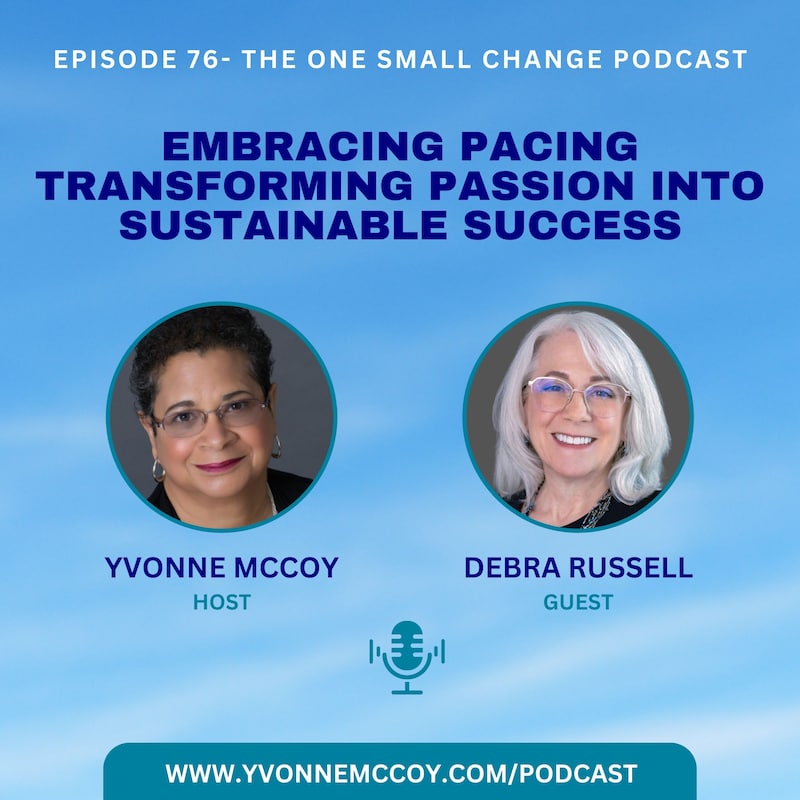
Shownotes
In this episode of One Small Change, Yvonne McCoy sits down with certified business coach Debra Russell to dive into the powerful impact of small, intentional changes on both health and entrepreneurship. Debra Russell shares her journey from a high-powered film and TV career to building a business that helps passionate individuals turn their craft into thriving, sustainable ventures. Through her personal story of overcoming illness, Debra Russell introduces the concept of “pacing” as a key to both healing and business growth, breaking the myth that more hustle always leads to success. Together, they unpack the importance of self-leadership, smart delegation, and developing systems that honor creativity without sacrificing profitability. Tune in for actionable insights—and a refreshing reminder that slow, steady, and strategic steps can create monumental transformation.
Guest Bio:
Debra Russell is a certified business coach, MBA, and expert in NLP and hypnosis. With a background in film and television production, Debra Russell transitioned into coaching after a serious illness, discovering her calling in helping creators, athletes, and passion-driven entrepreneurs build sustainable, profitable businesses. Raised with business savvy by a CPA parent and a lifelong entrepreneur herself, she brings a blend of practical business structure and heart-centered guidance to her clients.
Chapters:
00:00 "Surrendering to Heal"
04:52 "Pilates and Self-Acceptance"
09:41 Creativity Through Structure
12:35 Delegation and Workflow Simplified
16:47 "Join, Share, Grow, Transform"
17:37 "One Small Change Strategy"
Quote from the Guest:
“One small change at a time…if you try to change too much too fast, you will rebel against it or things will happen that throw you off and you will revert to your default. So one small change.”
Link:
Click here to get your free “Overwhelm into Action” workbook: https://tinyurl.com/TheOneSmallChange
Connect with Debra at: debra@debrarussellcoaching.com or https://www.debrarussellcoaching.com/
Transcripts
Welcome to the One Small Change. I can't believe it's another week. And I am
Speaker:thrilled to embark on this journey of exploration and
Speaker:transformation with you. I'm your host, Yvonne McCoy, and I bring almost
Speaker:30 years of entrepreneurial experience. And I have a passion
Speaker:for discovering growth through the power of seemingly small change.
Speaker:So I'm glad you came. With me this week we have another wonderful guest
Speaker:who's going to share how a small, unexpected or significant,
Speaker:insignificant decision sparked a
Speaker:transformation in either their personal or their professional
Speaker:or both. So today I am happy to
Speaker:share with you, introduce you to Debra Russell. Debra,
Speaker:thank you for being here. Thank you for having me, Yvonne. I'm
Speaker:thrilled to be here. So tell us what you do
Speaker:and what was it that made you start to do it and makes
Speaker:you really good at what you do? Okay, so I
Speaker:am a certified business coach. I'm an mba,
Speaker:and I also am certified in
Speaker:NLP and hypnosis. What
Speaker:got me into coaching was a very long,
Speaker:winding road, so I won't bore you with that. But I
Speaker:was very, very sick and knew I could not go back to
Speaker:my previous life, which was in film and television
Speaker:production. And I just kept saying, well, what am I supposed
Speaker:to do next? And coaching sort of found
Speaker:me. So I decided to investigate it. I
Speaker:hired a coach, and then I went ahead and
Speaker:did my coach training and opened my coaching business because it
Speaker:was the most perfect match
Speaker:for who I am, for my core competencies.
Speaker:Like, I never even. Like, coaching didn't exist back
Speaker:then. That was, you know, the early aughts. No one had ever heard of
Speaker:coaching. When I told people I was a coach, they would say Lamaze
Speaker:and I'd say, no.
Speaker:Right? No. So
Speaker:that, you know, just kind of following, just kept asking what
Speaker:was supposed to be next and then following wherever that led
Speaker:me took me to coaching through a lot of
Speaker:very interesting serendipities, which of course, you don't see
Speaker:while they're happening, but in hindsight become
Speaker:very clear. But I will say that when I was
Speaker:very ill, the one small change
Speaker:that changed everything for me, that I got a lot of
Speaker:pushback, frankly, for my family about. So I was very
Speaker:ill. I was bedridden. I was working with a
Speaker:therapist because I had lost everything.
Speaker:And something she said to me, which was, you chose
Speaker:an illness that you could not
Speaker:fight against, that the more you fight it, the
Speaker:sicker you get. You chose an illness
Speaker:that you have to surrender to.
Speaker:And she was right. And I'm a fighter,
Speaker:Yvonne. I am. I'm an a Type. Go get them.
Speaker:Hustle and grind fighter. That's my personality.
Speaker:And I couldn't fight this. The more I fought, the sicker
Speaker:I got. So I surrendered
Speaker:and I learned a key skill. Skill
Speaker:called pacing.
Speaker:Pacing. I know, I know.
Speaker:Pacing basically means you stop before you get
Speaker:tired. You don't do more than.
Speaker:Than you can. And if you. You're tired, it's
Speaker:already too late. You've done too much. Yeah, right.
Speaker:And so I kept having to do less and then do less
Speaker:until I found my baseline for what
Speaker:I could do on any given day and not get sicker.
Speaker:And that's where I started, and I built from there.
Speaker:I'm laughing because this sounds so
Speaker:familiar. I mean, you know, I can think about different points
Speaker:in my life when I just was like,
Speaker:I'm pushing, I'm pushing. And they're like, you know,
Speaker:this doesn't work. You know, you. You know, I. There was a time when
Speaker:my daughter was very sick, and I was like a
Speaker:maniac. And the therapist said
Speaker:to me, the child that you knew is no longer
Speaker:there. And I was. I was ready to physically assault her.
Speaker:I was like, how dare you say that to me? Right?
Speaker:You know, and. And I was not willing to accept her the way
Speaker:that she was. I mean, it was like, this is, you know, and, you
Speaker:know, and I. And I think back also, I just started Pilates,
Speaker:and the first session went really well. And the second session I was like, I
Speaker:can do more, right? And she was like. She was
Speaker:like, no. And the next day,
Speaker:I said to my husband, even my lips hurt. I. I mean, I.
Speaker:I almost couldn't get out of bed. I was like, so, yes, I
Speaker:absolutely do understand what you're talking about. And, And
Speaker:I think that one of the things that.
Speaker:That you said that, That I found
Speaker:interesting is you said you bring business savvy,
Speaker:you know, so tell me about that a little bit. Tell me about,
Speaker:you know, what it is that you actually do and, And. And where
Speaker:the pacing comes in. Right. So I
Speaker:specialize in working with people who are pursuing their
Speaker:passion as a business. So that started
Speaker:with working in the arts and entertainment industry. That's my
Speaker:background, working with artists, with musicians.
Speaker:I also work with athletes who are
Speaker:absolutely pursuing their passion, and it's a business.
Speaker:And I also work with people like you and me that. On. Who are
Speaker:doing what we do because we love it. The
Speaker:common through line is that we spend all this time, energy
Speaker:and money learning our craft, our skill, our game.
Speaker:But for most people, and yeah, there are exceptions to
Speaker:this Rule. But for most people, no time learning
Speaker:business. And so I
Speaker:was raised by a cpa. I've been in business
Speaker:for myself since I was a kid. I've always run my
Speaker:own business. Business is kind of a core part of who
Speaker:I am. And so. And I love
Speaker:the arts and I love hanging out with artists, I love hanging out with
Speaker:athletes. I love hanging out with people who are passionate
Speaker:because I should not be more passionate about your goals than
Speaker:you are. Right. That's boring to me.
Speaker:I could get you successful, but I'm not having fun. So.
Speaker:So I help you who
Speaker:love what you do, who know about what you do.
Speaker:I help you create the foundation of a business
Speaker:to support it. I help you create the systems, the
Speaker:strategies, build the team, understand,
Speaker:like what experts do you need on your team, what
Speaker:assistance do you need, how to hire and fire, how to
Speaker:describe the job, and how to
Speaker:delegate and give away the things you're doing
Speaker:yourself that you should not be doing yourself.
Speaker:And so that's how I bring the business savvy.
Speaker:So that you don't just have a passion, you have a business
Speaker:that is sustainable, that is profitable, that you
Speaker:can take a vacation from, and that at
Speaker:some point you might even be able to sell.
Speaker:So one of the things that I love about what you say is
Speaker:most people start their business from their passion. And
Speaker:so one of the things that I find is interesting is.
Speaker:In terms of the levels of leadership, it's kind of like
Speaker:self leadership, Leadership of a project,
Speaker:leadership of a team, the leadership of an organization.
Speaker:Many people are very good at leadership of the
Speaker:project, but they are not good at self leadership.
Speaker:And so it makes it really difficult for them to scale their business.
Speaker:And you know, one of the things that I say all the time is the
Speaker:two things. The first one is.
Speaker:Entrepreneurs are really good at spotting talent. And then they
Speaker:micromanage them to mediocrity because.
Speaker:Because they won't do it their way. It's so true.
Speaker:You know, but the thing is, you hired them because you saw something
Speaker:in them that was like exciting and now you totally
Speaker:squelched it. Right? Well, people
Speaker:micromanage because they don't know how to delegate. Right.
Speaker:Delegation is a skill. But also because they have not
Speaker:built out their system. Right. It's very hard to delegate
Speaker:something that lives inside your head. Yes. That is
Speaker:not documented and does not have an operations
Speaker:manual. And I would think that for the people that you work that are in
Speaker:the creative thing, it's like, you know, it just, it comes to
Speaker:me. It just, you Know, it just oozes from my course
Speaker:and they think that it will make them less creative. But actually
Speaker:it's very freeing. I mean, I have a thing called, you know,
Speaker:I have lots of acronyms and systems. But one is, you
Speaker:know, when you're in a situation, first you want to look at the
Speaker:procedural. Is there, you know, if somebody's not doing something right,
Speaker:is there, you know, did they follow the procedure or is
Speaker:there not a procedure or does the procedure need to be updated?
Speaker:Then you look at the personal. Because where we start is, oh, Susie never does
Speaker:this right. Or Bob is always, you know, whatever. But if
Speaker:you haven't told them what it is you want them to do
Speaker:in a way that they can duplicate, how can they get it right most of
Speaker:the time? So, you know, and then the issue is, have you
Speaker:actually trained them to do what it is that you want them to do?
Speaker:And probably even before that is, did you
Speaker:hire them for the role that you really needed them for? I mean, I had,
Speaker:I had, I used to coach women executives of non profits.
Speaker:And I cannot tell you how many times I heard this, this statement,
Speaker:the universe brought me this person.
Speaker:Oh dear. Yes. I would say, you know, how about
Speaker:we try you ask the universe for what you need so
Speaker:that when you, it brings you this person, it's the right person
Speaker:instead of you being affixed to this person and now trying to
Speaker:find a job for them. People find people
Speaker:are attracted to other people because of their energetic
Speaker:connection. That does not necessarily mean they have the skill
Speaker:set that they need. And I love what you were saying
Speaker:about understanding what you know, what is
Speaker:the job? Have you documented the job? Have you
Speaker:trained them on that documentation? But also
Speaker:have you then let them use their core
Speaker:genius to make your system
Speaker:so much better? Yes, but. And here's the most important
Speaker:piece. And then documented those changes. Yes. Because
Speaker:if they don't document those changes, they're going to move on to
Speaker:another job because people do. Right. And then
Speaker:you're screwed and because all the things that they're doing,
Speaker:gone. Yes, Right. And I have to say one other thing
Speaker:about delegation, because this is like a hot button with me. You
Speaker:know, typically people say you delegate, you automate, you eliminate. Right,
Speaker:Right. And I would say that you do it just in reverse.
Speaker:First of all, you have to have. My system is called Productivity
Speaker:ahead. So first of all, not everything works in every situation.
Speaker:So you have to be aware of what situation you're in and what it is
Speaker:that you're trying to accomplish. Then you put things on hold,
Speaker:then you eliminate stuff, then you automate, which is
Speaker:not necessarily a system. It doesn't have to be a technology
Speaker:thing. You know, it can just be, you know, you're the last person that drank
Speaker:the last cup of coffee, you make the next pot, right? Or, you know, you
Speaker:order the copy paper or whatever, right? And then
Speaker:you delegate the stuff that's important that's going to grow your
Speaker:business. Delegation is actually training. You are
Speaker:actually training people to do important parts of your business.
Speaker:If you start with delegation first, you are giving them the junk that's
Speaker:on the top of your pile, right? And there is a place for that.
Speaker:But what I. I have to leap on what you just said because
Speaker:it's so important. Especially with small business
Speaker:owners or solopreneurs, what happens is
Speaker:that they market, they market, they market, they market. They get busy, they get busy,
Speaker:they get busy. They're no longer busy because they stopped
Speaker:marketing. And then they. Because they're too busy to market. So then they market, they
Speaker:market to market. That is a roller coaster. That's the
Speaker:feast. That is not growth. The growth line for
Speaker:that business is flat, right? That.
Speaker:That is not growth. So what you've got to do
Speaker:is before you're too busy, you need to build out
Speaker:the marketing system and have someone
Speaker:else trained to do it because you're
Speaker:doing the thing that is your core genius,
Speaker:right? And you're too busy to market because you're doing
Speaker:your core genius. So you need someone else doing that.
Speaker:I. I hate to cut you off because I would love to keep
Speaker:talking, but we. I say this on every podcast,
Speaker:but we are running out of time. So tell me if, if you
Speaker:have a gift for us, tell me what it is and you know
Speaker:how people can get the most out of it. So let's start with that before
Speaker:we run out of time. You bet. You bet. So I have an
Speaker:ebook. I already sent you the short link for it.
Speaker:It's called Move from Overwhelm into Action. A Guide
Speaker:to Shift from Procrastination into Productivity.
Speaker:Productivity is one of my core areas of focus
Speaker:with clients. The first couple of chapters
Speaker:are absolutely the foundation from where you should
Speaker:start to deal with the basic
Speaker:mindset issues around productivity. And there
Speaker:are exercises in every chapter, so there's stuff for you to
Speaker:do to really start to shift that for yourself. If
Speaker:you. If you grab that, you are going to be in my
Speaker:circle of influence. And
Speaker:you can also reach me my email. If you can spell my name,
Speaker:you can email me. My email is
Speaker:deborah@deborahrussellcoaching.com
Speaker:and so, Debra, no extra letters. Russell, two
Speaker:S's, two L's. Okay, so, so here's the
Speaker:trick question. You bet. When was the last time you did something new for the
Speaker:first time? Gosh.
Speaker:Well, actually I. I am
Speaker:embarking on something new as we speak, which is
Speaker:really using Instagram to
Speaker:market my business. I am Insta stupid and
Speaker:I really don't understand Instagram. I don't know how it
Speaker:works. So I am delving into
Speaker:how to use, like, how Instagram really works. Like, I don't even
Speaker:know how to comment on people. Like, I'm so lost when it comes
Speaker:to Instagram. So I'm learning Instagram, I'm learning how to use
Speaker:it for my business and I'm a little terrified,
Speaker:but I'm doing it anyway, so. So stay tuned. I am
Speaker:@bizcoachdebra on Instagram, so you'll
Speaker:get to watch my growth. And my
Speaker:screw ups. Well, you know, that just makes you more
Speaker:relatable. So. So here's the commercial, guys.
Speaker:I hope you'll take the time to subscribe and share
Speaker:and engage on social media. And the reason I did this is so
Speaker:I wanted to be able to expose other people to some of the fabulous people
Speaker:that I'm meeting and help grow this vibrant community
Speaker:and fuel your quest for growth and impact. And so I hope you will continue
Speaker:to join me for the one small change and find things that you
Speaker:can sm, the smallest shifts that can, you know, yield really
Speaker:monumental transformations for you. And you may want to take a minute and
Speaker:listen to the first episode, why I where I explain why I'm
Speaker:doing what I'm doing. And also I do a quarterly clarity
Speaker:check in so that at the beginning of each quarter you can take a look.
Speaker:So, Debra, what are your last words of wisdom for people?
Speaker:What do you want them to remember? The one small change
Speaker:is a critical concept for everything you
Speaker:do in your business, what you do with your time management and
Speaker:productivity. One small change at a time.
Speaker:You know, slow and steady wins the race, as we all learned
Speaker:as kids. And if you try to change too much
Speaker:too fast, you will rebel against it or things will happen
Speaker:that throw you off and you will revert to your default.
Speaker:So one small change. All right then.
Speaker:All right. So what I want to say is, remember, change
Speaker:can be simple, but it's not always easy. And it requires
Speaker:courage, resilience, and a willingness to step out of your comfort zone. If
Speaker:you are comfortable, you are not growing. And in
Speaker:fact, you're probably stagnating, because if you
Speaker:think you're standing still, the world is moving past you. So I
Speaker:want to make sure that you. Have a mindset
Speaker:where you're curious and you want to embark on these changes to grow your
Speaker:business and have the impact and the profit that you really deserve.
Speaker:So if you will join me again for the one small change,
Speaker:we can together build bold visions and innovative
Speaker:possibilities. And so I'm going to say to you,
Speaker:until we meet again, stay very curious. And, Debra, thank
Speaker:you so much for being here today. Absolutely. Thank you for having
Speaker:me. This was great.