Speaker:
00:00:00
Before we begin, a quick thank you and sincere apologies for no doubt saying
Speaker:
00:00:04
this wrong, since it's a username, to Djfifjenwosmskeoend for their recent
Speaker:
00:00:09
Apple Podcasts review of Artifacts.
Speaker:
00:00:12
DJ wrote, "I really feel drawn to this idea of a slower, more intentional, more human life.
Speaker:
00:00:18
Thank you for reminding me of the reason why I can't seem to throw out my mixtapes or burn CDs.
Speaker:
00:00:23
I like the simplicity and thought in each of the episodes. Keep them coming."
Speaker:
00:00:26
DJ, thank you so much for the kind
Speaker:
00:00:28
words, and thanks for helping keep the archive alive with your review.
Speaker:
00:00:32
Now, this week's Artifact.
Speaker:
00:00:35
There used to be a place on the internet that nobody else in the world could
Speaker:
00:00:38
have made. It looked exactly the way you wanted it to.
Speaker:
00:00:42
Maybe the background was black. Maybe it was bright green.
Speaker:
00:00:46
Maybe there were animated flames at the bottom of the page. Maybe snow fell all year round.
Speaker:
00:00:51
Or maybe music started playing the second someone arrived, whether they wanted it to or not.
Speaker:
00:00:57
It was chaotic, sometimes impossible to read, occasionally an assault on good taste.
Speaker:
00:01:04
But it was perfect because it was yours.
Speaker:
00:01:08
Not designed by a template, not arranged by an algorithm, not optimized for
Speaker:
00:01:13
engagement, just a little corner of the internet that reflected who you were.
Speaker:
00:01:19
This was a time when the internet invited you to build something.
Speaker:
00:01:23
Not a following, not a brand, just a homepage, GeoCities, AngelFire, Tripod,
Speaker:
00:01:31
later MySpace, LiveJournal, even forum signatures.
Speaker:
00:01:37
Every one of them began with the same quiet question. What do you want this to look like?
Speaker:
00:01:42
And suddenly, people who had never written a line of code were teaching themselves HTML.
Speaker:
00:01:48
Not because somebody promised them a career but because they wanted sparkly
Speaker:
00:01:51
text, or scrolling marquees, or a visitor counter that proudly announced you're
Speaker:
00:01:57
visitor number 143, which somehow felt like the whole world had shown up.
Speaker:
00:02:03
You learned by breaking things by copying snippets of code, by changing one colour,
Speaker:
00:02:09
refreshing the page. and changing it back then trying something else.
Speaker:
00:02:14
Nobody called it learning to code - it was simply making your page yours.
Speaker:
00:02:19
Looking back, those websites were objectively terrible. Fonts clashed,
Speaker:
00:02:24
backgrounds fought with the text, buttons really lined up, half the GIFs blinked
Speaker:
00:02:29
at different speeds, and some pages took forever to load.
Speaker:
00:02:33
Others crashed your browser completely.
Speaker:
00:02:36
But perfection was never the goal, expression was.
Speaker:
00:02:40
You could tell who somebody was by the way their page looked.
Speaker:
00:02:43
The bands they loved, the films they quoted, the colours they chose,
Speaker:
00:02:47
The jokes they hid in tiny corners of the page.
Speaker:
00:02:51
Every homepage felt like walking into somebody's bedroom. Posters on the walls,
Speaker:
00:02:55
books on the shelf, music playing quietly in the background.
Speaker:
00:02:59
It wasn't polished, but it was personal. And maybe that's why we remember it so fondly.
Speaker:
00:03:05
Today, most of the internet is beautifully designed. Open almost any app and
Speaker:
00:03:10
everything feels familiar.
Speaker:
00:03:12
The same layouts, the same fonts, the same profile pictures inside the same circles.
Speaker:
00:03:18
Convenient? Absolutely. Accessible? More than ever.
Speaker:
00:03:23
But somewhere along the way, the internet stopped looking like the people who
Speaker:
00:03:26
used it, and it started looking like the companies that owned it.
Speaker:
00:03:30
Our creativity became customisation. Pick a profile picture,
Speaker:
00:03:35
choose a banner, maybe change your accent colour.
Speaker:
00:03:38
The walls stayed exactly where they were. but once upon a time we built the walls ourselves.
Speaker:
00:03:45
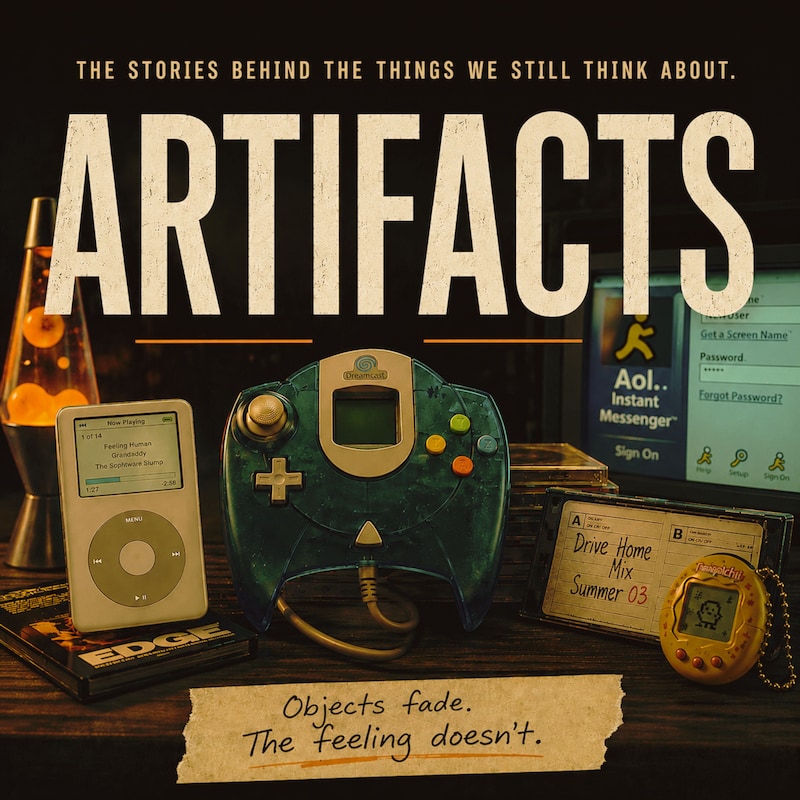
Over the last few weeks, we've talked about the Dreamcast, internet forums,
Speaker:
00:03:49
burned CDs, away messages, midnight launches, the family computer, and game manuals.
Speaker:
00:03:57
Different objects, different memories, different stories. Or so it seemed.
Speaker:
00:04:03
Because underneath every one of those artefacts was the same idea.
Speaker:
00:04:07
The Dreamcast wasn't really about a console. It was about optimism.
Speaker:
00:04:11
Forums weren't about message boards. They were about belonging.
Speaker:
00:04:15
Burned CDs weren't about music. They were about saying, I thought of you.
Speaker:
00:04:21
The family computer wasn't about technology. It was about sharing,
Speaker:
00:04:25
Game manuals weren't about instructions. They were about imagination.
Speaker:
00:04:30
And those homemade websites, well, they weren't really about HTML. They were
Speaker:
00:04:34
about leaving a little piece of yourself somewhere. A tiny digital fingerprint.
Speaker:
00:04:40
Proof that, for a moment, you were here.
Speaker:
00:04:43
The internet has become faster, smarter, and more useful in almost every measurable way.
Speaker:
00:04:50
And yet, sometimes I miss when it was wonderfully unfinished.
Speaker:
00:04:54
When curiosity mattered more than clicks, and when creativity mattered more than polish.
Speaker:
00:05:00
When people made things simply because making them brought them joy.
Speaker:
00:05:03
And maybe that's what all these artifacts have really been trying to tell us.
Speaker:
00:05:07
Technology changes. Platforms disappear. Websites vanish. Consoles stop working.
Speaker:
00:05:13
CDs become scratched, and forums go offline.
Speaker:
00:05:17
But every one of these things carried something far more durable than code or plastic.
Speaker:
00:05:22
They carried pieces of us. Our curiosity. Our friendships. Our imagination. Our optimism.
Speaker:
00:05:30
Our awkward teenage attempts at self-expression. The people we were becoming.
Speaker:
00:05:35
And maybe that's why these objects stay with us. Not because they changed the
Speaker:
00:05:38
world, but because they helped shape ours.
Speaker:
00:05:42
Thank you for spending this first season with me. For remembering,
Speaker:
00:05:46
for smiling, for sharing your own artifacts along the way. I'll see you soon when
Speaker:
00:05:51
we open the archive again.
Speaker:
00:05:53
Until then, take care of the things that matter to you - even the small ones. Because
Speaker:
00:05:58
sometimes the objects fade, but the feeling doesn't.
Speaker:
00:06:02
I'm Danny Brown, and this is Artifacts.