Transcripts
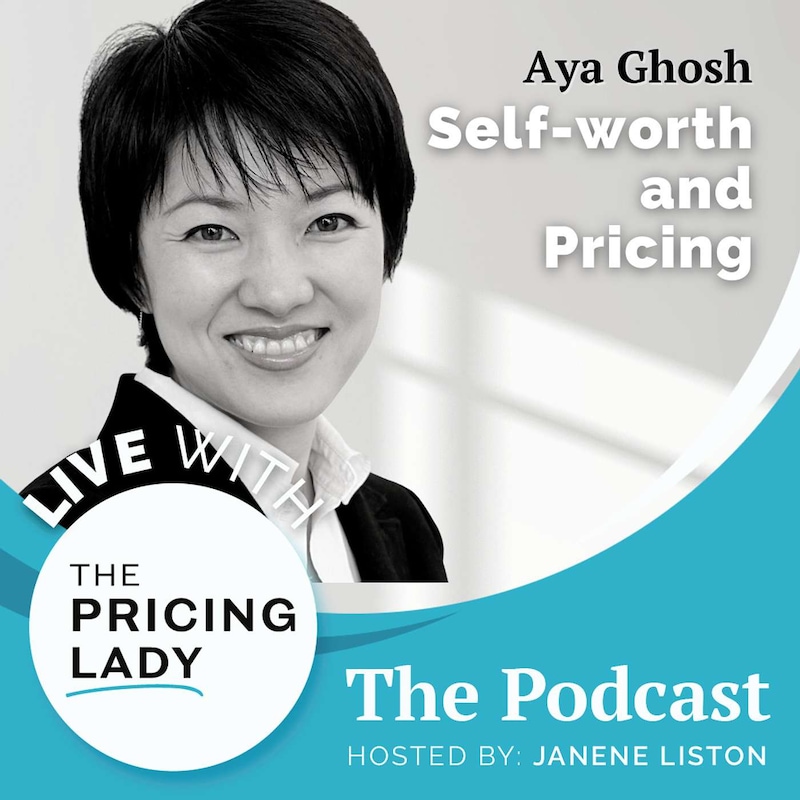
In this episode of Live with The Pricing Lady, I sit down with
Speaker:Aya Ghosh a consciousness coach.
Speaker:She shares with me that she thinks people should have more fun with
Speaker:pricing, but admits that mindset often gets in the way, as it did for her.
Speaker:Sit back, relax and enjoy this episode.
Speaker:As Aya shares with us, her own pricing journey.
Speaker:Today I'd like to welcome our very special guest, Aya Ghosh.
Speaker:Hi Aya.
Speaker:Hi Janene.
Speaker:I'm so excited to have you here with me today and to dig into this conversation.
Speaker:Why don't we start with where are you joining us from today?
Speaker:I'm joining you from Switzerland, Zurich.
Speaker:From Zurich, Switzerland.
Speaker:Excellent.
Speaker:And what would you call your super power?
Speaker:My superpower is to ask gorgeous questions.
Speaker:Oh, so actually you need to be in the driver's seat on this one.
Speaker:Super.
Speaker:That is a wonderful superpower because questions, you know, well asked questions
Speaker:can be such a door opener for people.
Speaker:Yeah.
Speaker:What's one interesting thing you'd like to share with us that
Speaker:most people don't know about you?
Speaker:I wanted to be a film director when I was 20.
Speaker:Oh, how interesting.
Speaker:And what, what was it that interests you about that?
Speaker:I just love the creative power and how, what you can give to the
Speaker:audience when you combine sound, you know, scenario, pictures.
Speaker:Okay.
Speaker:Interesting.
Speaker:So you have a creative side then as well.
Speaker:Yes.
Speaker:Super.
Speaker:Okay.
Speaker:Why don't we start at the beginning and, well, actually first, why
Speaker:don't you tell us a bit about what you do in your business?
Speaker:I work as a consciousness coach and I help people move on from the experiences that
Speaker:they're stuck with or to find the purposes that they want to find in their life.
Speaker:And this is, I think, something that keeps expanding.
Speaker:Yes.
Speaker:You know, I think if there's one thing I've learned over the
Speaker:years is that you're never done.
Speaker:It's just constantly growing and evolving and shifting.
Speaker:The universe has ways of throwing things your way that take you outside
Speaker:that comfort zone and challenge you.
Speaker:It's important to get that help and support along the way.
Speaker:Excellent.
Speaker:Well said.
Speaker:So Aya, what was it like that first time that you sat down and
Speaker:you had to actually set a price for something in your business?
Speaker:Well, the first time was very, very like exciting and anxious at the same time.
Speaker:When I started my own business, I was still in my coaching school.
Speaker:As I was finishing up my coaching school, I simultaneously started my own business.
Speaker:I was like, Ooh, like I'm still a student, but I want to start this.
Speaker:And it was the first experience of setting my own price.
Speaker:So that was quite memorable.
Speaker:Yeah.
Speaker:And how, how did you go about doing that?
Speaker:Doing that, I kind of like checked other people's rates, like
Speaker:who are already in the market.
Speaker:And I decided for something a little bit lower than that, including the
Speaker:fact that I'm still in the school.
Speaker:And if I may ask, the reason for pricing a little bit lower was
Speaker:because you were still training.
Speaker:Yes.
Speaker:That's what I had thought when I set that price,
Speaker:but then there came a point when I actually finished the, like a schooling
Speaker:and I wanted to raise my price and I had that experience in that.
Speaker:And I realized that I've had so many accomplishments in my life.
Speaker:in my life, but I don't have great self worth, right?
Speaker:This didn't have great self worth.
Speaker:And that was sort of like not helping me with the experience of the pricing.
Speaker:So I had to work on that as well.
Speaker:Yeah.
Speaker:Yeah.
Speaker:So when you, you say you felt like your self worth wasn't there, how
Speaker:would you describe what that felt like?
Speaker:What's so interesting is like, you don't see it yourself.
Speaker:All I had was this bad experience.
Speaker:Why is this so difficult for me emotionally to change the pricing?
Speaker:Being a coach, I think you need to walk the talk.
Speaker:I had a coaching session with my peers.
Speaker:It turned out like, wow, I don't feel like I'm good enough.
Speaker:. You know,
Speaker:. Okay.
Speaker:Okay.
Speaker:Yeah.
Speaker:Well, I think, I think a lot of people feel that way.
Speaker:Yeah.
Speaker:Not just in pricing, but in many aspects of life.
Speaker:And I guess that's something that comes up a lot with the people
Speaker:that you work with as well.
Speaker:Is that?
Speaker:Yes.
Speaker:That's fair.
Speaker:And I think also having your own business magnifies your personal
Speaker:beliefs, both positive and limiting beliefs, as well as your own energy.
Speaker:It's a really good way to learn about yourself.
Speaker:Yes.
Speaker:Yes.
Speaker:I always tell, I always share with people that, you know, I thought
Speaker:that starting your own business was this like career journey.
Speaker:And it is more than anything, a self development journey.
Speaker:Absolutely.
Speaker:100 percent a self development journey.
Speaker:Yeah.
Speaker:So what beliefs that did you discover?
Speaker:So aside from maybe the self worth or maybe in the context of the
Speaker:self worth even, what beliefs did you carry with you that really
Speaker:didn't help you in your business?
Speaker:There were many and they were kind of tied with each other, but some of them are,
Speaker:as we discussed, not being good enough.
Speaker:There was also something about externally referencing.
Speaker:So it's easy to like reference the external market.
Speaker:but there are range there and it could be really anything and at the end of
Speaker:the day you need to do your research and internally reference and find out
Speaker:what's right for you and I was not too strong with the internal referencing
Speaker:so that was something that I was also working on and then there was also this.
Speaker:Like a belief about like wanting to help as many people as possible.
Speaker:And if you accomplish that mission, right, like the cheaper, the better,
Speaker:but that's not going to be sustainable.
Speaker:Did you also have then beliefs that you felt actually were helping you as well?
Speaker:I did.
Speaker:I really had the conviction that this is what I meant to be doing and like, even
Speaker:though it had not yet been working at that point that I'm living my purpose.
Speaker:So that really, really helped me go through this self introspection process.
Speaker:Right.
Speaker:Okay.
Speaker:I think it's interesting because I think people assume that if they
Speaker:know how to do something that they won't have any problems doing it.
Speaker:Right.
Speaker:So they logically know the steps.
Speaker:And it sounds like you had a plan with some steps to take on
Speaker:how to find the right prices.
Speaker:Logically knowing them is one thing, but then the emotional
Speaker:connection to it is something else.
Speaker:Would you agree with that?
Speaker:Totally agree with that.
Speaker:Yeah.
Speaker:I feel like even if you have the optimal or strategically right price, unless you
Speaker:have an emotional connection to that, it's not going to work on an energetic level.
Speaker:Like people know that when you speak to people.
Speaker:So how do you build that energetic connection to your
Speaker:pricing or to your worth?
Speaker:I don't know whether you're, you're saying it in the context of your
Speaker:worth or of the, I always hesitate to say your own worth, but the worth
Speaker:or value of what you offer or in what context do you, do you mean that?
Speaker:Well, that's a really good point because like our worth is like infinite, right?
Speaker:Each one of us has anything (infinite) of value.
Speaker:It's not necessarily true to say that this pricing reflects who I am or
Speaker:my value as an individual, because it's always going to be much more.
Speaker:It's definitely more than 10 million or whatever you can number.
Speaker:But your sense of worth in terms of providing as a service provider, I
Speaker:think there is some kind of connection.
Speaker:And I think the easiest way to catch yourself is like, A,
Speaker:to like observe the reality.
Speaker:Is it actually working while you're doing in the world or not?
Speaker:That's a very easy way to tell.
Speaker:Another thing I recommend people is to calibrate yourself when
Speaker:you're offering your product.
Speaker:Let's say you have like a cup of coffee that you want to sell for five francs.
Speaker:Let's say like, I say Janene, like this is a coffee you can have for five francs.
Speaker:What does it feel like to say that?
Speaker:Yes.
Speaker:Yeah.
Speaker:That's very important.
Speaker:Being able to speak the number out loud and to be able to
Speaker:say it in a confident way.
Speaker:I'm sure I've mentioned this on an episode before, but quite often, when
Speaker:I meet people and we have conversations about pricing, eventually I'll ask
Speaker:them, Oh, well, what do you charge for your offer, for your product
Speaker:and their response is... 500 francs?
Speaker:They say it like a question.
Speaker:And to me that's like a dead giveaway.
Speaker:Now they may be doing it just because they know who I am and what I'm doing.
Speaker:And so they're sort of asking for my approval, but I would give some of
Speaker:them also do that with their clients as well, or with their customers.
Speaker:If they're having those conversations and, and yeah, that's a dead giveaway.
Speaker:But I think like, you know, even if it's with you, I think the
Speaker:science is different when you say like, well, this is 500 francs.
Speaker:What do you think about it?
Speaker:Right?
Speaker:Like, that's not a question.
Speaker:So, and at the end of the day, you need to take an ownership.
Speaker:Yes.
Speaker:Yes, that's absolutely true.
Speaker:That's absolutely true.
Speaker:So, one of the things you mentioned when we first spoke was that you found
Speaker:That there were challenges when it comes to pricing services specifically.
Speaker:Can you tell us a little bit more about that?
Speaker:Well, it's like for one thing, it's very, very sometimes difficult to
Speaker:explain what you do, because if I have a car, I can show you like, here's this
Speaker:beautiful car, this is what it does.
Speaker:But like with the service industry, I think like what people get really
Speaker:like depends on like how much people are reaching for change in terms
Speaker:of my own profession, and there is like no shape, no specific shape,
Speaker:but I can like Share with people.
Speaker:So, you know, it's like, from the brain configuration perspective, it's actually
Speaker:very difficult to start when you don't have a picture that goes with it.
Speaker:So,
Speaker:Yeah.
Speaker:Yeah.
Speaker:So I think it's, if I would paraphrase that, I would say it's a little less
Speaker:tangible, like it feels or people.
Speaker:Do you think that You as the business owner, the person offering the
Speaker:service that you feel it's less tangible or is it that you think
Speaker:other people, like your customers, think it's less tangible or both?
Speaker:That's a gorgeous question and you, you might be onto my belief,
Speaker:but I think other people think it's less tangible.
Speaker:Uh huh.
Speaker:Yeah.
Speaker:And how, how have you dealt with that when it came then to pricing and having
Speaker:those conversations with your clients?
Speaker:What I love doing is to share my own experience and what I got through the
Speaker:coaching services because now I'm also on the client side and What I got from
Speaker:it is just one demonstration example, what it can do for other people.
Speaker:And I also just really enjoy working with people.
Speaker:So sometimes I do offer like, free sessions or, you know,
Speaker:depending on where people are at.
Speaker:Okay.
Speaker:Excellent.
Speaker:And I think it's, you know, what's at the core is actually like
Speaker:the commitment to uncertainty.
Speaker:It's very difficult for any one of us to commit to what is uncertain.
Speaker:And it's less certain than committing to a cup of coffee or.
Speaker:Yeah, yeah, that's true.
Speaker:That's true.
Speaker:And I mean, we know most of us know if we're, okay, if we're hiring a plumber, we
Speaker:don't really have to invest our own time and money or effort into getting results.
Speaker:You know, the plumber comes in, they do their job and it's done.
Speaker:But when it comes to, you know, consulting or coaching, there's
Speaker:usually some aspect of the client.
Speaker:Where they actually have to do the work.
Speaker:And I think as a client, when you're in the position of being the one
Speaker:making the purchase and some level, you may not admit it, but on some
Speaker:level you want, you know, that you're going to have to do some work, right?
Speaker:Along the way.
Speaker:Yeah.
Speaker:Yeah.
Speaker:So it's a different experience in the service spectrum for sure.
Speaker:Yes.
Speaker:Okay.
Speaker:How in your experience do you think people can allow pricing to be easier for them?
Speaker:Wow, thank you so much for your question.
Speaker:I think one of the attitudes that really helps me is like, you
Speaker:don't have to be a perfectionist.
Speaker:You don't have to get the price pricing right in the first trial.
Speaker:It's just like a feedback system.
Speaker:So you try something.
Speaker:If it doesn't work, you adjust it.
Speaker:See it as a learning process other than like, Oh, I got it.
Speaker:Like, blah, blah, blah.
Speaker:Another thing is like to have really good friends that you can speak
Speaker:with, who understands what you do and the value, but who also have
Speaker:like a common sense perspective of the world or the market outside.
Speaker:Just ask them what they think.
Speaker:Yeah, those are great.
Speaker:Great tips.
Speaker:Thank you for sharing those.
Speaker:Something else that you spoke about that I found really interesting
Speaker:was you talked about having a needy energy at some point in time, right?
Speaker:And how that impacted what you did or didn't do, or how you did it.
Speaker:Can you talk to us a little bit more about that?
Speaker:Of course.
Speaker:And that's Media, Energy Store did not work.
Speaker:In the first years of my business, I actually had a hundred percent
Speaker:full time corporate job on the side.
Speaker:My livelihood, paying the rent and all of that, did not depend
Speaker:on my personal business income.
Speaker:And after that, I took a decision to leave work.
Speaker:And I was like, now I really need to be making money.
Speaker:So the pricing was still the same as before, but I was like, I was super
Speaker:needy about having the money and like pretty much all of the sales conversation
Speaker:during that period did not work out.
Speaker:Uh huh.
Speaker:And so I had more topics to work about myself.
Speaker:So you think that you were giving off this energy and that was
Speaker:influencing Other, the people who were making decisions in a sense.
Speaker:Yeah.
Speaker:I think I was like a dog who just did not stop barking and
Speaker:wants attention 24 hours a day.
Speaker:Okay.
Speaker:And so what, how were you able to shift that?
Speaker:Well, the first step of shifting that was like, just like notice,
Speaker:like, wow, something is not working.
Speaker:And then I got really curious about that.
Speaker:I kind of introspected, like, what it is like, that's different
Speaker:for me compared to before.
Speaker:And I was just like really feeling needy about everything in life.
Speaker:Like I wanted to have everything all at once.
Speaker:I was not patient.
Speaker:And a friend pointed out to me, like, no, that's not going to work.
Speaker:Ah, yeah.
Speaker:So it was.
Speaker:It's really nice to have good friends that tell you the truth.
Speaker:Absolutely.
Speaker:Yes, it is.
Speaker:Super.
Speaker:So thank you for sharing that.
Speaker:I think right now what we're going to do is we're going to start wrapping this up.
Speaker:I've got a few more questions for you.
Speaker:So what is one thing that you think or that you like people to
Speaker:remember from our conversation today?
Speaker:Ah, thank you for the question.
Speaker:I would really like people to think of pricing as something you can have fun
Speaker:with and learn with, and that you don't have to get it right in the first try.
Speaker:See, I love that answer.
Speaker:And I didn't tell her to say that.
Speaker:No, I mean, I think people think of it as this hard nose thing,
Speaker:but it can be very creative.
Speaker:And you know, that's what I hear from people a lot after they've
Speaker:experienced me as an, it can be fun and it can be creative, and I
Speaker:think that that's a wonderful way to approach it as well, because then it
Speaker:doesn't feel so daunting and scary.
Speaker:So thank you for that.
Speaker:What's one of the most amazing things you've overcome in your life?
Speaker:Can be business or personal, whatever you prefer to share.
Speaker:Oh, it's really like understanding who I am and just feeling good about
Speaker:being myself and liking myself.
Speaker:That's super important.
Speaker:You know, we're all on that journey, aren't we?
Speaker:Do you have a book or a tool that you'd like to share with the listeners today?
Speaker:I am a bookworm and I have a book I would love to share.
Speaker:Okay.
Speaker:New Earth by Eckhart Tolle.
Speaker:Yes, . It is an excellent book.
Speaker:It's been a few years since I've read it, so maybe this is
Speaker:a reminder to pick it up again.
Speaker:Thank you for that.
Speaker:What is it that you find so interesting or so rich about that book?
Speaker:It really, really changes your perspective and it really, really allow, at least
Speaker:it allowed me to appreciate my everyday life and it really made me realize.
Speaker:I don't have to go anywhere to change my experience.
Speaker:It's all inside.
Speaker:It's all inside, yeah.
Speaker:Well, thank you for sharing that.
Speaker:Excellent.
Speaker:One last question.
Speaker:If people would like to find out more about what you do and how to
Speaker:work with you, where should they go?
Speaker:Please visit my website, which is ayatransformation.
Speaker:com.
Speaker:Excellent.
Speaker:So we'll put the link to that and other links to Aya's social media in
Speaker:the show notes, also the book as well.
Speaker:So have a look there and reach out to Aya and say, at least say hello.
Speaker:All right, Aya, thank you so much for joining me today.
Speaker:It's been a real pleasure having you on the show.
Speaker:Thank you Janene.
Speaker:It was really fun.
Speaker:You're very welcome.
Speaker:And to you, dear listener, thank you so much for being with us today.
Speaker:We do appreciate that you are here.
Speaker:Before you go, I want to remind you, if you're curious about what a fair
Speaker:price is, you can always head on over to To have a look at getting to a fair
Speaker:price, which is an on demand web class.
Speaker:You'll find the link on my website under learn and we'll
Speaker:put it in the show notes as well.
Speaker:I wish you all the best.
Speaker:Have a great day.
Speaker:And as always enjoy pricing, everyone.