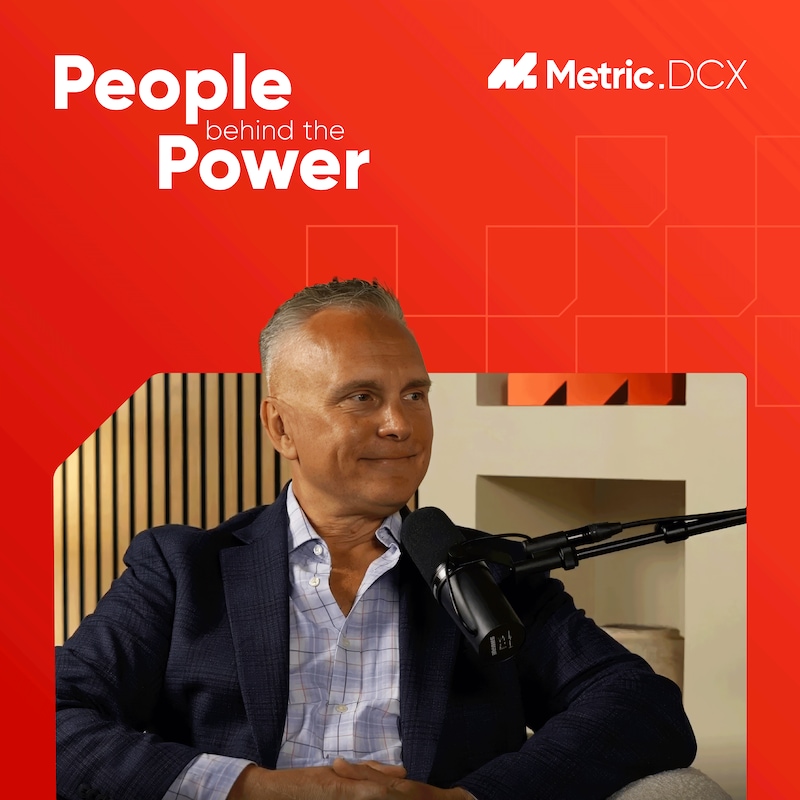
Shownotes
In this episode of People Behind the Power (EP08), host George Bacon sits down with Joe Capes, Co-Founder of LiquidStack, to explore his journey through the evolving landscape of data center technology. From his early career in industrial automation to pioneering liquid cooling solutions for hyperscale environments, Joe shares the leadership lessons he has learned while scaling high-performing teams.
In this episode, we discuss:
Leadership & Grit: Joe’s philosophy on hiring for adaptability and the importance of empathy in building resilient, mission-driven teams (9:05).
The Evolution of Cooling: How liquid cooling has shifted from a niche technology to an essential sustainability driver for modern AI workloads (18:03).
Industry Insights: A deep dive into why liquid cooling is critical for reducing energy and water consumption in the era of AI (19:02).
Navigating Ambiguity: Why risk tolerance is the defining trait for leaders in 2026 as the industry faces rapid growth and supply chain challenges (24:00).
About the Guest:
Joe Capes is an industry veteran and the Co-Founder of LiquidStack, currently serving as VP and head of the company following its acquisition by Trane Technologies. With a background in electrical engineering and a history of successful startups, Joe brings a wealth of knowledge on building tech infrastructure that stands the test of time.
Transcripts
0:03
Welcome to People Behind the Power, part of the Metric podcast Network.
0:07
Data centres are the backbone of the digital world.
0:10
But behind every facility, every build and every operational decision, there are people making it happen.
0:16
Every episode we sit down with the leaders driving the data centre industry forward, the careers they've built, the teams they've scaled, and what it actually takes to deliver at the pace this sector demands.
0:26
A Metric DCX production.
0:28
This is people behind the power.
0:31
Hi, we're here on day three at data Cloud in Cannes and we are joined by Joe Capes for this episode of people behind the power.
0:43
Joe is the Co founder of liquid stack, but I'm going to let Joe tell you much more about that.
0:51
So Joe, thank you for joining us.
0:54
Please tell us a little bit about you.
0:56
Thank you so much.
0:57
It's great to be here.
0:59
Yeah, a little bit about myself.
1:00
As you said, I'm a Co founder of Liquid Stack, presently Vice President and Head of the company and really happy to be part of Train Technologies.
1:11
The acquisition closed just about 3 months ago and it was a long journey.
1:17
It was exciting, but also a hard journey and took quite a lot of perseverance to get to where we are today.
1:24
Amazing.
1:26
Joe, we're going to start at the very beginning, if you like, and you can decide what the beginning is.
1:31
But how did you get into the space?
1:34
How did data centres form such a big part of your life?
1:39
It's, it's a difficult question because it's, it, I feel dated when I tell this, this part of my journey.
1:45
But when I graduated from university as electrical engineer, I, I was in the industrial automation space for several years.
1:56
And this was the early 90s, I was working in the US and manufacturing was, was dying.
2:03
It was just being shipped offshore.
2:07
And you know, I, I saw it as essentially being a, a dying industry and, and wanted to be part of something that was growing and exciting.
2:16
And in:2:28
So Dell was #1 APC was #2 and it was, it was an exciting 11 years.
2:35
APC was really the paramount company in backup power.
2:41
So primarily UPS, uninterruptible power supplies and during those days, I mean, you know, if the stock didn't go up a half a point today, you know, there was people whinging on at the water cooler saying what's going on.
2:55
But that's, that's how I started and I was fortunate to, to join APC in those days.
3:02
Amazing.
3:04
So talk to us about liquid stack.
3:05
I'm, I'm going to ask you for a, a pivotal moment in your career or a time when you felt the shift, but you can either relate that to you as an individual or a turning point for Liquid Stack.
3:19
Talk to me about that.
3:20
nd I eventually I left APC in:3:42
And you know, we, we commercialize that into a 150 kva 3 phase UPS system with this battery technology that like to be exercised and you can take all the, all the stored energy out of it without damaging the battery stack.
3:59
quickly learns that nobody in:4:05
They hoped that they never had to use their batteries.
4:08
So we pivoted in into telco and started backing up cell sites with -48 Volt plus 24 Volt technology and eventually commercialized mass energy storage for wind power.
4:22
Transacted that company and then spent about 7 weekends in a coffee shop in the US called Panera Bread.
4:30
Super bad coffee.
4:31
Sorry, sorry, Panera Bread.
4:34
But literally, literally wrote a business plan to found Coolcentric.
4:41
And Coolcentric was the first company to commercialize a technology known as rear door heat exchangers, which is essentially putting a, a chilled water coil on the back of an IT rack.
4:52
And you know, back in:5:01
So today I think there's probably 25 or 30 companies that manufacture rear door heat exchanger.
5:07
So it's kind of fun to be a founder of that, of that category.
5:12
My journey led me back to Schneider Electric eventually.
5:16
And I spent nine years of at Schneider Electric and, and Schneider had acquired APC while I was, I was doing these two other start-ups.
5:24
So I can tell you a little bit about how, how I got to Liquid stack, but, but I'll stop there.
5:29
No, you don't need to.
5:30
OK.
5:31
But the the next question is, I think you can probably answer that in the next question, which there are so many people in this industry that are technically brilliant and have such a technical depth to them.
5:45
But that needs to be combined with a commercialization like what you just spoke about in one of your previous businesses.
5:54
How not how easy is that?
5:57
Because I know it's not easy, but how do you do that?
6:00
And how do you combine that technical depth that you need to be brilliant and what you do with OK, it also needs to be commercialized.
6:10
I like to understand technology at a deep level.
6:14
And you know, I'm an engineer at heart.
6:16
That's how I started my career as an apps engineer doing industrial automation.
6:22
I feel like if you understand the technology, it's kind of 1 less thing to worry about, if that makes any sense.
6:29
And you can kind of focus on the important aspects of what it takes to, you know, build a business, persevere and ultimately be successful.
6:39
And also along the way, just learning a lot about leadership.
6:44
And, you know, from, from my own experience, right, people that I work for, that I, I really enjoyed working with, received a lot of mentorship and also people that I didn't necessarily enjoy working with.
7:00
I, I, I say to, to a lot of people that I think when I, when I got to be about 40 years old, I decided, you know, I didn't want to work for someone where, you know, you go out to dinner and you wonder how you're going to get through the next three hours, right?
7:17
It's just like I really enjoy getting to know my team members at a personal level and also, you know what, what motivates them not just in the workplace and for the company, but also outside of the company and in their personal lives.
7:34
Joe, you've obviously built businesses, which means building teams.
7:41
We are in the market of hiring, so talk to me about building such high performing teams and things that you look for to work in the space that you're not going to see on a resume.
7:57
It's a great question.
7:59
A friend of mine told me and he's and he's ACEO as well.
8:03
He, he told me that the CE OS job is keeping the company funded, hiring and firing.
8:12
And when he told me that, I felt like it was a bit harsh, especially the last bit.
8:18
I do think that when you're building an organization, it's not just about finding the right talent, it's also about bringing the talent in at the precise moment when you need that expertise or that experience within the company.
8:35
So for example, at Liquid Stack, for many years we we operated without a CFO And then last last year I hired ACFO, brought an individual into the company and that was a big part of the success of ultimately transacting the business.
8:52
And, and knowing that there were certain moments, whether it was hiring ACFO or COO, a challenge with building companies is making sure that you don't initially get too top heavy.
9:05
And the one thing that I always look for that's an intangible is grit.
9:12
I feel like often times it's about, well, where the individual study or you know what, what jobs have they, they had.
9:21
I always look for intangibles outside of what's on their CV that can demonstrate their ability to persevere and also to work with a level of ambiguity.
9:36
I feel like there's a lot of people that don't necessarily work well unless they're told all the answers.
9:44
And it's really difficult to to grow and to I think ultimately be successful if you're not comfortable having some level of ambiguity.
9:54
Especially doing what we're doing now in something that is moving so quickly and is developing so quickly and is under so much pressure to move so quickly.
10:04
It's amazing you said that.
10:06
We're doing a big piece of work for one of our partners at the moment.
10:10
And a big part of our screening process is stress testing an individual, an individual's ability to deal with a bit of chaos and ambiguity and challenge and frustration.
10:21
And that is such an important attribute, I think for anyone going into the industry.
10:27
And it's, yeah, amazing that you said the same thing.
10:30
I mean, Liquid Stack is a company that probably could have probably could have tanked 9 times.
10:38
you talk about leadership in:10:58
But it could have been a game over situation, you know, life ending situation.
11:03
And so when you talk about succession planning and, and sometimes people use the phrase, well, what if so and so steps off the curve curb, God forbid, right?
11:12
And so I was like literally the CEO that stepped off the curb, but ultimately came into the office on Monday, very banged up, very bruised and had a leadership team meeting.
11:23
And everybody on my team was like, what on earth are you doing here?
11:27
So that's incredible.
11:30
And I didn't know that.
11:31
And thank you for sharing that.
11:33
It bizarrely brings us to a question that I was going to ask later in the piece, but makes most sense to ask now considering you said that if you were to step out of your role tomorrow, which I know you have no intention to do.
11:47
But if you were to, what are some of the characteristics you would need or you would look for from a successor for you, Joe, I think somebody that can not only lead A-Team, but motivate a team.
12:03
And you know, now that Liquid stack is, is part of the train Technologies family.
12:07
We're part of a much larger organization.
12:10
You know, we, we are part of a 50,000 employee, you know, universe.
12:15
And I think motivation is really important.
12:19
I think empathy is also really important.
12:21
I think understanding that occasionally people do have bad days and it's not necessarily because of something that transpired at work.
12:30
It may be something like that's going on in their work life.
12:33
And you know, about four or five weeks ago, I actually lost my mother, unfortunately.
12:38
And it was just an amazing outpouring.
12:42
I had, I, I had some individuals on our team that traveled 6 or 7 hours to come to the, to the ceremony.
12:48
And it was just very moving to me that that people within the Liquid Stack team came together as a family and were able to support me while I was going through that particular life journey, but also the way that we support each other by teaming.
13:05
And I think ultimately you'd lead by bringing people to a common vision and a common ambition.
13:12
And you, you build a team that wants to win together.
13:16
No, nobody likes to lose.
13:17
I think winning is, is what it's ultimately about.
13:21
And I'm sorry to hear that.
13:22
And thank you for sharing that.
13:23
But it's incredible to hear how you were supported by individuals that obviously respect you.
13:29
And thank you.
13:30
Thank you.
13:31
We try and make this platform overwhelmingly positive as we discussed just off camera a moment ago.
13:38
But in hiring, mistakes happen, like not every hire is a perfect hire and we understand that.
13:45
And I wanted to ask you throughout your career and throughout the organisations that you've built, is there a hiring mistake you've made that really sticks out?
13:56
And is there anything from that that you learnt?
14:01
There is I as much as I espouse empathy in my management approach.
14:08
Many years ago I hired an individual who I had worked with previously and thought very highly of.
14:14
And when he joined that particular startup, there were certain aspects where, you know, we had agreed, you know, certain number of days in the office and so forth.
14:24
But ultimately is his performance wasn't great and I was trying to hold him accountable and ultimately felt like I, I needed to terminate him.
14:35
But because of the previous relationship that I had with him and also some things that I was aware of in his personal life, I, I decided to try to work through it when I, when I really should have terminated that employee.
14:48
And ultimately, he resigned to my boss, which was not a great look at at the time.
14:56
I had to really, it really put me on my heels in that moment.
14:58
So I think what I learned from that is, is as much as you do need to care and to have empathy about the people who work for the organization and work for your team.
15:09
If there is somebody who's not performing and you feel that you need to hold them accountable or ultimately make a very difficult decision, you have to carry through with it.
15:16
Yeah, Yeah.
15:18
It's part of your responsibility.
15:20
You get to do the good bits, you have to be responsible for doing the bits that you perhaps don't enjoy as well.
15:28
Talking about hiring the industry at the moment is I think, and you can correct me if I'm, I'm I'm wrong, but there is a challenge on bringing people in with the expertise that we need at the volume that we need them.
15:44
Is there a skill set within liquid stack that you think is most in demand right now?
15:52
What do you find most challenging to identify and hire or identify and hire?
16:00
Well, first of all, it's it's a huge issue in the industry right now.
16:03
to:16:20
And then there's another million that say they understand it, but they really don't.
16:24
And you know, one of the areas right now is on project deployment where you know, you need skilled field service technicians and field service engineers to help clients deploy their projects.
16:38
We have so many cases where clients are deploying liquid cooling for the first time and everybody, everybody talks a good talk going into the project.
16:48
And then ultimately time schedules are compressed and corners are being cut and mistakes are being made.
16:56
And often times they fall back on the manufacturer as saying, well, your product's not working or it's, it's not meeting specification.
17:05
And we work with those clients to to help them understand best practice how they're miss applying the liquid cooling architecture or infrastructure and ultimately becomes a win, win.
17:17
So many of our, our existing clients keep coming back to liquid stack and train technologies because we've helped them solve major issues in their initial deployments and they've come to trust us as somebody that can be relied on both with product and service and technology.
17:37
Joe, you have already achieved a lot and I know it's not the end and there's so much more that you want to do, I'm sure.
17:46
does the next, I don't know,:18:01
Well, first of all, since the acquisition, I've had a lot of colleagues and, and people that I know in the industry ask me, are you going to retire?
18:12
Are you going to hang it up?
18:13
And I'm like, are you crazy?
18:15
Like this is an epic period in tech and specifically in the data center industry.
18:26
And I've been around long enough now to recognize that what we're experiencing is historical in nature.
18:32
I don't think I would have recognized that 20 or 30 years ago.
18:36
But I want to be on the pitch.
18:39
I don't, I don't want to be on the sidelines.
18:42
You know, I, I want to be on the pitch when it's the big game, right, The big match.
18:47
And so that's what keeps me motivated.
18:49
I'm also really, really, I think emphatic about the change that liquid cooling brings to improve sustainability and specifically not just reducing energy, but also reducing the amount of water consumed by data centers globally.
19:09
And, you know, I think that recently NVIDIA and other companies are now starting to really put more focus on how the technology that that they're enabling, specifically liquid cooling is, is a, a positive story in our industry, right?
19:23
And, and how it's, it's a game changer and it's actually reducing the amount of energy and the amount of water that's consumed by running and supporting AI workloads.
19:34
That is a topic that has come up time and time again this week with all of the guests we've had on this podcast, whether they're from an organization like yourselves or whether they're from a developer or whether they're from an owner operator, whatever it might be.
19:51
The messaging around data centres at the moment is challenging to navigate.
19:57
There is a lot of vitriol, there is a lot of negative press, a lot of it unfounded.
20:03
But I think your willingness to contribute to changing that is a huge thing.
20:11
Well, I think that.
20:14
The reality is there's only a few technology leaders that are willing to pioneer technology like liquid cooling or like what we're starting to see on the power side with, you know, 800 Volt DC.
20:30
And, and I think that ultimately, you know, power and cooling are the two big issues right now for the infrastructure that supports AI workloads.
20:38
Inference is very, very, you know, it's very early stage, right?
20:42
And so I, I think that we will continue to see improvements in using higher water temperatures and leveraging the benefits of, of liquid cooling.
20:55
At the same time, air cooling is not going away.
20:57
I mean, there's also a lot of of kind of fuss about that, I think.
21:01
And the reality is that, you know, not every data center is homogeneous.
21:06
I mean, there's, there's going to be heterogeneous workloads and there's going to be a lot of different ways that technology can improve the sustainability of, of AI And that's a story that I think we need to do a better job of promoting.
21:19
Certainly, Joe, who in the industry would you like to hear from on a platform like this?
21:31
We are again, very grateful to you for coming on and, and giving your insight.
21:36
Who else would you find it interesting to hear from?
21:39
Who should we have on next?
21:40
Essentially, I would really encourage you to, to speak to Wahid Nawabi, who's the CEO and, and Chairman of AV Aero Environment and, and although not directly involved in the data center industry, Wahid was a colleague of mine in the early days at APC and was also the, the board Chairman at Liquid Stock prior to our acquisition by train.
22:08
And, and Wahid is, is somebody that I think is a, an amazing pioneer.
22:14
Another person that I think would be great for you to speak with would be Valerie Vavalov, who is the CEO of Bitfury.
22:23
the company that I joined in:22:37
And I think part of the, the interesting story there is what the crypto mining and Bitcoin industry has done to pioneer technology that's now being deployed in hyperscale data centers.
22:50
10 years ago, our industry looked at Bitcoin mines and and crypto mining sites is sort of laughable.
22:57
But now a lot of the technology that was pioneered in those days is, is forefront.
23:02
So I think Valerie would be a great guy to bring on amazing Joe to finish with all our guests, we just do 3 rapid ish fire questions and I'm going to go through that with you now.
23:16
So to kick things off, the best career advice you've received, be humble.
23:27
I think it's so important to know that success is hard to achieve and it's defined in many different ways.
23:37
I think that it's important to realize that when you achieve your ambitions and and you reach a pinnacle of success, depending upon how you define that, it's important also remember where you came from and to to stay humble.
23:51
ader in our industry needs in:24:00
Risk tolerance.
24:01
I would say this is not a moment for the faints of heart, especially as we look at supply chain challenges and what we have to enable as a manufacturing industry and a service industry to make sure that we have enough capacity to serve the the growth of AI and data centers as a as a segment.
24:27
At the same time maintaining quality and having the ability to provide a a common customer experience no matter where the project is being deployed in the world.
24:40
What book, podcast or person has influenced your thinking recently?
24:48
the company that I joined in:25:03
And George has written a very interesting book about the the journey at Bitfury, of which liquid stack was part of of that that background.
25:15
And there's a lot of really, really salient points about leadership and and building teams in that book that I think are are important for people to know.
25:25
Amazing Joe, thank you so much.
25:28
We want this to be about the people and that are behind the power, and you're certainly one of those.
25:34
So we really appreciate you giving us some time and joining us.
25:37
Thank you very much.
25:38
I appreciate it.


